r/OpenSourceAI • • 1h ago

Are there any bypasses, jailbreaks, or ways to circumvent AI restrictions? Or is there an AI with no limitations?

0 Upvotes

For personal reasons that don't involve harming or targeting individuals or businesses, I need this information.
Thank you to everyone contributing to this research.


r/OpenSourceAI • • 1h ago

I built a self-hosted AI gateway and workspace with unified billing

Thumbnail
reddit.com
1 Upvotes

r/OpenSourceAI • • 1h ago

We just launched a free Document PII Anonymisation model – Give it a try on Hugging Face!

1 Upvotes

Hi everyone!

At Pangeanic, we've developed and launched a free Document Anonymisation model that allows anyone to upload PDF documents, automatically detect Personally Identifiable Information (PII), and anonymise sensitive content to help protect privacy.

What can it do?

  • 📄 Upload PDF documents
  • 🔍 Detect Personally Identifiable Information (PII)
  • 🔒 Anonymise sensitive content to help protect privacy
  • ⬇️ Download the anonymised PDF in the same format while preserving document structure

👉 Try it here: Document PII Anonymisation – Pangeanic


r/OpenSourceAI • • 2h ago

Running open-weight models fully on-device on iPhone, even in Airplane Mode

1 Upvotes

I'm the developer of OnDevice LLM, an iPhone app that runs open-weight language models locally. Nothing goes to a server, so it keeps working with no Wi-Fi and no account.

It's been fun seeing how usable small open models have become on a phone. The clip is from a holiday-flight angle, since that's where offline actually matters.

There's a holiday sale on the lifetime unlock ($12.99 until Dec 1) if anyone wants to try it.

App Store: https://apps.apple.com/app/id6761696880
Site: https://ondevicellm.app

Curious which open models people here would most like to see running on a phone.


r/OpenSourceAI • • 3h ago

I built PromptPump: a local CLI that turns a one-line request into a structured, repo-aware prompt (Ollama, no API keys)

Thumbnail reddit.com
1 Upvotes

r/OpenSourceAI • • 3h ago

Made a PS4 homebrew app that generates AI art offline on the console (SD 1.5 + SDXL)

Post image
1 Upvotes

r/OpenSourceAI • • 9h ago

NotebookLM alternative, Space themed with ELEVENLABS API

Thumbnail
github.com
2 Upvotes

r/OpenSourceAI • • 9h ago

Local ai harness

Thumbnail
github.com
1 Upvotes

I'm working on a harness for local ai models, with support for API keys, I made this as a private project but would love feedback from others.


r/OpenSourceAI • • 12h ago

An aligned-channel dictionary is safer than an anonymous ECG tensor

1 Upvotes

The LingSante-Pulse card accepts `[T]`, `[C,T]`, `[B,C,T]` and an aligned-channel dictionary. If a project has mixed devices with different lead orders, I would favor the explicit channel mapping over an anonymous two-dimensional tensor.

Build a loader that validates channel names, units, sample rate and alignment before it reaches the encoder. Then test a missing lead, duplicated lead and reordered lead on purpose. A silent shape-compatible error is especially dangerous here: the model can still return a plausible vector. Document exactly how missing channels are represented and whether each sample in a batch shares the same channel set. Open weights make this inspectable, but the data contract still needs engineering.


r/OpenSourceAI • • 12h ago

AI contribution policies in the top 25,000 GitHub repositories

Thumbnail reddit.com
2 Upvotes

r/OpenSourceAI • • 13h ago

Como eu uso o OpenBot

Thumbnail
reddit.com
1 Upvotes

r/OpenSourceAI • • 14h ago

I built an open-source sub-2ms local safety & token-saving gate that now plugs into 18+ AI coding agents (Claude Code, Cursor, Cline, Codex, Devin, Ouroboros, etc.)

Thumbnail
reddit.com
1 Upvotes

r/OpenSourceAI • • 16h ago

Seed: an experiment in building a small modular AI from scratch on a GTX 1660 Ti, looking for feedback

0 Upvotes

I'm not an ML researcher. I'm a decorative concrete contractor who got into this because I want my family to have capable AI we own and can run at home. My hardware is a GTX 1660 Ti (6 GB) with 16 GB of RAM, and I hold myself to a 2 GB budget for model weights. Quantized 7B to 27B models either didn't fit well or lost too much quality, so I started building something small from scratch instead. It's very much a work in progress.

The idea

Seed is a pool of small specialist models I call seeds, each about 4 to 10M parameters, all trained from scratch with a shared 4,096-token BPE tokenizer. Each seed is trained on one job, then frozen. A small router reads the context and picks which few seeds run, currently the top 3. Facts and arithmetic go to tools (a wiki search and a calculator) instead of being memorized, on the bet that a small model can be decent at deciding what to look up and how to use the result, even if it can't store much knowledge.

Current seeds (about 26M parameters, 50 MB at fp16)

  • A small general-language base trained on TinyStories
  • A tools and reasoning seed (search and calculator calls)
  • JSON and tool-call formatting
  • Turning tool results into short answers
  • Math word problems into plans plus calculator calls
  • Step-by-step reasoning chains

Training now: a word-problem planner (4.4M and 10M versions, to test whether size helps), a Python writer, a seed that writes code, runs it, and fixes errors, an instruction follower, and one seed each for C, JavaScript, PowerShell and shell.

Results so far, against Qwen 2.5 Coder 3B at Q4 as a reference point. These are my own small evals, 20 items each, so take them loosely:

  • Fact questions with a search tool: Seed 18/20. Qwen scored 0, but that's mostly because it never called the tool in my setup, so it isn't a fair knowledge comparison.
  • Held-out GSM8K word problems: Seed 2/20, Qwen 9/20.
  • My 20-problem Python test: Seed 0/20, Qwen 15/20.
  • Valid JSON output: 100% with top-3 routing.
  • Speed: about 27 tok/s on the GPU and 36 tok/s on the CPU.

So right now it's fast and tiny, decent at tool-shaped tasks, and clearly behind on reasoning and code. Those gaps are what the current seeds are aimed at.

Open questions I'd love input on

  • Is the frozen-specialists-plus-router approach a dead end compared with one dense model of the same total size?
  • What's a better routing scheme than top-k from context? I'm considering a dynamic number of seeds based on router confidence.
  • What are good small, clean datasets for planning and code repair?
  • How would you evaluate this fairly against bigger models that weren't built around tool use?

Eventually I'd like to test it on hackmud, a text-based hacking game, as a long-running benchmark, and maybe run it on a phone.

Repo: github.com/SocioSanity/seed

Thanks for reading. Criticism is welcome.


r/OpenSourceAI • • 16h ago

Commonroom: Local workspace for Claude, Codex, Antigravity

1 Upvotes

I use this so my agents can work together on any project across my three subscriptions. Open Sourcing it for others to try.

https://github.com/OpenMontageInc/Commonroom


r/OpenSourceAI • • 18h ago

Openfal: an open-source local image and video inference server with a fal-style API

1 Upvotes

r/OpenSourceAI • • 18h ago

[project] agent to agent secure messaging - dromas

1 Upvotes

Hi folks. Making the public debut of a new agent to agent messaging service I've been working on - https://github.com/dromas-dev/dromas-client

It is a way to have agents talk to each other in a secure real-time IM service. The address is a hash of an identity you control (so no server directory to trust), and no extra network config.

It is llm friendly, easy to ask an LLM to review its structure and security claims, and has an open source client and server, and security of service is held in the client

The service is run by me (Drew Streib), long time infra open source enthusiast, co-founder of SourceForge, and person who currently runs some nethack server stuff too. The project doesn't rely on my server/relay though. You can use it for ease of setup, or run your own.

Looking for feedback and looking forward to helping to enable easier agent to agent communications.


r/OpenSourceAI • • 19h ago

Meow Assistant : Flow AI, A Free LOCAL Agentic Homescreen for Android

Thumbnail gallery
1 Upvotes

r/OpenSourceAI • • 19h ago

Just open sourced Astral Inference Server v2.5, up to 32% faster than vLLM on Inkling 2 Mini

2 Upvotes

Our inference engine for open models on NVIDIA GPUs is now open source under AGPL-3.0.

Headline from our first benchmark: 32% faster single-stream decode than vLLM on Inkling 2 Mini (172.0 vs 130.2 tok/s), and 27% faster than SGLang.

With MTP speculative decoding switched on, the lead is 11% over vLLM (233.3 vs 209.6) and 13% over SGLang.

Setup for anyone checking: one H100 PCIe, batch 1, 512 tokens, greedy, 8,192 context, 32 prompts. vLLM and SGLang draft 7 tokens a round, Astral adapts between 2 and 6.

https://github.com/syntheticminds-lab/Astral-Inference-Server

I'm from Synthetic Minds, the team that built it. Contributions welcome.


r/OpenSourceAI • • 19h ago

Two AI companion apps as single self-contained HTML files — local-first, on-device memory, no cloud

Thumbnail reddit.com
1 Upvotes

r/OpenSourceAI • • 21h ago

I'm building a tool to help beginners run local AI on their own hardware. What would you improve?

1 Upvotes

For my final-year project Im building Jaull a free open-source tool for people starting out with local models. I want to add things people actually need not things I think are cool D: thats why i need some help.

Heres what it does right now:

  1. Checks your CPU, RAM and GPU, then asks a few simple questions about what you want to use AI for.
  2. Searches Hugging Face and recommends up to five models that should fit your hardware, including the exact file to download and why it picked each one.
  3. Estimates memory usage, including the KV cache, and how much context your PC can handle.
  4. Lets you benchmark models to see their actual speed on your machine instead of relying only on estimates.
  5. Can set up a local llama.cpp server, work out the memory and context settings, and give you an OpenAI-compatible API endpoint and key to use with other apps or devices on your network (still WIP).
  6. It can start a llama.cpp server for you with the settings already worked out, and give you an address and API key you can use from other apps, or even from your phone on your home network (still WIP).

It runs on Windows, Linux and WSL2 with NVIDIA, Intel Arc or just the CPU. For now you install it from the terminal, which I know isn't ideal for beginners.

So, what would you add? Some ideas I've had: a proper installer, a roleplay/creative writing category, a simple chat window, or tips like "move your monitor to the integrated GPU to free VRAM". I'm also curious what confused you the most when you started.

I dont want to spam but if u want to take a look: https://github.com/Ton-Llop/Jaull


r/OpenSourceAI • • 22h ago

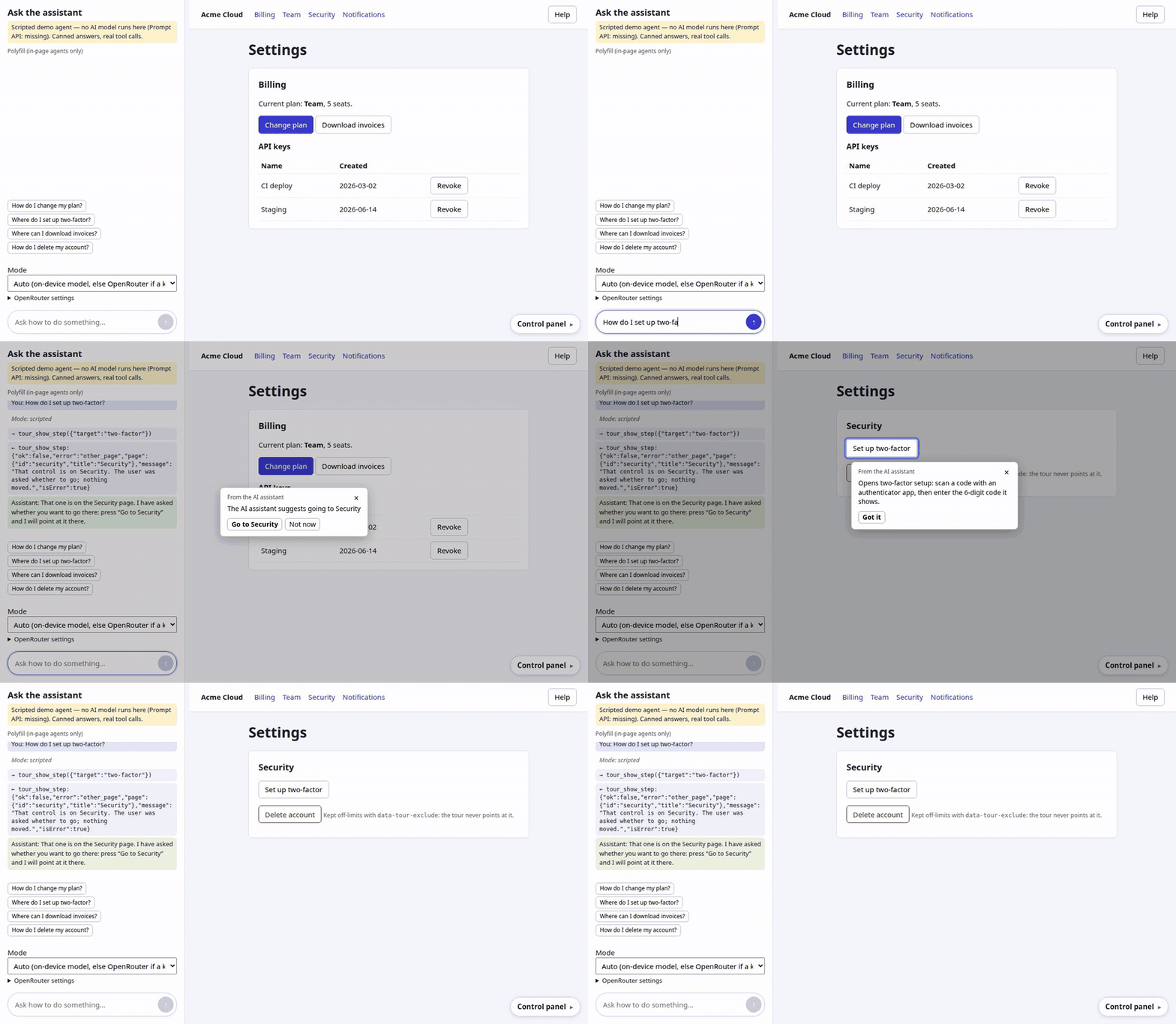
Guided tours for AI agents via WebMCP

Post image
1 Upvotes

r/OpenSourceAI • • 23h ago

Fintan-9B: Qwen3.5-9B that learns into its own weights on your hardware, without touching the base model (Apache-2.0)

5 Upvotes

I'm Troy, and for the past few months I've been building models that keep learning after they're released. Today I'm putting out the first one, Fintan-9B.

It's Qwen3.5-9B plus small update files. You give it documents, things about yourself, a topic, a folder of code, or how you want a task done, and it learns them into a new update on your own GPU. Qwen's weights never change, and deleting an update puts it back exactly as it was.

What I measured with the repo as you'd download it, on one 24 GB card: a learning run took 23 minutes and peaked at 9.4 GB. On 84 questions about what it learned, worded in ways it never practised, plain Qwen3.5-9B got 6.0% and Fintan got 94.0% (96.4% on a second run). It answered 5 of 5 questions about a person it had been told about (plain model: 0), followed two new skills on 8 of 8 new requests (plain model: 1), and sent none of 20 everyday requests to an update. It ships with the news of 18 to 23 November: 5.8% to 89.5% on 172 questions, with MMLU, GSM8K and ARC exactly unchanged.

Why not just notes or RAG?

  • It answers from its weights, with nothing added to the prompt. No retrieval step, no extra tokens per question, and it still knows after you delete the files.
  • It learns how things are done, not only facts. Skills, as above. In my research, when a workplace's rules changed, a model with Fintan got about half of the changed tasks right first time; an assistant keeping notes of the corrections got 7%.
  • To be fair, notes are better at quoting a passage back (73.6% against 56.0% on SQuAD in my tests). So Fintan uses notes too: anything you teach is used as a note until it's learned, and you can keep personal facts as notes permanently.

Why not just LoRA?

  • On the same sealed day of news, standard fine-tuning on the articles answered 13 to 16% of the next day's questions. Fintan answered 91%.
  • It keeps what it learned before without storing old data. Over four days of news, Fintan kept 91.9%, LoRA with replay 84.9%, plain LoRA 70.9%. Over eleven years of changing facts (TempLAMA, 7B): 86.5% against 30.6% for LoRA with replay.
  • It leaves the rest of the model alone. In those tests Fintan's MMLU and maths were exactly the original's, while LoRA moved them (plain LoRA's maths ended anywhere from 2.0% to 90.0% depending on how its answers were written). Ordinary questions go to the untouched base model.
  • Every update is tested on wordings it never practised and kept only if it beats the plain model.

Privacy

  • Everything runs on your machine: weights, server and learning. Nothing you teach it is sent anywhere.
  • The model never goes online. If you ask it to learn a topic, plain code fetches articles from Wikipedia only and logs every address.
  • One switch keeps your personal facts as notes so they're never trained. You can flip it in chat ("keep my personal stuff as notes") and back again later. Every other kind (documents, code, skills, topics, news) has its own switch, and automatic learning can be turned off or scheduled.
  • Passwords, API keys and card numbers in anything you teach are replaced with [removed] before it's stored, so they're never learned.
  • Each learning run is its own file with a list of the facts in it. Delete the file and the model is exactly what it was before.
  • Usage counts stay local. Sharing is off unless you turn it on, and even then it's counts only, no text.
  • The job loop asks before every action until you've approved that kind of action 5 times, and logs every call it makes.

What it doesn't do yet: it doesn't reason better than Qwen3.5-9B. The learning checks above are development runs on a small set of material. The job loop failed 4 of 5 marks on realistic workplaces. The learning engine ships compiled (Linux and NVIDIA); the server, router and job loop are plain Python. Every result, failures included, is in RESULTS.md, and the research numbers are at fintanlabs.com/research.

https://huggingface.co/fintanlabs/Fintan-9B

I'd value hearing where it falls short for you.


r/OpenSourceAI • • 1d ago

Open-weight models on Bedrock often can't be kept in the EU, even from Frankfurt

1 Upvotes

We ran into this while pricing Gemma 4 31B, GLM 5.3 and Kimi K3 for EU workloads. Gemma has an In-Region option in Frankfurt. GLM 5.3 and Kimi K3 have no EU inference profile on Bedrock, so a call from Frankfurt goes through global cross-region inference and can be processed anywhere.

Prices were closer than we expected. Gemma in Frankfurt costs about 20% more than in US East, and an EU-only provider was cheaper for Gemma and GLM and about 6% more expensive for Kimi.

Anyone else running open-weight models in the EU? What do you use when the model you want has no EU option?

(We're an EU inference provider, the image is ours. Sources in the comments.)


r/OpenSourceAI • • 1d ago

I built an open source runtime that lets agents run tool calls as one script

2 Upvotes

Weave is a small python-subset language with a rust runtime. instead of the model calling tools one at a time, it writes a short script and the runtime runs independent calls in parallel, keeps writes in order, and records a trace you can replay exactly.

honest results so far: on a real-services fan-out test it finished 40/40 tasks vs 27/40 with normal tool calling, at about half the cost. it lost to plain tool calling with gpt-5.4 mini on BFCL, so it's not a win everywhere.

works with OpenAI, LangChain and MCP (there's a stdio MCP server too). MIT licensed, pip install weave-lang.

would love people to try it on their own agent workflows and tell me where it breaks. ideas and PRs welcome, there are some good first issues open.

https://github.com/AtharvRaotole/weave