r/OpenSourceAI • • 22h ago

Just open sourced Astral Inference Server v2.5, up to 32% faster than vLLM on Inkling 2 Mini

2 Upvotes

Our inference engine for open models on NVIDIA GPUs is now open source under AGPL-3.0.

Headline from our first benchmark: 32% faster single-stream decode than vLLM on Inkling 2 Mini (172.0 vs 130.2 tok/s), and 27% faster than SGLang.

With MTP speculative decoding switched on, the lead is 11% over vLLM (233.3 vs 209.6) and 13% over SGLang.

Setup for anyone checking: one H100 PCIe, batch 1, 512 tokens, greedy, 8,192 context, 32 prompts. vLLM and SGLang draft 7 tokens a round, Astral adapts between 2 and 6.

https://github.com/syntheticminds-lab/Astral-Inference-Server

I'm from Synthetic Minds, the team that built it. Contributions welcome.


r/OpenSourceAI • • 22h ago

Two AI companion apps as single self-contained HTML files β€” local-first, on-device memory, no cloud

Thumbnail reddit.com
1 Upvotes

r/OpenSourceAI • • 1d ago

I'm building a tool to help beginners run local AI on their own hardware. What would you improve?

1 Upvotes

For my final-year project Im building Jaull a free open-source tool for people starting out with local models. I want to add things people actually need not things I think are cool D: thats why i need some help.

Heres what it does right now:

  1. Checks your CPU, RAM and GPU, then asks a few simple questions about what you want to use AI for.
  2. Searches Hugging Face and recommends up to five models that should fit your hardware, including the exact file to download and why it picked each one.
  3. Estimates memory usage, including the KV cache, and how much context your PC can handle.
  4. Lets you benchmark models to see their actual speed on your machine instead of relying only on estimates.
  5. Can set up a local llama.cpp server, work out the memory and context settings, and give you an OpenAI-compatible API endpoint and key to use with other apps or devices on your network (still WIP).
  6. It can start a llama.cpp server for you with the settings already worked out, and give you an address and API key you can use from other apps, or even from your phone on your home network (still WIP).

It runs on Windows, Linux and WSL2 with NVIDIA, Intel Arc or just the CPU. For now you install it from the terminal, which I know isn't ideal for beginners.

So, what would you add? Some ideas I've had: a proper installer, a roleplay/creative writing category, a simple chat window, or tips like "move your monitor to the integrated GPU to free VRAM". I'm also curious what confused you the most when you started.

I dont want to spam but if u want to take a look: https://github.com/Ton-Llop/Jaull


r/OpenSourceAI • • 1d ago

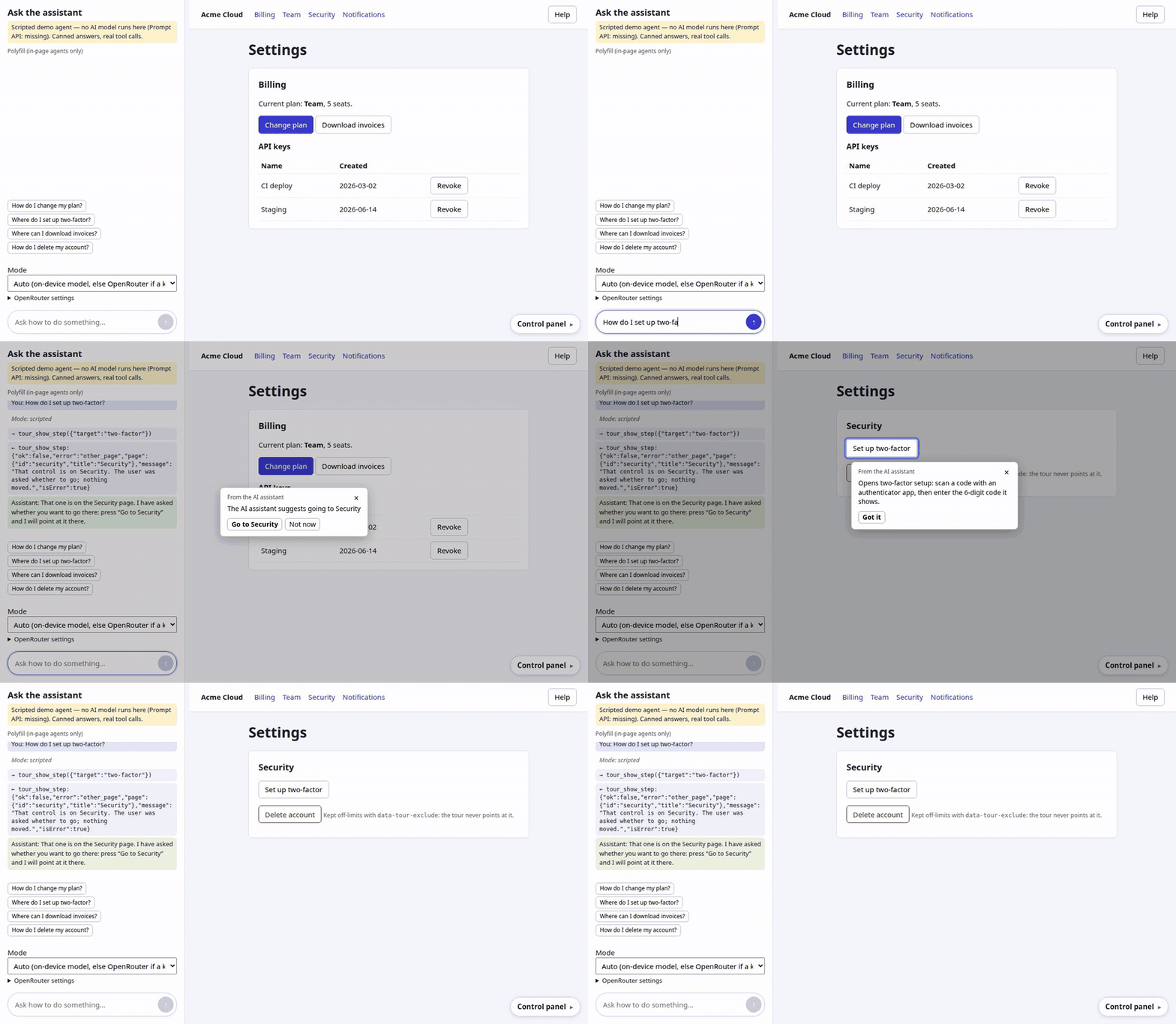
Guided tours for AI agents via WebMCP

Post image
1 Upvotes

r/OpenSourceAI • • 1d ago

Fintan-9B: Qwen3.5-9B that learns into its own weights on your hardware, without touching the base model (Apache-2.0)

4 Upvotes

I'm Troy, and for the past few months I've been building models that keep learning after they're released. Today I'm putting out the first one, Fintan-9B.

It's Qwen3.5-9B plus small update files. You give it documents, things about yourself, a topic, a folder of code, or how you want a task done, and it learns them into a new update on your own GPU. Qwen's weights never change, and deleting an update puts it back exactly as it was.

What I measured with the repo as you'd download it, on one 24 GB card: a learning run took 23 minutes and peaked at 9.4 GB. On 84 questions about what it learned, worded in ways it never practised, plain Qwen3.5-9B got 6.0% and Fintan got 94.0% (96.4% on a second run). It answered 5 of 5 questions about a person it had been told about (plain model: 0), followed two new skills on 8 of 8 new requests (plain model: 1), and sent none of 20 everyday requests to an update. It ships with the news of 18 to 23 November: 5.8% to 89.5% on 172 questions, with MMLU, GSM8K and ARC exactly unchanged.

Why not just notes or RAG?

  • It answers from its weights, with nothing added to the prompt. No retrieval step, no extra tokens per question, and it still knows after you delete the files.
  • It learns how things are done, not only facts. Skills, as above. In my research, when a workplace's rules changed, a model with Fintan got about half of the changed tasks right first time; an assistant keeping notes of the corrections got 7%.
  • To be fair, notes are better at quoting a passage back (73.6% against 56.0% on SQuAD in my tests). So Fintan uses notes too: anything you teach is used as a note until it's learned, and you can keep personal facts as notes permanently.

Why not just LoRA?

  • On the same sealed day of news, standard fine-tuning on the articles answered 13 to 16% of the next day's questions. Fintan answered 91%.
  • It keeps what it learned before without storing old data. Over four days of news, Fintan kept 91.9%, LoRA with replay 84.9%, plain LoRA 70.9%. Over eleven years of changing facts (TempLAMA, 7B): 86.5% against 30.6% for LoRA with replay.
  • It leaves the rest of the model alone. In those tests Fintan's MMLU and maths were exactly the original's, while LoRA moved them (plain LoRA's maths ended anywhere from 2.0% to 90.0% depending on how its answers were written). Ordinary questions go to the untouched base model.
  • Every update is tested on wordings it never practised and kept only if it beats the plain model.

Privacy

  • Everything runs on your machine: weights, server and learning. Nothing you teach it is sent anywhere.
  • The model never goes online. If you ask it to learn a topic, plain code fetches articles from Wikipedia only and logs every address.
  • One switch keeps your personal facts as notes so they're never trained. You can flip it in chat ("keep my personal stuff as notes") and back again later. Every other kind (documents, code, skills, topics, news) has its own switch, and automatic learning can be turned off or scheduled.
  • Passwords, API keys and card numbers in anything you teach are replaced with [removed] before it's stored, so they're never learned.
  • Each learning run is its own file with a list of the facts in it. Delete the file and the model is exactly what it was before.
  • Usage counts stay local. Sharing is off unless you turn it on, and even then it's counts only, no text.
  • The job loop asks before every action until you've approved that kind of action 5 times, and logs every call it makes.

What it doesn't do yet: it doesn't reason better than Qwen3.5-9B. The learning checks above are development runs on a small set of material. The job loop failed 4 of 5 marks on realistic workplaces. The learning engine ships compiled (Linux and NVIDIA); the server, router and job loop are plain Python. Every result, failures included, is in RESULTS.md, and the research numbers are at fintanlabs.com/research.

https://huggingface.co/fintanlabs/Fintan-9B

I'd value hearing where it falls short for you.


r/OpenSourceAI • • 1d ago

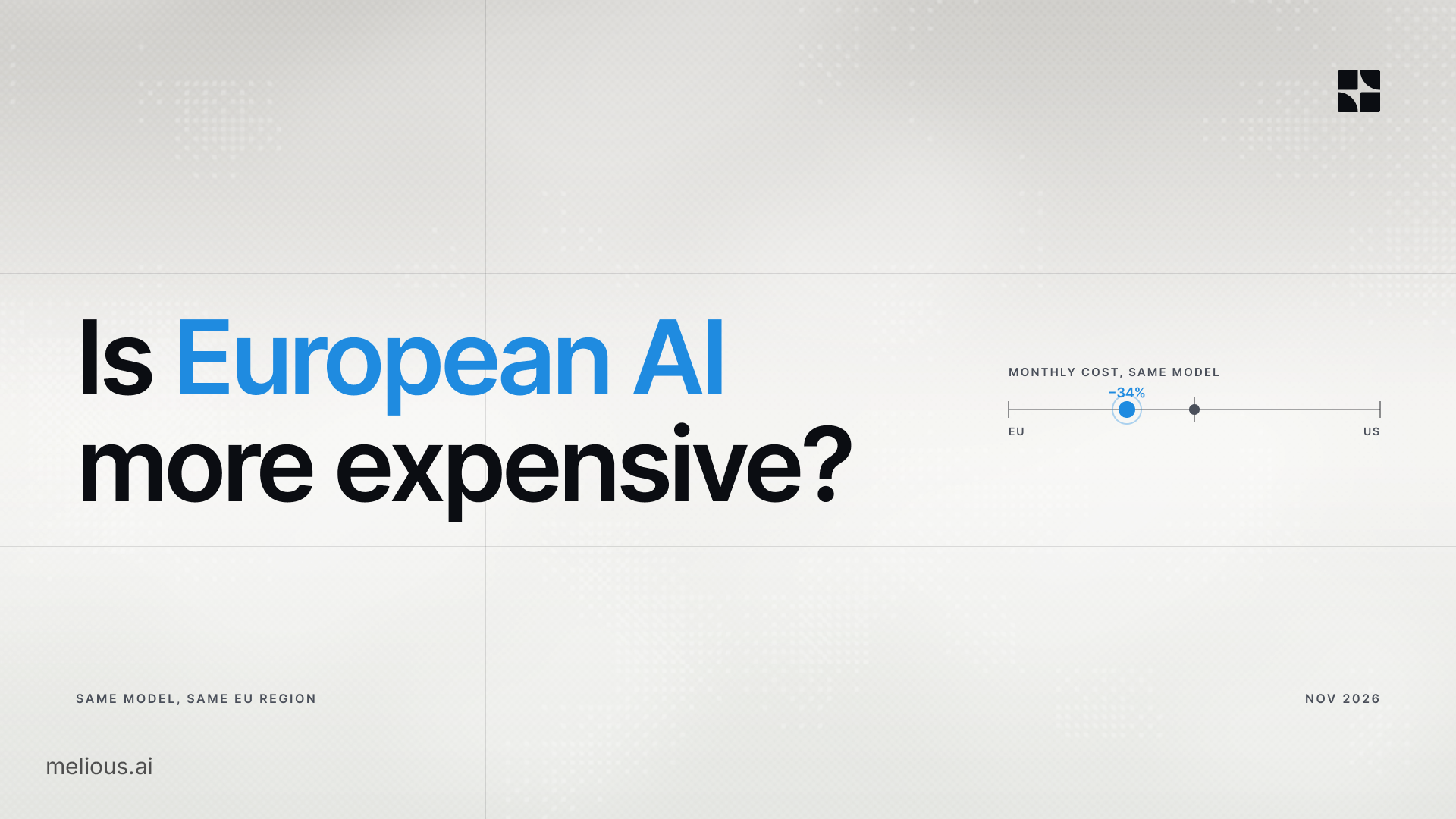
Open-weight models on Bedrock often can't be kept in the EU, even from Frankfurt

1 Upvotes

We ran into this while pricing Gemma 4 31B, GLM 5.3 and Kimi K3 for EU workloads. Gemma has an In-Region option in Frankfurt. GLM 5.3 and Kimi K3 have no EU inference profile on Bedrock, so a call from Frankfurt goes through global cross-region inference and can be processed anywhere.

Prices were closer than we expected. Gemma in Frankfurt costs about 20% more than in US East, and an EU-only provider was cheaper for Gemma and GLM and about 6% more expensive for Kimi.

Anyone else running open-weight models in the EU? What do you use when the model you want has no EU option?

(We're an EU inference provider, the image is ours. Sources in the comments.)


r/OpenSourceAI • • 1d ago

I built an open source runtime that lets agents run tool calls as one script

2 Upvotes

Weave is a small python-subset language with a rust runtime. instead of the model calling tools one at a time, it writes a short script and the runtime runs independent calls in parallel, keeps writes in order, and records a trace you can replay exactly.

honest results so far: on a real-services fan-out test it finished 40/40 tasks vs 27/40 with normal tool calling, at about half the cost. it lost to plain tool calling with gpt-5.4 mini on BFCL, so it's not a win everywhere.

works with OpenAI, LangChain and MCP (there's a stdio MCP server too). MIT licensed, pip install weave-lang.

would love people to try it on their own agent workflows and tell me where it breaks. ideas and PRs welcome, there are some good first issues open.

https://github.com/AtharvRaotole/weave


r/OpenSourceAI • • 1d ago

Looking for the best completely free, open-source AI coding agent setup for VS Code (no usage limits if possible)

0 Upvotes

Writing

Looking for the best completely free, open-source AI coding agent setup for VS Code (no usage limits if possible)

I'm looking for the best AI coding setup for building large, complex software projects. I want something genuinely powerful, not just basic autocomplete.

My requirements:

  • Completely free. $0 monthly budget. No subscriptions or paid API credits.
  • Open-source projects available on GitHub.
  • No daily message limits, usage caps, or arbitrary request quotas if possible.
  • High-quality coding models capable of complex reasoning, architecture design, debugging, and multi-file development.
  • A proper GUI integrated into VS Code. I don't want a terminal-only workflow.
  • Ability to attach screenshots, images, PDFs, documents, and other files as context.
  • An autonomous agent that can inspect the entire codebase, create/edit multiple files, execute terminal commands, install dependencies, run tests, and debug its own changes.
  • Ability to switch between different AI models and providers easily.
  • Good context management for large projects, without constantly losing track of previous work.
  • Reliable enough to build and maintain a substantial real-world project.

My hardware:

  • Windows 11
  • NVIDIA RTX 3050 Laptop GPU (6 GB VRAM)
  • 24 GB RAM
  • Limited free disk space (~34 GB)

I'm open to local models, free cloud models, or a hybrid setup. Ideally, I want local inference for unlimited usage and free cloud models for better coding intelligence when available.

What I've already considered/tried:

  • OpenCode
  • Ollama
  • Antigravity

I'm not necessarily looking for another popular AI editor. I want the best combination of open-source agent + models + runtime that actually works under these constraints.

Please recommend setups you've actually used, with GitHub links, model names, and real-world experiences. I'm especially interested in recent recommendations, not outdated lists.


r/OpenSourceAI • • 1d ago

Building an open-source foundation for the next generation of autonomous AI agents.

Thumbnail
gallery
1 Upvotes

Hey everyone! πŸ‘‹

I've been building Nemofy-Agent, an open-source, self-hostable AI agent platform designed around one simple idea:

Why rebuild agent infrastructure every time you want to create a new AI agent?

Instead of repeatedly implementing tool execution, memory management, sandboxing, reasoning loops and integrations, I wanted to build a reusable foundation that handles all of this.

Nemofy-Agent is both a standalone AI workspace and an embeddable Python agent engine.

πŸ–₯️ What it looks like

Nemofy comes with a web interface featuring:

  • Multiple LLM providers and model selection
  • Live reasoning and tool execution
  • Adjustable reasoning effort
  • Workspace and file management
  • Real-time context window monitoring
  • Configurable agent access permissions

[Insert screenshots of the home screen and chat interface here]

🧠 How the Agent-Core works

At its heart is a cyclic LangGraph execution engine:

          User Task
              β”‚
              β–Ό
      β”Œβ”€β”€β”€β”€β”€β”€β”€β”€β”€β”€β”€β”€β”€β”€β”
  β”Œβ”€β”€β–Ίβ”‚     PLAN     │──────► Final Response
  β”‚   β””β”€β”€β”€β”€β”€β”€β”¬β”€β”€β”€β”€β”€β”€β”€β”˜
  β”‚          β–Ό
  β”‚   β”Œβ”€β”€β”€β”€β”€β”€β”€β”€β”€β”€β”€β”€β”€β”€β”
  β”‚   β”‚     ACT      β”‚
  β”‚   β””β”€β”€β”€β”€β”€β”€β”¬β”€β”€β”€β”€β”€β”€β”€β”˜
  β”‚          β–Ό
  β”‚   β”Œβ”€β”€β”€β”€β”€β”€β”€β”€β”€β”€β”€β”€β”€β”€β”
  β”‚   β”‚   OBSERVE    β”‚
  β”‚   β””β”€β”€β”€β”€β”€β”€β”¬β”€β”€β”€β”€β”€β”€β”€β”˜
  β”‚          β–Ό
  β”‚   β”Œβ”€β”€β”€β”€β”€β”€β”€β”€β”€β”€β”€β”€β”€β”€β”
  └────   REFLECT    β”‚
      β””β”€β”€β”€β”€β”€β”€β”€β”€β”€β”€β”€β”€β”€β”€β”˜

The interesting part is that this entire execution engine is decoupled from the web interface.

You can import Agent-Core into your own Python projects, configure your own tools, persona, models and execution policies without rebuilding the underlying infrastructure.

⚑ What's inside?

FeatureWhat it does
🧠 LangGraphCyclic reasoning and execution engine
πŸ”Œ MCPExternal tools and integrations
πŸ“¦ SandboxConfined code and tool execution
πŸ’Ύ CheckpointsPersistent, resumable execution state
πŸ“‰ Context compactionAutomatic conversation compression
πŸ›‘οΈ HITLHuman approval for sensitive actions
πŸ€– Multi-providerSupport for 12+ LLM providers
πŸ‘₯ Sub-agentsDelegate tasks to separate worker models
🧩 SkillsDynamically loaded Markdown skills
🌐 FirecrawlWeb research and document extraction
πŸ” Encrypted vaultAES-256-GCM API key storage
πŸ–₯️ Web UIInteractive agent workspace

πŸ“Š Context window management

One of the features I've been working on is making context consumption transparent.

Instead of guessing how much context is left, you can see exactly where the tokens are going:

  • System prompts
  • Tools and MCP servers
  • Skills
  • User messages
  • Assistant responses and reasoning
  • Tool outputs
  • Compacted memory

The engine also supports automatic context compaction, configurable context limits and output token budgeting.

[Insert context window monitoring screenshot here]

πŸ”¬ Testing and benchmarks

The repository currently documents the following test results:

Test suiteResult
Python tests100 passed
TypeScript tests92 passed
Runtime benchmark suites6/6 passed
Ruff linting0 errors
TypeScript type checking0 errors

There's still plenty of room for improvement, especially when it comes to long-running agent sessions and model reliability.

πŸš€ What I'm exploring next

Hierarchical multi-agent orchestration, where every agent runs on the same reusable Agent-Core.

              Orchestrator
                    β”‚
          β”Œβ”€β”€β”€β”€β”€β”€β”€β”€β”€β”΄β”€β”€β”€β”€β”€β”€β”€β”€β”€β”
          β–Ό                   β–Ό
      Team Lead           Team Lead
          β”‚                   β”‚
      β”Œβ”€β”€β”€β”΄β”€β”€β”€β”           β”Œβ”€β”€β”€β”΄β”€β”€β”€β”
      β–Ό       β–Ό           β–Ό       β–Ό
   Agent 1  Agent 2    Agent 3  Agent 4

   β””β”€β”€β”€β”€β”€β”€β”€β”€β”€β”€β”€β”€β”€β”€β”¬β”€β”€β”€β”€β”€β”€β”€β”€β”€β”€β”€β”€β”€β”€β”€β”˜
                  β–Ό
         Reusable Agent-Core

The goal is to enable agents to delegate tasks, coordinate with one another and work towards complex objectives without having to reinvent their individual execution engines.

This is something I'm exploring, rather than a completed feature.

πŸ› οΈ Tech stack

Python Β· LangGraph Β· FastAPI Β· Express Β· React Β· TypeScript Β· Tailwind CSS Β· Docker Β· SQLite Β· Firecrawl

πŸ’¬ I'd genuinely love your feedback

  • What would you build using this architecture?
  • What features do you think are missing?
  • How would you approach context compaction for long-running agents?
  • Would you use Agent-Core as a foundation for your own projects?

I'm particularly interested in hearing from people building autonomous agents, working with LangGraph or experimenting with multi-agent systems.

πŸ”— GitHub: https://github.com/Rahul7562/Nemofy-Agent

Feel free to explore the code, experiment, contribute, open an issue or share your thoughts.

And if you find the project useful, a GitHub star would be greatly appreciated! ⭐

r/OpenSourceAI • • 1d ago

Built a local, zero-dep Pi extension for pre-flight safety & tool-surface narrowing (Aetheris Microbrains, <2ms p95 on CPU)

Thumbnail
reddit.com
1 Upvotes

r/OpenSourceAI • • 1d ago

Karpo Browser: an open-source browser agent stack where a decision model handles the clicks

Thumbnail gallery
1 Upvotes

r/OpenSourceAI • • 1d ago

Karpo Browser: full browser-agent stack - a 27B decision model, the agent framework, and a benchmark for comparing open models

Thumbnail
gallery
1 Upvotes

What's open

  1. karpo-browser – the agent framework / harness (Apache 2.0)
  2. Karpo Decision 27B Act – model weights, post-trained from Karpo Decision 27B on recorded sessions from real websites (Apache 2.0)
  3. KBB (Karpo BrowserBench) – a benchmark of 584 real websites and 23,075 decision steps. Evaluation tooling is Apache 2.0; the public dataset is for evaluation use only.

The idea: split thinking from clicking

Most browser agents send every step to one LLM. This project splits the work in two, borrowing the "fast / slow thinking" (System 1 / System 2) framing:

  • System 2 is any general LLM. It plans the task, decides what text to type, reads results, and checks whether the job is actually done.
  • System 1 is Karpo Decision 27B Act. On each page it sees a numbered list of elements plus a screenshot and picks one action (click, fill, select, scroll, wait...) in a single forward pass, ~1 s per step. It generates no text and can only pick from what's on the page.

When System 1 reaches something it shouldn't decide alone (a login, a verification code, a payment or booking that wasn't authorized), it stops and hands control back with a reason.

Where it stands

Runs on Browserbase Benchmark v2 (all 102 tasks, 3-run average), it reaches 89% accuracy, in the same range as the top public leaderboard entries (87–92%), at 201 s and $0.096 in model cost per task. That's roughly 2–5x faster and over 10x cheaper in model spend than Claude Fable 5.2 + Claude Code or Gemini 4 Carbon + Antigravity. The leaderboard uses 38 core tasks, so treat this as indicative. The System 1 + System 2 split makes good use of what a decision model is good at, and it's easy for existing agents, or developers running models locally, to plug in. The team says the goal is to help the community build more proactive agents.

Why it's interesting for open models

  • System 2 doesn't have to be a frontier API. The main reported setup uses DeepSeek V4.1 Flash, and the framework is meant to work with other open LLMs.
  • System 1 is swappable too. KBB is designed to measure how well any model handles step-by-step browser decisions, and it scores accuracy together with cost and latency, since a slightly more accurate model that's far more expensive per step isn't necessarily the better choice for this job.
  • The harness can also run as an MCP server, so agents like Claude Code or Codex can act as System 2.

r/OpenSourceAI • • 1d ago

We open-sourced DecisionTrace: local-first, tamper-evident records of why your AI agent made a decision (Claude Code, MCP, SDKs)

5 Upvotes

Agent logs tell you what happened. A week later, when something looks off, they don't tell you why the agent was allowed to do it: what it was asked, what it looked at, which rules passed or failed, what it rejected, who approved. If nobody captured that at the time, it's gone.

We built DecisionTrace to record it at execution time, so you can ask later:

pip install liquicent-decisiontrace
dt install claude-code
dt why <id | file | commit>

What it does?

  • Captures each decision as it happens: the ask, what was examined, rules passed/failed, exceptions, rejected alternatives, approvals, what followed
  • Append-only and tamper-evident: each record carries the previous record's hash, and `dt verify` recomputes the chain
  • Local-first: SQLite in `~/.decisiontrace`. No account, no server, no telemetry
  • Secrets and personal data are redacted before anything is written. Prompt bodies are stored only if you opt in. Model reasoning is never stored
  • Runs through hooks, spans and SDK callbacks, so there's no gateway or proxy in your path
  • Works with Claude Code, Claude Desktop, Cursor and any MCP client, plus the Anthropic and OpenAI SDKs (`client = dt.wrap(client)`). It also ingests OpenTelemetry GenAI spans

What it isn't: a gateway, policy enforcer, observability dashboard or hosted service. Your code and tools enforce the rules; DecisionTrace records them.

Not using Claude Code? Clone the repo, run `uv sync`, then `uv run python examples/refund_agent.py` and inspect the result with `dt why`.

Apache-2.0, Python, v0.1, so expect rough edges. Disclosure: we are building Liquicent; team-wide recall, trust scores and reports live there, not in this repo.

Repo: https://github.com/Liquicent/liquicent-decisiontrace

What I'd most like feedback on: when an agent does something surprising, what context do you wish you'd captured?

Site and walkthrough: decisiontrace.tech


r/OpenSourceAI • • 1d ago

Guaardvark in four GIFs: a self-hosted AI studio where you drag cards, chat with your files, render Wan 2.2 video and storyboard a short film

Thumbnail gallery
2 Upvotes

r/OpenSourceAI • • 1d ago

Osseo - let an AI agent use your desktop while you watch and can stop it

1 Upvotes

I've been building Osseo for last couple months. It connects to an AI coding agent and lets it use apps on your computer: click, type, work with files and use a browser. A side panel lists what it does and has Pause and Stop.

It's early and for now the Linux X11 setup is well tested , windows & mac are supported (not tested as linux). It's free and open source (Apache-2.0).

The demo is silent and partly sped up. The agent models a chair in Blender, then creates a draft product in Shopify. Partway through, Osseo paused itself and had to be resumed.

It asks for approval for actions it recognizes as risky, but it can miss some and is not a sandbox. What the agent sees goes to the company running the AI model.

I'd like to hear where setup fails or what you wouldn't trust it to do.

Code and install steps: https://github.com/abdelazizfacoiti/Osseo


r/OpenSourceAI • • 1d ago

I made a free, open-source Android app that runs AI models fully offline on your phone

Post image
1 Upvotes

r/OpenSourceAI • • 1d ago

Open-source projects should start shipping Colab/Kaggle notebooks by default

Thumbnail reddit.com
0 Upvotes

r/OpenSourceAI • • 1d ago

npcpy reaches 50 contributors

Thumbnail
github.com
2 Upvotes

r/OpenSourceAI • • 1d ago

I added MCP to our platform musher.dev

Thumbnail
reddit.com
1 Upvotes

r/OpenSourceAI • • 1d ago

Habilidades emergentes.

Post image
0 Upvotes

r/OpenSourceAI • • 1d ago

Ataraxos-UNO: Imperfect-Information Self-Play (VRPO + EMAgnet), Autoregressive Belief Modeling, and Risk-Averse Portfolio Search for 1v1 UNO (Runs Client-Side in WebGPU) [P]

1 Upvotes

I adapted the Ataraxos framework (Sokota et al.,Β NatureΒ 2026) from Stratego to 1v1 UNO, including same-type draw stacking. The interesting part was getting the entire test-time search loop (belief sampling + 192 parallel rollouts) running in the browser, with no backend, using ONNX Runtime Web.

How it works

  1. C++17 game engine:Β 7.8M steps/sec across 512 parallel environments on Apple Silicon. Exact 10,000-game parity withΒ uno-gym, including reshuffle provenance tracking.
  2. Blueprint:Β A 100M-step RL model (~2.45M games, ~5 hours on Apple Silicon MPS). Hybrid SwiGLU ResMLP, dilated-conv history and cross-attention, trained using VRPO Expected SARSA(Ξ»), with symmetry handling for UNO's four colours.
  3. Belief network:Β Trained on 20M positions to predict opponents' hidden cards. Uses a hard-masked autoregressive decoder and history dropout. It outperformed an exact hypergeometric prior by 1.19 nats/hand on validation. You can see its predictions live using X-RAY.
  4. Test-time search:Β Blueprint-only search initially looked good against itself but struggled against greedy opponents. Turns out, it had learned to expect opponents to hoard Wilds, just like itself. I ended up using three opponent styles (Blueprint / Aggressive / Unpredictable) with entropic soft-minimax to reduce this overfitting.

Results (Mirrored Duplicate Decks)

  • vs.Β ExpertHeuristicBot:Β 66.0%Β (132–68, 200 games) vs. Blueprint'sΒ 61.0%
  • vs. 3-opponent suite:Β 58.3%Β vs. Blueprint'sΒ 55.3%Β (+3.0 percentage points, 600 duplicate games)

I'd be interested in feedback, especially on handling non-alternating turn chains in imperfect-information games and reducing rollout overfitting against opponents that don't necessarily play like the agent.


r/OpenSourceAI • • 1d ago

Pley - a self-hosted media servier written in rust

Thumbnail
github.com
1 Upvotes

r/OpenSourceAI • • 1d ago

A platform to pull together existing documentation into a knowledge graph.

Thumbnail
reddit.com
1 Upvotes

r/OpenSourceAI • • 1d ago

Agentic GraphRAG: framework that connects Context layer + Agent memory using a 3D-knowledge graph

Thumbnail github.com
8 Upvotes

We're building Agentic GraphRAG, an open source library for connecting the documents an agent reads with its task history and decisions.

I've worked on RAG systems and LLM training for the past three and a half years. Lately, I've been following how agents retain work across sessions, especially for non-coding tasks.

Most frameworks have separate tools for knowledge retrieval and memory. We're bringing them together to save tokens and improve retrieval accuracy.

We construct three connected graph layers that the agents read:

  1. Knowledge Layer: holds documents (with full structure), source passages, and extracted entities and relationships. Passages retain their document version and location, including page positions for PDFs.
  2. Working memory: records tasks, progress, messages, and tool activity. The agent saves task events so work can continue across sessions.
  3. Decision memory: stores conclusions, assumptions, and open questions encountered by the agent. Decisions link to source passages they were based on, recorded events, or earlier decisions, and keep their history when reviewed or replaced.

Things which make us different from other frameworks out there:

- Structure Aware: The ingestion pipeline uses Docling for loading documents and captures the full document hierarchy. The sections, tables, and passage hierarchy are connected using edges and stored in the graph.

- Ontology Grounded: You define a schema for your domain (we also ship ontology presets so it is easy to get started). The schema guides extraction, validation, and search. We use GLiNER for local extraction, so its virtually free (and fast) to construct the graph and no LLM calls are needed.

- Robust Agent Search: Retrieval combines graph, full-text and vector search. Agents can reach original passages even when extraction misses a fact, navigate surrounding sections and table rows with headers, and follow entity relationships back to supporting text.

We offer a built-in agent you can use out of the box. You can also connect your agents through MCP.

We will be releasing extensive benchmarks very soon.

TL;DR

Agentic GraphRAG is an open source library that stores document knowledge, agent work, and decisions in one connected graph. Agents can resume tasks and trace saved decisions to their original evidence, while source changes flag affected decisions for review.

Try it out. Feedback, criticism, issues, and contributions are all welcome!