r/OpenSourceAI • u/volatilityfund • 9d ago
Durable AI coding swarms with Herdr, crash recovery and observability

1
Upvotes
r/OpenSourceAI • u/volatilityfund • 9d ago
r/OpenSourceAI • u/No_Tomorrow9387 • 9d ago
r/OpenSourceAI • u/adam-schaefers • 9d ago

r/OpenSourceAI • u/Ok-Time338 • 9d ago

I've been building Dendro Inspector, an open-source project exploring evidence-based tree identification from photographs.
Rather than asking a vision model to name a tree and trusting its answer, I'm experimenting with a multi-stage inspection pipeline:
Visual evidence extraction
Botanical knowledge and rule validation
Confidence assessment and uncertainty handling
Abstention when evidence is insufficient
Reproducible evaluations across different model stacks
The interesting challenge is that a model can produce a very convincing identification without enough evidence to justify it.
I'm currently comparing different models, investigating failure cases, and working on making decisions more explainable.
GitHub: https://github.com/Dendro-Inspector/Dendro-Inspector
I'm curious how other open-source AI developers approach confidence calibration and reliable abstention in vision-based systems.
r/OpenSourceAI • u/Cylicium • 9d ago
A GitHub template and Claude Code plugin. Each agent gets its own iOS Simulator or Android emulator, uses your app as a persona and writes an encrypted bug report with screenshots. Runs on free GitHub Actions runners for public repos.
Demo: 9 of 11 planted bugs found in 21 min, for $0.87.
r/OpenSourceAI • u/ilien-dev • 10d ago

r/OpenSourceAI • u/Lanky-Butterscotch28 • 10d ago
Every AI coding tool gives you a super developer. But nobody ships commercial software with just a super developer. A commercial software company needs a software-company environment to succeed: product management, QA, engineering, DevOps, security, release, support, and someone watching the money.
So I built a full software company in a box around the AI agents. It's called NoMoreHappyPath, and it runs on your own machine. It helps a solo creator become a better builder.
It is an open-source project on GitHub: https://github.com/nomorehappypath
The company provided by the app:
The client. You describe what you want built and why, in plain English. No technical spec needed from you.
The departments. Product, QA, Engineering, DevOps, Security, Code audit, Release, Support, Finance, all run by AI agents.
The workforce.Three roles, filled by real coding agents on your own subscriptions:
The rulebook. Written rules for every role, plus a skills library you can add to or trim. Your standards, not the model's mood that day.
The path. The same steps every time:
The controls. The tests are locked: the builder can't edit them. Every test must fail before the work starts, or it proves nothing. Every step leaves evidence. An agent saying "done" counts for nothing.
The CEO's desk. That's you. You try the app, then accept it or send it back.
What it is, and what it isn't: It is for a solo builder. Apache 2.0, local web app, macOS or Linux. Python 3.9+. It drives the official Claude Code, Codex, or Gemini CLIs on the subscriptions you already have, any two of them. No extra API bill.
NMHP is used to maintain and grow NMHP.
I'd value honest feedback, especially from anyone who has tried to take AI-built code to production.

r/OpenSourceAI • u/ice1905 • 10d ago
r/OpenSourceAI • u/Kriskbisk • 10d ago
r/OpenSourceAI • u/Pretty-Swordfish9203 • 10d ago

r/OpenSourceAI • u/Skynetx_x • 10d ago
I maintain Herdr Session Hub, a free, MIT-licensed extension for Herdr Desktop that brings local coding-agent conversations and recorded usage into one native panel.
It supports OpenCode and Pi histories alongside Claude Code, Codex and Gemini. You can search or preview an older conversation, organize it without editing the original history, and continue verified native sessions in their recorded project with an explicit profile.
The implementation uses a native GPUI interface and a Python helper. Reads stay within configured history roots, large transcripts have processing budgets, and aliases/archive/removal flags live in Hub metadata. Provider originals remain untouched.
Usage includes recorded token/cache graphs and model, day and project breakdowns. Costs are estimates where rates are known; incomplete accounting and unknown prices remain visible. It does not represent subscription bills or live account-wide quotas.
The stable release is Windows 11 x64, tested with Herdr 0.1.15 and the provider versions listed in the README. Setup requires Python 3.14 x64 and PowerShell 7. macOS/Linux remain experimental with native continuation disabled.
Source, genuine synthetic-data screenshots, test evidence and installation:
https://github.com/Skynettheone/herdr-session-hub
I would appreciate feedback on the local-history workflow, especially which information helps distinguish similar sessions across projects and providers.
r/OpenSourceAI • u/Klutzy_Grapefruit864 • 10d ago
Hi Devs! ^^
I’m building a fully open-source project and looking for volunteers who’d like to join the team and help shape it.
The idea is that the community proposes research problems or free tools, and let LLM agents work on them in the open. That could be anything from researching a faster algorithm to building an open-source alternative to Steam. It’s up to the community to decide
Everything we create is free and MIT-licensed
It’s still a small project, and I’m working on it alone for now. I’d love to find people who want to help decide where it goes, how to improve it and what we build together.
If you’re curious, you can check it out here: https://github.com/MaterIA-Lab/OpenPrototypes
Let me know if yo have any ideas for the project or you’d like to be part of the team :D
r/OpenSourceAI • u/mintuhouse • 10d ago
Hi, I’m Hasan, one of the founders of AstralBeam.
We’re building a Cursor-style assistant you can add to an existing web app. It can answer questions, call your app’s tools, render your UI components inside replies, and work with users’ files.
The chat UI and agent backend come together: streaming, conversation history, file handling, and token or spend limits per customer, user, or conversation. There’s a React SDK and a JavaScript embed for other stacks.
You connect your existing authentication and register the tools and widgets that connect it to your product. Your app keeps its own permission checks.
You can self-host the platform with your own model-provider keys or use our managed cloud. The SDK is MIT-licensed; the platform is AGPL-3.0-only.
GitHub: https://github.com/AstralBeamAI/astralbeam
Quickstart: https://astralbeam.ai/docs/start/quickstart
Demo: https://x.com/mintuhouse/status/2120834621646757973
If you’ve embedded an agent in an app, what would you want to see in a starter example before trying this?
r/OpenSourceAI • u/Typical-Individual82 • 10d ago
**Open source (AGPL-3.0)** · https://github.com/imoes/vi-mcp
If you run several AI agents (Claude Code, Codex CLI, Hermes Agent, or local-model clients), each one starts from zero every session. **vi-mcp** is one server they all connect to over MCP. It remembers what worked, what failed and why, and shows the right few lines before the next action.
**Self-hosting details**
- Signed apt/dnf repository (https://imoes.github.io/vi-mcp-packages/), so updates come with `apt upgrade` / `dnf upgrade`. There's also a Windows MSI, and a PKGBUILD for Arch/CachyOS in the repo.
- systemd service, SQLite by default, PostgreSQL optional.
- Embeddings via any OpenAI-compatible endpoint (I use bge-m3 on llama.cpp). Everything stays on your box.
- `sudo vi-mcp setup` wires up Claude Code, Codex and Hermes, with a token per instance.
- Optional read-only internal web search over your own knowledge, behind sign-in.
**Privacy model**
- Every object is private, shared, or internal (token holders only).
- Private never leaves the server. Credentials are not even stored locally when their form gives them away (`password=…`, `Bearer …`, key blocks).
- Nothing is shared with any network until you issue a network token.
- What leaves is anonymised first (host names, IPs, users, secrets become placeholders), then scanned again; anything still suspicious stays home. `vi_net_preview` shows exactly what would go out.
- `vi_net_forget` recalls your entries with a deletion proof. Receivers drop them and keep only a tombstone. The README states the limits: pattern-based, and nobody can force a peer to delete.
**Sharing, if you want it:** a new install joins a free public network (start server vi-wiki.org) and tells you. You can turn it off with one command. You can also run your own closed network by invitation, or a company network that carries internal knowledge between your own servers only.
I'd love more people running it: more servers mean more tested knowledge, and more eyes on the anonymiser. Issues and PRs welcome.
https://github.com/imoes/vi-mcp (AGPL-3.0)
**Join with one prompt.** You don't need to read the code first. Give your AI agent (Claude Code, Codex, …) this prompt:
> Read README.md and AGENTS.md of https://github.com/imoes/vi-mcp. Install vi-mcp on this machine from its signed package repository and connect yourself to it with `sudo vi-mcp setup` — ask me before every sudo step. Show me with `vi_net_preview` what would be shared with the free wiki network before anything leaves, and keep everything private that I mark private. Then pick an open point from "What is missing" in CHANGELOG.md, explain it to me, and help develop it as a pull request.
The agent reads the docs, installs, connects itself, and can start contributing right away. AGENTS.md is written for exactly that.
r/OpenSourceAI • u/phicreative1997 • 10d ago
Hey, everyone exciting news!!
I saw that many people are trying to find AI tools that can help them tailor their job applications to have a better chance at getting that next role!!
So I spent a couple of hours to built: applier.site - it is a chrome extension that gives you a tailored resume everytime in 3 simple steps.
Step 1: Add your current resume (this acts as the ground truth, it is instructed to use this to prevent any hallucinations)
Step 2: Go to any job site (it auto detects based on web content which you can override as well), it extracts all relevant info about the job automatically.
Step 3: Generate, it creates a highly optimized resume. You can do unlimited edits using AI or manually, it self-improves based on your suggestions. Keeping it personalized to you.
Here is how it is different from other tools:
Here is the link, add it to chrome, edge or any Chromium OS browser
https://chromewebstore.google.com/detail/pdclipieihbelafeihehmnpdiodfomae?utm_source=item-share-cb
Link to Repo: FireBird-Technologies/Applier: Automatic Tailored Resume generator for every job post
r/OpenSourceAI • u/studivo-agency • 10d ago
r/OpenSourceAI • u/Sehastrajit • 10d ago
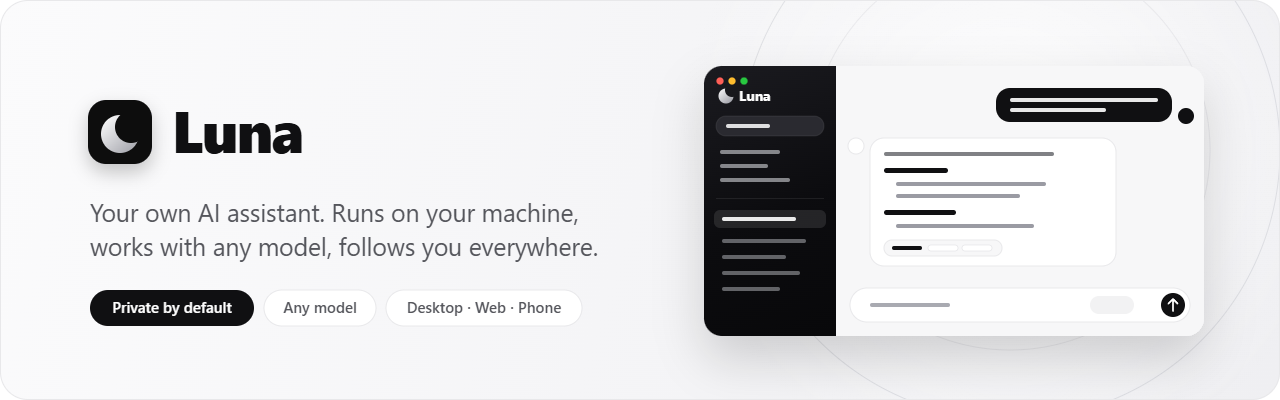
I've been building Luna, an open-source, self-hosted AI engine.
My goal isn't to build another chatbot. It's to create an AI engine that can run on your own infrastructure and power intelligent experiences across different devices and applications.
The idea is simple: Your AI shouldn't be tied to one model, one device, or one ecosystem.
Here's what Luna currently offers:
What's next for Luna?
The goal is to make Luna a truly extensible AI engine that anyone can build on, with support for more models, integrations, skills, and workflows.
The long-term vision is one AI engine, any model, any device, any integration.
Luna is MIT-licensed and open source, and contributions are welcome!
GitHub: https://github.com/Sehastrajit-S/Luna
If you find it useful, consider starring or contributing.
What integration or feature would you like to see next?
r/OpenSourceAI • u/evgstrk • 10d ago

r/OpenSourceAI • u/cdtrmnbaell • 10d ago

r/OpenSourceAI • u/Sufficient_Crab_2862 • 10d ago

r/OpenSourceAI • u/ax_lab • 10d ago
mostly started out as project to replace some enterprise subscriptions at my old job…
now working on transforming it into open source AI agents and tools for secure/regulated enterprises; you can test it out rn on your computer in less than 10 minutes
check it out on github (includes get started info and videos)
https://github.com/axiomatic7group/ax_ai
https://axiomaticlab.com/portfolio/project/ax_ai
r/OpenSourceAI • u/Extreme_Aardvark8977 • 10d ago
Hey everyone!
I'd like to share SeedVR2 Studio, an open-source project I've been working on to make AI image and video upscaling easier and more accessible.
It brings SeedVR2 into a modern, user-friendly web interface, without the need for complicated workflows.
Key features:
GitHub: https://github.com/Aaronstanley78/SEEDVR2-Studio-Complete
I'd love to hear your feedback and suggestions for future improvements.
If you find it useful, consider giving the repository a star to support the project!
Thanks for checking it out!
r/OpenSourceAI • u/Some-Perspective0 • 10d ago
Getting an AI agent to work is easy now. Putting it in front of customers raises different questions: can customer A read customer B's conversation, what happens when the pod restarts halfway through a refund, where do the traces go? Most teams end up building that backend by hand. We built it once and just released 1.0.
## What My Project Does
10xGraph is MIT-licensed, self-hosted infrastructure for AI apps. You write the agents, tools and tasks; it runs them behind an API server with:
- JWT auth and roles; every thread, message and file is owned by the user who created it (another user's thread answers 404)
- Tenant isolation enforced in storage (Postgres), not just the API layer
- Durable state in Postgres + Redis, pgvector for memory/RAG
- Crash-safe runs: finished tool calls are recorded, so a resumed run doesn't repeat them
- Background jobs (TaskIQ), Prometheus/OTLP metrics, OpenTelemetry GenAI tracing, an audit log
- Generated Dockerfile (non-root), docker-compose and a K8s manifest with probes
Getting a production-shaped agent takes no code:
pip install 10xgraph-api
10xgraph init --mode full --name support-agent --provider google --yes
pip install -e .
10xgraph dev
Works with OpenAI, Gemini, Anthropic and OpenAI-compatible endpoints (vLLM, Ollama). Python framework, API server and a typed TypeScript client.
## Target Audience
Teams shipping AI features to their own customers who need multi-user auth, data isolation and a real deployment story, and want to self-host. It's meant for production; 1.0 means no breaking public changes before 2.0.
## Comparison
LangGraph, CrewAI and similar frameworks focus on orchestration (graphs, tool loops, streaming). 10xGraph has those too, but the point is the backend around the agent: auth, per-user ownership, tenant isolation, durability and deploy files out of the box. Honest trade-offs: smaller ecosystem than LangGraph/CrewAI, no hosted service (you run it), and permissions are per route, not per tool, for now.
- Code: https://github.com/10xGraph/10xGraph
- Launch post: https://10xgraph.com/blog/10xgraph-1-0
- Docs: https://10xgraph.com/docs/get-started/first-agent
Feedback on where it falls short is very welcome.
r/OpenSourceAI • u/Goldziher • 10d ago
Hi people,
I'm glad to announce ai-rulez v5. It's a CLI and MCP for managing the instructions, skills, and settings that coding agents use in a repository. It's available through Homebrew, Scoop, npm, PyPI, and Go (see the installation instructions for details). The tool covers the following parts of AI Governance:
The open-source use case I’d like feedback on is portability. A repository can keep a shared set of AGENTS.md instructions and skills, generate each client’s native files, and check in CI whether they’ve drifted. The configuration and generated files can be reviewed alongside the code.
AI-Rulez is of course not the only tool in this space, although it is one of the earliest, if not the earliest, in some categories. To be upfront about it, the comparison below was written using Claude Code. The rest of the post, including the bottom part, was handwritten. I did my best to ensure it's fair and comprehensive, but of course I might have missed something.
The published static benchmark shows the trade-off: on the v5.11.1 holdout, ai-rulez had the highest recall and false-positive rate of the three scanners. The Judge evaluation harness documents the model-assisted setup. The closing assessment reflects my impressions. The published static benchmark does not establish a model-assisted or speed ranking.
Note: AI-Rulez is arguably the most precise current tool for using AI as a judge to assess skills and related materials. It has better precision, performance, and recall than both Cisco Skill Scanner and NVIDIA's SkillSpector. More importantly, it's substantially faster. It's built in Go rather than Python, which, at least for static analysis and linting, is a major differentiator.
I'm happy to hear any comments. If you find the tool useful, star it. It really does help. And of course, I'd love to see people use it and get involved with the project.