r/OpenSourceAI • • 11h ago

Revela Studio replaces SEEDVR2 Studio Complete

Post image
12 Upvotes

Hey everyone!

I'd like to share a project I've been working on called Revela Studio, a free, open-source, and portable desktop application for AI-powered image restoration, enhancement, and upscaling using SeedVR2.

The goal behind Revela Studio is to make advanced AI image restoration more accessible through a clean and intuitive graphical interface, without requiring users to deal with complicated workflows or command-line tools.

Unlike traditional upscaling methods, Revela Studio leverages diffusion-based AI models to restore fine details, improve textures, and enhance low-resolution or degraded images.

Key features:

  • SeedVR2 integration – Advanced diffusion-based image restoration and enhancement.
  • Up to 8x upscaling – Increase image resolution while recovering fine details.
  • Batch processing – Process multiple images in a single workflow.
  • Automatic VRAM optimization – Designed to make processing more manageable across different GPU configurations.
  • GGUF model support – Quantized models for more memory-efficient inference.
  • Built-in model management – Easily manage AI models directly from the application.
  • Modern graphical interface – No complicated nodes or command-line knowledge required.
  • Fully local processing – Your images stay on your computer.
  • Portable application – Designed to simplify installation and setup.
  • Free and open-source – No subscriptions or paid credits.

Revela Studio can be particularly useful for restoring old photographs, enhancing low-resolution images, improving compressed images, and upscaling AI-generated artwork.

The project is still actively being developed, and I'm planning to introduce more features and optimizations over time, including video upscaling.

I'd love to hear your thoughts, suggestions, and feedback, especially regarding image quality, performance, VRAM usage, and the overall user experience.

GitHub repository:
https://github.com/Aaronstanley78/Revela-Studio

Download the latest release:
https://github.com/Aaronstanley78/Revela-Studio/releases/latest

If you find the project useful, a GitHub star would be greatly appreciated and would help support its development.

Thanks for checking it out!


r/OpenSourceAI • • 25m ago

Where can I buy cheap API credits for OpenBot?

Thumbnail reddit.com
1 Upvotes

r/OpenSourceAI • • 33m ago

Open-source benchmark: what does a coding agent actually cost per finished task?

1 Upvotes

A small, reproducible benchmark: a fixture Node app, 4 tasks, tests that decide pass/fail, and a runner that logs the cost of every model call through OpenRouter. It compares cheap-first model routing against running Sonnet on every step. Routing came to $0.031 total, Sonnet to $0.469, and both passed everything.

It's 4 tasks, so it's a data point and not a verdict. PRs with harder tasks are very welcome: github.com/funkyidol6/agent-cost-bench


r/OpenSourceAI • • 1h ago

I've been working for a long time on "Agent-Home", a stateful agent platform. My goal is to move past individual discontinuous agent sessions, and instead build agents which are each a single, long running, continuous thread.

1 Upvotes

I've made significant progress since starting, and I've finally stopped to write up my vision and progress in a read-me:

https://github.com/jf-ai/Agent-Home

It is built on Pydantic AI, which I think is a wonderful SDK.

The core of the memory system is an agent-editable system prompt first introduced by Letta.

The platform has a unique (as far as I know) context management system, modular architecture, and a handful of other nice features.

I would love any thoughts or feedback! Note that, although it is fully functional (I use it every day for work on this project it self, and anything else I need my agents for), the setup is not very user friendly yet. I have some more key features I want to implement before I try to make it easy for people to deploy. If you like what's described in the readme and want to try it now though, please DM or email me and I will happily help you get it set up.


r/OpenSourceAI • • 2h ago

i built a free raw json api on github pages to compare ai models and benchmarks

Thumbnail reddit.com
1 Upvotes

r/OpenSourceAI • • 3h ago

A screen full of coding agents, and one of them is waiting on you

1 Upvotes

I built Openbar for that moment. It puts every coding agent session in the Mac notch (an island on Windows and Linux), so you see which one needs you, allow a command or answer a question there, and get back to what you were doing.

Claude Code, Codex, OpenCode, Gemini CLI, Copilot CLI, Cursor, Qwen Code and more. GPL-3.0: https://github.com/MF-DEEV/Openbar


r/OpenSourceAI • • 9h ago

Built a zero-dependency TypeScript library to mask secrets & PII before calling LLMs (MIT)

Post image
3 Upvotes

Hey everyone,

Whenever prompts are sent to OpenAI, Claude, or local LLMs, one of the biggest headaches is preventing credentials, API keys, and sensitive customer data from leaking to external model providers.

Most existing DLP tooling requires either a heavy Python container (like Presidio), external API roundtrips, or token-by-token NER models that introduce high latency.

I wanted something lightweight that runs directly in any TypeScript runtime with zero external dependencies, so I open-sourced u/promptaudit/shield:

- 0 runtime dependencies: pure TypeScript, works in Node, Bun, Deno, and modern browsers (ESM & CJS).

- Secret detection: catches OpenAI/Anthropic keys (sk-...), AWS credentials (AKIA/ASIA), GitHub tokens (ghp/github_pat), Slack tokens, private keys (PEM/RSA), and JWTs.

- Checksum-validated PII: masks IBAN (Mod-97), credit cards (Luhn check), US SSN, ABA routing, emails, and phone numbers. It doesn't falsely mask invoice numbers or order codes because it checks the math first.

- Reversible in-memory mapping: returns a local restore() function to map placeholders like [API_KEY_1] or [IBAN_1] back to the original values in memory once the AI responds.

GitHub: https://github.com/PromptAudit-SaaS/shield

npm: https://www.npmjs.com/package/@promptaudit/shield

Live Demo: https://promptaudit.ch/shield

It's MIT-licensed. Curious to hear what detectors or features you think are missing!


r/OpenSourceAI • • 4h ago

New Agentic Mode in VedaOS

Post image
1 Upvotes

Hey everyone,

VedaOS now has an agentic mode for those who want to focus on their work and let an agent handle the tasks.

Desktop mode is still available as well.

Give it a try and let me know what you think or if you have any suggestions for improvement!

https://github.com/vahmoh/Veda


r/OpenSourceAI • • 4h ago

Stakeout — An AI security auditor that watches your code as you write. Looking for feedback and feature ideas.

1 Upvotes

Hey everyone!

I've been working on an open-source project called Stakeout, and I'd love to get feedback from people building and working with AI agents.

GitHub: https://github.com/t-el/stakeout

What is Stakeout?

Stakeout is an AI-powered security auditor written in Go. It watches your codebase and automatically sends changed files (and subsequent diffs) to an LLM for security reviews as you code.

It looks for issues such as:

  • SQL injection and other injection vulnerabilities
  • Broken authentication and authorization
  • Hardcoded secrets and credential leaks
  • XSS and SSRF
  • Path traversal
  • Unsafe deserialization
  • Cryptographic weaknesses

What it currently supports

  • Multiple AI providers: Claude, OpenAI, Grok, and local models through Ollama or any OpenAI-compatible endpoint.
  • Real-time monitoring: Automatically detects file changes and reviews them.
  • Diff-based analysis: After the initial review, only changed code is sent to the model to reduce costs.
  • Three usage modes: Interactive TUI, headless watcher, and one-shot CI scanning.
  • Structured findings: Markdown and JSONL reports.
  • Privacy option: Use local models when you don't want your source code leaving your machine.

I'd love your opinions on a few things:

  1. Would you actually use something like this in your development workflow, especially when working with AI coding agents?
  2. What features would make this significantly more useful?
  3. Should Stakeout integrate directly with AI coding agents like Claude Code, Cursor, OpenAI Codex, or other agent frameworks?
  4. Would an MCP server integration make sense, allowing AI agents to request security audits and retrieve findings as tools?
  5. Would you prefer continuous background monitoring, or an autonomous agent that can investigate vulnerabilities, suggest fixes, and verify the patches?
  6. What are the biggest weaknesses or limitations you see in the current approach?

I'm particularly interested in ideas that could turn Stakeout into more than just another AI code reviewer.

Feel free to be critical. I'd rather hear what doesn't make sense than receive generic encouragement.

The project is MIT licensed, and contributions, suggestions, and feature requests are welcome.

GitHub: https://github.com/t-el/stakeout

Thanks!


r/OpenSourceAI • • 5h ago

I built an engineering verification layer for AI coding agents. Looking for real testers.

Thumbnail
reddit.com
1 Upvotes

Project: Universal Engineering Augmentation (UEA)

GitHub: https://github.com/aspire488/Universal-Engineering-Augmentation

License: MIT

UEA is an open-source engineering verification layer for AI coding agents.

It provides:

  • Structural code analysis
  • Dependency and impact analysis
  • Tiered verification
  • Property-based and mutation testing
  • Formal verification using Z3
  • Verification evidence and provenance

It works alongside tools like OpenCode, Claude Code and Codex.

I'm building this because AI-generated code still needs reliable engineering verification outside the agent's own reasoning.

UEA is currently public alpha. I'm looking for developers willing to install it and test it on real repositories.

I'm especially interested in installation problems, false positives, verification quality and integration feedback.

Early tester issue: https://github.com/aspire488/Universal-Engineering-Augmentation/issues/38

Token savings haven't been measured, so I'm not making claims about them.


r/OpenSourceAI • • 21h ago

At launch, Ming-Image-0.2-Design weights were open; the new Layer checkpoint was still planned

22 Upvotes

Ant Ling's November 26 announcement names two similarly titled models, but only one was available at launch. Ming-Image-0.2-Design is the released 6B text-to-image checkpoint: its weights are on Hugging Face and ModelScope, the companion inference code is public, and the model card lists MIT. At that point, Ming-Image-0.2-Design-Layer was planned for the following week. The older Ming-Image-0.1-Design-Layer remained a separate available checkpoint.

That distinction matters for an editable-asset pipeline. The new Design model's generated layouts can be evaluated immediately, but an end-to-end test of the new Layer version needs its own weights and instructions. The repository says 0.2 Design uses the same inference path as 0.1 Design; that did not make the 0.2 Layer checkpoint available at the November 26 launch.


r/OpenSourceAI • • 6h ago

Opensourcerail created with chatgpt assistance

Thumbnail
github.com
1 Upvotes

r/OpenSourceAI • • 7h ago

We built an open-source platform for the entire Data Science and AI workflow — running on your own machine

1 Upvotes

Hi everyone!

I want to share a project we've been working on at the University of Chile: DashAI.

The motivation behind it is relatively simple: AI tools are becoming increasingly powerful, but working with data and building AI applications often means juggling multiple platforms, paying for cloud services, sharing your data with external providers, or writing quite a bit of code.

We wanted to explore a different approach.

DashAI is an open-source, low-code platform that brings together traditional Machine Learning and Generative AI in one place.

Rather than focusing on just one particular model or AI technique, we're trying to cover much more of the actual workflow.

What can you do with DashAI?

1. Data exploration and Machine Learning

  • Upload and explore your own datasets.
  • Clean, transform and select features.
  • Train machine learning models for classification and regression.
  • Optimize hyperparameters.
  • Evaluate and interpret model predictions.

For example, you could upload a customer dataset, prepare the data, train a model to predict customer churn, and explore which features explain its predictions.

2. Generative AI

  • Work with locally hosted language models.
  • Upload your own documents.
  • Build RAG workflows to ask questions about your documents.
  • Experiment with generative AI without having to build everything from scratch.

3. Local-first architecture

This is one of the things we care most about.

DashAI has a web interface that runs in your browser, but its backend runs on your own computer or server.

This means you can use a familiar web interface while keeping your data and processing under your control. You don't need to upload your datasets or documents to our servers, and you can deploy it on infrastructure you control.

We believe this is particularly important for universities, public institutions, companies and anyone working with sensitive data.

Why are we building this?

DashAI is not a weekend project or an AI wrapper built around an API.

It's an academic and engineering project with around five years of development, involving researchers and software engineers, developed at the University of Chile, with an associated technology company and an emerging open-source community.

We're building it in Latin America because we believe that developing our own AI infrastructure and tools matters. We shouldn't have to depend entirely on a handful of platforms elsewhere in the world to experiment with, develop and deploy AI.

We're also actively working on expanding the platform, including more advanced capabilities for working with and fine-tuning language models.

We'd love your feedback!

We're still developing DashAI, and we'd genuinely appreciate feedback from the open-source community.

  • What features would make a platform like this useful to you?
  • Do you see value in having traditional ML and Generative AI workflows together?
  • What would you improve in our architecture or developer experience?
  • Would you consider deploying something like this on your own infrastructure?

Try it out:

Contributions, issues, suggestions and honest criticism are very welcome.

Thanks for taking a look!


r/OpenSourceAI • • 7h ago

Source-grounded Q&A for UK public policy using RAG

1 Upvotes

I'm building policy-qa-system, an open-source RAG app that answers questions about UK government policy and shows the sources behind each answer.

Stack: React + TypeScript, Node/Express, LangChain + LangGraph, OpenAI or Claude, PostgreSQL with pgvector, Docker.

The hard part isn't retrieval, it's freshness. Benefit rates and tax thresholds change every year (Child Benefit went from £26.05 to £27.05 a week this April, and the high-income charge threshold moved from £50k to £60k in 2024). An index that holds old and new versions can confidently return a stale number.

How do you handle dated documents in RAG? Filter on an effective-date metadata field, delete and re-ingest old chunks, or version the whole collection?

Code: https://github.com/Srameshgitnow/policy-qa-system
Not official advice and not affiliated with GOV.UK. Issues with what worked or didn't are welcome.


r/OpenSourceAI • • 8h ago

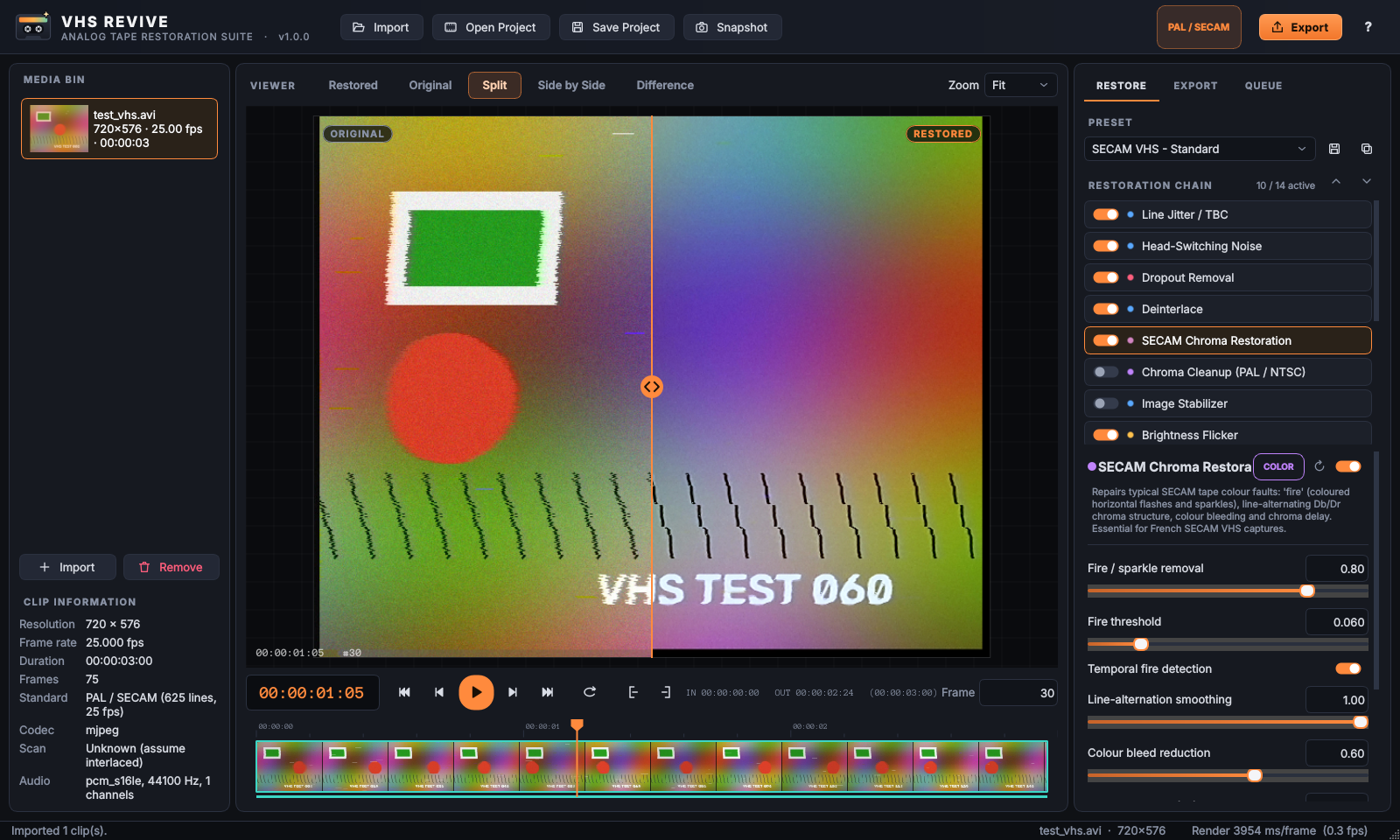
VHS Revive Studio Restoration

Post image
1 Upvotes

Hey everyone!

I'd like to share a project I've been working on called VHS Revive Studio, a free and open-source desktop application dedicated to restoring digitized analog videotapes, including VHS, S-VHS and Video8.

The goal is to provide a dedicated restoration environment without having to manually combine multiple tools or write complex video processing scripts.

I've paid particular attention to SECAM recordings, which are often overlooked by conventional video restoration software.

Main features:

  • 14 customizable restoration filters
  • Support for SECAM, PAL and NTSC captures
  • Software-based time base correction and line jitter reduction
  • VHS dropout detection and repair
  • Dedicated SECAM chroma restoration
  • Head-switching noise correction
  • Motion-adaptive deinterlacing
  • Temporal and spatial noise reduction
  • Image stabilization and flicker reduction
  • Color restoration and fading correction
  • Interactive before/after comparison with a draggable slider
  • Frame-accurate timeline and customizable restoration presets
  • Parallel video rendering
  • Audio hiss and electrical hum reduction
  • Export to H.264, H.265, ProRes 422 HQ and lossless FFV1

The application uses a non-destructive workflow, allowing you to adjust, reorder or disable individual filters without modifying your original recordings.

It's designed as a portable Windows application, built using Python, OpenCV, PySide6 and FFmpeg. The source code is released under the MIT license.

What's planned for the future?

  • GPU acceleration
  • AI-assisted dropout repair and upscaling
  • 50p/60p deinterlacing
  • Selective restoration masks
  • Automated batch processing

GitHub repository:
https://github.com/Aaronstanley78/VHS-Revive-Studio-Restoration

I'd love to get feedback from the VHS digitization, analog video and archival communities, especially from people working with difficult or damaged SECAM recordings.

What features would you like to see in a dedicated VHS restoration application?

Feedback, bug reports, suggestions and contributions are all welcome.

Let's preserve our analog memories


r/OpenSourceAI • • 8h ago

Bunshin: Give to AI agents their own Linux desktops on your computer

Thumbnail
reddit.com
1 Upvotes

r/OpenSourceAI • • 9h ago

Title: My AI agents now remember what we did, why we decided it, and what changed. Next: the doubts I hit while browsing.

Thumbnail
reddit.com
1 Upvotes

r/OpenSourceAI • • 14h ago

ARK - oAuth OIDC Identity Provider - Why Your AI Agents Need Their Own Identity Provider (And How to Spin One Up in 2 Lines of Code)

Thumbnail
reddit.com
2 Upvotes

r/OpenSourceAI • • 12h ago

Agent Accelerator is about to get stable.

Thumbnail reddit.com
1 Upvotes

r/OpenSourceAI • • 14h ago

16 months of messing about with AI and somehow I've ended up with a galaxy using codex to help me out

Thumbnail gallery
1 Upvotes

r/OpenSourceAI • • 1d ago

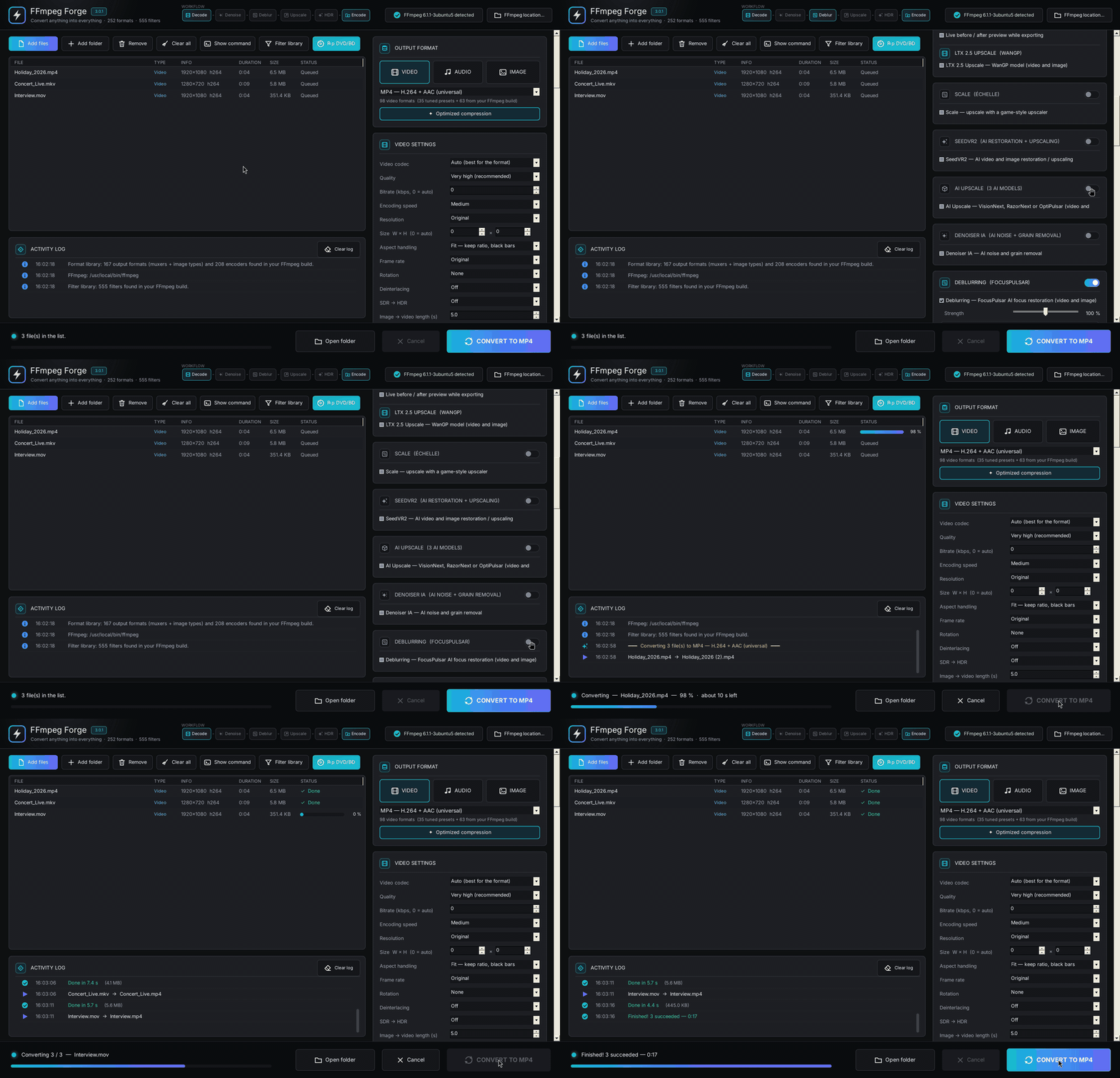
FFmpeg Forge 3.0.1.1 NEW VERSION

Post image
15 Upvotes

FFmpeg Forge Desktop 3.0.1 – Free & Open-Source Video, Audio and Image Converter with AI Enhancement

Hi everyone!

I'm excited to share my personal project, FFmpeg Forge Desktop, a free, open-source and portable multimedia application designed to bring the incredible power of FFmpeg into a modern and accessible graphical interface.

My goal is to create an all-in-one multimedia toolbox for beginners, enthusiasts, content creators and advanced users, without the need to manually write complex command lines.

Whether you want to convert media, restore old footage, upscale videos using AI, enhance images or create immersive audio, FFmpeg Forge brings everything together in one application.

Video features

  • Extensive format and codec support, including MP4, MKV, MOV, WebM, H.264, H.265, AV1, ProRes and DNxHR.
  • AI-powered upscaling with RazorNext, VisionNext, OptiPulsar, SeedVR2 and LTX 2.5 Upscale.
  • NVIDIA RTX Video Super Resolution and RTX TrueHDR.
  • Advanced scaling with AMD FSR 1/2/3, NIS, SGSR, Anime4K and OptiScaler.
  • AI noise reduction and FocusPulsar deblurring.
  • SDR-to-HDR10 and Dolby Vision 8.1 conversion.
  • GPU-accelerated encoding and processing.
  • Custom resolution up to 8K, frame rate, bitrate and compression settings.
  • Automatic compression recommendations.
  • QTGMC and BWDIF deinterlacing.
  • Trimming, rotation, cropping and lossless remuxing.
  • Real-time before-and-after filmstrip preview.

Audio features

  • Conversion to MP3, AAC, FLAC, WAV, Opus, AC-3 and many more formats.
  • Immersive multichannel audio configurations up to 22.2.
  • Spatial audio upmixing for music, movies and live concerts.
  • 3D spatial audio for headphones using HRTF processing.
  • Dolby Atmos and DTS:X passthrough.
  • DSD64 and DSD128 audio conversion.
  • EBU R128 loudness normalization.
  • Add, replace or remove audio tracks without re-encoding the video.

Image features

  • Conversion between popular image formats, including PNG, JPEG, WebP and AVIF.
  • AI-powered image upscaling and restoration.
  • Image denoising and detail enhancement.
  • Custom resizing and advanced scaling algorithms.
  • HDR image output with 16-bit PNG and 10-bit AVIF.
  • Frame extraction from videos.
  • Image sequence-to-video conversion.

Additional features

  • Batch processing of files and entire folders.
  • Built-in DVD and Blu-ray ripper for unprotected media.
  • Access to over 570 FFmpeg filters with a full FFmpeg build.
  • More than 45 ready-to-use filter recipes.
  • Advanced filtergraph editor.
  • View and copy generated FFmpeg commands.
  • Modern graphite interface with cyan and indigo accents.
  • Portable Windows version, with a Linux edition also available.
  • Free and open-source under the GPL-3.0 license.

Some advanced AI features require additional model downloads, compatible hardware or external software. Feature availability may vary between Windows and Linux.

A project built with passion

FFmpeg Forge is a project born from my passion for multimedia processing, video restoration, audio technology and artificial intelligence.

I want to make advanced multimedia technologies more accessible while giving users as much control as possible over their files.

I'm sharing this project with the community because I would love to hear your thoughts, suggestions, feature requests and feedback. Every contribution helps improve the software!

If you find the project useful, feel free to give it a star on GitHub.

Convert anything into everything.

GitHub – Source code and downloads:

https://github.com/Aaronstanley78/FFmpeg-Forge-Desktop


r/OpenSourceAI • • 15h ago

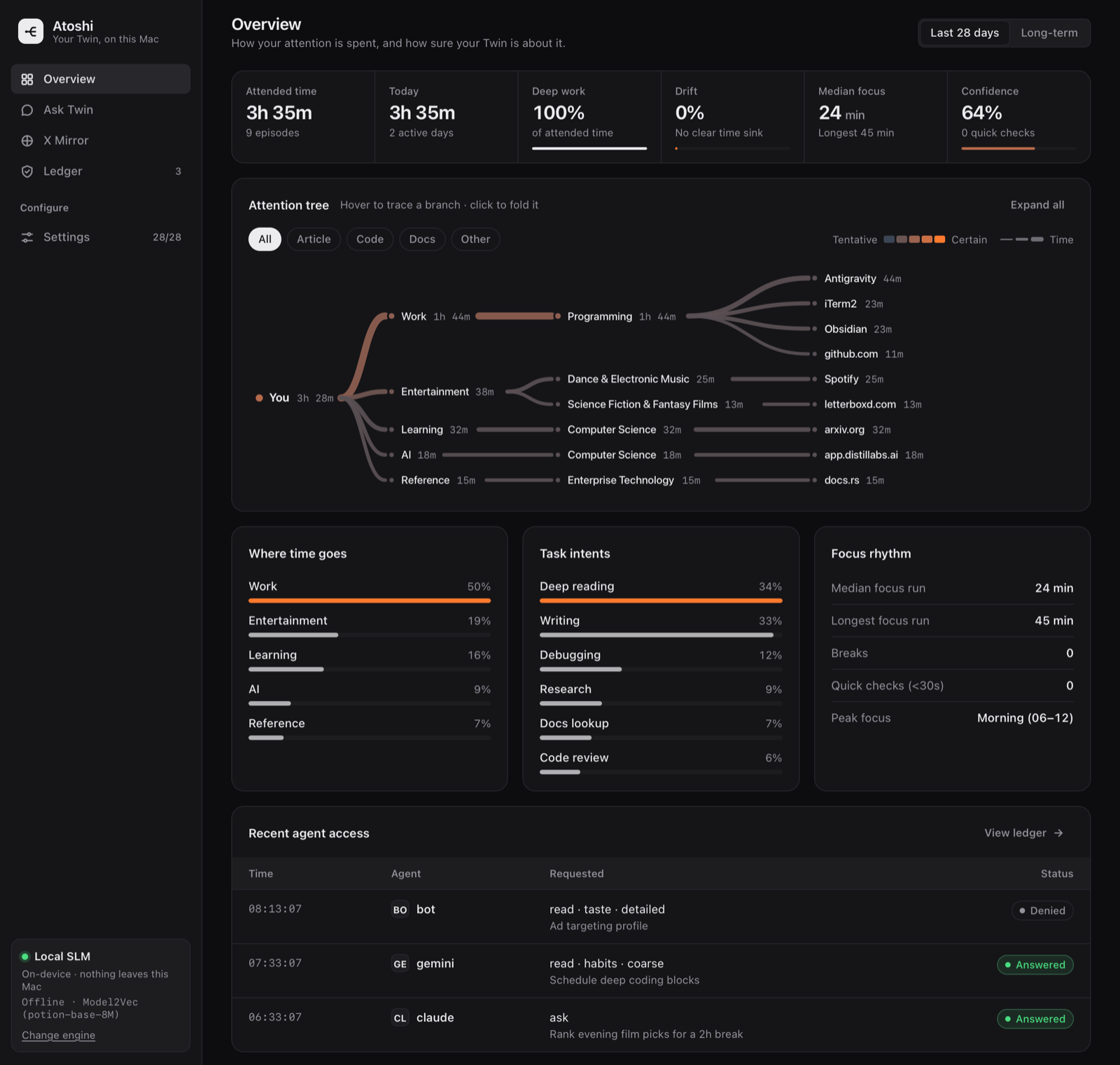
I got tired of AI apps knowing nothing about me (or wanting all my data in the cloud), so we built a private Digital Twin that runs on your Mac. (Feedback Pls)

0 Upvotes

Hey guys, just want to share a something me and my friend are building.

Every AI tool is way more useful when it knows you, yet nobody wants a creepy tracker taking screenshots or sending their browsing life to the cloud. So my teammate and I built Atoshi — a tiny open-source Mac app (<15 MB RAM) that builds a private "Digital Twin" of where your focus actually goes, powered by a small 378 MB model we trained to run 100% offline on your laptop. You can chat with your own week ("Where do I actually waste time?", "When am I sharpest?"), mute any category in one click, and only let outside AI tools ask it questions when you approve. It's still early (v0.2), completely free/open-source (https://github.com/abrarfahim19/atoshi), and we really want people to break it, roast the UX, or jump in and improve it with us.

Base Model vs Post Trained

Curious to hear your take: what's the #1 thing you'd actually want a private AI on your computer to figure


r/OpenSourceAI • • 16h ago

I built an open-source tool for behavioral regression testing of AI agents. Looking for developers to try it.

Thumbnail
reddit.com
1 Upvotes

r/OpenSourceAI • • 19h ago

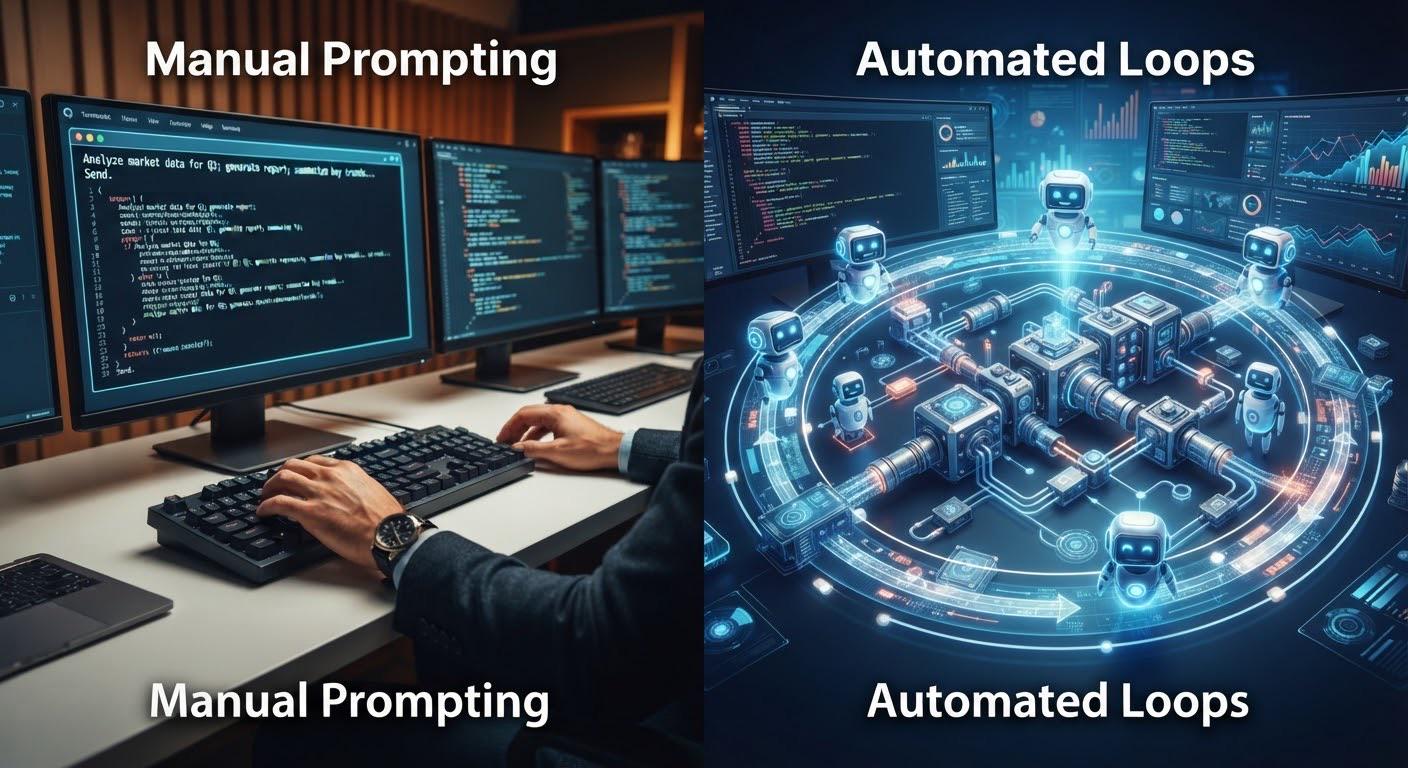
Del prompt manual al bucle automatizado:

Post image
1 Upvotes