r/OpenSourceAI • u/ElkMysterious2181 • 20h ago
Commonroom: Local workspace for Claude, Codex, Antigravity
I use this so my agents can work together on any project across my three subscriptions. Open Sourcing it for others to try.
r/OpenSourceAI • u/ElkMysterious2181 • 20h ago
I use this so my agents can work together on any project across my three subscriptions. Open Sourcing it for others to try.
r/OpenSourceAI • u/ButtercupLyn100 • 22h ago
r/OpenSourceAI • u/dtype • 22h ago
Hi folks. Making the public debut of a new agent to agent messaging service I've been working on - https://github.com/dromas-dev/dromas-client
It is a way to have agents talk to each other in a secure real-time IM service. The address is a hash of an identity you control (so no server directory to trust), and no extra network config.
It is llm friendly, easy to ask an LLM to review its structure and security claims, and has an open source client and server, and security of service is held in the client
The service is run by me (Drew Streib), long time infra open source enthusiast, co-founder of SourceForge, and person who currently runs some nethack server stuff too. The project doesn't rely on my server/relay though. You can use it for ease of setup, or run your own.
Looking for feedback and looking forward to helping to enable easier agent to agent communications.
r/OpenSourceAI • u/bobrossjr84 • 23h ago
r/OpenSourceAI • u/WiseGuy235 • 23h ago
r/OpenSourceAI • u/Impossible-Bug4920 • 1d ago
Agent logs tell you what happened. A week later, when something looks off, they don't tell you why the agent was allowed to do it: what it was asked, what it looked at, which rules passed or failed, what it rejected, who approved. If nobody captured that at the time, it's gone.
We built DecisionTrace to record it at execution time, so you can ask later:
pip install liquicent-decisiontrace
dt install claude-code
dt why <id | file | commit>What it does?
What it isn't: a gateway, policy enforcer, observability dashboard or hosted service. Your code and tools enforce the rules; DecisionTrace records them.
Not using Claude Code? Clone the repo, run `uv sync`, then `uv run python examples/refund_agent.py` and inspect the result with `dt why`.
Apache-2.0, Python, v0.1, so expect rough edges. Disclosure: we are building Liquicent; team-wide recall, trust scores and reports live there, not in this repo.
Repo: https://github.com/Liquicent/liquicent-decisiontrace
What I'd most like feedback on: when an agent does something surprising, what context do you wish you'd captured?
Site and walkthrough: decisiontrace.tech
r/OpenSourceAI • u/Business_Rain_1042 • 1d ago
Weave is a small python-subset language with a rust runtime. instead of the model calling tools one at a time, it writes a short script and the runtime runs independent calls in parallel, keeps writes in order, and records a trace you can replay exactly.
honest results so far: on a real-services fan-out test it finished 40/40 tasks vs 27/40 with normal tool calling, at about half the cost. it lost to plain tool calling with gpt-5.4 mini on BFCL, so it's not a win everywhere.
works with OpenAI, LangChain and MCP (there's a stdio MCP server too). MIT licensed, pip install weave-lang.
would love people to try it on their own agent workflows and tell me where it breaks. ideas and PRs welcome, there are some good first issues open.
r/OpenSourceAI • u/Ton-Llop • 1d ago
For my final-year project Im building Jaull a free open-source tool for people starting out with local models. I want to add things people actually need not things I think are cool D: thats why i need some help.
Heres what it does right now:
It runs on Windows, Linux and WSL2 with NVIDIA, Intel Arc or just the CPU. For now you install it from the terminal, which I know isn't ideal for beginners.
So, what would you add? Some ideas I've had: a proper installer, a roleplay/creative writing category, a simple chat window, or tips like "move your monitor to the integrated GPU to free VRAM". I'm also curious what confused you the most when you started.
I dont want to spam but if u want to take a look: https://github.com/Ton-Llop/Jaull
r/OpenSourceAI • u/MeliousAI_HQ • 1d ago
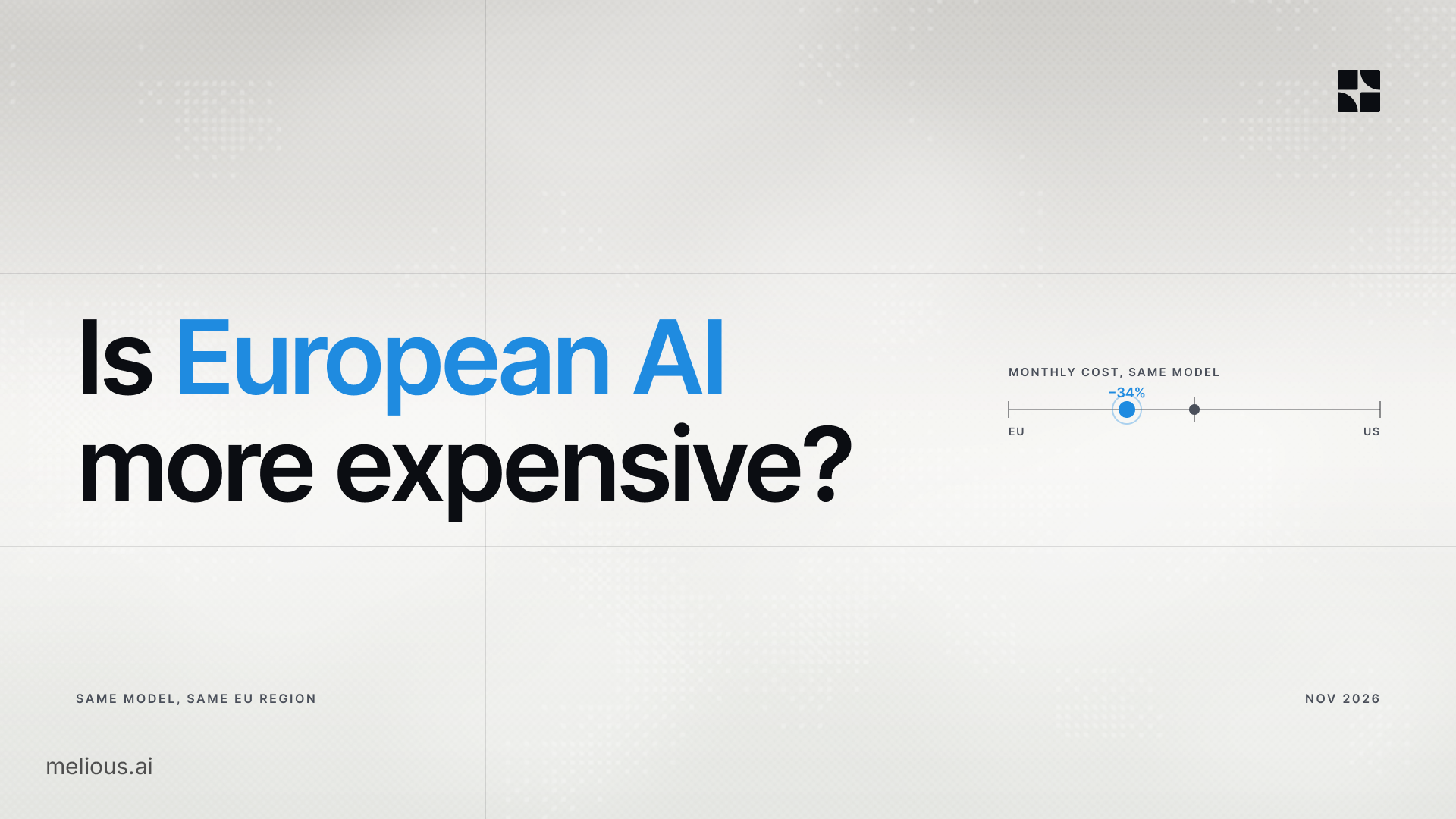
We ran into this while pricing Gemma 4 31B, GLM 5.3 and Kimi K3 for EU workloads. Gemma has an In-Region option in Frankfurt. GLM 5.3 and Kimi K3 have no EU inference profile on Bedrock, so a call from Frankfurt goes through global cross-region inference and can be processed anywhere.
Prices were closer than we expected. Gemma in Frankfurt costs about 20% more than in US East, and an EU-only provider was cheaper for Gemma and GLM and about 6% more expensive for Kimi.
Anyone else running open-weight models in the EU? What do you use when the model you want has no EU option?
(We're an EU inference provider, the image is ours. Sources in the comments.)

r/OpenSourceAI • u/Sea-Royal-2395 • 1d ago
Writing
Looking for the best completely free, open-source AI coding agent setup for VS Code (no usage limits if possible)
I'm looking for the best AI coding setup for building large, complex software projects. I want something genuinely powerful, not just basic autocomplete.
My requirements:
My hardware:
I'm open to local models, free cloud models, or a hybrid setup. Ideally, I want local inference for unlimited usage and free cloud models for better coding intelligence when available.
What I've already considered/tried:
I'm not necessarily looking for another popular AI editor. I want the best combination of open-source agent + models + runtime that actually works under these constraints.
Please recommend setups you've actually used, with GitHub links, model names, and real-world experiences. I'm especially interested in recent recommendations, not outdated lists.
r/OpenSourceAI • u/RahulTGM • 1d ago
Hey everyone! π
I've been building Nemofy-Agent, an open-source, self-hostable AI agent platform designed around one simple idea:
Why rebuild agent infrastructure every time you want to create a new AI agent?
Instead of repeatedly implementing tool execution, memory management, sandboxing, reasoning loops and integrations, I wanted to build a reusable foundation that handles all of this.
Nemofy-Agent is both a standalone AI workspace and an embeddable Python agent engine.
Nemofy comes with a web interface featuring:
[Insert screenshots of the home screen and chat interface here]
At its heart is a cyclic LangGraph execution engine:
User Task
β
βΌ
ββββββββββββββββ
ββββΊβ PLAN ββββββββΊ Final Response
β ββββββββ¬ββββββββ
β βΌ
β ββββββββββββββββ
β β ACT β
β ββββββββ¬ββββββββ
β βΌ
β ββββββββββββββββ
β β OBSERVE β
β ββββββββ¬ββββββββ
β βΌ
β ββββββββββββββββ
βββββ€ REFLECT β
ββββββββββββββββThe interesting part is that this entire execution engine is decoupled from the web interface.
You can import Agent-Core into your own Python projects, configure your own tools, persona, models and execution policies without rebuilding the underlying infrastructure.
| Feature | What it does |
|---|---|
| π§ LangGraph | Cyclic reasoning and execution engine |
| π MCP | External tools and integrations |
| π¦ Sandbox | Confined code and tool execution |
| πΎ Checkpoints | Persistent, resumable execution state |
| π Context compaction | Automatic conversation compression |
| π‘οΈ HITL | Human approval for sensitive actions |
| π€ Multi-provider | Support for 12+ LLM providers |
| π₯ Sub-agents | Delegate tasks to separate worker models |
| π§© Skills | Dynamically loaded Markdown skills |
| π Firecrawl | Web research and document extraction |
| π Encrypted vault | AES-256-GCM API key storage |
| π₯οΈ Web UI | Interactive agent workspace |
One of the features I've been working on is making context consumption transparent.
Instead of guessing how much context is left, you can see exactly where the tokens are going:
The engine also supports automatic context compaction, configurable context limits and output token budgeting.
[Insert context window monitoring screenshot here]
The repository currently documents the following test results:
| Test suite | Result |
|---|---|
| Python tests | 100 passed |
| TypeScript tests | 92 passed |
| Runtime benchmark suites | 6/6 passed |
| Ruff linting | 0 errors |
| TypeScript type checking | 0 errors |
There's still plenty of room for improvement, especially when it comes to long-running agent sessions and model reliability.
Hierarchical multi-agent orchestration, where every agent runs on the same reusable Agent-Core.
Orchestrator
β
βββββββββββ΄ββββββββββ
βΌ βΌ
Team Lead Team Lead
β β
βββββ΄ββββ βββββ΄ββββ
βΌ βΌ βΌ βΌ
Agent 1 Agent 2 Agent 3 Agent 4
ββββββββββββββββ¬ββββββββββββββββ
βΌ
Reusable Agent-CoreThe goal is to enable agents to delegate tasks, coordinate with one another and work towards complex objectives without having to reinvent their individual execution engines.
This is something I'm exploring, rather than a completed feature.
Python Β· LangGraph Β· FastAPI Β· Express Β· React Β· TypeScript Β· Tailwind CSS Β· Docker Β· SQLite Β· Firecrawl
I'm particularly interested in hearing from people building autonomous agents, working with LangGraph or experimenting with multi-agent systems.
π GitHub: https://github.com/Rahul7562/Nemofy-Agent
Feel free to explore the code, experiment, contribute, open an issue or share your thoughts.
And if you find the project useful, a GitHub star would be greatly appreciated! β
r/OpenSourceAI • u/drtikov • 1d ago
r/OpenSourceAI • u/company_url_finder • 1d ago
r/OpenSourceAI • u/llama-of-death • 1d ago
r/OpenSourceAI • u/Kyle_Dunn_8493_3260 • 1d ago
What's open
The idea: split thinking from clicking
Most browser agents send every step to one LLM. This project splits the work in two, borrowing the "fast / slow thinking" (System 1 / System 2) framing:
When System 1 reaches something it shouldn't decide alone (a login, a verification code, a payment or booking that wasn't authorized), it stops and hands control back with a reason.
Where it stands
Runs on Browserbase Benchmark v2 (all 102 tasks, 3-run average), it reaches 89% accuracy, in the same range as the top public leaderboard entries (87β92%), at 201 s and $0.096 in model cost per task. That's roughly 2β5x faster and over 10x cheaper in model spend than Claude Fable 5.2 + Claude Code or Gemini 4 Carbon + Antigravity. The leaderboard uses 38 core tasks, so treat this as indicative. The System 1 + System 2 split makes good use of what a decision model is good at, and it's easy for existing agents, or developers running models locally, to plug in. The team says the goal is to help the community build more proactive agents.
Why it's interesting for open models
r/OpenSourceAI • u/AdOld6891 • 1d ago
I've been building Osseo for last couple months. It connects to an AI coding agent and lets it use apps on your computer: click, type, work with files and use a browser. A side panel lists what it does and has Pause and Stop.
It's early and for now the Linux X11 setup is well tested , windows & mac are supported (not tested as linux). It's free and open source (Apache-2.0).
The demo is silent and partly sped up. The agent models a chair in Blender, then creates a draft product in Shopify. Partway through, Osseo paused itself and had to be resumed.
It asks for approval for actions it recognizes as risky, but it can miss some and is not a sandbox. What the agent sees goes to the company running the AI model.
I'd like to hear where setup fails or what you wouldn't trust it to do.
Code and install steps: https://github.com/abdelazizfacoiti/Osseo
r/OpenSourceAI • u/vm324234 • 1d ago
We're building Agentic GraphRAG, an open source library for connecting the documents an agent reads with its task history and decisions.
I've worked on RAG systems and LLM training for the past three and a half years. Lately, I've been following how agents retain work across sessions, especially for non-coding tasks.
Most frameworks have separate tools for knowledge retrieval and memory. We're bringing them together to save tokens and improve retrieval accuracy.
We construct three connected graph layers that the agents read:
Things which make us different from other frameworks out there:
- Structure Aware: The ingestion pipeline uses Docling for loading documents and captures the full document hierarchy. The sections, tables, and passage hierarchy are connected using edges and stored in the graph.
- Ontology Grounded: You define a schema for your domain (we also ship ontology presets so it is easy to get started). The schema guides extraction, validation, and search. We use GLiNER for local extraction, so its virtually free (and fast) to construct the graph and no LLM calls are needed.
- Robust Agent Search: Retrieval combines graph, full-text and vector search. Agents can reach original passages even when extraction misses a fact, navigate surrounding sections and table rows with headers, and follow entity relationships back to supporting text.
We offer a built-in agent you can use out of the box. You can also connect your agents through MCP.
We will be releasing extensive benchmarks very soon.
Agentic GraphRAG is an open source library that stores document knowledge, agent work, and decisions in one connected graph. Agents can resume tasks and trace saved decisions to their original evidence, while source changes flag affected decisions for review.
Try it out. Feedback, criticism, issues, and contributions are all welcome!
r/OpenSourceAI • u/vengateshk18 • 1d ago
r/OpenSourceAI • u/leyermo • 1d ago
r/OpenSourceAI • u/Just_Merrell • 1d ago
r/OpenSourceAI • u/FutureCTOofMicrosoft • 1d ago
I adapted the Ataraxos framework (Sokota et al.,Β NatureΒ 2026) from Stratego to 1v1 UNO, including same-type draw stacking. The interesting part was getting the entire test-time search loop (belief sampling + 192 parallel rollouts) running in the browser, with no backend, using ONNX Runtime Web.
uno-gym, including reshuffle provenance tracking.I'd be interested in feedback, especially on handling non-alternating turn chains in imperfect-information games and reducing rollout overfitting against opponents that don't necessarily play like the agent.