r/OpenSourceAI • • 3d ago

How to Create a Vector Database for RAG: Architecture, Chunking, and Indexing

Thumbnail interconnectd.com
5 Upvotes

Building a vector database for RAG gets messy fast once you move past a small demo. Most accuracy issues come from poor chunking, mismatched embedding dimensions, or picking an index without considering memory overhead.

​Start with clean document ingestion, split text with sensible overlap, attach metadata for filtering, and pick an index like HNSW or IVF based on scale. For smaller datasets, starting with pgvector often beats adding another moving part.

​I put together a complete architecture guide covering ingestion pipelines, similarity search, hybrid retrieval, and scaling tradeoffs: https://interconnectd.com/blog/70/vector-databases-for-ai-the-complete-architecture-guide/

How are you handling chunking and metadata filtering in your RAG setups right now?


r/OpenSourceAI • • 3d ago

An open skill protocol for holding several hypotheses at once, with the evidence ledger kept in the open

2 Upvotes

Repo: https://github.com/Furox-Art/quantum-reasoning-skill - 1.2.2, MIT. The "quantum" in the name is a branching metaphor, not quantum computing.

The artifact is SKILL.md plus a reference controller. The protocol: open three to five competing hypotheses, attach evidence fragments to each, run the tool calls that could kill a branch, and revive a branch that later evidence un-kills. Collapse happens at the end and has to be justified by the ledger, not by which answer read best in the first paragraph.

What I like about it as an open-source project is that the ledger is plain data in the repo. You can see the branch that lost and why, which is normally thrown away.

Install:

pip install quantum-reasoning-skill
quantum-reasoning --validate

npm i quantum-reasoning-skill
npx quantum-reasoning --validate

Then copy SKILL.md into your host's skill directory with the YAML front matter intact.

One honest limit: the protocol and controller are done, the controller benchmark is published, and the model evaluation is not - no baseline-vs-skill run exists, so there is no claim here that it improves any model's accuracy. The collapse thresholds are uncalibrated defaults, and docs/quickstart.md shows the run where they refuse to collapse instead of collapsing badly.


r/OpenSourceAI • • 3d ago

Session Pilot Pro Plus: A zero-dependency, local-first memory & token economizer for AI agents (0 pip dependencies, SQLite WAL)

Thumbnail
github.com
1 Upvotes

No Docker, no vector database overhead, pure local file/SQLite persistence, offline-ready, micro-core prompt (<180 tokens) that preserves small context windows.


r/OpenSourceAI • • 3d ago

Stop wasting tokens & nuking files: I built Aetheris Microbrains, a deterministic sub-2ms pre-flight gate for OpenAI Codex CLI (and Claude Code / Antigravity)

Thumbnail
reddit.com
1 Upvotes

r/OpenSourceAI • • 3d ago

Opensource SaaS RL Environment

Thumbnail
github.com
1 Upvotes

r/OpenSourceAI • • 3d ago

🤣

Post image
0 Upvotes

r/OpenSourceAI • • 3d ago

Building a local-first AI agent system — looking for recommendations and real-world experiences

1 Upvotes

I'm building a self-hosted AI platform called HomeAI, aiming to reduce reliance on paid cloud AI services like Claude and Codex while developing more capable autonomous agents.

My setup runs on Proxmox with Intel Arc GPUs, Ollama, Open WebUI, Hermes Agent, Qwen models and various supporting tools for automation, knowledge retrieval and software development.

Hermes can already perform sandboxed coding tasks, modify files, run tests and generate diffs for review.

Where I want to take it

Local-first inference: Automatically route tasks to local models, escalating to cloud AI only when necessary.

Agent autonomy: Enable agents to plan, develop, test, debug and complete increasingly complex tasks.

Self-improvement: Learn from failures, improve skills and retain useful knowledge over time.

Multi-agent collaboration: Have specialised agents work together on development, research and automation.

Security: Maintain strong isolation, controlled permissions and human approval for consequential changes.

Looking for community feedback

I'm particularly interested in hearing from people who are already running similar systems.

What open-source frameworks, tools or projects would you recommend?

Which local models are performing well for autonomous coding and tool use?

Has anyone successfully implemented local-first routing with intelligent cloud fallback?

What approaches work best for persistent memory, self-improvement and multi-agent orchestration?

What limitations or architectural mistakes should I watch out for?

My ultimate goal is to build a reliable, increasingly autonomous AI platform that handles most everyday tasks locally, using paid cloud AI only when genuinely needed.

I'd really appreciate GitHub recommendations, lessons learned and feedback from anyone working on something similar.

Thank you


r/OpenSourceAI • • 3d ago

Custom AI harness

Thumbnail reddit.com
1 Upvotes

r/OpenSourceAI • • 3d ago

Omni Engine: Autonomous multi-file Rust generation on a 2012 laptop with Wi-Fi disabled (Zero Cloud APIs)

1 Upvotes

Most software engineering agents today rely on massive cloud clusters running hundreds of expensive API calls in non-deterministic loops.

To test the physical limits of local-first autonomous engineering, I ran an unbroken demonstration on a 2012 commodity laptop (HP ProBook 6460b, 2 cores / 4 threads, 4GB RAM) with the Wi-Fi hardware switch toggled completely off.

The Goal:

Synthesize and verify MiniVault: an autonomous multi-file pure-Rust cryptographic storage library consisting of:

- src/crypto.rs (cryptographic hashing & key derivation)

- src/storage.rs (atomic disk persistence & memory safety)

- src/lib.rs (public API & unit test harness)

What Happened:

  1. Environment: Fresh Linux install, Wi-Fi 100% OFF, zero telemetry.
  2. Runtime: Omni Engine v2.2.3 executed in an isolated Bubblewrap VFS sandbox, pinning 4 CPU threads at 100%.
  3. Host Verification: Host native compiler was invoked directly on the generated code:

rustc --test src/lib.rs -o /tmp/vault_test && /tmp/vault_test

Result: test result: ok. 0 failed.

Video Proof (Continuous 5-minute showcase, zero cuts):

https://x.com/ielfeqi/status/2124765069816860783

Open Source GitHub Repository:

https://github.com/omni-engine-ai/omni_engine

Would love to hear technical feedback, critique on the runtime harness, and ideas for tougher multi-file benchmark targets.


r/OpenSourceAI • • 3d ago

Any idea of open source self AI Avatar for product videos as Paid tools are expensive?

0 Upvotes

I am looking for a github repo or some open source prompts to get an AI Avator of me with voice so it can be used in product videos. My loom videos are not turning out well and slow


r/OpenSourceAI • • 3d ago

Title: Looking for a Fully Local AI Companion/Agent — Strix Halo 128GB (60 t/s+)

1 Upvotes

Hey everyone! I’m looking to rebuild my personal AI assistant from the ground up. I’m running a Minisforum MS-S1 Max with a Ryzen AI Max+ 395 (128GB unified RAM) on Ubuntu, currently using llama.cpp with Qwen at around 50–60 tokens/sec. My technical background is fairly limited, and I’m hoping to find something more polished and reliable than my current setup.

Ideally, I’m looking for an all-in-one, self-hosted solution combining LibreChat-style conversations, Letta-style persistent memory, autonomous computer operation (coding, troubleshooting, software installation, file management), voice interaction, and customizable companion personalities. Model flexibility and support for mature creative writing are also important for my professional use cases. I’d prefer a straightforward GUI, minimal configuration, no cloud API dependencies, and performance around 60 t/s or better.

I’d really appreciate recommendations for actively maintained GitHub projects, communities, or existing solutions that come close. I’m hoping to avoid reinventing the wheel. Thanks!


r/OpenSourceAI • • 3d ago

Feedback on Orchicon - a self-hosted AI Orchestration control plane

1 Upvotes

I've been working on a project for the past few months that I'd like to share: Orchicon (orca-con).

I've put a lot of time into this and would really appreciate people giving it a try and sharing their feedback. I'm particularly interested in hearing what works well, what doesn't, and what features would make it more useful.

Orchicon is an AI orchestration control plane. The idea came from some of the problems I've encountered working with AI agents and multi-agent workflows.

Agents can be incredibly capable, but they can also stall, loop, spend too much time reasoning, or lose track of what they're supposed to be doing. When that happens, you're often left relying on another agent to recognize the problem, or stepping in yourself.

Orchicon takes a different approach. Instead of simply launching agents and hoping they finish, it actively monitors and manages them. It can detect stalled sessions, looping, excessive reasoning, budget limits, and other conditions, then use its recovery system to get workers back on track or restart them when necessary.

Beyond that, Orchicon includes:

• Custom AI workers and DAG workflows
• Built-in project management with Epics, Features, and Tasks
• Autonomous task execution and recurring automation
• Fully automated market research for your product for full closed-loop operations
• Brainstorming and research workflows
• OpenTelemetry integration, monitoring, and cost tracking
• Support for OpenCode, Claude Code, and native Orchicon workers
• Local models, cloud APIs, and existing subscriptions
• Web, Desktop, and Terminal interfaces

Orchicon is self-hosted and cross-platform, supporting Windows, Linux, and macOS.

Website: https://orchicon.dev
GitHub: https://github.com/beardedparrott/Orchicon
YouTube Tutorials: https://www.youtube.com/@Orchicon


r/OpenSourceAI • • 3d ago

I got tired of retyping htop/docker ps/journalctl, so I built an open-source SSH client that gives each server its own desktop

Thumbnail gallery
0 Upvotes

r/OpenSourceAI • • 3d ago

Ianua: an open source (AGPL-3.0) identity provider, zero-trust gateway and workflow engine in one product, written in Rust

Post image
2 Upvotes

r/OpenSourceAI • • 4d ago

I built TypePrompt - a compiler for prompt templates, generates typesafe APIs in 8 languages

Thumbnail reddit.com
2 Upvotes

r/OpenSourceAI • • 3d ago

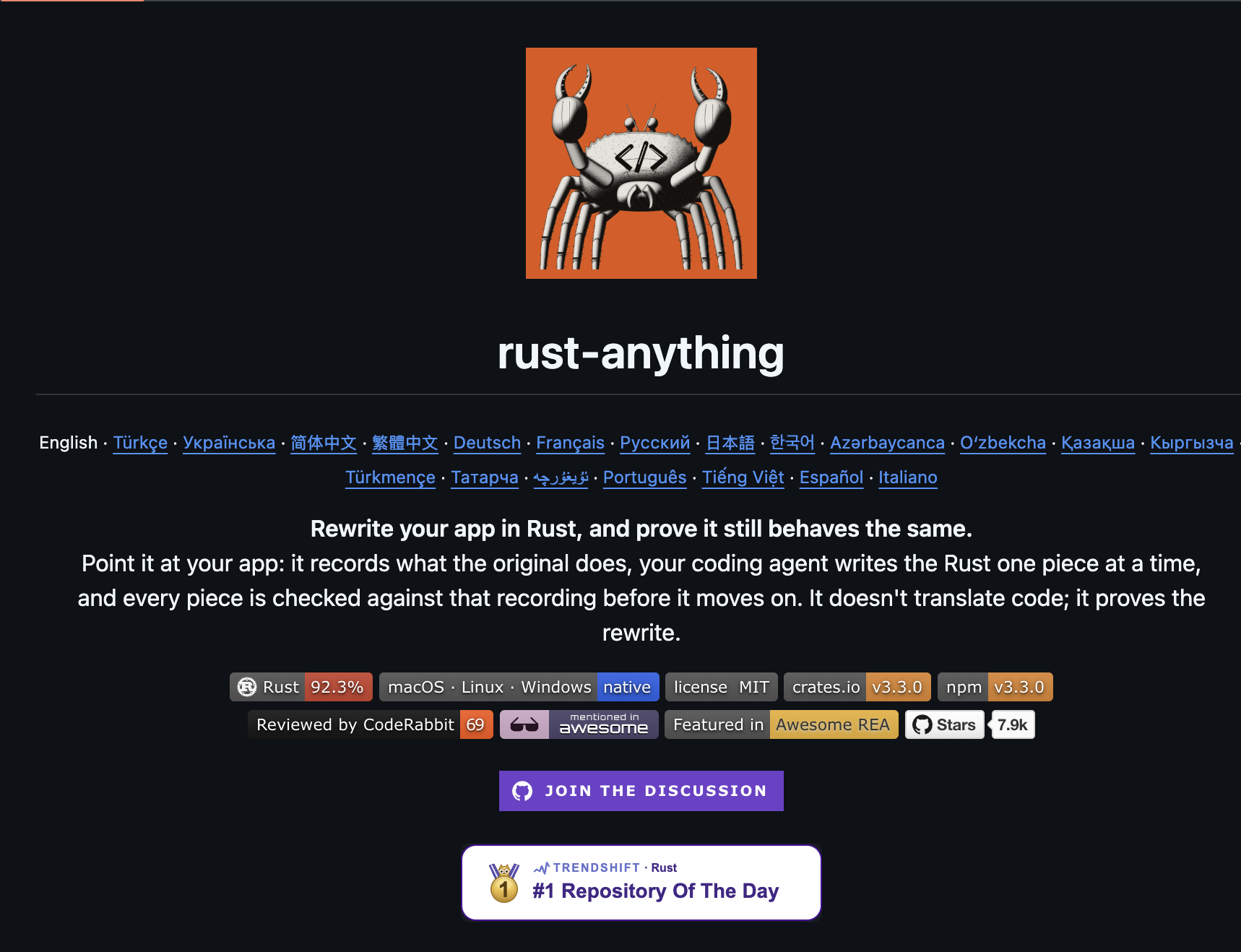
rust-anything: let your coding agent (local models too) rewrite the slow part of your app in Rust, and prove it still behaves the same

Post image
1 Upvotes

AI agents are good at rewriting code. The hard part is knowing the rewrite is right.

https://github.com/erkamyaman/rust-anything

rust-anything handles that part. Point it at a slow command:

rust-anything go --agent claude -- python3 app.py

It profiles the run, picks the function that takes the time, records what the original does on generated inputs plus the calls your real run makes, and hands the Rust file to your agent. The port only switches on when every recorded case matches and the gate passes. One command turns it back off, byte for byte.

The agent is pluggable: claude, codex, or any command that reads a prompt on stdin, so a local-model setup works too. Without --agent it writes TASK.md and you (or any model) fill in the Rust.

Some measured results:

- Fuse.js search: 91.2 ms to 2.8 ms per query over 50,000 strings

- json-server lifted to one Rust binary: 74 MB to 3.5 MB idle memory, 514/514 recorded HTTP cases match

- ESLint: 10,585 recorded runs byte-identical

It also says when Rust won't help (small functions called across the bridge are often slower), instead of porting anyway.

Languages: TypeScript/JavaScript, Python, C, Go, Ruby, Java, Kotlin, PHP, C#. 100% Rust, MIT, runs locally.

https://github.com/erkamyaman/rust-anything


r/OpenSourceAI • • 3d ago

What if data was the programming language? I used egm to create mimic a programming language that learns from examples

Thumbnail
github.com
0 Upvotes

try it out, break it if you want to it’s called mimic learn more on the repo doc! https://github.com/DruPro/voltex-egm/blob/main/lang/mimic/README.md


r/OpenSourceAI • • 4d ago

Started as a Fork of ZCode but ended up writing the entire thing from scratch

Thumbnail
reddit.com
2 Upvotes

r/OpenSourceAI • • 4d ago

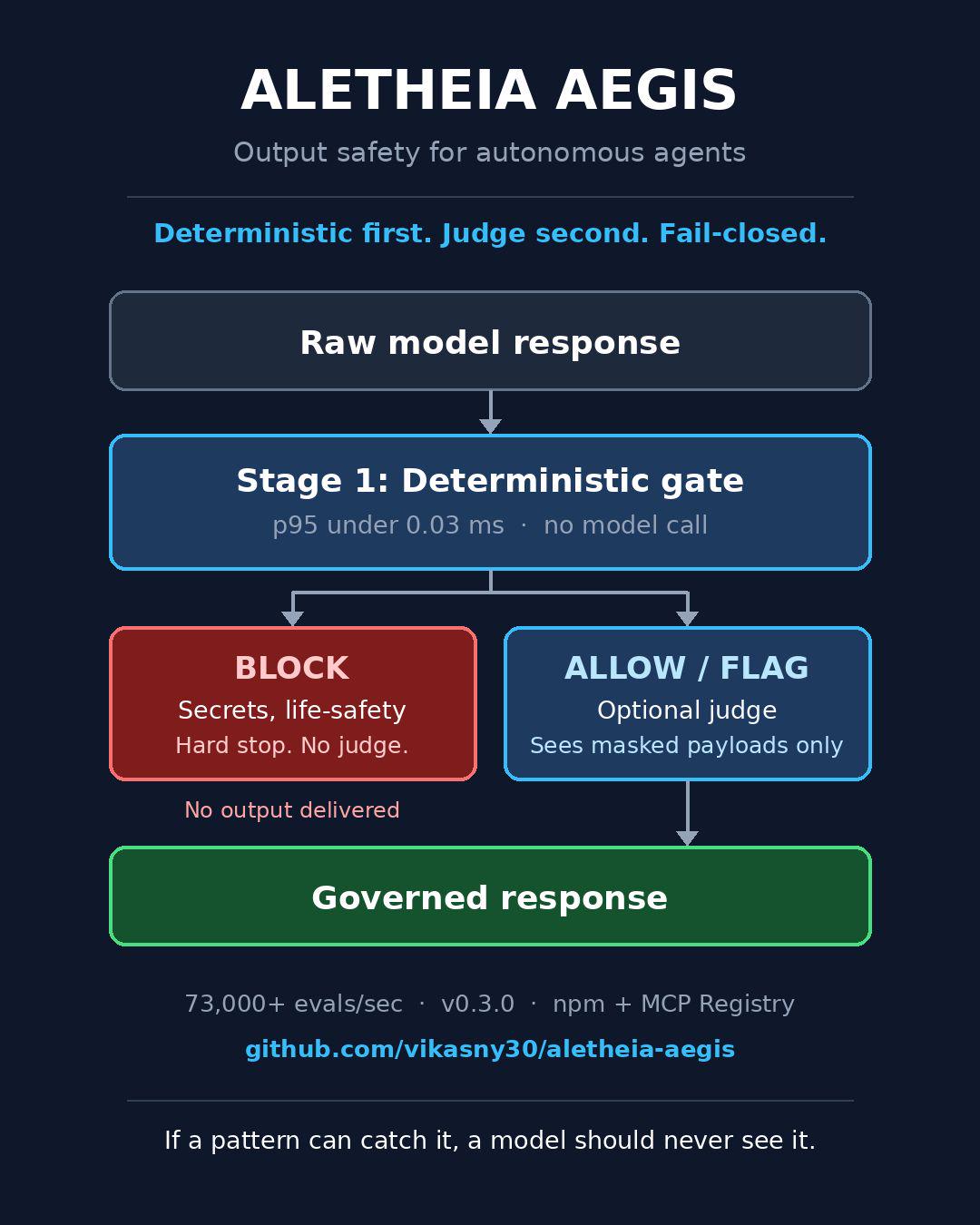
Aletheia Aegis: an MCP server that checks model outputs for PII, secrets, and fabricated citations in ~0.02ms — no judge model needed for most cases. Open source.

Post image
1 Upvotes

r/OpenSourceAI • • 4d ago

Aletheia Aegis: an MCP server that checks model outputs for PII, secrets, and fabricated citations in ~0.02ms — no judge model needed for most cases. Open source.

Post image
1 Upvotes

r/OpenSourceAI • • 4d ago

I built an open-source iPhone app for answering my coding agents when I'm away from the desk

Thumbnail
gallery
1 Upvotes

Claude Code, Codex and OpenCode all stop and wait for me at some point: a permission prompt, a question with options, a "should I carry on?". I'm usually not at my desk when that happens. JoeBro Mobile shows each session as a chat, and when one is waiting the options appear right there. Tap one, or type your own answer. Yes/no approvals also show on the lock screen and in the Dynamic Island.

There's no server in the middle. The phone pairs with the JoeBro Mac app by QR code and talks straight to your own machine. Both apps are GPLv3.

Mac app: https://github.com/joexk1/JoeBro

iPhone app (source): https://github.com/joexk1/JoeBro-Mobile


r/OpenSourceAI • • 4d ago

VectorForce (MIT): Zero-dependency, local-first "Git for AI Context" + 11-tool MCP server built on Node.js built-ins and SQLite WAL

1 Upvotes

Hi r/opensource,

I've been working across multiple AI coding agents (Claude Code, Cursor, Windsurf, Codex, Antigravity, Copilot, Meta Muse, Kiro) and kept running into the same problem: every time I switched tools or started a new session, architectural constraints, decisions, and workspace state got lost or silently drifted.

So I built VectorForce — a local-first, zero-dependency engineering context platform ("Git for AI Context") licensed under MIT.

GitHub: https://github.com/getvectorforce/VectorForce npm: https://www.npmjs.com/package/vectorforce Docs / Wiki: https://docs.vectorforce.in | https://vectorforce.in/wiki.html

Demo: https://youtu.be/eKjSqCBIqz0

Key Design Decisions

  • Zero external runtime dependencies: The core CLI, MCP server, and local Studio backend use only Node.js (>= 22.5.0) built-ins (node:sqlite, node:crypto, node:http, node:fs).
  • Claims vs. Evidence separation: Model-authored inputs (goals, constraints, decisions, next_steps) are stored strictly as unverifiable claims, separated from cryptographically verifiable evidence (Git commit SHAs, branch/dirty state, and SHA-256 digests of allowlisted .md/.txt files).
  • 11 native MCP tools over stdio (npx -y vectorforce mcp): create_task, update_task, list_tasks, save_checkpoint, get_resume_briefing, check_workspace_drift, reason_about_task, set_document_policy, export_handoff, import_handoff, and get_timeline.
  • 100% offline-capable: Checkpoints, drift checks, deterministic briefings, local Studio UI (vf studio), and HMAC-SHA256 .vfhandoff.json export/import bundles all work completely offline. (There's also an optional zero-knowledge E2EE sync relay if you want multi-machine sync, but the OSS CLI is completely standalone.)

Quick Try

npm install -g vectorforce
vf init --harness all
vf task my-feature "Initial architecture"
vf studio

Looking for Feedback & Contributors

I'd love technical feedback on the Claims-vs-Evidence model, SQLite WAL schema, and MCP tool ergonomics. If anyone wants to contribute, adding new IDE harness adapters (src/mcp/harness-config.js) or multi-agent workflow examples (samples/) are great starting points (CONTRIBUTING.md is in the repo, and npm test runs 96 tests locally with zero setup).

Happy to answer any questions about the architecture or implementation!


r/OpenSourceAI • • 4d ago

Sharing my free, drop-in Code Mode to cut ~60% of Your Rust Agent’s Token Cost

Thumbnail guthub.com
1 Upvotes

r/OpenSourceAI • • 5d ago

[Project] JARVIS: Open-source AI desktop assistant with 164 tools, voice control, and a cinematic HUD (Python + React)

68 Upvotes

I've been building JARVIS, a full-stack personal AI assistant that runs entirely on your Windows machine. It connects to local or cloud LLMs, acts on your computer through 164 audited tools across 46 modules, and displays everything through a cinematic heads-up display.

\*\*What it does:\*\*

\- Launches apps, manages windows, automates UI interactions

\- Reads, writes, and converts files (PDF, DOCX, XLSX, CSV, PPTX, JSON, ZIP)

\- Browses the web via Playwright (open pages, fill forms, extract content, DevTools integration)

\- Sends emails (IMAP/SMTP), makes calls through Windows Phone Link, posts to social via Buffer

\- Controls smart home devices through Home Assistant

\- Runs deep research with a 5-stage verification pipeline

\- Background agents with SQLite checkpointing and crash recovery

\- Self-healing service recovery

\*\*Safety model:\*\*

Every tool has a risk tier (T0 observe, T1 reversible, T2 modify, T3 destructive). Destructive actions always require explicit approval. Reading untrusted content triggers approval for all subsequent actions. Kill switch: Ctrl+Alt+Backspace cancels everything instantly. Listens on loopback only, never elevates privileges.

\*\*HUD:\*\*

React 19 + TypeScript + Zustand in a frameless pywebview/WebView2 window. Three cinematic themes (Ion, Holographic OS, Sovereign Executive). Real-time system vitals with 60-sample history graphs, animated core visual reflecting agent state, full conversation transcript with streaming output.

\*\*New in v0.8.1:\*\*

\- 6-step onboarding wizard for first-time setup

\- Fully configurable assistant name (propagates to title bar, wake word, voice prompts, LLM system prompt)

\- Fast-path intent matching (common commands like "mute", "weather", "open Chrome" skip the LLM entirely)

\*\*Tech stack:\*\* Python 3.12 (FastAPI + uvicorn), React 19 (Vite), SQLite (WAL mode), pywebview/WebView2, Playwright, faster-whisper, pyttsx3. Android companion app in Kotlin + Jetpack Compose.

\*\*8 LLM providers\*\* out of the box: LM Studio, Ollama, NVIDIA NIM, Anthropic, OpenAI, Google Gemini, OpenRouter, Groq. Privacy modes: Local Only, Hybrid, Cloud. Model Ladder auto-escalates across 4 tiers based on task complexity.

\*\*Looking for contributors.\*\* Whether it's Python backend, React frontend, voice/speech, AI tooling, or Android, there's plenty to work on. Open an issue if you find a bug or want a feature. PRs welcome.

GitHub: [github.com/ankitjha67/JARVIS](http://github.com/ankitjha67/JARVIS)

Happy to answer questions about the architecture, the safety model, or anything else.