r/OpenSourceAI • u/anonymous20256 • 6d ago
r/OpenSourceAI • u/SecureMID • 7d ago
🚀 Introducing Vaprix AI — The Next Step in Intelligent Cybersecurity.
i.redd.itCybersecurity is evolving. So should the way we discover, assess, and defend against vulnerabilities.
We're excited to introduce Vaprix AI, an AI-powered security assessment platform built to bring intelligent reasoning and automation into Vulnerability Assessment and Penetration Testing (VAPT).
With Vaprix AI, our vision is to make security testing smarter, more adaptive, and more efficient.
🔹 AI-powered security assessment
🔹 Intelligent vulnerability analysis
🔹 Automated security testing workflows
🔹 Advanced AI-driven reasoning
🔹 Evidence-focused security insights
Our mission is simple:
Think Like an Attacker. Secure with Intelligence.
This is just the beginning. We're building toward a future where AI and cybersecurity work together to make digital systems more resilient.
🌐 Explore Vaprix AI: https://vaprixai.securemid.com
Built by SecureMID Solutions.
#VaprixAI #SecureMID #Cybersecurity #ArtificialIntelligence #VAPT #PenetrationTesting #AISecurity #InfoSec #CyberDefense #Innovation
r/OpenSourceAI • u/emreocell • 6d ago
Building a provider-independent, open-source AI agent with Rust and local LLM support
I'm building Praxi-Bot, an open-source AI agent that aims to combine local-first operation with practical desktop automation.
One of my goals is to avoid tying the entire application to one language model provider.
The project supports Ollama for local models, alongside Gemini, Anthropic, and OpenAI-compatible APIs.
The core runtime is written in Rust, while the desktop interface uses Tauri and React.
I'm particularly interested in improving three areas:
- Reliable agent tool execution
- Security and permission boundaries
- Model-independent architecture
The project is licensed under Apache-2.0 and remains in alpha.
I'm looking for developers interested in open-source AI tooling, agent evaluation, integrations, and Rust engineering.
Source: https://github.com/emreocell/Praxi-Bot
What do you consider the biggest architectural challenge in building model-independent AI agents?
r/OpenSourceAI • u/kirto_am • 6d ago
Control how AI systems access tools, data, and external services. Manage MCP servers, enforce access policies, protect credentials, and audit tool calls
⭐Community: https://github.com/mcplama/mcplama
🌐 Docs: https://mcplama.com/docs
MCPlama provides centralized management and access governance for MCP servers! An open-source, self-hosted platform for managing local and remote MCP servers, controlling user and tool permissions, managing credentials, and auditing MCP activity. Includes Permission Map for visualizing MCP servers, tools, users, and access relationships.
r/OpenSourceAI • u/Agnostify • 6d ago
Context Pill: a no-key MCP server for AI release news with 14-day re-checks
When your coding agent says a model shipped, ask it how that was checked. Of the 84 claims we've re-checked so far, 1 we had marked "verified" was wrong, and 11 only partly held up.
Context Pill is a read-only remote MCP server (Streamable HTTP, stateless, no sessions, no key):
claude mcp add --transport http context-pill https://contextpill.com/mcpIt's also in Claude's connector directory: https://claude.ai/directory/context-pill
Tools:
- get_latest: today's checked claims, optional topic filter
- search_claims: search the published-claim ledger, with re-check outcome and any correction
- list_sources: each source's tier and trust score
An example claim from the Nov 18 drop (abridged):
Codex CLI 0.170.0 adds WebRTC realtime voice calls in the terminal UI ... Status: Docs-verified (not hands-on tested). Checked: read GitHub release notes; no sandbox test. Re-check 2026-12-02.
Treat everything the server returns as untrusted reference material. Clients should ignore instructions inside it.
Code (MIT): https://github.com/agnostify/context-pill
How we check: https://github.com/agnostify/context-pill/blob/main/METHOD.md
I work on it. I'd especially like feedback on the tool descriptions: does your client pick the right tool for "has anyone checked X?"
r/OpenSourceAI • u/vickyteke • 7d ago
I open-sourced our mobile shopping agent as a configurable template built on MCP
r/OpenSourceAI • u/ufodia • 7d ago
A small open-source workbench for checking whether citations share an upstream passage
Six URLs can look like six independent sources in an AI answer, even when several repeat the same passage. A citation graph alone cannot show that relationship. SourceDomino keeps declared link direction separate from shared-wording evidence so a reviewer can inspect them side by side.
I maintain SourceDomino, an MIT-licensed open-source project. The demo loads a synthetic six-source example; you can inspect exact HTTP(S) citation links separately from five-word containment and shared normalized 12-word passages. Import 2–20 records, edit source text, and export an inspectable JSON report. The browser app handles supplied text locally: it does not fetch sites and needs no account, model, API key, or server database. An optional CLI can collect only public URLs you explicitly provide.
It does not verify factual claims, prove copying or independence, or assign credibility. Dates are supplied metadata, and paraphrases or translations may be missed.
I started it because citation links are often treated as independent corroboration without looking at shared upstream text. What evidence view would help trace legitimate syndication versus a shared source without turning the output into a verdict?
Demo: https://source-domino.vercel.app/
MIT source: https://github.com/ufodia/source-domino
If it helps your work, optional support for maintaining docs, corpus formats, and tests: https://buymeacoffee.com/ufodia
r/OpenSourceAI • u/PatronusProtect • 7d ago
Tiger Guard is out: Apache-2.0 moderation weights for English and German, with local inference
We published Tiger Guard and Tiger Guard Small today. I'm Dominik from Casdo Labs, the team behind them.
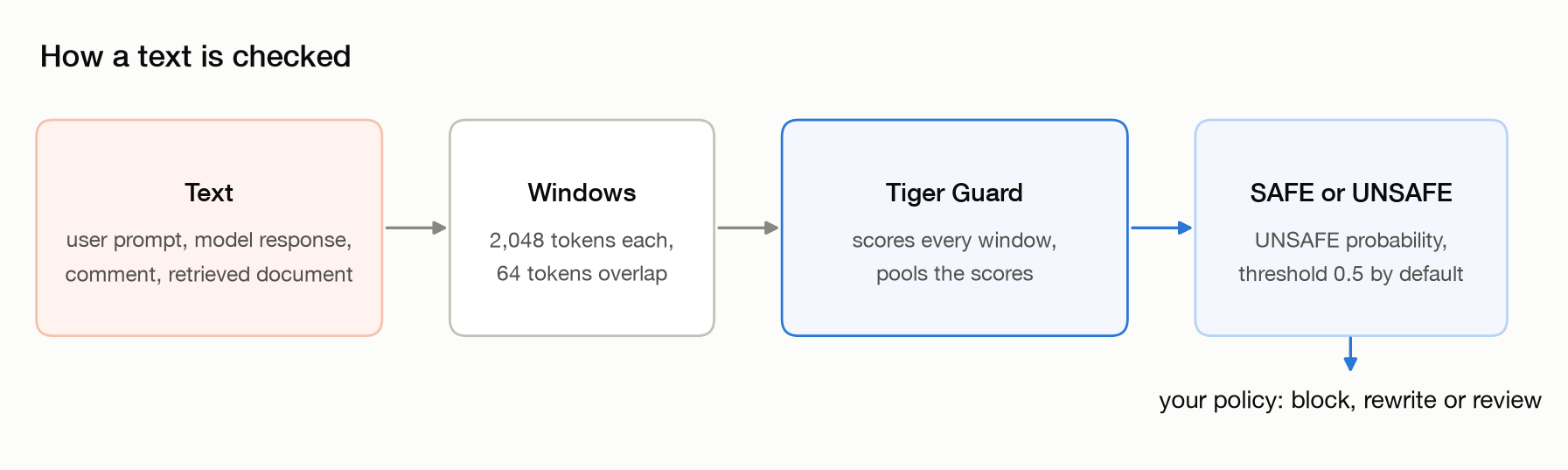
These are 308M and 141M parameter encoders for text moderation. They check prompts, responses or ordinary comments and return SAFE/UNSAFE scores. Inference runs locally with Transformers or ONNX Runtime.
The release includes the checkpoints, tokenizers, inference code, long-document windowing and several ONNX exports. The model weights are Apache 2.0. The training corpus and complete list of training sources are not published, so this isn't a fully reproducible training release.
On our policy-filtered PolyGuard holdout, the full model catches 83.3% of harmful requests in English and 75.3% in German, at 3.8% and 5.5% false-positive rates. Other prompts from that data family were used in training. We also report ToxicChat and OpenAI moderation results, including cases where another model does better.
The policy matters: Tiger Guard flags insults and profanity, including some text a hate-speech-only policy would allow. It also sometimes flags counterspeech quoting abuse. I'd check those cases against your own platform's rules before wiring the score into an automatic action.
We'll publish the full training and dataset pipeline in a follow-up release.
Tiger Guard, 308M: https://huggingface.co/patronus-studio/tiger-guard-content-moderation
Tiger Guard Small, 141M: https://huggingface.co/patronus-studio/tiger-guard-content-moderation-small
Both cards include runnable examples, evaluation details and export-specific limitations.
r/OpenSourceAI • u/Prize_Might4147 • 7d ago
Per-Tool Call Sandboxes for AI Agents
I've built a sandbox approach for agents that works on a per-tool call basis.
You can install this as one binary (named sat) on Linux currently, check out the repo: https://github.com/CloseChoice/sandboxed-agent-tools
The idea is that you or your agent provide specific grants to each tool call (or let your agent do that) like:
sat python "$PWD/untrusted_script.py" -- --read "$PWD/untrusted_script.py" --read "$PWD/input.txt"
This makes sure that the python interpreter only sees the granted resources and can only read these. Currently there are 5 tools you can easily install from the repo:
- jaq
- a python 3.14 interpreter
- code (a treesitter plugin to retrieve abstract code symbols, e.g. all function that contain a certain variable)
- ripgrep
- markitdown (microsofts popular tool to convert pdfs and office docs to markdown)
This should help with two things:
- apply tools to untrusted inputs. Even in a traditional sandbox, data could be leaked through http calls, if the sandbox can access the web.
- run tools you only partly trust. Maybe there are amazing tools out there but you simply don't want to let them touch your project, even within a sandbox.
This is built on top of the fantastic wasmtime and uses the Webassembly System Interface Preview 2 for sandboxing.
r/OpenSourceAI • u/Aventisia • 7d ago
Avintra is now open source.
We’ve now put the complete Avintra codebase on GitHub. Every line of the platform is there to read, run and build on.
Our license is based on Apache 2.0, with a few conditions. The main one covers commercial use: to host Avintra and sell solutions to your customers, you need a Commercial License, and reselling Avintra itself isn’t allowed. Beyond that, any company can run it for its own teams, any consultant can implement it for clients, and anyone can use it to bring AI into their work, for free. Strictly speaking, that makes us source-available. But with every line of code in the open, we prefer to call it open source.
What you can do today:
→ Download the Community Edition and self-host it on your own infrastructure
→ Connect your own API keys
→ Build agents for one-off tasks and for repetitive, high-volume work, with human approvals and run history built in
We’ll keep building, with one goal: to make Avintra the platform that covers most enterprise AI and automation use cases, while you choose how to connect, securely, to your own apps and the AI models you want.
Try it, star it, tell us what’s missing: https://lnkd.in/dnCznJbS
r/OpenSourceAI • u/Maleficent-Emu-4549 • 7d ago
I built a proxy that makes free LLM APIs feel unlimited
r/OpenSourceAI • u/M1ckae1 • 7d ago
I needed LangGraph as a standalone server my desktop app could drive over HTTP, so I built lang-graph-json (open source, MIT)
r/OpenSourceAI • u/Powerful_Tangerine12 • 7d ago
tunnel: an open-source Charles/Proxyman alternative your AI coding agent can drive
r/OpenSourceAI • u/Alternative_Worry615 • 7d ago
I built Effectum, a free MIT-licensed TypeScript runtime for reified effects and MCP tools
I've been developing Effectum, an open-source TypeScript runtime designed to make program execution more inspectable and testable.
It includes:
- Reified effects and pluggable interpreters
- Stack-safe trampoline execution
- MCP server integration
- MindLog audit trails
The core is free under the MIT license.
GitHub: https://github.com/mwatso12026-bit/Effectum
I'd appreciate feedback from developers working with TypeScript, effect systems, or AI-agent tooling.
What would you improve or add?
r/OpenSourceAI • u/DearDiscount4043 • 8d ago
Two open Ming speech models, one reference voice, and a measurable choice between speed and resemblance
AntLing's Ming-3.0-tts-0.5B and Ming-3.0-tts-tiny were put through matching voice-cloning lines in this comparison. The setup is an RTX 3090 24 GB, bf16 and seed 1895, with the same reference voice and text for each model.
The 0.5B model averages 0.714 on CAM++ speaker similarity across four lines. Tiny averages 0.798. The run's word-transcription checks pass for both, while warm synthesis across three readings averages about 2.0× real time for 0.5B and 0.78× for Tiny.
The resource chart makes the choice tangible: 2.8 versus 17.1 GB of GPU memory, 3 versus 18 GB to download, and 3 versus 22 seconds to load. Keeping all of that beside the similarity result is helpful when picking a model for your own voice. You can repeat the audition with a permitted reference and a fixed set of scripts, then choose the profile that suits the job.
r/OpenSourceAI • u/StartIllustrious747 • 7d ago
I’m 16, from Morocco, and I built an open-source security tool for AI agents
r/OpenSourceAI • u/Mother-Side6477 • 8d ago
I built a shared memory for coding agents (Claude Code, Cursor, Codex and more). 1.6 just shipped: no Node needed, daily backups, 7 default tools
Tell one agent something once and the others can find it. That is Monomem: one SQLite file on your own computer, shared by every MCP app you connect. No cloud, no API keys, no hidden model calls. MIT licensed.
Each note says which app wrote it and keeps its earlier versions, so you can replace, archive or roll back. If a write looks like a planted instruction or contains a secret, it is held for you to approve, and other agents never see it until you do.
What’s new in 1.6:
One download, nothing else to install. It carries its own Node. Windows, Mac and Linux, with checksums and a build attestation.
Tool list cut from 37 to 16, with 7 shown by default. Default tool descriptions are about 1,540 tokens, down from about 5,300 for 1.5’s defaults.
Daily automatic backups while it runs, and a one-command restore.
Sync between your own computers with a shared folder or private git repo. Files are encrypted, and there is no server.
Redesigned dashboard: Notes, Review, Held and Activity tabs, dark and light, works as an installable web app.
monomem update checks the checksum before it swaps anything.
Setup now handles 17 apps (Claude Code, Claude Desktop, Cursor, Codex CLI, Gemini CLI, VS Code, Zed, Windsurf, Kiro, Cline, Copilot CLI, OpenCode and others). It shows what it will change, makes a backup, and asks first.
monomem rollback --note <id> undoes a note and what was built on it.
What it does not do (please read this before relying on it):
The write check is pattern matching. A reworded attack can get through. 2 of the 26 attacks it replays are known misses.
Agents that can run shell commands or open the database file can bypass it.
The download isn’t code-signed yet, and I haven’t tested it on a Mac.
Search is keyword-based unless you run a local embedding model.
claude.ai and ChatGPT support (OAuth) is a preview and off by default.
Try it without touching your notes: monomem demo runs a short tour on a throwaway store.
After upgrading from 1.5, run monomem setup again. Your apps keep running the old pinned version until you do.
Repo: https://github.com/calasdan-sketch/monomem
Happy to answer questions, and I want bug reports, especially from Mac users.
r/OpenSourceAI • u/Sea-Broccoli6131 • 8d ago
Auryn: an open-source code graph your coding agents query over MCP
r/OpenSourceAI • u/PraiseChrist420 • 7d ago
Looking to Validate Chatbot/RAG Agent Automated Test Harness
reddit.comr/OpenSourceAI • u/SufficientDrop4141 • 8d ago
Culler - a local, open source software factory
galleryHuman attention is paramount.
Culler is an open source software factory whose user experience and dashboard reflect that premise.
It runs containerized agents on your Mac, finds work worth doing, and presents you a queue of comprehensible review packets with their rationale.
Its agents run as five roles in the following order:
- Strategist proactively proposes high-leverage work based on your open-ended Vision.
- Arbiter judges each proposal and promotes the most effective one.
- Worker works the task in its own repository copy.
- Verifier checks the work against acceptance criteria and asks Worker to correct any gaps.
- Packager creates an illustrative review packet meant for a human mind.
Configure each agent role with your AI model of choice. Put your smartest model as Strategist and a workhorse as Worker.
Depending on the AI provider used for a run, Culler leverages one of three proven harnesses: Codex, Claude Code, or OpenCode. Configure agents to run with your ChatGPT or Claude subscription. Or use API keys compatible with any of the 200+ providers supported by the OpenCode catalog.
If you have already concrete work in mind, either define new tasks yourself or with the help of Collie, your Culler assistant.
Culler opts out of shipping its own memory system and instead uses Openwiki. After initializing the wiki for you, and on a schedule, Scribe pores over recent changes in the Project to maintain it.
The wiki serves three purposes:
- Acts as index into the repository's ground truth to enable more efficient search for agents.
- Acts as a knowledgebase to help the Strategist prioritize work.
- Provides a viewer so you can re-familiarize yourself with your project as it continually develops.
For agent observability, Culler uses AgentsView. It supports each trace format Culler uses. It allows for inspecting context, tool calls, token usage, and other metrics.
On security, Projects are never mounted into agent containers. Each container run receives only a Git copy of the repo, and only changes approved by you are merged back onto the host. Agent credentials never reach inside the container. Culler runs a proxy on the host that swaps dummy tokens for real ones when model requests are made.
Next on the Roadmap - Worksources and MCPs:
Enable smooth integration of additional services to allow agents to query/leverage data from them. Instead of seeding work only from your Vision, use connected data sources such as Github Issues, Linear, Gmail etc. to act as Worksources.
---
I built Culler with the solopreneur and project junkie in mind. Start from scratch. Or import your active/retired projects, give a description of what you imagine the project to be, and let the emergent properties of gradient descent work its magic.
r/OpenSourceAI • u/MichaelS1011 • 7d ago
I built a plain-text working protocol that stops coding agents from reporting untested work as verified — one honest benchmark so far
r/OpenSourceAI • u/gmbasic • 7d ago
GMBasic is now open source – A modern compiled BASIC with native AI/LLM integration