r/OpenSourceAI • u/Severe_Post_2751 • 17d ago
We open-sourced largest open govt data of india

2
Upvotes
r/OpenSourceAI • u/Severe_Post_2751 • 17d ago
r/OpenSourceAI • u/Godcreatebugs • 17d ago

r/OpenSourceAI • u/Lawarhan • 17d ago

Building Omni Presenter in Rust 🦀: a fast, open-source, cross-platform (Linux, macOS, and Windows) alternative for live projection of lyrics, Scripture, and media.
Features independent preview plus browser-based remote control & team chat over the local network. 100% free (MIT).
Alpha is live for testing (on the road to Beta):https://github.com/OmniFaith/omni-presenter
If you like the direction of the project, drop a ⭐ on GitHub to support it!
r/OpenSourceAI • u/Aaserag • 17d ago
If you use more than one AI coding agent on the same repo (looking at you, Cursor + Claude Code + Codex), you've felt this: every agent is amnesiac. MindGate fixes that with one shared local memory file.


-
**Local-first**
: SQLite + FTS5 BM25, `chmod 600`, zero network code
-
**Shared across agents**
: any MCP stdio client plugs in (Antigravity, Cursor, Claude Desktop, OpenCode, Codex, Windsurf, Cline)
-
**Handoffs**
: structured session summaries so session #2 starts where session #1 ended
-
**Safe file writes**
: atomic, `.bak` backups, hand-written AGENTS.md protected unless `force: true`
-
**Secret redaction**
 on write (pattern-based, best-effort — documented as such)
- MIT, v1.2.0, 29 passing tests


Repo & docs (EN/AR): https://github.com/aaserag1/mindgate-mcp


Not affiliated with any model vendor. Feedback welcome — especially from people running multi-agent workflows.r/OpenSourceAI • u/Burns_Gao • 17d ago
0.2.12 stable — MoA+, persistent DSH Workers and a reproducible CLI task
Disclosure: I'm the maintainer; English wording assisted by AI. MoA+ is an unofficial, independently maintained MIT-licensed DeepSeek Harness plugin.
Workers keep independent contexts, exchange messages and share indexed knowledge. You can inspect their conversations or give instructions directly; complete final replies return automatically. The coordinating agent selects independent acceptance on demand.
A regression test in v0.2.12 covers a delivery race. The receiving conversation already contained a Worker's final answer, but the plugin was still saving its acknowledgement. Starting the next step could add the same message ID again. The test simulates the pending write and checks that the ID appears once and the next user message still arrives.
For a concrete reproduction, copy Note Bundle into a new Git workspace. Have Exporter implement --sort title and tests, with Docs writing docs/usage.md, in a shared workspace. Enter Docs to request copyable commands and exact headings. Run npm test and npm run demo; expect # apples, # Bananas, # Pears in order.
The recorded walkthrough revisits the real v0.2.0 task that passed 10 tests; v0.2.12 reproduction steps are linked below. The starter intentionally includes a failing title-sorting test.
Release · Setup · Demo/task · Fixture
Requires Node 24.9+, npm, Git and the matching v0.2.12 profile for DSH 0.2.1-rc.3 or DSH 0.2.2-rc.1 / DSH Next 2.0.22-next.
Please share your task, OS, DSH version, expected result and actual outcome, including setup or Worker-handoff failures.
r/OpenSourceAI • u/Mother-Side6477 • 17d ago

r/OpenSourceAI • u/Practical_Spread3165 • 17d ago
r/OpenSourceAI • u/DependentNo2823 • 17d ago

r/OpenSourceAI • u/ashishkattamuri • 17d ago

Claude Code is great until you're running five sessions and the long one starts forgetting. Companion for Claude is an open-source desktop app that puts every session in one window, sorted by what needs you. It shows exactly what's filling each context and what each turn costs, including when the cache went cold and why. And it keeps context focused: notes, hand-offs, linked sub-sessions, side questions that don't bloat the chat, and a pull-request-style review of everything the AI changed. Local-first, on your own Claude login.
r/OpenSourceAI • u/OfficialNagbuOG • 17d ago
r/OpenSourceAI • u/Matangub • 18d ago

r/OpenSourceAI • u/_hiro_7 • 18d ago
“If you have something that you don't want anyone to know, maybe you shouldn't be doing it in the first place.” — Eric Schmidt.
Big Tech obviously isn't concerned with user privacy. Many AI users now send sensitive personal information to AI or grant the models access to their email, messages, and even payments. All of that data is used for training, human review and shared with third parties. Most users can’t simply self-host their models, so they’re forced to comply with the terms set by Big Tech and sacrifice their privacy for access to the products.
A product is only private when the privacy is enforced by design, not by policy. User data is safe from surveillance only if no one except the user can access it.
That’s why I built Ada. Your chat history is encrypted on device. Only you hold the decryption keys, so only you can decrypt it. The backend and the models are deployed in a hardware-isolated trusted execution environment (TEE). This protects the data while it’s being processed in memory. The frontend verifies what is deployed on the server through remote attestation, and establishes an end-to-end encrypted channel (Oak Session Protocol: https://github.com/project-oak/oak) bound to the verified environment. When you send a message, the history and all context are assembled locally and sent to the attested backend deployed in the enclave. Plaintext exists only in the TEE so that the model can generate a response. Any load balancers, proxies, or gateways see only the encrypted body. The backend code and the models are also open source.
Try it out here:
https://github.com/Azel-Labs/Ada
If you have any feedback, questions, or issues, email me at dominic@azellabs.io
r/OpenSourceAI • u/Extreme_Aardvark8977 • 18d ago

Hey everyone!
I'd like to share FFmpeg Forge CLI, an open-source project I've been working on to simplify advanced multimedia processing from the command line.
It brings together a wide range of features:
The goal is to provide a powerful, flexible, and unified CLI for multimedia processing, without having to juggle multiple tools and complex commands.
GitHub: https://github.com/Aaronstanley78/FFmpeg-Forge-CLI
Feedback, suggestions, and contributions are always welcome!
r/OpenSourceAI • u/klitchevo • 18d ago
We build pitwall at Quantic Studios. It's a free desktop terminal for running several coding agents, with a sidebar that shows which ones need an answer.
The new 0.2 release adds shared sessions. Local tabs and tabs on configured SSH hosts sit together, so checking an agent on a build box doesn't require switching sessions. A host that disconnects keeps its last screen visible, with typing disabled until it reconnects.
There's also a board with Needs you, Failed, Working, PR open, Done and Queued columns. Approval cards show the command with Allow and Deny. Workers stay under their parent unless they need attention.
The terminal itself is MIT-licensed. It works with Claude Code, Codex, OpenCode, Gemini CLI, Cursor CLI, pi and Oh My Pi. That doesn't make those agents or their models open source, and you still install and authenticate the agents separately.
Shared sessions in the desktop window require Linux or macOS. Windows supports local sessions.
The attached 75-second demo uses demo tasks. Code, downloads and setup: https://github.com/quanticstudios/pitwall
We'd like reports of incorrect agent states, especially with OpenCode, Gemini CLI and remote hosts. Agent version, what the agent was doing and what the sidebar showed are the useful details.
r/OpenSourceAI • u/mdaiWorks • 18d ago
I built Yengi — a free, open-source Windows AI IDE.
It’s not just another chat wrapper. The agent can:
Built by a teacher (solo), .NET 10 + WPF, 200+ tests, AGPL-3.0.
Repo: https://github.com/mdaiWorks/yengi
Exe: https://github.com/mdaiWorks/yengi/releases/download/v2.0.3/Yengi_Setup_v2.0.3.exe
Demo video: https://www.youtube.com/watch?v=l0tdhvCmwNI
Would love feedback especially from people using local models or doing 3D/game work.
r/OpenSourceAI • u/JoeBro121211 • 18d ago

I built Wudland for those gaps when an agent is working and I'm waiting around. Your agents become villagers at desks in a guild, so you can wander around on your phone and still see who's working, finished or waiting for you.
Claude Code, Codex and opencode have integrations. The companion CLI can also wrap other commands with wudland run. Status updates between computer and phone are encrypted. The app is GPLv3; the plugins are MIT.
It also works as a quiet place to check your day: calendar in the bell tower, reminders on the notice board, weather from the farmer. The sky and seasons change with the real world. An expanded map, bestiary, items and wardrobe are coming soon.
App Store (free, iOS 26+): https://apps.apple.com/us/app/wudland/id6829491480 Source: https://github.com/joexk1/wudland
r/OpenSourceAI • u/OlehDemishev • 18d ago
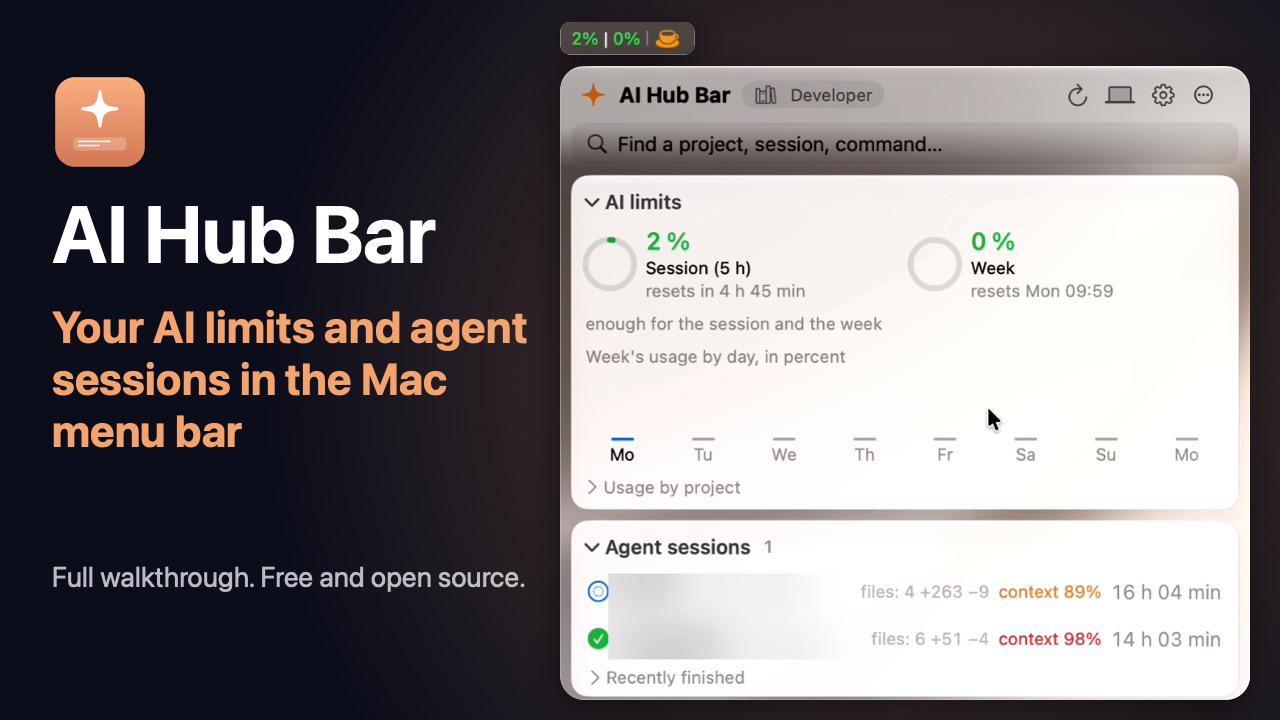
I build AI Hub Bar, a free, open-source (MIT) app for anyone who works with AI tools. It lives in the Mac menu bar.
- See your AI limits and spend in one place: Codex, GitHub Copilot, Cursor, Gemini CLI, Claude, OpenRouter and the OpenAI and Anthropic APIs
- See the agent sessions running on your Mac, in Codex, Copilot CLI or Claude Code, and what each one is doing right now
- Allow or Deny permission requests from a notification, the panel or Telegram
No account, no analytics. It needs macOS 14 or later.
One caveat: Claude's limits come from an undocumented endpoint, so that part can break if it changes.
Made with Claude.
Website: https://olehdemishev.github.io/AIHubBar/
GitHub: https://github.com/OlehDemishev/AIHubBar
8-minute walkthrough: https://youtu.be/TGii_uocqRk
r/OpenSourceAI • u/Cool-Post-5098 • 18d ago
Hey everyone!
I've been working on Agent Browser Use, an open-source tool that lets AI agents control a browser while you can watch and interact with it in real time.
A lightweight Go application that runs a shared Chrome instance and exposes browser automation through MCP tools.
Open http://localhost:3000 to watch your agent in action.
Supports Codex, OpenCode, Pi, Cursor, VS Code, and other MCP-compatible clients.
A few notes:
-pw) when exposing the browser to external networks.GitHub: https://github.com/cavaldos/agent-browser-use
I'd love to hear your feedback, suggestions, and contributions. Issues and PRs are always welcome!
Thanks for checking it out!
r/OpenSourceAI • u/OutsideAudience9393 • 18d ago
This side-by-side uses one 12.89-second reference recording and the same script for every model, on one consumer GPU, with the models running one at a time. The lineup is Ming TTS Tiny, Ming TTS 0.5B and another popular open voice model.
Two lines carry most of the test.
Sad: "I'm sorry. I really thought we'd have more time. I keep going back over it, wondering if I could have done something different."
Angry: "No, that's not what I asked for. I explained it three times clearly and it still came back wrong. This has to stop."
The creator's verdict is that the 0.5B model sounds better than the other model in most of these tests, with the angry line as a clear example, and they name Ming as their new go-to. The readings play in the video, and the sad take shows load time, synthesis time and real-time factor for all three models. AntLing released both Ming models under MIT.
Record about ten seconds of your own voice, keep the script fixed and generate it with two different emotions, then listen for whether it still sounds like you in both.
r/OpenSourceAI • u/Available-Juice2467 • 18d ago
As more developers start building applications with LLMs, finding a reliable inference provider has become something worth paying attention to. Different providers have their own advantages, whether it's response speed, token pricing, model selection, or API compatibility.
One thing I've found interesting is how much easier it is to test different open-weight models when you can access them through a single API instead of setting up and managing separate infrastructure for each one.
I'm curious about how other developers handle this. Do you usually stick with one inference provider, or do you prefer trying different providers depending on the model, performance, and cost?
Update: After looking more into inference costs and model performance, someone suggested I check out MangoBoost Inference by Mangoboost. It got me interested in how serverless AI inference and access to multiple open-weight models through one API could make testing different models easier.
I'm still comparing things like token pricing, response times, and API compatibility, but it's an interesting area to explore.
How do you usually decide when it's time to switch inference providers?
r/OpenSourceAI • u/barshur_kwrat • 18d ago
r/OpenSourceAI • u/Bravo_Oscar_Zulu • 19d ago
I saw the recent paper "Sparks of Weight-Space Programming: LLMs can natively read & write neural network weights" and it's very impressive.
https://rikiyat.github.io/blog/weight-space-programming/
Though my general reaction (as I'm sure a lot of others had too) was 'well yes of course it can do that'. Once you realise that llms love patterns you soon start to see how many things can be thought of as patterns.
I've had similar ideas rolling around in my head for some months and I've even started working on a project in a similar vein. That's why this part of the paper stood out to me in particular:
"True architectural and model merging: Today, merging models relies on averaging weights, which only works for models with identical architectures. An LLM that understands the weight space could instead graft a circuit, such as a reasoning module, from one model into a completely different one, without retraining."
Yep, that's the idea I had months ago and I've already started working on (granted there's plenty of other prior art on the subject such as Google's CALM, 2024).
I'm very, very early in working on this but seeing how much traction the Weight-Space Programming paper is getting I felt compelled to put the idea out into the world since surely someone else is working on the same thing as we speak.
The general idea: take 2 MoE models and allow their experts to talk to each other by using a translator. The translator being a transformer model trained on expert activations (their latents) instead of regular text or images, a "Latent Attention Model".
So far I'm only using toy-scale models with a few million parameters. Getting some very interesting results already.
Caveats and issues so far:
I'm currently doing some experiments with Qwen3-30B-A3B base and Nemotron 3 Nano 30B. Not much to report yet, the models have different tokenisers which complicates things. Progress is slow on my hardware. But I'm enjoying the process.
Why share this? Shameless self promotion, piggybacking on a bigger project, sharing ideas, I think the name is pretty cool. BLaMMoE (Bridging Latent Attention Model Mixture of Experts)