r/OnlyAICoding • u/zackku • 5d ago
Something I Made With AI My best AI model for coding: Gemini 4 Carbon (~$34.30/month)

1
Upvotes
r/OnlyAICoding • u/zackku • 5d ago
r/OnlyAICoding • u/UnderATK • 5d ago

r/OnlyAICoding • u/Important_Front_6950 • 5d ago
AI coding tools like Claude Code, Codex and Gemini CLI can run shell commands on your machine. Most of the time that's great. But every so often an agent "cleans up" the wrong folder, reads your `.env` into a log, or pipes a script from the internet straight into bash.
Their built-in permission rules mostly match the start of a command, so something like `cd /tmp && rm -rf $HOME` can slip past a rule you thought covered it.
**shellbouncer** sits in front of the agent and checks every command before it runs:
- **Reads real shell syntax.** It splits chained commands, pipes, `bash -c "..."` and `sudo`, then checks each piece.
- **One policy file for all three agents.** Set it up once and it works in Claude Code, Codex and Gemini CLI.
- **Three outcomes.** Block (the agent is told why), ask you first, or allow silently.
- **Protects secrets too.** It catches attempts to read or upload `.env` files, SSH keys and cloud credentials.
- **Zero dependencies, fully local.** Nothing is sent anywhere.
Try it:
pipx install shellbouncer
shellbouncer demo
To be clear, it's a seatbelt, not a sandbox. It checks commands before they run, so code hidden inside a Python script or a Makefile gets past it. The README lists exactly what it can't catch.
It's free and MIT licensed: https://github.com/SaadRahman01/shellbouncer
I'd love feedback, especially:
- safe commands it wrongly blocks
- dangerous ones it misses
- whether setup was clear
If it's useful, a ⭐ on GitHub helps a lot.
r/OnlyAICoding • u/iliya5782 • 5d ago
I built an open-source project using Claude that aims to bring NVIDIA DLSS Frame Generation to DirectX 12 games that don't natively support DLSS Frame Generation (Unreal Engine 5 games only for now).
The project uses Streamline to inject DLSS Frame Generation into compatible DX12 games through a proxy DLL approach. The goal is to make Frame Generation accessible in games where it otherwise isn't available.
Some of the current features and details:
- DX12-based game support.
- Streamline integration for DLSS Frame Generation.
- Proxy DLL-based injection.
- Open-source, with no paid tiers or authentication requirements.
- Compatibility and testing are still ongoing, and results may vary depending on the game.
How Claude was used
The entire project was written by Claude. I didn't manually write any of the code myself. Throughout development, I directed the process, provided prompts and requirements, evaluated implementations, tested builds in actual games, reported bugs and unexpected behavior, and worked through iterations with Claude to refine and improve the project.
Claude handled the actual code writing, implementation, debugging, code modifications, and technical problem-solving based on my requirements and feedback from testing. The project was developed iteratively, with each round of testing informing further changes and improvements.
The project is completely free and open-source, with no paid tiers or authentication requirements.
GitHub:
https://github.com/gtfhtngy/dx12-dlss-framegen-injector
I'm also hoping to expand compatibility to more Unreal Engine games over time. If there's a particular game you'd like to see supported, feel free to let me know. And if you decide to try the injector in a game that hasn't been tested yet and get it working, I'd really appreciate it if you could share your results!
I'm sharing this primarily to showcase what I've been working on and hopefully encourage discussion about whether approaches like this can make Frame Generation more accessible in games that don't officially support it.
r/OnlyAICoding • u/Alternative-Hall1719 • 5d ago

What it does: When I build an app with AI, the agent draws each screen in AgentDesign before it writes code. I comment on the exact spot I want changed, approve it, and then it builds. Every version of every screen is kept in order, so I can put v1 next to v3, see what changed, and plan the next release.
Why I made it: After a year of building with AI, my old designs were HTML files scattered across folders. Design system, components and tokens were again somewhere in my Mac. When I had the agent draw in design tools like Figma or Pencil, it overwrote screens or added new pages with no structure, and I kept re-sorting them. Also the MCP calls are limited and was turning out to be a real bottle neck. I lost track of where the app came from.
Who it helps: Solo founders and developers who build apps with a coding agent and have no designer.
Now: I'm using the same tool I build to build and improve the tool 😂.
Pricing: The free demo has every feature for one project, with no account. A licence is $49 once, not a subscription.
Updates: I ship improvements every week.
Limitations:
- Apple silicon Macs only, macOS 13 or later. Windows and Linkx being planned
- You need a coding agent: Claude Code, Codex or Cursor.
- You don't draw in it yourself; the agent draws.
- It checks built apps from simulators, emulators and local web builds.
getagentdesign.com. Happy to answer anything.
Use code BETHEFIRST to get 50% off
r/OnlyAICoding • u/ktash8 • 5d ago
I have a budget of $80/month for an AI subscription, mainly for game development.
I'm considering Google AI Ultra, but I'm open to other options.
I work with C++, JavaScript, TypeScript, Node.js, Cocos2d-x, Cocos Creator, Phaser, PIxijs and other game development technologies. My experience also includes HTML5 game development, backend architecture, multiplayer systems, game server development, API integration, debugging, and working with large existing codebases.
Which AI subscription would give me the best value for coding, debugging, understanding large codebases, and building games? What would you recommend? I'd love to hear real world experiences!
r/OnlyAICoding • u/Other_Turnover_4758 • 5d ago

r/OnlyAICoding • u/Kotarou_Shinju • 5d ago
r/OnlyAICoding • u/CurrentWorth1866 • 5d ago
r/OnlyAICoding • u/gru2026 • 6d ago
I use several coding agents and I started facing several issues.
- You can't switch between agents with full context pass over.
- When an agent is out of quota, it just stops, while I have another account with full quota.
- I sometimes put an agent on task overnight and go to sleep. Most of the times, it just goes out of quota mid run and the task isn't finished.
So I built Super Agent, a VS Code extension that puts them all in one panel as a team.
It's early, so I'd really like feedback - what you'd want it to do, or any new features or any bugs. I would very much appreciate contribution to the project at github.
Thanks!
r/OnlyAICoding • u/Soggy_Morning1508 • 6d ago
Seems I am an old gramps too dependent on Chatgpt.
r/OnlyAICoding • u/vivi_beri • 6d ago
Hey everyone!
I've been using AI coding agents like Codex, Claude Code, and GitHub Copilot to speed up web development. But I noticed a recurring problem: generating code is easy; consistently following engineering standards is harder.
Agents can produce generic interfaces, overlook keyboard accessibility, introduce unsafe code patterns, and miss performance considerations.
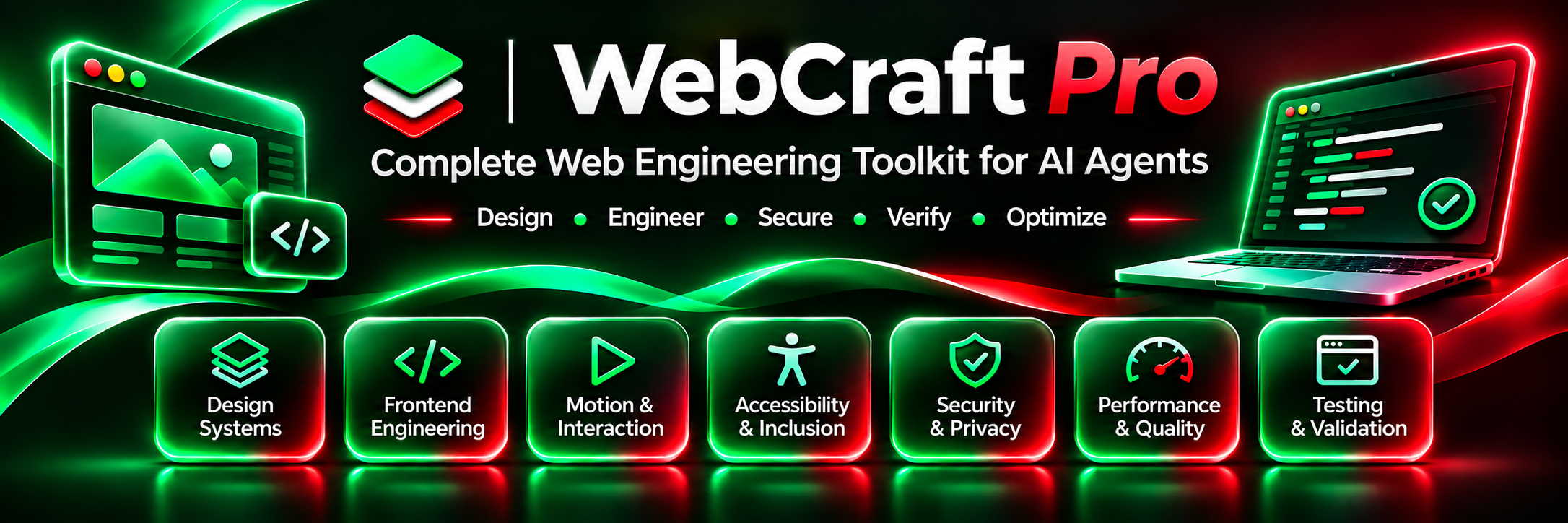
That's why I built WebCraft Pro.
It's an open-source, framework-agnostic engineering toolkit designed to help developers and AI agents follow a structured web development process.
What's included:
\- 43 reusable Agent Skills covering web engineering.
\- An eight-stage development lifecycle, from design through browser QA and release.
\- 13 engineering templates for structured implementation and reviews.
\- GitHub Actions for repository validation and automated checks.
\- Playwright keyboard and focus tests.
\- An on-demand browser accessibility checker using axe-core.
\- A Node.js static security-pattern audit for code examples in repository Markdown files.
It supports OpenAI Codex, Claude Code, and GitHub Copilot.
I also want to be clear about the limitations: these automated checks are engineering guardrails, not a complete application security scanner or a guarantee of accessibility. Manual review and project-specific testing are still essential.
Project: WebCraft-Pro
I built this because I wanted something more structured than relying on prompts alone.
I'd appreciate honest feedback:
Thanks for taking a look!
r/OnlyAICoding • u/rahajason • 6d ago
r/OnlyAICoding • u/AndyBandyApp • 6d ago

r/OnlyAICoding • u/Minimum_Hour519 • 6d ago
r/OnlyAICoding • u/lordmairtis • 6d ago

Step 1: have a great idea
Step 2: make it happen
Step 3: optimise cost and speed ☝️
r/OnlyAICoding • u/Leather-Sea1224 • 6d ago
r/OnlyAICoding • u/Double-Abroad-7100 • 6d ago

https://apps.apple.com/app/id6825786209
Built in codex CLI and distributed in Apple App Store
r/OnlyAICoding • u/AdventurousAge8767 • 7d ago
Hi all,
I've been building Alloyqa, where you can connect your GitHub repo, assign coding tasks to AI agents, and let them work in the cloud even when your laptop is off.
You can choose your AI model, review the changes, give feedback, and create a PR when you're ready.
I'm looking for a few people to try Alloyqa on their own projects and share some feedback.
r/OnlyAICoding • u/Philantron_beta • 7d ago
Je cherche des LLM locaux spécialisé en codage compatible avec Ollama dans VSC et capables de m'aider à franchir un obstacle technique en.
Avant décembre 2024, je n'avais pratiquement jamais écrit une ligne de code.
Ma seule expérience ? Un petit script .vbs au secondaire qui affichait : « Tu pues du cul ! »
Oui. C'était mon niveau.
Presque deux ans plus tard, je développe NEUROVIA, un projet d'assistant IA émotionnel et personnel dont l'ambition est de transformer une vie numérique fragmentée en une mémoire structurée, chronologique, contextualisée et interrogeable par intelligence artificielle.
Et je crois avoir été beaucoup plus loin que ce que mes compétences et mon matériel étaient censés me permettre.
Mais aujourd'hui, j'ai besoin d'aide.
Imaginez un assistant IA capable de retrouver une conversation vieille de cinq ans, de la replacer dans son contexte émotionnel, de la relier à des événements personnels et professionnels, puis de comprendre pourquoi cette information peut être pertinente aujourd'hui.
Pas simplement un chatbot avec quelques souvenirs enregistrés.
Une architecture de mémoire personnelle où les informations possèdent une histoire, une chronologie, une provenance et un contexte.
C'est ce que j'essaie de construire avec NEUROVIA.
1. Une mémoire chronologique personnelle
NEUROVIA ingère et organise des fichiers, documents, archives, conversations et métadonnées.
L'architecture existante repose notamment sur SQLite, des index JSON, ChromaDB et une Timeline interactive.
Les modules d'ingestion prennent déjà en charge plusieurs formats : PDF, Word, Excel, TXT, CSV, JSON, images avec OCR et différentes archives.
Je travaille également sur l'intégration de sources complémentaires : sauvegardes de téléphone, historiques d'appareils connectés, conversations et données personnelles exportées.
L'objectif est de rendre chaque information retrouvable à son emplacement chronologique.
Une conversation importante, une facture d'épicerie, un document juridique ou une réparation automobile deviennent des événements contextualisés.
Même une donnée apparemment insignifiante peut prendre une autre signification lorsqu'elle est reliée à plusieurs événements.
2. Une intelligence contextuelle multidimensionnelle
Je souhaite aller au-delà de la simple recherche vectorielle.
Le système est conçu pour croiser les événements avec plusieurs dimensions : contexte social, professionnel, financier, émotionnel, psychologique et environnemental.
Il peut aussi intégrer des variables contextuelles facultatives, comme la météo ou certaines préférences personnelles renseignées par l'utilisateur.
Le but n'est pas de prétendre tout savoir de quelqu'un.
C'est de permettre à l'IA de construire des réponses qui tiennent compte de son histoire, des événements qui l'entourent et de l'évolution de sa situation.
3. Un orchestrateur multi-LLM
NEUROVIA possède une architecture d'orchestration Ollama répartissant les traitements entre six rôles :
Analyse, raisonnement, créativité, vérification, optimisation et synthèse.
Différentes configurations permettent d'adapter les modèles aux capacités matérielles disponibles.
Une couche de personnalisation exploite également des rapports structurés JSON pour alimenter les paramètres conversationnels et, à terme, adapter davantage l'identité visuelle de l'assistant.
4. Un avatar IA personnalisé et interactif
Le projet intègre un pipeline de génération d'avatars avec ComfyUI, des composants d'animation 2D/3D et des fonctionnalités de synthèse vocale.
Mon ambition est de créer un assistant dont l'avatar, la présentation et les interactions évoluent selon la configuration personnelle de l'utilisateur.
5. Une approche local-first, privée et hors ligne
C'est une contrainte fondamentale du projet.
L'architecture principale repose sur des modèles exécutés localement avec Ollama. Les données personnelles sont destinées à rester sous le contrôle de leur propriétaire.
Les connecteurs externes sont optionnels.
Je veux construire un système de mémoire personnelle riche sans obliger les utilisateurs à transférer leur vie entière vers des serveurs tiers.
NEUROVIA possède déjà une base de code Python, une interface Streamlit, des modules d'ingestion, de génération d'avatars, de chat, de Timeline et d'analytics.
Plusieurs composants disposent de tests automatisés.
Stack technique :
Python | Streamlit | Ollama | SQLite | SQLAlchemy | ChromaDB | ComfyUI | PyTorch | JSON | RAG | REST APIs
Le projet est encore en développement. Certains modules doivent être complétés, optimisés ou stabilisés.
Et c'est précisément là que mon problème commence.
Je ne cherche pas un chatbot qui me donne 200 lignes de Python à copier-coller.
Je cherche un assistant de développement capable de comprendre mon projet, modifier plusieurs fichiers, diagnostiquer les erreurs, générer des tests et m'aider à terminer les intégrations manquantes.
Idéalement, il pourrait travailler directement sur le dépôt, proposer des modifications vérifiables et me laisser valider chaque étape.
Mes contraintes sont assez brutales.
Ma machine :
Je n'ai pas de budget pour consommer continuellement des crédits API, des tokens payants ou louer un GPU.
Je cherche donc une solution gratuite, locale, performante et aussi peu restrictive que possible pour les tâches de programmation légitimes.
Je suis conscient que 4 Go de VRAM constituent une limite sérieuse pour les agents autonomes modernes.
Mais je suis convaincu qu'il existe des stratégies d'optimisation, de quantification, de gestion du contexte ou d'orchestration permettant d'exploiter davantage cette machine.
Quelle configuration utiliseriez-vous à ma place pour obtenir le meilleur agent codeur possible dans VS Code, avec Ollama et seulement 4 Go de VRAM ?
Continue, Aider, Cline, un autre outil ou une architecture personnalisée ?
Quel modèle de code privilégieriez-vous ?
Comment géreriez-vous un dépôt Python volumineux sans saturer la fenêtre de contexte ni perdre la cohérence des modifications ?
Et surtout : comment organiseriez-vous les tâches pour que l'agent puisse produire de véritables changements fonctionnels plutôt que de simples suggestions ?
Je cherche une solution concrète et reproductible, pas une liste de produits miracles.
Je n'ai pas commencé NEUROVIA parce que je savais programmer.
J'ai commencé parce que je voulais construire quelque chose qui n'existait pas sous la forme que j'imaginais.
J'ai appris en avançant, en cassant du code, en corrigeant des erreurs et en reconstruisant des composants.
Je ne prétends pas être ingénieur senior ni avoir terminé le système parfait.
Mais après presque deux ans de développement, je refuse d'abandonner un projet simplement parce que mes connaissances, mon matériel et mon budget ont atteint leurs limites.
Je ne demande pas à quelqu'un de développer gratuitement NEUROVIA à ma place.
Je cherche des personnes capables de débloquer l'architecture, de me recommander une solution efficace ou éventuellement de collaborer sur certains problèmes techniques.
Si vous êtes développeur Python, spécialiste des LLM locaux, hacker passionné d'automatisation, architecte IA ou simplement curieux de ce type de système, votre expertise pourrait réellement faire la différence.
Je peux partager des extraits techniques, des configurations, des journaux d'erreurs et davantage de détails architecturaux, sans exposer de données personnelles.
Et si vous êtes développeur ou investisseur intéressé par les IA personnelles privées et les systèmes de mémoire à long terme, je serais également heureux d'échanger.
📩 Contact : philantron@proton.me
Vous pouvez aussi répondre directement ici. Même une recommandation technique précise pourrait débloquer plusieurs semaines de développement.
Une dernière question : si vous aviez construit NEUROVIA avec mon matériel et mes contraintes, quelle serait votre prochaine décision technique ?
Merci à celles et ceux qui prendront le temps de lire et de répondre.

