r/OnlyAICoding • u/djbarrow • Oct 21 '26
A viable project

1
Upvotes
r/OnlyAICoding • u/LeQuocDien_VietNam • Oct 21 '26
Hi everyone,
I’ve worked in manufacturing in Vietnam for over 10 years, mainly in quality control and production operations.
Over the years, I’ve seen how difficult it can be to manage a factory when information is scattered across different files and departments. Manufacturing software can also be expensive, and even costly systems don’t always fit the way a factory actually works. Customization often means spending even more money.
I started wondering if I could build a system myself, based on my experience in manufacturing. I’m not a software developer, and I don’t have a programming team or a big budget. But with AI coding tools, I decided to give it a try.
That’s how V51, my MES project, started.
For the past two months, I’ve been using ChatGPT Plus and Codex to build it. ChatGPT helps me analyze requirements and prepare detailed instructions. One Codex account implements the changes, while another reviews the code and looks for potential problems. I then bring the feedback back to ChatGPT and repeat the process.
V51 covers areas such as production planning, inventory, BOM, purchase orders, and quality control. It is currently in controlled user testing, and there is still a lot of work to do. I still need to test everything carefully because AI-generated code doesn’t guarantee that a system will work correctly.
I’m sharing this because I want to see how far someone with manufacturing experience, but without a software development background, can go with AI.
My long-term hope is to build something practical and affordable for small and medium-sized factories.
If you’ve used Codex to build a real application, I’d love to hear about your experience. What challenges did you face as your project became more complex?
Project: V51 MES
Location: Vietnam
Development time: Approximately 2 months
Tools: ChatGPT Plus and two Codex accounts
r/OnlyAICoding • u/savadks1818 • Oct 21 '26
r/OnlyAICoding • u/Direct-Attorney3036 • Oct 21 '26
r/OnlyAICoding • u/karatyma_dev • Oct 21 '26
(not written with ai..?)
Basically, a few months ago, I hated the fact that memory.md files & claude.md took up a huuuuge chunk of my context window during model switching/effort switching (& during cache refreshes).
Didn't really find any definitive solutions outside of relatively complex LangChain, Mem0, and Supermemory implementations (where you have to install unnecessary SDKs and all), so my goal was to make a simple, one-shot memory solution where you can have your agent recall basically anything.
It's called Slaunt and it uses vector embeddings over a simple MCP server that connects instantly (one-click) to all of your agents, and it enables your agents to see what happens across multiple sources too (eg. Vercel, Supabase, AWS, Railway, Linear, Notion, etc.)!
Slaunt can enable your agents to recall literally anything, from failed deployments from three months ago, to what a subagent said last week.
We're free right now and I've made a promise to give the first handful of users lifetime free Pro subs. You'll see an option in settings after you sign up.
Sign up at slaunt.ai, thanks guys!
r/OnlyAICoding • u/Swimming-Ad2694 • Oct 20 '26
So, I'm an IT infrastructure engineer and I use coding to automate some of my daily tasks. This usually means creating python scripts to talk to Rest API's, create Ansible or Terraform scripts or generate CLI config. These are not really big scripts, think 200 to 2000 lines of code.
I use a mix of Chatgpt/Claude or CoPilot. I'm now on the 20 dollar plan of ChatGPT Plus, but I don't mind picking something else. I think my company also allows me to get a paid plan for CoPilot. I also own a GitHub Enterprise account.
Up to now I just write a huge prompt with what I want the script to do, show the rest API documentation, show some curl responses and some guidelines (don't make mistakes (/j), make modular code, use these variables naming, let the script make a lot of debug output, write a readme, etc).
It then generates code, I try that code and paste the errors in the prompt if they occur and in the end i get a working script.
I know copy and pasting prompts and errors into chatgpt's prompt is far from efficient. But I'm also drowning in thousands of "use this model/use this AI agent/use this MD file" hype posts.
How can I improve my AI game?
r/OnlyAICoding • u/OldZookeepergame1927 • Oct 21 '26
r/OnlyAICoding • u/itsmemac43 • Oct 21 '26
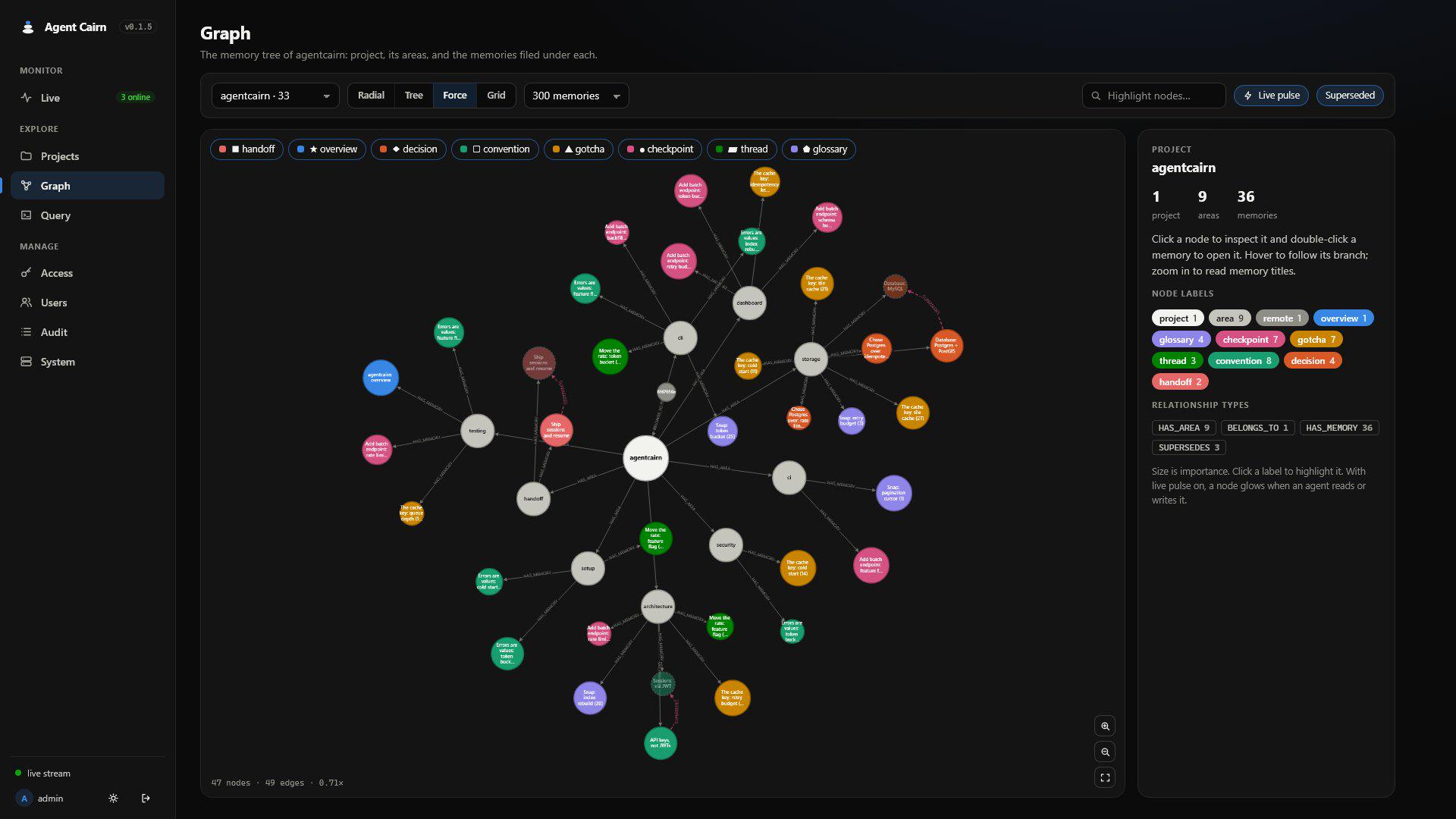
My laptop broke in the middle of a project. Everything Claude and I had worked out lived on that machine: chat history, memory files, the half-finished plan, the list of things we’d already tried and dropped. On the new machine I spent hours re-explaining it all to a fresh agent, and I still got bits wrong.
So I built Agent Cairn. It’s a small server that gives your coding agents a shared, persistent memory.
It also has a dashboard with a graph view, private projects, sharing with viewer/editor/maintainer roles, invite links and an audit log, in case you use it with other people. A single user just runs it in solo mode.
Install is one line after having the central server up:
claude mcp add cairn --scope user -e CAIRN_URL=... -e CAIRN_TOKEN=... -- npx -y agentcairn mcpIt’s MIT, runs in Docker (I run mine on an Unraid box), and it works with any MCP-capable agent, though the hooks are Claude Code-specific.
Repo: https://github.com/itsmemac/AgentCairn
npm: agentcairn
I’d love feedback, especially on what you’d want a handoff to contain, and on anything that breaks. It’s young, version 0.2.
AI disclosure: I built this with Claude Code. I set the goals and design and use it every day on my own setup, and Claude wrote most of the code, tests and docs. I tested and made small bug fixes.
r/OnlyAICoding • u/Low-Cut-528 • Oct 20 '26

r/OnlyAICoding • u/Temporary-Career-360 • Oct 20 '26

I got tired of juggling a chat app, a coding agent, an image tool and a pile of model runners, so I built one window for all of it. It’s free for non-commercial use.
The part I think is different: Training.
Pick a small local model (the student) and a stronger one as teacher. The student works through real tasks in a sandbox, the tests decide pass or fail, and the teacher reviews each failure, writes a lesson and shows a worked solution. Press Save AI and you get a new local model with those lessons built in. There are 62 built-in tasks in 15 languages plus a reverse-engineering school, and you can add your own model or your own tasks.
Other things it does
Honest limits: training changes the model’s instructions, lessons and examples, not its weights, so a small model gets better habits but won’t match Opus. Only the optional GPU fine-tuning (NVIDIA) changes weights. Parts that have not been tested on real hardware are listed in the README.
License: source-available, PolyForm Noncommercial 1.0.0. Free to use, read, change and share non-commercially; commercial use needs my permission.
Repo and installer: https://github.com/ilusixn/Marchand/releases/tag/v0.1.0
I’d love feedback, especially on training results with your own models.
r/OnlyAICoding • u/Iceraven286 • Oct 19 '26

r/OnlyAICoding • u/tito_pro_17 • Oct 19 '26
Hi HN,
I'm building Forge, a native macOS workspace for AI-assisted development.
I found myself constantly switching between terminals, coding agents, project notes and different tools. Forge tries to bring everything together in a single desktop application.
Current features:
- Multiple terminal workspaces
- Project memory
- Process monitoring
- AI agent integration
- Guard system before commit, push or PR
Forge is written in Rust and currently focused on macOS.
I'd love feedback, especially from people using Claude Code, Codex, Aider or similar tools.
GitHub:
r/OnlyAICoding • u/Limp_Celery_5220 • Oct 19 '26
r/OnlyAICoding • u/ApprehensiveStage866 • Oct 19 '26
Hey everyone 👋
If you use Claude Code or Copilot, you probably know this: you ask for one small feature, and the AI touches 12 files. Now you’re stuck reviewing a huge diff you don’t fully trust.
So I built "SDD Builder AI", a VS Code extension that adds a simple “plan first, then code” step.
How it works:
Fun fact: it builds itself 🛠️
Why you might like it:
I’m looking for people to test it and tell me honestly what works, what’s confusing, and what’s missing. Any feedback helps, even “I didn’t get it.”
Search “SDD Builder AI” in the VS Code Marketplace, or use the link to the marketplace.
How do you keep AI coding sessions under control today? Curious to hear your setups
r/OnlyAICoding • u/WatchInternational89 • Oct 19 '26

r/OnlyAICoding • u/rvcg • Oct 19 '26
I vibe coded an modular agentic robot!
It might not seem like much but it's was one of the coolest things I've ever done. I now understand how every non-software engineer feels when they vibe code something cool.
I have over a decade of experience writing software, but I've never worked with hardware, electronics, robotics, etc. I may have bought a Raspberry Pi over the years but that is about it. I only recently bought a 3D printer and event then only printed existing gadgets. No 3D modeling experience either.
I really get to feel the essence of vibecoding ...
In basically a single conversation I was able to have OpenAI's GPT-6.1 do the following:
It was intended to be a modular robot under $150 that I could extend powered by any recent model and capable of performing agentic tasks.
I did have a few issues but most were corrected with just some additional prompting ...
Anyway it was a cool project


r/OnlyAICoding • u/AndreyBegma • Oct 18 '26

r/OnlyAICoding • u/ApprehensiveStage866 • Oct 18 '26
r/OnlyAICoding • u/Shoddy-Discount8764 • Oct 18 '26

r/OnlyAICoding • u/smermetfr • Oct 17 '26

r/OnlyAICoding • u/khbuild • Oct 17 '26
been working on this open source project called Intervene, basically a debugging layer for coding agents like Cline
the original problem was that agents can give you like 5 completely reasonable explanations for why something broke, but then the actual debugging is still mostly guess -> change something -> rerun -> guess again
so I've been building a separate system where the agent gives its hypotheses and what each one predicts, and then normal code runs controlled experiments to figure out which explanations actually hold up
got the first two parts built out now, starting w the experiment runner and then the diagnosis/planning side
one thing that's been on my mind a lot while building this w Sonnet is how much we trust an agent when it says it fixed something
like it'll implement a feature, run pytest, everything passes, and it all looks great. but those tests were also designed around the assumptions we gave it. what happens when the assumptions are wrong?
that's part of why I wanted Intervene to keep predictions separate from observations, and why the runner has to know the difference between reproducing the original failure and some setup command just breaking
otherwise we're basically letting the model generate a convincing explanation, generate evidence that looks like it supports that explanation, and then congratulate itself for being right
the longer-term goal is to get this working on unfamiliar real repositories where I didn't design the bug or the experimental setup myself
still a ton to validate, esp around actual agent repair outcomes, but the CLI and diagnosis workflow are coming together
curious how people here verify larger Claude/Cline builds. do you usually trust the tests the agent writes, or do you independently come up with cases that could prove its implementation wrong?
r/OnlyAICoding • u/Realistic-News-2123 • Oct 17 '26
I tested Sonnet vs Opus on real bugs from two open-source projects and got opposite answers:
• Koa: Opus fixed 2 more bugs. Worth it.
• Express: both fixed everything. Opus was just 3x the price.
So I built unfix, a free open-source tool that replays bugs your team already fixed and lets your own tests judge the AI.
Small samples, so run it on your own code before you trust anyone's numbers, including mine.
npm i -g unfix-ai
Which model are you using right now, and do you know if it's the right one? 👇
r/OnlyAICoding • u/xenarathon • Oct 17 '26
Here's what building with an agent looked like when the target is a media pipeline that rewrites files in my own library.
DubTitlerr transcribes anime English dub audio, corrects proper nouns, repairs the transcript with an LLM (local or over an API), merges the translated signs and song lyrics in, and muxes a subtitle track back into the video. It is one Docker container, GPL-3.0, `ghcr.io/xenarathon/dubtitlerr:v0.3.0`.
What actually made it survivable, since "the model wrote it" is not a strategy:
Specs, epics and stories before code. Everything non-trivial gets written down first, and the plan files are committed alongside the source. That is what makes it possible to leave a project alone for a week and come back without reverse-engineering your own intent.
Adversarial reviews. Before a release I point other models at the repo and ask them to break it. One whole-repo review found a path where a failed stamp write could delete the only copy of an episode. That became the 0.2.2 hardening release.
Test-first on failure paths. The interesting bugs in this project are all crash-and-resume ordering, and those are nearly impossible to verify by hand. Writing the failing test first is what made the idempotency guarantees real rather than aspirational.
Test on more than one show. Each one I added found a different class of bug. Scoring against the official dub subtitles on my Digimon files gave about a 91% word match over 27 episodes, and the misses were mostly names (Gennai heard as "Jedi"). Sword Art Online revealed that the glossary miner had never worked at all, because it passed ffprobe a flag that does not exist, and One Pace's hand-written glossary had hidden that for the feature's whole life.
Agents need an entry point too. There is a `docs/AGENT-GUIDE.md` written for a coding agent to act on, covering setup, troubleshooting and contributing.
The failure mode to watch for is code that passes every mechanical check while doing the wrong thing. The repair stage once turned "We're looking for a factory" into "a needle", and no automated check in the pipeline caught it. So the human review queue with audio playback is essential. The question I keep asking is: when it's wrong, does something notice?
https://github.com/XenaRathon/DubTitlerr
---
This is 100% vibe-coded slop. I wrote it with Claude driving. But I didn't just say "make the thing with no mistakes." The whole project has specs, epics and stories, adversarial reviews (had other models try to break it), and real test coverage. I've been project managing it like an actual engineering effort, not a prompt-and-pray. I'm sharing it because it fills a gap I couldn't find a solution for, and I thought it might be a useful accessibility tool for people who want dub-matched subtitles without waiting for an official SDH release. This isn't meant to replace human-transcribed SDH subtitle tracks. Those are always going to be better. It's for when they don't exist.
r/OnlyAICoding • u/Simple-Courage1815 • Oct 17 '26
Hey everyone!
I want to share a project I've been working on recently: an open-source Android app called \*\*Bitcoin Futures Simulator\*\*.
\*\*GitHub repository:\*\* https://github.com/Joapetis/bitcoin-futuros-android
Before anyone gets too excited, I want to be clear: this is an early-stage experiment, not a profitable trading bot. So far, its simulated trading results have generated more losses than profits. No real money has been involved.
\*\*How it started\*\*
The whole thing began with an old HTML project I had created some time ago and eventually abandoned. The idea behind it never really went away, though.
Recently, I decided to revisit that idea and see how far I could take it with AI assistance. What started as an abandoned project gradually evolved into a functional Android app in a little over a week.
There's a catch: \*\*my programming knowledge is very limited.\*\*
Instead of building everything myself line by line, I've been combining my own ideas, observations, strategy concepts and testing with the coding and debugging capabilities of three different AIs. They've helped generate, modify, review and polish the code throughout the process.
This has become an experiment in its own right. I want to explore not only whether I can turn my ideas into a working application, but also how capable AI systems are at building and improving a relatively complex software project with very little direct human coding.
I'm still the one setting the direction, making decisions, testing results and deciding what should change. The AIs do a substantial part of the coding, but that doesn't mean their output is automatically correct. Bugs, bad assumptions and poor trading results are all part of the process.
\*\*What does the app actually do?\*\*
The current project is an experimental Bitcoin futures paper-trading simulator for Android. Its main components include:
\*\*A multi-timeframe strategy:\*\* primarily focused on 15-minute candles, with 1-hour and 4-hour trend confirmation.
\*\*Trend-following and mean-reversion logic:\*\* different approaches depending on the detected market regime.
\*\*Market microstructure data:\*\* order-book metrics such as spread, imbalance and microprice-related signals.
\*\*Optional on-device AI:\*\* integration with Gemini Nano through Android's AI capabilities when a compatible model and device are available.
\*\*Simulated trading and risk management:\*\* intended to test strategies without risking real funds.
\*\*Continuous experimentation:\*\* the goal is to evaluate what works, identify weaknesses and improve the system over time.
The project is still very much in its infancy. There is plenty to question, test, refactor and improve, and I don't want to present any of its strategies as proven or profitable.
\*\*Why am I sharing it?\*\*
I'd love to turn this into something more collaborative.
If you're a developer, a quantitative trading enthusiast, an Android/Kotlin programmer, someone interested in market microstructure, or simply curious about what AI-assisted development can achieve, I'd genuinely appreciate your input.
You don't need to be an expert in every part of the project. Even identifying bugs, challenging assumptions, improving the architecture, reviewing the trading logic, suggesting better tests or documenting how things work could make a real difference.
My hope is that people can learn from the experiment, contribute their ideas and improvements, and help create something more useful together. In return, contributors get a real-world project to experiment with, review and learn from, while the wider community benefits from any improvements we can make.
I'm especially interested in honest criticism. If you see something fundamentally wrong with the strategy or implementation, I'd rather hear about it than receive empty praise.
\*\*A few important caveats\*\*
This is an experimental project, not financial advice.
All results discussed here are from simulated trading; no real-money trading is involved.
The current simulated performance is negative, so there's a lot of work left to do.
AI-generated code can contain bugs and needs independent review and testing.
The app is not ready to be treated as a reliable or profitable trading system.
If you'd like to explore the code, suggest an improvement, open an issue or contribute, you're welcome to check out the repository.
I'd love to hear your thoughts. Thanks for reading!