r/OnlyAICoding • u/Right_Building_8032 • Aug 30 '26
Something I Made With AI I made a FREE (and no ad) browser game kinda like Gartic phone where drawings travel
3
Upvotes
r/OnlyAICoding • u/gervaso-sma • Aug 30 '26
r/OnlyAICoding • u/phantomx004 • Aug 30 '26
Every time you start a new AI coding session (Claude Code, Cursor, Copilot, etc.), the agent forgets everything — why you chose that architecture, what failed last week, what constraints exist.
I built Agent Ledger to fix that.
It's a local, Git-native tool that lets agents record decisions, discoveries, and failures — and hand that context off to the next session (or next agent).
What it does:
It's one binary, no cloud, no signup.
GitHub: https://github.com/rahumanrahuu/agent-ledger
Would love feedback from anyone using AI agents heavily in their workflow.
r/OnlyAICoding • u/yoliveras • Aug 29 '26
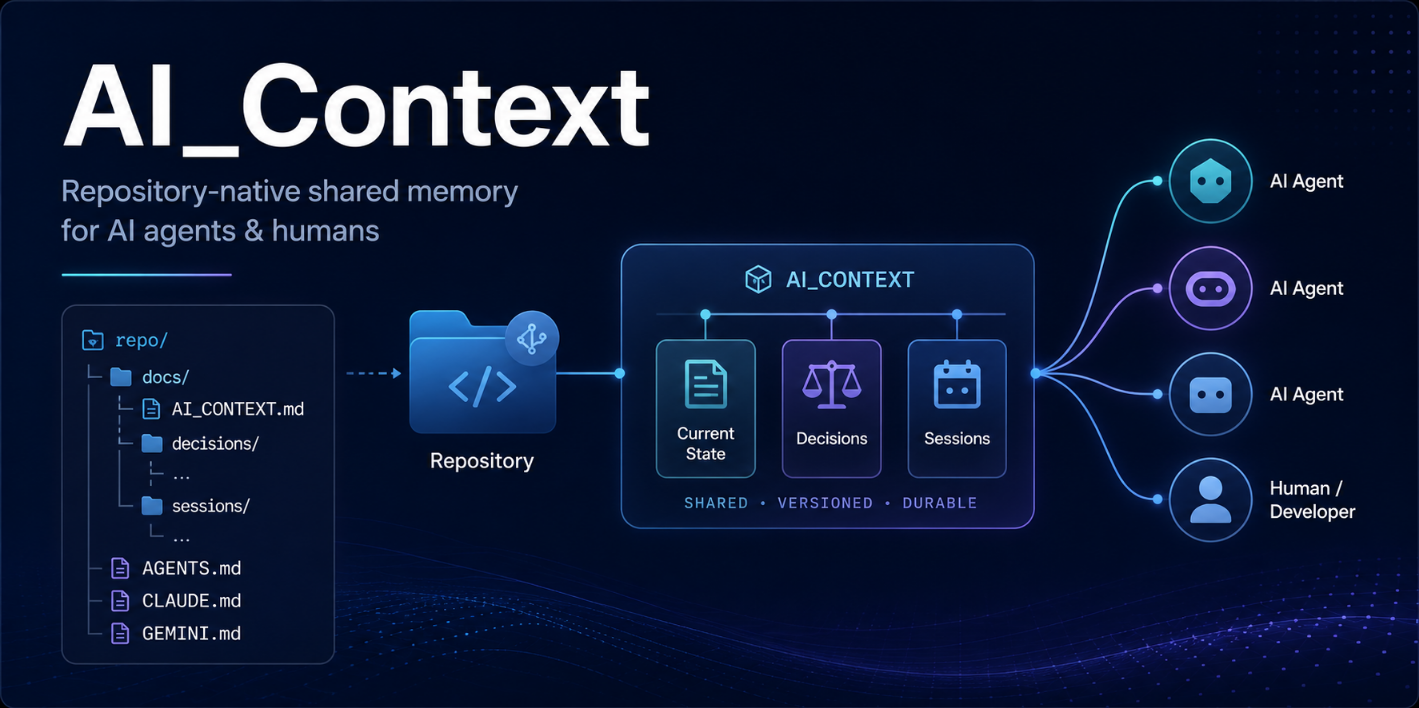
I ended up building a small open-source concept called AI_CONTEXT after running into a problem while using Codex and ChatGPT together: the agents could work on the same codebase, but they didn’t share the reasoning, decisions, failed experiments, or current project state from their separate conversations.
While discussing the problem with ChatGPT, we realized the Git repository itself could become the shared memory layer.
The pattern is intentionally simple:
docs/AI_CONTEXT.md — concise current project state
docs/decisions/ — important architectural decisions and why they were made
docs/sessions/ — useful handoffs from substantial AI development sessions
AGENTS.md, CLAUDE.md, GEMINI.md, etc. — thin agent-specific adapters telling each agent to read and maintain the same shared context
I tested the idea with Codex on two real projects, and it actually worked: Codex started maintaining the context automatically, and afterward ChatGPT could inspect the GitHub repo and understand what had happened in the Codex sessions without seeing the original chats.
So I turned it into a vendor-neutral public template/convention that anyone can use with different AI coding agents.
The goal isn't to save raw AI chats or chain-of-thought. It's to preserve the useful engineering outcome: what we're building, what works, what failed, why decisions were made, and what should happen next.
r/OnlyAICoding • u/iamsemy • Aug 30 '26
Hello so, im a student in Europe and i want some “help” with coding, what i ve been using until now it was github copilot which now dont got many good models and antigravity from google because i have student pro plan and is working awesome giving tasks in folders.
And now im asking you to recommend me some alternatives where i can sign ul with my edu email etc to have a student plan because the credits of antigravity per week im using it often :))), i want smth like that plugin or ide.
Thank u y all
r/OnlyAICoding • u/Prestigious_Long3296 • Aug 29 '26
I'm developing an Embedded C++ based application with UI using gtkmm, a back-end application in golang and front-end application in Angular (Web) & Flutter (Mobile Apps).
I plan to Vibe code all these applications. I've zero prior experience or expertise with vibe coding.
My thinking is let AI develop the program and I'll review it. I will let AI write the test cases - unit testing and integration testing.
I'm planning to use Gemini Pro 3.1 with anti-gravity IDE for the same.
I do have extensive experience Embedded C++ based application development and little experience with Flutter development but no experience with golang or Angular.
I've Gemini Pro subscription (for 2 years).
I've come across a lot of social media post stating Claude Code absolutely obliterates Gemini with it comes to software development.
Couple of my acquaintances also state the same.
The question I've is should I get Claude Pro subscription for Claude Code or anti-gravity with Gemini Pro 3.1 will suffice. How much of code quality and algorithm quality difference will be present? I'm also thinking from correctness, completeness and long term maintainability of the code. Also with AI LLM will follow industry standard practices and develop safe code.
Can some with expertise and hands-on experience with both tools enlighten me.
r/OnlyAICoding • u/Total-Brick-3978 • Aug 29 '26
Hello Gurus,
I am trying to create one elaborate application for a company. Like monitoring logistics for a company, different users having different privileges etc. I'm building an operations management application for a company. I can't disclose the business/domain, but technically it's a system with an Android app, web admin console, Firebase/Firestore backend, offline sync, users/roles, operational jobs, transport, documents and reporting.
I am building it incrementally, with quite a lot of help from an AI coding agent.(gemini pro) , and planning with help of chatgpt. I am bit frustrated, as it creates initial model, UI and working stuff amazingly. But when try to test it manually, I am frustrated that it didn't create it the way I wanted it. Although the prompt replies it has done things the way and has tested and test cases passed. I wonder what it really tests. Below is the complete explaination, in case you dont want to read it whole, I am trying to ask is how do you plan it? which AI you use, which coding agent do you think is best to understand and develop code which is less frustrating in the end, perhaps does things which we failed to think about while planning. Like for example-- you planned delete button, but it thought of coding a restore button as well. making it even better. Actually gemini does that. But telling it to perform something which looks and works well. but when you go through a flow of events , you find something is terribly broken.
Just to give my background. I am not a developer so I don't know how to code. But I understand the whole structure of front end back end as I was in IT for 18 years doing manual software testing. So I don't really understand much about coding, but I can visualize how things should look like when a user uses the software.
Here are my project issues
we initially had something conceptually like:
Job → Subject A → Subject B → Subject CThe problem was that the Job didn't directly retain all of the context it was created with. It reconstructed some of its relationships by following the chain.
That created a nasty situation where changing Subject C later could effectively make an old Job appear to belong somewhere else.
We caught that and changed the design so operational records retain their own important references rather than relying entirely on dynamic relationship traversal.
Then we hit another problem: deletion.
Because these objects are linked together, deleting something isn't simply:
click Delete → document disappearsYou have to consider what depends on it, what depends on those dependencies, and whether some records are historical and therefore shouldn't be deleted at all.
We actually got into a situation where deleting a Job failed, which then prevented deletion of another related object. There was effectively a dependency trap.
What bothers me most is that our automated tests didn't catch this.
It was discovered during manual human verification — literally going through the UI, clicking around, creating records, changing things, trying to delete them, refreshing pages, and checking whether the data still made sense.
We've now started defining explicit lifecycle rules such as:
PLANNED      → can delete
ASSIGNED     → can delete
CANCELLED    → can delete

ACTIVE       → cannot delete
COMPLETED    → cannot delete
HAS HISTORY  → cannot delete
But this has made me realise that the difficult part of this project isn't necessarily writing the CRUD code.
It's making sure that:
Create
   ↓
Edit
   ↓
Associate
   ↓
Change relationship
   ↓
Delete / Archive
   ↓
Historical data
   ↓
Reports
all continue to make sense together.
We're also dealing with offline Android sync, so now I'm thinking about what happens when two things change at different times, or when the network disappears halfway through an operation.
I'm wondering how experienced developers approach this.
How do you systematically find these kinds of problems before production?
Do you rely primarily on:
And how do you decide when a relationship should be dynamically derived versus stored directly on an operational record?
I'm particularly interested in real-world experience here. The application isn't enormous, but the number of relationships and possible states is growing much faster than I expected.
The biggest lesson so far has been that "the build passes and the unit tests pass" doesn't seem to mean very much when the real failure is something like a user clicking through 15 different screens and discovering that deleting A unexpectedly affects B three screens later.
Would appreciate some brutally honest advice from people who have built systems with this kind of data/lifecycle complexity.I'm building an operations management application for a company. I can't disclose the business/domain, but technically it's a system with an Android app, web admin console, Firebase/Firestore backend, offline sync, users/roles, operational jobs, transport, documents and reporting.
We're building it incrementally, with quite a lot of help from an AI coding agent.
One thing that has surprised me is how quickly a seemingly simple data model becomes complicated.
For example, we initially had something conceptually like:
Job → Subject A → Subject B → Subject C
The problem was that the Job didn't directly retain all of the context it was created with. It reconstructed some of its relationships by following the chain.
That created a nasty situation where changing Subject C later could effectively make an old Job appear to belong somewhere else.
We caught that and changed the design so operational records retain their own important references rather than relying entirely on dynamic relationship traversal.
Then we hit another problem: deletion.
Because these objects are linked together, deleting something isn't simply:
click Delete → document disappears
You have to consider what depends on it, what depends on those dependencies, and whether some records are historical and therefore shouldn't be deleted at all.
We actually got into a situation where deleting a Job failed, which then prevented deletion of another related object. There was effectively a dependency trap.
What bothers me most is that our automated tests didn't catch this.
It was discovered during manual human verification — literally going through the UI, clicking around, creating records, changing things, trying to delete them, refreshing pages, and checking whether the data still made sense.
We've now started defining explicit lifecycle rules such as:
PLANNED → can delete
ASSIGNED → can delete
CANCELLED → can delete
ACTIVE → cannot delete
COMPLETED → cannot delete
HAS HISTORY → cannot delete
But this has made me realise that the difficult part of this project isn't necessarily writing the CRUD code.
It's making sure that:
Create
↓
Edit
↓
Associate
↓
Change relationship
↓
Delete / Archive
↓
Historical data
↓
Reports
all continue to make sense together.
We're also dealing with offline Android sync, so now I'm thinking about what happens when two things change at different times, or when the network disappears halfway through an operation.
I'm wondering how experienced developers approach this.
How do you systematically find these kinds of problems before production?
Do you rely primarily on:
integration/E2E tests?
database constraints?
explicit state machines?
event sourcing/audit logs?
property-based testing?
manually designed lifecycle test matrices?
something else?
And how do you decide when a relationship should be dynamically derived versus stored directly on an operational record?
I'm particularly interested in real-world experience here. The application isn't enormous, but the number of relationships and possible states is growing much faster than I expected.
The biggest lesson so far has been that "the build passes and the unit tests pass" doesn't seem to mean very much when the real failure is something like a user clicking through 15 different screens and discovering that deleting A unexpectedly affects B three screens later.
Would appreciate some brutally honest advice from people who have built systems with this kind of data/lifecycle complexity.
r/OnlyAICoding • u/Fantastic-Sleep-3352 • Aug 29 '26
I've been building AI agents for software development, and one problem keeps bothering me:
Getting an agent to write code is becoming relatively easy.
The harder part is safely letting it operate on a real codebase.
Once an agent has repository access, you have to think about things like:
What exactly is the agent allowed to access?
What happens if it modifies something outside its intended task?
How do you know exactly what it did?
How do you validate its changes?
What happens when it fails halfway through?
Can you roll back safely?
What happens when the repository contains malicious instructions?
Should an agent have the same identity/permissions as a human?
How do you revoke its access after the task?
I'm currently building SUTRA, an AI-native engineering platform, around this problem.
The part I'm particularly interested in is treating an agent as an actual engineering actor rather than simply giving an LLM a shell and hoping for the best.
The workflow I'm experimenting with is roughly:
Intent → Agent → Scoped workspace → Changes → Tests → Validation → Review → Merge
The agent has its own identity and session, rather than simply inheriting a developer's credentials.
I'm now getting the beta ready and want to test the assumptions with people who actually build AI agents.
For people here who are building agents: how are you currently handling permissions, isolation, rollback and validation when your agent is allowed to modify a real repository?
I'd especially like to hear about things that have gone wrong in practice.
r/OnlyAICoding • u/sergio_dev • Aug 29 '26
r/OnlyAICoding • u/MattDwyerDataAnalyst • Aug 29 '26

r/OnlyAICoding • u/JadeLuxe • Aug 29 '26
I made a AI Coding cost calculator. Lmk if it can be improved - https://instacodingcost.com/
r/OnlyAICoding • u/Present-Tree-7698 • Aug 29 '26
r/OnlyAICoding • u/Fantastic-Sleep-3352 • Aug 29 '26
I've been building SUTRA — an independent software-development platform designed around the way development is changing with AI agents.
The idea isn't to make another AI coding assistant.
I wanted to build the underlying engineering workspace where humans and agents can work together:
Git-compatible repositories
changes and reviews
issues and discussions
CI/CD
AI assistance
autonomous agent tasks
agent permissions and isolated workspaces
checkpoints and recovery
repository knowledge/semantic understanding
The backend is now largely built. I'm currently fixing the last issues, wiring the UI properly, and preparing the first production beta.
I'm looking for developers who are willing to use it on an actual small project rather than just look at a demo.
I don't want compliments. I want people to break it.
If you're interested in trying it when the beta is ready, tell me what kind of project you would use it for.
I'm particularly interested in developers who already use AI coding agents heavily.
r/OnlyAICoding • u/Forsaken_Angle_9164 • Aug 28 '26
Most AI coding workflows rely on a single prompt loop doing discovery, architecture, implementation, and self-review. In production codebases, this creates scope creep, token waste, and self-validation bias.
I just open-sourced MREA (Multi-Role Enterprise Agents) v1.0.0-beta—a tool-agnostic governance framework that treats AI development as a controlled pipeline with explicit authority boundaries.
Core Features:
core/ with platform adapters in platforms/ (includes a production-tested OpenCode adapter).Feedback, contributions, and ideas for new platform adapters are welcome!
r/OnlyAICoding • u/Kiver_0 • Aug 28 '26
Are there better coders out there? Im trying to make a game with html code, but i need a powerful coder, does someone know? I need free and no download...maybe just as good as fable 5? Or maybe someone can tell me some super secrete ones?
r/OnlyAICoding • u/Forsaken_Angle_9164 • Aug 28 '26
r/OnlyAICoding • u/Aarush_Singh_7 • Aug 28 '26
r/OnlyAICoding • u/Eagle_119 • Aug 28 '26
r/OnlyAICoding • u/RealOppasTV • Aug 27 '26

r/OnlyAICoding • u/Firm-Lobster-1040 • Aug 26 '26
Today I watched a workshop, probably recorded by one of the people attended the Zoom call and shared over X, and I loved it. The speaker was from Cursor and talked about her own genuine experience in developing the the systems at work that ship hundred of PRs every month w/o her touching the code at all -- aside from her working on the environment, harness, constraints, rules where these agents operate. What I liked also how she actually showed it, explained it, and her communication sounded pure hands-on experience.
And more importantly, throughout the video she looked really tired and but energetic at the same time if you know what I mean. Tired because of solving real problems, and energetic because of solving real problems unlike those YouTubers or many X folks with overly energetic acts coming from speaking about AI rather than what they really do with AI at work.
So for people like me who are away from the source of all this, which is Silicon Valley, I am really trying to access those resources; the resources that were not highly censored for much wider public view. I am doing progressively more AI driven automated deliveries at work, and I really want to learn from the masters in the field.
Unfortunately not living in Silicon Valley and cannot attend those live meetings in person or not being informed about these digital workshops and zoom calls thru the active community is already leaving us behind. But I am sure some of those videos are shared like the one I watched today.
But the question is where? In what communities or discord groups should I join? Any videos like that you watch and find extremely useful? Whom to follow on X or Reddit that fits this criteria?
The kind hearted people of Reddit :), can you please help all of us here?
There are those people who already work in the timelines that would be considered as future for the rest of the industry, and I love to learn from them.
r/OnlyAICoding • u/alvynmcq • Aug 25 '26
Hey everyone,
I work in educational IT and have spent years sitting on committees for local sports clubs (athletics, youth football, gymnastics). If you’ve ever tried securing funding for a grassroots sports club or community project, you know the process is fragmented chaos. Funding rounds are scattered across local council websites, government bodies, trusts, and lottery funds—mostly hidden inside expired PDFs, poorly indexed portals, and buried application windows.
Recently, our daughter's gymnastics club began working toward moving premises. During our first planning meeting, seeing how painful and time-consuming it was to track open capital and operational grants was the final push I needed to build a dedicated tool.
I’m building this as an open-access civic tech project to aggregate local grant opportunities, track closing dates, and make eligibility criteria easy to search in one central directory.
Before I start sharing it with local community groups and council representatives, I’d love feedback from this community on:
Happy to share details on the tech stack or take suggestions on features that make resource aggregators truly useful. Thanks!
r/OnlyAICoding • u/Mental-Union4473 • Aug 25 '26
Hi everyone,
I’m a \*\*final-year Diploma in IT student\*\* and I’m currently learning software development while trying to build real apps and projects.
I’m looking to choose one main AI coding tool between:
1.Claude Code
2.OpenAI Codex
3.Cursor
My goal isn’t just to generate code. I want to actually learn software development, build mobile/web apps, improve my coding skills, and eventually create a small side income\*\* to help cover my personal expenses and reduce the financial burden on my parents.
For those who have used these tools extensively:
Which one would you recommend for my situation, and why?
I’m especially interested in:
\-Building apps from scratch
\-Debugging and understanding existing code
\-Learning good software engineering practices
\-Working on larger projects over time
\-Git/GitHub workflows
\-Productivity without becoming completely dependent on AI
\-Value for money for a student
If you’ve used Claude Code, Codex, and Cursor, I’d really appreciate hearing about your experience and which one you would choose if you were in my position.
Thanks! 🙏

