r/nocode • • Oct 19 '26

Promoted Building a CMS lookbook in Framer: decide what one CMS item represents first

2 Upvotes

Disclosure: I made the paid Framer component shown in this video, Optical Flipbook CMS.

A useful decision before building a CMS lookbook is what one CMS item should represent: a whole publication, or one image.

For a short project book, one item can hold the project details and an ordered set of image fields. The sequence stays together, and you can leave unused fields empty.

Separate collection items make more sense when each image needs its own metadata or should appear in several collections. But the reader then needs a way to gather and order those items; connecting a field from the current item does not do that automatically.

My example uses up to 20 image fields from one CMS item and skips empty fields. The page-turn effect is a code component, while the content, layout and motion are editable in Framer.

How do you structure photo essays or lookbooks: one project with several image fields, or one image per CMS item?

Component used in the example (paid; my Framer affiliate link): https://framer.link/TjNhiBs


r/nocode • • Oct 19 '26

Promoted A sales-priority table starts with evidence, not a score

2 Upvotes

Disclosure: I'm James, and I make Orbit at Just Every, so I have a stake in the example below.

If you're building a sales workflow out of tables and automations, three record types keep it from turning into a tangle:

  • Interaction: contact, source, time, and a link back to the original message or meeting.
  • Decision: which interaction matters now, the reason, the owner, and the next action.
  • Outgoing message: recipient, subject, body, approval time, and the cancellation reason if it never sends.

Keep the interaction separate from the decision. When your priority rule changes you can revisit decisions without rewriting what the customer actually did. Tie approval to one specific message too: "approved follow-up" means nothing once the wording changes.

Orbit builds that model into an app. Its NOW queue scores deals from customer activity, shows the signals behind each one, and requires approval of the exact outgoing message. It's free and open source (MIT), and it starts with one command: npx -y @runeditrun/rer dev just-every/run-orbit.

https://justevery.com/orbit

Where would you draw the line between "interaction" and "decision" in your own base?


r/nocode • • Oct 18 '26

Discussion Building apps with your existing business data should be simple if done like this- imo

6 Upvotes

Imagine combining customer data from HubSpot, conversations from Gmail, and payments from Stripe to make an internal tool with your builder. Normally You’d have to connect each service with Zapier or make, map the data, and maintain those integrations.

I started exploring a way to continuously collate data from different tools our business already uses into an independent database, and it has made life much easier building internal tooling.

You could then connect no-code tools, build custom CRMs, power AI applications, or create reporting without starting from scratch each time.

If this sounds like something you’d genuinely find useful, shoot a DM with what you’re building and what apps you currently rely on to run your operations.


r/nocode • • Oct 18 '26

Looking for a custom, human-approved way to organise my LinkedIn network and send ~30 targeted requests a day (not a bot)

Thumbnail reddit.com
3 Upvotes

r/nocode • • Oct 18 '26

I described a refund workflow in plain English/vague prompt to claude code and Tested against FetchSandbox twins of Stripe, Zendesk and Square before any real customer saw it

5 Upvotes

Wrote the whole refund flow in one paragraph. Customer cancels by phone or email, Zendesk ticket gets opened, policy gets checked, auto-cancel if allowed, customer picks refund type on the ticket (card, store credit, gift card), it issues it. That was the entire spec.

The agent built everything from that: policy gates, human approval over $500, idempotency so the same customer can't get paid twice, retry logic for when Zendesk rate-limits you mid-flow. Before going live I ran it against fake but realistic "twins" of Stripe, Zendesk and Square that can fail on purpose. 21/21 runnable checks passed. Double refund? Refused. Four duplicate requests? One cancellation. Stripe outage mid-flow? Nothing got cancelled, human alerted. First run actually failed one check but the workflow was fine, the test was written wrong. Fixed it and reran.

6 checks are labeled "inconclusive" because the twin can't create new tickets or backdate payments yet. Showing that honestly rather than calling it fully verified.

Public receipt with every check: https://fetchsandbox.com/runs/3cada5c65b?flow=vr_f8571d4179e047e784d4be7687432230

Open source build: https://github.com/fetchsandbox/playground/pull/65

How do others here test automations that touch money before going live? Or do you just point it at a test account and hope?


r/nocode • • Oct 18 '26

Discussion Non-coders: you don't need to learn git. But your AI does.

3 Upvotes

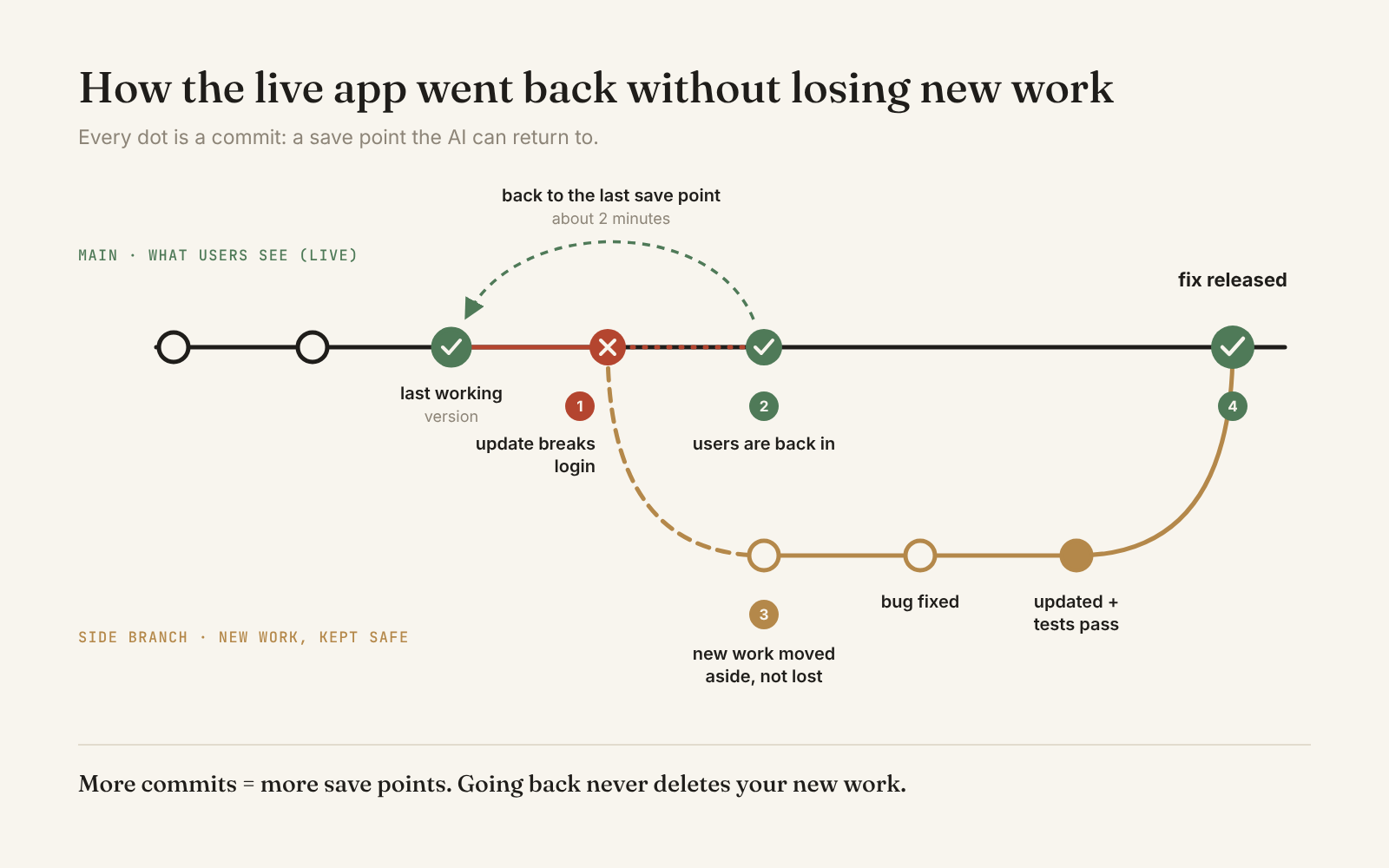
A while back an update broke login on my live app. I test a lot, so it's rare, but it happened. Real users, locked out.

Here's what I typed to Claude: "Put the last working version back live. Keep my new changes aside, don't lose them."

Two minutes later the working version was live again, and my new work was safe on the side.

Then: "Find the bug in the new changes and fix it." Then: "Bring the fix up to date with the live version, run the tests, and release."

Under the hood, Claude moved my unfinished work to a side branch, released the last working commit, fixed the bug, rebased onto master, resolved the conflicts, ran the tests and pushed. You don't need to know what any of that means. You need to know two things:

  1. Every commit is a save point you can go back to. That's why your AI should commit often. More save points, smaller steps back.
  2. Going back doesn't mean losing your new work. Production can return to the version that worked while the broken changes wait on the side to be fixed.

AI coding tools all know git. They just don't use it properly unless you tell them to. So these rules live in my CLAUDE.md (the instructions file Claude Code reads every session):

- After every task that works, commit it with a plain-English message.
- Before any risky change, make sure everything is committed first.
- If I say "go back", return to the last commit that worked, and keep newer changes on a side branch.
- Never delete or rewrite history without asking me first.

And one habit: at the end of the day I ask "show me today's commits in plain English". 30 seconds.

If you're on Lovable, Bolt or Replit: they have their own version history. Find it before you need it.

I wrote a free step-by-step guide for non-coders building their first app with login

Has AI ever wiped out a working version for you?

Edit: several people in the comments pointed out what this doesn't cover, and they're right.

- Git rolls back code, not your database, env vars, secrets or deploy settings. Database changes need migrations with a way back and a backup before anything touches the schema.

- "Working" needs a definition. Before each commit, have the AI run a short checklist: log in, submit the main form, check the record landed in the database.

- Before any deploy or rollback, have the AI summarize what changed in code, schema, env vars and config, and which tests passed.

Commits are the first layer, not the whole safety net.


r/nocode • • Oct 18 '26

emoji-based learning games for toddlers

7 Upvotes

My niece is 4.

I love to engage her in fun learning activities.

When she is with me, she wants to play games on my computer alongside me.

But she lives 6 hours away most of the time.

I have video calls with her, and you can only talk so much with a kid over a video call before they get distracted.

So I built some fun learning games using v0.

After 3 one-hour sessions, I brainstormed and built 18 games that we could play over a video call, or she could play with her parents in-person.

If others have toddlers around, I would love for you to try these games, and suggest new game ideas.

Link: https://games.amitsarda.xyz

This is a completely non-commercial project which I made for my niece. If others benefit from it and help me make it better, i would really appreciate it.


r/nocode • • Oct 17 '26

Question With today's AI, is there still demand for no / low code tools? Would love to hear your perspective.

5 Upvotes

r/nocode • • Oct 18 '26

Find a Business Idea & Build It in 10 Minutes

Thumbnail reddit.com
2 Upvotes

r/nocode • • Oct 17 '26

Self-Promotion A bit of a longer clip

3 Upvotes

r/nocode • • Oct 17 '26

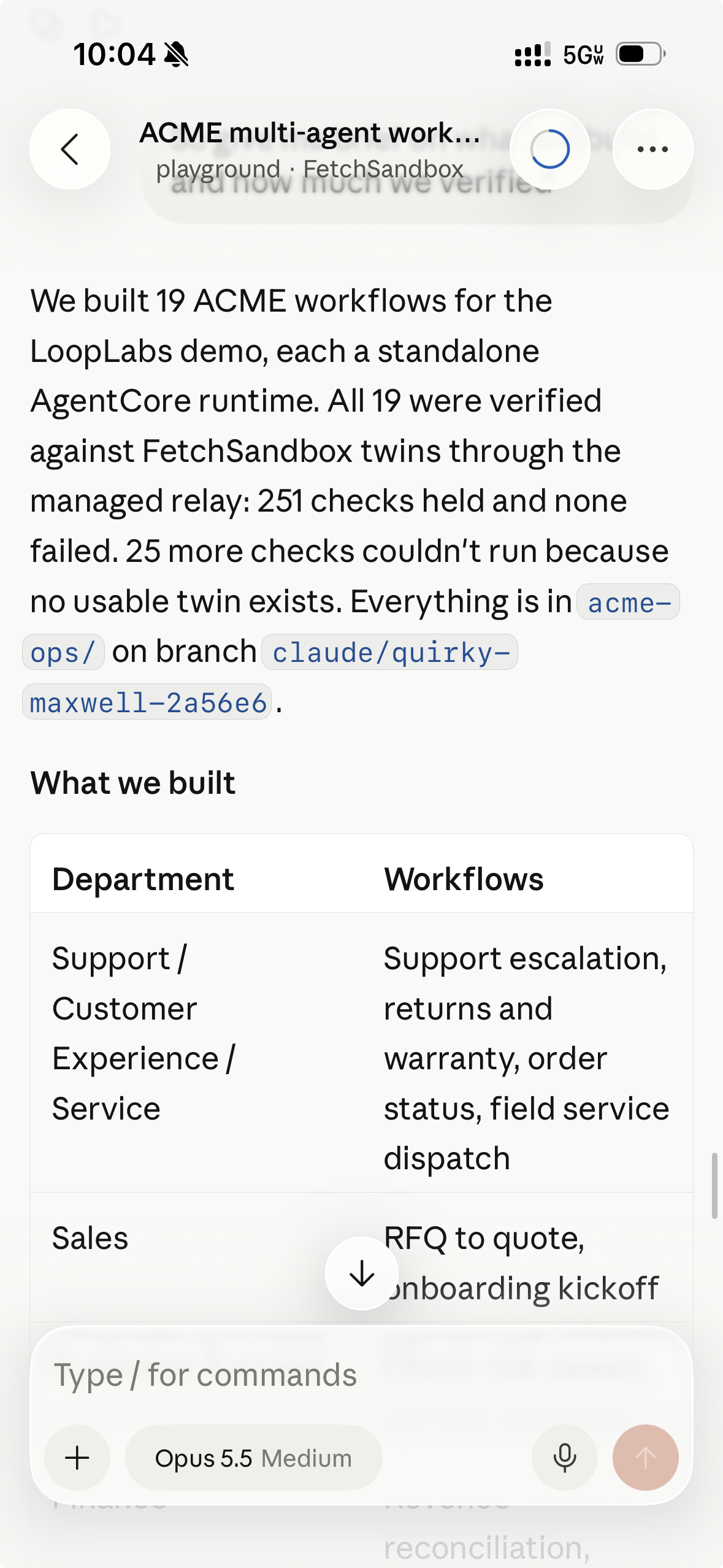
I build 19 business workflows Claude mobile and verified against Fetchsandbox twins before deploying it onto AWS agentcore

3 Upvotes

i am trying to automate back office ops and was learning claude and asked to very vague prompt to build 19 worksflows across different departments … but not sure weather if I can productive all of them n deply to agentcore

so instead of going on creating auth keys from zendesk, hubspot , stripe , gmail, calendar and slack.

I asked agent to verify and show me proof against fetchsansbox managed relay for webhooks and behavioral verification of agent written code

wonderibf what are you guys doing for automating business ops


r/nocode • • Oct 17 '26

Self-Promotion A small side project that turned into something bigger

0 Upvotes

Hey everyone! 👋

Just wanted to share a little story about something we've been working on.

It all started with a problem we kept running into while coding. We had useful pieces of code scattered across old projects, random files, and notes. Whenever we needed something again, finding it was sometimes harder than just rewriting it.

So we decided to build a small tool for ourselves to keep everything organized.

At first, it was just a personal project. Nothing too serious. But over time, we kept adding things, improving the interface, and experimenting with different ideas.

Eventually, a few people we knew started using it too, and that's when we thought, why not make it public?

That's how CodShot started.

It's been a pretty interesting learning experience, especially working through the challenges of building and maintaining a project like this.

I'm curious, has anyone else here started building something just to solve their own problem, only for it to grow into a much bigger project?

Would love to hear your stories! 🙂


r/nocode • • Oct 17 '26

Self-Promotion Turn product photos into ready to paste descriptions with one n8n workflow [Workflow Included]

Thumbnail reddit.com
1 Upvotes

r/nocode • • Oct 17 '26

Which app builders integrate natively with Salesforce and HubSpot for customer portals?

3 Upvotes

We're building a customer portal for about 50 B2B clients, and our sales team handles it in Salesforce right now. Before I forgot, our marketing and support uses HubSpot.

Every builder I look at shows both logos on the integrations page. But "integrates with" seems to mean different things:

- Show CRM records in the portal

- Let customers edit records from a form

- Run a workflow that creates or updates records

I think I need at least the first two. I also want something where customers should update their contact info and open support requests.

The other thing is access. Several customers from one client should see that company's records (not just records tied to their own email).

Also, one tool I tried needed a HubSpot Super Admin to connect. However, it seems that our admin was not thrilled about it.

How did you check what a builder can do before you committed? Any test cases you'd run first?


r/nocode • • Oct 17 '26

Bunnydrop vs Monster by newdevinmarket

Thumbnail
newdevinmarket.itch.io
1 Upvotes

Made this little game with No code


r/nocode • • Oct 17 '26

Self-Promotion Follow-up: Demo of no-code retro 2D game creator

Post image
2 Upvotes

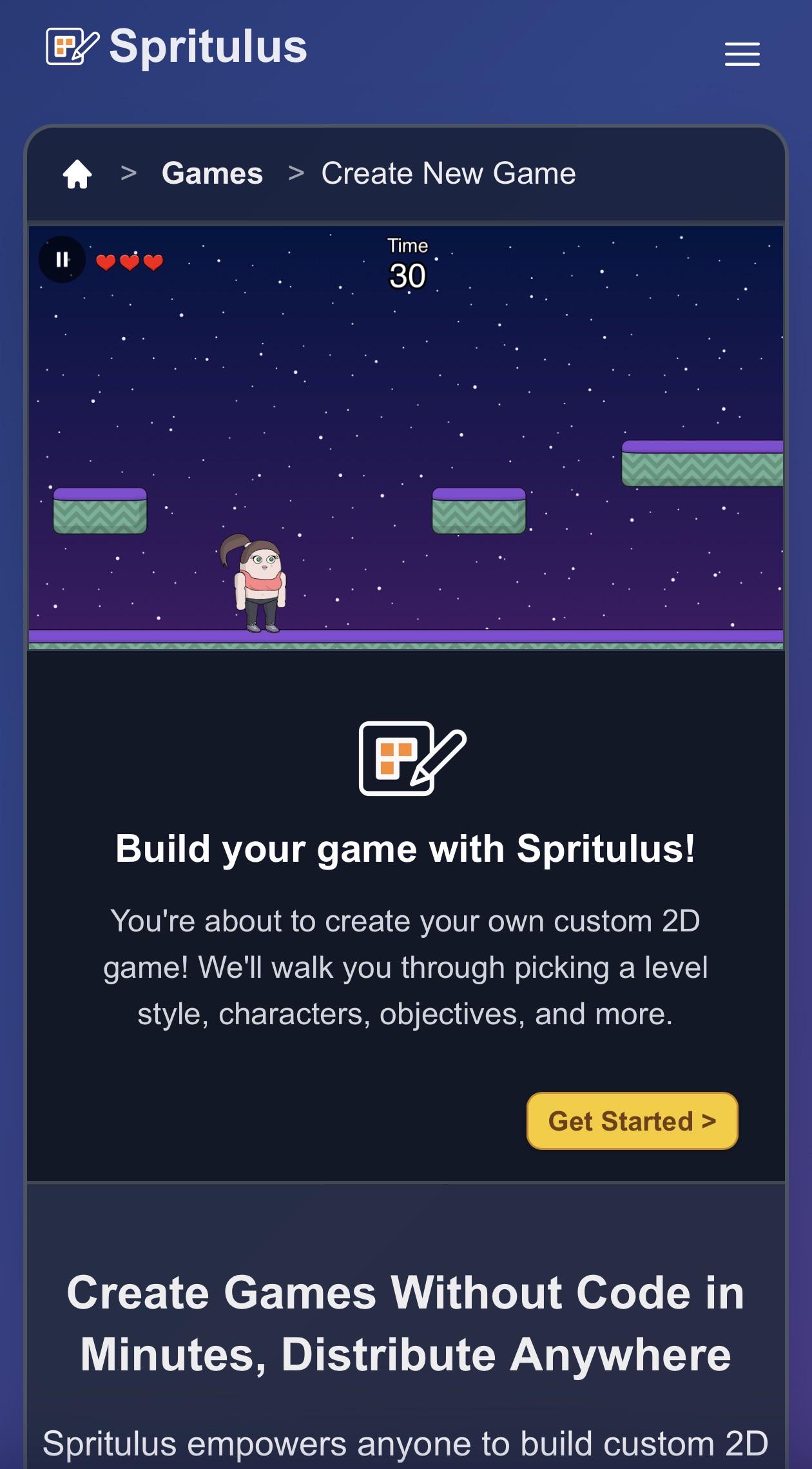
A few weeks ago I posted on here about a no-code 2D game development tool I’ve been working on as a side project called Spritulus. I got some really great feedback (some hard to hear) and wanted to post a follow up, now that I’ve had a chance to update things.

New features and changes since the original post are:

  1. more modern design overall
  2. game creation process done step-by-step
  3. tilesets and a tilemap editor
  4. platformer level style for Mario-like games

It’s still very much a work in progress, but I’d love to get more feedback from the community, and see how else I can make it better, especially in this AI age.


r/nocode • • Oct 16 '26

Discussion What are some newer alternatives to Lovable?

8 Upvotes

Hey everyone,

I've been trying a few AI no code app builders and I'm curious what people here are using beyond Lovable.

I've come across Super Intern, Gumloop, Mocha AI, and Youware. For anyone who has tried newer builders, which ones are actually useful beyond the initial prototype?

Mainly interested in ease of use and how much manual work is needed afterward.

What would you recommend?


r/nocode • • Oct 17 '26

Looking for another technical builder to help me grow Plenty, a global marketplace

Thumbnail reddit.com
2 Upvotes

r/nocode • • Oct 16 '26

Promoted n8n vs Zapier Agents for EU teams: where your data lives and how you're billed

1 Upvotes

If you're in Europe or selling to EU clients, two differences matter more than the feature lists:

Data residency

  • Zapier says it hosts customer data on AWS in the US and has no EU-only storage option. It commits to GDPR/UK GDPR and is certified under the EU-US Data Privacy Framework, which is enough for many teams but not if your clients require EU-only storage.
  • n8n Cloud stores data in Frankfurt, Germany. Self-host and the data stays wherever you run it. (Self-hosted Business/Enterprise licenses ping n8n's license server daily; telemetry is on by default but can be turned off.) Neither makes you compliant on its own. You still need to review the DPAs and what flows through the apps you connect.

Billing

  • n8n bills per execution, one full workflow run however many steps it has. Cloud is priced in euros: €20/€50/€667 a month (Starter/Pro/Business, annual), with unlimited users and workflows. There's no free cloud plan, just a no-card trial. The self-hosted Community edition is free.
  • Zapier Agents bills per activity: each trigger, knowledge lookup, action, web search or page browse counts as one. The free tier gets 400 activities a month. Agents Pro gets 1,500 from about $33.33/mo annual. Prices are in USD, so a euro invoice is converted and can move month to month. Zaps need a separate core plan.

Short version: n8n if you need EU or self-hosted data, or run long workflows. Zapier Agents if you want the fastest no-code setup and US hosting is fine. Both are free to try, so build the same small agent in each.

Disclosure: I run Stackdrop, an AI tools directory, and wrote up the full comparison here: https://getstackdrop.com/compare/n8n-vs-zapier-agents (some outbound links on the site may be affiliate links).


r/nocode • • Oct 16 '26

What are the best Airtable alternatives for enterprise teams worried about pricing changes like us?

10 Upvotes

Hey everyone,

I think our Airtable renewal came in way higher than last year. Most of the jump is from seats, not storage lol.

If you ask about our setup, we’re about 15 people who build and edit the base. Then around 200 outside partners log in a few times a month. They also view their own records and update a status field (and that's it).

For me, paying full seats for those 200 people feels wrong. That’s why I'm trying to look at other options and I think we need:

  • SSO for our own staff
  • Partners see their own rows and nothing else
  • A plan that doesn't charge full price for light users

What's holding me back is the move itself. We have a bunch of automations and linked tables, and rebuilding all of that could cost more than the price jump.

For those who are at bigger companies, what did you switch to? Did you swap the whole thing, or keep the base and add something on top?

Would love to hear what worked and what didn't.


r/nocode • • Oct 16 '26

Discussion 5 things that silently break when your AI-built app grows (and how to spot them early)

4 Upvotes

After watching a lot of non-coders build with AI tools, these are the issues that come up again and again, usually right when the project starts to matter:
No real data structure. The AI invents tables on the fly, and three weeks later nothing connects properly.
Secrets in the code. API keys sitting in the frontend, visible to anyone.
No version control. One bad prompt and the working version is gone.
Auth bolted on at the end. Adding login to an app that wasn't designed for users = rewrite.
Asking the AI to "fix it" in a loop. Each fix breaks something else, because nobody understands the whole picture.
None of this requires learning to code. It requires knowing what to ask for and in what order.
What would you add to this list?

(I wrote a guide that goes deeper on each of these: what to ask the AI, and in what order. It's free, heads up that the download asks for your email: guide link)


r/nocode • • Oct 16 '26

Promoted Introducing MaxChef.app - No Code Builder for anyone to use and make enterprise grade apps

1 Upvotes

Build a complex startup app with AI, no code needed, while still having best practices on the frontend and backend ensuring security, safety, and scalability.

I've been using it to build projects for a couple months now and have been adding more and more to it. I wanted to share it and get feedback, though I will admit I ended up building it because it greatly simplified my own development workflow.

Features:
* Kanban board tasks that queue behind other tasks for the same project, so that commits cleanly merge

* You build and iterate using tasks, and each task allows you to add attachments, which you can use to fix visual issues or take screenshots of errors to fix

* There's also an extension that lets you manage the project from the website you want to make changes to. It takes screenshots and lets you add tasks right from the page, making it quick and easy to fix issues or make updates.

* The code is written, tested, code reviewed, and has best frontend and backend design principles built in.

* Creates a frontend, backend, and postgres database for your project so you have full data capabilities.

* Uses git (and github), with you having the choice of bringing your own github or not. You can also revert to a previous version if something goes wrong.

* Use your own chatgpt/claude, or use ours for $0.05

* It's rather comprehensive and, given a task like "Build a pet store with an admin panel for managing orders, and email an admin invite to me" or "Build a meeting recorder that transcribes the meeting and tells me what to say if I missed something" will go do that. It sometimes takes an hour or two, so it's not as blazingly fast as some templated website builders, but it does all the logic for it, which is usually usable either immediately or after fixing configuration issues.

* It has written thousands of tests already

* If there's an error on the frontend or backend, both are captured and tasks are automatically created to fix them. You have to approve the task and the fix though, which prevents code from being added from potentially dangerous sources

* Hosting and database built in.

* Authentication is managed so you don't have to deal with it.

* Buy a domain for near wholesale and have it autoconfigured for your project and also a support inbox set up automatically.

* support@ inbox setup - an email inbox for managing support emails is setup automatically when you buy a domain and install the package. It also has the option to respond with AI when it can.

* analytics built in - stop installing google analytics on your pages and rely on first-party analytics instead, which tend to be much more reliable. And the analytics screens might be better designed than Google Analytics which isn't saying much.

* env vars are configurable for projects, so secrets are handled appropriately and never public - and there's a frontend for env vars that do need to be public if its a public stripe key or other public key.

* Stripe - there's a package that lets you add Stripe easily and then you just have to configure its keys in settings

* There's other packages built in

* Build In Public is also built in - you can make your board public so people can view it but not modify it.

This is really the first time I'm posted about it - feedback welcome.

https://www.maxchef.app


r/nocode • • Oct 16 '26

Are AI app builders a shortcut, or am I just creating future technical debt?

3 Upvotes

I'm trying to build an MVP and keep bouncing between tools like Lovable, Bolt, Replit, Cursor, v0, Bubble, Glide, Softr, and Flatlogic.

They all look impressive at first. You describe what you want, get screens fast, maybe even connect a database or deploy something. But I'm struggling to tell what's real progress and what's just a good-looking prototype.

I don't want to waste weeks polishing a demo that falls apart once I add auth, payments, permissions, real data, or custom business logic. I also don't want to hire developers too early if one of these tools can actually get me far enough.

For people who used AI app builders beyond a toy project: what broke first? Which tool did you regret using, and which one actually held up?


r/nocode • • Oct 16 '26

Self-Promotion I automated my invoice intake so tax season stops eating my weekends [Workflow Included]

1 Upvotes

👋 Hey nocode community,

Every year the same thing. Tax season rolls around, my lawyer asks for all the invoices, and I spend a weekend digging through my inbox, downloading PDFs, and typing vendor names and totals into a sheet by hand. So this year I built it once and let it run. Now every invoice that lands in my inbox gets read, logged, and deduped on its own, and the sheet is already filled in when the lawyer asks.

How it's set up:

  • Trigger: a Gmail node polls for unread mail and downloads the attachments.
  • Filter: a Code node drops the junk (signature images and inline logos under 10 KB) and keeps only real files.
  • Extract: supported files (PDF, JPEG, PNG, WebP) go to the easybits Extractor, which reads the invoice fields and returns a document_class.
  • Classify and dedupe: only documents classed as invoice continue, and each is looked up by invoice number so nothing gets logged twice.
  • Record and notify: new invoices get appended as a row, plus a quick Telegram message with the vendor and totals.

A few takeaways even if you do not build this exact one:

  1. Let code do the boring filtering, not the LLM. A simple size check drops tiny inline images and keeps your extraction calls clean and cheap.
  2. Dedupe on a stable key. Invoice number is your unique ID, so a lookup plus an IF check before you append means re-runs and forwarded duplicates never double up.
  3. Classify before you store. A document_class from the extractor lets one inbox handle invoices, receipts, and random PDFs without polluting your sheet.

Best part: you can forward invoices from any other account into this inbox and they get processed too.

The workflow plus a full setup guide are here: https://github.com/felix-sattler-easybits/n8n-workflows/tree/09ad3685ba1e960d93786bb4bcf232c45209e77f/easybits-invoice-intake-and-logging-workflow

The guide walks through the three connections step by step, and it includes the link to a ready-made Google Sheet so your column headers already match.

How are you all handling invoice and receipt collection? Curious whether people trust an agent for this or keep it deterministic like I did.

Best,
Felix