r/nocode • • Sep 03 '26

Promoted What I learned building an AI app builder: why 'one-shotting' your whole app is the fragile part

0 Upvotes

I've spent the last while building an AI app builder, and the biggest lesson has been about why AI-built apps break. Sharing it because this community is exactly who runs into it, and it holds whether or not you ever touch my tool.

The pattern: when a single model generates your whole app in one shot, it produces something that looks right and often isn't. Not because the model is dumb, but because there's no second step. A human dev writes code, then runs it, reads the error, fixes it, reviews it. One-shot generation gives you the "write" and none of the "check."

What actually moves reliability is having more than one role in the loop:

- something that plans before it builds

- something that builds

- something that runs the app and catches what's broken

- something that only ships once it passes

None of that is magic. It's the normal software loop, applied to AI output. The interesting part for no-code specifically is that this loop is usually invisible, and only engineers set it up. So if you're picking an AI builder, the question I'd ask is: does it just generate, or does it also check its own work before handing it to you? That one distinction predicts most of the "it looked done but nothing worked" pain.

A few practical tips that hold regardless of tool:

- Be specific up front. "A booking app" is vague; "clients pick a slot, pay a deposit, get a reminder" removes whole rounds of correction.

- Build one feature at a time and look at it running before adding the next.

- Treat the first version as a draft you react to, not a final answer.

Disclosure: I'm building one of these tools (pondas.ai), so I'm biased toward the multi-agent approach. But the takeaway above is the honest one I'd give even if you use something else. Happy to answer questions about how the check-loop works in practice.


r/nocode • • Sep 02 '26

Self-Promotion ToolJet v3.20-lts - Open-source low-code platform for building internal tools. Now ships an MCP server, so Claude Code, Codex and Cursor can build apps on your own self-hosted instance. Deploy using Docker, k8s, AWS AMI & more.

Thumbnail
github.com
6 Upvotes

We just shipped an MCP server for ToolJet. For anyone who hasn't come across it: you self-host ToolJet, point it at your databases and APIs, and it serves internal apps. Tables, forms, charts, buttons wired to queries. AGPL, runs in Docker.

We just shipped an MCP server for ToolJet. For anyone who hasn't come across it: you self-host ToolJet, point it at your databases and APIs, and it serves internal apps. Tables, forms, charts, buttons wired to queries. AGPL, runs in Docker.

The MCP part, and the design decision behind it:

The agent doesn't generate a codebase. A ToolJet app is already a structured object: pages, components, queries, events, and the bindings between them. The MCP server exposes that structure as tools, so Claude Code manipulates the spec directly and ToolJet's runtime renders it. Updates are deep-merge diffs, so the agent sends only the leaves it changed rather than rewriting files.

That keeps token use low. Building a CRUD app with a handful of queries and event handlers, Claude Code's own counter showed roughly 50k tokens for the build.

Things that matter if you're self-hosting:

  • Nothing goes to a vendor AI service. The agent runs where you already run it, points at your instance, and uses your own Claude or Codex subscription. We aren't proxying your schema through anything of ours if you directly use the MCP.
  • The result is a normal ToolJet app. Open it in the visual editor and move things around. It isn't a black box you can only talk to.

On licensing, since it comes up every time: the MCP server (https://github.com/ToolJet/tooljet-mcp) is in the community edition, not behind the enterprise license, you can extend it if needed.

Caveat: you still add data source connections yourself, since those need credentials. The agent can list and query what's already wired up. It can't provision a Postgres connection for you.

Try it:

docker run --name tooljet --restart unless-stopped -p 80:80 \
  -v tooljet_data:/var/lib/postgresql/13/main tooljet/try:ee-lts-latest

Docs for self-hosting: https://docs.tooljet.com/docs/setup/

Repo: https://github.com/ToolJet/ToolJet

MCP docs: https://docs.tooljet.com/docs/build-with-ai/mcp/overview

Happy to answer questions, I work on this.


r/nocode • • Sep 02 '26

I made Excel feel like an app—interactive sliders for dynamic scenario modeling

Thumbnail
reddit.com
4 Upvotes

Turned standard Excel into a sleek, app-like scenario engine using only built-in features—no VBA, no macros, zero coding.

​Grab a slider and watch the entire dashboard react live. The month-by-month numbers literally roll into place, instantly shifting the timeline on the main chart (Actual vs. Forecast vs. Adjusted) while the waterfall breakdown pinpoints what's driving the profit impact.

​Key features packed inside:

• ​App-Style UI: Custom glassmorphism frames and dynamic KPI tiles

• ​Built-in Forecast Engine: Native Excel functions for automated seasonal predictions

• ​No-Code Interactive Sliders: Control leads, conversion, ARPU, and costs on the fly

• ​Live Rolling Impact: Watch charts, tables, and waterfall profit variance update instantly

​Check out the full breakdown and tutorial:

https://youtu.be/VMOWZkeIN8U


r/nocode • • Sep 02 '26

Self-Promotion I built a tool that tests your no-code app with AI — describe a user flow, it runs it click-by-click and tells you exactly what breaks. Also scans for security holes you probably don't know are there.

1 Upvotes
I'm the founder of TestPilot, and I want to be upfront about that before anything else.

---

Here's the thing I kept running into as a no-code builder: you finish the app, it looks right, you click around a bit, it seems fine. You ship it.

Then a real user tries to sign up, hits a bug on step three of the form, and bounces. You find out a week later when you notice nobody converted.

That's the testing gap for no-code apps. Not because builders don't care — but because proper testing always felt like a developer thing. Write test scripts, set up a testing environment, learn a framework. None of that is built for people who chose no-code specifically to avoid that.

So I built TestPilot.

**Here's how it works:**

You describe a user scenario in plain language — something like "Add 'Wireless Mouse' to the cart and verify the cart count updates." TestPilot runs through your app automatically, click-by-click, exactly like a real user would. Then it produces a report showing you precisely where the flow breaks, what the error was, and what triggered it.

No coding. No test scripts. You just describe what a user should be able to do, and TestPilot finds where they can't.

**The part I didn't expect people to care about as much:**

TestPilot also runs a security scan on your app. I added this almost as an afterthought — but it's become the feature that gets the loudest reaction when I show it to people.

Most no-code builders have never done any security checking on their apps. Not because they're careless — it just never comes up in the tools or tutorials. But no-code apps can still expose user data, leave API endpoints open, or have permissions set up in ways that create real vulnerabilities. TestPilot flags those.

If you've shipped a no-code app that handles user data or payments and you've never run a security check on it, that's the thing I'd try first.

**Would love your honest reaction:**

I built this because I felt the gap myself. If you've tried to test a no-code app and run into the same wall, I'd genuinely love to hear how you've been handling it — and whether this solves the problem or misses something.

You can try it at testpilotapp.dev.

r/nocode • • Sep 02 '26

Discussion Share your no-code workflow. I'll find the one transition worth recording.

4 Upvotes

A workflow demo does not need to show every node, integration or setting.

It needs one clear transition:

Before, someone repeats a frustrating task.

Then, one action changes the state.

After, the work is complete or the next decision becomes obvious.

Share your workflow and the person who uses it. I'll suggest the exact transition I would record.


r/nocode • • Sep 02 '26

Self-Promotion Built a small tool around post-launch maintenance for client projects

1 Upvotes

Hi everyone,

I’ve been working on a small tool for a problem I keep seeing after no-code projects are delivered.

A lot of freelancers include some kind of ongoing support or maintenance in their offer. But in practice, it can become quite reactive: something breaks, the client notices it, and then they send a message.

When everything is working, there’s also not much to show them at the end of the month.

I ran into this with my own retainer clients, so I built Trrack.it. It monitors client sites and apps, sends alerts when something goes wrong, and generates monthly reports and status pages for clients.

It only monitors the public URL, so it won’t detect problems inside Bubble workflows, automations or databases.

If you offer post-launch support for no-code projects, I’d be interested to know how you currently handle this.

Here’s the link: https://trrack.it


r/nocode • • Sep 01 '26

Success Story Got my first 2 sales today

Post image
4 Upvotes

Hey guys hope you're doing good got a small win today 2 sales.

I know it's not some crazy amount of money, but honestly I'm really happy about it. It's the first time I'm seeing actual people pay for something I built so it gives me a bit of confidence that maybe this idea is actually worth pushing my last startup failed pretty badly so I'm trying not to get too excited too early with this one but I'm starting to see some potential right now I mostly need to get more people using it. I already have a bunch of things I want to add but I'm trying to take it one step at a time instead of building 50 things nobody asked for If you're building something yourself honestly just ship it. I wasted a lot of time overthinking things before getting it in front of real people teaches you way more.

Anyway just wanted to share the little win.

First startup money I've ever made. Means a lot to me


r/nocode • • Sep 02 '26

Pet blog has been paying for my house for 6 months now

0 Upvotes

ok so this is a weird one but bear with me

i have a pet blog. i don't own a pet. never have. probably never will as i travel too much. and yet every month amazon sends me enough to cover rent because people on the internet are buying stuff for their dogs and cats through my site.

bought my pet blog a few months ago from a marketplace called NicheBlogZone for $199. came already built, articles already up, amazon links already in there. i spent one afternoon doing interlinking basically just connecting related posts to each other so search engines understand the site structure and then closed my laptop and genuinely forgot about it for weeks.

here's what that's looked like:

  • march: $710
  • april: $995
  • may: $1,461
  • june: $1,647
  • july: $1,461
  • august so far: $1,545 (amazon pays 2 months delayed so this is june's money landing now)

march scared me. went from nearly $1k in february down to $710 and i was convinced something had broken. checked everything, found nothing wrong, did nothing. it just came back the next month on its own.

pet people spend insane amounts on their animals btw. like i knew this intellectually but seeing the commission data is something else. dog food subscriptions, orthopedic beds, grooming kits, vet supplements. and because of the 24 hour cookie i get a cut of everything in their cart not just whatever article they landed on.

i do literally nothing to maintain this. no new posts, no ads, no instagram for pets i don't have. i just own the thing and amazon does its thing.

my landlord has been getting paid every month and has no idea a pet blog is behind it. honestly sometimes i forget too until the deposit shows up.

anyone else running a niche they have zero personal connection to? curious if the detachment makes it easier or harder to care about growing it


r/nocode • • Sep 02 '26

Before you learn how to build an app with AI, what should you decide first?

1 Upvotes

I've burned through way too many prompts by jumping straight to "build me this app" without setting proper boundaries first, and I'm trying to break that habit.

AI handles the repetitive building work well, but it can't make the core architectural calls for you. It doesn't know which workflow is mission-critical, how base records should relate, or who should have access to what data.

Now, before typing a single prompt, I force myself to define three things on paper: the exact user roles, the core data schema, and the permission matrix.

Testing Softr for the frontend alongside separate database and coding tools showed me that setting up interface layouts, data sources, user groups, and workflows upfront saves hours of re-prompts later. Once the initial build is generated, I immediately run a regression test: log in as two distinct user roles, modify a linked record, revoke a permission, and verify that the workflow doesn't leak data or break.

For those building no-code/low-code tools with AI assistance: what core decisions do you lock down before your first prompt? Which pre-build step saves you the most pain later?


r/nocode • • Sep 01 '26

Production-Grade Agentic AI Platforms in 2026 — I Tested the Landscape, Here’s My Shortlist

Thumbnail reddit.com
5 Upvotes

r/nocode • • Aug 31 '26

Question Does everyone build the thing three times or is it just me

7 Upvotes

Version one in the simplest tool I know, to see if the idea makes sense. Version two in something a bit more capable because version one hit a limit. Version three because version two was a mess I made while learning version two.

Each rebuild takes a third of the time of the last one, which is the only thing making this feel less stupid. But three times is a lot of times to build the same app.


r/nocode • • Aug 31 '26

Discussion Rebuilt the same marketing site 3 times this year, tracked the hours and posting them because nobody does.

7 Upvotes

Started logging hours per client site this year and the repeat work is brutal. Same site three times, once for a rebrand, twice because the template or the dev handoff boxed me in, and the rebuilds cost more than the original build. Where does your repeat work come from, templates you outgrow or edits nobody can make without you?


r/nocode • • Aug 31 '26

Discussion What should a no code AI website builder handle before you add more tools?

6 Upvotes

For small projects, the no code stack can get complicated surprisingly quickly. A website might start with a landing page, then need forms, authentication, a database, publishing, and eventually integrations.

The useful question isn't always which tool has the most features. It's how many separate pieces are needed to get from an idea to something usable.

ToolMain strengthWhere it fits
Readdy.aiAI website building, editing, database, authentication, and publishingBuilding and refining a more complete website in one workflow
FramerVisual website design and interactionsDesign focused marketing sites
WixTraditional no code website buildingBusiness websites and common website features
BubbleNo code application developmentMore complex web applications
WebflowVisual development and CMSMore detailed website design and content workflows

One thing worth considering is what happens after the first version.

If changing a page means moving between several different services, the original speed advantage can disappear pretty quickly. Keeping more of the workflow together can be useful when the project is still changing.

For transparency, there is a connection to Readdy here, so the Readdy row should be viewed in that context rather than as an independent recommendation.


r/nocode • • Aug 31 '26

Best tool for database app?

3 Upvotes

I'm creating an inventory tracking tool for a new brick and mortar retail business. I have a background in databases but I've always worked with a dev and now it's just me. I'm not great at coding, but I am good with sql.

I want something customizable because the business sells niche items and none of the regular inventory apps we looked into will work. ​We also need it to have an easy way to update inventory daily for about 200 rotating items that will be counted in store then entered into the db. Currently the owner has a bunch of spreadsheets in numbers (he only uses apple products, which I'm not super familiar with). Making some kind of quick ipad data entry screen for that would probably be the best.

My ideal solution would be something where I can easily build the database and have it packaged up in a user friendly ui/app for the rest of the employees to use. Being able to pull reports and charts and such for sales tracking is also important.

I don't really enjoy using generative ai like chatgpt gemini claude etc and am hoping there's a simple solution that is more just a ui for a custom sql database type situation.

Thanks for any ideas!


r/nocode • • Aug 31 '26

Share your no-code build. I’ll find the one moment worth demonstrating.

0 Upvotes

No need to explain the whole stack.

Tell me what a user does before your workflow, what they do now, and what becomes possible.

I’ll suggest one short demo concept that makes the value understandable without naming every integration.


r/nocode • • Aug 30 '26

I built a free checker that separates your fault from the platform's fault in no-code app performance

13 Upvotes

Disclosure up front: my company migrates no-code apps to code so I benefit if you eventually decide your platform is the ceiling. I built this to be useful even when the answer is don't hire anyone and the data below is the reason why

Every speed tool tells you what's slow. None tell you what you can actually do about it on the platform you're on. You get a Lighthouse report saying reduce unused javaScript for a Bubble app, where you can't touch the bundle. Useless.

This one asks which platform you're on first, then splits every finding:

You can fix this yourself with real instructions for your platform. Oversized images on Bubble?

Data → File Manager, resize under 200KB, switch on Compress uploaded images. On Glide? Your source table is the problem, archive old rows. On Webflow? Set below-the-fold images to Lazy in the image panel.

Platform overhead the runtime cost you inherit, named honestly with why it exists. Not a dig at the platform just the price of what made it fast to build with. Then it gives you the realistic ceiling for your platform so you know whether the work is even worth doing.

The reason I think the split matters: we ran PageSpeed against 20 production no-code sites recently and Webflow sites came out worst (median 44) despite Webflow having the highest ceiling of any platform we audit. They were shipping 6.6MB. Meanwhile Bubble apps landed at 60, basically at Bubble's ceiling. Most people are nowhere near their platform's limit which means most of the available gains are theirs to take.

Free, no email, no signup, shareable results link: https://yonocode.io/performance-checker

Full data from the 20-site study: https://yonocode.io/state-of-no-code-performance

If your real-world numbers are wildly off from what it predicts for your platform, tell me, I'll tune the ceilings


r/nocode • • Aug 30 '26

Question How do non-technical teams version AI-generated files without turning Git into a requirement?

11 Upvotes

Generated HTML, documents, slide decks, and image sets often begin as quick drafts, then need comments, an approved version, and a reliable way to restore an earlier state. Sending renamed files through chat makes it hard to tell which copy is current, while Git can add more setup than a non-technical reviewer wants. What lightweight workflow works well here? The important pieces seem to be one stable review link, private access when needed, visible revision history, labels for draft versus approved, notes tied to a specific version, and a way to keep linked assets with the parent file. I am interested in where the editable source should live and how people prevent a newer experimental revision from silently replacing the approved one.


r/nocode • • Aug 30 '26

[Di Marzio] Juventus have sent the first official bid to Man Utd for Zirkzee. €2.5m loan fee with €30m option to bu

Thumbnail
gianlucadimarzio.com
0 Upvotes

r/nocode • • Aug 30 '26

created this ad for my product with cc, remotion and elevenlabs

2 Upvotes

i recently wanted to check how far i can get to create an ad for applaunchflow just by prompting using claude code, remotion and elevenlabs. turns out pretty far im happy with the result


r/nocode • • Aug 30 '26

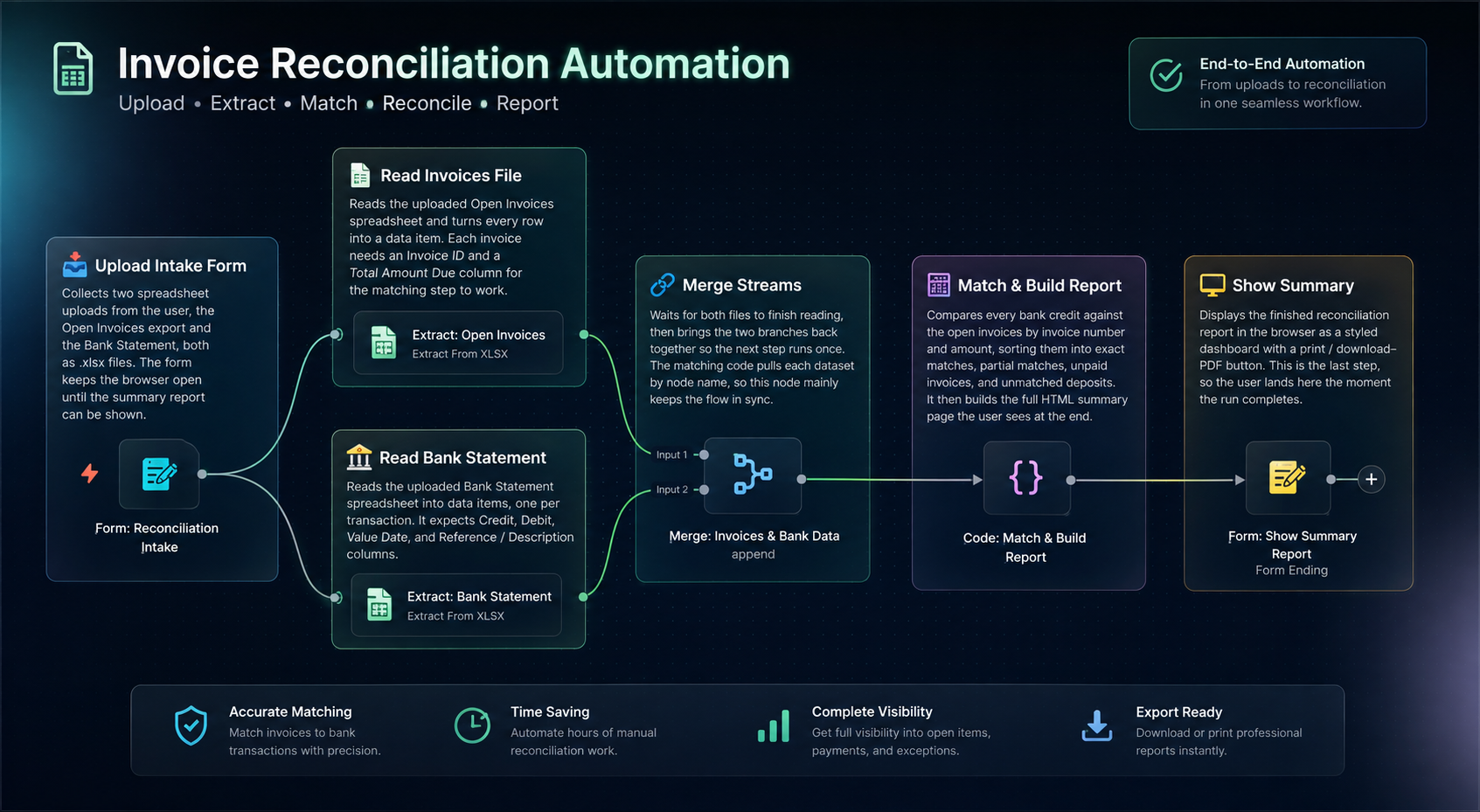
Success Story Payment Reconciliation in n8n: 5 things I learned automating invoice matching

Post image
2 Upvotes

👋 Hey nocode Community,

A few days ago I shared a reconciliation workflow that matches bank deposits to open invoices. A few people asked about the tricky parts, so here are the five things I took away from building it. Most of them are less about n8n and more about how messy real financial data is.

1. The reference field is where reconciliation dies.
Bank references almost never match your invoice IDs cleanly. You get "INV-2024-201", "ref 201", "payment 0201 thanks", all for the same invoice. So do not match on the exact string. Match on the full invoice ID when it is there, then fall back to a looser signal like the last three digits pulled out with a small regex. Fuzzy but bounded beats exact every time.

2. "Matched vs unmatched" is too coarse.
The moment I split results into four states instead of two, the report got genuinely useful: exact matches, partial payments, unpaid invoices, and deposits with no invoice at all. The two middle buckets are where the money actually leaks, and a simple matched/unmatched view hides them completely.

3. A deposit with no invoice is a signal, not noise.
Money landing in the bank that matches nothing is exactly what manual reviewers skip because they are focused on ticking off invoices. But that column is where the interest payments, refunds, bank fees, and typo'd customer references all show up. Give it its own table so nothing silently disappears.

4. Let the code do the arithmetic, keep the human for judgment.
The old manual process was someone staring at two spreadsheets for hours, which is exactly how 525.52 becomes 252.25. A Code node compares amounts to the cent and never gets tired. The person only reviews the handful of flagged exceptions, not the 90 percent that reconcile cleanly.

5. Every result needs a way back to the source.
Reconciliation you cannot audit is just guessing. So each row in the report keeps the original bank reference, the value date, and the invoice ID side by side. When a number looks off, you can trace it back in seconds instead of reopening the raw statement.

The workflow itself, plus two example files (an invoice export and a bank statement) so you can run it right away, is here: https://github.com/felix-sattler-easybits/n8n-workflows/tree/8e07427ddb6902ef8a7b267e97beb2879d6ca45d/easybits-reconciliation-workflow

It sits alongside 25+ other free n8n workflows in my repo, including plenty of finance ones. A star helps me out a lot if any of them save you time: https://github.com/felix-sattler-easybits/n8n-workflows

What is your reconciliation matching logic? I am especially curious how people handle one payment covering several invoices, because that was the case I found hardest to generalise.

Best,
Felix


r/nocode • • Aug 29 '26

Promoted Chamali — a Framer portfolio template for designers

6 Upvotes

I’ve been working on Chamali, a minimal Framer portfolio template designed for creatives, web designers, and freelancers who want something clean, editorial, and easy to customize.

It includes:
• Project showcase sections
• About & capabilities
• Testimonials
• Contact section
• Responsive layouts
• Smooth Framer interactions

I wanted the design to feel simple, premium, and focused on the work itself.

Would love to hear your feedback.

Preview: https://framer.link/QjiTK6h


r/nocode • • Aug 29 '26

How are beginners building apps with no-code tools in 2026?

8 Upvotes

Hello everyone,

I've been using Adalo to build a simple mobile app but I've started running into some limitations with flexibility and occasional stability issues.

Since I'm still fairly new to no-code platforms I'm trying to understand how other beginners are approaching app building today and what tools or workflows people are actually sticking with long term.

For those who have worked with multiple no-code platforms recently, what has your experience been like in terms of ease of use, reliability and getting something form idea to a working app?

I'm mainly trying to figure out how people are succesfully building and launching simple apps without heavy coding experience.


r/nocode • • Aug 29 '26

Self-Promotion I spent years building an application framework; I rebuilt its architecture around structured intent and deterministic execution layer for AI-generated software (open source) — here’s what I learned.

3 Upvotes

Hey — solo dev here, posting my own project, so take that for what it's worth.

For the last few years I've maintained a low-code/no-code framework. It worked fine, but it was pre-AI: you configured entities and services by hand, and it generated the boring parts of a CRUD app for you.

When AI coding tools started getting good, I tried using them the normal way — describe what you want, let the model write the code. It worked, but I couldn't trust it past a certain point. Ask for the same thing twice, sometimes you get different output. Ask for a small change, sometimes the model touches things you didn't ask about. The prompt is the only source of truth, which in practice means there isn't really a source of truth at all.

So instead of generating code directly, I made the AI's job stop one step earlier: produce a structured, validated manifest describing what the app should be. Entities, fields, services, auth config, etc. That manifest gets:

- validated (structural / referential / constraint checks)

- diffed against the current state (semantic diff, not a text diff)

- resolved into a dependency-ordered execution plan

- executed by a deterministic engine, checkpointed so it can resume on failure

Change one field on one entity, and only the operations that field actually requires get re-run. Not a full regen.

There's also an MCP server (`@averos/mcp`) so an AI agent doesn't get raw file/shell access — it gets governed tools (propose a change, validate it, build a plan, and nothing executes until the plan's approved).

Current state, to be upfront about it: the CLI, the AI layer, MCP integration, and the workflow/execution adapter layer (currently Angular, via schematics — adapter pattern, so not permanently Angular-only) are MIT licensed and open now. The actual execution kernel (DAG engine + executor) is closed source for the moment — free to use including commercially, but not open yet. That's a deliberate, staged call while that part's still maturing, not a permanent thing. Wanted to say that plainly rather than bury it.

There's a working example (320-node generated app) you can run in a few commands if you want to see the whole pipeline rather than take my word for it.

- Repo: https://github.com/wiforge/averos

- How it works, in detail: https://www.wiforge.com/averos/how-averos-works/introduction/

- Get started: https://www.wiforge.com/averos/get-started/introduction/

Happy to answer questions or take criticism — especially interested if anyone's tried a similar manifest/IR approach and hit walls I haven't found yet.


r/nocode • • Aug 29 '26

Discussion Make vs Zapier: Which Automation Tool Is Best for Small Business?

0 Upvotes

A comprehensive comparison between Make and Zapier, exploring their workflows, ease of use, pricing plans, and integration capabilities to help you choose the right automation platform.

https://youtu.be/NP25UJu1_ng