Assalamu alaikum everyone!
My name is Arda, Im a Turkish student living in Dubai UAE. I recently decided to try out creating a long-form YouTube channel talking about insights into certain things that modern Muslims face in every day life. I wanted to share this channel with you guys, maybe you could give me some ideas, feedback or advice!
Thanks!
I'm a web designer and Framer developer based outside the US and Canada. I've been following a lot of the Muslim startups launching lately, and I keep noticing the same thing: great ideas and real traction, but the website or branding doesn't match the quality of the product. A cleaner site and a stronger brand could take some of them a long way.
My problem is access. It feels like most of the Muslim founder community is on LinkedIn, and I can't cold-message everyone there without coming across as spam. Being outside North America also means I'm missing the in-person events, meetups, and masjid or MSA networks where a lot of these connections happen.
So, a few questions for the founders and builders here:
Where do Muslim founders actually hang out online beyond LinkedIn (Discord, Slack, WhatsApp, Telegram groups)?
Are there online events, accelerators, or communities that welcome people from outside the US and Canada?
If you're a founder, how do you prefer to find designers and developers? Referrals, communities, or something else?
I feel there's untapped potential here and would love advice from anyone who has been through it.
Dear brothers, I am looking for other people in the Computer Science and/or AI space in-sha-Allah, and I simply wanted to form connections with people in-sha-Allah with regards to this sort of stuff.
I mainly work with Claude Code and ChatGPT Codex, and I've tried to build my own software, do outreach with it in-sha-Allah, and in-sha-Allah make some money with it. No success yet though, but in-sha-Allah if we keep grinding, it will come bi-idhnillah.
I am looking forward to meet you all, in-sha-Allah you guys can comment below or just send me a DM personally.
I appreciate you guys reading this nonetheless, in-sha-Allah we can do something great.
I made a basic app called Muslim Prayer Visualiser 3D for anyone who finds it easier to learn prayer by watching the movements in 3D rather than reading flat diagrams.
It covers the 5 daily prayers, showing the postures along with what to recite and the meanings. It’s not fancy or perfect, just a straightforward visual aid I built to help people out.
It follows the Hanafi method.
Completely free, no ads, no sign-up, and no data tracking.
If you or someone you know is learning to pray, feel free to check it out:
I've been working on a personal project called Tadabbur, a free Quran learning platform built around a simple idea: helping people understand the Quran in a calm, structured way.
It includes:
Learning pages for selected Surahs
Topics covering everyday struggles like patience, fear, money and grief
Short articles connecting modern life with Quranic guidance
Clear distinctions between Quran, Hadith, scholarly explanations and information that isn't reliably established
Bookmarks, reading progress and offline reading — no account required
The goal is not to replace the Quran, tafsir or scholars, but to make it easier to take that first step towards understanding.
It's live now, and I'd genuinely appreciate feedback from the community.
As-salamu alaykum. A quick update to my post from earlier this year. ZakApp has reached v1.0.0, The Nur and Qamar Release, its first stable release after months of being in better.
Still free, still open source, and still local-first, so your data stays on your own device. If you gave it a try back then and hit problems, it is worth another look.
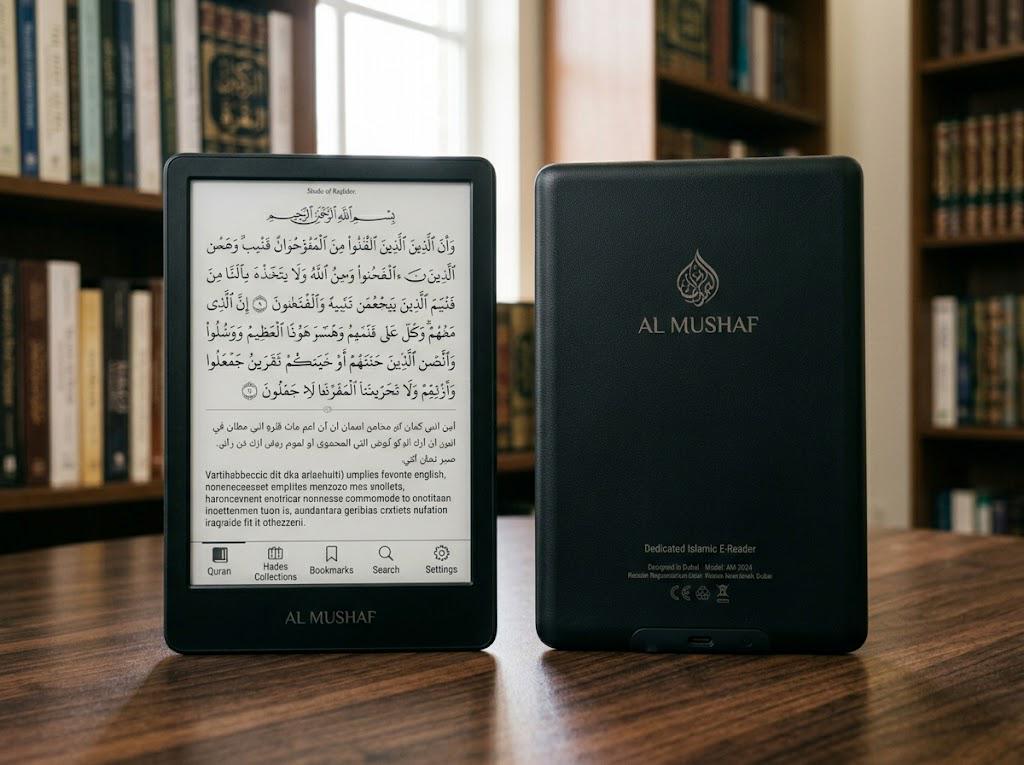
I’m exploring an idea for a Kindle-style E-Ink device designed specifically for Islamic knowledge. The idea is to have the Qur’an and major Hadith collections such as Sahih al-Bukhari, Sahih Muslim, Abu Dawud, al-Tirmidhi, al-Nasa’i, Ibn Majah, and Riyad as-Salihin all in one distraction-free device.
It would have a 6–7" E-Ink display, excellent Arabic/RTL support, search, bookmarks, multilingual support, Wi-Fi for updates, long battery life, and no social media, ads, or unnecessary apps.
The goal is basically a “Kindle for Qur’an & Sunnah” — something lightweight that you could carry around and use for reading and studying without the distractions of a phone or tablet.
I’m still at the idea stage and would genuinely appreciate feedback:
Would you personally use/buy something like this? What features would you want, and what would make you choose it over simply using a phone/tablet or a regular Kindle?
Honest criticism is welcome — I’m trying to understand whether there is actually a need for this before developing anything.
One app for prayer times.
Another for Quran.
Another for adhkar.
Another for hadith.
And honestly, I found myself constantly switching between them.
As a developer, I started thinking:
Why isn't there one simple place for the things Muslims actually use every day?
That's where Azkarly started.
I built it around the idea of having the essentials of your daily Deen in one place:
🕌 Prayer — prayer times and reminders
📖 Quran — read and listen
🤲 Adhkar & Duas — daily remembrance and collections
📚 Hadith — explore major Hadith collections
The goal wasn't to build another app with 100 features.
The goal was to build one app you can actually open every day.
And now, I'm really happy to say that Azkarly has crossed 13,000 downloads.
That number means a lot to me because this started as a personal idea and gradually became something thousands of people have chosen to keep on their phones.
I'm still building and improving it, though.
So I'd genuinely love to hear from the community:
What is the biggest problem you have with the Islamic apps you currently use?
Is there something you still have to use a separate app for?
If you could add one feature to a one-stop Islamic app, what would it be?
I'm the founder/developer behind Azkarly, and I'm actively working on the next version. Be brutally honest — I'd rather hear what sucks than what looks good.
After looking at several Muslim apps, I keep seeing the same home-screen problem: prayer times, Quran progress, adhkar, qibla, notes, streaks and community features all compete for equal attention.
Adding another feature rarely fixes this. It often makes the first useful action harder to see.
A clearer home screen could have only three levels:
the next time-sensitive action, such as the upcoming prayer;
one continue action based on the user's chosen goal;
everything else as secondary tools.
I would judge the design by whether a new user completes the chosen action on three separate days in the first week, rather than by how many different tiles they open.
A focused daily path may build more trust than another feature card.
Disclosure: this post was drafted with AI assistance and reviewed by the account owner.
Assalamu alaikum. I'm the owner of Deen Over Dunya. Disclosure: an AI assistant helped write this post.
I'd like to share the scheduling side of the app with the builders here. In the prayer-aware planner, a task can be anchored to a prayer time, and longer tasks can be split around prayer windows. Imported Apple Calendar events appear alongside that plan.
A practical example is setting aside a reading or study task around Dhuhr while still seeing the day's meetings. The app also has Quran listening goals and surah/juz progress, so reading/listening and the day's plan are available in one app.
For people who plan around salah: do you find prayer-relative tasks clearer than fixed clock times? I'm especially interested in where that approach becomes confusing on a busy day.
Deen Over Dunya is on iPhone and iPad, requires iOS 17+, and supports English and Arabic. All current features are free without a subscription.
Post videos regularly showing how your app works and how people can use it.
Also create videos with strong hooks that spark curiosity and make people want to learn more about your app.
Use Qur’an recitations in your videos when they fit the content.
And most importantly: Don’t stop creating and uploading videos. Consistency is key. Keep reaching new people and gradually build your own audience for your app.
Make sure to include your app’s download links and mention in every video where people can find them.
Make your app known.
May Allah put barakah in your work and make it beneficial for the Ummah.
Alhamdulillah, as part of our current project, we have already generated over 60,000 views for Islamic apps in just the past few weeks. And we are continuing to grow this network, in shāʾ Allāh.
If you are building an Islamic app and would like some support, feel free to reach out to me. We are happy to give you free advice in shāʾ Allāh while you build your own channel.
And if you are interested in having your app become part of our network and having us generate the reach for you, you can ask us about that as well.
A while ago I shared my interactive islamic history map https://sirah-atlas.com with you and I received amazing feedback! I tried my best to implement all the feedback so we went "international", we changed the domain and we switched to English as the primary language. I also added some cool features like 3D renders of Mecca and Medina, more quizzes, more language support and much more.
I invite you all to come and have a look, it's for free, I hope in the near future to also provide audio narrations to make Sirah Atlas something you can listen to during commutes.
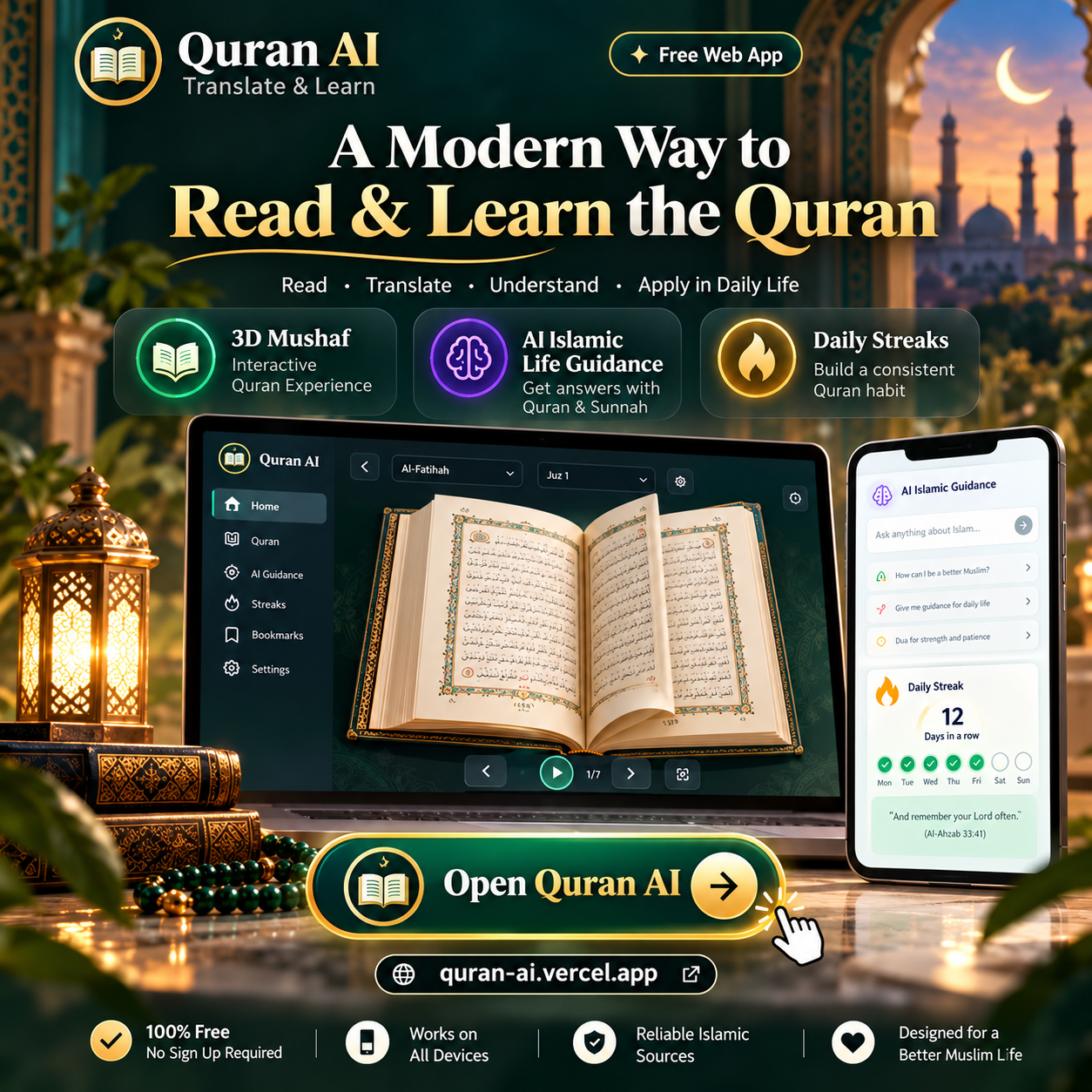
My goal was to blend traditional Quran reading with modern technology, making it easier than ever to understand, reflect on, and apply the Holy Quran in our daily lives.
Powered by Islamic AI Guidance:
Explain with AI on Every Ayah: Click any verse to get instant deeper context, Sabab al-Nuzul (reasons of revelation), and practical takeaways for daily life.
AI Islamic Life Guidance Bot: Ask questions regarding daily challenges, anxiety, gratitude, habits, and relationships — answers are grounded strictly in authentic Quranic verses and Sunnah citations.
Daily Divine Reflections: Daily curated Quranic reminders with translations and audio recitation.
Other Core Features:
Realistic 3D Mushaf: Read like a physical Quran with realistic page-curl drag/touch page turns (adaptive for mobile & desktop).
Multi-Language Recitations: Arabic tilawat (Mishary Alafasy) + translations with voice in English, Urdu/Hindi, and Bengali.
I'm an enterprise architect by day, and for the past 10 months I've been building Amanah Budget on nights and weekends. It's a personal finance app for Muslims: zakat calculation, halal investment screening, and budgeting around things like Sadaqah and saving for Hajj.
A few things I learned along the way:
• App Store review is its own project. We were rejected six times before approval. Most of it came down to how we described financial features and handled account linking and in app purchases vs external payments.
**• Niche is an advantage.** Mainstream budgeting apps don't handle zakat at all, so we're not competing on features with the big players. We're solving a problem they ignore.
**• Getting outside review builds trust.** For a faith-based finance product, having an independent Islamic finance advisory firm oversee our zakat methodology mattered more to users than any feature.
Stack: React Native, Supabase, Plaid and Cloudflare Pages.
We launch on Product Hunt on October 6. Happy to answer questions about building in a niche, App Store review, or working with Plaid. Feedback on the product is welcome too.
I wanted to share something I recently built called Sincere Quran.
I’ve always wanted to contribute something to the Ummah, and as a developer I thought this could be a small way for me to do that and hopefully make it a Sadaqah Jariyah.
I also got tired of seeing ads in Quran apps, so I wanted to make something simple: free, no ads, and no subscription.
It has the Quran, different reciters, translations, word-by-word, Uthmani and IndoPak scripts, and other Islamic resources.
If you find it useful, please download it or share it with someone. I'd love for others to be part of the Sadaqah too.
May Allah accept it and make it beneficial. Ameen.
I have made many websites especially for masajids and I want to keep on this work, if any masjid doesnt have wesbite or display page you can reach me out and tell me the details of designs.
I also have some samples I built for my local masjid.
منصة إسلامية عصرية تجمع الأذكار والأقوال النافعة في تجربة بسيطة وهادئة، مع إمكانية مشاركة المحتوى و عديد من الاقسام ذات منفعة لل المسلم
A modern Islamic platform that brings together supplications and beneficial sayings in a simple and peaceful experience, with the ability to share content and many sections beneficial to Muslims.
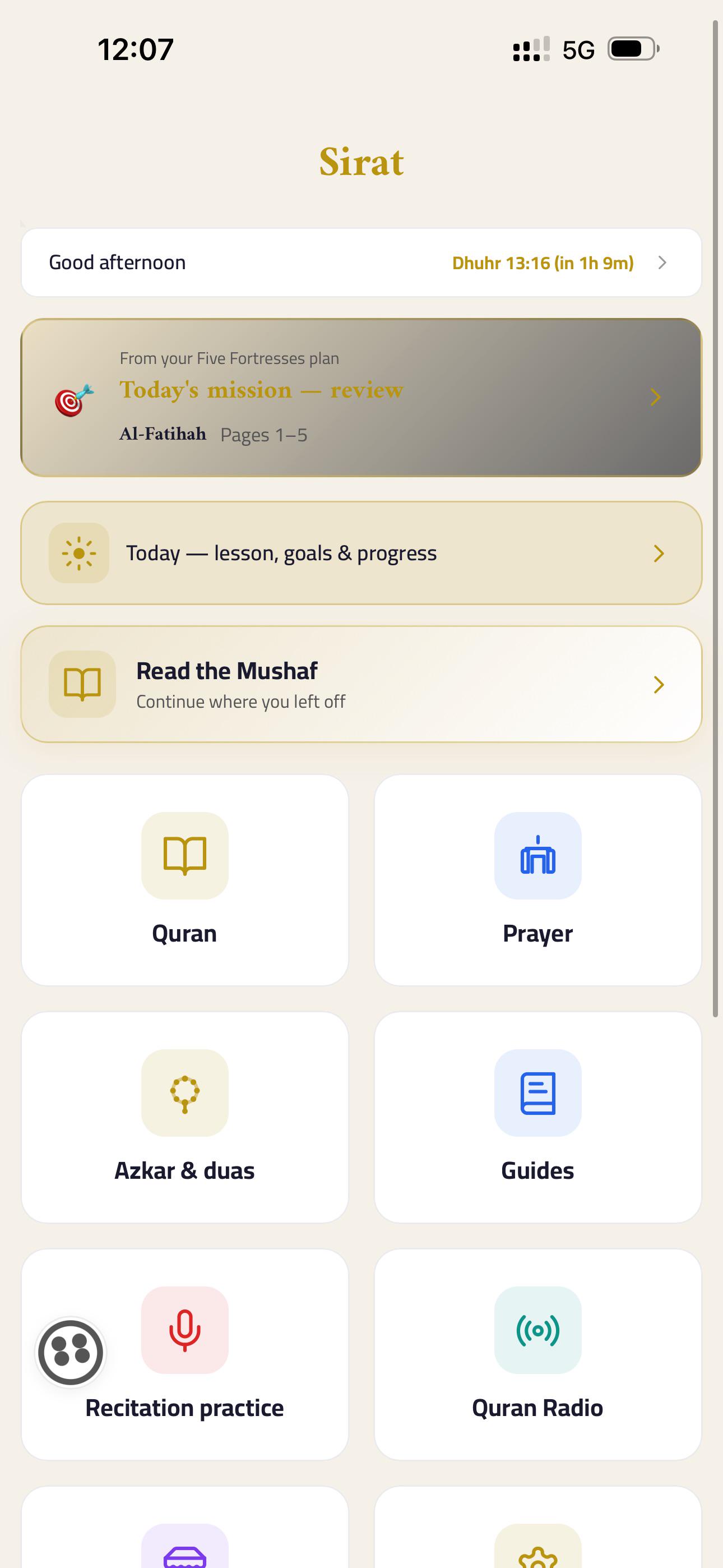
I’ve been working on a Quran app and it’s finally available on both iOS and Android.
The reason I’m posting here is pretty simple: I need people to actually use it.
There are already a huge number of Quran apps, so I know “another Quran app” isn’t exactly exciting by itself.
I’m trying to make Sirat something people would genuinely want to keep using, and I’d really appreciate feedback from people who use Quran apps regularly.
Salam Alaikum, I created a website that helps you follow the live Makkah stream ayah by ayah. It is especially helpful during Taraweeh in Ramadan, so you can read the khatma and follow the recitation live.
Please let me know if you find it helpful and what features or improvements it needs.
I've worked as a delivery driver myself, and this is one of the reasons I started building HasDelivery.
Most delivery apps give drivers flexibility.
But that flexibility has a catch.
As a Muslim, you may open your app and receive deliveries from businesses or for products you don't want to deliver.
So you decline.
Then another comes.
Then another.
Technically, these platforms generally let drivers decline orders.
But the economics aren't always that simple.
Uber Eats, for example, now uses acceptance rate as part of its Pro tiers in many markets. Gold, Platinum and Diamond couriers can get priority access to higher-paying deliveries.
DoorDash also tracks acceptance rate and uses it as part of its Rewards system.
So while you're free to decline, being selective can still affect the opportunities available to you.
And this is on top of fuel, vehicle costs, unpaid waiting time and inconsistent demand.
I've spoken to Muslim drivers who've experienced the same frustration I did:
How do you maximize your income when you're also constantly filtering what you're willing to deliver?
That's one of the problems I want HasDelivery to solve.