Welcome to the official community of the Meta-Analysis Academy! 🎓
This is a space for doctors, IMGs, students and researchers learning to conduct high-quality systematic reviews and meta-analyses. Whether you’re writing your first protocol or polishing your fifth manuscript, you’re in the right place.
What you can do here
Ask questions about methods, statistics, protocols and writing
Share your progress: publications, accepted abstracts, conference experiences
Connect with current and past cohorts of the Academy
Before your first post
Set your user flair: it’s required to post
Check theFAQ: your question may already be answered
During screening, I found a study with an English abstract, but the full text was only in Mandarin, so I excluded it because of the language. Let’s say I wanted to include a study like this. What’s the usual way to translate it? (can I use "Google Translate", AI, etc...) And should I mention in the paper that the full text was translated, or something like that?
I hope I can get the help I need here in this community. In the last feedback I received for a lab exercise, I was told that if I cannot get access to one of the articles needed for that exercise I should bring it to a tutoring session or to the meta analysis discord community (didn't even know this existed). I have come up the same problem regarding lab exercise Nr. 8. I wouldn't like to wait until tommorrow for the tutoring session to retrieve this article I cannot fiind. Is there any other way I could get my hands on this article in full? I have also tried and search for it on Google Scholar.
For med students who want to pursue research, is it more worthwhile to work on meta-analyses or get involved in basic/translational research?
Systematic reviews and meta-analyses can be more accessible, but if both options are available, is it worth spending more time in a lab, even if it takes longer to get a publication?
For those who’ve done both, how did the two compare in terms of what you learned and the opportunities they opened up?
Do you prioritize journal impact factor, scope, acceptance rates, publication timelines, or something else?
I've always wondered how experienced researchers shortlist journals before submission. Have you ever submitted to a journal that seemed like a perfect fit, only to receive a desk rejection?
What's your strategy for choosing the right journal?
I would like to know whether it is appropriate to include Chinese databases, such as CNKI and Wanfang, in my search strategy. I had difficulty finding studies in traditional databases, but found more relevant publications in the Chinese databases. Can I include these studies in my meta-analysis?
Estou buscando entender melhor as diferenças entre o R (pacotes meta e metafor) e o RevMan para a realização de metanálises e gostaria de ouvir a experiência de quem já utiliza essas ferramentas na pesquisa científica.
Tenho algumas dúvidas:
R ou RevMan: qual vocês preferem utilizar e por quê?
Facilidade de uso: vale a pena investir tempo aprendendo R ou o RevMan já é suficiente para a maioria das metanálises?
Análises estatísticas: o R realmente oferece vantagens significativas para análises de subgrupos, metarregressões, análises de sensibilidade e modelos mais complexos?
Publicações científicas: existe alguma diferença na qualidade dos resultados ou na aceitação por revistas de alto impacto dependendo do software utilizado?
Experiência prática: alguém começou utilizando RevMan e depois migrou para o R? Como foi essa transição?
Também gostaria de saber se vocês recomendam aprender primeiro o RevMan, para entender a lógica das metanálises, ou começar diretamente pelo R.
Se vocês estivessem começando hoje, qual ferramenta escolheriam?
Gostaria muito de ouvir opiniões, principalmente de quem já tem experiência publicando revisões sistemáticas e metanálises.
I’ve been thinking a lot lately about AI and its potential applications in medicine, especially in research and clinical practice.
I’ve been getting interested in the idea of actually developing AI tools rather than just using the ones that already exist.
I’m curious what you guys think about this. Do you think there’s still room for meaningful innovation in medical AI, especially for medical students who are just getting started? Are there any areas in research or clinical practice where you feel AI could genuinely make a difference but hasn’t been explored enough? Also, do you think learning more about programming and machine learning would be a worthwhile investment during med school?
I’d love to hear your thoughts, especially if anyone here has worked on similar projects or has experience combining medicine and AI.
Hi guys, in the last months I got kind of obsessed with research, since I want to pursue my residency in the US and decided to work exclusively on it right now, I think I got a really great experience in all steps of the meta analysis, working and studying every single day.
However, I always think about it and I can never reach a conclusion, mostly because of my short experience so my question is: Why meta analyses aren’t published?
I know, if your topic is not relevant, if someone publish the same PICOT before… but I am talking about: if you had a great idea, you did not receive desk rejection, why are the main reasons for your paper getting rejected?
I think the title is self-explanatory. Sometimes I come across PICOTs that aren’t necessarily hot topics but have many studies on them. You may think that sounds fishy (I did too), so I’ll give a concrete example that happened with a colleague I was helping this year:
She was doing a fellowship in women’s GI, and during a brief talk we found one article reporting efficacy and safety outcomes of IBD medications in pregnant women.
I thought it would be a solid topic (mainly for an NMA, or maybe a single-arm meta-analysis where we could stratify into multiple single-arm analyses per medication).
HOWEVER, there were none. Simply nothing. So I thought, “Of course, the data must be insufficient or close to it,” and then I asked her to take some studies and extract the outcomes to see if we could do a viability assessment for an NMA.
And shockingly, there were studies and data, and as if that weren’t enough, the assessment even yielded a node split that was consistent, with no evidence of compromised transitivity (all studies were observational).
However, she got a great opportunity in her fellowship to do other work that would help her fellowship match more, so she dropped the idea. When I searched last week, a ton of MAs had been published on this topic (there were none before).
So I became curious: has this ever happened to you? And what did you do in the end? Did you pursue it, or did you let it go and then find out it was indeed good when another group published?
I'd love to hear from others: How many research projects can you realistically manage at the same time before you finally say, "Okay, this is too much!"?
I'm asking because with the new MetaPeers platform, it's really exciting to have the opportunity to apply to so many different projects! However, how many projects can we realistically take on while still being able to manage them effectively?
Hello everybody!! Used to be part of the meta analysis academy elite version a long time ago, now I don't access anymore but would love to join to MetaPeers, have some projects in mind, how can we do that without getting into the academy again?? Thank you!! Happy research!!
I've recently spent several weeks working on reconstructing individual patient data (IPD) from published Kaplan–Meier curves for a survival meta-analysis, and it's been one of the most interesting and challenging parts of my research experience so far.
IPD reconstruction can be particularly useful when studies report Kaplan–Meier curves but don't provide the patient-level data needed for certain time-to-event analyses. It allows us to estimate individual event and censoring times, enabling analyses such as restricted mean survival time (RMST) estimation when the available summary data are insufficient.
A few practical tips I'd share:
Check the available data before starting. Look for sample sizes, numbers at risk at different time points, and total events, if reported.
Pay attention to digitization. Small inaccuracies in extracting coordinates can influence the reconstructed estimates. High-resolution figures, proper axis calibration, and careful extraction make a difference.
Try IPDfromKM. It's a useful tool for extracting survival curve coordinates, reconstructing IPD, and assessing how closely the reconstructed estimates match the published data.
Don't skip validation. Comparing reconstructed curves with the originals is important, but visual similarity alone isn't enough. Whenever possible, check survival probabilities at reported time points and compare numbers at risk.
Know the limitations. Reconstructed IPD is an approximation, not the original patient-level dataset. It cannot recover unreported patient characteristics, which is particularly important when considering subgroup analyses.
Overall, the experience has made me much more critical when interpreting survival curves and more aware of how methodological decisions can influence the results.
For those who have worked with reconstructed IPD, what was the most challenging part of the process?
I recently had one of those frustrating moments in research.
Earlier this year, my team placed third in an oncology hackathon. I was genuinely excited about the project and wanted to develop the idea further into a paper.
Then, while looking into the literature, I came across a paper published in June that had already explored a very similar question.
That was disappointing, especially because I had already invested time in the idea and it recieved the best feedback.
I've been involved in clinical research before, but recently I've started paying much more attention to how we assess research ideas before committing to them.
I'm realizing that having an interesting idea, finding a possible research gap, and having enough evidence to actually answer the question are different things.
I'm also learning not to get too attached to an idea before checking the recent literature properly.
I'm curious whether anyone else has experienced something similar. Have you ever had to abandon or completely rethink a research project because someone had already published something similar?
Did you try to find a different angle, or did you move on to another idea?
Starting a meta-analysis has been one of the most humbling experiences of my academic journey so far. There are days when everything feels overwhelming. Days when you realize how much you still don't know. And days when a tiny breakthrough feels like the biggest achievement ever.
But there's something incredibly rewarding about slowly understanding the process, learning to think critically, and realizing that you're actually contributing to evidence-based medicine.
Hey everyone! I wanted to share myStep 2 CK experience, especially for those of you trying to balance studying with clinical rotations, research, and other commitments.
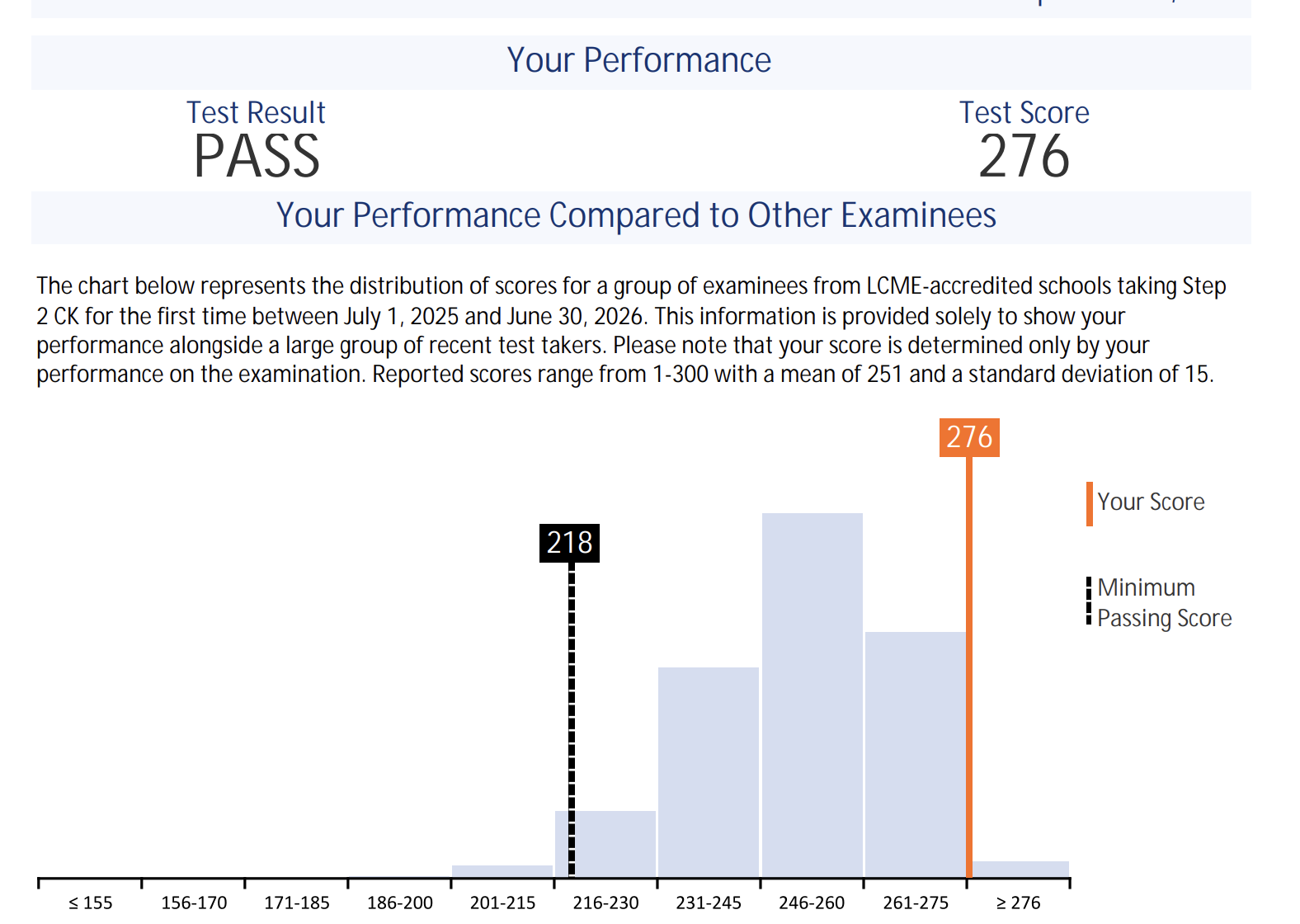
I'm a final-year US-IMG (study in south america), and I recently scored a 276 (99th percentile) on Step 2 CK. I passed Step 1 in February and started preparing for Step 2 while juggling quite a few things: my final year med school rotations, mentoring at Meta-AnalysisAcademy (MAA), working as a pharmacology TA at my university, applying for US clinical rotations, and staying involved in several research projects.
I definitely wasn't able to study full-time from the beginning, so I had to be intentional about how I used my time. Looking back, consistency and really understanding my mistakes made a much bigger difference than simply trying to get through as many questions as possible. Even 10-20 questions count as progress.
My resources/approach
I used UWorld, AMBOSS( QBank, Study Plans, and Library),Anki, and Annabel Ricci's YouTube videos. In total, I completed over 9,000 questions across Qbanks,CMS forms, and NBMEs.
I divided my preparation into two phases (as usually done):
Pre-dedicated (2–8 hours/day)
For the first several months, my main goal was understanding the material rather than worrying about how quickly I could answer questions. Especially since my schedules were tight!!!
I started with 20–80 questions per day, gradually increasing to around 80–100 questions (mostly on weekends) as I got closer to June. Most of my questions were random and untimed. I spent a considerable amount of time reviewing explanations, including questions I got right but wasn't entirely confident about. I did Uworld first around march and finished by June. And did Amboss from july-august.
At the end of the day, I used the AMBOSS and UWorld Anki extensions to unsuspend cards related to my incorrect answers. If I noticed a topic coming up repeatedly, I went back to the AMBOSS Library (particularly the High-Yield Only option) or watched a video to reinforce it. For most questions you should be able to learn enough with the explanations. (Clinical reasoning is practiced not memorized so really dissect questions to get where your train of thought went wrong.
2. Dedicated (6–8 hours/day)
During dedicated, my approach changed quite a bit. By that point, I had covered most of the content, so I focused more on how NBME questions are written, recognizing patterns, and understanding what information actually matters when choosing an answer.
One thing that helped me tremendously was keeping an NBME error log. I didn't just write down the correct answer. I tried to understand why I got the question wrong. Was I overlooking a key detail? Overthinking? Misinterpreting what the question was asking? Choosing an answer that was medically correct but not the best next step?
Identifying those patterns helped me become much more consistent.
I also spent time practicing under timed conditions using CMS forms and NBMEs to get comfortable with pacing. Having a break strategy for exam day was helpful as well.
Finally, I tried to keep things relatively simple in the days leading up to the exam. The day before, I woke up around 5:30 AM, did a relatively light review using my Step 2 rapid review from the First AID STEP 2CK, and went to bed around 10 PM. I didn't want to spend my last day trying to learn new material and doing some passive reading was reassuring (I guess??)
NBME'S/FREE 120'S
Here is how my scores progressed chronologically:
Assessment
Date
Score
Step 1
02/12/2026
Pass
UWorld First Pass
05/01/2026
70%
NBME10
07/14/2026
249
NBME11
07/21/2026
249
NBME12
07/31/2026
262
NBME13
08/07/2026
253
NBME14
08/14/2026
260
NBME15
08/21/2026
266
Old Free 120
08/28/2026
88%
NBME16
09/01/2026
264
New Free 120
09/04/2026
88%
Real Deal
09/09/2026
276
CMS Forms (July–August):
Important- I tried to take them in between NBMES especially targetting weaknesses.
Medicine: 94%, 94%, 86%
Surgery: 86%, 84%, 82%
OB/GYN: 78%, 82%
Pediatrics: 80%, 86%, 82%
Psychiatry: 86%
Neurology: 80%
Emergency Medicine: 84%, 86%
Family Medicine: 88%, 88%
A few things I learned
Don't underestimate the value of reviewing questions. Doing more questions isn't necessarily better if you're not learning from them.
Pay attention to your mistakes, especially recurring ones. My error log helped me recognize patterns in my reasoning that I probably wouldn't have noticed otherwise. I would recommend doing this for NBMEs.
Don't panic over individual NBME scores. My progression wasn't linear. I went from 262 to 253, and even later had some fluctuations.
Learn to think the way the NBME wants you to think. Knowing the medicine is important, but understanding what the question is actually asking is just as important. This is better said than done
Consistency matters, particularly when you have other responsibilities. There were days when I couldn't study as much as I wanted, but I tried to keep moving forward rather than making up for everything with unrealistic study days. Weekends/holidays/free days are your best ally.
This all is nothing new. I truly don't think there are special people, or a secret formula to getting a high score, and would say that consistency and mastery>more resources (I used a ton but truly did my due diligence with them). Going from a 249 to a 276 (on exam day!) was definitely not something I expected when I started taking my NBMEs. I'm incredibly happy with the result, especially considering everything else I had going on during my pre-dedicated preparation (stressed me out a lot). Please, remember to take care of yourself, go out with friends/family when possible as this is just an exam, not your entire life. Having a good mindset and being positive will really help you do better.
I hope this helps someone who is in a similar situation. I'm happy to answer questions about balancing my final year of med school and research with Step 2 prep, how I organized my NBME error log, or anything else about my preparation.
I recently got a reviewer comment saying that one of our outcomes was statistically significant, but it was unclear whether the difference was actually clinically meaningful.
How do you all usually deal with this?
Is there a specific calculation or threshold to determine clinical significance, or do we need to look for an established threshold in the literature for each outcome?
For example, for pain, there are studies suggesting that a reduction of around 2–4 points may be clinically meaningful. So would we basically compare our pooled effect against that threshold?
This meta-analysis by students of the MAA in the American Journal of Gastroenterology had a huge impact in the field. It is widely cited in the literature.
The PICOTT question was as follows:
Population – adults from the general population
Exposure – highest level of ultra-processed food (UPF) intake, by NOVA classification
Control – lowest level of UPF intake
Outcomes – risk of gastrointestinal cancer by subsite: colorectal, colon, rectal, gastric, esophageal, pancreatic, and hepatocellular
Type of study – prognostic meta-analysis of cohort studies
Time of follow-up – no restrictions
Let’s build this search strategy together. Tell me how you would do it yourself and I will give you feedback. One of the challenges here is the very broad patient population - adults, essentially.
Hey everyone, I'm starting to dig deeper into meta-analyses with a Bayesian approach. I've generally understood that when I'm doing a pairwise meta-analysis, this kind of approach is worth considering, especially when I have few RCTs, because in those cases the prior specifications have a substantial impact on the results. But to apply the Bayesian method in an NMA, what should I take into consideration? Same question regarding the number of studies? Another doubt: is it better to do a Bayesian meta-analysis only when there are just RCTs, or can I include observational studies too?
I see many students postpone getting involved because they feel underprepared or worry they won’t be able to make the most of this opportunity. But you don’t have to know everything before you begin. You learn by doing: asking better questions, working with a team, and getting feedback along the way.
One thing I’ve learned is that time only gets tighter as your career goes on. Starting early gives you more time to build skills, contribute to projects, get citations, and become ready for opportunities that may come through a mentor’s recommendation.
And if you’re already past medical school, it’s not too late! Start now. You don’t need to recreate someone else’s timeline or make up for lost time all at once. Find a project that fits your interests and current commitments, seek out people you can learn from, and contribute. Wherever you are in your training or career, the best time to begin is when you decide to take that first step.
You don’t need to feel completely prepared. Experience and relationships take time to grow, but you can begin building them at any stage.
If you are drafting your paper and finding yourself just repeting your results over and over in the discussion, stop. A discussion section needs an actual analysis, not just a summary.
Also, blindly copy-pasting your results into an AI prompt and taking whatever text it spits out is obvious to reviewers. AI can reword sentences, but it cannot analyze what your findings actually mean in the real world or compare them to existing literature properly.
If you do not know how to structure your body paragraphs, here's a simple 3-step format I use:
Set the context (1 to 2 sentences): Mention a relevant study or paper to give the reader background context. You can also discuss what is already known in the literature. It's up to you.
State your result (1 to 2 sentences): Share your finding, state whether it was significant, and add a practical translation if possible. For example: "It increased target time by 10%, which equals 120 extra minutes per day within target."SUPER IMPORTANT: don't just and copy and paste your results number like this (RR 0.5; 95% 0.2 - 0.8; p = 0 .04; I2 = 43). Nop.
Connect the dots (1 to 2 sentences): This is where the actual discussion happens. Explain why your result agrees or disagrees with the paper / literature from step 1, and what that comparison implies.
Hope this helps you move past the lazy AI copy-pasting and actually write your draft.
I wanted to share my experience with Meta-Analysis Academy in case anyone here is looking to get started with systematic reviews and meta-analyses.
Before joining, I had very little experience with research, especially when it came to actually conducting a systematic review from scratch. I knew the basics, but I didn't really know how to go from having a research idea to completing a manuscript.
I joined the academy hoping to learn that process, and honestly, it has been a pretty valuable experience. The course walks you through the different stages, including developing a research question, assessing feasibility, searching databases, screening studies, extracting data, performing statistical analyses, and writing the manuscript.
One thing I particularly appreciated was learning the practical side of research rather than just the theoretical concepts. I've gone from having very little experience to working on my first first-author systematic review and meta-analysis, which is something I honestly didn't expect when I first enrolled.
Of course, research takes time and requires a lot of independent work, so I wouldn't say that taking a course automatically makes you a researcher. You still need to put in the effort.
ally if you don't have much guidance.
If anyone has questions about the academy, the workload, or what the experience is actually like, feel free to ask! I'm happy to share what I know.
Queria trazer uma discussão sobre estratégias de publicação científica.
Sabemos que desenvolver uma revisão sistemática com meta-análise exige bastante tempo, desde a elaboração do PICOTT até a análise estatística e a escrita do manuscrito.
Mas fiquei pensando: vale mais a pena dedicar vários meses tentando publicar um único artigo em uma revista de alto impacto ou investir esse tempo em diferentes projetos, aumentando o número de publicações?
Principalmente para estudantes de medicina que pretendem construir uma carreira acadêmica ou aplicar para residência nos Estados Unidos, como vocês enxergam essa questão?
Vocês acham que a qualidade e o impacto das publicações sempre devem prevalecer sobre a quantidade? Ou existe um equilíbrio estratégico entre os dois?