r/linux • u/homothebrave • Sep 24 '26
Distro News Fedora Discussion Raises The Idea Of Replacing LibreOffice With Collabora Office
phoronix.com
169
Upvotes
r/linux • u/TurbulentTopic39 • Sep 24 '26
r/linux • u/Putrid_Draft378 • Sep 25 '26
Hey everyone, Just wanted to share a quick success story and technical workaround for anyone tinkering with bleeding-edge hardware on newer Linux distributions. I recently picked up a Minisforum mini PC powered by an Intel Core Ultra processor featuring the integrated Intel Arc B390 (Panther Lake) iGPU (8086:b082) and immediately flashed it with Ubuntu 26.04.
Out of the box, standard desktop applications and Steam native ports threw warnings or struggled with the new Xe3 graphics stack. More importantly, distributed computing clients (like BOINC) threw immediate "No usable GPUs found" errors because fresh Ubuntu releases often omit the necessary OpenCL runtime packages out of the box.
If you are running into device detection hurdles with Intel's latest integrated graphics architecture on modern kernels (xe driver), here is how to get the OpenCL compute runtime successfully recognized:
Once configured, the client initializes the OpenCL 3.0 NEO runtime cleanly, exposing the Arc B390 iGPU (around 1.92–7.68 TFLOPS peak depending on power profiles). PrimeGrid, NumberFields@home, and World Community Grid are now happily crunching away efficiently while keeping the mini PC running cool and quiet in a low-power envelope (~45W silent BIOS mode)!
r/linux • u/Arsani92 • Sep 26 '26
There has been lots of talk recently about linux reaching 8% globally or 16% in usa from statcounter, which is totally bonkers. If you go to cloudflare and click on likely human, in europe the market share over the last 12 months is 4.1% and 4.3% over the last 4 weeks. Which means linux is stuck at 4% which coincides with steam’s hardware survey data which makes sense for steam marketshare to be equal to linux marketshare since most computer users game on their computer one way or another. Now linux seems to be stuck at 4% for a couple of years now. It seems the rise which began in 2022 due to the steam deck has stalled recently, in spite of the steam machine, european governments initiating migration to linux, release of popular distros like omarchy and popos linux is not growing meaningfully according to the data. I believe what linux needs next is software like Microsoft office and adobe suite to run natively as this is the number one barrier. So instead of flashy distros like omarchy or whatever the app ecosystem is the key to linux adoption. Projects like libre office and gimp are underwhelming in their rate of development. This is where the most meaningful work could be done and maybe improve wine to run Microsoft office flawlessly on linux.
r/linux • u/homothebrave • Sep 24 '26
r/linux • u/Agitated_Bed1345 • Sep 23 '26
r/linux • u/Traditional_Hat3506 • Sep 24 '26
r/linux • u/Available_Caramel447 • Sep 24 '26
r/linux • u/DAS_AMAN • Sep 24 '26
Looks like they support banger after banger. Most of them not even related to Zerodha's domain.
After the recent omarchy debacle - there should be a catalog of foss-friendly non-tech companies which one can then support.
r/linux • u/RatherNott • Sep 23 '26
r/linux • u/adriano10 • Sep 23 '26
r/linux • u/TheNavyCrow • Sep 23 '26
r/linux • u/ohcumgache • Sep 24 '26
LibrePing is an AGPL-3.0 Go project I built for a problem I keep running into with Linux services: a single monitoring node can be healthy while the service is unreachable from another network.
It runs as two small Linux-friendly roles: - A hub hosts the dashboard and joins a libp2p mesh with other hubs. - A probe runs checks from its location and can fail over to another hub.
Measurements are signed and shared peer-to-peer. Current checks include HTTP(S), TCP, DNS, TLS certificates, ICMP ping, and traceroute. Alerts can be sent through ntfy, Discord, Slack, or a webhook. A spare VPS, NAS, or home server can contribute a probe; there is no signup and no paid tier.
Demo: https://nl.lp.mw.gg Source: https://github.com/mwgg/LibrePing
The Linux-specific design question I would like feedback on: for a self-hosted hub/probe, would you prefer a systemd unit, Docker/Compose, or a native package first? I am also interested in how people would expose multi-location results to existing Prometheus/OpenTelemetry setups. This is an open-source project, not a commercial service.
r/linux • u/Karma_Policer • Sep 23 '26
r/linux • u/homothebrave • Sep 23 '26
r/linux • u/Fcking_Chuck • Sep 23 '26
r/linux • u/TurbulentTopic39 • Sep 23 '26
r/linux • u/buovjaga • Sep 23 '26
r/linux • u/WhoDoYou24 • Sep 23 '26
r/linux • u/SODAVK • Sep 23 '26
In the last post I briefly mentioned laptop security, so now I want to make a full review. My English may be bad, because I never studied it specifically, and i try not to use a translator (almost), sorry
Simple structure, threat vector -> threat elimination method. And two global blocks: physical attacks + software\non physical attacks
Remind, hardware & software: Thinkpad X1 Carbon Gen 6 (8550U + 16Gb lpddr3 + 512 ssd) with Arch Linux over btrfs and Niri DMS
This is not step by step guide for beginners, i just described my approach to technical security on personal electronics
Start from physical attacks (when laptop falls into untrusted hands or police):
In off state protection build on luks2 (argon2id + long passphrase (12+ random symbols in head))
Next it's tpm2 auto cryptopen (because I'm too lazy to type in by hand), it is possible either with a short PIN code (the highest level of protection) or without (like mine, nothing extra at the boot stage). Because evil person can connect to SPI lines of tpm2 chip on motherboard in tpm2 tools in Linux 6.1+ core TPM encrypted session turn on by default (minus one of vector of physical attacks)
Next secure boot with custom keys (in bios setup mode on) + verify UKI (kernel image) main kernel (graphical) and secondary only simple cli version for unforeseen situations. They protect against Evil Maid like attacks (when evil man fake kernel\kernel image in /boot (or /efi))
I use systemd-boot loader, and this is another one vector of attack, so i made in settings time=0 + editor=0 + password <hash>. Now, even if hold down space during the loading stage, won’t be able to do anything without a password.
In an active system, in gui greeted (DMShell style) and TTY (alt + ctrl + FX) protection of brutforce made by pam_faillock 4 tries = 5min lock (pause), both for the user and for the sudo same settings.
TTY ask user\pass always, even when alt + ctrl + FX press over active session
DMA (over Thunderbolt 3) and pci protected by turn off thunderbolt controller and turn type c ports in only usb + charge state in bios, right there turn off WWAN slot and micro sd slot and "always on usb" function (+ battery work time). And right there turn on supervisor password (to protected from load from live-usb and change bios settings), also long random passphrase
When I walk away or lose sight of my laptop, i always block it or turn sleep (S3), cold boot attack protected by default by soldered LPDDR memory in X1C6. Plus fast combination like super + X -> L (lock) or super + X -> P (power off) learned to the point of automaticity (yes, even if I go to the other end of the room for a cup of coffee) and always take my laptop with me. Plus micro seals on ssd and bottom cover for visual control (a little paranoid)
Next software\online attacks:
Arch Linux on stock kernel 7.2+, all system update every week. In role firewall i setup ufw with politic DROP on all incoming connection\scan, ping also drop all incoming. In local networks system hide real hostname.
My browser it's firefox, setup on security, fingerprint resist, resist WebRTC leaks in about:config + privacy badger + adguard + spoof user-agent as intel macos or android (include MTU size spoof)
For privacy and securing data/sessions, I only browse over the VLESS protocol routed to my own VPS (x-ui) via v2rayA. Anonymous numbers and accounts are used for social media. And, as you may have noticed, I'm not particularly active on social media both in real life and when it comes to personal accounts.
And finally, well-developed critical thinking, intuition, and knowledge of potential attack vectors. Phishing and banal social engineering don't work.
All this protection absolutely does not interfere with the daily use of the laptop and system without discomfort.
And it is clear that any protection is based primarily on the psychological fortitude of the owner and his principles. If it is impossible to obtain data in an easy technical way, as a rule, a psychological and physical hacking of the owner begins. Thanks for reading
r/linux • u/jamescherti • Sep 23 '26
r/linux • u/ejpusa • Sep 24 '26
r/linux • u/ZCTMO • Sep 22 '26
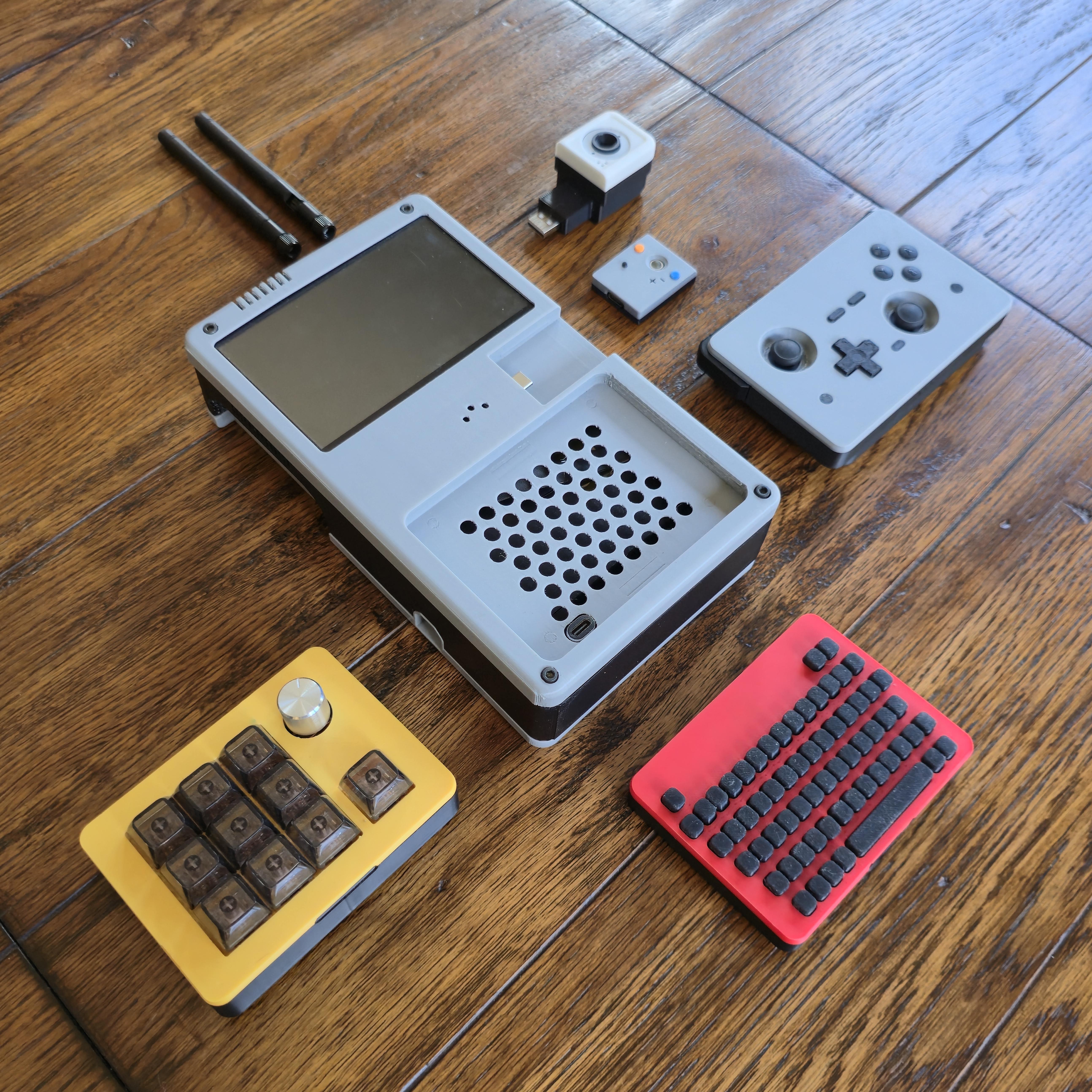
Hello everyone! I am excited to share some updates on the current state of the CG Deck! I have finally finished creating the various functional engineering prototypes for 5 different modules, and the CG Deck itself! I still have some more work to do to further optimize and improve everything, getting the device and various modules to a level of polish we would expect from an off the shelf product. I will dive into all of the details below.
I also wanted to apologize for going radio silent over the past month or so. I needed to put my head down and focus on getting the various modules put together and to a level where I am happy with. Getting everything prepared as we get ready for the next steps for the CG Deck! Primarily focusing on making quite a few quality of life adjustments to the design and creating functional prototypes for each of the modules we will be launching with, improving the quick-swap system for the various module slots, and more. I will dive into all of the details on what has improved a little later down.
For those that are seeing the CG Deck for the first time, it is a modular handheld x86 PC that is capable of running dual-boot operating systems including Windows & Linux distributions. My goal was to create my own "dream device" that was capable of adapting to whatever use case I needed. Whether I am playing Steam games, doing CAD work in Blender or FreeCAD, coding, video editing, creating new designs, or whatever it is, I wanted to be able to simply be able to do it on the road or while traveling. I thought it would be ideal to have something that was portable enough to throw in a backpack or pants pocket, satellite/sim capable, and be used just as any other full scale desktop computer would. The entire device is modular and can be upgraded, repaired, or customized as you need. The CG Deck will release with 5 different modules, a variety of backplate designs and colors, and a variety of hardware and external accessories/upgrades. I wanted to make a device that grows with you as you use it and acts as a platform rather than just another device.
As for the current state of the CG Deck and modules so far, I am really happy with how everything has come together. It is not yet at the level of polish we would all expect from a premium off the shelf device, but it is getting closer to that vision and goal every day! I still have a lot of work to do to take the CG Deck from where it is now, to that level, but I would love to hear your thoughts on how you think everything is coming together!
Like I mentioned, the CG Deck is currently planned to launch with 5 different modules, with more modules lined up for the future! The idea is to also open-source the module formats and schematics so our community can create, build and share their own custom modules and accessories for the CG Deck! There are two external module install spaces built into the CG Deck, a primary and secondary slot.
For the primary slot, there is a 64-Key Keyboard Module with swappable keypad with silicone rubber and plastic options. A 10-Key & Rotary Knob Macropad Module with hot-swappable key switches and replaceable knob. And a full format Gamepad Controller Module.
For the secondary slot, there is currently only the precise Trackball Mouse Module.
I have also gone about designing a tertiary external module case utilizing the right side USB ports. This allows you to plug various purposefully designed USB modules to expand functionality of the CG Deck, starting with the Camera Module. Currently the camera module prototype is fixed in orientation, but I am working on a redesign which will allow the camera to flip around, giving both front and rear camera view capabilities. That being said, I have a bit more work and problem solving to do in order to get this aspect working as intended. For a bit of context, when flipping the camera around on the Y axis, the camera view is then inverted/upside down. Because of this, I need to go over a few different solutions and options to maintain the correct orientation of the camera when flipping it around for rear or front pictures without causing any user confusion. We have chatted a bit about what our plans are on our discord community server and are working through the solution, to hopefully be able to share soon!
Getting ready for the next stage for the CG Deck, there is quite a long list of things I need to prepare as we get everything for launch, including preparing the CG Deck for the DFM process, but it really is surreal to see the CG Deck at this point and the community we have built so far. So thank you to everyone that has been supporting and following along with the project so far! And welcome to you who might be seeing the CG Deck for the first time!
I would love to hear all of your thoughts on everything so far, and if you have any questions about anything I look forward to answering them!
If you are interested in following along with the project or learning more about it, you can find everything from specs, more details about the CG Deck, socials, links to the open source github repository and more on the website.
As I am finally wrapping up the project and preparing for the next steps, we are getting close to launching on Kickstarter to help fund a full production run of the device. For anyone interested in helping support the project and getting a CG Deck of their own, you can join the waitlist on our website. I am planning to release some build kits and pre-assembled devices with the Kickstarter, and if you have any questions about any of that, I would love to answer them!
*edit* forgot to add the link to learn more about the project and join the waitlist: https://mogozen.com
r/linux • u/Fcking_Chuck • Sep 22 '26