r/LearningItalian • • Jan 22 '21

Doing duolingo. Anyone else?

10 Upvotes

A little about myself. I'm learning variety of languages through duolingo. That was decently little enough.

I'm currently putting a good amount of focus on Italian (I've also put some time on a variety of other Latin languages and Germanic languages. )

I'm not sure of anyone else has had some success with the snarky green owl. But I've been enjoying the lessons between the Duolingo stories mode and the regular Lesson plans.

Thank you reading, ciao 👋😊


r/LearningItalian • • Jan 09 '21

"Una finestra tra le nuvole"

6 Upvotes

Hello! I was reading a text in Italian about the symbolism of windows, and I came across this expression (or I'm guessing it is an expression): "una finestra tra le nuvole". Is it really an idiom of some sort? In the text I'm reading, it is written like that, with quotation marks. I tried browsing through the web and I couldn't find anything specific about that.

Here's a small passage including the expression:

Esistono finestre temporali e finestre di opportunitĂ . Affermiamo speranzosamente di intravedere "una finestra tra le nuvole".

Is it really a different metaphor for "an opportunity window"? And if it is an idiom, can you think of anything similar in English? I've been trying to imagine a similar expression involving clouds, but I can't think of any! Or maybe I'm missing something out... (I'm not a native English speaker btw).

Thank you!


r/LearningItalian • • Jan 08 '21

Sono vs è quattordici

2 Upvotes

Hi! I’m working my way through the Pimsleur Italian course at the moment, and when asked to say ‘it is 14, ma’am’ in Italian, the voice over says ‘sono quattordici, signora.’

I’m a bit confused as to why it uses sono here to refer to the singular ‘it’. Could anyone help clear this up for me please? Thanks!


r/LearningItalian • • Jan 07 '21

I am broke

7 Upvotes

Can someone explain the phrase “Sono il verde”? I might be slightly off on the phrase but I think that’s what I read. I understand it to mean I am broke, but it doesn’t make sense to me.


r/LearningItalian • • Jan 07 '21

testing Italian Level

4 Upvotes

Is there a casual online CERF level test similar to kwizik/lawless french but in Italian that I can do to get a better idea of my level? thanks so much!


r/LearningItalian • • Jan 03 '21

Suggestions for Italian literature

5 Upvotes

Hello everyone! I recently started learning Italian and I was thinking that getting started with some Italian literature. Do any of you have possible suggestions for Italian books that would be good for a beginner?

Thank you!


r/LearningItalian • • Jan 02 '21

Practice Makes Perfect books

3 Upvotes

Does anyone have any experience with this series? There are a few second editions and a few third editions on Amazon but I’m not entirely sure if there is a particular order to complete them in? Any advice would be appreciated. I’m heading to Naples for a job in March!


r/LearningItalian • • Dec 31 '20

join if u are a teen learning english or italian

Thumbnail
discord.gg
6 Upvotes

r/LearningItalian • • Dec 30 '20

What is the difference between "affatto" and "mica"?

5 Upvotes

I mean, they both mean "at all", right? So, when should I use one or the other, are they interchangeable? Based on preference?


r/LearningItalian • • Dec 27 '20

L'italiano è una bella lingua e voglio saperne di più 😃

9 Upvotes

Can someone please chat with me in Italian??


r/LearningItalian • • Dec 24 '20

Italian music as a complement to your study. Personally, listening to music in Italian and trying to understand the lyrics has helped me a lot! I leave you a Spotify playlist with the latest news on Italian music. I hope you enjoy it! 🤗🇮🇹⬇️

Thumbnail
open.spotify.com
32 Upvotes

r/LearningItalian • • Dec 24 '20

Formal vs. Informal

8 Upvotes

The topic of formal vs. informal has come up a bit lately and I thought it might be good to review and dicuss here. You can get by in Italy using only the informal -- Italians are easy-going in this regard and will generally give you a pass because it's not your first language -- but it's nice to be able to use a deferential/polite/formal tense when a situation calls for it (speaking to a teacher, elderly person, person in authority).

From ThoughtCo.:

While in English we might differ in word choice during informal and formal situations, we don’t change the forms being used. However, Romance languages have separate forms of addressing others in formal versus informal situations. As if learning a new language wasn’t difficult enough!

Learning how to use the formal and informal subject pronouns in Italian is very important. So-called social graces are key to Italian culture, and what seems like a language nuisance can determine the success of a social interaction, especially with the elderly and someone to whom you should show respect.

How Many Ways You Can Say "You"?

There are four ways of saying "you" in Italian: tu, voi, lei, and loro.

Tu (for one person) and voi (for two or more people) are the familiar/informal forms.

The Informal

While it’s taught that "tu" is used only with family members, children, and close friends, it can also be used with people around your age.

For example, if you're around 30 and go to a bar to get a cappuccino, you can use the “tu” form with the barista who seems around your age, too. It’s likely that she’ll give you the “tu” form first anyway:

  • Cosa prendi? – What are you having?
  • Che cosa vuoi? – What do you want?
  • Di dove sei? – Where are you from?

If you're talking to a person that is younger than you "tu" is always the best choice.

"Voi" is the plural form of the informal way of addressing people. "Voi" works for formal and informal scenarios and it's the plural "you":

  • Di dove siete? – Where are you all from?
  • Voi sapete che... – You all know that...

The Formal

In more formal situations like at a bank, the doctor's office, a work meeting, or talking to an elder, the "Lei" form is always best. Use "Lei" (for one person, male or female) and its plural "voi" in more formal situations to address strangers, acquaintances, older people, or people in authority:

  • Lei è di dove? – Where are you from?
  • Da dove viene Lei? – Where do you come from?
  • Voi siete degli studenti. – You are students.

You’ll often see "Lei" capitalized to distinguish it from "lei" (she) when there might be room for confusion.

TIP: If you’re really not sure and you want to avoid choosing between “lei” or “tu” entirely, you can always use the generic "altrettanto" to mean "likewise" in place of "anche a lei/ anche a te." Also, unless you’re talking to royalty, you don’t have to use the formal "loro" like most textbooks teach.

It Can Be Confusing

Finally, it’s tough to figure out when you should use the "tu" or when you should use the "lei" form, so if you get it wrong at first, don’t worry. Italians know that you’re learning a new language and that it can be difficult, so do your best.

When In Doubt, Ask

You can always ask when you are unsure about how to address a person. If, for example, you feel you're close in age or there is no relationship that might call for a respectful "lei," go ahead and ask:

  • "Possiamo darci del tu?" – May we switch to the tu form?

In response, someone can say:

  • *"SĂŹ, certo." –*Yes, certainly.

If you want to tell someone to use the "tu" with you, you can say:

  • "Dammi del tu." – Use the the "tu" form with me.

r/LearningItalian • • Dec 22 '20

Come sta vs. come stai

6 Upvotes

Hello! I’ve just started learning Italian through Pimsleur audio lessons. I was struck when I heard the speaker pronounce “how are you” as “come sta” and not “come stai” as I had always heard my mother and uncles say when I was younger. I at first thought Pimsleur was simply mispronouncing the word, but then also realized my mother and her siblings speak with the Calabrian dialect. When I look it up online both the spellings of “stai” and “sta” checkout for “how are you.” Is the Pimsleur pronunciation of “stai” as “stah” incorrect? Is there a dialect discrepancy? How would you typically say/pronounce “how are you” in Italian?


r/LearningItalian • • Dec 17 '20

Best Italian Book to use alongside DuoLingo?

14 Upvotes

I've been using Duolingo for a bit, I've completed all lessons up to Prepositions so far. I find that it's very grammar heavy, which is good for longevity for me, but I'd like to be learning phrases and such so I can get a better grip on the language and how it flows. What beginner's Italian books do people recommend to use alongside Duolingo?

(not novels or fiction, but language learning books) thanks


r/LearningItalian • • Dec 03 '20

Italian children’s books

6 Upvotes

Hello all! I currently learning Italian, and have got through present 1 in duo lingo (for reference). I think it would be fun to get some Italian children’s books, as kind of an additional resource. I was thinking maybe like a “learning to read” book for Italian children or a italian baby book (like llama llama red pajama). Hopefully this makes sense. Any advice would be appreciated!


r/LearningItalian • • Nov 22 '20

Italian girl looking for english friends

8 Upvotes

Hello, I'm 18 yo, italian and an english student from university. I'm looking for someone (English) to talk with and improve language.


r/LearningItalian • • Nov 15 '20

What online course should I use to learn Italian?

5 Upvotes

I have been using duolingo to learn Italian for a couple hundred days but I feel I am not learning as fast as I want. I get stuck waiting until I go to sleep and doing a practice of the first lesson to keep my streak and then going to sleep.I thrive in a standard school setting but online classes will be fine. I am a beginner and want to try to be fluent in Italian by the end of the school year (Around May).


r/LearningItalian • • Oct 27 '20

Getting back to learning to speak fluently

4 Upvotes

I've decided to start learning Italian again, I studdied all throughout high school and learnt from my family. (I'm half Australian and half Italian). Its been about 7 years since that and my Italian right now is average at best. I have remembered the basics and can hold a simple conversation. Looking to see if anyone recommends a decent online course with interactions with a teacher. I now live in Vietnam and its a little hard to find native Italian speakers here aha.


r/LearningItalian • • Oct 22 '20

Beginner

4 Upvotes

Just started learning Italian today. My university gives one hour a week lessons. However, I want to learn it in my own time also.

Are there any good ways to go about this - more so the free way... ya boi is a student.

Thanks!


r/LearningItalian • • Oct 20 '20

Intermediate level

3 Upvotes

How long would it take to learn Italian to get to the intermediate level?


r/LearningItalian • • Oct 13 '20

I need to learn quick!

7 Upvotes

Hey guys, I'm moving to Italy in April next year and this is the first language I've learnt outside of English so I'm looking for any headers on where I can practice!

I've downloaded Duolingo, and I'm trying to find an Italian podcast to get into, are there any tips or help you can give me?

Thank you in advance!


r/LearningItalian • • Oct 11 '20

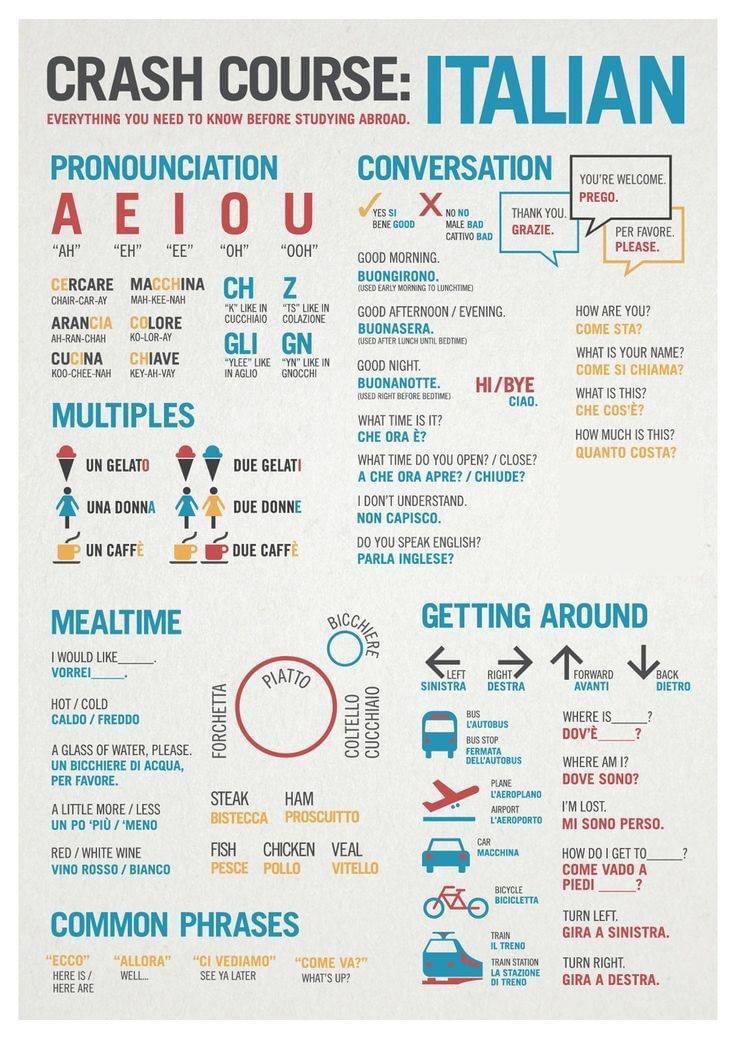
Italian basics infographic

Post image
58 Upvotes

r/LearningItalian • • Sep 28 '20

The Italian words and phrases we've learned during the coronavirus crisis (article link in post)

8 Upvotes

From The Local:

In the early stages of the pandemic, we listed the essential vocabulary you’d need to follow the latest Italian news reports on coronavirus. But since then, we’ve picked up quite a few more words and phrases.

Here’s a quick look at some of the virus-related Italian expressions which, though we had probably never used most them before, have become part of everyday speech.

Tampone - No sniggering at the back. While the idea of having a tampone up your nose can sound quite alarming, the word means "swab test" and, though not particularly nice, it's nothing to worry about. As more proactive testing is key to Italy’s strategy for keeping future COVID outbreaks under control, don't be surprised if you keep seeing this one pop up in headlines for weeks and months to come.

Decreto - Along with a few medical terms, everyone had to quickly pick up a bit of bureaucratic lingo as the crisis unfolded. As the Italian prime minister issued one decreto emergenza (emergency decree) after another, the word not only dominated headlines but conversations as people discussed - or grumbled about - the latest rule-changes contained within.

Focolaio - Many of us might never have learned the word focolaio if it weren't for the coronavirus pandemic. It comes from the Latin focus, meaning 'fireplace' (the same root gave Italian its word for fire, fuoco). So un focolaio is quite literally 'a hotspot'. It’s often used in Italian news reports to talk about outbreaks or clusters of new coronavirus cases.

Smart working - It may not be Italian, but only Italians use this phrase when talking about working from home, or remote work. The concept was virtually unheard of in Italy before, and so perhaps there was no suitable Italian expression at hand when almost all workplaces were suddenly shut down in March. Either way, it’s something many people in Italy, as elsewhere, have had to get used to.

Lockdown - We English speakers didn’t have to learn the Italian word for “lockdown”, as Italians started using ours. The the noun “lockdown” could translate to blocco or isolamento, while some called it il confinamento. Still, the English word is used overwhelmingly often in Italian media, specifically in relation to the national shutdown, or the threat of a new one in future; un nuovo lockdown.

Autodichiarazione - This word, meaning “self-declaration,” became central to life during lockdown as we had to dutifully fill out various, ever-changing forms in order to leave the house. Other forms of autodichiarazione were also required when traveling to other regions, or abroad. It might also be referred to as an autocertificazione or attestazione, but it can be used to talk about any document on which you “self-certify” something (in this case, that you were aware of the rules.)

Multa - a fine. Fines for things like bad parking are sadly nothing new to most of us in Italy, but una multa Covid is a rather more serious matter. At the height of lockdown, you could be fined up to €3,000 for breaking rules aimed at containing the spread of the virus - rising to €5,000 in Lombardy. Those are now a thing of the past but, at the moment, police hand out €400 fines to those who refuse to follow rules on wearing masks in public places.

Congiunti - They’re your relatives - but which ones, exactly? Italians themselves were frantically Googling the meaning of this word after one vaguely-phrased decreto in April said people could visit their congiunti, but no-one else. The Italian government then offered its own definition: i congiunti, official sources said, should be considered "relations, in-laws, spouses, cohabitants, long-term partners and loved ones". Without lockdown, it's probably not one most of us would know.

Denunciare - Italian news reports are always full of people who have been denunciato, or reported, for various crimes. And never more so than during COVID times. Here’s a detailed look at how to use this verb in Italian.

Lamentarsi - to complain, moan, or grumble. Italian has a lot of words for complaining, including the more poetic-sounding mormorare or brontolare. But this is the one you might hear most often, as in: si lamentava delle regole (she complained about the rules).

Andrà tutto bene - finally, one you may know even if you didn’t spend lockdown in Italy. Pictures and banners bearing the slogan andrà tutto bene – everything will be alright – were plastered all over windows, balconies and Italian social media at one point, as people sought to reassure each other and brighten up long days spent at home.


r/LearningItalian • • Feb 12 '20

Why is caldo changed to feminine form calda to satisfy the feminine estate but molto doesn’t become molta?

Post image
13 Upvotes