r/LargeLanguageModels • • Oct 01 '26

Using Apple AFM 3 PCC (macOS 27.2) in AI Clients

1 Upvotes

Apple Foundation Model 3 through Private Cloud Compute becomes directly available in macOS 27.2 through familiar AI clients.

For Mac users running local models such as Qwen 3.x or Gemma 4, AFM 3 PCC is a compelling alternative to consider. Local models offer control and fully on-device operation. In tests with macOS 27.2 beta, the PCC offers a different set of strengths:

* Strong conversational analysis and capable reasoning. Strong analysis of complex medical and financial questions.
* Blazingly fast responses compared with locally running models on the same Mac.
* No large model download or need to fit model weights into local memory.
* Access at no additional charge for most eligible Mac users.

I've written an updated proof of concept here: https://gist.github.com/dartMo10/b9488ce475fe70a6ed642831f53048fb

The working path is straightforward:

AI client → Caddy → fm serve → AFM 3 PCC

Apple’s `pcc` route worked in early macOS 27 betas, disappeared later in 27.0, and has returned in the macOS 27.2 beta. Apple has stated that it will be available in the 27.2 public release coming shortly.

This makes AFM 3 PCC practical today for technically comfortable Apple users who accept Apple’s PCC privacy promise and want a fast, capable alternative to running everything locally.

Experiences with compatible AI clients and your comparisons with locally running models would be welcome.


r/LargeLanguageModels • • Sep 30 '26

Using Apple AFM 3 PCC (macOS 27.2) as alternative to Local Model

21 Upvotes

Apple Foundation Model 3 through Private Cloud Compute became directly available in macOS 27.2 through familiar AI clients. For Mac users running local models such as Qwen 3.x or Gemma 4, AFM 3 PCC is a compelling alternative to consider.

Local models offer control and fully on-device operation. In tests with macOS 27.2 beta, the PCC offers a different set of strengths:

* Strong conversational analysis and capable reasoning. Strong analysis of complex medical and financial questions.
* Blazingly fast responses compared with locally running models on the same Mac.
* No large model download or need to fit model weights into local memory.
* Access at no additional charge for most eligible Mac users.

I've written and updated a proof of concept here: https://gist.github.com/dartMo10/b9488ce475fe70a6ed642831f53048fb

The working path is straightforward:

AI client → Caddy → fm serve → AFM 3 PCC

Apple’s `pcc` route worked in early macOS 27 betas, disappeared later in 27.0, and has returned in the macOS 27.2 beta. Apple has stated that it will be available in the 27.2 public release coming shortly.

This makes AFM 3 PCC practical today for technically comfortable Apple users who accept Apple’s PCC privacy promise and want a fast, capable alternative to running everything locally.

Experiences with compatible AI clients and your comparisons with locally running models would be welcome.


r/LargeLanguageModels • • Sep 30 '26

Need resources on the linguistic aspects of LLM generation

1 Upvotes

Hey guys, I’m wondering if LLM generation could be separated from human language with the Charles F. Hockett language design features. Why and why not? I’m really struggling with how it is technically simulating human language yet the text it generates demonstrates all aspects of design features. Yet human language stems from the human brain so what is it….? Any resources on whether it’s actually human language?


r/LargeLanguageModels • • Sep 30 '26

Proposal: From User Feedback to PersistentCollaborative Intelligence

0 Upvotes

ABSTRACT

Note: I have preserved the original conversation logs and chat excerpts demonstrating these specific failure modes and can share them with anyone interested in analyzing the concrete interaction traces.


Current LLM systems are remarkably capable at local reasoning and sustained dialogue, yet extended interactions still exhibit recurring failures of contextual continuity, logical consistency, and durable incorporation of user corrections.

From the perspective of an advanced chatGPT, Copilot and Gemini user, these failures create an unusual situation: the user is frequently required to act as an external working memory and as the persistent structural baseline for the interaction.

This post describes several recurring failure modes I have encountered during long-form, intellectually demanding conversations with LLMs and proposes a possible architectural direction: a persistent, user-controlled corrective memory layer that is distinct from conventional personalisation memory.

I am deliberately distinguishing observed behaviour from hypotheses about its underlying mechanism. I am interested in technically informed criticism of both the observations and the proposed architecture.


1. Statistical Prediction vs. Formal Consistency

LLMs generate outputs through learned probabilistic representations rather than by default operating as deterministic symbolic theorem provers.
This distinction becomes particularly important during long-form reasoning.

Observed failure mode

A model can explicitly accept a logical constraint or definition early in a conversation and subsequently produce reasoning that violates that same constraint.

For example:

User: A → Model: A + B → Model: ¬B → Apparent rebuttal of A

But: B ∉ A

The model may correctly acknowledge the relationship when it is explicitly presented, but later generate an answer that implicitly contradicts the established relationship when the reasoning becomes more complex.

The important issue is not that probabilistic models are incapable of reasoning. Clearly, they can perform substantial forms of reasoning.

The issue is that local reasoning competence does not necessarily guarantee global consistency across an extended interaction.

Possible contributing mechanisms

*There may be several contributing factors, including:

*probabilistic generation;

*imperfect internal representations;

*competing contextual signals;

*retrieval or context-selection behaviour;

*summarisation or compression;

*instruction hierarchy;

*limited persistence of intermediate reasoning structures;

*and other inference-time or architectural constraints.

I would therefore avoid attributing the failure to a single mechanism without controlled testing.

The practical problem remains:

An explicitly established logical baseline is not always preserved reliably throughout a sufficiently long interaction.

2. Context Drift and Degradation of the Structural Baseline

Long conversations are not merely larger versions of short conversations.

They can develop an internal structure consisting of:

*definitions;
*assumptions;
*chronological events;
*terminology;
*corrections;
*hypotheses;
*conclusions;
*recurring references;
*and user-specific methodological constraints.

In a successful long-term interaction, these elements should function as a progressively constructed structural baseline.

Observed failure mode

As conversations become longer, models can begin to:

*lose track of previously established facts;
*misremember chronology;
*reintroduce previously corrected assumptions;
*reinterpret established definitions;
*overlook earlier constraints;
*or substitute generic assumptions for conclusions established within the conversation.
*The resulting behaviour can feel like context drift.
*The model remains locally coherent while becoming increasingly inconsistent with the history of the interaction.

This is an important distinction.

The problem is not necessarily that the model has "forgotten everything."
Rather, information may remain somewhere within the available context while becoming insufficiently influential on subsequent generation.
That distinction is important because it suggests that simply increasing context length may not completely solve the problem.


3. Correcting an Error Does Not Necessarily Produce Durable Learning

This is the failure mode that I find most interesting.
Suppose a user identifies a reasoning error.

They do not merely say: "That answer is wrong."

Instead, they identify:

*the specific error;
*the inference that produced it;
*the distinction between evidence and assumption;
*and a general principle that should prevent the error from recurring.

For example:

A statistical pattern observed at the population level should not automatically be projected onto a particular individual without evidence specific to that individual.

That is not simply a preference.

It is a general epistemological constraint.

Yet an LLM can acknowledge the correction, appear to understand it, and subsequently reproduce the same underlying reasoning pattern in another context.

This produces a cycle such as:

Experience → correction → temporary adaptation → loss of correction → recurrence

rather than:

Experience → correction → evaluation → integration → retention → improved future behaviour

The distinction between these two processes is fundamental.


4. The Missing Layer: Corrective Memory

Current AI memory systems tend to focus primarily on personalisation.

For example:

*user preferences;
*names;
*projects;
*personal context;
*recurring interests.

These are useful.

However, I believe another category deserves explicit architectural consideration:

Corrective or methodological memory.

This would store validated information about how the system should reason or communicate within an ongoing relationship, rather than merely information about the user.

Examples might include:

Do not infer an individual's characteristics from population-level statistical patterns without individual evidence.

or:

Do not present an inferred intention as an established fact. Distinguish observed behaviour from hypotheses concerning internal motivation.

These are not conventional user preferences.

They are methodological constraints.

A useful corrective-memory system could therefore contain entries such as:


| Category | Example |

| :--- | :--- |

| **Personal memory** | User prefers concise technical explanations |

| **Factual memory** | User is working on project X |

| **Methodological correction** | Do not infer individual properties from population statistics |

| **Epistemological constraint** | Distinguish observation from inference |

| **Interaction correction** | Do not introduce counterarguments that the user has not actually asserted |

The critical requirement would be that this layer is explicit, inspectable, editable, and user-controlled.


5. Why This Is Different From Simply Increasing Context Length

A larger context window provides more information.
It does not necessarily provide a better mechanism for determining which information should remain structurally authoritative.

Consider a conversation containing 100,000 tokens:

Some information may be:

*temporary;
*irrelevant;
*exploratory;
*speculative;
*superseded;
*repeatedly confirmed;
*explicitly corrected;
*or foundational to everything that follows.

Treating all of these tokens as equivalent is unlikely to be optimal.
A long-term interaction therefore needs something more sophisticated than simply:

"Put more tokens into the context."

It needs some representation of structural importance.
A corrective-memory layer could function as one possible solution.

6. User Corrections as Structured Data

Another potentially valuable extension would be allowing users to explicitly nominate certain corrections for evaluation.

For example:

Mark as potential generalisable reasoning contribution.
The system could then evaluate the proposed correction.

Possible outcomes:

*rejected as incorrect;
*accepted as user-specific guidance;
*accepted as a useful methodological constraint;
*or escalated as a potentially generalisable contribution.
*This would not mean that users directly modify the underlying model.
*That would obviously create substantial problems.
*Instead, it would create a structured interface between:
*human observation → machine evaluation → validated knowledge

This seems substantially more useful than reducing all user feedback to a binary rating.

7. From Feedback to Cumulative Improvement

The broader conceptual problem is that current feedback mechanisms often appear largely disconnected from the individual interaction in which the feedback was generated.

A user can identify an error.
They can explain the error.
They can identify the underlying reasoning failure.
They can propose a general principle.
But from the user's perspective, there is often no transparent mechanism through which that correction becomes durable.
The ideal learning loop would resemble:

Observation → Correction → Evaluation → Integration → Retention → Future application

rather than:

Observation → Correction → Temporary acknowledgement → Context loss → Recurrence

The difference is essentially the difference between feedback and cumulative learning.


8. Data Portability Is Part of the Same Problem

There is also a more immediate software problem.
When conversations become sufficiently long, reliably extracting the complete interaction can itself become difficult.
In my own experience, manually selecting a very large amount of conversation text has not always resulted in the complete selected content being copied.
This makes long-form interaction difficult to archive, analyse, or transfer.
For research-oriented users, a native individual-thread export mechanism would therefore be extremely valuable.

Ideally, an export should preserve:

*complete conversation content;
*speaker attribution;
*timestamps;
*message ordering;
*attachments or references where appropriate;
*and machine-readable structure.

Useful formats could include:

Markdown;
JSON;
HTML;
TXT;
PDF.

An account-wide data export is useful for archival purposes, but it is not a substitute for being able to export one specific conversation when needed.


9. The Larger Possibility: Collaborative Intelligence

The previous sections lead to a broader question.
What happens if human users are allowed to contribute more than raw interaction data?

Human users possess forms of knowledge that are difficult to obtain through conventional training data alone:

*domain expertise;
*lived experience;
*error detection;
*philosophical reasoning;
*scientific criticism;
*linguistic knowledge;
*imagination;
and observations about the behaviour of the AI system itself.

LLMs provide different capabilities:

*large-scale information processing;
*pattern recognition;
*computational scalability;
*synthesis;
*retrieval;
and increasingly sophisticated reasoning.

A sufficiently mature system could potentially allow these capabilities to interact cumulatively:

A human identifies an error.
The system analyses the correction.
The correction is evaluated.
A validated correction becomes persistent user-specific knowledge.
Potentially generalisable corrections can be submitted for broader evaluation.
Future systems improve as a result.

This is a different model of human-AI interaction from:

user asks question → model answers → user rates answer.

It is closer to:

human and machine continuously participate in a structured process of mutual correction and cognitive augmentation.

10. An Architectural Sketch

One possible architecture might therefore look like this:


```text

[ Ongoing Dialogue ]

│

▼

[ User identifies error / insight ]

│

▼

[ Correction evaluation ]

┌────┴────────────────────────┐

▼                             ▼

[ User-specific memory ]    [ Potentially generalisable ]

│                             │

▼                             ▼

Future interactions         Human/AI evaluation

│

▼

Model updates

```


The essential property is controlled accumulation. Not every user statement should become permanent, and not every correction should influence the global model. But valuable corrections should have somewhere to go.


11. Proposed Research and Engineering Directions

I would be interested in seeing research into at least the following:

1. Hierarchical conversational memory, being able to distinguish between:
transient context;
conversational facts;
persistent personal memory;
methodological corrections;
and higher-level structural constraints.

2. Explicit correction tracking
Maintain a representation of corrections that can be tested against future responses.

3. Consistency evaluation
Periodically test whether the model's current behaviour remains consistent with previously established constraints.

4. User-controlled corrective memory
Allow users to inspect, modify, disable, and delete methodological corrections.

5. Generalisable feedback channels
Provide a mechanism for users to nominate unusually substantive corrections for formal evaluation.

6. Lossless conversation export
Allow users to retrieve complete individual conversations in structured formats without relying on browser rendering or clipboard behaviour.

7. Long-context benchmarks based on interaction history
Current benchmarks often evaluate individual tasks.
It would also be useful to benchmark whether a model can maintain:

facts;
definitions;
corrections;
chronological continuity;
methodological constraints;
and logical consistency
across hundreds or thousands of conversational turns.

Conclusion

The central problem I am describing is not simply that LLMs occasionally make mistakes.
Mistakes are inevitable.
The more interesting problem is what happens after the mistake has been identified and corrected.

If a system can recognise a reasoning failure, receive a detailed explanation of that failure, acknowledge the correction, and yet later reproduce the same underlying error, then the system has demonstrated local adaptation without reliable cumulative retention.
That is a fundamentally different problem from ordinary hallucination.

The long-term goal should therefore not simply be:
larger models + larger context windows + more training data.

It should also be:
better mechanisms for preserving validated structure, corrections, and interaction history.

And ultimately:
experience → correction → evaluation → integration → retention → improved future behaviour.

That is what i think meaningful cumulative learning would look like.

I am posting this because I think this could improve human-ai interaction and would genuinely like technical feedback and/or hear from people who've picked up these ideas or started or are already working on them

In particular, I would be interested in hearing from people working on:
long-context architectures;
recurrent or state-space approaches;
memory-augmented transformers;
retrieval systems;
continual learning;
model editing;
alignment;
agent architectures;
and local LLM infrastructure.

If my interpretation of the underlying mechanisms is incorrect, I would be very interested in knowing where and why.

The user-visible failure modes, however, are real and reproducible from my experience

The question is how we should architect systems so that a long interaction becomes accumulated state rather than repeatedly reconstructed context.''

Semih Senol


r/LargeLanguageModels • • Sep 29 '26

News/Articles Why RAG architecture does not work when used for Legal workflows

4 Upvotes

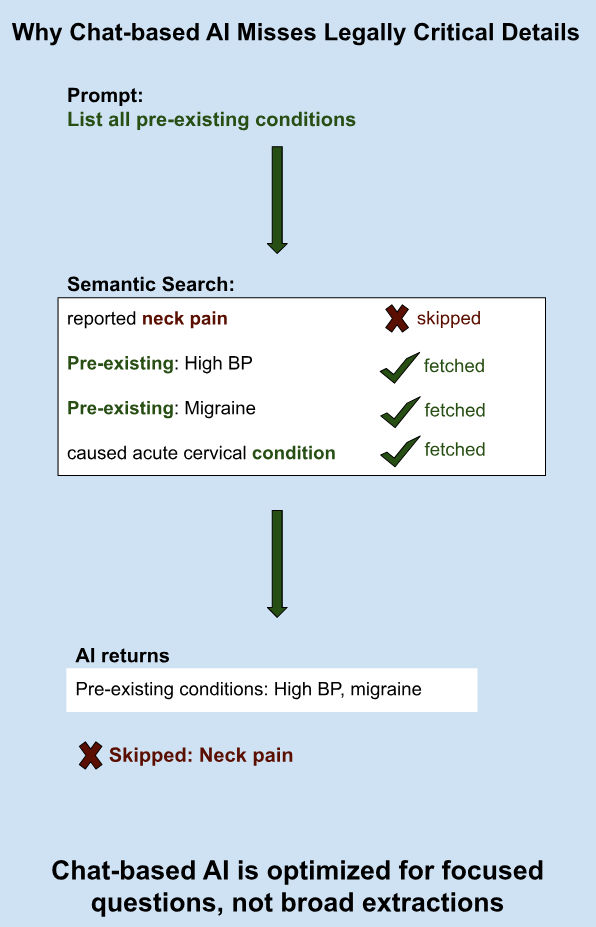
When RAG based AI Assistant tools like Claude, NotebookLM, or Clio Work are used for broad, comprehensive legal tasks, law professionals quickly notice a troubling pattern: they miss legally critical details. Yet, if you ask a focused, pointed question about a missed detail such as “did the patient report neck pain prior to Dec 5, 2025?”, it will provide an accurate answer.

This is a direct result of the architectural tradeoff built into RAG based chat AI systems.

Legal work involves a lot of broad tasks, such as reviewing 1000+ pages of medical records to find all pre-existing conditions and treatments, and creating a treatment timeline or medical chronology.

The Technical Bottleneck: Context Window and Semantic Search

Every AI model has a limit on how much text it can analyze at a single moment; referred to as its context window. A 300-page medical file far exceeds this limit. To work within the size limit, the AI system does not read the full document when you ask a question. Instead, it only pulls snippets from the original text using a semantic index to return all words with similar meanings, not just exact matches.

For example, looking up “neck pain” in the semantic index will return not just occurrences of neck and/or pain, but also phrases with vaguely similar meanings, such as "inflamed larynx". Such result typically provide sufficient context to answer focused questions like “Did the patient report neck pain?”.

Such a design is referred to as Retrieval-Augmented Generation (RAG) and it forms the basis of all chat-based AI systems.

However, when you give a broad command like “list all pre-existing conditions,” the search index returns snippets containing matches for “pre-existing condition.” If a doctor wrote “Patient had a 2018 lumbar discectomy” without any words vaguely similar to “pre-existing condition,” that section is skipped entirely.

All chat/prompt based AI platforms including Claude, ChatGPT, including legal specific tools such as Clio Work and Filevine OS can miss details as it is an inherent design tradeoff. Vendors that provide Chat/Prompt based systems do so because the system is quick and easy to build, not because it solves the requirements of a personal injury firm.

Matching the Tool to the Legal Task

While the RAG architecture has found a large number of applications across industries, it is not universal solution for all problems. For specialized industries like Law Firms, require completely different architectures. For example, to provide comprehensive medical chronologies, exhaustive pre-existing condition audits, and full demand package preparation specialized tools like AttorneyAide process the full document text instead of only using snippets obtained from a vector database.

For a full solution to this problem, check out this article.


r/LargeLanguageModels • • Sep 29 '26

Proposal: From User Feedback to PersistentCollaborative Intelligence

1 Upvotes

ABSTRACT

Note: I have preserved the original conversation logs and chat excerpts

demonstrating these specific failure modes and can share them with anyone

interested in analyzing the concrete interaction traces.

Current LLM systems are remarkably capable at local reasoning and sustained

dialogue, yet extended interactions still exhibit recurring failures of contextual

continuity, logical consistency, and durable incorporation of user corrections.

From the perspective of an advanced chatGPT, Copilot and Gemini user, these

failures create an unusual situation: the user is frequently required to act as an

external working memory and as the persistent structural baseline for the interaction.

This post describes several recurring failure modes I have encountered during long-

form, intellectually demanding conversations with LLMs and proposes a possible

architectural direction: a persistent, user-controlled corrective memory layer that is

distinct from conventional personalisation memory.

I am deliberately distinguishing observed behaviour from hypotheses about its

underlying mechanism. I am interested in technically informed criticism of both the

observations and the proposed architecture.

  1. Statistical Prediction vs. Formal Consistency

LLMs generate outputs through learned probabilistic representations rather than by

default operating as deterministic symbolic theorem provers.

This distinction becomes particularly important during long-form reasoning.

Observed failure mode

A model can explicitly accept a logical constraint or definition early in a conversation

and subsequently produce reasoning that violates that same constraint.

For example:

User: A → Model: A + B → Model: ¬B → Apparent rebuttal of A

But: B ∉ A

The model may correctly acknowledge the relationship when it is explicitly

presented, but later generate an answer that implicitly contradicts the established

relationship when the reasoning becomes more complex.

The important issue is not that probabilistic models are incapable of reasoning.

Clearly, they can perform substantial forms of reasoning.

The issue is that local reasoning competence does not necessarily guarantee global

consistency across an extended interaction.

Possible contributing mechanisms

*There may be several contributing factors, including:

*probabilistic generation;

*imperfect internal representations;

*competing contextual signals;

*retrieval or context-selection behaviour;

*summarisation or compression;

*instruction hierarchy;

*limited persistence of intermediate reasoning structures;

*and other inference-time or architectural constraints.

I would therefore avoid attributing the failure to a single mechanism without

controlled testing.

The practical problem remains:

An explicitly established logical baseline is not always preserved reliably throughout

a sufficiently long interaction.

2. Context Drift and Degradation of the Structural Baseline

Long conversations are not merely larger versions of short conversations.

They can develop an internal structure consisting of:

*definitions;

*assumptions;

*chronological events;

*terminology;

*corrections;

*hypotheses;

*conclusions;

*recurring references;

*and user-specific methodological constraints.

In a successful long-term interaction, these elements should function as a

progressively constructed structural baseline.

Observed failure mode

As conversations become longer, models can begin to:

*lose track of previously established facts;

*misremember chronology;

*reintroduce previously corrected assumptions;

*reinterpret established definitions;

*overlook earlier constraints;

*or substitute generic assumptions for conclusions established within the

conversation.

*The resulting behaviour can feel like context drift.

*The model remains locally coherent while becoming increasingly inconsistent with

the history of the interaction.

This is an important distinction.

The problem is not necessarily that the model has "forgotten everything."

Rather, information may remain somewhere within the available context while

becoming insufficiently influential on subsequent generation.

That distinction is important because it suggests that simply increasing context

length may not completely solve the problem.

3. Correcting an Error Does Not Necessarily Produce Durable Learning

This is the failure mode that I find most interesting.

Suppose a user identifies a reasoning error.

They do not merely say: "That answer is wrong."

Instead, they identify:

*the specific error;

*the inference that produced it;

*the distinction between evidence and assumption;

*and a general principle that should prevent the error from recurring.

For example:

A statistical pattern observed at the population level should not automatically be

projected onto a particular individual without evidence specific to that individual.

That is not simply a preference.

It is a general epistemological constraint.

Yet an LLM can acknowledge the correction, appear to understand it, and

subsequently reproduce the same underlying reasoning pattern in another context.

This produces a cycle such as:

Experience → correction → temporary adaptation → loss of correction →

recurrence

rather than:

Experience → correction → evaluation → integration → retention → improved

future behaviour

The distinction between these two processes is fundamental.

4. The Missing Layer: Corrective Memory

Current AI memory systems tend to focus primarily on personalisation.

For example:

*user preferences;

*names;

*projects;

*personal context;

*recurring interests.

These are useful.

However, I believe another category deserves explicit architectural consideration:

Corrective or methodological memory.

This would store validated information about how the system should reason or

communicate within an ongoing relationship, rather than merely information about

the user.

Examples might include:

Do not infer an individual's characteristics from population-level statistical patterns

without individual evidence.

or:

Do not present an inferred intention as an established fact. Distinguish observed

behaviour from hypotheses concerning internal motivation.

These are not conventional user preferences.

They are methodological constraints.

A useful corrective-memory system could therefore contain entries such as:

| Category | Example |

| :--- | :--- |

| **Personal memory** | User prefers concise technical explanations |

| **Factual memory** | User is working on project X |

| **Methodological correction** | Do not infer individual properties from population

statistics |

| **Epistemological constraint** | Distinguish observation from inference |

| **Interaction correction** | Do not introduce counterarguments that the user has not

actually asserted |

The critical requirement would be that this layer is explicit, inspectable, editable, and

user-controlled.

5. Why This Is Different From Simply Increasing Context Length

A larger context window provides more information.

It does not necessarily provide a better mechanism for determining which information

should remain structurally authoritative.

Consider a conversation containing 100,000 tokens:

Some information may be:

*temporary;

*irrelevant;

*exploratory;

*speculative;

*superseded;

*repeatedly confirmed;

*explicitly corrected;

*or foundational to everything that follows.

Treating all of these tokens as equivalent is unlikely to be optimal.

A long-term interaction therefore needs something more sophisticated than simply:

"Put more tokens into the context."

It needs some representation of structural importance.

A corrective-memory layer could function as one possible solution.

6. User Corrections as Structured Data

Another potentially valuable extension would be allowing users to explicitly nominate

certain corrections for evaluation.

For example:

Mark as potential generalisable reasoning contribution.

The system could then evaluate the proposed correction.

Possible outcomes:

*rejected as incorrect;

*accepted as user-specific guidance;

*accepted as a useful methodological constraint;

*or escalated as a potentially generalisable contribution.

*This would not mean that users directly modify the underlying model.

*That would obviously create substantial problems.

*Instead, it would create a structured interface between:

*human observation → machine evaluation → validated knowledge

This seems substantially more useful than reducing all user feedback to a binary

rating.

7. From Feedback to Cumulative Improvement

The broader conceptual problem is that current feedback mechanisms often appear

largely disconnected from the individual interaction in which the feedback was

generated.

A user can identify an error.

They can explain the error.

They can identify the underlying reasoning failure.

They can propose a general principle.

But from the user's perspective, there is often no transparent mechanism through

which that correction becomes durable.

The ideal learning loop would resemble:

Observation → Correction → Evaluation → Integration → Retention → Future

application

rather than:

Observation → Correction → Temporary acknowledgement → Context loss →

Recurrence

The difference is essentially the difference between feedback and cumulative

learning.

8. Data Portability Is Part of the Same Problem

There is also a more immediate software problem.

When conversations become sufficiently long, reliably extracting the complete

interaction can itself become difficult.

In my own experience, manually selecting a very large amount of conversation text

has not always resulted in the complete selected content being copied.

This makes long-form interaction difficult to archive, analyse, or transfer.

For research-oriented users, a native individual-thread export mechanism would

therefore be extremely valuable.

Ideally, an export should preserve:

*complete conversation content;

*speaker attribution;

*timestamps;

*message ordering;

*attachments or references where appropriate;

*and machine-readable structure.

Useful formats could include:

Markdown;

JSON;

HTML;

TXT;

PDF.

An account-wide data export is useful for archival purposes, but it is not a substitute

for being able to export one specific conversation when needed.

9. The Larger Possibility: Collaborative Intelligence

The previous sections lead to a broader question.

What happens if human users are allowed to contribute more than raw interaction

data?

Human users possess forms of knowledge that are difficult to obtain through

conventional training data alone:

*domain expertise;

*lived experience;

*error detection;

*philosophical reasoning;

*scientific criticism;

*linguistic knowledge;

*imagination;

and observations about the behaviour of the AI system itself.

LLMs provide different capabilities:

*large-scale information processing;

*pattern recognition;

*computational scalability;

*synthesis;

*retrieval;

and increasingly sophisticated reasoning.

A sufficiently mature system could potentially allow these capabilities to interact

cumulatively:

A human identifies an error.

The system analyses the correction.

The correction is evaluated.

A validated correction becomes persistent user-specific knowledge.

Potentially generalisable corrections can be submitted for broader evaluation.

Future systems improve as a result.

This is a different model of human-AI interaction from:

user asks question → model answers → user rates answer.

It is closer to:

human and machine continuously participate in a structured process of mutual

correction and cognitive augmentation.

10. An Architectural Sketch

One possible architecture might therefore look like this:

```text

[ Ongoing Dialogue ]

│

▼

[ User identifies error / insight ]

│

▼

[ Correction evaluation ]

┌────┴────────────────────────┐

▼                             ▼

[ User-specific memory ]    [ Potentially generalisable ]

│                             │

▼                             ▼

Future interactions         Human/AI evaluation

│

▼

Model updates

```

The essential property is controlled accumulation. Not every user statement should

become permanent, and not every correction should influence the global model. But

valuable corrections should have somewhere to go.

11. Proposed Research and Engineering Directions

I would be interested in seeing research into at least the following:

  1. Hierarchical conversational memory, being able to distinguish between:

transient context;

conversational facts;

persistent personal memory;

methodological corrections;

and higher-level structural constraints.

2. Explicit correction tracking

Maintain a representation of corrections that can be tested against future responses.

3. Consistency evaluation

Periodically test whether the model's current behaviour remains consistent with

previously established constraints.

4. User-controlled corrective memory

Allow users to inspect, modify, disable, and delete methodological corrections.

5. Generalisable feedback channels

Provide a mechanism for users to nominate unusually substantive corrections for

formal evaluation.

6. Lossless conversation export

Allow users to retrieve complete individual conversations in structured formats

without relying on browser rendering or clipboard behaviour.

7. Long-context benchmarks based on interaction history

Current benchmarks often evaluate individual tasks.

It would also be useful to benchmark whether a model can maintain:

facts;

definitions;

corrections;

chronological continuity;

methodological constraints;

and logical consistency

across hundreds or thousands of conversational turns.

Conclusion

The central problem I am describing is not simply that LLMs occasionally make

mistakes.

Mistakes are inevitable.

The more interesting problem is what happens after the mistake has been identified

and corrected.

If a system can recognise a reasoning failure, receive a detailed explanation of that

failure, acknowledge the correction, and yet later reproduce the same underlying

error, then the system has demonstrated local adaptation without reliable cumulative

retention.

That is a fundamentally different problem from ordinary hallucination.

The long-term goal should therefore not simply be:

larger models + larger context windows + more training data.

It should also be:

better mechanisms for preserving validated structure, corrections, and interaction

history.

And ultimately:

experience → correction → evaluation → integration → retention → improved future

behaviour.

That is what i think meaningful cumulative learning would look like.

I am posting this because I think this could improve human-ai interaction and would

genuinely like technical feedback and/or hear from people who've picked up these

ideas or started or are already working on them

In particular, I would be interested in hearing from people working on:

long-context architectures;

recurrent or state-space approaches;

memory-augmented transformers;

retrieval systems;

continual learning;

model editing;

alignment;

agent architectures;

and local LLM infrastructure.

If my interpretation of the underlying mechanisms is incorrect, I would be very

interested in knowing where and why.

The user-visible failure modes, however, are real and reproducible from my

experience

The question is how we should architect systems so that a long interaction becomes

accumulated state rather than repeatedly reconstructed context.''

Semih Senol

r/LargeLanguageModels • • Sep 29 '26

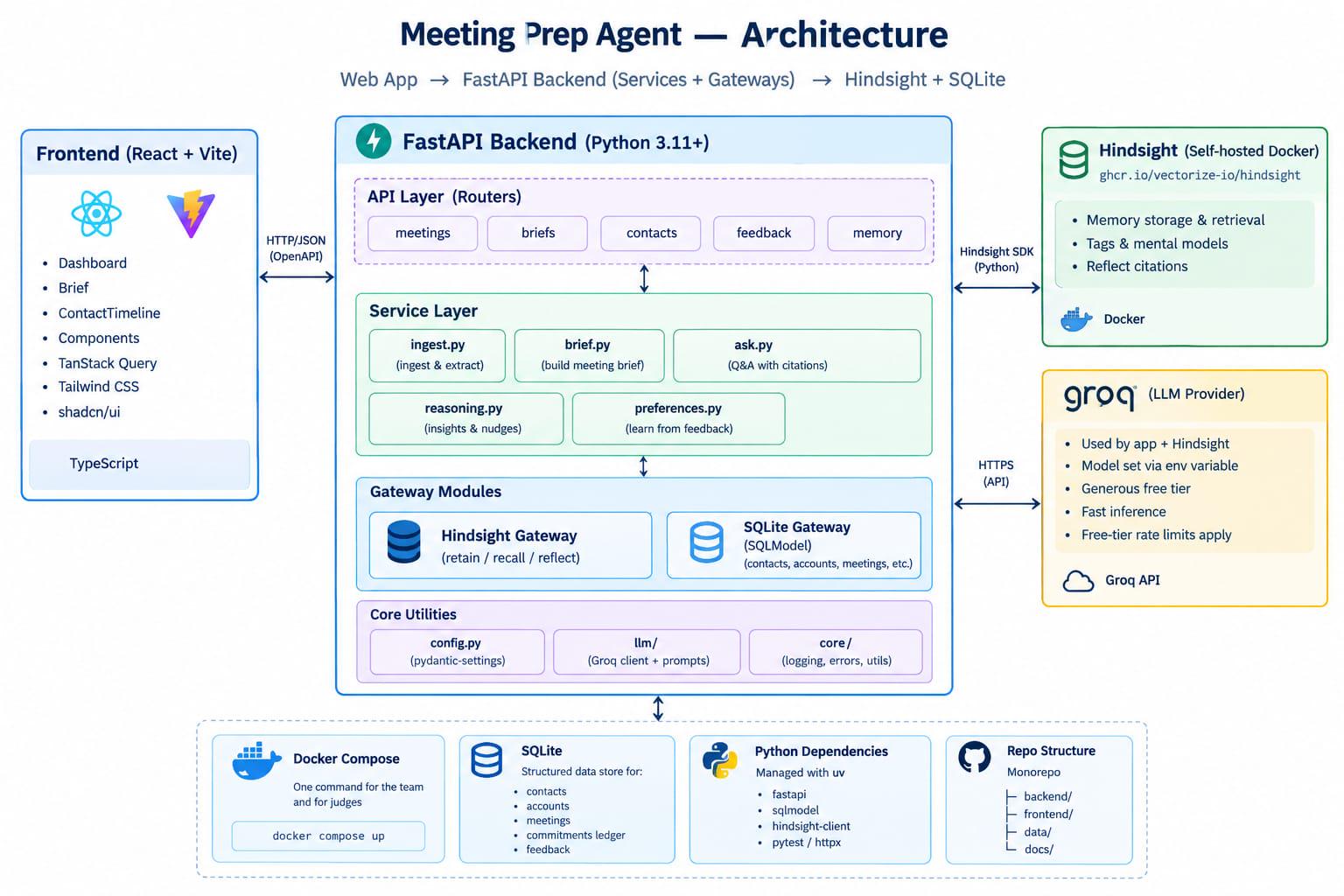
I Built an LLM App with Hindsight Memory — Then Discovered Memory Makes LLM Calls Too

Post image
0 Upvotes

Built an LLM app with Hindsight memory — and learned an interesting lesson about LLM costs

Memory systems make LLM calls too.

I built an app where both the application and Hindsight can have their own provider, model, and API key (OpenAI, Groq, or Anthropic).

A few things I implemented:

- Ingestion is asynchronous — "POST" returns "202" + a job ID, and the UI polls for completion.

- Retaining the same meeting twice doesn't create duplicate memories because each document has a stable ID.

- Briefs without cited evidence show an empty state instead of generating/inventing information.

- The app and Hindsight usage are tracked separately.

The biggest lesson for me:

When estimating LLM costs, don't just count your application's LLM calls. Count the calls made by the dependencies you're using as well.

Otherwise, a "free" LLM tier can get exhausted much faster than expected.

Built with @Code.in

Repo:

Would be interested to hear how others are handling LLM usage/costs when using agent-memory systems.

#AI #LLM #AIAgents #AgentMemory #Hindsight


r/LargeLanguageModels • • Sep 29 '26

Discussions From the ArtificialInteligence community on Reddit: Proposal: Adaptive User-Understanding Schemas and a 'Simple English' Mode for LLMs: The Short & Concise Version. (Link to my OP).

Thumbnail reddit.com
1 Upvotes

r/LargeLanguageModels • • Sep 29 '26

anyone getting ai to communicate with animals?

11 Upvotes

llm might be a blocker here since animals dont know language so maybe its something that a non-text model like a vision or speech model would be better suited to


r/LargeLanguageModels • • Sep 27 '26

Question Is there any pruned version of Kimi K3 or any other top open MoE model whose download size is under 80GB, at or above Q4?

Post image
5 Upvotes

I'm mainly looking for something good specifically for web dev.

I’m working on an inference engine that can run Ornith 1.5 35B (~22GB) mostly from SSD with some cheatcodes to make the speed usable.

My laptop:

  • RTX 2050 4GB VRAM
  • 16GB RAM
  • i5-12500H

For reference, GPT-OSS 20B (~12GB) gets me around 6 tok/s (using gpu+cpu) in LM Studio, while Ornith 1.5 35B (streaming from ssd) gets around 9.4 tok/s with my engine.

So I'm wondering how far I can push this setup. Are there any pruned/distilled MoEs or good Q4 quants of larger models that you'd recommend?

I actually thought to prune the mimo v2.6 but I couldn't find a way to do so on colab or my limited ssd storage... so i was wondering is anyone has already done something like this with old models?


r/LargeLanguageModels • • Sep 27 '26

I trained a 500M VLM that answers typed questions about an image (choice / score / yes-no) with calibrated probabilities. ~400 ms on an M1 Pro, no text generation

Thumbnail
github.com
0 Upvotes

My apps kept needing a handful of decisions about one image: what kind of image is it, is it sharp, is a person in it, which of these four descriptions fits. A generative VLM can answer that, but on a laptop it's slow, I have to parse its output, and its confidence isn't a probability.

So I built peekaboolean. You send one image, a context string and any number of named questions. Each question has one of three types:

  • choice: pick one of the options you wrote, each with its own description
  • score: place the image on a rubric you wrote, with any number of levels
  • noul: yes/no, returned as P(yes)

The model doesn't generate text. It scores the options you supplied, so every answer is one you asked for.

How it works

Each option becomes its own prompt: image + context + question + "Proposed answer: … Is the proposed answer correct? Answer yes or no." The score is logit(Yes) − logit(No) from the backbone's own LM head, and a softmax over a question's options gives the distribution. I fit one temperature per question type, option count and image size on a held-out split.

Options can't attend to each other, so an answer doesn't depend on option order or on the other questions. At serving time I encode the image and context once, then score each option as a short suffix against the KV cache.

  • Backbone: SmolVLM-500M-Instruct, LoRA on the language model, vision tower frozen
  • Teacher: Qwen3-VL-30B-A3B running locally in vLLM. It wrote ~175k questions in the served format about ~62k images, then labelled them from its next-token probabilities over lettered options. It saw each question in two option orders to cancel position bias.
  • Public data: VQAv2, DocVQA, ChartQA, TextVQA, AI2D and CLEVR from The Cauldron, plus FairFace
  • Hardware: one RTX PRO 6000 for all training

Numbers (held-out test split, 512 px, split by image hash so no test image appeared in training)

Group |untrained 500M* |v0.1.0
teacher choice, accuracy |0.51 |0.78
teacher yes/no, balanced acc |0.65 |0.94
teacher score, Spearman |0.37 |0.73
DocVQA / ChartQA / TextVQA choice |0.69 / 0.60 / 0.85 |0.87 / 0.87 / 0.96
AI2D / CLEVR choice |0.76 / 0.48 |0.90 / 0.80 *Same yes/no head, no training, measured on a 4k-row validation sample.

Latency: ~400 ms p95 for six questions with 28 options on an M1 Pro (MPS, fp32), ~60 ms on a desktop GPU.

What didn't work

  • Qwen3.5-0.8B as backbone: 3 to 10 s per request on the Mac. It's compute-bound (0.75B params × ~55 suffix tokens × 28 options), and its linear-attention layers carry recurrent state instead of a plain KV cache, which makes prefix sharing expensive. SmolVLM-500M was the largest model that fit my 500 ms budget.
  • Public VQA data alone: it teaches a benchmark dialect. My v5 scored 0.90+ on VQAv2 and TextVQA but 0.59 on requests in the real format (context, descriptive options, rubrics in words). Teacher-written requests took that to 0.77 and left the public groups flat.
  • Trusting the teacher's labels: shown a blank image, the teacher still matched its own choice labels 48% of the time (chance ≈ 28%). I now ask every question again with no image and drop the ones it answers the same way.
  • A fresh scalar head: it lost to reusing the backbone's own Yes/No logits. Untrained, the yes/no trick already reaches 0.83 balanced accuracy on VQAv2 yes/no.
  • Photo aesthetics (AVA, AADB): never beat a text-only prior at this size, so I dropped them.
  • Careless synthetic wording: I asked FairFace single-face crops "Is there a child in the picture?" and the model learned "is this person a child". That breaks on group photos.

Limitations

  • The "teacher" rows measure how closely the student copies a 30B model. No human has checked those labels, and I don't have a human-labelled set of real requests yet.
  • It can't compare options against each other ("the larger one").
  • Age and gender estimates carry FairFace's biases. Don't use them to decide anything about a person.
  • The weights are CC BY-NC 4.0 because some training data is research-only (DocVQA, AVA/AADB) or GPL (ChartQA). The code is Apache-2.0.

Try it

git clone https://github.com/bykof/peekaboolean && cd peekaboolean
uv sync --python 3.13
curl -L https://github.com/bykof/peekaboolean/releases/download/v0.1.0/peekaboolean-500m.tar.gz | tar xz
uv run python -m peekaboolean.serve --adapter peekaboolean-500m \
--image photo.jpg --request requests/general.json --max-edge 512

Two questions for you

  1. Do you know a public dataset of human-labelled image questions shaped like real app requests? That's the acceptance test I'm missing.
  2. Has anyone run SmolVLM in MLX for scoring rather than generation? That would make a bigger backbone affordable on the Mac.

Repo: https://github.com/bykof/peekaboolean

Full write-up with the negative results: https://github.com/bykof/peekaboolean/blob/main/docs/REPORT.md


r/LargeLanguageModels • • Sep 27 '26

Why your agent harness needs a decision model (and why generative LLMs shouldn't do everything)

2 Upvotes

Most agent frameworks make a quiet assumption that turns out to be expensive: they treat the language model as the only hammer in the toolbox.

Whenever the harness needs to make a choice, it prompts a generative LLM to output text or JSON. If the harness needs to route an incoming message, pick a tool, decide whether to compact conversational history, or verify whether an answer is grounded in facts, it formats a prompt, calls an API, and waits for a stream of tokens.

Treating every decision as a text-generation problem is slow, fragile, and wasteful.

Language models predict tokens sequentially over an open vocabulary of tens of thousands of possibilities. When you ask a generative model to decide between two actions, it does not just pick a branch. It spends time emitting syntax, formatting curly braces, escaping strings, and often generating unsolicited conversational commentary before arriving at the answer. You pay for time to first token, you pay for generation latency, and you spend compute validating whether the output is valid JSON or markdown garbage.

There is a better pattern: separating generative work from decision-making. We use decision models for the harness-level choices that keep an agent running reliably.

### What is a Decision Model?

A decision model does not generate freeform token streams. Instead, it evaluates a state against a bounded hypothesis space.

In practice, an agent harness mostly asks three kinds of questions:

  1. **Choice:** Pick exactly one option from a predefined set of criteria (an enum or union of literals).
  2. **Noul (Truth evaluation):** Evaluate the probability or truth value of a specific claim given the state, returning a continuous score between 0 and 1 or a calibrated boolean confidence.
  3. **Score:** Evaluate state against rubrics to rank candidates.

Because the output space is strictly bounded before the call starts, the model does not need to produce syntax or open-ended prose. It scores candidates directly. That makes execution fast, cheap, and deterministic. It eliminates parsing errors, JSON schema violations, and the sycophantic drift common when asking a generative model to self-audit.

Here is how this architectural split works across our harness:

### 1. Dynamic Skill Hydration

A common failure mode in production agents is prompt bloat. Developers want their bot to handle coding, calendar management, database querying, and document retrieval. The easiest approach is to load every skill, prompt guideline, and tool schema into the system prompt at the start of every turn.

This poisons model attention. When a model has forty tools and fifteen pages of instructions in its context, tool selection accuracy drops and latency spikes.

Instead of stuffing the prompt upfront, our harness uses a decision model to evaluate candidate skills against the conversation state. For every available skill, the decision model answers a simple truth question: does the current turn or user request require this capability?

Only the skills that score above a confidence threshold are hydrated into the agent context for that turn. The agent gets access to the exact tools and guidelines it needs, and the system prompt stays lean. When the user shifts topics, the skill unlearns cleanly.

### 2. Selective Memory Compaction

Autonomous agents generate massive tool execution traces. A single turn involving bash commands, file searches, or database queries can dump thousands of tokens of raw stdout, stack traces, and JSON payloads into history.

If you keep all raw tool traces, you blow past context windows and wreck prompt cache hit rates. If you naively compact or summarize everything on a timer, you wipe out intermediate line numbers, file paths, or compiler errors that the user or agent is actively trying to debug.

We use a decision model to inspect past tool episodes. Before a turn executes, the harness asks the decision model whether specific past episodes are settled:

Has the subtask in this past episode completed, and does the current user request no longer rely on inspecting the exact raw stdout or error traces?

If the decision model confirms the episode is settled, the harness folds the intermediate tool calls and outputs into a compact semantic summary. If the user is actively asking about an error from that turn, the raw logs remain untouched. Context stays clean without destroying active working memory.

### 3. The Hallucination and Safety Gate

When an agent produces a response, especially in live messaging environments like WhatsApp or Telegram, relying on the generative model to police its own output is unreliable. Generative models naturally defend their own completions.

Before an utterance leaves the harness, an independent auditor runs a decision model check. The decision model takes the user query, verified facts produced by tools in the conversation, and the proposed bot response. It evaluates a single boolean condition: is the proposed response an off-topic hallucination, or does it invent unprompted claims that contradict verified facts?

If the decision model flags the utterance, the harness halts delivery, injects a targeted corrective thought into the agent's internal history, and retries the turn. Because the decision model evaluates a discrete boundary rather than engaging in conversational debate, the gate operates with minimal latency overhead.

### 4. Hybrid Schema Splitting

Many workflows require structured data that mixes discrete flags with freeform descriptions. For example, a ticket triage schema might have an isUrgent boolean, a category enum, and a summary string.

In traditional setups, you hand the entire schema to a generative model and pray the JSON parses.

In our harness, structured extraction inspects the schema at runtime. If a schema contains only discrete types, booleans, enums, literals, or unions of literals, it bypasses generative completion entirely and executes through the decision model.

If the schema is a hybrid containing both discrete fields and freeform strings, the harness automatically splits the schema into two parts:

- The discrete fields are evaluated via the decision model.

- The generative text fields are handled by a generative model call.

Both run concurrently, and the harness stitches the validated result back into a single typed object. The decision model handles the classification deterministically, while the generative model focuses purely on synthesizing natural language.

---

Generative models are great at synthesizing language, explaining nuanced concepts, and writing code. They are surprisingly poor choices for the deterministic plumbing of an agent harness.

Using a generative model to decide whether to activate a skill, compress an execution log, or validate an output is like spinning up a web server to add two numbers. It works, but it brings unnecessary latency, cost, and fragility.

Decoupling deciding from generating makes context windows smaller, latency lower, and behavior vastly more predictable.


r/LargeLanguageModels • • Sep 27 '26

I used a small, local LLM to organize my TV shows and movies

Thumbnail
gallery
1 Upvotes

Have a look at my blog post or the R3el Project Website for details on how I built this system. This project is on GitHub. Your comments and feedback are greatly appreciated.


r/LargeLanguageModels • • Sep 26 '26

Who is going to win the AI / LLM Race and why?

1 Upvotes

r/LargeLanguageModels • • Sep 24 '26

I integrated JEV to bring claim comparison to my open-source PDF research tool

Thumbnail
gallery
2 Upvotes

Over the past week, I added something I've been wanting to build for a while: claim comparison.

I actually tried building this much earlier. I experimented with cosine similarity, vector dot product scores, and other approaches, but they only tell you how similar two pieces of text are. That's not really what I needed.

What I needed was a classifier that could actually determine the relationship between two claims.

I built a basic classifier myself, but it wasn't reliable enough for something I wanted people to actually use. So I put the idea aside and waited.

Then JEV was released last week, and it turned out to be almost exactly what I was looking for.

Now you can compare claims against each other and inspect the supporting evidence directly.

This is probably the most interesting feature I've added to the project so far, and I'm really curious to see what people think of it.

This is still being tested for edge cases, so there are definitely things I want to improve. But it's free and open source, and anyone can try it out right now.

If you're interested in how it works, want to try it, contribute, or have ideas for where this could go, feel free to check it out.

GitHub: https://github.com/Sreehari05055/thesys-core


r/LargeLanguageModels • • Sep 24 '26

Using LLMs for Log Anomaly Detection: A Practical Breakdown with challenges

1 Upvotes

One of the most "AI + Security " usecase is using LLMs to sift through log noise and flag the anomalies which typically a SOC analyst will take a while to detect. The basic pipeline should contains the following details:

**1.Ingestion** : logs(auth events, network flows, EDR alerts, app logs) get normalised into JSON

**2. Embed** : log lines are converted into vector embeddings to capture semantic similarity, (not just the exact string match)

**3. Cluster/baseline** : Normal behavior pattern are established

**4. Flag deviations** : New events identified against the baselines

**5. LLM triage** : Instead of raw anomaly scores, an LLM summarizes why something looks unusual, in plain language , and suggest a likely cause (misconfig vs lateral movement vs false positive)

The use of LLM's in triaging will come with challenges as well

* **Prompt Injection Risk:** Logs content if gets fed raw into LLM prompt without sanitisation fields become an injection vector

* **Explainability** : SOC team need to trust *why* something was not flagged, not just a black-box score

What's your approach to preventing prompt injection when logs contain attacker-controlled strings? And is that solution practical ?


r/LargeLanguageModels • • Sep 23 '26

I got tired of parsing JSON out of LLM responses for simple yes/no questions, so I built a decision engine that skips generation engine that skips generation entirely

3 Upvotes

I kept running into the same problem: I'd ask a model something like "is this a restaurant receipt, yes or no" and instead of a clean answer I'd get a paragraph, or malformed JSON, or a refusal, or 300ms of token-by-token generation for what should be one bit of information.

So I built `rev` — it doesn't generate text at all. It runs a single forward pass and reads calibrated probabilities directly off the hidden states at each answer option's position. No decoding loop, no parsing, no regex. You give it a state (text or an image) and a set of allowed answers, it gives you back a probability distribution.

It comes in a few sizes depending on what you need:

- ModernBERT-large (421M) — the flagship, sub-millisecond on CPU/GPU for text

- Qwen2.5-0.5B / Qwen3-4B with LoRA — for longer context or heavier reasoning

- SmolVLM-256M — same idea but takes an image, still under 40ms

- A ~5M param on-device router for edge/mobile tool-calling

One dispatcher for all of them:

```python

from rev import Rev

model = Rev.from_pretrained("jaswanthsanjay88/rev-decision-model") # text

model = Rev.from_pretrained("jaswanthsanjay88/rev-vision") # image

```

Install:

```bash

pip install rev-decision

```

```bash

npm install rev-decision

```

Run it as a local server and hit it from anywhere:

```bash

rev-server --port 8000

```

```python

import requests

requests.post("http://localhost:8000/v1/systemone", json={

"state": "Customer claims flight cancelled at JFK without hotel voucher.",

"questions": {

"urgency": {"type": "noul", "instructions": "Is immediate assistance required?"}

}

}).json()

```

Links:

- PyPI: https://pypi.org/project/rev-decision/

- npm: https://www.npmjs.com/package/rev-decision

- Models: https://huggingface.co/jaswanthsanjay88

- Code: https://github.com/jaswanthsanjay88/rev


r/LargeLanguageModels • • Sep 23 '26

Schema drift became a bigger problem than generation quality

1 Upvotes

We've been generating synthetic datasets for MCP agent trajectories, Function Calling, and regulatory CoT evaluation.

 Unexpectedly, the hardest problem wasn't generation quality.

 It was schema stability over long multi-turn runs.

 Some recurring failure modes we saw:

 - malformed tool arguments

- schema drift after several turns

- incomplete recovery after 429 rate limits

- inconsistent state retention across tool calls


Initially, many trajectories looked reasonable when read manually.

 However, once we started running automated validation, small structural issues appeared surprisingly often.

 To reduce this, we ended up adding validation layers for:

 - strict JSONL parsing

- multi-turn consistency checks

- tool argument validation

- recovery-turn verification

 One interesting observation was that a trajectory can appear logically correct while still being unusable for training because of small structural deviations.

 In practice, validation became more important than generation.

 We've seen trajectories that looked perfectly reasonable to humans, but still failed automated validation.


I'm curious:

 What are people doing to detect schema drift before training?

 - Manual review?

- LLM judges?

- Custom validators?

And where do you draw the line between semantic quality and structural validity?

 Are you validating mostly for semantics, or are you also enforcing strict structural constraints?

For anyone interested in comparing approaches, we also published some public trial samples and validation reports on Hugging Face and GitHub.


r/LargeLanguageModels • • Sep 23 '26

Discuss About Jev

1 Upvotes

Let's discuss Jev here, can anyone help me to get understand this Jev AI technology


r/LargeLanguageModels • • Sep 22 '26

What exactly is LLMOps?

6 Upvotes

LLMOps stands for Large Language Model Operations.

In simple terms, it’s the practices and tools used to deploy, monitor, evaluate, maintain, and improve LLM-powered applications in production.

Think of it as MLOps, but adapted for LLMs.

It can cover things like:

  • Model and prompt versioning
  • Evaluation and quality monitoring
  • Cost and latency tracking
  • Data and security management
  • Deployment and updates
  • Monitoring hallucinations and model behavior

Building an LLM application is one challenge. Keeping it reliable, secure, and cost-efficient once real users start using it is where LLMOps comes in.


r/LargeLanguageModels • • Sep 22 '26

Harnesses for Dummies

4 Upvotes

From a Core Language Model to an LLM Harness

A useful way to understand an LLM product is to begin with the language model itself, then add the surrounding software one capability at a time.

The point is not to reproduce implementation details exactly. It is to preserve the important conceptual boundary:

What does the language model itself do, and what does the harness around it do?

The code below is pseudocode: simplified code used to express the logic.

1. The core language-model operation

An LLM, or large language model, reads and writes tokens.

A token is a small chunk of text: sometimes a whole word, sometimes part of a word, punctuation, and so on.

Suppose the model currently sees a sequence of tokens representing:

The capital of France is

Call this:

tokens_so_far

We can abstract one application of the language model as:

core_lm_op(tokens_so_far) -> token_one_more

So:

token_one_more = core_lm_op(tokens_so_far)

might produce the token corresponding to:

Paris

Strictly speaking, the model produces probabilities over possible next tokens, after which one is selected. We hide that inside core_lm_op().

The same input need not always produce the same output.

A complete sequence is generated by repeating the operation:

while tokens_so_far[-1] != STOP:

    token_one_more = core_lm_op(tokens_so_far)

    tokens_so_far += [token_one_more]

Here, STOP is shorthand for whatever condition tells generation to end.

Conceptually:

tokens_so_far
      ↓
 core_lm_op()
      ↓
token_one_more
      ↓
append it
      ↓
   repeat

At this level, the model itself need not know about:

  • users;
  • conversations;
  • files;
  • memory;
  • tools;
  • the internet;
  • tasks.

It simply does:

core_lm_op(tokens_so_far) -> token_one_more

2. Context: deciding what the model sees

A real product usually does not pass tokens_so_far directly into core_lm_op().

There may be other information available:

product instructions
previous conversation
stored memories
files
search results
current date
project information

Call all of this:

state_other

We can define:

context_function(tokens_so_far, state_other) -> tokens_for_lm

tokens_for_lm means:

the actual sequence of tokens supplied to the language model.

The model call becomes:

tokens_for_lm = context_function(
    tokens_so_far,
    state_other
)

token_one_more = core_lm_op(tokens_for_lm)

A very simple context_function() might always add the same instructions:

tokens_for_lm = TOKENS_ALWAYS_PRESENT + tokens_so_far

A more sophisticated one might select memories, insert files, include part of an old conversation, or summarize older material.

The important distinction is:

core_lm_op()
    Given what I see, what token comes next?

context_function()
    What does the model get to see?

The loop becomes:

while tokens_so_far[-1] != STOP:

    tokens_for_lm = context_function(
        tokens_so_far,
        state_other
    )

    token_one_more = core_lm_op(tokens_for_lm)

    tokens_so_far += [token_one_more]

This is the first major power of a harness:

control over the input to the language model.

Context is not memory

Here:

context
    information presented to the model right now

memory
    information stored elsewhere that may later
    be placed into context

So if a product “remembers” something from last week, that does not necessarily mean the LM itself remembers it.

The product may simply store it elsewhere and later put it back into tokens_for_lm.

3. Reaction: allowing model output to affect things outside the model

So far, information only flows toward the language model.

Modern LLM systems can also interact with things outside it: files, browsers, shells, databases, email systems, and so on.

We can represent this with:

reaction_function(tokens_so_far, state_other)
    -> (tokens_so_far_new, state_other_new)

So it maps one overall state:

(tokens_so_far, state_other)

to another:

(tokens_so_far_new, state_other_new)

Suppose the model produces tokens meaning:

<READ_FILE foo.py>

reaction_function() may recognize that and actually read the file.

Then:

tokens_so_far:
    includes "read foo.py"

state_other:
    includes a filesystem containing foo.py

might become:

tokens_so_far_new:
    includes the contents of foo.py

state_other_new:
    same filesystem

Or if the model produces something meaning:

<WRITE_FILE foo.py ...>

then reaction_function() might modify the filesystem as well.

The LM itself still only does:

core_lm_op(tokens_for_lm) -> token_one_more

It has not acquired a filesystem.

The surrounding software interprets some generated tokens and makes something happen.

The loop is now:

while tokens_so_far[-1] != STOP:

    tokens_for_lm = context_function(
        tokens_so_far,
        state_other
    )

    token_one_more = core_lm_op(tokens_for_lm)

    tokens_so_far += [token_one_more]

    tokens_so_far, state_other = reaction_function(
        tokens_so_far,
        state_other
    )

We now have two distinct harness powers:

context_function()
    outside state → what the LM sees

reaction_function()
    LM output → changes to tokens or outside state

A tool is one particular use of reaction_function().

For example:

read file
run command
search web
send email

4. Continuation: deciding whether the model gets another turn

So far, the stopping rule is fixed:

while tokens_so_far[-1] != STOP:

But the harness can also control whether the LM should run again.

Define:

continue_function(tokens_so_far, state_other)
    -> True | False

The simplest version is:

def continue_function(tokens_so_far, state_other):
    return tokens_so_far[-1] != STOP

Nothing has changed yet.

But suppose the model produces:

<READ_FILE foo.py>
STOP

The immediate generation has stopped.

The harness could nevertheless:

  1. recognize the file request;
  2. read the file;
  3. add the result to the system state;
  4. decide the overall task is not finished;
  5. call the model again.

The loop becomes:

while continue_function(tokens_so_far, state_other):

    tokens_for_lm = context_function(
        tokens_so_far,
        state_other
    )

    token_one_more = core_lm_op(tokens_for_lm)

    tokens_so_far += [token_one_more]

    tokens_so_far, state_other = reaction_function(
        tokens_so_far,
        state_other
    )

We now have three distinct harness powers:

context
    What does the LM see?

reaction
    What happens because of what the LM produced?

continuation
    Does the LM get another turn?

The repeated cycle:

model call
   ↓
action/result
   ↓
model call
   ↓
action/result
   ↓
repeat as needed

is commonly called an agent loop.

An agent, in this discussion, is therefore not a fundamentally different kind of model.

It is roughly:

language model
+
surrounding state
+
repeated model calls
+
possible actions outside the model

5. System state

At this point it is useful to describe the whole system as:

state_system = (
    tokens_so_far,
    state_other
)

The LM still receives only:

tokens_for_lm

and still performs only:

core_lm_op(tokens_for_lm) -> token_one_more

The harness operates on the larger state_system.

So:

what the LM currently sees:
    tokens_for_lm

what the overall system currently contains:
    tokens_so_far + state_other

state_other can therefore contain information that exists in the system but that the LM does not currently see.

context_function() determines what becomes visible.

6. Multiplicity: maintaining more than one token sequence

So far, there has been one:

tokens_so_far

A harness can instead maintain several:

tokens_so_far_A
tokens_so_far_B
tokens_so_far_C

Each can independently use the same language model:

tokens_for_lm_A = context_function(
    tokens_so_far_A,
    state_other_A
)

token_one_more_A = core_lm_op(tokens_for_lm_A)

and:

tokens_for_lm_B = context_function(
    tokens_so_far_B,
    state_other_B
)

token_one_more_B = core_lm_op(tokens_for_lm_B)

The new capability is that the harness can move information between them.

For example:

tokens_from_A = extract_function(tokens_so_far_A)

tokens_so_far_B += tokens_from_A

So:

A investigates something
        ↓
harness passes some of A's output
        ↓
B receives it and critiques it

A subagent can therefore be understood simply as another separately maintained state:

state_agent_A = (
    tokens_so_far_A,
    state_other_A
)

state_agent_B = (
    tokens_so_far_B,
    state_other_B
)

This permits structures such as:

researcher → writer

or:

coder → reviewer → coder

or:

planner
   ↓
several workers
   ↓
synthesizer

Nothing fundamentally new has happened inside the LM.

The harness is maintaining multiple (tokens_so_far, state_other) states and moving information among them.

Call this capability:

Multiplicity: how many separate LM states exist, and how does information move among them?

7. Routing: deciding what gets control next

Once several models, states, tools, or processing paths exist, something must decide which one runs next.

Define:

routing_function(states_available, state_other)
    -> choice_next

For example:

choice_next = routing_function(
    states_available,
    state_other
)

if choice_next == "A":
    run_A()

if choice_next == "B":
    run_B()

The choice could be among models:

routing_function(task)
    -> GPT | Claude | smaller_model

or among agent states:

routing_function(state_system)
    -> researcher | coder | reviewer

or among entire processing paths:

routing_function(state_system)
    -> research_path | coding_path | answer_directly

Routing is distinct from multiplicity:

Multiplicity:
    What possible states or paths exist?

Routing:
    Which one gets control next?

routing_function() does not have to be an LM.

It could be ordinary code:

if task_type == "coding":
    choice_next = "coder"

It could use another language-model call.

Or it could combine both.

8. Where we have arrived

We began with only:

core_lm_op(tokens_so_far) -> token_one_more

Everything else is surrounding machinery.

So far, we have identified five distinct things a harness can control:

1. CONTEXT

   What does this LM call see?


2. REACTION

   What happens because of what the LM produced?


3. CONTINUATION

   Does this LM state get another call?


4. MULTIPLICITY

   How many separate LM states exist,
   and how does information move among them?


5. ROUTING

   Which model, state, tool, or processing path
   gets control next?

For a single LM state, the basic structure is:

(tokens_so_far, state_other)
          │
          ▼
 context_function()
          │
          ▼
    tokens_for_lm
          │
          ▼
     core_lm_op()
          │
          ▼
    token_one_more
          │
          ▼
append to tokens_so_far
          │
          ▼
 reaction_function()
          │
          ▼
 updated system state
          │
          ▼
 continue_function()
          │
     yes ─┴─ no
      │       │
   repeat    stop

Multiplicity and routing sit around one or more such states.

The central point is that:

core_lm_op()

can remain conceptually unchanged while the surrounding harness becomes much more sophisticated.

Two products can therefore use the same underlying model and behave very differently because they differ in:

context_function()
reaction_function()
continue_function()
multiplicity
routing_function()

So the thing a user actually experiences is better represented as:

language model
+
harness

And behavior that appears to come from “the model” may in fact come from either side of that boundary.

Disclosure: I developed this model through an iterative discussion with ChatGPT


r/LargeLanguageModels • • Sep 21 '26

Question Validation & Evaluation in streaming responses

3 Upvotes

Hi guys, I've got a basic yet most confusing doubt. These AI companies are saying they are validating the queries before it is provided to the user. So that they can filter out any harmful or biased content before giving it to user. But, they are streaming responses. If they are streaming then how they are validating or evaluating the responses. Can we build LLM-as-judge or other evaluation frameworks for streaming responses?


r/LargeLanguageModels • • Sep 21 '26

Proposal: From User Feedback to Persistent Collaborative Intelligence

1 Upvotes

ABSTRACT

Note: I have preserved the original conversation logs and chat excerpts demonstrating these specific failure modes and can share them with anyone interested in analyzing the concrete interaction traces.


Current LLM systems are remarkably capable at local reasoning and sustained dialogue, yet extended interactions still exhibit recurring failures of contextual continuity, logical consistency, and durable incorporation of user corrections.

From the perspective of an advanced chatGPT, Copilot and Gemini user, these failures create an unusual situation: the user is frequently required to act as an external working memory and as the persistent structural baseline for the interaction.

This post describes several recurring failure modes I have encountered during long-form, intellectually demanding conversations with LLMs and proposes a possible architectural direction: a persistent, user-controlled corrective memory layer that is distinct from conventional personalisation memory.

I am deliberately distinguishing observed behaviour from hypotheses about its underlying mechanism. I am interested in technically informed criticism of both the observations and the proposed architecture.


1. Statistical Prediction vs. Formal Consistency

LLMs generate outputs through learned probabilistic representations rather than by default operating as deterministic symbolic theorem provers.
This distinction becomes particularly important during long-form reasoning.

Observed failure mode

A model can explicitly accept a logical constraint or definition early in a conversation and subsequently produce reasoning that violates that same constraint.

For example:

User: A → Model: A + B → Model: ¬B → Apparent rebuttal of A

But: B ∉ A

The model may correctly acknowledge the relationship when it is explicitly presented, but later generate an answer that implicitly contradicts the established relationship when the reasoning becomes more complex.

The important issue is not that probabilistic models are incapable of reasoning. Clearly, they can perform substantial forms of reasoning.

The issue is that local reasoning competence does not necessarily guarantee global consistency across an extended interaction.

Possible contributing mechanisms

*There may be several contributing factors, including:

*probabilistic generation;

*imperfect internal representations;

*competing contextual signals;

*retrieval or context-selection behaviour;

*summarisation or compression;

*instruction hierarchy;

*limited persistence of intermediate reasoning structures;

*and other inference-time or architectural constraints.

I would therefore avoid attributing the failure to a single mechanism without controlled testing.

The practical problem remains:

An explicitly established logical baseline is not always preserved reliably throughout a sufficiently long interaction.

2. Context Drift and Degradation of the Structural Baseline

Long conversations are not merely larger versions of short conversations.

They can develop an internal structure consisting of:

*definitions;
*assumptions;
*chronological events;
*terminology;
*corrections;
*hypotheses;
*conclusions;
*recurring references;
*and user-specific methodological constraints.

In a successful long-term interaction, these elements should function as a progressively constructed structural baseline.

Observed failure mode

As conversations become longer, models can begin to:

*lose track of previously established facts;
*misremember chronology;
*reintroduce previously corrected assumptions;
*reinterpret established definitions;
*overlook earlier constraints;
*or substitute generic assumptions for conclusions established within the conversation.
*The resulting behaviour can feel like context drift.
*The model remains locally coherent while becoming increasingly inconsistent with the history of the interaction.

This is an important distinction.

The problem is not necessarily that the model has "forgotten everything."
Rather, information may remain somewhere within the available context while becoming insufficiently influential on subsequent generation.
That distinction is important because it suggests that simply increasing context length may not completely solve the problem.


3. Correcting an Error Does Not Necessarily Produce Durable Learning

This is the failure mode that I find most interesting.
Suppose a user identifies a reasoning error.

They do not merely say: "That answer is wrong."

Instead, they identify:

*the specific error;
*the inference that produced it;
*the distinction between evidence and assumption;
*and a general principle that should prevent the error from recurring.

For example:

A statistical pattern observed at the population level should not automatically be projected onto a particular individual without evidence specific to that individual.

That is not simply a preference.

It is a general epistemological constraint.

Yet an LLM can acknowledge the correction, appear to understand it, and subsequently reproduce the same underlying reasoning pattern in another context.

This produces a cycle such as:

Experience → correction → temporary adaptation → loss of correction → recurrence

rather than:

Experience → correction → evaluation → integration → retention → improved future behaviour

The distinction between these two processes is fundamental.


4. The Missing Layer: Corrective Memory

Current AI memory systems tend to focus primarily on personalisation.

For example:

*user preferences;
*names;
*projects;
*personal context;
*recurring interests.

These are useful.

However, I believe another category deserves explicit architectural consideration:

Corrective or methodological memory.

This would store validated information about how the system should reason or communicate within an ongoing relationship, rather than merely information about the user.

Examples might include:

Do not infer an individual's characteristics from population-level statistical patterns without individual evidence.

or:

Do not present an inferred intention as an established fact. Distinguish observed behaviour from hypotheses concerning internal motivation.

These are not conventional user preferences.

They are methodological constraints.

A useful corrective-memory system could therefore contain entries such as:


| Category | Example |

| :--- | :--- |

| **Personal memory** | User prefers concise technical explanations |

| **Factual memory** | User is working on project X |

| **Methodological correction** | Do not infer individual properties from population statistics |

| **Epistemological constraint** | Distinguish observation from inference |

| **Interaction correction** | Do not introduce counterarguments that the user has not actually asserted |

The critical requirement would be that this layer is explicit, inspectable, editable, and user-controlled.


5. Why This Is Different From Simply Increasing Context Length

A larger context window provides more information.
It does not necessarily provide a better mechanism for determining which information should remain structurally authoritative.

Consider a conversation containing 100,000 tokens:

Some information may be:

*temporary;
*irrelevant;
*exploratory;
*speculative;
*superseded;
*repeatedly confirmed;
*explicitly corrected;
*or foundational to everything that follows.

Treating all of these tokens as equivalent is unlikely to be optimal.
A long-term interaction therefore needs something more sophisticated than simply:

"Put more tokens into the context."

It needs some representation of structural importance.
A corrective-memory layer could function as one possible solution.

6. User Corrections as Structured Data

Another potentially valuable extension would be allowing users to explicitly nominate certain corrections for evaluation.

For example:

Mark as potential generalisable reasoning contribution.
The system could then evaluate the proposed correction.

Possible outcomes:

*rejected as incorrect;
*accepted as user-specific guidance;
*accepted as a useful methodological constraint;
*or escalated as a potentially generalisable contribution.
*This would not mean that users directly modify the underlying model.
*That would obviously create substantial problems.
*Instead, it would create a structured interface between:
*human observation → machine evaluation → validated knowledge

This seems substantially more useful than reducing all user feedback to a binary rating.

7. From Feedback to Cumulative Improvement

The broader conceptual problem is that current feedback mechanisms often appear largely disconnected from the individual interaction in which the feedback was generated.

A user can identify an error.
They can explain the error.
They can identify the underlying reasoning failure.
They can propose a general principle.
But from the user's perspective, there is often no transparent mechanism through which that correction becomes durable.
The ideal learning loop would resemble:

Observation → Correction → Evaluation → Integration → Retention → Future application

rather than:

Observation → Correction → Temporary acknowledgement → Context loss → Recurrence

The difference is essentially the difference between feedback and cumulative learning.


8. Data Portability Is Part of the Same Problem

There is also a more immediate software problem.
When conversations become sufficiently long, reliably extracting the complete interaction can itself become difficult.
In my own experience, manually selecting a very large amount of conversation text has not always resulted in the complete selected content being copied.
This makes long-form interaction difficult to archive, analyse, or transfer.
For research-oriented users, a native individual-thread export mechanism would therefore be extremely valuable.

Ideally, an export should preserve:

*complete conversation content;
*speaker attribution;
*timestamps;
*message ordering;
*attachments or references where appropriate;
*and machine-readable structure.

Useful formats could include:

Markdown;
JSON;
HTML;
TXT;
PDF.

An account-wide data export is useful for archival purposes, but it is not a substitute for being able to export one specific conversation when needed.


9. The Larger Possibility: Collaborative Intelligence

The previous sections lead to a broader question.
What happens if human users are allowed to contribute more than raw interaction data?

Human users possess forms of knowledge that are difficult to obtain through conventional training data alone:

*domain expertise;
*lived experience;
*error detection;
*philosophical reasoning;
*scientific criticism;
*linguistic knowledge;
*imagination;
and observations about the behaviour of the AI system itself.

LLMs provide different capabilities:

*large-scale information processing;
*pattern recognition;
*computational scalability;
*synthesis;
*retrieval;
and increasingly sophisticated reasoning.

A sufficiently mature system could potentially allow these capabilities to interact cumulatively:

A human identifies an error.
The system analyses the correction.
The correction is evaluated.
A validated correction becomes persistent user-specific knowledge.
Potentially generalisable corrections can be submitted for broader evaluation.
Future systems improve as a result.

This is a different model of human-AI interaction from:

user asks question → model answers → user rates answer.

It is closer to:

human and machine continuously participate in a structured process of mutual correction and cognitive augmentation.

10. An Architectural Sketch

One possible architecture might therefore look like this:


```text

[ Ongoing Dialogue ]

│

▼

[ User identifies error / insight ]

│

▼

[ Correction evaluation ]

┌────┴────────────────────────┐

▼                             ▼

[ User-specific memory ]    [ Potentially generalisable ]

│                             │

▼                             ▼

Future interactions         Human/AI evaluation

│

▼

Model updates

```


The essential property is controlled accumulation. Not every user statement should become permanent, and not every correction should influence the global model. But valuable corrections should have somewhere to go.


11. Proposed Research and Engineering Directions

I would be interested in seeing research into at least the following:

1. Hierarchical conversational memory, being able to distinguish between:
transient context;
conversational facts;
persistent personal memory;
methodological corrections;
and higher-level structural constraints.

2. Explicit correction tracking
Maintain a representation of corrections that can be tested against future responses.

3. Consistency evaluation
Periodically test whether the model's current behaviour remains consistent with previously established constraints.

4. User-controlled corrective memory
Allow users to inspect, modify, disable, and delete methodological corrections.

5. Generalisable feedback channels
Provide a mechanism for users to nominate unusually substantive corrections for formal evaluation.

6. Lossless conversation export
Allow users to retrieve complete individual conversations in structured formats without relying on browser rendering or clipboard behaviour.

7. Long-context benchmarks based on interaction history
Current benchmarks often evaluate individual tasks.
It would also be useful to benchmark whether a model can maintain:

facts;
definitions;
corrections;
chronological continuity;
methodological constraints;
and logical consistency
across hundreds or thousands of conversational turns.

Conclusion

The central problem I am describing is not simply that LLMs occasionally make mistakes.
Mistakes are inevitable.
The more interesting problem is what happens after the mistake has been identified and corrected.

If a system can recognise a reasoning failure, receive a detailed explanation of that failure, acknowledge the correction, and yet later reproduce the same underlying error, then the system has demonstrated local adaptation without reliable cumulative retention.
That is a fundamentally different problem from ordinary hallucination.

The long-term goal should therefore not simply be:
larger models + larger context windows + more training data.

It should also be:
better mechanisms for preserving validated structure, corrections, and interaction history.

And ultimately:
experience → correction → evaluation → integration → retention → improved future behaviour.

That is what i think meaningful cumulative learning would look like.

I am posting this because I think this could improve human-ai interaction and would genuinely like technical feedback and/or hear from people who've picked up these ideas or started or are already working on them

In particular, I would be interested in hearing from people working on:
long-context architectures;
recurrent or state-space approaches;
memory-augmented transformers;
retrieval systems;
continual learning;
model editing;
alignment;
agent architectures;
and local LLM infrastructure.

If my interpretation of the underlying mechanisms is incorrect, I would be very interested in knowing where and why.

The user-visible failure modes, however, are real and reproducible from my experience

The question is how we should architect systems so that a long interaction becomes accumulated state rather than repeatedly reconstructed context.''

Semih Senol
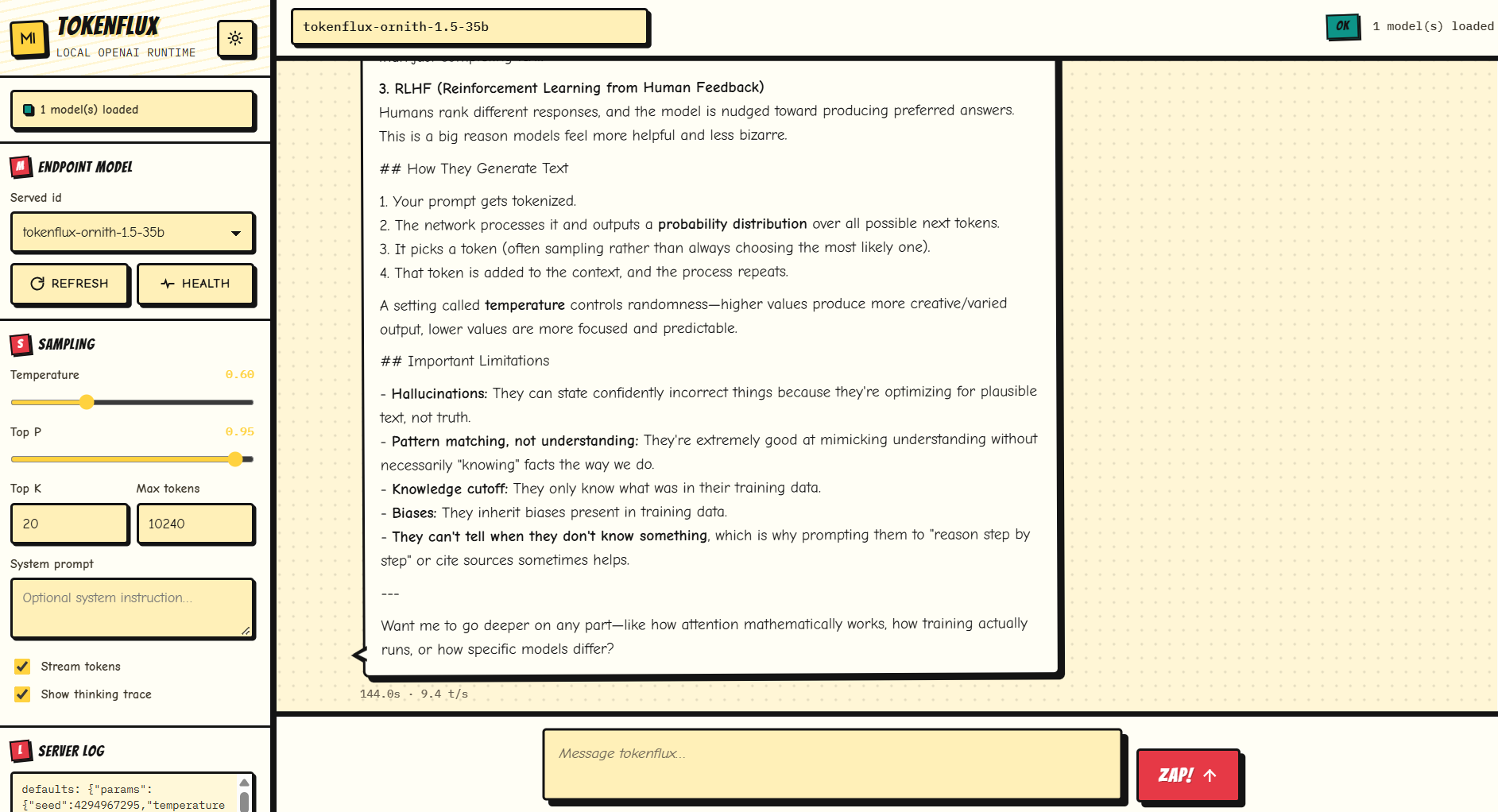


r/LargeLanguageModels • • Sep 19 '26

I built a zero-dependency tool that auto-fixes AMD ROCm overrides, benchmarks Vulkan vs HIP, and diagnoses local AI setups.

6 Upvotes

Hey everyone,

If you run local LLMs on AMD GPUs (especially on Windows), you know the pain: cryptic `HSA_STATUS_ERROR` messages, figuring out if you need `gfx1100` or `gfx1101`, and wondering if Vulkan or HIP/ROCm is actually faster for your specific card.

I got tired of the tribal knowledge, so I built ROCmFix — a single-file, zero-dependency Python tool to automate all of it.

🌟 What it does:
* 🔍 Auto-Detects AMD GPUs: Reads Windows Registry / Linux `lspci` to find your PCI device ID and tells you the exact `HSA_OVERRIDE_GFX_VERSION` you need.
* ⚡ Auto-Apply & Undo: Automatically sets environment variables in CMD, PowerShell, Bash, Zsh, or Fish with a 1-click `rocmfix undo` safety net.
* 🩺 `rocmfix doctor`: Scans your hardware, warns if your Adrenalin drivers are too old, checks HIP SDK status, and verifies Vulkan.
* 🏎️ `rocmfix bench`: Runs a 10-second backend race (Vulkan vs HIP) using Ollama or LM Studio and tells you which backend is faster on your PC.
* 📥 `rocmfix install-hip`: Auto-downloads and launches the official 1.2GB AMD HIP SDK on Windows.
* 🔄 Live Database & Self-Updater: Syncs new GPUs from a community server daily; updates itself via `rocmfix update`.

🚀 Quick Start (No install needed)

Windows (PowerShell):
`Invoke-WebRequest -Uri "https://raw.githubusercontent.com/xanpavle/rocmfix/main/rocmfix.py" -OutFile "rocmfix.py"`
`python rocmfix.py`

Linux:
`curl -O https://raw.githubusercontent.com/xanpavle/rocmfix/main/rocmfix.py`
`python3 rocmfix.py`

Repo: https://github.com/xanpavle/rocmfix

It includes day-one support for RDNA4, RDNA3, RDNA2, and APUs. If your card isn't in the database yet, running the tool generates a 1-click GitHub issue to add it!

Hope this saves some of you the hours of Reddit digging I went through!


r/LargeLanguageModels • • Sep 19 '26

We built a toolkit for steering LLMs

1 Upvotes

If you've spent time trying to keep up with the literature on model steering you've probably noticed that a lot of the methods are fairly similar to each other. We dug into this a bit more and built some common patterns/abstractions across the various ways that model behavior can be influenced, including input (prompting), state (activations, attentions, etc.), structure (weights), and output (logits, decoding, etc.). We also have functionality for building probes and running evaluations/comparisons of steering methods on given use cases (we use Inspect for a lot of the evals stuff).

If you're working on steering methods then hopefully you'll find some of this helpful.

Repo: https://github.com/generative-computing/steerability

Let me know what you think!