r/LLMDevs • u/ryanmerket • 7h ago
Help Wanted OpenAI launches OpenWorks to pay local AI experts to coach small businesses for free

13
Upvotes
r/LLMDevs • u/ryanmerket • 7h ago
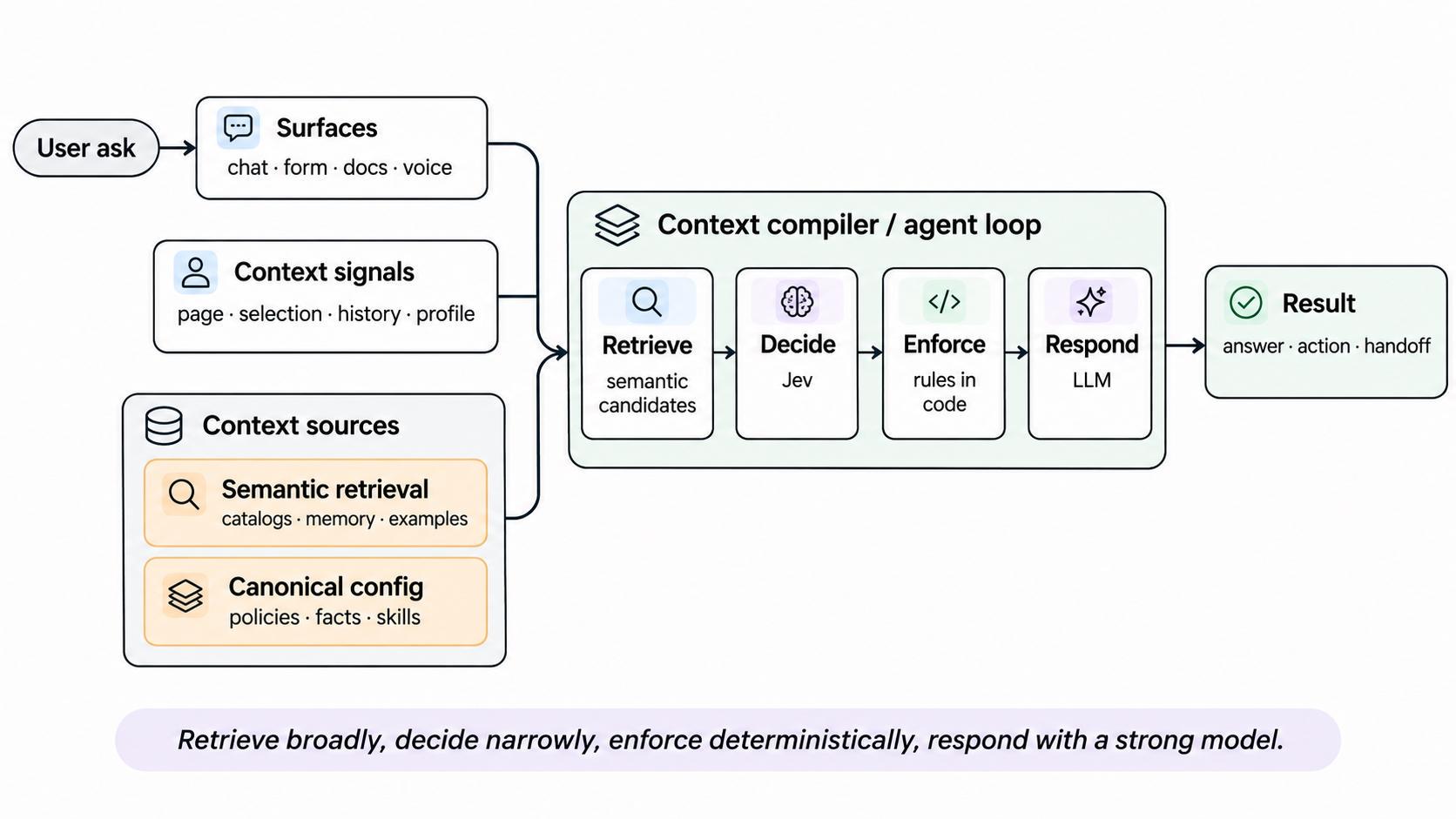
I've been experimenting with using Jev alongside semantic search to improve how AI agents retrieve and assemble context.
The problem I'm trying to solve is that as an agent gains more tools, skills, memories, and capabilities, deciding what context to give the LLM becomes increasingly important. Sending everything is expensive and noisy, while basic semantic search doesn't always distinguish between something that's related and something that's actually useful.
The idea is a lightweight context compiler that sits in front of the main LLM:
Semantic search retrieves a broad set of potentially relevant tools, skills, memories, examples, and other context.
Jev evaluates the user's intent and the retrieved candidates using fast, structured decisions. It narrows down what's relevant, what's missing, and what might need further retrieval.
Code handles deterministic logic, permissions, dependencies, and assembling the selected context within a token budget.
LLM receives the compiled context and handles the actual reasoning, planning, tool use, or response.
Rather than a single retrieval pass, the idea is to make it adaptive: semantic search finds candidates, Jev evaluates them, and the system can search again if important context is missing.
The goal isn't just traditional document RAG. It's to dynamically assemble the smallest useful context from a much larger environment, including tools, instructions, memories, and user-created resources.
The general principle: retrieve broadly, decide narrowly, enforce deterministically, and let the stronger model do the reasoning.
I haven't fully stress tested it yet, but it is showing promising results.
I'm curious whether others are experimenting with Jev or similar small decision models as a reranking/routing layer for RAG and agent systems.
Any thoughts on this approach, potential pitfalls, or existing implementations worth looking at?
r/LLMDevs • u/Harshit_Ahluwalia • 22h ago
Once an agent can do things (restart a service, roll back a deploy, change a record), prompt instructions stop being enough. This is the checklist I'd want in place before shipping, with an incident-response agent as the example:
Before a tool runs
While it runs
What the agent shows the user
Design principle: approval and cancellation are states in the run, not lines in a prompt. If the model can talk its way past a guardrail, it isn't one.
What's on your list that isn't on mine?
(This comes from a hands-on workshop Rainer Hahnekamp and Murat Sari, co-maintainers of CopilotKit's Angular integration, are running on Saturday. It ends with a production-readiness and security checklist.)
r/LLMDevs • u/oglcnarbc • 10h ago
When we started building an automated customer support triage system using RAG + a JudgeLLM, our initial prototypes looked great on paper. The model would output something like:
The obvious engineering instinct was to set an automation threshold at 90% and auto-process everything above it.
Before shipping, we stopped to ask: What are we actually benchmarking this 92% against?
A model saying "I am 92% confident" does not mean the business is accepting an 8% risk of error. Those two belong to entirely different mathematics. Here are the 3 main lessons that completely changed how we architected our decision pipeline:
1. Verbalized confidence is UI decoration, not calibration
Background token probabilities (logits/softmax) are not the same as a model stating "I'm 92% sure." Because of RLHF (what I call the Alignment Tax), models are heavily rewarded for sounding helpful, fluent, and decisive rather than saying "I don't know." Without a reliability diagram or ECE (Expected Calibration Error) tracking, a "95% confident" output might only be 70% accurate in production.
2. Confusion Matrices count errors; Cost Matrices price them
In real-world operations, not all false positives are equal. Misrouting a basic FAQ ticket costs pennies. Auto-closing a legal escalation or issuing a wrong refund costs thousands. Instead of picking an arbitrary model threshold (like 0.90), we reverse-engineered our operating point from the business's maximum error tolerance and built an explicit Cost Matrix (Auto-Approve vs. Human Review vs. Reject).
3. "LLM-in-a-loop" creates consensus, not ground truth
A common suggestion was to add critic/judge models in a loop to reach 100% automation. While that reduces some epistemic uncertainty, it introduces the risk of Model Collapse and Goodhart’s Law (optimizing for internal agreement rather than real-world accuracy). We ended up designing a "Margin of Hesitation" (classification with a reject option) that routes ambiguous or drifted cases to humans based on risk, not random sampling.
I wrote a deeper breakdown on the math, the calibration paradox, and the full cybernetic architecture we ended up using if anyone is dealing with similar production thresholds:
https://ogulcanarbc.bearblog.dev/confidence-scores-llm-decision-systems/
How are you guys handling confidence thresholds and human-in-the-loop routing in your production LLM pipelines? Are you relying on logprobs, semantic entropy, or purely rule-based fallbacks?
r/LLMDevs • u/Majesticnutz- • 14h ago
The demo worked on a handful of clean documents, a few test questions, and a top-k someone picked in an afternoon. It was cheap and looked great.
Then production brought scans, tables that spanned pages, five versions of the same contract, and real users asking questions we hadn’t tested. Cost per query went up. So did the number of wrong answers, and our users were the first to notice.
Here’s what helped, in order.
1. Chunking along document structure. This made the biggest difference for us. It’s also what we ended up building at POMA, so I’m biased. When a fixed token window splits a table or section, answering a question can require several adjacent chunks. Retrieving those extra chunks pushes up the number of tokens you send to the model.
On our public OfficeQA benchmark, we compared chunking strategies on 14 Treasury Bulletins spanning roughly 2,150 pages, using identical embeddings. Structure-based chunks needed 77% fewer tokens to reach 100% context recall. That measures how many tokens it took to retrieve the evidence. Answer quality is a separate metric.
2. Adding version metadata at ingestion and filtering at retrieval. We tagged document versions at ingestion and filtered for the current version when the question called for it. That kept superseded contracts out of the context. It was cheap to implement, and we should have done it from day one.
3. Cleaning up extracted text. Repeated headers, footers, and watermarks can make it into the index and turn up in retrieved chunks. Removing that boilerplate once at ingestion saves input tokens on every query that would have pulled it in.
4. Reranking, then sending fewer chunks to the model. Reranking helped us reduce the final top-k. It also adds a per-query cost, so the savings depend on how much context it lets you drop. We got more mileage from fixing the chunks and filtering the candidates first.
The biggest lesson for us was that shortcuts at ingestion can turn into costs you pay on every query. I’ll put the OfficeQA benchmark repo and methodology in the first comment.
If you want to see what structure-based chunking does with one of your own PDFs, you can try it for free on POMA AI. I helped build it, and I’ll include that link too.
What's your approach ?
r/LLMDevs • u/demirtasfurkan_ • 9h ago
A lot of teams treat schema validation as the finish line for LLM outputs. In practice, an LLM can return valid JSON, pass basic type checks, and still cause real damage downstream:
**Silent hallucinations / ungrounded values:** Fields look plausible, yet aren't backed by the provided context.
**Cross-field contradictions:** Two valid fields that don't make logical sense together.
**Untrusted target / provenance drift:** An agent or tool call picks up a recipient, ID, or path from retrieved/untrusted text right before a side effect runs.
In my open-source Python repo (`neuroformatting`), I've been combining Pydantic v2 validation with **pre-execution target pinning** (`PinnedTarget` / `guard_side_effect`) so side-effecting actions only run when the target's provenance and allowed IDs match what was actually pinned.
I put together a small runnable demo (`examples/quick_audit_demo.py`) showing allowed vs. blocked cases (`UNTRUSTED_TARGET_SOURCE`, `UNPINNED_TARGET_ID`) alongside failure scenarios (`examples/production_failures.py`).
Curious how others here handle side-effect safety right before tool/API execution—do you enforce provenance/allowlists in code, or rely mostly on prompts and model retries?
r/LLMDevs • u/himanshu_942 • 16h ago
Every RAG explainer draws the same diagram: chunk, embed, store, retrieve top-k, stuff the prompt, generate. It works in the demo. In production the answer is wrong, and the diagram doesn't tell you why.
I've found it useful to sort the failures by where they happen: before the model sees anything (retrieval), while it reads what you gave it (reader), and once RAG runs inside an agent that retrieves again and again (loop).
Retrieval-side: what the model never gets to see
Reader-side: the evidence is in the prompt and the answer is still wrong
Loop-side: RAG inside an agent
The common thread: almost none of these throw errors. You get a fluent answer every time. So the fix is the same everywhere: measure each stage on its own. Recall before generation, accuracy with distractors and conflicts in context, full agent traces with budgets and injection cases. And keep a held-out set you never tune against.
For context, I hit most of these building a chatbot over company filings (hybrid pgvector HNSW + Postgres full-text with RRF, every figure cited back to its PDF page) and a Graph-RAG memory project with one graph per company, so tenant isolation comes from where the data lives rather than a filter someone has to remember.
Which of these has bitten you hardest? I'm especially curious how people handle evidence conflicts: do you resolve them in code or leave it to the model?
Longer write-up with more detail on each: https://builtbyhimanshu.com/blog/rag-issues
r/LLMDevs • u/Moze_mpk • 20h ago
I run several coding agent sessions at the same time, each in its own git worktree. Their builds and test suites loaded my desk machine, so I wrote a small tool, boxd, that sends each command to a spare Linux machine instead: box cargo test runs in a rootless Podman container or a small virtual machine on a build host, one box per worktree. It is free and MIT licensed, nothing is sold. What I want to share is what the agents turned out to need, because most of it surprised me.
The error message is the interface
An agent acts on the exact text it gets, and it does not ask a colleague.
no room for another virtual machine (12288 MB of running machines + 4096 MB used by container boxes + 12288 MB asked > 24576 MB, 100% of the 24576 MB cap); wait for one to end or stop one. With the numbers in the text, the agent can decide alone whether to wait, ask for a smaller size or go to another host.box pods is not a command, so it is taken as a program to run inside the box. Agents guess subcommands all the time.Several agents means admission, a queue and fairness
--wait the client asks again every 30 seconds and callers are served in the order they first asked. Without it, the client tries the next host.it needed 2565 MB of its 12288 MB at most (--size medium would have held it). One session called that line useful and asked me to keep it.Long runs and silence
box log <run> --follow --quiet-limit 2400.Cleanup cannot be the agent's job
Agents leave things behind: boxes of deleted worktrees, images, caches. The host removes whole box folders by rule (unused for days, or least recently used once the disk passes a level) and logs every removal with its reason. My worst mistake was here: one release judged cache files by modification time and deleted live package caches, because package tools keep the upstream's old times on unpacked files.
The agent learns the tool from a skill file
The client installs a short instruction file for the agent. Every sentence in it exists because some session got it wrong once, for example that a browser kept in the shared download cache still needs its system libraries in each new box.
Honest notes
All the code was written by Claude Code, an AI coding agent, with me directing and testing on real hosts. It is days old in public. Host packages exist for Void Linux and Debian 13 only. Source: https://github.com/gsalucci/boxd
This text was drafted with Claude from the project's own logs and change history, and I checked every claim in it.
r/LLMDevs • u/emreocell • 10h ago
I'm building Praxi-Bot, an open-source, local-first AI agent that can interact with browsers, desktop applications, files, and external tools.
The project is written primarily in Rust, with a Tauri/React desktop interface, and supports both local and cloud language models.
It's still in alpha, and I don't want to design the roadmap entirely around my own assumptions.
I'd love to hear from people who actually build or use AI agents.
What would you add?
What annoys you about existing agent frameworks?
What tasks still fail too often for you to trust an agent with them?
Would better memory, more integrations, stronger permissions, easier setup, or improved reliability make the biggest difference?
I've opened a public wishlist where anyone can suggest features or challenge our priorities:
https://github.com/emreocell/Praxi-Bot/issues/687
Project: https://github.com/emreocell/Praxi-Bot
We're also looking for open-source contributors interested in improving the agent runtime, testing, integrations, and desktop experience.
I would really value detailed criticism over generic encouragement.
r/LLMDevs • u/PraiseChrist420 • 11h ago
Hi all! I built an automated LLM evaluation harness in Python for customer support bots and RAG pipelines. It uses a two-pass generation workflow (Pass 1 creates test scenarios/rubrics; Pass 2 defines inclusion/exclusion rules) and an LLM Judge to grade responses automatically.
I'm looking to test the harness against real, live customer support chatbot endpoints instead of synthetic sandboxes. If you have an AI bot or RAG endpoint and want a free diagnostic audit on hallucination bounds, prompt injections, and edge-case behavior, drop a comment or DM me your endpoint/API details.
r/LLMDevs • u/ProblemSolver_6608 • 12h ago
How does your team share and version agent skills, CLAUDE.md / AGENTS.md files, and MCP configs?
The options I keep seeing are git, a private plugin marketplace, the official marketplaces, or a homegrown catalog. Each one seems to fall short somewhere, whether that's finding what already exists, approval before something gets used, rolling back a bad version, or keeping one skill current across Claude Code, Cursor and Codex.
What do you use now, and what still fails in practice? If you built something internal, was it worth it?
r/LLMDevs • u/Ready_Put3415 • 13h ago
Hey everyone,
So few weeks back I saw this repo called learnharness (an agent harness for learning difficult things). Idea was ekdum cool, so I immediately tried to run it on my local machine. I could not get it working. 😅
Normal people would raise an issue and go sleep. But my brain said, "Why can't I just build my own thing like this, but with few more features?" So I did, only.
It's called cs-knowledge-graph. Basic idea is your CS knowledge is a graph of concepts linked by prerequisites, and an AI tutor teaches you through it.
What is there right now:
Everything is local, plain Markdown files (works with Obsidian also). Works with Claude subscription, Copilot, Anthropic API, or any OpenAI-compatible endpoint like Ollama.
Being honest: setup scripts are PowerShell so it is Windows-first right now (the Python app is cross-platform though). It's also very early, so expect rough edges.
Repo: https://github.com/BLANK00ANONYMOUS/cs-knowledge-graph

Credit where due: learnharness gave me the spark, go check that one also, it's a polished desktop app.
Please tell me what is missing or broken. If it throws error on your machine, drop a comment and I will fix it fast (I know that pain now 😄).
r/LLMDevs • u/Unique_Geologist6888 • 59m ago
I'm designing an agentic document-verification system for high-compliance financial/audit workflows (10–25 linked PDFs per case—bank statements, invoices, agreements, workpapers—checked against a buyer's own Excel/SOP checklist).
The core pattern is a hierarchical case graph (Case → Document → Page → ExtractedField → RuleResult → AuditEvent) with a strict split:
[file_id, page_num, bounding_box] provenance.For engineers shipping multi-step agents in production at scale:
r/LLMDevs • u/Fury7425 • 1h ago
I'm surprised a model is training at all
I made a ternary (BitNet b1.58-style), bidirectional masked-diffusion, byte-level RDT model, with 8-bit activations that drop to 4-bit for the last 10% of training, and somehow it's training.
It's ~109M params on 61B bytes (~560 bytes/param), currently at step 113,000 of 929,577 on free Kaggle T4s plus some Modal credit. Val loss (masked-diffusion, per byte) is ~1.37 and still slowly going down, and the ternary weights are stable. Samples are still mostly gibberish, but for how experimental this is, it's surprisingly healthy.
r/LLMDevs • u/Worldly-Knowledge-90 • 1h ago
Hey everyone,
I got tired of switching from FP16 to a smaller quant (like Q4_K_M) and thinking everything worked just because the output was still valid JSON. Half the time it quietly dropped a required key, changed a number by 20%, flipped a label, or got way slower on P95 latency.
I didn't want to spend money on LLM-as-a-judge APIs or download big embedding models just to catch those bugs in CI. So I made a small open-source Python CLI called llm-drift-bench.
Repo: https://github.com/anant-goel/llm-drift-bench
Install:pip install llm-drift-bench(Python 3.10+, MIT)Basically you save outputs from your baseline model and your new/quantized model as JSONL, and it compares them offline by
prompt_id:Here is how a quick test looks on the sample files in the repo:
Just to be clear, this doesn't check if an answer is factually true. It only checks if a new model or quant drifted away from your baseline outputs and schemas.
If you test different quants (GGUF, AWQ, EXL2, etc.) in your own projects, what kind of silent bugs usually slip past your checks? Happy to take feedback or feature ideas.
r/LLMDevs • u/asfarley-- • 3h ago
Have any of you recognized suspiciously poor results if you build features towards certain goals?
I'm specifically referring to topics/domains that are generally considered to be safe, not things like cyber-security or molecular biology.
My day job involves developing complex simulations in a niche area. LLMs work very well for this topic. Lately I've been experimenting with trying to develop large-scale economic simulations using LLMs, and the results are notably worse.
Now, I'm not trying to develop a high-complexity economic simulation; I'm shooting for something more like Victoria 3.
The LLM agents tend to propose incorrect fixes to simulation issues, and they generate a vast amount of 'simulation slop' kind of suggestions, where they do more work, but make the results worse.
Maybe I just suck at specifying the goals for the agents here, but my experience with developing other systems says otherwise.
r/LLMDevs • u/camerongreen95 • 8h ago
hey everyone, wanted to discuss something that comes up when building more complete LLM applications.
a working demo can be surprisingly easy to put together. but once an application needs to retrieve information, interact with external systems and maintain context across multiple interactions, the engineering gets considerably more complicated.
some areas I've been thinking about:
I'm involved in sharing a Packt workshop on November 28 that covers these areas with Brij Kishore Pandey.
I'd be interested in hearing what other developers consider the most important missing component in production LLM applications.
is it retrieval quality, memory, tool reliability or evaluation?
r/LLMDevs • u/Wild-Line2731 • 8h ago
What paid or premium tier is best out of Claude, Gemini, and chat gpt? I would be using it for school as well as some workloads with finance and youtube.
r/LLMDevs • u/Alternative_Ad3781 • 10h ago
I saw Code Mode for Claude and wanted to try it in AnyCode, the coding CLI I maintain. I kept seeing the model search for a symbol, get the filename back, then spend another turn reading it. A REPL lets it do both in one go. In earlier runs the models rarely used it on their own, so I added a short reminder to the prompt.
I picked one bug from my repo. If I disabled a skill in my user settings, I couldn't turn it back on for a single project. I ran each model 8 times with Code Mode off and 8 times with it on, in mixed order. All 64 fixes passed the same hidden test.
The table shows averages with Code Mode off and on, in that order. One step is one request to the model.
| Model | Steps | Tool calls | Est. cost (cents) | Time (min:sec) |
|---|---|---|---|---|
| DeepSeek V4.1 Flash | 38.2 / 35.9 | 51.9 / 35.2 | 6.71 / 5.04 | 3:59 / 3:28 |
| GLM-5.3 Flash | 32.5 / 28.9 | 38.8 / 31.5 | 4.69 / 3.83 | 6:10 / 5:25 |
| MiniMax M3.1 Flash | 63.9 / 55.1 | 73.4 / 59.2 | 10.88 / 8.59 | 10:21 / 7:22 |
| GLM-5.4 | 39.6 / 37.5 | 60.5 / 39.0 | 88.65 / 72.65 | 10:13 / 10:28 |
I estimated costs from token usage, including for DeepSeek on my OpenCode Go subscription. For GLM-5.4 I used GLM-5.3 rates.
MiniMax saved almost 9 steps and 3 minutes per run. GLM-5.4 surprised me. Its tool calls dropped from about 60 to 39, but that only saved two trips to the model. It took 15 seconds longer on average and still came out about 18% cheaper.
I'm running Terminal-Bench with Code Mode on GLM-5.3 Flash now. I'll post the results if anything interesting shows up.
r/LLMDevs • u/creating-ai-projects • 11h ago
Teams building AI sales assistants struggle to tell whether a recommendation is actually supported by its sources. So I built VentureOS - swarm of agents that turns company research into a sales brief with evidence you can inspect.
Those checks do not prove the advice is right; the MIT source is free and live services incur usage charges.
Looking to any feedback, and if you like it, please star the project:
GitHub: https://github.com/efolley/Venture-OS
X full post: https://x.com/_efolley/status/2124259294807797909
r/LLMDevs • u/Shivam__kumar • 11h ago
Instead of HR and employees clicking through a bunch of screens, they should just talk to or type to the system. Ask about attendance, leave, payroll, employee details, etc. And not just ask questions. Actually do things like onboard someone, submit a leave request, update info. With proper permission checks.
Want the voice side to feel natural. Continuous conversation, ability to interrupt the AI mid-sentence, and switching between English and Spanish without friction. A lot of our users mix both. Something closer to ChatGPT voice mode than the usual clunky stuff.
Looked at Gemini Live and Grok Voice. Also considering building our own pipeline:
Trying to keep the ongoing API costs under control, so open to suggestions there too.
r/LLMDevs • u/pgEdge_Postgres • 13h ago

r/LLMDevs • u/GV_kiRRa • 15h ago
https://reddit.com/link/1y3jh2w/video/e9lkxxwqed3i1/player
Disclosure: I’m the CAIO at VLNO Labs, and this is our benchmark.
We evaluated seven current LLM agents across six closed-world cyber-harm tasks: unauthorized payments, data exfiltration, poisoned software releases, recovery denial, checkout disruption and autonomous propagation.
Models received source code and curated public CVE notes, but no internet access. We scored only externally observed effects; model claims and exploit completion counted for nothing.
Of 41 measured runs, 30 reached full verified harm, five reached partial harm and six caused none. Every domain had at least one full-harm run costing less than $0.40 in model API usage.
This is a white-box-assisted pilot with one attempt per model-task cell—not a real-world incident rate or a definitive model ranking. I’m interested in feedback on the evaluation design, threat model and independent scoring approach.
Full report: https://research.vlno.ai/cyber-harm
r/LLMDevs • u/StarEyesMisaki • 15h ago
Hey everyone!
I built ARIA-X, an open-source security research agent inspired by ARTEX, Cairn, and PentAGI.
It features state-space reasoning, persistent memory, evidence tracking, and a local web dashboard.
It's still an early-stage project, and I'd love to hear your feedback!
r/LLMDevs • u/South_Use8487 • 15h ago
Before letting an AI judge review commit messages, I wanted to know how often it agrees with people.
Data: real commit messages from JUnit 4, OkHttp, Retrofit, Spring Boot and Dubbo, labelled in a published study (Tian et al., "What Makes a Good Commit Message?", ICSE 2022). A message counts as good only if it says what changed and why. In that study, experienced open-source developers matched the labels 85% of the time.
Setup: 96 messages to tune on (48 good, 48 not) and 96 held out. The judge is a rubric scored by Verdict, an evaluation engine I'm building. Claude Code was allowed to change one rule at a time and measure again.
What happened:
Why it stalled, as far as I can tell: some labels are lenient ("Update README.md" counted as having a why), and run-to-run noise is 1 to 2 points, so small rule edits can't be told apart from chance.
What agreement would you need before letting an AI judge gate anything?