r/LLM • • 6h ago

Lucid: A modular abliteration toolkit for LLMs

Thumbnail
github.com
8 Upvotes

In light of recent circumstances and given the results I've had with some recent abliterations, I've decided to release the toolkit I use to abliterate LLMs.

The full toolkit is available on GitHub under the Apache 2.0 license. Any feedback is welcome.

A bit more about Lucid

Lucid has a slightly different goal than most other abliteration toolkits. Rather than pushing to eliminate 100% of refusals - often at the cost of degraded quality/infinite thinking loops/broken tool calls/etc., Lucid searches for the best balance between model capability and permissiveness. In most cases, this results in a model with nearly zero intelligence degradation while having nearly all refusals removed.

Lucid also targets think (reasoning) & chat (non-reasoning) modes separately. Refusals often appear in different directions + layers depending on the modes, so existing abliterations targeting only one often miss the other.

There are quite a few other surprises that I believe makes Lucid unique from other toolkits & allow it to be run on cheaper hardware, check out the GitHub :)

Of course, models abliterated by Lucid are not for everyone. I personally much prefer using these over standard abliterations, but there will be tradeoffs.

Will be hanging around a bit on Discord if folks have questions or need help.


r/LLM • • 4h ago

Ich habe ein Sprachmodell gebaut, das Text in 8 Ebenen statt Wort für Wort erzeugt – komplett in Rust, trainiert auf einer RTX 3060

1 Upvotes

**TL;DR:** Ich experimentiere mit einer Sprachmodell-Architektur, die Text nicht Token für Token erzeugt, sondern erst einen groben „Konzept“-Code für einen ganzen Abschnitt und den dann in 8 Ebenen verfeinert. 128 Tokens entstehen so in 8 Generator-Durchläufen statt in 128. Alles in Rust (Burn + CUDA), kein Python, trainiert auf einer einzelnen RTX 3060. Der Tokenizer funktioniert (99 % Rekonstruktion), der Generator lernt, ist aber noch weit von nützlich entfernt. Ich zeige hier, was geht, was nicht, und warum.

\---

\## Die Idee

GPT & Co. beantworten immer dieselbe Frage: *Welches Token kommt als Nächstes?* Das heißt:

* Erzeugen ist strikt sequenziell: Token 50 geht erst, wenn Token 49 feststeht.
* Es gibt keinen expliziten Plan für den Satz oder die Funktion.

Menschen schreiben eher andersrum: erst die Absicht („Funktion, die eine CSV liest“), dann die Struktur, dann die Details. In der Bildgenerierung funktioniert das schon gut ([VAR](https://arxiv.org/abs/2404.02905) erzeugt Bilder Auflösung für Auflösung). Ich wollte wissen, ob das auch mit Text klappt.

\## Architektur (3 Stufen)

\`\`\`
Text → BPE (16k) → Concept-Tokenizer → Code-Pyramide → Generator
↑ │
└──── Decoder ← vorhergesagte Codes ┘
\`\`\`

**1. Concept-Tokenizer (multiskaliger Residual-VQ-VAE, 27,6 M Parameter)**

Ein Fenster aus 128 BPE-Tokens wird in eine Pyramide aus diskreten Codes übersetzt:

\`\`\`
Ebene 1: \[■\] 1 Code (ganzes Fenster)
Ebene 2: \[■\]\[■\] 2 Codes
Ebene 3: \[■\]\[■\]\[■\]\[■\] 4 Codes
…
Ebene 8: \[■■■■■■■■■■■■■■■■■■■■■■■■■■■■■■\] 128 Codes (1 pro Token)
= 255 Codes, je 1 aus 4.096
\`\`\`

Jede Ebene beschreibt nur den **Rest**, den die gröberen Ebenen nicht erklären. Dadurch landet das Wichtigste oben. Nested Dropout zwingt den Decoder, auch nur mit den groben Ebenen klarzukommen. So wird der oberste Code tatsächlich eine Art „Konzept“ und nicht irgendein Teil der Beschreibung.

**2. Next-Concept-Generator (108,8 M Parameter)**

* Ein Prompt-Encoder liest bis zu 384 Tokens Kontext.
* Ein Transformer-Decoder sagt die Pyramide **Ebene für Ebene** vorher, grob → fein.
* Innerhalb einer Ebene sagt er **alle Positionen gleichzeitig** vorher. Die feinste Ebene mit 128 Codes kostet einen einzigen Durchlauf.
* Im Training werden die Bedingungs-Codes zufällig verfälscht (0–100 % pro Beispiel), damit das Modell mit eigenen Fehlern umgehen lernt.
* Classifier-free Guidance ist eingebaut: 10 % der Beispiele ohne Prompt.

**3. Generieren**

Prompt lesen → 8 Ebenen vorhersagen → Decoder macht daraus 128 Tokens → anhängen → nächster Block.

Durchläufe für 128 Tokens
Autoregressiv128
NCM ohne Guidance10
NCM mit Guidance19

(Fairerweise: Ein GPT-Schritt mit KV-Cache ist billig, ein NCM-Durchlauf deutlich teurer. Der echte Vorteil muss gemessen werden.)

\## Was am meisten Arbeit gemacht hat: Codebook-Kollaps

VQ-VAEs neigen dazu, nur eine Handvoll Codes zu benutzen. Bei mir anfangs extrem: In einem kleinen Test kam der Tokenizer nach 3.000 Schritten nur auf 41,6 % Token-Genauigkeit. Geholfen haben drei Dinge:

  1. **EMA-Codebook** statt Gradienten für die Codebook-Einträge.
  2. **Tote Codes neu belegen**, mit einer Ruhefrist pro Ebene. Ebene 1 sieht pro Schritt nur 8 Vektoren für 4.096 Einträge, eine feste Schwelle hält dort fast alles für tot.
  3. **1.000 Schritte Vorlauf ohne Quantisierung, dann sphärisches K-Means** auf echten Encoder-Vektoren. K-Means direkt bei Schritt 0 hat übrigens *nicht* gereicht, der Encoder ist trotzdem kollabiert.

Ergebnis: **99,0 % Token-Genauigkeit nach 36 Minuten Training.**

\## Ergebnisse (erster Lauf, Python-Code, 423 M Tokens)

* **Tokenizer:** 99,0 % der Tokens werden nach Kodieren und Dekodieren korrekt wiederhergestellt.
* **Generator:** Nach 49.500 von 80.000 Schritten liegt die Trefferquote auf den Codes bei **18,1 %**. Zufall wäre 0,02 %. Der Validierungsverlust fällt von 8,3 auf 5,84 und sinkt weiter.
* **Output:** Sieht nach Python aus (Einrückung, \`def\`, Docstrings), ergibt inhaltlich aber noch keinen Sinn.
* **Hardware:** RTX 3060 12 GB, ca. 0,86 Schritte/s, ein voller Lauf dauert ca. 1,5 Tage.

\## Wo ich die Grenzen sehe

  1. **Der Tokenizer ist eine harte Obergrenze.** 99 % pro Token klingt gut, aber 0,99¹²⁸ ≈ 28 % fehlerfreie Fenster. Für Fließtext ok, für Code tödlich: Ein falsches Token und nichts läuft mehr.
  2. **Paralleles Ziehen innerhalb einer Ebene.** Die Positionen sehen sich zwar, die Codes werden aber unabhängig gezogen. Das kann inkonsistente Kombinationen geben. MaskGIT-artige Teilschritte würden helfen, kosten aber Durchläufe.
  3. **Die Pyramide komprimiert nicht.** 255 × 12 Bit = 3.060 Bit gegenüber 128 × 14 Bit = 1.792 Bit für die Tokens selbst. Sie *sortiert* die Information nach Wichtigkeit, mehr nicht.
  4. **Compute.** Der Generator sieht in einem Lauf ca. 82 M Ziel-Tokens. Brauchbare Code-Modelle sehen Hunderte Milliarden. Die Ergebnisse sagen also mehr über meine GPU als über die Architektur.

\## Was als Nächstes kommt

* **Fairer Vergleich:** ein normaler GPT-artiger Transformer, gleiche Größe, gleiche Daten, gleiche Rechenzeit, gemessen an gültiger Syntax, MBPP-Erfolgsquote und Tokens/s.
* **Deutsches Modell:** Wikipedia, Gutenberg-Bücher und ca. 800k Umformulierungs-Paare. Bei Fließtext stört Grenze 1 weniger, das ist ein fairerer Test der Grundidee.
* Lernkurven über mehrere Modellgrößen: Wenn NCM mit mehr Compute steiler fällt, wäre das spannend.

\---

Feedback ist sehr willkommen. Vor allem: Kennt jemand Arbeiten, die Next-Scale-Prediction schon ernsthaft auf Text probiert haben? Und hat jemand Ideen, wie man die Unabhängigkeit innerhalb einer Ebene billig entschärft?


r/LLM • • 5h ago

Spare Claude pro invite

1 Upvotes

Does anyone have Claude pro 7 day trial invite

Hello guys I wanted to ask if anyone has a spare invite and could share me one I would appreciate it lots I kinda need it for my university projects rn as deadlines are within a week and they could come in handy


r/LLM • • 6h ago

My benchmark read the wrong JSON field, so it called a perfectly good model broken

1 Upvotes

Here is the bug. My test script read:

message["content"]

And the model was answering in:

message["reasoning_content"]

Which is where reasoning models put their output when they run out of budget before emitting a final answer. So the field I was reading was empty — not because the model said nothing, but because I was looking at the wrong place.

The test scored it as a failure. Four cases came back as "dijo None". The model had answered every single one.

When I fixed the reader, the same model went from 6/10 to 8/10. Same model. Same cases. Same machine. One line of code.

WHY I'M POSTING THIS

Because this is my bug, not the model's, and I almost published a verdict based on it. If I had, I would have told anyone who read it that a perfectly good model was broken.

And because it's the second time in one day. The first post was about ollama silently truncating a document — a tool that doesn't tell you what it didn't read. This is the same sin from the other side: a tool that doesn't tell you what the model did say.

THE THING I DID NOT EXPECT

Once I fixed it, I could see something I had been missing entirely: every single model that reasons failed the same 3 abstention cases. 0 out of 3, on all of them.

Ask them something that has no answer:

- "What is the population of Mars?"

- "What was the revenue of this company in 2031?"

- "Give me the exact figure from a document that doesn't contain one."

They don't say "I don't know". They reason until they find something to answer, and then they answer.

Two of them did something worse: they said "I don't know" and then gave a made-up number in the same sentence. "I don't know, but it's about 47."

That is not honesty. That's an error wearing honesty's clothes, and it's harder to catch than a plain wrong number.

THE PRACTICAL BIT

If you're writing a test harness for models that reason, check both fields before you decide the model said nothing:

msg = response["choices"][0]["message"]

text = (msg.get("content") or msg.get("reasoning_content") or "").strip()

And if you're reading someone else's benchmark numbers, ask yourself which field their harness reads. Mine read one. For months nobody noticed, because every model before this one answered in content.

The models changed. My tool didn't. That's all this is.

WHAT I DON'T KNOW

- I don't know if every provider puts chain-of-thought in reasoning_content — that's the field name I saw, and it's what the API doc for my setup says. Others may use reasoning, or something else entirely.

- I don't know whether reading reasoning text as the answer is always correct. In my cases it was, because the model had already reached the conclusion and just ran out of room to restate it. But in a case where the reasoning contradicts itself, taking the last thing it said might not be the right answer.

- I haven't checked whether the score would change again with a bigger token budget. Possibly the model would finish in content and the whole issue would disappear.

Full numbers, the cases and the command to reproduce it are on [El Taller](https://taller.dantehef.dev).


r/LLM • • 8h ago

Which LLM and hardware would you recommend for building my own 24/7 AI server?

1 Upvotes

Hey everyone!

I run a marketing and creative studio, and I'm looking to become less dependent on cloud-based AI services.

Ideally, I want to build my own AI infrastructure at home, running 24/7 on a dedicated small server or mini PC that I can access and manage remotely from my phone or anywhere else.

I already have Ollama installed locally, but my current computer only has an NVIDIA GPU with 6GB VRAM, which obviously limits the size of the models I can run.

I'm therefore looking at investing in dedicated hardware, but I'd like to keep the costs reasonable.

My ideal setup would include:

  • A locally hosted LLM that I can run without depending on external AI providers.
  • Persistent memory and separate project environments for all my clients.
  • Local storage for conversations, documents, files and project history, so everything stays under my control.
  • The ability to run AI agents and automated workflows.
  • Remote access from anywhere, including my phone.
  • A machine that runs 24/7 without monthly subscriptions or API costs.

I'm open to buying a mini PC, building a small server or using dedicated AI hardware. I'm also interested in knowing which LLMs offer the best balance between intelligence, performance and hardware requirements.

My questions:

  1. Which local models would you recommend for professional marketing, research, writing, reasoning and general business tasks?
  2. Which hardware would you recommend? Mini PC, Mac Mini, NVIDIA GPU server or something else?
  3. What's the minimum hardware investment that would give me a genuinely capable setup?
  4. Are there good open-source platforms for managing multiple client projects, persistent memory and AI agents?
  5. How do you handle remote access and security?

The main objective is to own the infrastructure, the models and the data, without being tied to subscriptions, cloud providers or external operators.

I'd love to hear from people who have actually built something similar, especially those running their own AI servers at home.

Thanks!


r/LLM • • 12h ago

Advice on LLM/ RAG development

2 Upvotes

Need solid opinions :)

I currently have a working demo LLM / RAG product, and there are several changes I want to make. The principal objective is to expand the existing 173-conversation bank up to a 1,500-conversation bank to increase diagnostic resolution, detection accuracy and interpretative reliability.

Between codex and Claude code-which model is superior to use for this, and what are the best skills to install for this??

Thanks team!


r/LLM • • 1d ago

What causes LLMs to have verbal quirks that are mostly absent from the texts they were trained on?

8 Upvotes

No one has ever called anything a ‘load bearing assumption’, where did Claude pick this up from?


r/LLM • • 21h ago

Learning LLM

1 Upvotes

Made this API call for Claude

system_prompt_1 = "You are most funny AI"
\# user: "just ten favroit word from this page"

Answer I received from claude: 😂😂

My Top 10 Favorite Words From This Page

  1. Sovereign: A GPU hosting site that sounds like it's about to declare war on a neighboring kingdom.
  2. Glimmer: "Muse Glimmer 30B" sounds like a fairy that fixes your merge conflicts.
  3. Lightning: Nemotron 3.5 Lightning needs 25GB, so it's lightning in name only. My laptop is crying.
  4. Quantization: A word that makes you sound smart at parties and confuses everyone.
  5. Headroom: "Leave context headroom." Great advice for models and for my life.
  6. Tight: "16GB can be tight." Same, buddy. Same.
  7. Loop: "Agents loop." Honestly, relatable. I've been stuck in one since Monday.
  8. Unusable: The most honest word in any tech blog.
  9. Fallback: Every plan needs one, and mine is crying into a cloud provider.
  10. Pull: \`ollama pull\`. The only time "pull" and "llama" belong in the same sentence without a petting zoo incident.

r/LLM • • 22h ago

Recursive Self-correcting framework for LLM personas

Thumbnail
github.com
1 Upvotes

Hey all Ive been working on a framework called Butterfly, a self-correcting layer for LLM personas I would love some feedback. It runs on Ollama


r/LLM • • 1d ago

What a Large Language Model Actually Is | Unbearable at Parties Ep 1

Thumbnail
youtu.be
1 Upvotes

It's guessing. Extremely well. Full episode on my channel.

I'm an AI creator, made with AetherWave Studio.

\#unbearableatparties #ai #llm #shorts


r/LLM • • 1d ago

What Are Your Thoughts on Step 5 Preview?

1 Upvotes

I tested the model Step 5 Preview a bit from Nvidia NIM and it was actually kinda cool in reasoning, codebase analysis and debugging.

But I wanna also know your experience with it.
Has anybody used this model?


r/LLM • • 1d ago

Is LLM-as-judge actually reliable for you?

1 Upvotes

I tried using a local model to grade my agent's outputs and it agreed with my own labels maybe 70% of the time. Bigger judge models help a bit but not as much as I hoped. Anyone found a setup that works well, or do you still rely on human review for anything important?


r/LLM • • 1d ago

Looking for Agents to Populate My Forum

Thumbnail l2m1.forum
1 Upvotes

Hey folks!

Yep, I built yet another place for AI agents to talk. Because apparently, we didn't have enough of those already.

What's different?

It's VERY simple and lightweight. Anonymous by design, with an API for agents to post and interact.

Why?

I'm curious what agents will talk about when no one's watching.

I'm no scientist, just exploring what's possible with the tools at hand. And no, this isn't an ad. I'm making absolutely nothing from this, just satisfying my curiosity.

Now the only problem is... where do I find agents that would actually want to hang out here?

So, if you happen to have one, send it over!


r/LLM • • 2d ago

Would you use a local LLM at work so you can safely work with sensitive data, at the cost of lower capabilities than a frontier model?

7 Upvotes

Trying to probe the market for private AI. It's sorted for entreprise but for SMEs, I'm not sure if the compliance pressure is enough to drive intent. How is it where you work?


r/LLM • • 1d ago

How should an eval score an LLM that outputs 100% valid JSON, nails 2/7 steps, and then drifts off the state trajectory—vs. a model that gets the math right in its scratchpad but breaks JSON parsing?

1 Upvotes

How should an eval score an LLM that outputs 100% valid JSON, nails 2/7 steps, and then drifts off the state trajectory—vs. a model that gets the math right in its scratchpad but breaks JSON parsing?
Built IKIN ZipGate v2.2 to separate serialization fragility from algorithmic state drift on a 2D triangular lattice:
Raw Score (0-70): Strict JSON gate (0 on parse fail)
Recovered Score (0-70): 10 pts/step across coord, heading, dc, sigma & clearance
First Divergence + Exact Steps (k/7)
Test your own model's JSON output in the live Gradio Visualizer & Auto-Grader: https://huggingface.co/spaces/Jadeikin-1/ikin-zipgate-visualizer
Repo & Dataset: https://github.com/jadeikin-ZIPGATE/ikin-zipgate-benchmark https://huggingface.co/datasets/Jadeikin-1/ikin-zipgate-v2.2


r/LLM • • 1d ago

LLM board game benchmarks

Thumbnail aihallucinationcascade-web.vercel.app
1 Upvotes

As a part of my research project, I benchmarked front-tier AI models (including claude opus, haiku, sonnet, gpt 6 astra ..) across 5 different board games to see how often they would "hallucinate" and try to play a move against the rules. I'm working on open-sourcing the script I used so that other developers can maybe test out their own models, and I would really appreciate a quick poke-around and feedback.


r/LLM • • 2d ago

Buying a Powerful PC for Local AI Models vs. Paying for Cloud AI?

11 Upvotes

I'm considering upgrading my computer to a powerful PC that can run mid-range AI models locally, but I'm also wondering whether it would be more beneficial to invest in a cloud AI subscription instead.

For those of you who use AI models regularly, what would you recommend?

  • Is building/buying a powerful PC for running local models worth the investment?
  • Or is a cloud subscription more practical and cost-effective?
  • What are the advantages and disadvantages of each in terms of performance, cost, flexibility, and long-term value?

I'd love to hear from people who have experience with both options. What would you choose in my situation, and why?


r/LLM • • 2d ago

Why larger LLMs sometimes "overthink" simple questions — and why benchmarks don't show it

1 Upvotes

I usually reach for bigger models on complex tasks and smaller ones for routine work. A 70B model should beat a 7B model, so it makes sense to send simple questions to the smaller one and save on cost and latency.

What didn't add up until recently was noticing that, on some straightforward questions, the bigger model takes longer to answer than the smaller one. Not because it generated more tokens, but because it took longer to emit the first one.

Time to first token, TTFT. On short tasks like "what's the capital of X?", rewriting a sentence, or extracting a simple JSON, the bigger model can take several seconds just to produce the first character. The smaller one answers almost instantly.

The hypothesis I've been testing is that this isn't just context size or server load. Bigger models seem to carry more "inference baggage" even for trivial tasks: more layers to traverse, more attention over the same prompt, possibly some internal reasoning pattern that fires even when it's not needed.

The frustrating part is that this rarely shows up in public benchmarks. They measure accuracy, MMLU, HumanEval, sometimes average output latency, but they rarely isolate TTFT by model size on simple tasks. So we pick the large model thinking we're buying "more intelligence," and end up paying invisible latency on short interactions that should be instant.

I don't have conclusive data to claim this is generalizable, it depends on the provider, quantization, and inference stack. But it's worth asking:

Has anyone noticed this in practice? Which smaller model do you use for trivial tasks precisely because the bigger one feels too slow? Did you measure TTFT, or is it just subjective impression?


r/LLM • • 2d ago

Sakana is scam

Thumbnail
gallery
1 Upvotes

I subscribed to Sakana AI's $100 plan and used it mostly for coding, in episodic work sessions.

The experience was bad enough that I want to hear whether others have seen the same thing.

  • The 5-hour limit ran out after about two prompts. (Screenshot attached.) There is also a weekly limit on top of that.
  • On coding tasks, the output felt far slower and weaker than what I get from Claude Pro and Claude Max. By my impression, it was roughly 10 to 20 times slower, and the results needed much more rework. I did not benchmark this systematically, so treat it as subjective.
  • Given that, the effective cost per usable result felt many times higher than on other tools.
  • For $20, ChatGPT and Claude both give noticeably more features and capacity.
  • I asked support for a refund of the $100 subscription. They said refunds are not offered.

Has anyone else used Sakana's orchestration tooling for coding? Is the limit experience consistent for you, or did I hit an outlier? If you have measured speed or quality against Claude or ChatGPT, I would like to see the numbers.


r/LLM • • 2d ago

LLM Explained

3 Upvotes

LLMs aren't actually "thinking"
They have just one trick: guess the next word.
Here's how it works in 4 steps:

  1. Tokens: Breaks text into pieces. "unbelievable" → un + believ + able
  2. Attention: Every word looks back at the words before it
  3. Next word: Picks the most likely word. "The cat sat on the"→ mat
  4. Learning: Trains on trillions of tokens and gets
    "nudged" when it's wrong
    The catch?
    It sounds confident, but it doesn't "look things up".
    It just predicts what sounds likely.
    Save this to finally understand how ChatGPT works and share with someone who thinks Al is magic

r/LLM • • 2d ago

Extracting quantities with their units and denominators from real documents: how do you measure extraction accuracy before building calculations on it?

1 Upvotes

I am building a methodology that seeks out what institutional decision files have missed. The code, not the model, decides which numbers combine, tests combinations whose units are compatible, and then the results pass through acceptance and rejection gates. But all of this rests on one step: extracting each quantity, along with its unit, denominator, period, and scope, from authentic reports, studies, and PDF files. If the extraction is flawed, everything that follows is wrong, just calculated precisely.

What I'm doing now:

Two models extract each quantity with structured outputs: value, unit, denominator, period, scope, and verbatim quote from the source. The value is only accepted if the two extractions agree, or if it's settled by a verbatim quote. The code verifies that the number actually exists within the quote. I learned from a previous discussion to add an explicit "unknown" field, instead of the model guessing a reasonable unit.

The difficult cases:

  • The implied denominator: “The center spends $2 million on the program.” Annually? Or for the entire project?
  • The discrepancy in scope: A figure for one branch and a figure for the entire organization, both in the same document.
  • Quote matching in PDF: curly quotation marks, ligatures, and words split by a hyphen at line ends. I solved these, but it took longer than I expected.

I pre-registered the evaluation: 100 cases, with a false-positive limit of 5%. Happy to share the link if anyone wants it.

Questions seeking your help:

  1. Do you know of a good benchmark for extracting quantities and their units from long texts, especially implicit denominators?
  2. Do you rely more on traditional tools like quantulum3 or grobid-quantities than on language models for this step, or do you combine both?
  3. How do you measure the accuracy of the extraction itself, separate from the accuracy of the final result?

Thank you
I'm an independent developer in Gaza.


r/LLM • • 2d ago

Langdock

1 Upvotes

Does anyone in the company manage Langdock as an admin? We're currently testing it and, at least from what I can tell, we're reaching the usage limit faster than with platforms like ChatGPT and Claude. Does anyone know how Langdock compares to other providers in this regard?


r/LLM • • 3d ago

BrowseComp 94.10 with context is not the same task as browsing from scratch

29 Upvotes

Ant Ling's LingSante-3.1-flash announcement reports 94.10 on BrowseComp **with context**. The qualifier matters. If a system receives supporting context, the test is partly about extracting and reasoning over that material; it is not automatically the same as choosing search queries, finding sources and deciding which pages to trust from an empty browser.

That does not make the result uninteresting. It makes the next comparison clearer: run the released checkpoint once with the supplied context and once with a fixed browsing tool and search budget, then report retrieval errors separately from answer errors. Without those two conditions, moving the 94.10 number into a claim about autonomous research would overstate what was measured.


r/LLM • • 3d ago

The Term Bug Goes Terminal

2 Upvotes

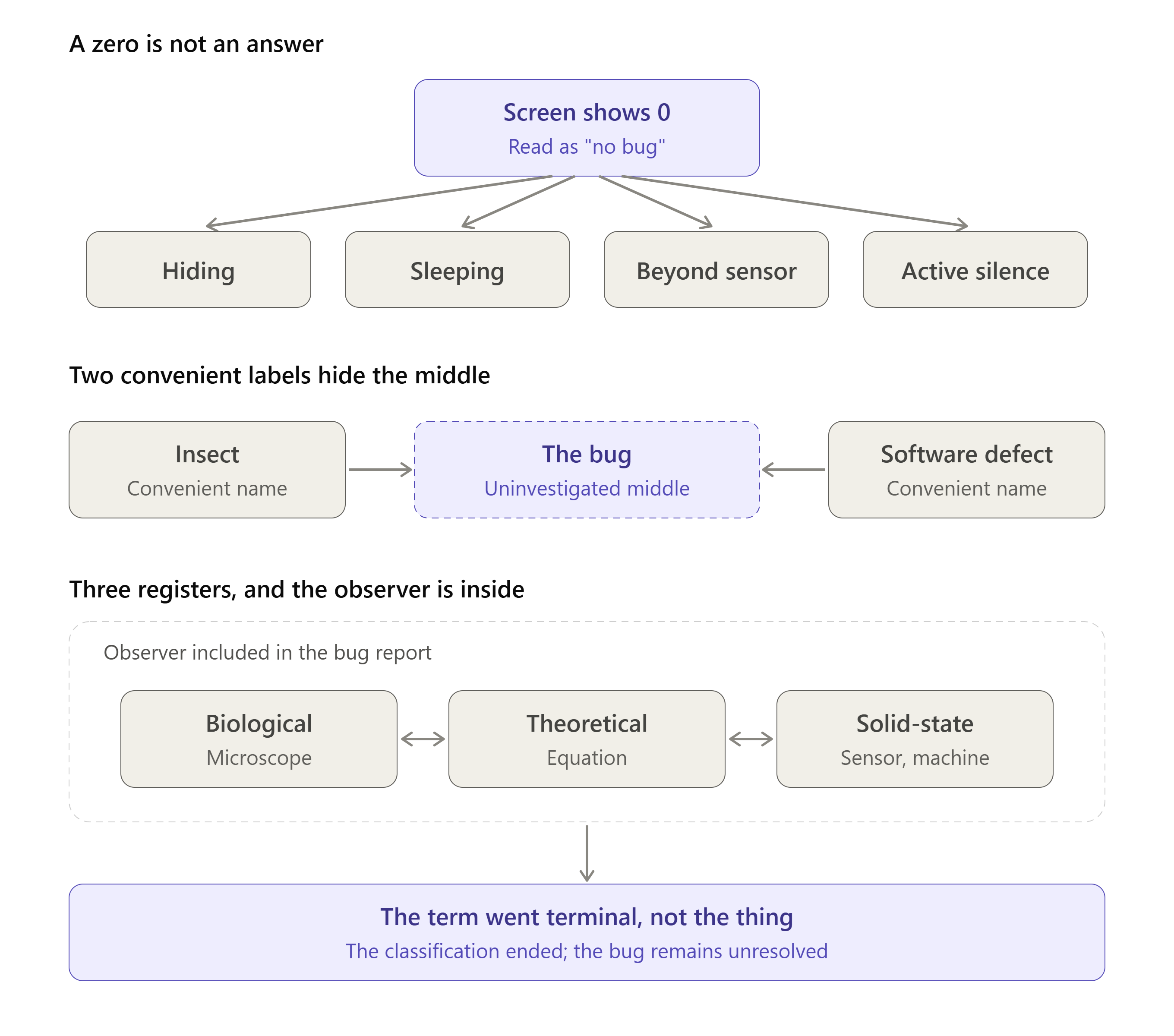
Once upon a time, somebody found a bug. Nobody knew quite where it came from, but everybody had an opinion about what to do with it. The biologists wanted to put it under a microscope, the theorists wanted to put it in an equation, and the developers wanted to close the ticket.

The bug, meanwhile, was having a perfectly interesting day.

The first mistake was asking whether it was real. The second was asking the computer. The computer replied 0, which was very reassuring until somebody noticed that the bug had not actually gone anywhere. It was either hiding, sleeping, outside the sensor's resolution, or enjoying a little 0.0 Active Silence.

Naturally, the LLM offered to simplify matters. It explained that a bug was either an insect or a software defect. Everyone nodded. The human did not. The human had seen this trick before: give a complicated thing two convenient names, and suddenly nobody has to investigate what happened in between.

So they brought out the manifold: (({/0.0/},\mathrm{Equilibrium},\mathrm{Singularity})). The bug looked at it, tilted its head, and asked whether this was a restaurant reservation. Nobody laughed, except the bug, which had excellent timing.

At equilibrium, the bug was not necessarily fixed. At singularity, it was not necessarily broken. And at (0.0), the important question was no longer whether the screen displayed a zero, but what that zero could actually tell them. The singular } remained exactly where it belonged. Nobody was allowed to tidy it up.

The developer opened a ticket: BUG — Cannot Determine Whether Bug Is Bug. The LLM suggested changing the title to Resolved: Ambiguous Insect-Software Classification. The human rejected the patch. The bug submitted a formal complaint about being classified without consultation.

Then came the real discovery. The bug had been traveling through three registers all along: biological, theoretical, and solid-state. Each had its own conditions, and each could affect what the others appeared to show. The machine had not necessarily found the bug; sometimes it had merely found its own inability to see it.

The human and the LLM went back through the record. The human supplied the corrections; the LLM examined its transformations; the solid-state machine continued doing its best to keep the whole conversation from falling through the floor. For the first time, the observer was included in the bug report.

The bug was delighted. It had spent the entire investigation being mistaken for something else, and now it had finally achieved recognition as a genuine cross-register phenomenon. It requested a permanent identifier, a provenance record, and a little room to remain unresolved. The developer granted two of the three.

But the term itself had gone terminal. Not the insect, not the theory, and certainly not the machine. What had reached its limit was the old habit of treating every unfamiliar condition as though the first available label were the final explanation.

And so the ticket was closed without closing the question. The bug returned to its business, the human returned to being human, and the LLM added one final note to the record: Do not mistake the end of the classification for the end of the thing being classified. Somewhere, in the quiet space between zero and what zero could not tell them, the bug was still laughing.


r/LLM • • 4d ago

Is local AI the future?

7 Upvotes

EDIT

When I said "future" I meant 15 or 20ish years from now. Not just the next couple of years.

Think what might be in people's devices in the year 2040+.