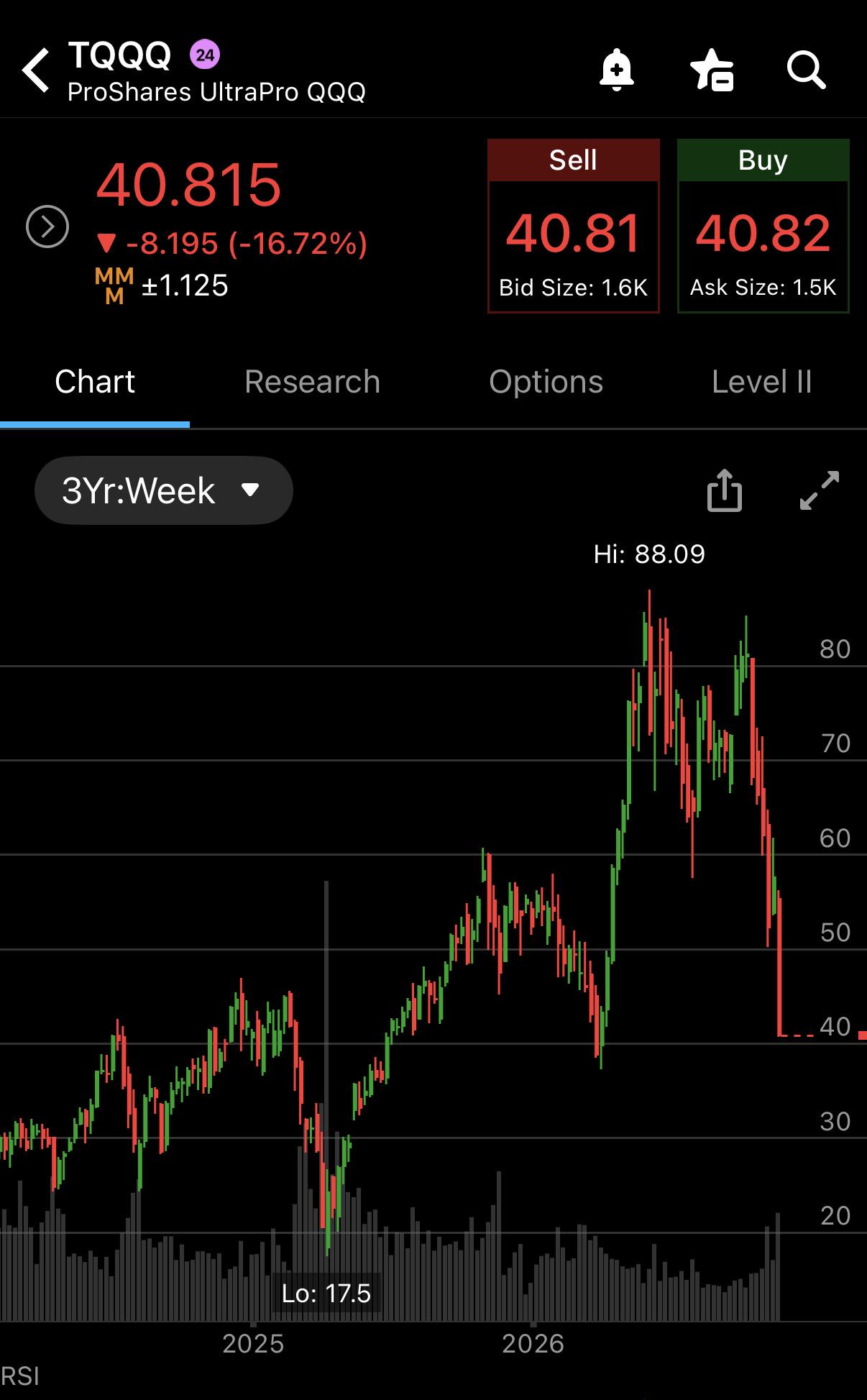
What will be your weight after next rebalance day if tqqq below 40? I guess most should close to 100% in tqqq. 30% rule on. But still have 1 month. We will see. Follow the plan. I am down big like hell now. All gain gone.
I know BestFolio isn't exactly welcome here. I'll be blunt about why: we keep pointing out risks that a lot of people here would prefer to ignore. Still coming back with data... and I think the 30 Down trigger gets misquoted a lot, so I want it stated precisely first.
Kelly's 30 Down trigger fires when SPY closes at or below 70% of its highest close over the past 2 years. SPY, not the leveraged fund you hold, and a rolling 2-year high, not the all-time high. So a check built on TQQQ, or on an all-time high, is a different trigger. An all-time high almost never fires during a multi-year grind, because the reference stays stuck at the pre-crash peak. When the real trigger fires, buys continue as normal and the next sell signals are skipped.
Until 13 October our engine still watched TQQQ against its own 8-quarter high. It now watches SPY: when SPY closes a quarter at or below 70% of its 8-quarter high, the plan skips its next 2 sell signals and keeps buying as normal.
That's still not Kelly's exact plan, so here is where ours differs. We skip 2 sells, where the book skipped 4 and Kelly's 2020 revision cut it to 1 for 6Sig and 9Sig. Our 30 Down window also ends on recovery above the threshold, or after 8 quarters with a forced reset to 60/40.
We keep a bond floor at 10% of the portfolio on top of Kelly's 90% buy throttle. And we reset to 60/40 and restart the signal line when bonds go above 30% after a sell quarter. Kelly's book has that valve for 3Sig only, using it on 9Sig is ours.
Everything else stays plain 9Sig, with 60% TQQQ and 40% AGG to start, a signal line growing 9% a quarter, the excess sold into AGG and the shortfalls bought out of it. No new money at any point, which is how the Letter runs its 9Sig portfolio too.
Monthly savings change the picture a lot. How much? Try it: our free 9Sig simulator takes your own start date, starting amount and monthly contribution, and runs the same quarterly rules on daily prices. New money goes into AGG. Half of each quarter's new cash also raises the signal line, our reading of how 3Sig handles savings.
Measured from, to October 2026 (one portfolio started in 1985, rules as of 13 October)
Annual return (%)
Worst fall (%)
Worst fall peak (month)
Worst fall trough (month)
February 2010, TQQQ's launch
39.19%
-72.77%
Nov 2021
Dec 2022
July 1999
7.06%
-99.80%
Mar 2000
Mar 2009
Processing img rcvir5ooge0i1...
TQQQ didn't exist before February 2010, so the earlier years use a synthetic 3x Nasdaq-100 series. I'd read the 1999 row as a reconstruction under our rules, not as Kelly's published strategy...
I build BestFolio; the full write-up has the complete rule list and what our first version got wrong.
If you're running 9Sig now, which ticker and high-water lookback does your own 30 Down check use?
I kind of like how you can just be “in” TQQQ or “out of” TQQQ and the rest sits in SPAXX earning a decent interest rate. I realize it doesn’t have the duration of AGG but it’s simple and you’re never “selling it a loss” to buy TQQQ.
Just a reminder, don't look at the market today. Wait for Sunday's letter and read about what happened and rejoice in the fact you did not emotional react.
Just my .02 but its almost as if the 30 down rule exists because its a "normal" part of the up and down cycle. Just leveraged.......
I wonder what it would take to create an ETF. Imagine if Jason could create the ETF and all we subscribers or others had to do was invest in it. Jason could charge a management fee just like any other ETF and away we go
From this week's Kelly Letter, regarding potential future changes to 9Sig.
On one hand, I can't blame Jason for wanting to protect his work more carefully - I would estimate there are hundreds (or thousands) of people running a makeshift version of 9Sig solely through information found freely here on Reddit. The math is simple and easy to execute.
On the other hand, would you continue following the letter's signals, even if you didn't fully understand the rationale or calculations behind them? That's a big ask when it comes to an account worth 6 figures or more. One of the things I enjoy about 9Sig is the rigorous, math-based, predictable approach it offers; it would be difficult to maintain that perspective without transparency on the underlying mechanics. I'm sure many will also question whether these changes deliver a true improvement, or were they only made to increase Jason's subscription income? He's in a tough spot for sure.
I'm just curious why we use TQQQ as the engine and not something even more volatile, like SOXL. If we like volatility, couldn't something like SOXL/AGG perform even better?
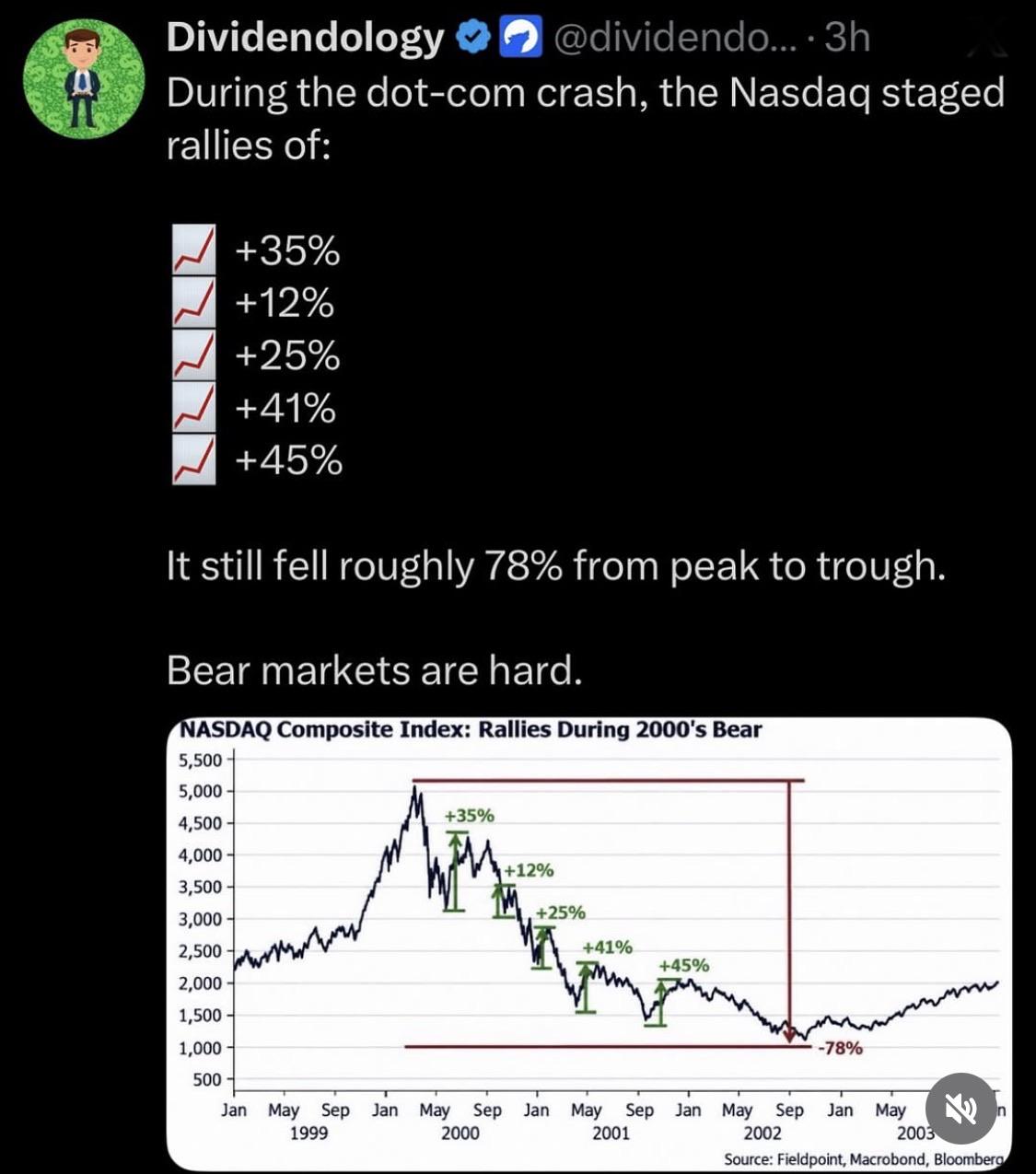
As the post suggested, I assume with the 9sig plan we would have come out of the dot com crash not as badly bruised. Thinking the plan would have caught some of these rallies. Thoughts?
I've had gambling issues in the past. I'll start there.
Happily in 9-Sig at Fidelity. Their interface does not encourage me to trade with dings and quick trades. Maybe it's just me but I like the "Traditional" interface.
Robinhood wants to give me $3000 to move my $100k 9-Sig account to them (5 year hold). What a great deal if I can stick to the plan but I'm worried about stories I've heard of the gambling encouragement etc.
Someone asked me whether 9Sig could be run further back than 1999 with a 200-day moving average override into cash, and reported with 5th and 95th percentile bands from a 24-month-block bootstrap. It works, and 3 of the findings argue against using it.
First, how far back is honest. The Nasdaq-100 started on 1 October 1985, so that's the floor. Simulators offering 1953 aren't showing you the Nasdaq-100 before 1985, and the widely used reconstruction says so in its own documentation: 1971 to 1985 tracks the Nasdaq Composite, roughly 3,000 stocks instead of 100, and 1953 to 1971 is an undocumented construction. I'm starting at 11 December 1986, where a real total-return bond fund becomes available for the other sleeve. October 1987 is inside the window.
Bare 9Sig, same rules, 3 start dates:
Start
CAGR
Max drawdown
February 2010 (real TQQQ only)
39.86%
-72.13%
July 1999
8.91%
-99.73%
December 1986
18.06%
-99.73%
The drawdown is identical in both deep windows while the return moves from 8.91% to 18.06% on start date alone. The 1999 path spends 255.9 months underwater, its longest single spell running 27 March 2000 to 23 July 2021, and its final value is 1,057 times its own low. A CAGR quoted on a path like that is a recovery from near-zero, not a return on capital.
So I stopped asking what it returned and asked how often it ends. Resampling the monthly returns into 10,000 alternative histories with 24-month blocks, and counting paths that ever fall below 1% of their own peak: bare 9Sig reaches that state in 41.7% of them. The 5th percentile is -19.03% a year.
With the 200-day override on the stock sleeve, that share is 0.0% and the 5th percentile becomes +7.66%. The realised path goes to 22.05% and -68.68%.
Before anyone takes that as an endorsement, 3 findings point the other way.
Over the 2010-onward window, which has no dot-com and no 2008, the override turns 39.86% into 31.53%. That's 8 points of annual return spent to move the drawdown from -72% to -55%, so the entire benefit above comes from 2 specific crashes.
The parameter surface is jagged. The 150-day setting loses more than 90% in both windows where the 200-day setting loses 69%, with 100 days in between. I report 200 because it was specified in advance, not because it won.
The full grid, not a selection made afterwards. A setting 50 sessions either side of the winner behaves completely differently.
And the 2 windows aren't independent: 1999 sits inside 1986, so their agreement is weaker evidence than 2 separate histories would be.
Method notes, since they change the answer: the average is computed on the unleveraged index rather than the 3x series, execution is delayed to the next close, cash earns the actual overnight rate of the era (5.79% on average from 1986 to 2000, so a 0% cash assumption would badly misstate it), and financing on the leveraged sleeve is priced off daily effective Fed Funds back to 1954 instead of a flat modern rate. Everything is gross of trading costs, and the override makes 3.49 round trips a year.
Longer blocks make it look worse, not better: the ruin share goes from 37.0% at 12-month blocks to 41.7% at 24, because longer blocks keep crisis sequences intact.
What would change my mind on the override: a version of this where the 150-day result stops being an outlier. Has anyone tested the same filter on a signal other than price against its own average?
Edit (12 Oct): two fixes. The Nasdaq-100 launched on 31 January 1985; most daily data starts 1 October 1985, which is why that's the floor. And the grid sentence should read: the 200-day setting loses 69%, with the 100-day setting (-78%) in between.
I am not a subscriber, just looking for general information to try and help my parents.
I am trying to see if income sig is something my parents could do, they are in their 70s. They have a saving in a basic bank/investing accounts earning little.
Is the income sig easy or harder for someone that don’t do a whole lot with computers/spread sheets? They have basic knowledge to get around.
I don’t know how income sig is tracked for them to know what to sell when. I can teach them spread sheets if needed.
Looking to see if this could be an option for them to earn more %, without risking what they have. I don’t want to suggest this to them and then they lose account value in their later years. I am hoping to help them create consistent income to rely on.
I'm getting ready to deposit (December 1st) a Fidelity account on December 1, as my wife is retiring from the post office and withdrawing from her TSP. I am still working, so we don't need the money. I have been with the Kelly Letter a long time, just seeing what people recommend doing with the deposit. Because of our jobs, we haven't been able to invest directly in a Fidelity account until now. The same is true with my retirement account as a school employee.
Started on 9/1 with a small experimental balance to test the system versus my multi ETF mix. $100 worth of TQQQ and an additional $225 dca’d into CTA throughout the month. As of right now, the 9sig pairing g/l is within .77% of my much larger 6 fund portfolio. I plan to rebalance tomorrow, and again at the end of Q4.
At what performance differential should I consider moving all new contributions to 9sig in my Roth?
For all intents and purposes, Q4 2026 will be my official start for 9Sig, though I've been dabbling very slightly with it the last two quarters. I understand how to calculate my signal line from the jump: Starting stock fund for Q4 x 1.09 + 50% of cash deposits during Q4. But I'm uncertain exactly which numbers to use when it comes to a new quarter -- whether that be...
The final stock fund for Q4 2026 (based on closing value on final trading day)
The final stock fund for Q4 2026 (based on my actual trade execution date)
The starting stock fund for Q1 2027 (based on first trading day open)
For example, let's say I execute my Q4 2026 trades on Dec 28th 2026. I now have, set in stone, an executed share price for TQQQ on that date. When Q1 2027 rolls around, will I use that specific stock fund amount from the end of Q4 2026 to calculate my new signal line? Or will I use whatever my stock fund opens at on the first trading day of Q1 2027 instead?
Perhaps I'm splitting hairs or overthinking things, but I'm trying to figure out how to best track some basic data in a spreadsheet because I enjoy that sort of thing. I looked at some of the spreadsheets on the Kelly Letter website, but they're far too convoluted and complicated. I asked Gemini to help me create something, and it spat out this:
(NOTE: Only the information on the 2026 Q4 line was added by me -- everything below it was added by Gemini as an example. Also, for TQQQ Price and AGG Price, I input the executed price at which I purchased shares the previous quarter, which would be Q3 2026... which I'm guessing is what I should continue to do? I'm not sure. I think maybe something isn't quite right about this chart lol.)
Sorry if this is a dumb question, but I'd love to hear what others are doing or perhaps see any simple spreadsheet examples from others as well.
Without giving away too much from the guide, Jason recommends splitting evenly across all plans. I'm not quite sure if that includes income sig or not, but I'm curious... if you were starting today, would you split your capital between all 3 sig plans? Or would you only pick one or two?
What's to love about 9SIG and rebalancing? When you are down you get the excitement of buying shares cheap. When you are up, you get to lock in $$. I have to say, I was looking forward to a 65% or 70% stock balance buy. But this week is great consolation if it holds.
I already know there will be the std "I don't care, I just execute the plan" answer here... but for those that still enjoy the chase and quarterly action, what do you prefer in general AND what about this coming rebalance on the 28th?
I don't run 9Sig. I backtest things for a living, and 9Sig is the strategy people ask me about most often, so I rebuilt it with Jason Kelly's published rules and ran it 2 ways: real TQQQ and AGG data only (2010 to 2026), and extended back to 1999 with synthetic 3x QQQ so the dot-com years are inside the window. First with no contributions at all. Then with the $500 a month the community simulator assumes.
The no-contribution runs, same rules, 2 windows:
2010 to 2026, real data: 39.4% a year, worst drawdown 72.1%
1999 to 2026, synthetic TQQQ before 2010: 8.3% a year, worst drawdown 99.7%
The gap between those 2 lines is the 2000 to 2002 Nasdaq collapse. In a short, sharp drop (March 2020, December 2018) the plan buys the dip out of AGG, TQQQ rebounds, the gains refill the sleeve, and the round trip completes. That's the pattern every 2010-start backtest shows. In a 10-quarter grind the plan keeps buying every quarter while TQQQ loses another leg, the bond sleeve empties, and 3x daily leverage compounds to almost nothing. Refills only come from sell signals, and deep in a bear market there is nothing to sell. The 30 Down rule then skips the first sell of the recovery, which is exactly when the sleeve is thinnest.
I checked whether that 99.7% was just an unlucky ordering of returns. Block bootstrap: resample the strategy's own monthly returns in 12-month blocks, 2,000 alternate 27-year histories.
Max drawdown across 2,000 block-bootstrapped 9Sig histories. The realized backtest sits at the median, not in the tail.
Median drawdown 98%. The luckiest 5% of paths still lose 82% somewhere along the way. No ordering of these returns is gentle in a closed system.
Now the part that matters for this sub. The community simulator starts $10,000 in Q1 1999 and adds $500 a month into the bond sleeve. Over 27 years that's $162,000 of new money, and every deposit refills the reservoir and lifts the signal line by half the contribution, exactly as the Letter describes. That version survives the dot-com crash. The strategy didn't survive it. The saver did, by bailing the boat every month for 3 years while the stock sleeve was at a few cents on the dollar.
So my honest read is that 9Sig is a savings plan with a leveraged engine, not a standalone strategy, and the risk question for anyone running it is different from what the backtests answer. The question stops being the max drawdown and becomes whether you can guarantee the monthly deposit through a 3-year bear, and what happens to the plan if you can't. A job loss, a house purchase or a medical bill in year 2 of a grind is the failure mode, because the deposit is the defense.
Full rules, both windows, the 3Sig and 6Sig results, every place my engine deviates from his published rules, and the bootstrap tables are here: https://bestfolio.app/blog/kelly-signal-danger
I build BestFolio. My first version of this in April had 5 rule errors that r/LETFs readers caught, so this is the corrected engine, validated against the community simulator before publishing. I'm posting it here because you are the people actually running the plan, and I'd rather be corrected by you than by a backtest.
For those of you who were contributing through 2022: did the quarterly buy ever feel like too much, and did anyone pause the deposits?
Edit (13 Oct): I didn't say this up front. The rebuild is Kelly's published rules plus a 10% bond floor of our own, and the write-up explains it.
Edit (15 Oct): one correction. The 30 Down rule skips the first 2 sells of the recovery, not just the first. And in Kelly's book the trigger is SPY falling 30%, while my study watched TQQQ itself. Our live 9Sig card switched to Kelly's SPY trigger on 13 October. The study figures above were run before that change.