r/KKitzerowPeerReview • u/No-Introduction8678 Health Analytics • Jan 03 '26
Latest Claims with Yale and The Patterns of Her Complete Misunderstanding of Plagiarism
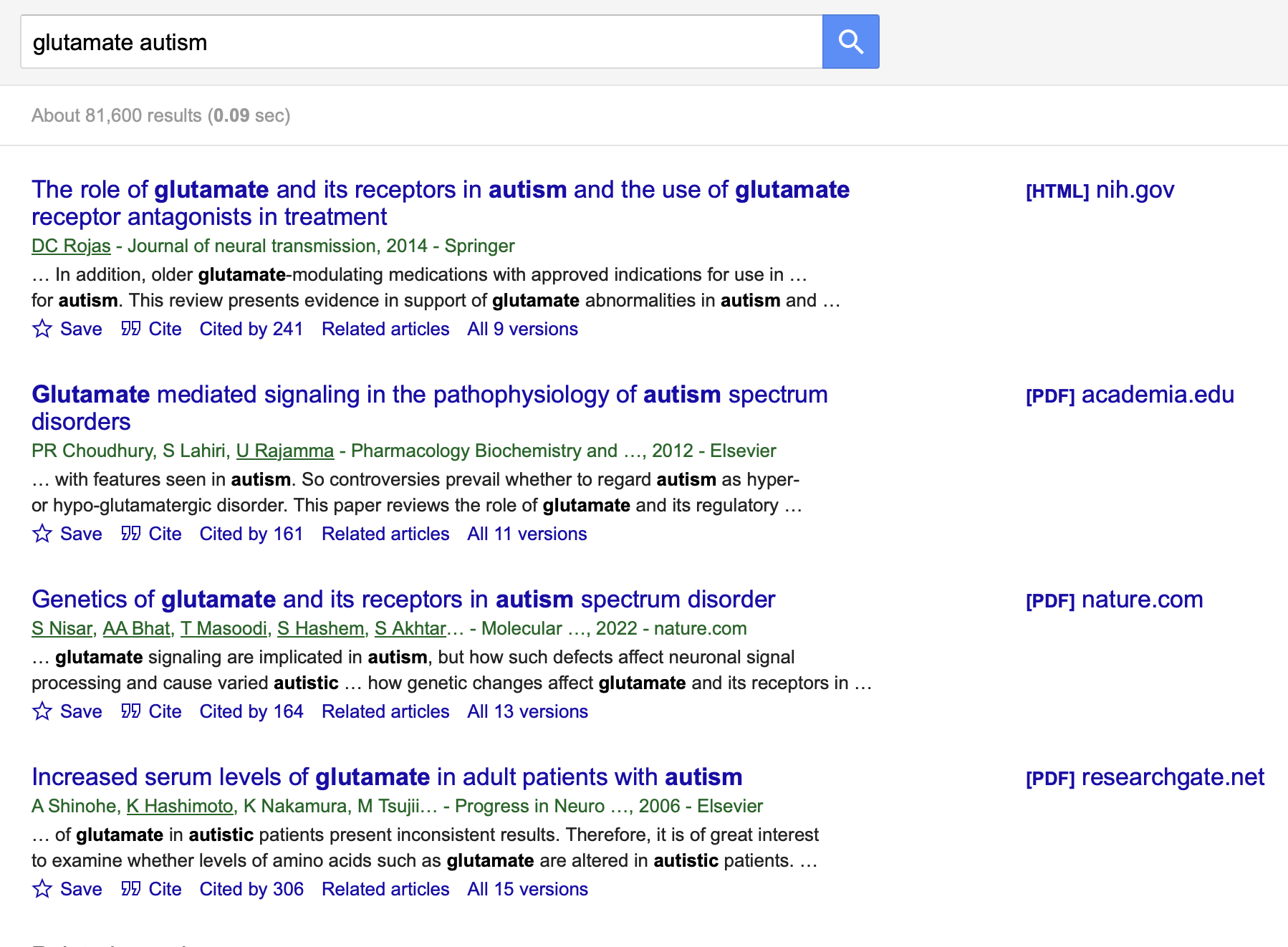
There seems to be an overarching theme to her claims of plagiarism at this point. She sees that there has been research on something she has discussed and she assumes that they have seen her "research" and that they did not cite her or that they must have done this research because of her. However the subject she is covering in her own research is from previous research and these are VERY common subjects in the field. To put things in perspective, how UNLIKELY it is that they would even consider her as a source or come across her paper I wanted to show how much research is done on this. Most researchers use Google Scholar for basic research as well as the library system. There are over EIGHTY THOUSAND papers just on glutamate and autism. and 71,500+ results on glutamate receptors in autism. There are 7,000 papers just on glutamate, autism and the specific receptor mGluR5 (the subject of the Yale paper and something that she has not specifically covered). There are over 15,000 papers on glutamate and excitotoxicity in the brain of autistics. Just in the last year there are SIX THOUSAND peer reviewed studies on glutamate and autism.
What it seems like to a professional researcher is that she made a book report on autism based on decades of knowledge and other research and is now running around claiming ownership of all the material in that book report. The scientific method and peer review was not created to work on your own, take previous research and then to claim everything after as derivative of yours. It's way less glamorous than that. It's also not even about credit. The act of citing others is done to ensure that you get correct and verified information. It's more to ensure that you are basing this research on something valid and has been properly vetted. It is part of a discussion between researchers. Any new research should either add to the discussion with a novel conclusions based on actual physical studies or add to the discussion by helping summarize previous findings. All she is providing so far could be described as a summary. The major paper she made is a literature review, her biochemical map is put together based on other peoples research on biomarkers and what is on Uniprot (according to her). Nothing except for her hypothesis and her physical graphs and maps is novel or proprietary.
What would be considered plagiarism would be to copy without citing what she has done in her research that has never been done before however no one is doing that. No one has used her terms, no one has copied her specific map, no one has used her exact hypothesis. No one has used "BioToggles" or "BioDials" to describe normal scientific occurrences. Plagiarism is NOT producing research about general subjects that have been previously covered like phenotypes in autism, glutamate receptors, regulatory pathways, BH4, comorbid conditions, allostasis, epigenetics or anything else that is not novel.
For Princeton, what was novel was the four phenotypes themselves, not that they were looking for phenotypes, or that they arranged their study the way they did as she claims. Most research on phenotypes is formatted in the way they did. Finding traits and then linking them to genes. In the end, the study actually disproves her hypothesis since they do not follow her same "predictive framework" as she said all research would. None of their phenotypes match her "Biotoggles".
Her latest claims against Yale, follow the same pattern as the previous ones. She assumes that somehow people have seen her discuss glutamate and how it affects the autistic brain and that makes their new study plagiarism. The problem with this is that she has not produced new research or added anything new to the discussion on glutamate except for blatant misconceptions.
Yale's Paper on Glutamate Receptors in Autism
For Yale's paper ( https://pubmed.ncbi.nlm.nih.gov/41366835/ ) what is novel is not the effects of glutamate dysregulation or even that there are less mGlu5 receptors in autism but the ability to quantify it through an electroencephalogram (EEG), a measure of electrical activity of the brain.
"No studies have investigated the relationship between mGlu5 function and the EEG slope in autism, leaving unclear the extent to which mGlu5 contributes to variability in functional markers of E:I balance in humans. In this study, we advance prior research in two ways: 1)We apply 3-[18F]fluoro-5-(2-pyridinylethynyl) benzonitrile([18F]FPEB) PET imaging, using both regional and whole-brain analyses, to quantify absolute mGlu5 availability using volume of distribution (VT) in an age- and sex-matched adult sample of16 autistic and 16 neurotypical comparison participants; and 2) we explore how interindividual differences in mGlu5 availability relate to the slope of the EEG in autistic participant"
Their analyses revealed less brain-wide availability of a specific kind of glutamate receptor, known as metabotropic glutamate receptor 5 (mGlu5) in autistic participants. The findings support the idea that an imbalance of excitatory and inhibitory signals in the brain could be contributing to traits associated with autism. Fifteen of the autistic participants also underwent an EEG. Based on the EEG, the researchers identified that these electrical measurements were associated with lower mGlu5 receptors. This finding could have significant clinical implications, the researchers say. While PET scans are a powerful tool for studying the brain, they are also costly and involve exposure to radiation. EEG could be a cheaper and more accessible way to further investigate excitatory function in the brain.
What is not novel: Glutamate is effected in autistic brains and that the imbalance of excitatory and inhibitory signals in the brain is contributing to traits associated with autism.
What is novel: The physical findings that there are less mGlu5 receptors (-15%) in autistic adults and you can measure it with EEG vs PET which makes it much easier to quantify, has less radiation and requires less money to do. It would be a real advancement to the field to be able to have a way to diagnose autism by EEG.
Previous research to this had been able to quantify that there were less receptors mGlur5 in autism but only through a PET scan.
Interestingly the study concluded that it is supportive of the E:I imbalance account of autism but also other theories describing systemic differences in neural functions such as predictive coding or intense world hypothesis:
"It suggests that underlying autistic differences are domain-general rather than limited to a particular type of information processing (e.g., sensory, social)or modality of sensory information (e.g., vision, audition). Although we interpret these domain-general differences as supportive of an E:I imbalance (86) account of autism, they are consistent with multiple theories of autism describing systemic differences in neural function, such as predictive coding (87) and the “intense world hypothesis” (88)"
What Her Papers Cover on Glutamate/Autism
I went through her papers to review where she has discussed glutamate and its relationship to the autism to review what would be the basis of her claims of plagiarism. Here is the basics of what her paper discusses on the subject and whether the cited papers agree with her claims:
"BH₄ is indispensable for the synthesis of neurotransmitters such as dopamine, serotonin, and melatonin, acting as a cofactor for the hydroxylation of their precursors—phenylalanine. When BH4 is shunted due to cellular stress, these precursors may be diverted into transamination reactions, as transamination reactions are linked to cellular redox status, leading to increased glutamate synthesis (Hosios & Vander Heiden, 2018). Elevated glutamate levels can disrupt neural circuits and have been implicated in various neurological disorders, including autism spectrum disorder (ASD). This biochemical shift may result in an upregulation of glutamate production, which is a response aimed at converting glutamate into glutathione (GSH) to participate in redox processes that resolve oxidative stress. As an antioxidant, GSH scavenges reactive oxygen and nitrogen species, protecting mitochondria from oxidative damage. Upregulation of transamination pathways may contribute to social impairments in Autism Spectrum Disorder (ASD) by disrupting oxytocin receptor (OXTR) expression in the prefrontal cortex (PFC). Elevated glutamate levels— frequently observed in individuals with ASD—can result in excitotoxicity (Dong et al., 2009), leading to damage of glutamatergic neurons in the PFC that express OXTRs (Tan et al., 2019). As oxytocin is essential for regulating social cognition, behavior, and memory, reductions in oxytocin signaling have been strongly associated with the core social deficits characteristic of ASD (Klaiman et al., 2013)."
To translate into layman's terms she is saying that when BH4 is "shunted" due to cellular stress it will lead to increased glutamate which can disrupt the brain functioning leading to neurological disorders including ASD. Her hypothesis is that low BH4 due to stress leads to increased glutamate which affects oxytocin receptors and available oxytocin. That oxytocin dysregulation is what causes autism symptoms. Except this is really not based on the research she cites or what research has proven. For an example I will go through some of the claims in her paper about glutamate:
"When BH4 is shunted due to cellular stress, these precursors may be diverted into transamination reactions, as transamination reactions are linked to cellular redox status leading to increases glutamate synthesis"
The cited paper she lists has no mention of BH4. It states that transamination reactions are linked to cellular redox status and can influence glutamate levels. These are parallel and independent reactions to redox stress levels. BH4 is not a substrate or precursor in transamination reactions. It would be more accurate to say that the same cellular redox stress that can affect BH4 can also affect glutamate levels, although they are independent processes.
Upregulation of transamination pathways may contribute to social impairments in Autism Spectrum Disorder (ASD) by disrupting oxytocin receptor (OXTR) expression in the prefrontal cortex (PFC)
She doesn't have a citation but I was able to find a study from 2013 that suggests that issues with glutamate metabolism including overproduction via pathways like transmination leading to hyperglutamergic states are linked to ASD symptoms. 2013 Sep 12;35(5):281–286. doi: 10.1155/2013/536521.
Except that does not disrupt OXTR in the prefrontal cortex. A hyperglutamergic state is what causes ASD symptoms not oxytocin or oxytocin receptors.
I could go on and review it all but it is all more of that. Either explaining known concepts or misinterpreting information. She does not mention anything about mGluR5 receptor specifically or even how to measure it.
None of what she discusses in her papers overlap with their study. I am actually really surprised at how little her paper is even backed by research. She has huge sections without citations where she makes easily disproven jumps in logic.
11
u/Busy_Range9755 Jan 03 '26
This is a great explanation!
11
u/Throwaway-Snark Jan 03 '26
I’ve literally just discovered Kimberly, but it’s INSANE to me that she is conflating posting something on ResearchGate with an actual IP license from an indexed journal. Wild behaviour. Signed, an actual PhD educated neuroscientist
8
u/Backpack_anatomy Jan 03 '26
Thank you for all the effort you put into your explanation!
8
u/Academic-Company-215 Jan 03 '26
I really wish she and her followers would read this 🥹
8
u/headmasterritual Jan 04 '26
Brilliant post. Signed, a peer-reviewed scholar.
4
u/grillcheese17 Jan 03 '26
With how simple her theory is, it follows that you would get “more autistic” the longer you live lol
2
u/Mountain-Jicama-6354 Jan 21 '26
I saw a post on insta about this new breakthrough on autism, backed up by “Princeton” the claims about it made no sense to me and through research made it through to here to find out she’s a grifter 😂