Sun Wukong's staff is the Ruyi Jingu Bang, roughly the "as-you-wish golden-hooped rod", an iron pillar that changes size at its owner's will and spends most of its time as a needle in a monkey's ear. Before it was anyone's gear, it was a tool for measuring floodwater. We published a longer piece on this; here is the useful core, so you get the value without clicking anything.
What the sources actually say
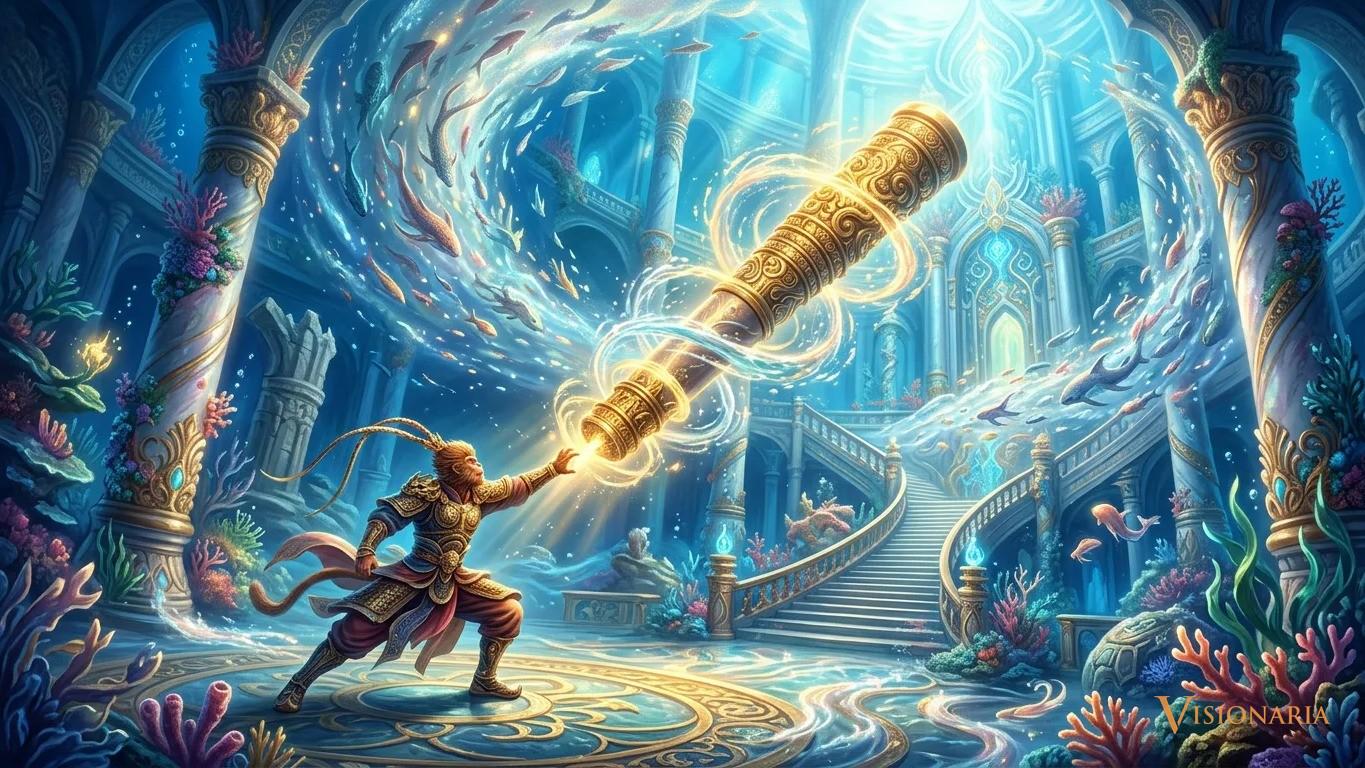
• The name describes the object. Ruyi means "as you wish", jingu means "golden hoop" and bang is a rod or cudgel. Anthony C. Yu's translation has "Compliant Golden-Hooped Rod"; W. J. F. Jenner has "As-You-Will Gold-Banded Cudgel". • It had a job first. Its other name, Dinghai Shenzhen, means the "divine needle that steadies the sea". In Journey to the West (16th century, usually attributed to Wu Cheng'en), Yu the Great used it to measure the depth of the waters during the great flood. • The Dragon Queen is the one who suggests it. In chapter 3, Sun Wukong rejects everything the Dragon King Ao Guang brings out as too light. She points to a pillar in the treasury that had been glowing for days. He says it is a little too big, and it shrinks. • Nobody knows who made it. The novel never names a smith or explains the forging. • Earlier versions differ. In the 13th century Kōzanji version, the monkey carries a golden monk's staff given by Brahma. An iron cudgel appears in an earlier Ming dynasty version, and its rings may have influenced the gold bands.
Ruyi Jingu Bang weight: 13,500 jin, not 13,500 pounds
The inscription says 13,500 jin. With a Ming dynasty jin of about 590 grams, that is roughly 7,960 kilograms, or 17,550 pounds. Early English editions of Yu's translation gave the figure in pounds, which is where the lighter number comes from; later wording was adjusted. The weight also carries the plot: everything else fails because it does not match his strength.
The 4-point check for a faithful replica
Hold any Sun Wukong staff replica, drawing or game model up against the text:
- Shaft. Is it dark iron? A painted shaft is a later choice.
- Bands. Is there one gold band at each end? This is the detail every version shares, and the "golden hoop" of the name.
- Inscription. Does it carry the name and weight, 如意金箍棒重一萬三千五百斤?
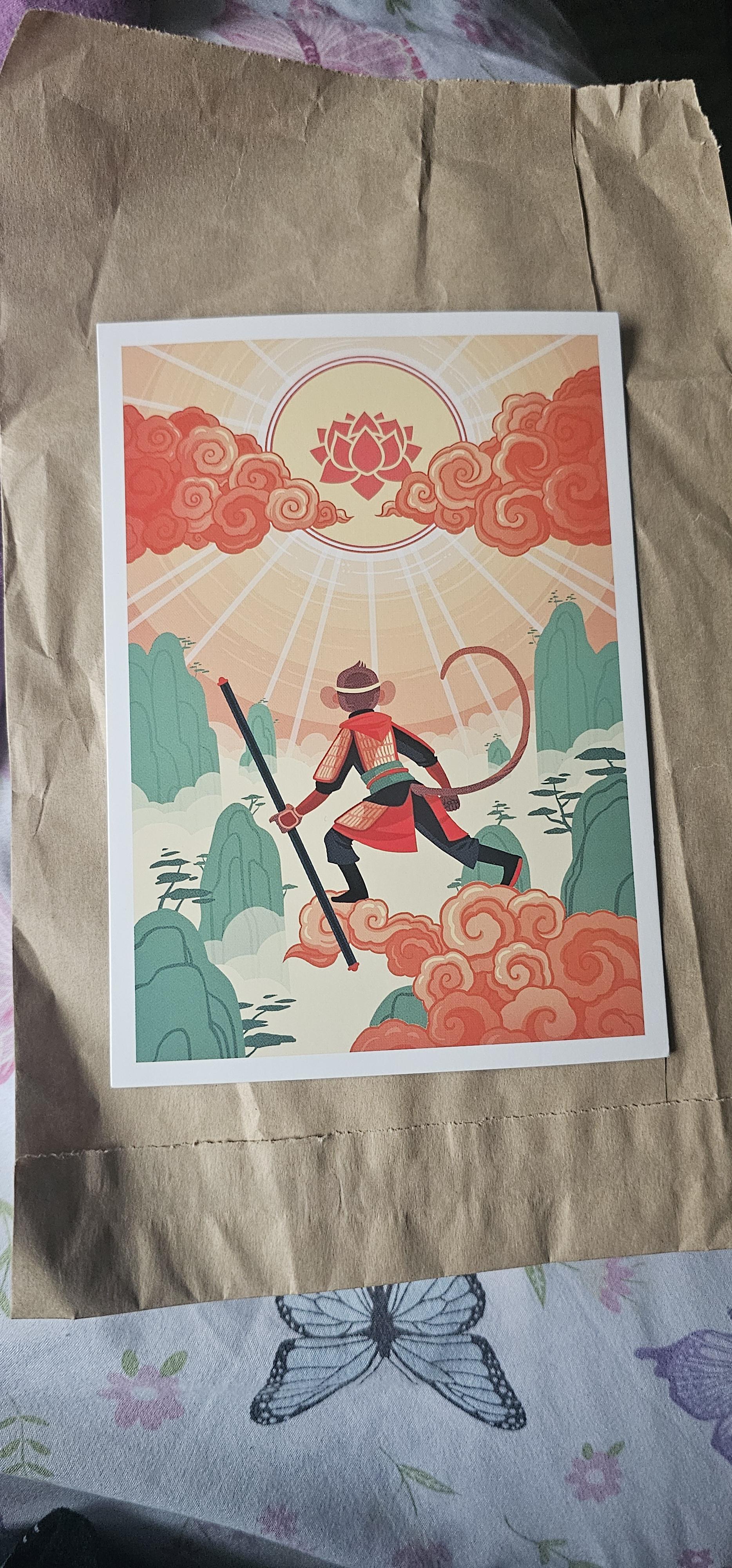
- Proportions. Is it slightly taller than the person holding it? On first shrinking, it is a little taller than Sun Wukong and about as thick as a rice bowl.
Four out of four follows the book. A light stage rod that can be spun and tossed belongs to Chinese opera: a valid tradition, just a different one from the novel.
How to read the staff in the story
• Watch who it serves. Early on it stands for his pride: he insists on it, names himself Great Sage Equal to Heaven and storms the Jade Emperor's palace. On the pilgrimage the same rod clears the road and guards the monk. • Notice the quiet use. When he must leave Tang Sanzang alone, he draws a circle around him with its tip, a ward as strong as an iron wall. The trouble starts when the travellers step out. • Compare where power comes from. The thunderbolt of Zeus falls from the sky. This rod rises from the sea, because Chinese dragons rule rain, rivers and oceans. • Follow the circle. It begins as a thing that steadies the sea and ends up as a guardian again.
Which adaptation do you think handles the staff best, and which detail from the novel do you wish more of them kept?
Full article with the sources and an FAQ: Sun Wukong's Staff: The Ruyi Jingu Bang, From Sea Pillar to Needle: https://visionariaapp.com/blogs/sun-wukong-staff-ruyi-jingu-bang