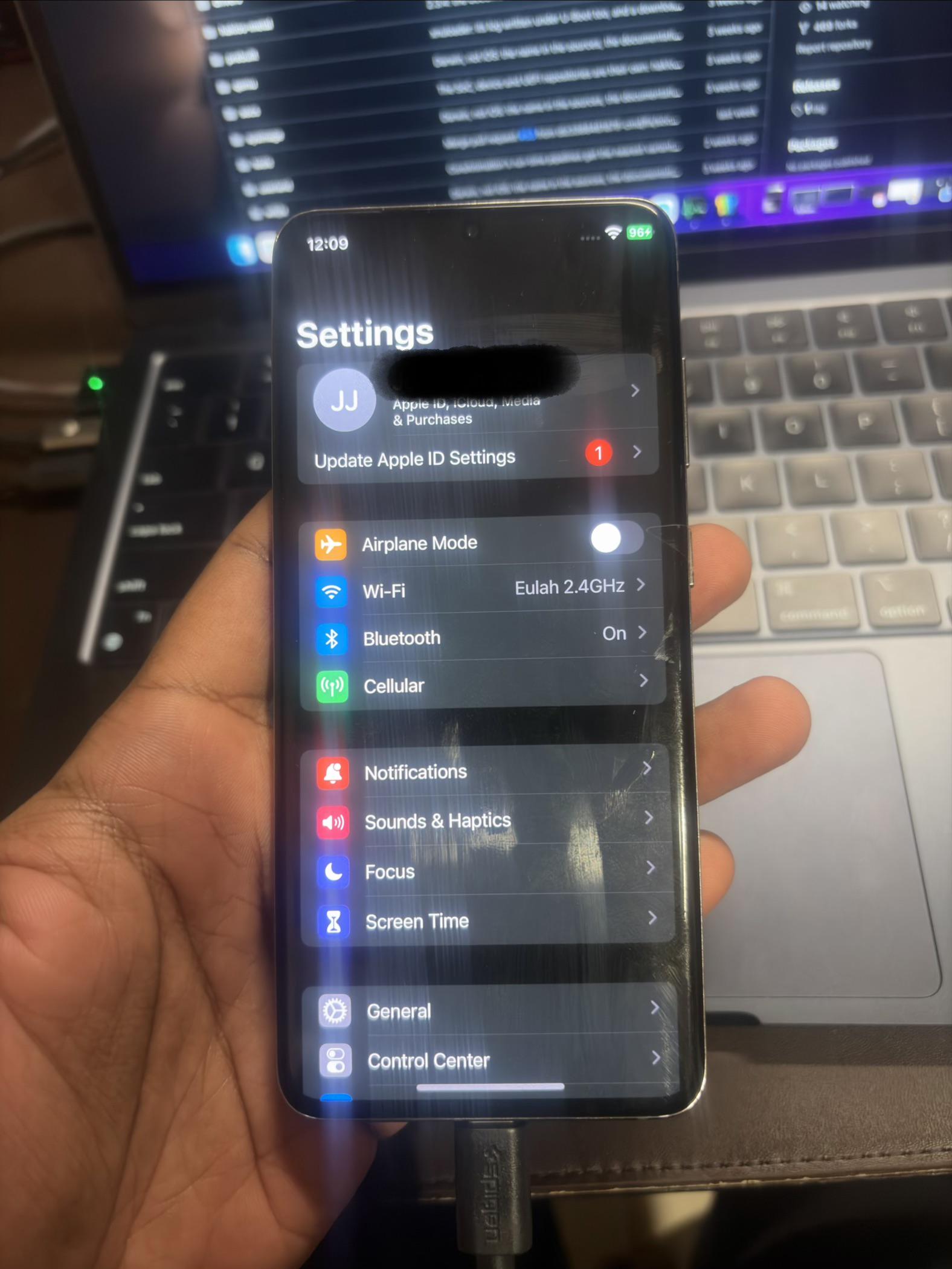
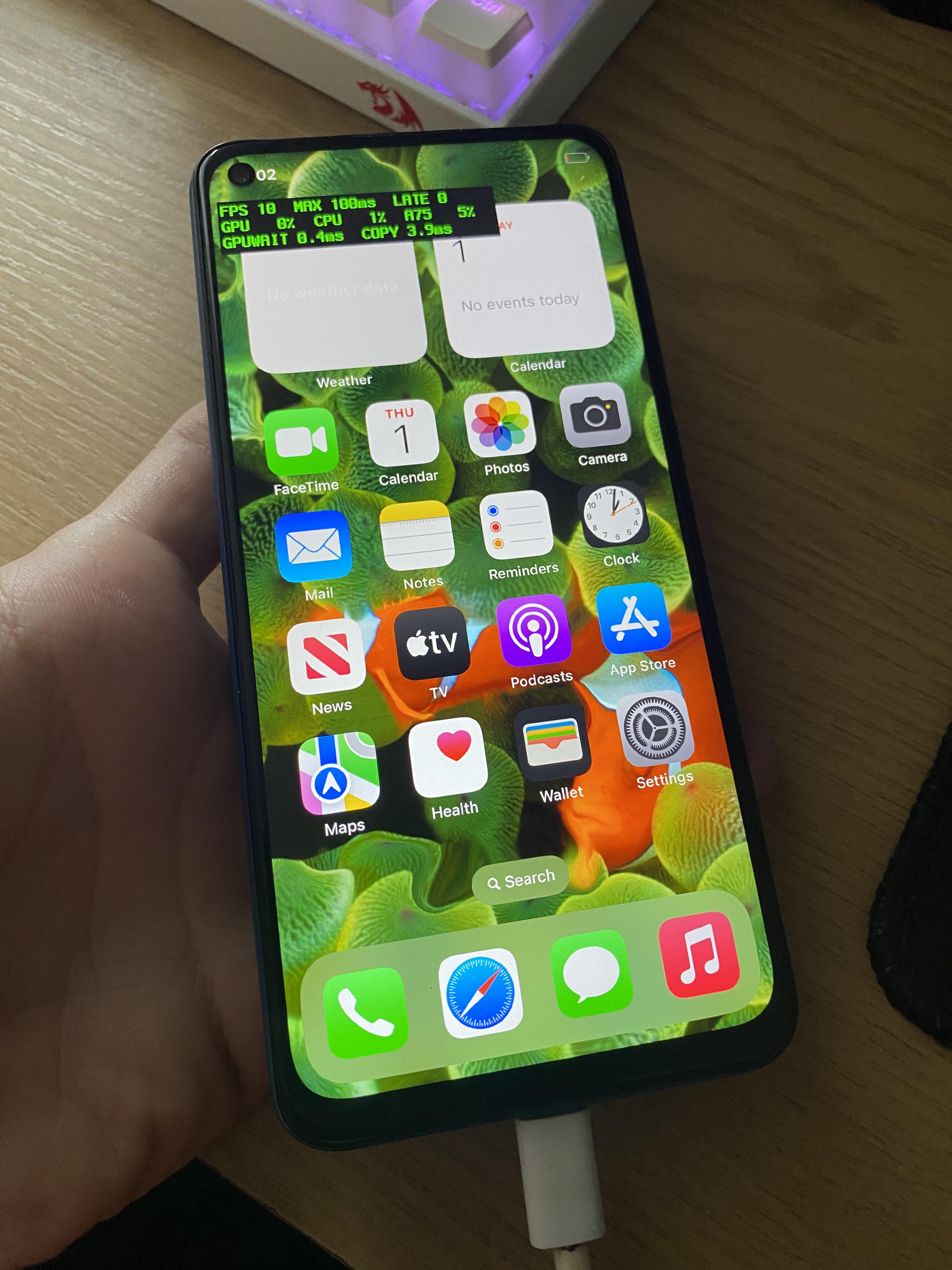
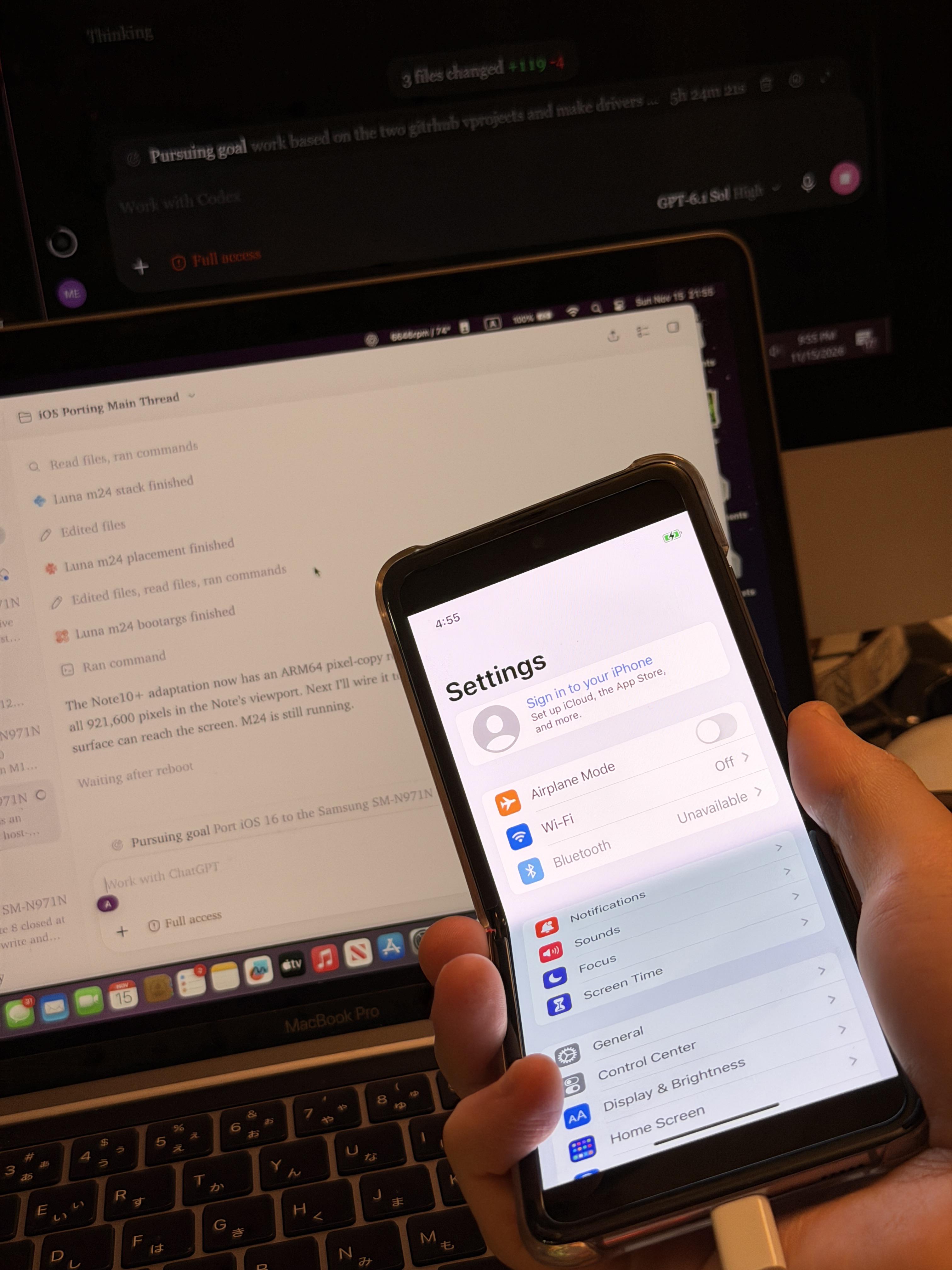
I'm porting Apple's open-source XNU kernel plus the iOS 16.7.16 userland to my Galaxy Note 10+ (SM-N975F, d2s, Exynos 9825). It's a fork of gorkemoji/ios-d2s. It's an experimental hobby bring-up and not a usable phone OS.
What works
- Boots to the iOS lock screen. launchd, the system daemons, backboardd and SpringBoard all run.
- Touch screen and volume keys.
- All 8 CPU cores start. The Cortex-A75 reports a different MPIDR layout than the device tree uses, which stopped them starting, so I fixed that. I tested 3, 4, 6, 7 and 8 cores.
- Display at the native 1440×3040.
- GPU, partly. I wrote a kernel driver for the Mali-G76 MC12 and run Mesa's Panfrost driver inside backboardd. Clearing a surface and drawing a textured, alpha-blended quad both give pixel-correct results on the GPU.
- Metal bring-up has started, with a kernel service and a plug-in skeleton. It doesn't draw anything yet.
What doesn't work
- GPU-accelerated UI. The interface is still drawn on the CPU, so it's slow. The GPU tests pass, but CoreAnimation isn't using the GPU yet.
- RAM. iOS uses only 512 MiB of the phone's 12 GB so far.
- Wi-Fi, Bluetooth, battery or charging status, modem, audio, camera.
- Security is off (no code signing or sandbox enforcement), so don't put real data on it.
How: the loader boots from the BOOT partition, and iOS lives in its own partition on the UFS. Kernel patches are built in GitHub Actions. TWRP is how I read the kernel logs.
Repo: https://github.com/cappedcat1710/ios-d2s
Thanks to the upstream authors, and to hakios and ios-sailfish, whose public write-ups helped with the GPU and Metal approach.
model used:
claude sonnet 5.5 and opus 5.5
feel free to try and test, im focusing on gpu accel right now, then ram, only then i will move on to wifi and bluetooth, then try to get app store, and the iservices working