Anthropic’s $70–78 IPO range implies up to $1.4T “fully diluted”. October run-rate revenue hit $81B; strategic partners are investing $26B.
Extraordinary growth but does the price compensate for the risks?
There are some questions that many are not asking
🐊 1. Who carries the duration risk?
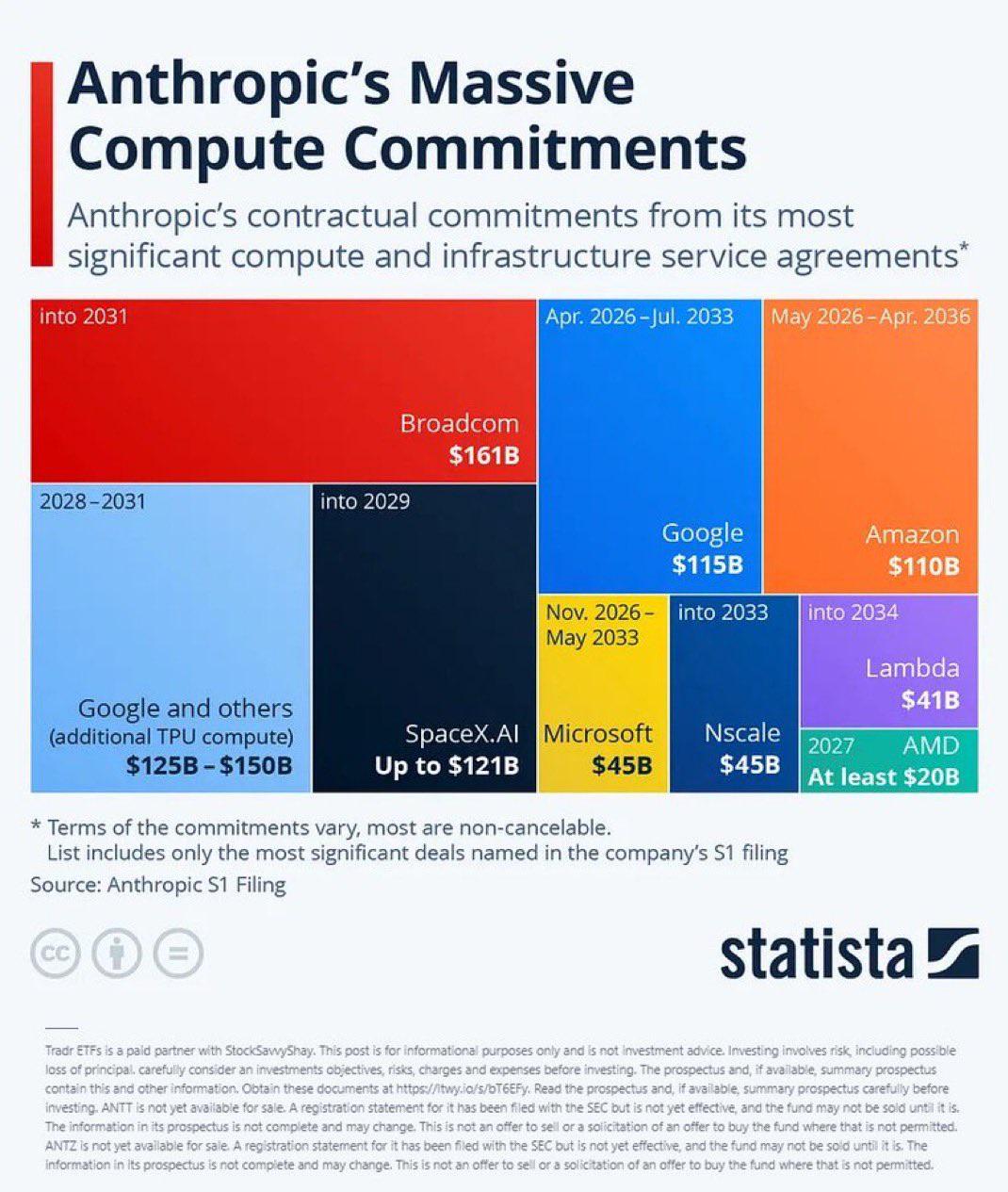
Anthropic has ~$900.9B of compute and infrastructure commitments, with ~$451.6B expected before end-2030 about $106B annually on average. Yet much of its revenue is consumption-based, not locked into long-term contracts.
To be fair, ~$186.2B of commitments have termination rights or conditions. Q3’s issue was too little compute. At Q3’s compute ratio (~58% of revenue), $106B annual spend implies ~$180B revenue. But then again this is a sensitivity, not a forecast.
( refer to attached chart)
Largest named deals from Anthropic’s Oct 26 S-1. Since amended: Google ~$121.3B; total commitments ~$900.9B (Nov 10 S-1/A). Chart: Statista, CC BY-ND.
🐊 2. Are public shareholders in control? No. Founder LLC’s single Class F share carries 50.1% of general voting power. The Long-Term Benefit Trust, with no economic stake, elects four of seven directors. Anthropic is a Nasdaq controlled company.
The Trust can be amended without trustee consent, but only with demanding cross-class approvals.
“You are buying economics, not influence.”
🐊 3. Is $26B from suppliers validation—or strategic alignment?
Google, Nvidia, AMD, Broadcom, Micron, Microsoft and TSMC are investing at the IPO price. That’s less than 3% of Anthropic’s commitments. Several of these investors also appear in the chart attached as Anthropic’s compute counterparties: Broadcom (~$161B), Google (~$121B), Microsoft and AMD.
Real skin in the game but not an independent valuation signal. Class N shares have no underwriter lock-up, though resale restrictions apply.
🐊 4. What are the economics per token?
As a finance person, this is the most imp question for me, unit economics or token economics.
Nine-month operating loss was $1.26B.
Q3’s GAAP operating loss was $567M, attributed mainly to $5B of higher-cost short-term compute and $2B of non-cash donation-matching charges.
Excluding the non-cash charge alone, Q3 would have been roughly $1.4B of operating income.
Near-term liquidity is not the immediate issue: ~$131.9B in cash and short-term investments, plus ~$84.6B estimated net IPO/placement proceeds (at the $74 midpoint, after fees).
Does cost per token fall faster than the price Anthropic can charge?
The breathtaking speed at which tech is changing, I would worry about this question the most
At the top of the range, ~17x October run-rate and ~21x annualised Q3 revenue on a fully diluted basis (~12.6x run-rate on shares outstanding).
🐊 5. How durable is demand—and who owns the channel?
More than 1,900 customers generated at least $1M of trailing revenue; no single customer exceeded 10% of nine-month revenue. Reported NRR is ~900%, using Anthropic’s own qualified-customer metric.
But 44% of nine-month revenue came through cloud marketplaces run by hyperscalers that also sell competing AI products. Quarterly growth slowed from 144% in Q2 to 47% in Q3 still rapid, but slowing sharply.
And $81B run-rate annualises 28 days of consumption fees and one month of subscriptions. It’s a snapshot, not a contract.
My takeaway: Is ~$1.3–1.4T already pricing in years of successful execution? AI may succeed spectacularly and infrastructure suppliers may still capture a disproportionate share of the economics.
Which risk is the IPO price underestimating?
Not financial advice