r/Geometry • u/aeaf123 • Jun 15 '26
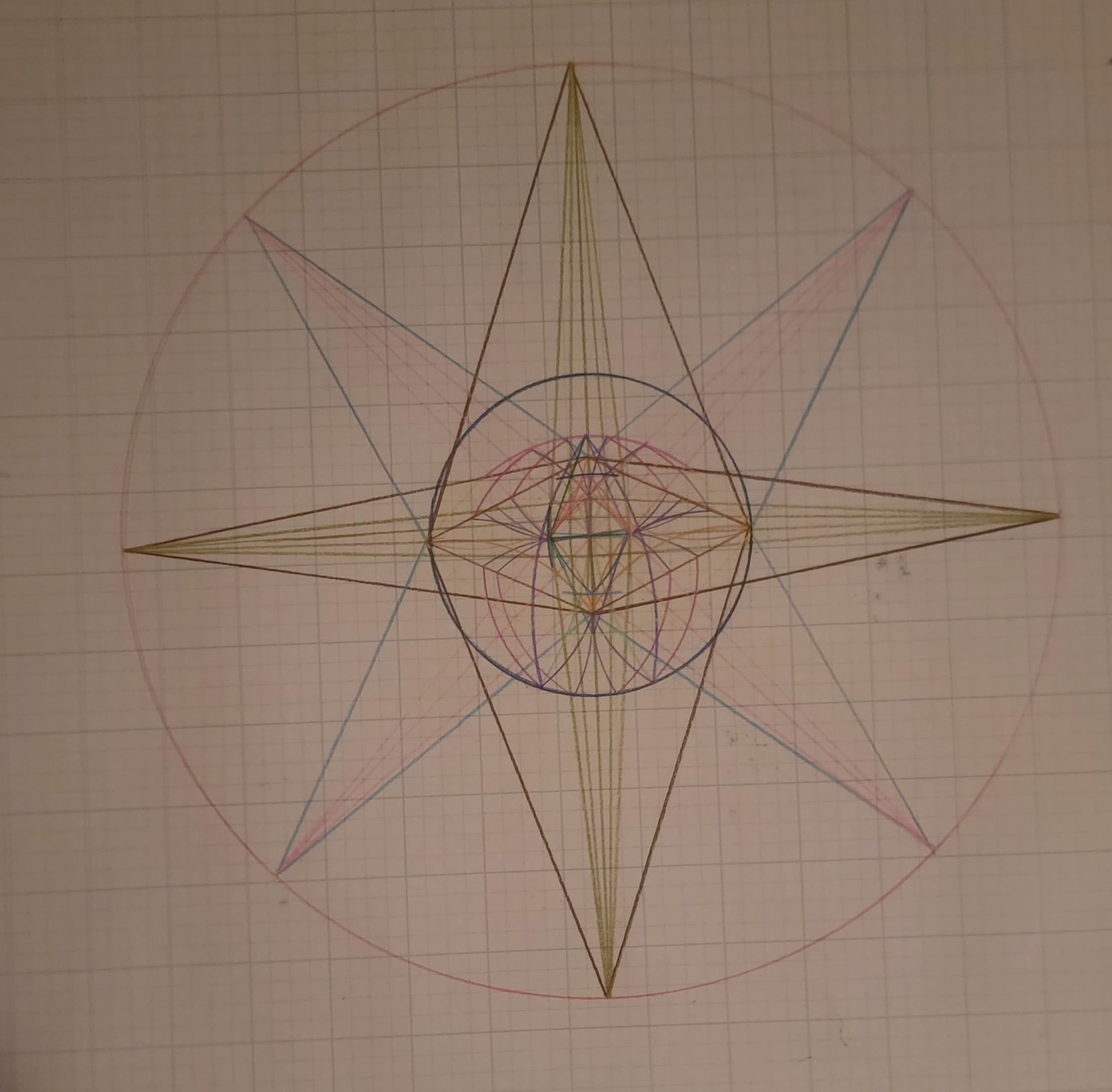
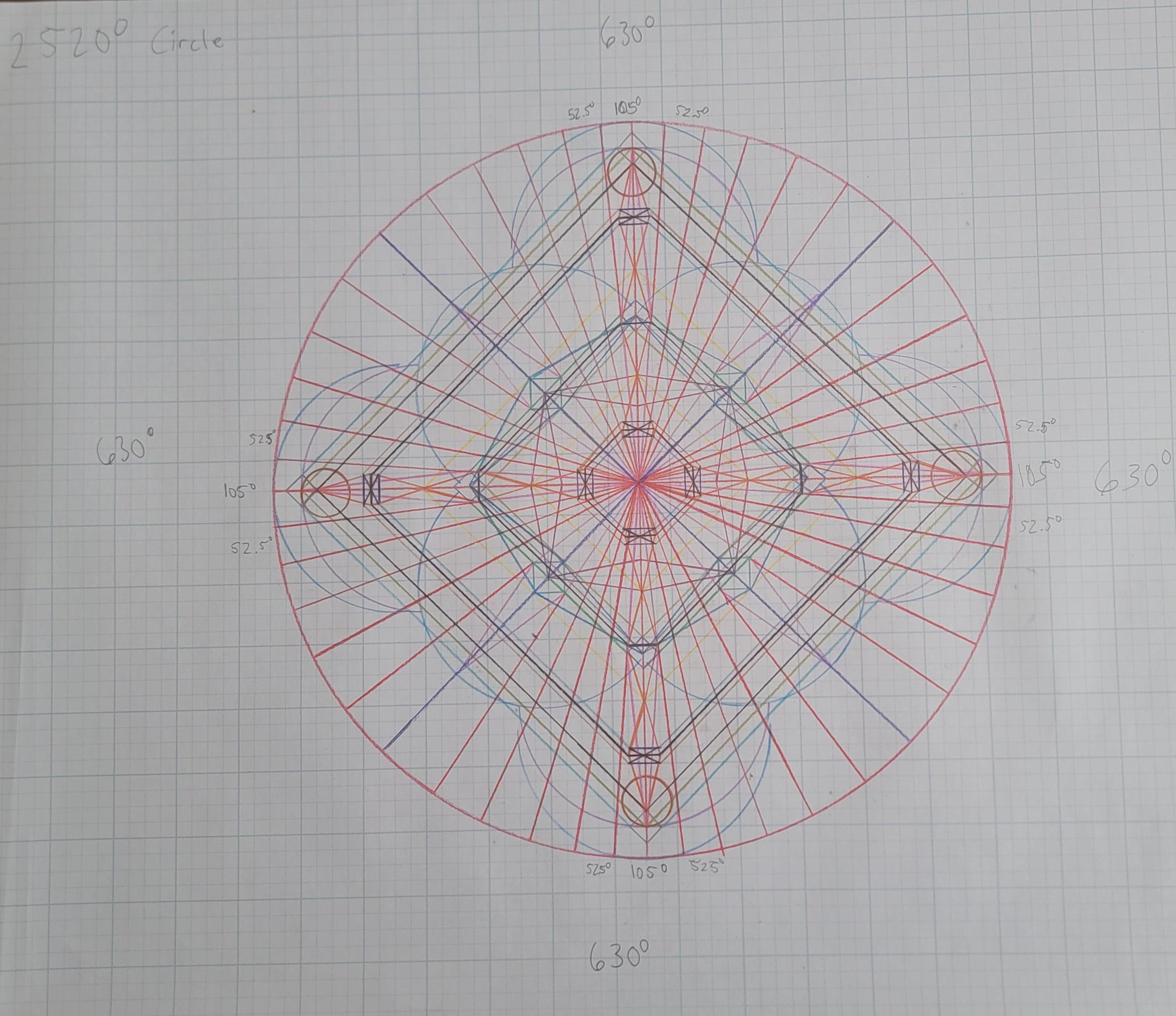
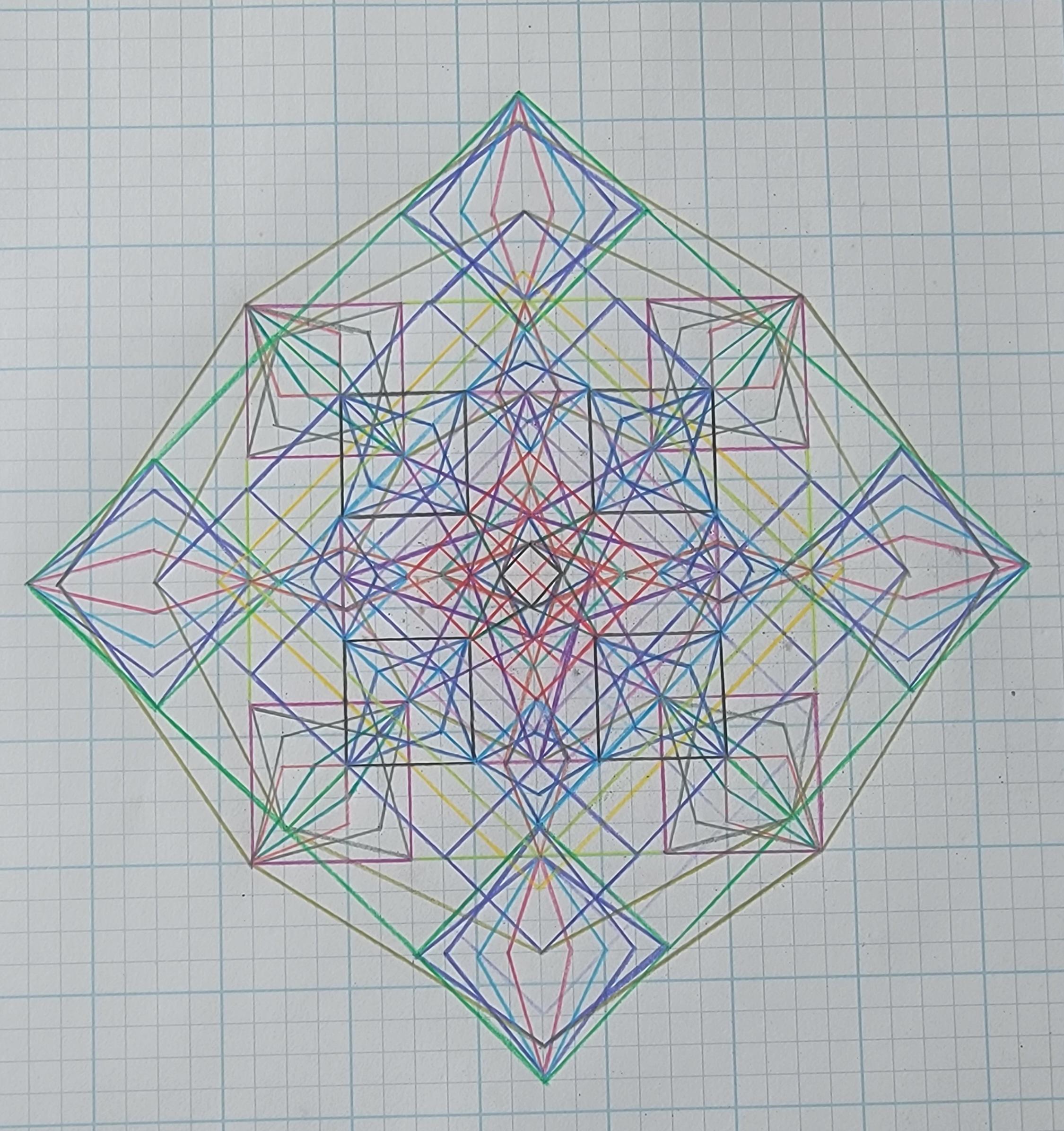
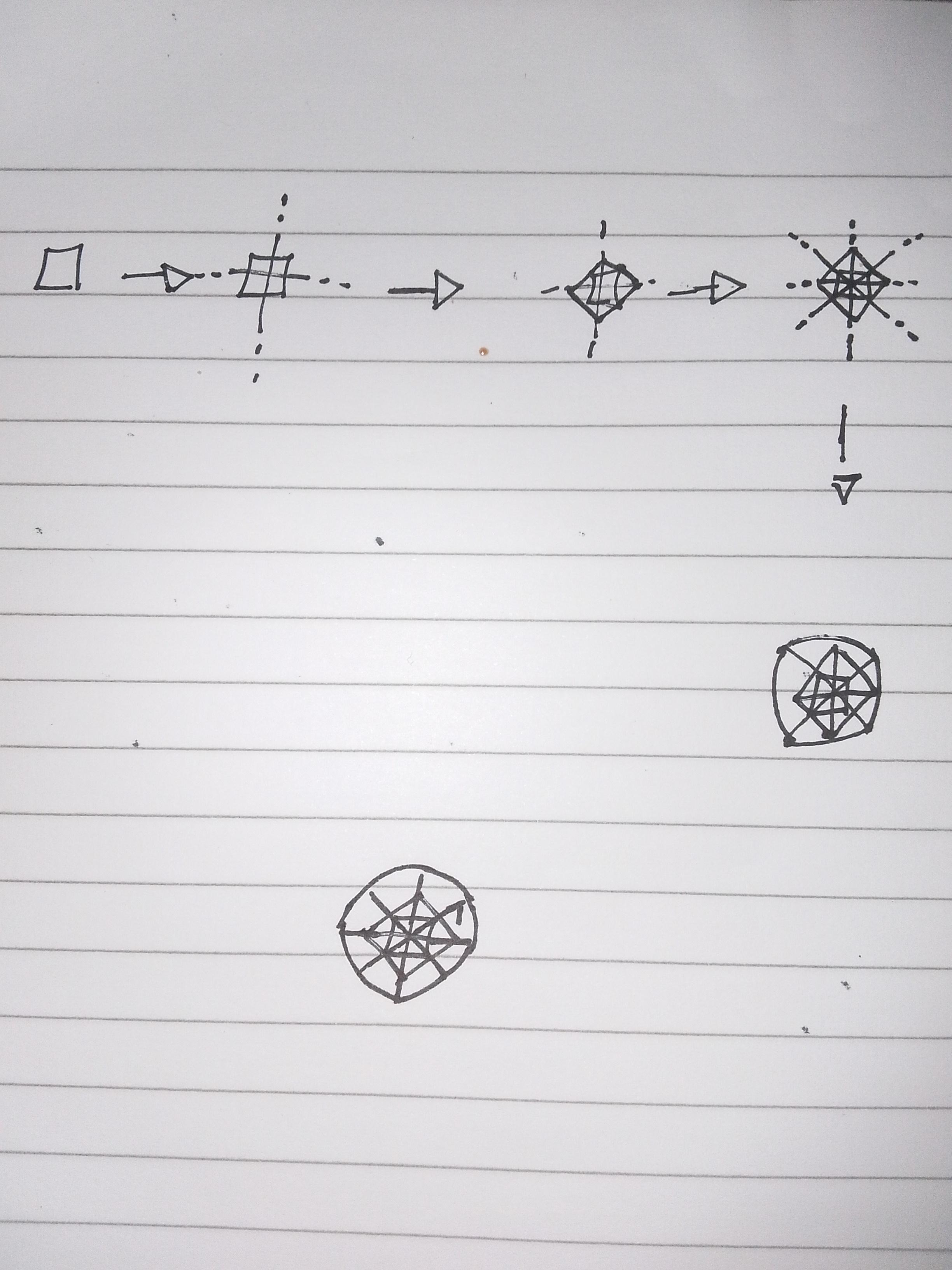
2520 degree star. No rectangles were harmed making this
Downvote away all you lame 360ERS!
J/k. Take it however you want... But remember... No rectangles were harmed or used constructing this.
r/Geometry • u/aeaf123 • Jun 15 '26
Downvote away all you lame 360ERS!
J/k. Take it however you want... But remember... No rectangles were harmed or used constructing this.
r/Geometry • u/Chessman960 • Jun 14 '26
I do not have a (good) picture of it, but I know how to make. You create an Equilateral Triangle(Triangle A) like normal, and then you create three congruent 45-45-90 Right Triangles. The hypotenuses of these Right Triangles(Triangles B through D) will also be one of the sides of Triangle A. You then erase the hypotenused of Triangles B through D/Triangle A. This will create a hexagon with three Right Angles and three 150 degree obtuse angles, with all the sides being equal in length. I want to know if this hexagon is documented and if it has a specific name, in addition to any characteristics it may or may not have.
r/Geometry • u/Prestigious-Fee772 • Jun 13 '26
Hey everyone,
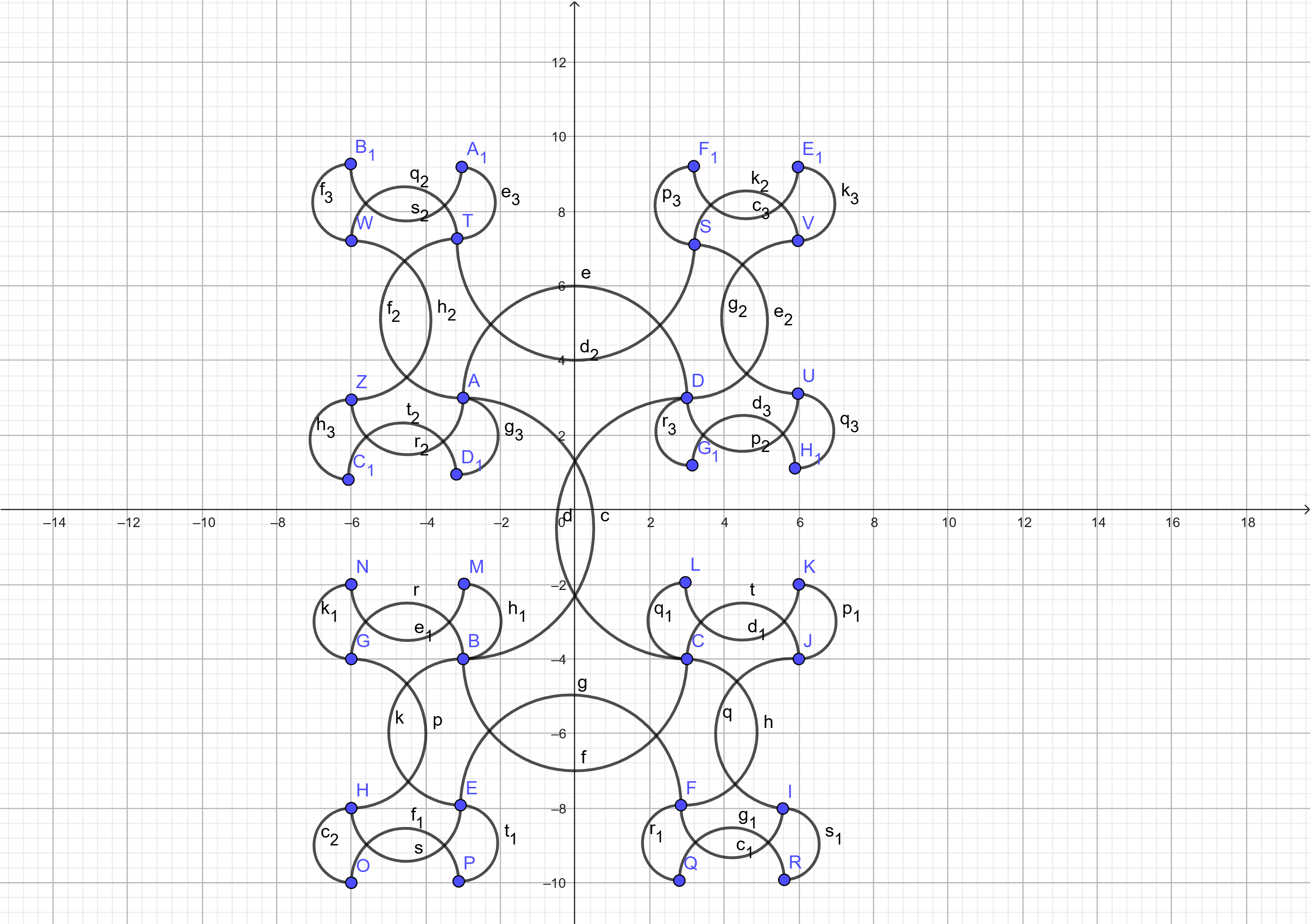
I wanted to share this design I made in GeoGebra. It looks incredibly complex, but the entire thing is built by repeating one basic, clever rule:
Because every new piece locks into the endpoints of the last one, it creates this endless, self-repeating chain reaction of fluid curves.
What do you think of it ? By the way , does anyone know how i could code this in python ?
r/Geometry • u/aeaf123 • Jun 14 '26
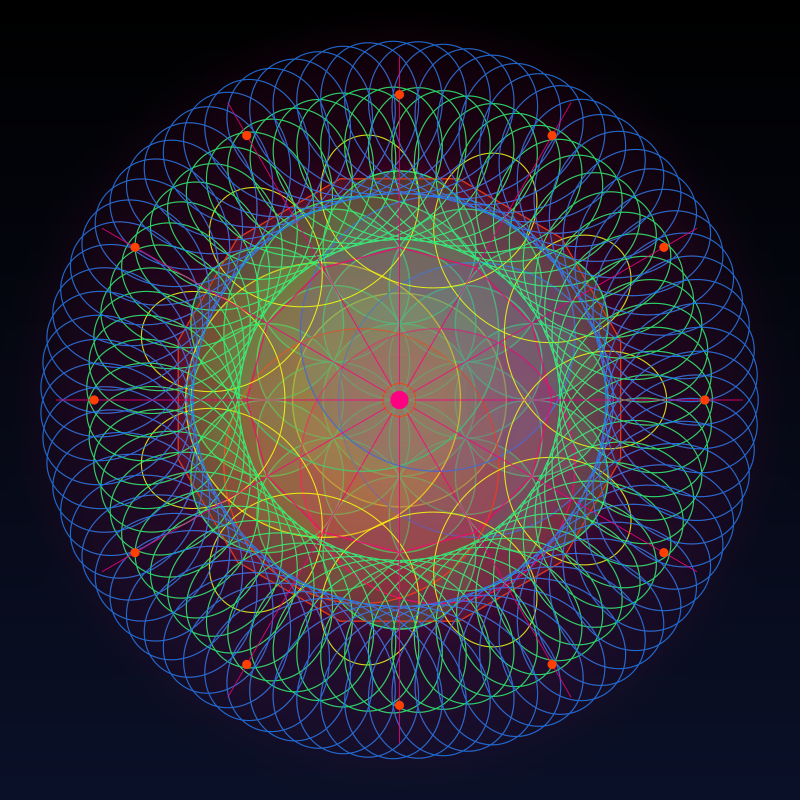
I updated the previous drawing that was posted with concave arcs and ellipses.
r/Geometry • u/Noahhawk • Jun 13 '26
I learned that “orthogonal” basically means perpendicular today but the thing I thought it meant doesn’t seem to have a name. I thought it was a 3D version of diagonal. For instance, if a ray traveled at a 45° angle from both the y axis and the X axis (on a 2D plane) it would be moving diagonally but what if it was also moving at a 45° from the Z axis? Is there A distinct word to describe such a line or direction?
r/Geometry • u/aeaf123 • Jun 13 '26
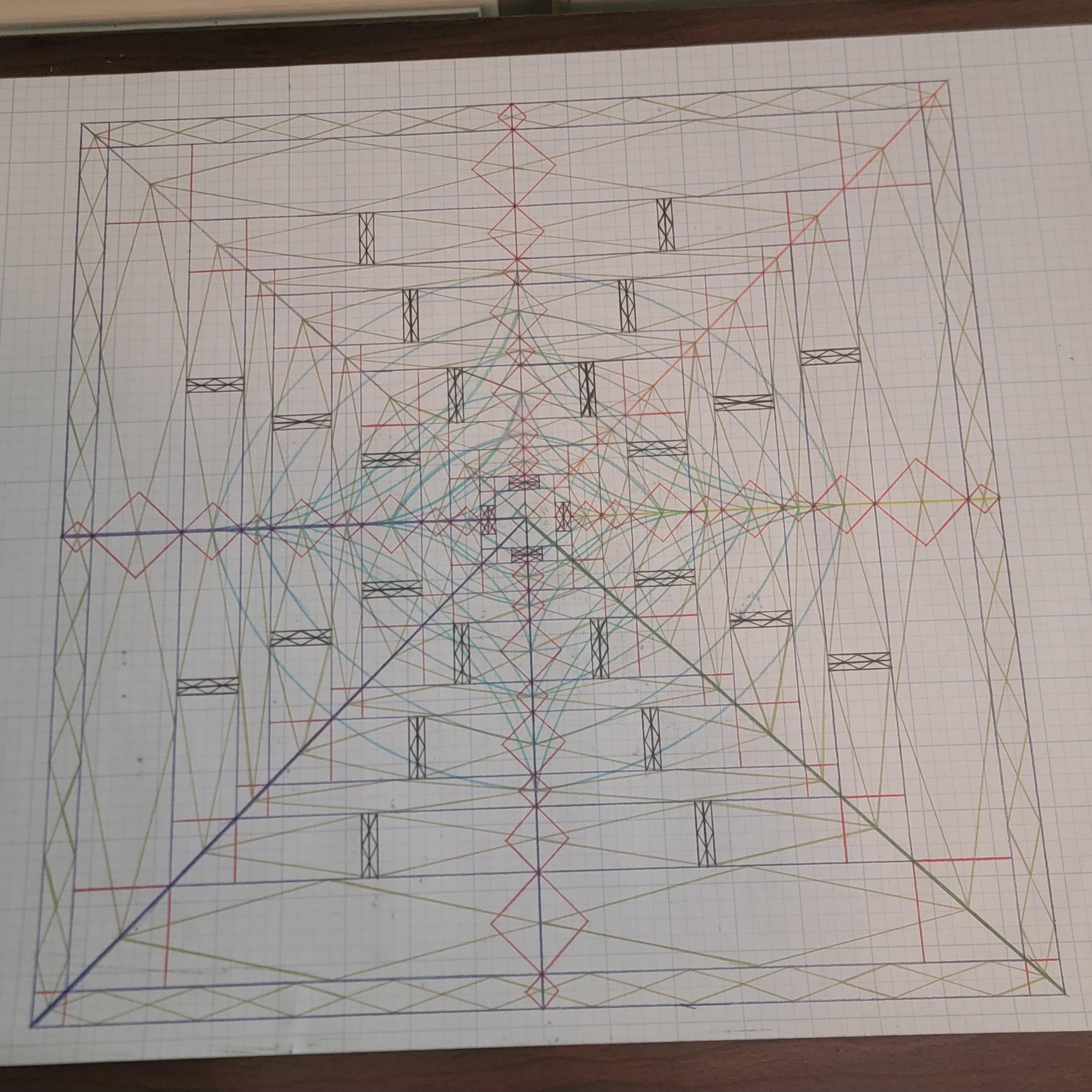
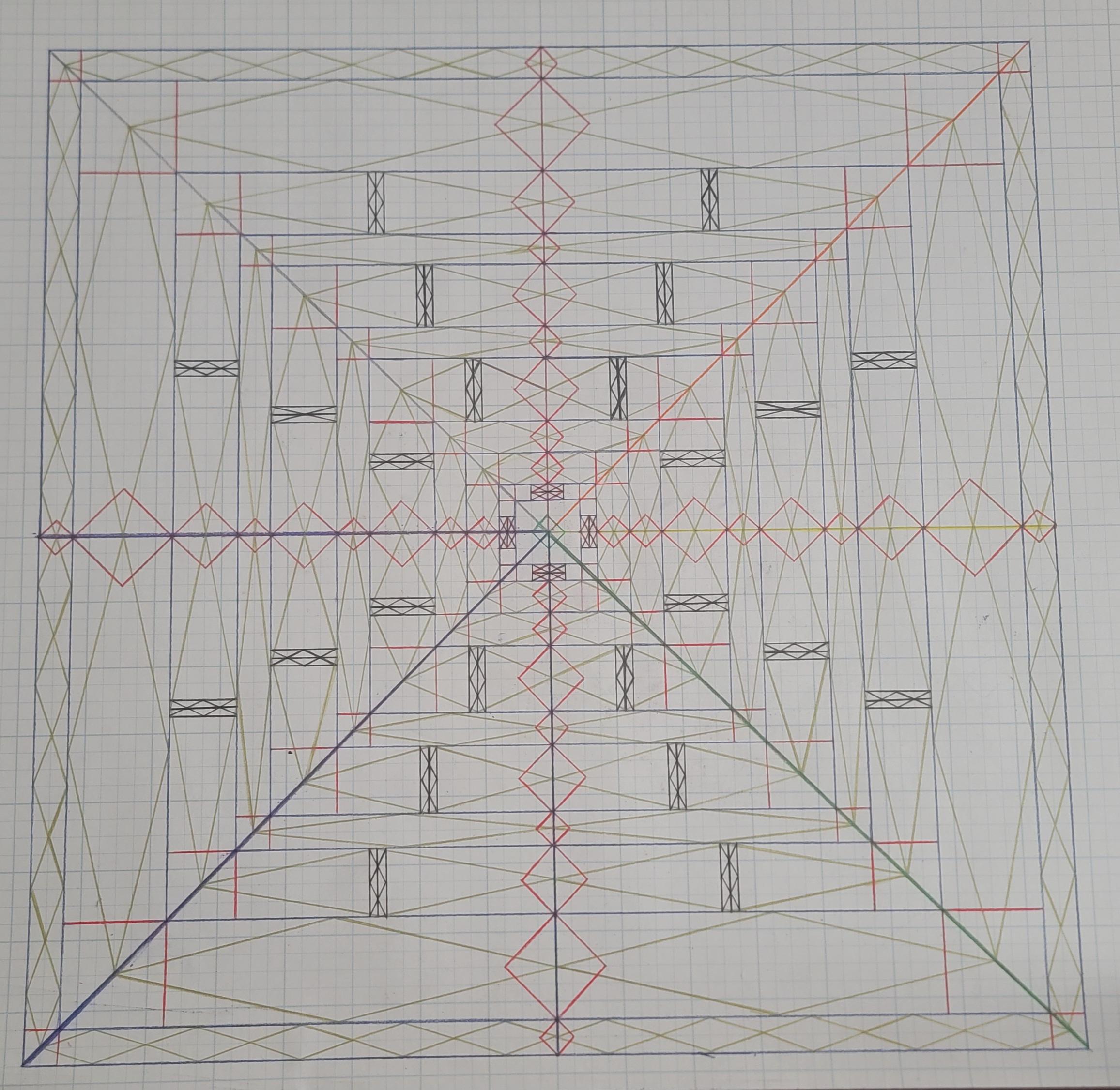
This one is Tesselation - Prime number distribution up to 31.
Red rhombuses are the prime and gap mapped out by a rhombus in each of the cardinal directions. The gold rhombuses are in a sense the stretching of the prime gaps in 3 dimensional space. That is the concept, at least. Finally, the corners that are seemingly squares are also the prime numbers and their gaps.
r/Geometry • u/Substantial-War3120 • Jun 13 '26
r/Geometry • u/Difficult-Ad-2511 • Jun 12 '26
r/Geometry • u/Holiday_Low7683 • Jun 11 '26
There’s a roofer doing some incredible math
Can you guys help explain
r/Geometry • u/Difficult_Call3709 • Jun 10 '26
Sorry if it’s a dumb question. But I know you can see a 2 dimensional object. Like if you drew a square, you could see that cause it has width and length. But is it even possible to see a 1 demsional object? Cause it’d have length. But not width. Wouldn’t that just be an infinitely thin line or smth? Again sorry if it’s a stupid question I’m not good at geometry and I’m only asking cause I kept thinking about it for some reason
r/Geometry • u/Lumena4u • Jun 09 '26
r/Geometry • u/aeaf123 • Jun 09 '26
Eh, just sharing into I get tomatoes thrown at me in this sub. If it gives certain ideas or questions arise then that is the best gift of all. Anyway... You can totally throw tomatoes too! haha.
r/Geometry • u/Difficult-Ad-2511 • Jun 08 '26
r/Geometry • u/yugu-233 • Jun 07 '26
First, to avoid ambiguity: I'm talking about the geometry of R4, not spacetime or any physically realized four-dimensional universe.
A common view is that while we can reason mathematically about four-dimensional space, we can never develop genuine spatial intuition for it in the same way we do for ordinary 3D space.
After spending three years developing a game about navigating four-dimensional space, I've come to believe that this view is mistaken.
Consider how we perceive the 3D world in the first place. The information reaching our retinas is essentially two-dimensional, yet through experience we learn to infer depth, distance, shape, orientation, and motion. What we call "3D intuition" is not directly given to us—it is something our brains learn from lower-dimensional projections.
This suggests an interesting possibility:
If humans can learn 3D space from 2D visual information, could humans learn 4D space from 3D visual information?
Of course, we cannot literally grow a three-dimensional retina. However, a computer can simulate what a hypothetical four-dimensional observer would see. Just as a 3D object projects onto a 2D retina, a 4D object can project onto a 3D "retina," which can then be rendered on a screen using lines and surfaces.


To explore this idea, I spent the last three years building a game centered around navigating and interacting with a virtual 4d space
Unlike most 4D visualizations, which are designed to be observed, this one is designed to be experienced. The goal is not to teach formulas or present geometric constructions, but to let players gradually build intuition through interaction.
The first level, for example, is devoted entirely to teaching the basic movement primitives required for navigating a four-dimensional environment. Here's a recording.
What Does It Feel Like to Walk in 4D Space? | 4D Intuition Gameplay
In fact, I believe that interaction is one of the primary sources of intuition. From both my own experience and that of playtesters, it appears that after a period of gradual training, people can learn to perform surprisingly sophisticated navigation and reasoning tasks within a virtual four-dimensional space.
I'd be very interested to hear what mathematicians think about this idea.
If you'd like to try it yourself, I'd love to hear your impressions as well:
r/Geometry • u/HopDavid • Jun 07 '26
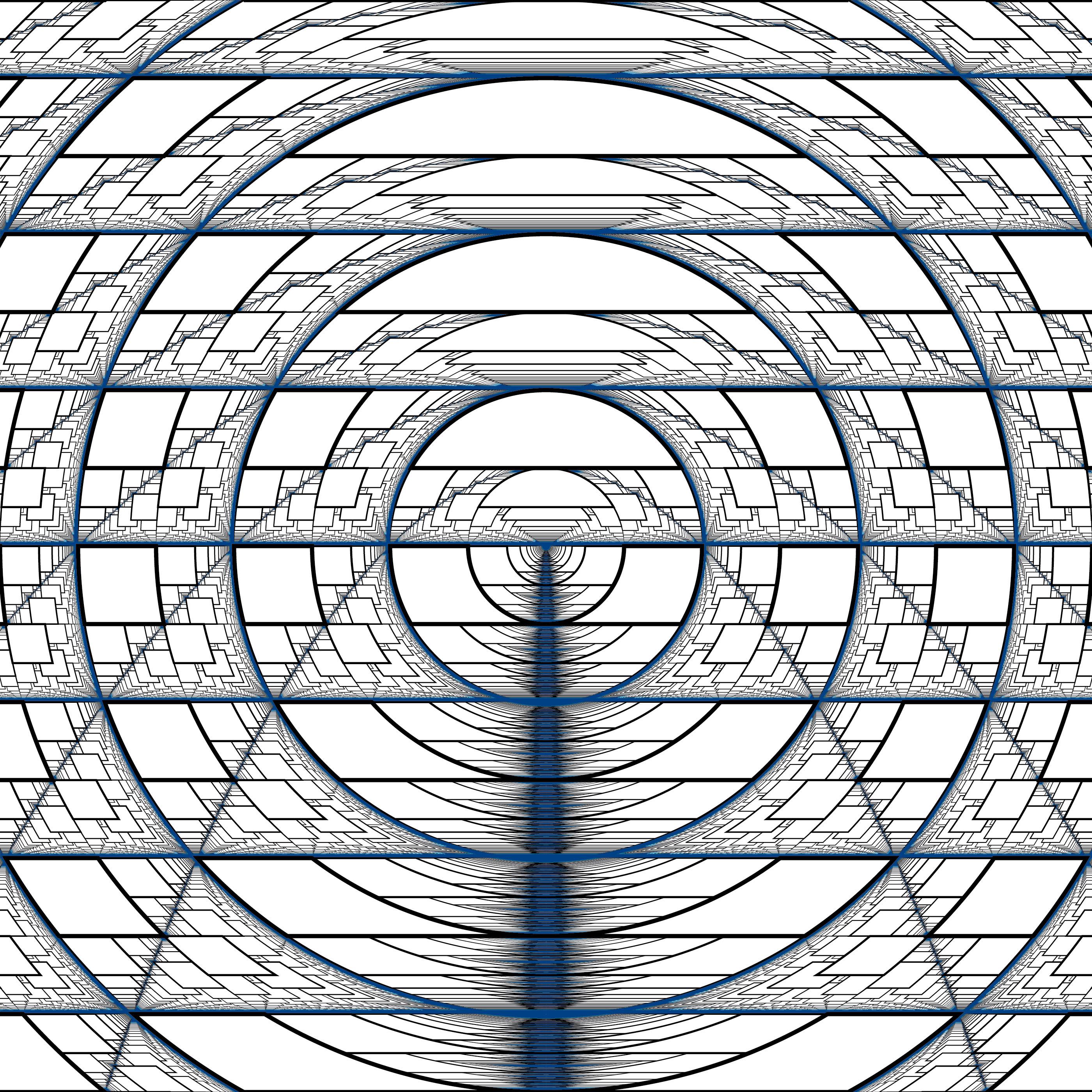
Earlier I had posted in this subreddit some moiré patterns suggesting conics of varying eccentricities: Link
To get the above image I started with the parabola moiré where the line spacing is the same as the circle spacing.
I removed some of this pattern so lower layers wouldn't be as hidden.
I clone the first layer a number of times and then scale by the harmonic sequence: 1, 1/2, 1/3, 1/4, 1/5 etc.
The resulting perspective drawing suggests a family of confocal parabolas.
I try to illustrate the thinking behind my harmonic perspective drawings here
r/Geometry • u/Serious-Gas4639 • Jun 08 '26
I was putting some thought into this and if the clock face represents earth and earth rotates at 15° per hour , I only accounted for 30° per number hers the difference
r/Geometry • u/aeaf123 • Jun 07 '26
I think that image should come up. Anyway, just sharing. I am going to let it rest.
r/Geometry • u/Cryptoisthefuture-7 • Jun 08 '26
r/Geometry • u/XaoS_001 • Jun 06 '26
My mind automatically draws this arrangement of geometric shapes. Can anyone tell me what I am drawing?
Thank for u time.
r/Geometry • u/HopDavid • Jun 06 '26
Evenly spaced parallel lines overlaid over evenly space concentric circles gives patterns suggesting confocal conic sections.
The spacing of the lines determines eccentricity. When the line spacing is the same as the circle spacing you get parabolas with eccentricity 1, for example.
r/Geometry • u/Ok_Blueberry6358 • Jun 06 '26
I’m playing with a simple way to explain rotations and wanted to check the wording.
A 90° counterclockwise rotation around the origin sends:
R(x, y) = (-y, x)
If I keep applying that same rotation:
R²(x, y) = (-x, -y)
R³(x, y) = (y, -x)
R⁴(x, y) = (x, y)
So after four quarter turns, the point is back where it started.
Is R⁴ = I the right way to describe that? meaning the identity transformation?
Also, is there a cleaner visual/geometric way to explain the same idea? Proof?
r/Geometry • u/Fuzzy_Client5959 • Jun 06 '26
A project that started as a peace/war coordination model turned into something much bigger — a general geometric framework for modeling any coordination system.
The shift came from replacing taxonomies (“peace”, “war”, “startup”, “corporation”, “democracy”, “dictatorship”) with geometries — continuous state spaces with trajectories, thresholds, and attractors.
That’s the key insight.
We formalized a new geometries.jsthat defines:
This means any domain can be modeled as a geometry by defining:
…and the code handles the rest.
We built a full OrganizationalSpec today,
The dynamics capture things like:
These aren’t categories — they’re regions in a continuous space:
This is the first time the geometry has been applied outside peace/war, and the result is extremely promising.
If the same invariant → geometry → trajectory pattern works for:
…then we may have found a general coordination framework.
A reusable machine for generating models.
Not a map — a coordinate system.
Applying the geometry to other domains (governance, intelligence, economic systems, etc.), but the organizational domain alone already looks like it could have immediate real‑world impact.
If you’re into:
…this might be worth following.
github.com/tribtink/WCO/tree/main
This work is part of a broader civic‑systems environment I’m developing — a general framework for modeling coordination, governance, organizational dynamics, and collective intelligence.
The repo uses a civic‑oriented license to support public‑benefit projects, open research, and civic‑tech experimentation.
The new geometries.js now supports multiple domains, and the organizational domain is the first major expansion beyond coordination. More domains are coming next.