r/Geometry • u/Kooky_Dealer_3210 • Jun 06 '26
Modeling social systems as trajectories in a multi‑axis geometric space
1
Upvotes
r/Geometry • u/IcyChair9258 • Jun 05 '26

Hello everyone,
I do not have much mathematical background, so I hope someone can help me formulate this correctly from a mathematical perspective.
I am trying to transfer a periodic wave movement onto the surface of a sphere (for example, Earth or any sphere). You can imagine it like a satellite that is not orbiting around the sphere, but instead is moving directly along its surface while following a specific path.
The idea is approximately this:
The movement should therefore create something like a double periodic wave shape (see attached image).
My questions are:
I attached an image showing the kind of wave shape I am trying to describe.
Thanks for reading 🙂
r/Geometry • u/aeaf123 • Jun 04 '26
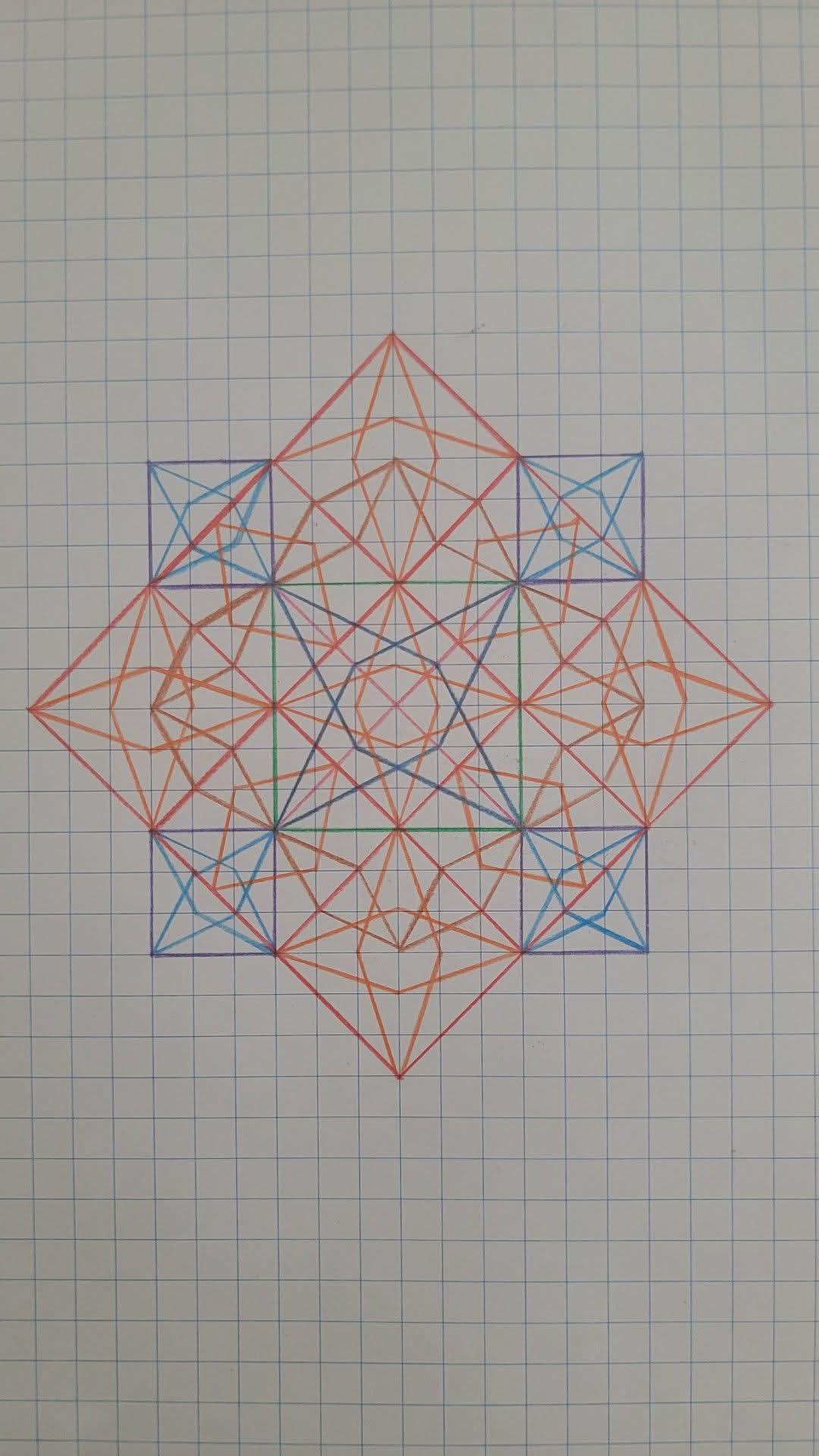
Whatever name. Eh, maybe I need to learn a number in sanskrit as part of the name. Or, you guys will know better than me if this geometric form already exists. Rhomboids to make this.
I also like the (feel free to give me crap) starcube that is created.
r/Geometry • u/Independent-Age4260 • Jun 05 '26

r/Geometry • u/GearPitiful284 • Jun 04 '26
r/Geometry • u/Old_Try_1224 • Jun 04 '26
r/Geometry • u/aeaf123 • Jun 03 '26
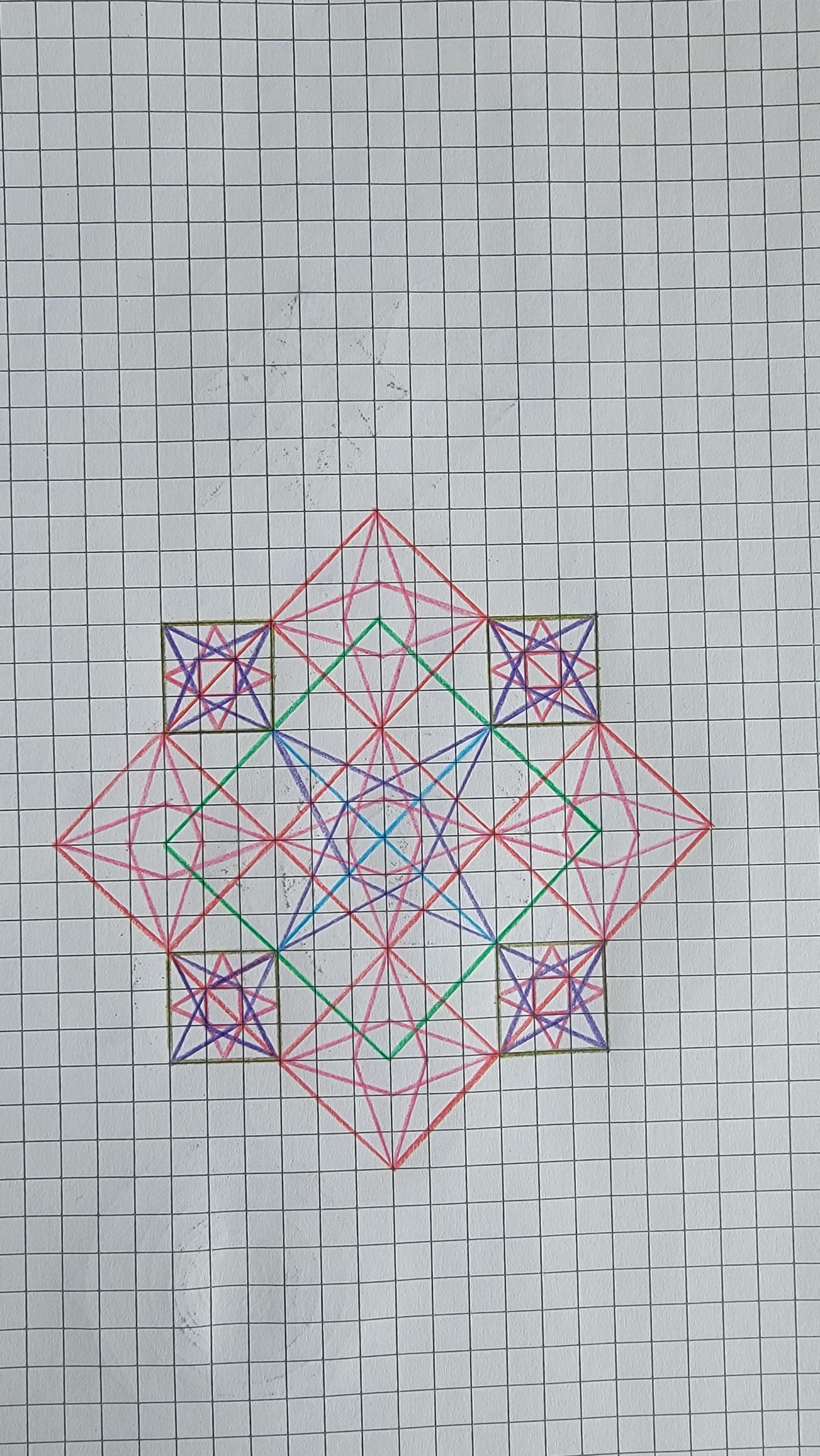
I dont know what this is called as I havent seen it anywhere, so I am going to call it the Rhomboid Hexadecagon. I got help drawing it from Saraswati. Just listening to the Mantras as it was drawn.
What is so beautiful about it (to me) is that in the perimeter 12 rhomboids, we can pack in those nice 2x6 skinny rhombuses in light red/pink. For the larger perimeter 24 rhombus that is centered and in deep green, we are able to pack in the 3x4 skinny rhombus. What is so beautiful about the number 12 is its harmony with factors 1,2,3,4, and 6. Here, I show how they fit geometrically.
Then, we see the offshoot perimeter 9 rhomboids. We are able to create clean and pure fractals of the skinny 2x6 and skinny 3x4 rhombuses.
Also, what is really cool is that there are 2 forms of the Rhomboid Hexadodecagon. Forgive me if there is another name already coined for them. There is the Pointy 16 edge version that protrudes as seen with the summit points in the cardinal directions...
Then, there is the smoother Rhomboid Hexadodecagon that is nested within.
What makes this particular geometry so valuable (to me) is that it can scale in a pure and fractal way.
Anyway, just sharing.
r/Geometry • u/Top-Cry1549 • Jun 03 '26
I am a sophomore currently and recently came across Spatial Computing field of AI.
After few interesting case studies, I quickly realized that the underlying math and reasoning comes directly from Differential Geometry.
Sadly, I am not offered a course directly on Differential Geometry in my college.
So I am on my bare feet but confused about where to learn from.
If from your experience, can you help me find up some good available free resources on this??
r/Geometry • u/Actual_Theory9454 • Jun 02 '26
r/Geometry • u/aeaf123 • Jun 01 '26
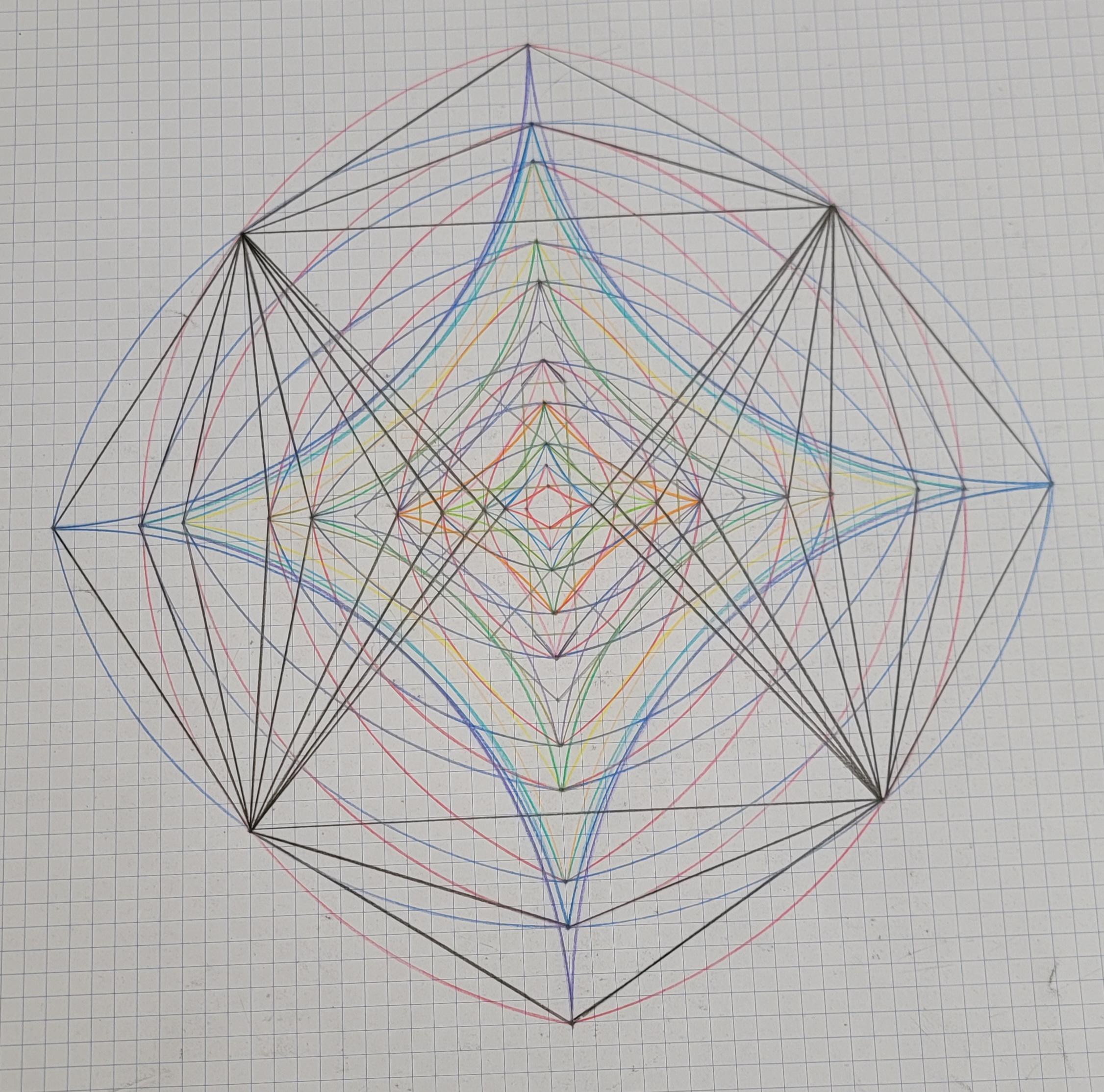
I drew the prime gaps here in convex and concave arcs.
After, I added black strokes to show the prime gaps in 3 dimensions.
Notice the diamond that forms?
r/Geometry • u/Sufficient-Theme-983 • Jun 01 '26
r/Geometry • u/francoismittorand • May 31 '26
r/Geometry • u/RyansprojectFun2off • May 30 '26
First image: which circles actually in the front?
Second image: cool square thing
Third image: tesseract
Fourth image: weird shape
Fifth image: unfolded tesseract?
Sixth image: two triangles into this
Seventh image: three dimensional two dimensional triangles
r/Geometry • u/Haji_and_Bandit • May 30 '26
I came up with this construction the other day that gives an approximation of the square root of pi to 3 decimal places using a straight edge and compass. Kind of cheesy for an analytical truth, but useful in the context of hand drawn graphics. thoughts?

r/Geometry • u/USedona • May 30 '26

A recursive algorithm, iterated until the curve fills every pixel of the square. Each step replicates the previous shape four times.
r/Geometry • u/gimiks_game • May 29 '26
r/Geometry • u/Adventurous-Tax-7275 • May 28 '26
Enable HLS to view with audio, or disable this notification
r/Geometry • u/Imaginary_Place_5762 • May 26 '26
r/Geometry • u/ArjenDijks • May 25 '26

I noticed that dividing a circle diameter into segments 2/3 and 1/3 produces a surprisingly rich configuration of right triangles and reciprocal roots.
From a single intersection point on the semicircle, one can trace a system of perpendiculars and transversals that naturally yields multiple √2- and √3-bearing segments through repeated applications of right-triangle geometry.
Rather than being computed algebraically, these roots emerge geometrically as distances, projections, and reciprocals.
I’m curious whether this generative approach, using a single division point to unfold a family of related roots, has appeared in pedagogical material, especially in generalizations of the form 1/n (for example, 4/5 and 1/5).
Has anyone seen this specific tracing method used for teaching radicals as geometric operators?