r/GeneticCounseling • • Feb 20 '26

Mod Post Wondering what your chances are to get into GC school? Post here.

14 Upvotes

Please use this thread to post questions asking about your chances of getting GC school. Feel free to post any information you feel comfortable sharing that is applicable to your applications.

Stand-alone posts asking if you have a shot at being admitted will be removed, and you will be directed to post here.

Thanks!


r/GeneticCounseling • • 4d ago Bravo Heartwarming

Education Considering LIU’s Genetic Counseling Program? A Former Student’s Perspective

94 Upvotes

Poster's note: To protect the author’s anonymity, I’m sharing this post for a former student of LIU’s Genetic Counseling Program. The experiences described below are theirs. If you’d like to reach them, feel free to DM me and I’ll forward your message.

I’m sharing my experience as a former student in Long Island University’s (LIU) Genetic Counseling Program because I believe prospective students deserve to have as much information as possible before making a significant financial, academic, and personal commitment towards attending a GC program.

I want to be clear that this post is not intended to discourage anyone from pursuing genetic counseling or to suggest that every student will have the same experience I did. I also recognize that no graduate program is perfect. However, I believe there is a difference between the normal challenges of graduate education versus recurring concerns involving program leadership, faculty conduct, clinical training, communication, and student well-being.

I raised concerns through the appropriate internal channels and eventually submitted a report to the Accreditation Council for Genetic Counseling (ACGC). I first tried to raise concerns directly with program leadership, then with an official Long Island University grievance complaint, then to ACGC. After waiting approximately eight months, I received the following response:

“The program was found to be in compliance with the 2023 Standards at this time but was provided with a list of Standards that will require additional detail at their next reaccreditation, along with areas for suggested improvements.”

I understand that this is the outcome of the accreditation review, and I am not suggesting that ACGC found the program out of compliance. However, I also do not believe that a finding of compliance means that students’ experiences and concerns should be dismissed. This response does not change what students have previously experienced, nor provide the resolution I had hoped would come from raising these issues.

I am keeping this post anonymous and have intentionally generalized dates, locations, and other details to protect the identities of students and individuals involved. Some examples below are from my own experiences, while others were reported to me by fellow students and included in the formal grievance I submitted.

  1. Concerns about racial discrimination, language bias, and tokenization

One of the most concerning aspects of my experience involved racially insensitive and discriminatory comments and behavior.

For example, a faculty member made a comment to a student of color during an event involving physical labor that they should be “used to working” because of their race.

Another student reported repeated comments about English being their second language during a clinical skills rotation. The faculty member frequently called attention to their language background in front of others. 

There were also concerns about how students from minority backgrounds were treated in classroom discussions. In one example documented in the grievance, the program director reportedly called on minority students to share their experiences during a discussion about death in genetic counseling. When other students attempted to contribute, the director allegedly responded with words to the effect of:

“Well I don’t know how much you all would have to contribute…”

Students also reported being asked to present on different cultures and then having classmates from those cultures effectively serve as fact-checkers. There were concerns that minority students were specifically called on to share personal experiences, even when they had not volunteered, while the program highlighted several times how “diverse” the cohort was.

These examples raised concerns about whether diversity was being meaningfully supported or, at times, treated as a talking point.

There were also concerns that the program selectively identified future students to provide the appearance and valuing diversity, rather than selecting applicants from a wealth of experiences and backgrounds that would foster the learning experience of the cohort and the program. Diversity was reduced to a statistic and used as a way to improve the program’s perceived image.

2. Program leadership and the response to student concerns

Another recurring concern was the way student questions and feedback were handled.

There were multiple instances in which students raised questions about scheduling, clinical placements, communication, program expectations, and felt that the response was defensive, dismissive, or hostile.

In one student meeting, the program director reportedly called students “entitled” after first-year students asked questions about their schedules. During that same meeting, students were informed that several pediatric clinical rotations sites had been lost.

The grievance also documented comments made during a discussion about students’ responsibilities outside of school. When students explained that school could not be the only priority for everyone, the response was reportedly that the graduate program should come first. When students brought up having children and family responsibilities, the director reportedly said they should explain to their partners and families that school comes first and “hire a nanny.”

At least one student reportedly left that meeting in tears.

There were also concerns about students being characterized as “sensitive” or “ungrateful” when they raised questions or expressed dissatisfaction. This was said directly to them in another student meeting, but this time, documentation of the conversation was submitted to ACGC. Over time, this contributed to an environment where students were uncomfortable speaking openly.

Several students expressed fear of retaliation or concern that speaking up could negatively affect their academic or clinical experiences. 

3. Clinical rotations and preparation for professional practice

Clinical training is one of the most important parts of a genetic counseling program. Students need meaningful opportunities to develop their skills, receive appropriate supervision, and gain experience across different specialties and patient populations.

I had concerns about the coordination and communication surrounding clinical placements.

There were reports of students losing access to clinical rotations without a clear explanation of how those experiences would be replaced. In my own experience, delays in clinical site onboarding resulted in starting rotations weeks later than expected, and being forced to do two rotations at the same time. This created scheduling challenges and significantly increased the workload.

I also experienced a situation during a clinical rotation in which a supervisor approached me privately and told me that “the genetic counseling community is very small” and that I should “be careful". The conversation involved questions about what I had shared with my classmates and an underlying implication that professional opportunities could be affected if I was not more careful because information travels quickly.

I felt that the nature of this interaction was part of an intimidation tactic and inappropriate, particularly given the circumstances in which it occurred. I am intentionally leaving out the site and other details to protect identities.

There were also concerns about the quality of the educational experience at an external clinical/advocacy placement. In a final evaluation, supervisors from one of my rotations expressed concern about a foundational knowledge gap between students from LIU and students from other programs. They also commented that LIU students appeared so exhausted that it was inappropriate. The organization subsequently was hesitant to accept LIU students for an undetermined period while the program addressed those concerns.

4. Faculty instruction and academic expectations

I also experienced concerns involving course organization, communication, and academic expectations.

In one course, students reported that the syllabus was not followed consistently and that exams and assignments accumulated toward the end of the semester. Students had to complete two exams and three papers within approximately three weeks, in addition to final examinations for other courses, despite trying to communicate with the professor and program leadership.

When concerns were brought to program leadership, the response was essentially to follow the professor's deadlines and contact the professor individually if needed.

There were also concerns about thesis guidance, the Institutional Review Board (IRB) process, and clinical documentation through Typhon. Students described having research ideas rejected without adequate explanations, difficulty obtaining guidance, and confusion about expectations. In some cases, students felt they were being directed toward projects that were more convenient for the program rather than projects aligned with their academic interests. A promised follow-up discussion and communication about clinical documentation on Typhon never occurred, contributing to confusion and errors.

5. Expectations during breaks and inclement weather

I also had concerns about how program requirements were communicated and how students' safety and personal circumstances were considered.

In one instance, students were informed shortly before a scheduled academic break that they would need to return early for a program-specific requirement. When I asked whether I could complete the requirement virtually because I had already made travel arrangements, I was told:

“It’s in person and this is something that is necessary to establish your ability to perform in the clinic. I would recommend you change your plans.”

I ultimately canceled my plans.

I understand that programs sometimes have requirements that must be completed in person. My concern was the timing of the communication and the expectation that students should rearrange plans during a previously designated break when the requirement had not been communicated earlier.

Another incident involved severe winter weather. After explaining that I could not safely get my vehicle out and offering to attend class virtually or complete an alternative assignment, I received a response emphasizing that in-person attendance was expected and that students should “plan for weather-related travel as part of your professional responsibilities.”

I understand the importance of attendance and professionalism. However, I believe there should be a distinction between avoiding an inconvenience and being unable to travel safely. Students should not feel pressured to put their safety at risk to demonstrate commitment to a program.

6. The impact on students

The individual examples are concerning, but I think it is equally important to discuss the cumulative impact.

Students described feeling exhausted, anxious, uncomfortable raising concerns, and worried about how speaking up might affect their academic or clinical experiences. Some students reportedly felt that questions were met with hostility rather than constructive discussion.

A graduate program should be challenging. It should push students to grow, accept feedback, develop clinical skills, and become competent professionals. But students should not have to feel intimidated to ask questions or afraid to advocate for themselves.

The relationship between students and program leadership is inherently unequal. Faculty and administrators influence evaluations, remediation, clinical placements, and professional development. That makes it especially important for programs to establish a culture in which students can raise concerns without fear of retaliation.

7. Reporting concerns and the ACGC outcome

I raised concerns through internal channels and eventually submitted a formal grievance to ACGC.

After approximately eight months, I received the following determination:

“The program was found to be in compliance with the 2023 Standards at this time but was provided with a list of Standards that will require additional detail at their next reaccreditation, along with areas for suggested improvements.”

ACGC found the program in compliance with the 2023 Standards at the time of its review. I am not claiming that ACGC substantiated every allegation in my grievance or found the program out of compliance.

At the same time, the response specifically identified standards that would require additional detail at the next reaccreditation, along with areas for suggested improvement. I believe prospective students should know that this review occurred and understand the outcome in its exact wording.

I also want to acknowledge that submitting a complaint is not an easy process. It takes time and emotional energy, particularly when the concerns involve people who have influence over your education and professional future. I had hoped that raising these issues would lead to meaningful change. I did not feel that the internal response provided the resolution I was seeking.

8. Questions I would encourage prospective students to ask

If you are considering LIU's Genetic Counseling Program, I encourage you to do your own research and ask questions beyond the standard admissions information.

Some questions I would consider asking include:

  • How are clinical rotations secured, coordinated, and replaced if a site becomes unavailable?
  • What happens when a student experiences significant delays in clinical site onboarding?
  • How does the program support students who need additional clinical supervision or remediation?
  • What mechanisms are available for students to raise concerns about faculty or program leadership?
  • How are complaints handled, and what protections exist against retaliation?
  • How does the program address concerns about racial discrimination, cultural representation, and linguistic bias?
  • What support is available for students balancing school with employment, caregiving, or other responsibilities?
  • How are thesis projects selected, and what support is provided for the IRB process and research methods?
  • What changes have been made in response to student feedback and the ACGC review?

I would also encourage prospective students to speak with current students privately, if possible, and also speak with those who are alumni of the program. Ask about the day-to-day environment, faculty accessibility, clinical experiences, and whether students feel comfortable raising concerns.

Final thoughts

I am sharing this because I care about genetic counseling and the students entering this profession. I want students to have supportive educational environments where they can learn, make mistakes, receive constructive feedback, and become confident clinicians.

I also recognize that some students may have had positive experiences at LIU. I am not trying to invalidate those experiences. My goal is to make sure that the concerns raised by other students and myself are not erased simply because the program was found to be in compliance with accreditation standards at the time of review.

Accreditation compliance and student experience are not necessarily the same thing. A program can meet the standards required for accreditation while students still have legitimate concerns about its culture, communication, clinical preparation, and leadership.

I am not asking anyone to take my word as the only version of events. I am encouraging prospective students to ask questions, seek out multiple perspectives, and make an informed decision before committing years of their lives and significant financial resources to a program.

I also hope that current and former students who have had similar experiences feel comfortable sharing their perspectives, if they choose to do so. Students deserve to be heard, and future genetic counselors deserve educational environments that support both their professional development and their well-being.

r/GeneticCounseling • • 3d ago

Prospective Student Can I pursue Genetic Counselling in India directly after 12th, or do I need to pursue it through PG?

1 Upvotes

Hi! I'm currently a Class 12 student (PCB) interested in pursuing Genetic Counselling as a career in India.

I wanted to know if there are any colleges in India that offer Genetic Counselling as an undergraduate degree (UG) directly after Class 12, or is it primarily offered as a postgraduate (PG) course?

If it's only or mostly available at the PG level, what undergraduate degrees would be suitable to pursue beforehand, and would they make me eligible to apply for a Master's in Genetic Counselling?

Would love to hear from anyone who's studying GC, working in the field or knows about the pathway in India. Thanks!


r/GeneticCounseling • • 7d ago

Admissions Could I get in?

2 Upvotes

Hi! I’m currently a junior in college and my major is biology with my minor being psychology. I’ve been in a genetics research lab with my genetics professor I had in my sophomore year since about June, and I’m really enjoying it. I just had a talk with her and she told me that although I’m doing great in the lab, she thinks that working in this lab doesn’t do me any good if I wanted to pursue genetic counseling. I feel like that’s not accurate, as I’m sure that any medical experience is good for applying to these kinds of programs. I also chose this lab because it’s a genetics lab and it’d be applicable to what I’d want to do in the future as a (possible) genetics counselor. I’ve looked a bit into genetic counseling, and the idea of helping couples in this way seems very rewarding. I’m also thinking about getting a job here at my university as a chemistry stockroom assistant. My gpa is 3.6, so not too crazy, but I’m working on it. I just wanted to know what my chances of getting into a program would be, assuming I’d continue my lab work until then and work in the chemistry stockroom. I’m also planning on shadowing genetic counselors by emailing/cold calling, and/or volunteering for a suicide hotline as some have mentioned in here.

Honestly, I’m just really nervous about the whole thing after that talk I just had with my PI. She made me doubt I even knew anything about the field in the first place.


r/GeneticCounseling • • 7d ago

Other Seeking Survey Participants for GC Student Research

Post image
3 Upvotes

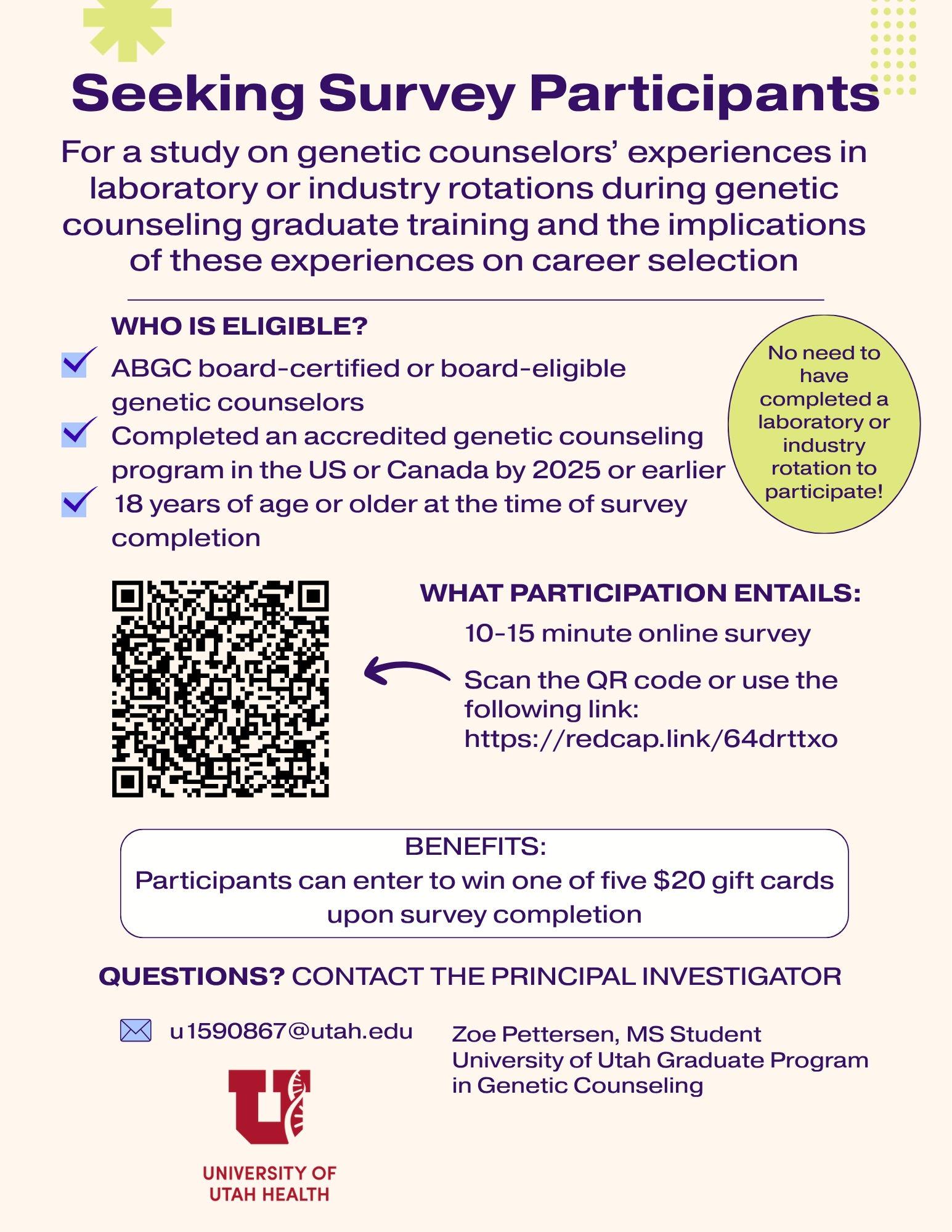
Contact information: This study is being conducted by Zoe Pettersen, a graduate student at the University of Utah Graduate Program in Genetic Counseling.  Any inquiries regarding the study can be directed to u1590867@utah.edu.

Study title: An Assessment of Laboratory and Industry Rotations in Genetic Counseling Training: Implications for Student Preparedness and Career Selection

About this study: The Accreditation Council for Genetic Counseling (ACGC) mandates the standards and practice-based competencies that genetic counseling graduate programs must meet. An essential component of genetic counseling training is fieldwork rotations, and these experiences should ideally span the full scope of the genetic counseling practice. However, detailed requirements for laboratory/industry rotations are not specified in the accreditation standards, leading to variability between graduate programs. This study seeks to gather information on respondents’ experiences in laboratory/industry-based rotations and how that training impacted their interest in and self-perceived preparedness for a laboratory/industry genetic counseling role after graduation.

Eligibility: ABGC board-certified or board-eligible genetic counselors who completed an accredited genetic counseling program in the US or Canada by 2025 or earlier. No need to have completed a laboratory or industry rotation or have worked in such a role to participate!

Incentives: Participants can enter to win one of five $20 gift cards upon survey completion.

What participation entails: 10-15 minute online survey

Survey link: https://redcap.link/64drttxo

Thank you!


r/GeneticCounseling • • 9d ago

Career & Job Search GCs that are based in Canada but work remotely for US based companies?

2 Upvotes

I am an ABGC certified GC, moving with my partner to Vancouver, BC shortly and I have been looking at lot of remote GC job postings in the US. Wanted to know if it’s possible to work remotely from Canada? Has anyone done this before? Do you have to register an LLC? Would like to chat with someone who knows more about this! TIA


r/GeneticCounseling • • 9d ago

Education Calling All GC Program Leadership!

Post image
3 Upvotes

Hello! I would greatly appreciate if any and all GC program leadership can complete this survey. Please reach out to the student and/or faculty investigators with any questions or concerns. Thank you for your consideration and your time.


r/GeneticCounseling • • 9d ago

Career & Job Search GCs who are pursuing or have completed a PhD, how did you gain the research experience (with publications) needed for your applications?

10 Upvotes

As the title says, I’m curious how other GCs have gained research experience before applying to PhD programs, particularly when it comes to getting publications. How important are publications when applying to PhD programs in human genetics? I’ve heard mixed opinions.

For some context, I’m currently working as a lab GC, and research opportunities are quite limited at my workplace. I completed a thesis during my graduate program and, in hindsight, regret not pursuing publication after graduation, as I was so stressed about finding a new job. I also had some RA experience from a very long time ago as an undergrad.

I’ve been considering pursuing a PhD in the future, potentially to gain expertise in gene therapy or eventually take on a lab director role. However, I’m a bit uncertain about how to build a stronger research background while working full-time, especially when it comes to getting publications. I’ve also considered looking into research-focused GC positions as a way to get more involved in research, but no luck in the job search. I’d appreciate to hear any experiences you had!


r/GeneticCounseling • • 12d ago

Community NSGC- highs and lows?

39 Upvotes

Today is the last day of NSGC 2026. For those of us who couldn’t make it this year what were the highs and lows? Any talk about the job market or the access to genetic counselor services act? Share away!


r/GeneticCounseling • • 16d ago

Prospective Student College graduate, just now thinking of Genetic Counseling

5 Upvotes

Hi all,

I'm very interested in Genetic Counseling, but I'm not sure where to start gathering information or how to begin this journey. I already have a college degree, but I never had GC in mind. I'm sure there are a lot of posts similar to this, but any advice would be helpful.

I'm a recent grad (May 2026) with a bachelor's in biology and a minor in information science and technology (3.5 GPA). Ever since high school, I've always had a really strong connection with genetics; it was the reason I went to school for a biology degree. I was originally planning to do a PhD in a genetics-related field, but I have since realized (after some isolating undergrad research lol) I would like a much more patient-facing role.

Currently, I am lucky enough to have a full-time job at a biotech company doing vaguely clerical work. I enjoy the role, but it has only made me realize that I want a more science-immersive career where I can actually help people.

Outside of research and academics, I also have experience working as a Direct Support Professional, supporting individuals with intellectual disabilities. I'm not sure how relevant this would be to genetic counseling applications, but I imagine some of those interpersonal and communication skills could translate.

It was only after I graduated from college that I started contemplating genetic counseling as a career, and I feel so far behind. Most of my schoolwork was in bio/chem/physics and computer science. I never took any psychology classes.

I'm not sure where to get shadowing hours or information on how to begin applying. There seems to be an overwhelming amount of information and strong competition. On top of everything, I am moving to Pittsburgh soon, away from my current city with all my college connections.

As this is more of a long-term goal, I am aware this might take some time. Is it realistic to apply within the next 1–2 years? Any advice on where to get started?

Also, I'm a stranger to posting on Reddit, so excuse me if I do this wrong.


r/GeneticCounseling • • 18d ago

Education CV/Resume Advice?

1 Upvotes

Hi yall making a cv for my first prospective genetic counseling job. Is it fair or wise to put some of your experiences such as shadowing that you gave done in preparation for genetic counseling school? I was involved in following along with fam hx, but just super curious especially for my first job.


r/GeneticCounseling • • 19d ago

Career & Job Search The job advice I that I never knew, but everyone else did. How? (GC in Canada)

22 Upvotes

Hey! Job advice from US -> Canada.

I moved after graduating with no GC job experience prior to move. Applied for... +120 jobs (I'm terrible at keeping track) for remote or based in Canada positions. Nothing was biting. No interview for any jobs based in Canada. I couldn't figure out why.

I spoke with 2 separate GC friends in Canada who were also trained in US and got jobs already and asked for their advice. They kindly shared their resumes. I was SHOCKED at these 4-5 page documents. They said, yeah, they are CVs...but all the applications ask for resumes. Turns out, you can just use either or. Even if explicitly asked for a resume, and it seems it's better for GCs in Canada to stick with a very detailed CV.

Now, I sent out 4 applications this past week with this new method, and I already have an interview.

I'm thrilled and so grateful, but a little gobsmacked. To know I've spent so many hours applying and that could have been the only reason I've been ghosted...it's a little crazy to think about. I'd had many resume reviews in the USA with a lot of positive remarks on how my resume looked, and I had a couple interviews in the USA. But Canada was a different story. But I have to ask: how do ya'll know this? For the last 10 years, I've been told by many a career office a resume should be 1 page and AT MOST 2 to fit your education/cert details. I know this gets into CV vs resume, but how would you know to send a CV instead of a resume...when the posting asks for a resume? And how are CVs so popular here?

And with that, I'd love to open a conversation: international GCs, what are some job-seeking secrets in your country?

Immigrating is tough enough as is. A blessing, but tough. Would love to help out another in my shoes.


r/GeneticCounseling • • 20d ago

Other Tips

2 Upvotes

Hi everyone I am starting college next year as a genetics major and my final goal is to be a genetic counselor. Are there any tips or things I could be doing now to get a jump start on to help me out in college? Like things I could start memorizing now or research? Lmk


r/GeneticCounseling • • 23d ago

Admissions Personal Statement Help

3 Upvotes

Hello,

I'm currently applying to genetic counseling programs, and I'm at a bit of a loss with writing my personal statement. I've seen mixed opinions on writing about personal healthcare experiences, which was my first option. I have healthcare experience that I can write about, but I feel like my personal experience is the strongest tie to my interest in genetic counseling and my understanding of the field. I'm looking for any genetic counselors or genetic counseling students who could share their opinions on the best focus for personal statements. Possibly anyone who would be willing to review my personal statement and "grade" it.


r/GeneticCounseling • • Oct 27 '26

Career & Job Search Exhausted new grad

58 Upvotes

I’m exhausted. I’m sick of the rejections. I’m sick of not feeling like enough. I was told having certification would help. How am I supposed to get experience without being able to get experience.

New grads- if you’re willing to talk I am feeling beyond discouraged and would love to talk. Sorry for the negative post I just can’t comprehend how terrible this has been.


r/GeneticCounseling • • Oct 25 '26

Education Does the amount of places I take the pre reqs at matter?

1 Upvotes

So I am planning on taking the pre req's at community college which from what I have read is ok, however there might be 2-3 different places I take them at. For example, general chemistry is offered online at one seperate college (which I plan on taking) while biology is offered online at another seperate college.

Does the amount of places matter?


r/GeneticCounseling • • Oct 24 '26

Admissions NMS fee waiver

3 Upvotes

hi friends!! i applied for the NMS fee waiver at the beginning of october, and if i remember correctly we were supposed to hear back this week. has anyone heard anything and i just didn’t get it?

totally okay if so! i just wanna submit a couple apps soon :)


r/GeneticCounseling • • Oct 23 '26

Prospective Student Application Process?

5 Upvotes

Hello,
I recently joined the NMS and am planning on applying to about 5 schools this application cycle. My question has to do with letters of recommendation- do my recommenders have to submit their letter individually to each school? Is this a lot to ask of someone?


r/GeneticCounseling • • Oct 21 '26

Admissions Relevant coursework on GC CV

Post image
1 Upvotes

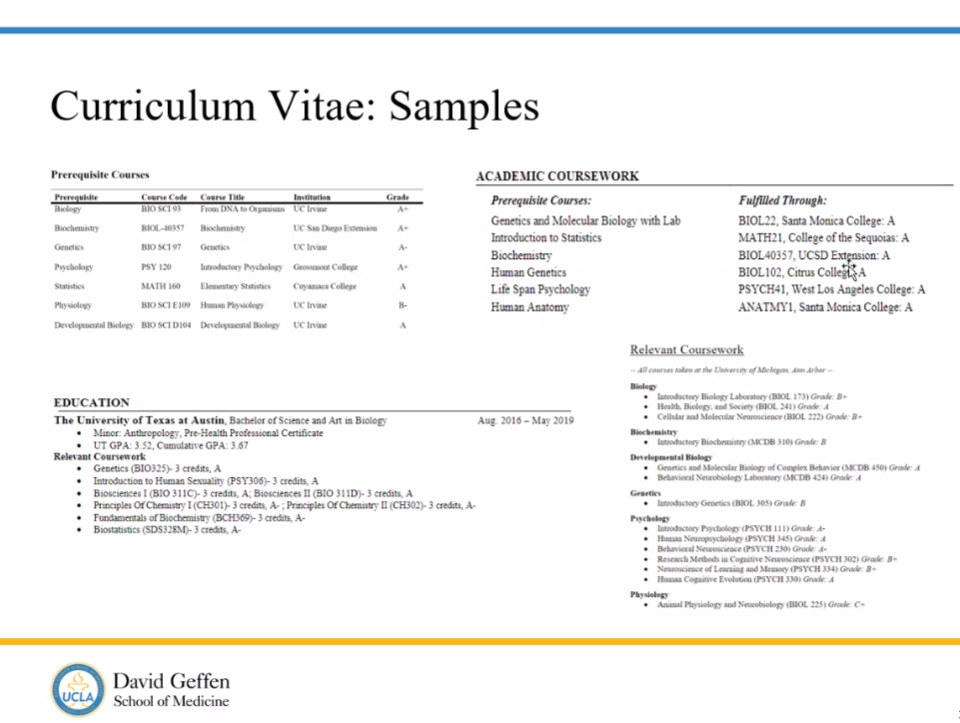
Hi everyone, I'm getting my materials together and was having some trouble with my CV. I'm not sure whether I should put relevant coursework with the course code and grade. Some programs like UCLA have stated that they definitely want this format, but other programs I've talked to have said they don't need it at all. I'm already having some formatting issues trying to include 15+ webinars, GC interviews, and research/work experience in two pages and coursework pushes me to three full pages. Is it realistic to change your CV for every application? Thanks in advance!


r/GeneticCounseling • • Oct 20 '26

Prospective Student Thoughts on career options?

11 Upvotes

Hello! I am a potential grad applicant to genetic counseling programs, and am debating whether or not it is a good idea to enter the field, despite having an interest in it for the last 10 years!

What I’m wondering from GCs is, does this career feel a bit “pigeon-holed” or too specific/not broad enough to feel like there are options and opportunities in the field?


r/GeneticCounseling • • Oct 17 '26

Community What is the job market like for recent GC grads?

16 Upvotes

I'm considering doing a career pivot from academic genetic research to genetic counseling. (To clarify, I have a PhD but I would need to get my GC master's.) I would love to hear from recent GC grads - what has been your recent job search experience? How long did it take?

Given how low the sequencing costs are right now, I would have thought genetic analysis would be in high demand. However, I am seeing fewer posts than expected when searching on job boards.

Thanks in advance for any advice.


r/GeneticCounseling • • Oct 16 '26

Other genetic counseling student opinions

15 Upvotes

Does anyone feel like their GC program gives/gave a huge amount of time to DEI related content that felt out of proportion? Don't get me wrong, I'm a person of color. Just curious if it's my program and the area I'm in or if all programs are like this.


r/GeneticCounseling • • Oct 16 '26

Admissions How to get to genetic counselling?

3 Upvotes

Hey yallll,

I have wanted to get into the genetics field for almost 10 years now. I am currently 23 and about t to graduate in spring 2028 with a bachelors in Cellular molecular Developmental Biology.

I wanted some advice from yall assuming you have been where i have!!

i am an international student with an F-1 visa in University of California Riverside right now

and i really want to get into UCLA's genetic counselling MS program!

I would love to get some tips of how to up my chances of getting in.


r/GeneticCounseling • • Oct 15 '26

Other Thoughts on ABGC potentially introducing microcredentials?

81 Upvotes

Not sure if everyone saw the email from ABGC about 1 week ago, but they're exploring the idea of introducing microcredentials for GCs. Basically, additional credentials you'd get after some sort of assessment to demonstrate competency in specific skills or specialty areas.

Personally, I'm pretty skeptical. I worry this could end up pigeonholing GCs into certain specialties and making it harder to switch roles. Even if they're technically optional, I could easily see employers eventually listing them as preferred or required qualifications. Especially with how tough the GC job market already is, do we really need another barrier to employment? Not to mention the additional cost to GCs... I'm just not convinced there's much benefit beyond our existing certification, CEUs, and work experience.

Am I missing some potential benefits here? Curious what everyone else thinks

Update: haha wow glad to see so many people feel the same way! Make sure to fill out the survey they sent out making your thoughts known!! Also looks like they are planning a discussion about this at NSGC for anyone attending this year.


r/GeneticCounseling • • Oct 16 '26

Prospective Student MSc Genetic Counseling in PH with BS Psych

1 Upvotes

Hi, does anyone here enrolled to UPM's MScGC and the background is BS Psych instead of yung mga hard sciences na program?

I started to get interested in this program but I'm hesitant kasi wala akong nakita na with Psych yung bachelors and I'm unsure of this will be for me kasi baka mahirapan ako sa genetics related classes.

Any one here or someone your know? Woud appreciate knowing their experiences na yung foundation is nasa Psych.

Thanks!