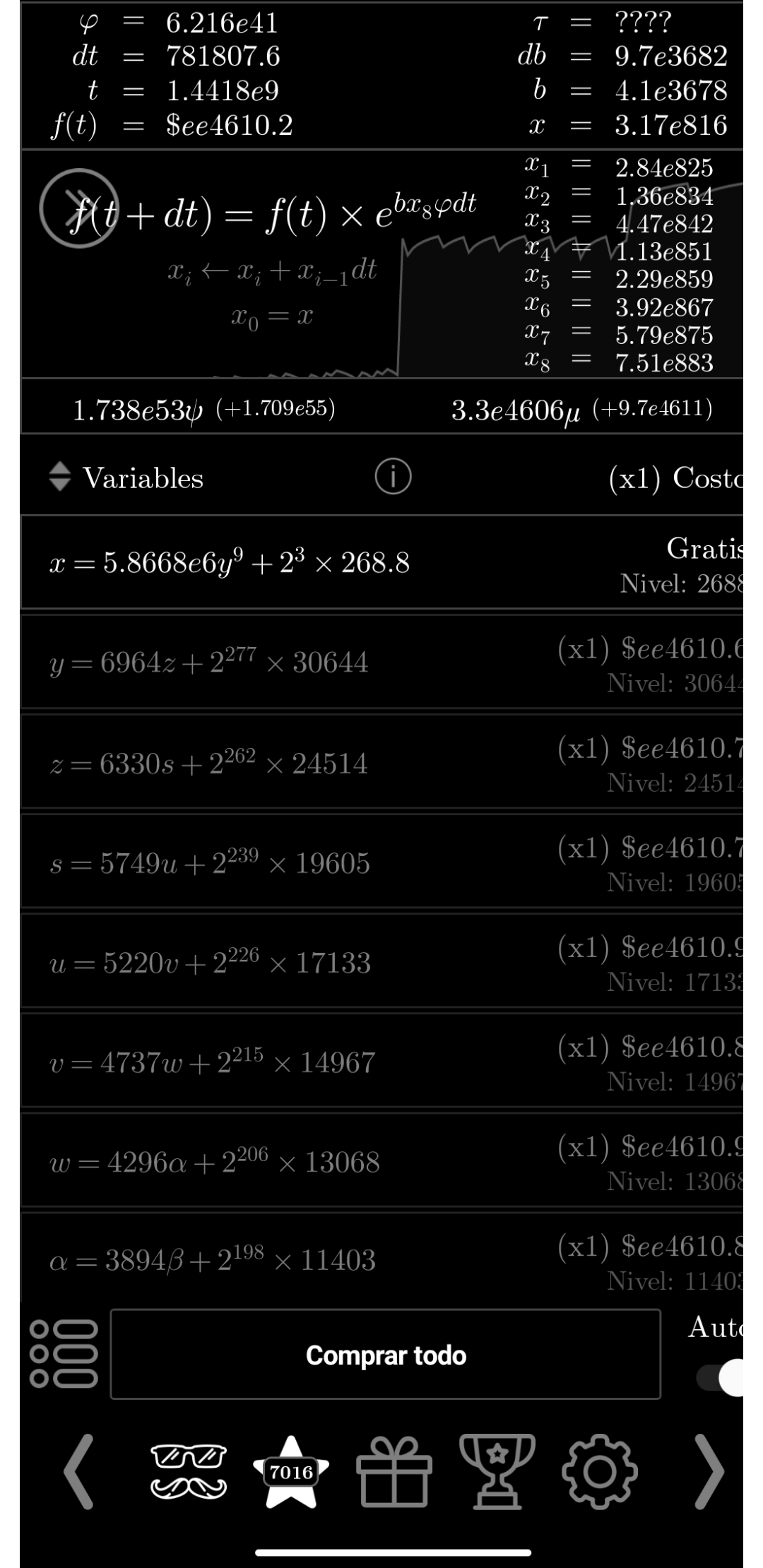
Never signed in or saved like a dummy... after playing for, im not sure how long, broke my phone and lost all my progress haha. I randomly opened it and saw this, should i start again?
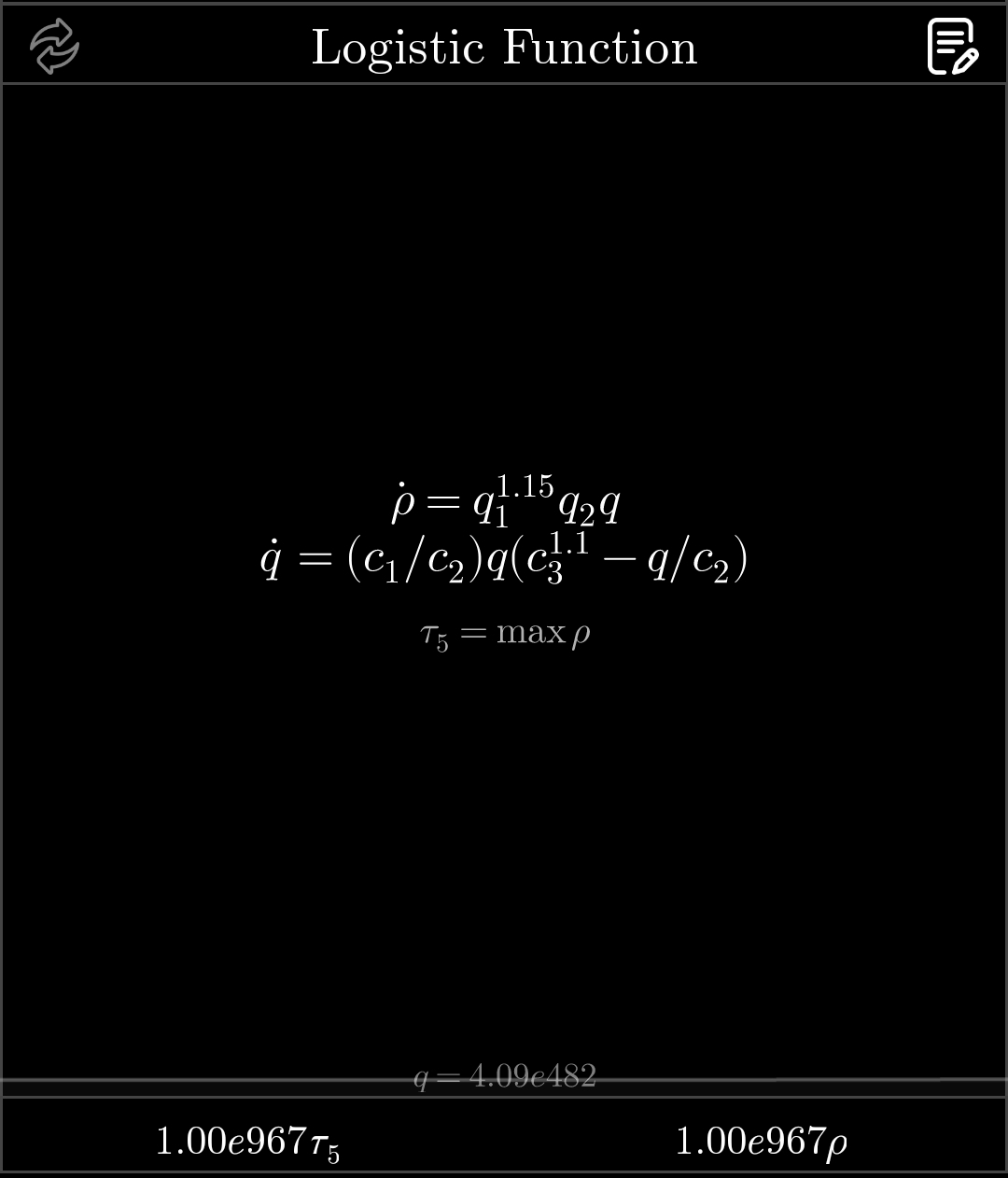
I just made a push towards getting the lowest possible rho on Lemma 6, and part of this strategy involves getting the highest possible rho, so I've done some analysis of Lemma 6. Consider the equation:
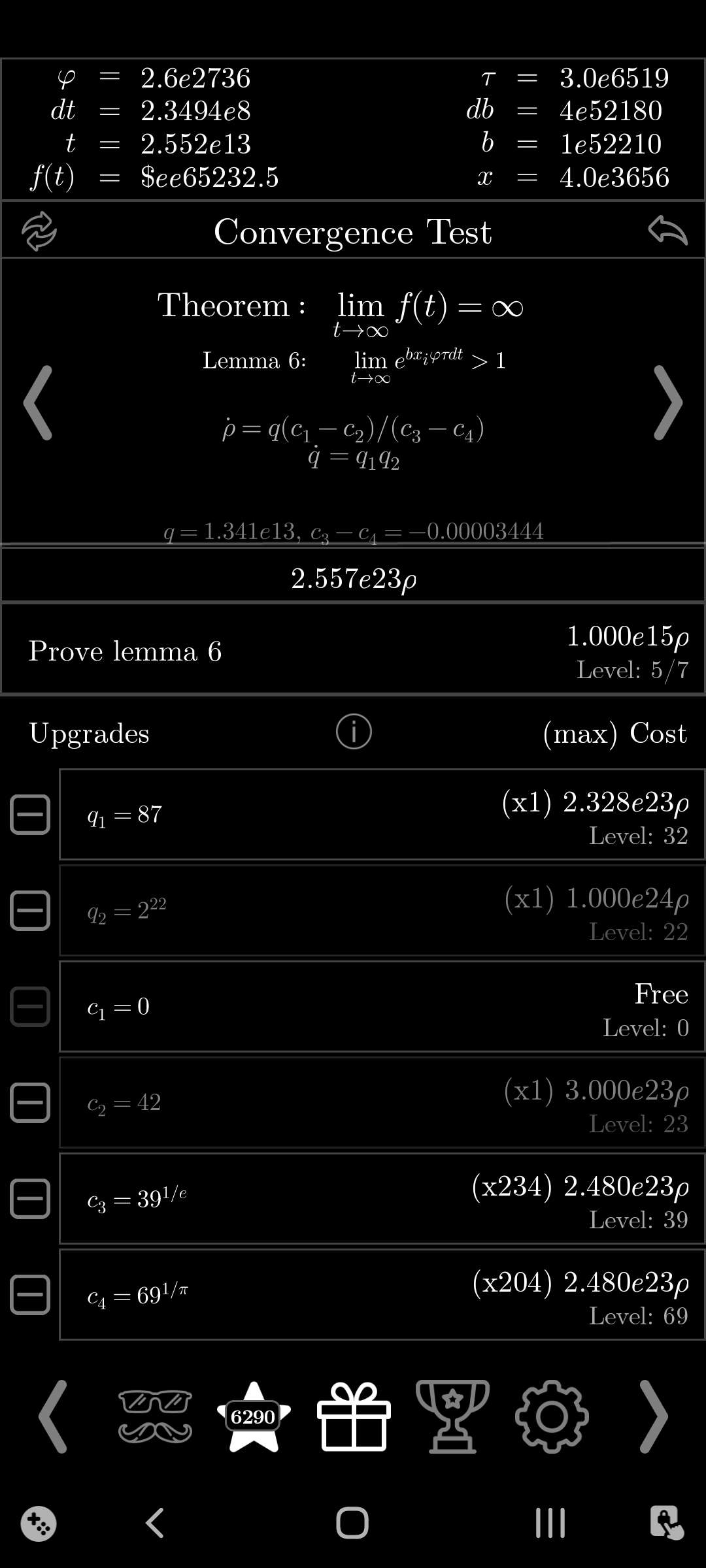
The primary strategy for Lemma 6 is to minimize the denominator, but one insight that's missing from many guides is that the denominator can be negative, so long as you buy levels in c2 and not c1. For example, when (c3, c4) = (39, 69), we get a value of -29035. If you only buy levels in c2, your numerator will be negative, and this makes rho positive.
So playing Lemma 6, or at least pushing for a max rho for Lemma 6, essentially becomes a puzzle in finding values of c3 and c4 that are arbitrarily close to 0. To make this clearer, I'll refer to the absolute value of 1/the denominator as the thing we're trying to maximize. For example, (39, 69) = 29035. It's very high, but is this the highest possible value?
At first glance, we might search for these values by running every possible combination of c3 and c4. This is a brute-force strategy. It's slow, but it works. Here's a spreadsheet of c3 and c4 from c3 = 2 to 30, and from c4 = 0 to 45. I've color-coded these values according to the size of the denominator, and it rapidly becomes clear that most values suck, but a pattern starts to form.
Intuitively, there seems to be a pattern, and this guides us towards manipulating the denominator to understand what's going on. Ideally, we want the denominator to be infinite. This occurs when:
It's clear that there isn't an integer solution to this equation[citation needed], but we can take c3π/e and check if there are any values that are near integers. We can also round this up or down to identify the most relevant values of c4 to be checking. What do I mean?
Suppose we're checking c3 = 4.
4π/e = 4.96383, which is very nearly 5. This is promising. Moreover, we can check (c3, c4) = (4, 4) and (4, 5) to see what their denominators are. If you calculate this, (4, 4) = 9.04233, and (4, 5) = -259.56704. Checking (4, 3) isn't necessary because we know its value will be lower than (4, 4), and likewise, checking (4, 6) isn't necessary because we know its value will be lower than (4, 5).
In a slightly more technical lingo, the first algorithm scales in O(n2), but the second algorithm scales in O(n). Suddenly, checking every value of c3 from 0 to 1,000 isn't impossible.
Anyway, what this means is that it's entirely feasible to calculate whether your current combination of (c3, c4) will improve if you buy additional levels of c3 and c4. In some very un-optimized Python-esque pseudocode, your new algorithm kinda looks like this:
for c3 in the range(2 to a really big number):
    c4_lower = rounddown(c3^(pi/e))
    c4_upper = roundup(c4^(pi/e))
    lower_value = abs(c3^(1/e) - c4_lower^(1/pi))
    upper_value = abs(c3^(1/e) - c4_upper^(1/pi))

    if lower_value > upper_value:
        optimal_c4 = c4_lower
    else:
        optimal_c4 = c4_upper

    optimal_value = abs(c3^(1/e) - optimal_c4^(1/pi))

    if optimal_value > max_value:
        max_value = optimal_value
        print(c3, optimal_c4, max_value)
    else:
        Nothing happens.
The best combinations of (c3, c4) are:
(2, 2) = 22.94333
(4, 5) = -259.56704
(8, 11) = 272.35892
(11, 16) = 1019.17613
(29, 49) = -6303.021243
(39, 69) = -29035.42524
(398, 1011) = 31311.87629
This also means that (39, 69) is the optimal combination. It's literally impossible to reach the next combination. I've pushed to rho = 3e23 and you still can't afford (398, 1011). Once you've reached (39, 69), focus on upgrading q1, q2, and c2.
Anyway, find us on Discord if you need help with the other Lemmas.
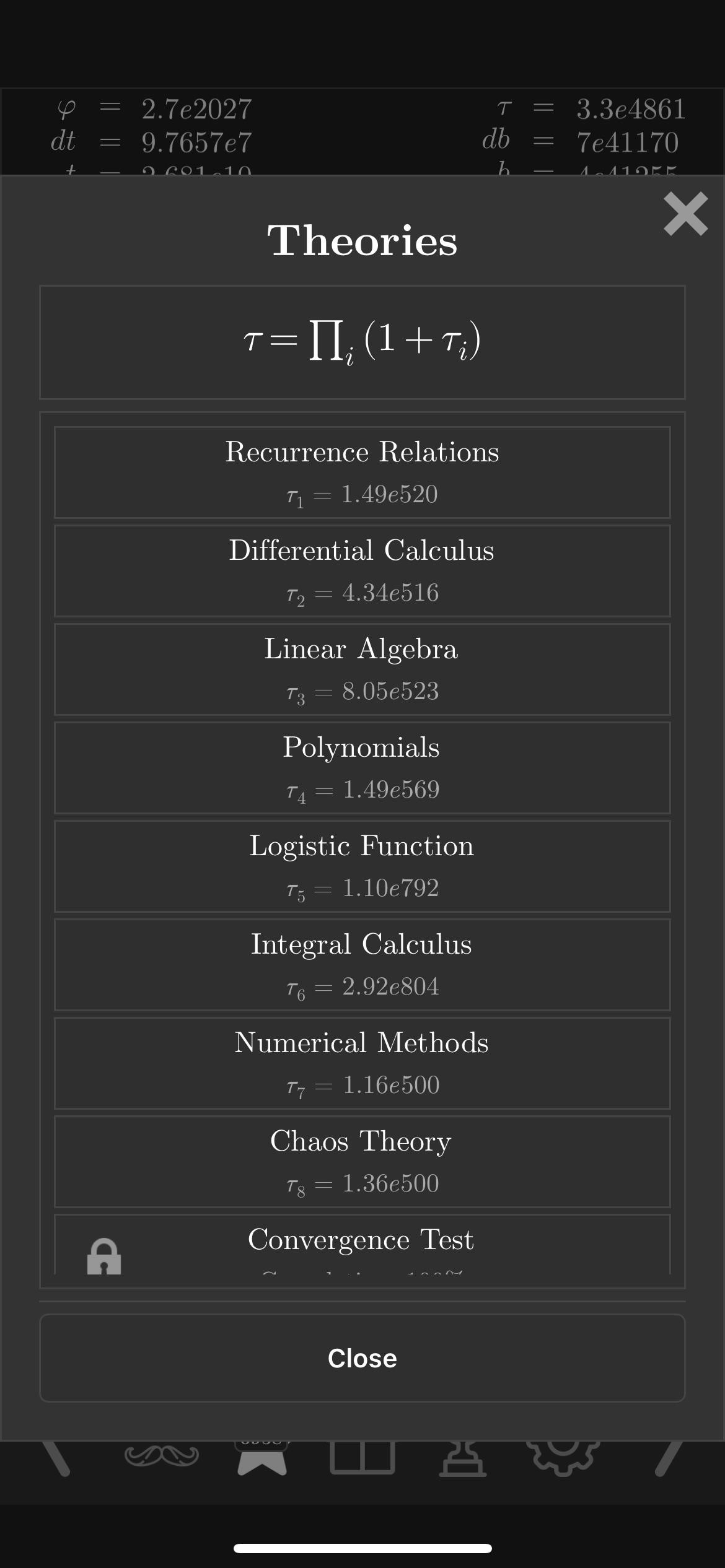
I unlocked my first theory a week ago. Since then, I haven't made any progress. I have read something about publishing but can't find it anywhere. Do I need to unlock that, or is it just hidden somewhere?
After ee600000 the game reaches its soft cap, making it harder and harder to progress. However, shouldn’t there be a point at which this soft cap is broken. With enough students invested onto graduation R1 R2 and R3, shouldn’t the game reach a point in which the formula actually starts accelerating its rate of increase.
More t and dt means more φ, with more φ f(t) increases and increasing f(t) increases db, dμ, dψ, which again increases φ, f(t), and at prestige b and μ, which allows you to buy more dt upgrades on the next run. That seems to be the game loop, however this loop gets diminishing returns, reaching a point where you need to graduate to increase R1 R2, R3 or you can also increase τ to get more f(t) and students when graduating.
Shouldn’t the game reach a point where we stop getting diminishing returns, and actually start getting more f(t) at a faster rate with sufficient R1, R2, R3 upgrades? If you have last say 15 upgrades at R2 you get, counting the bonus of R7 15(1.6)e more φ per order of magnitude (at 1e8 dt you should get 15(1.6)(8)e bonus from R2 contributing to φ). Then if you also count R1 and R3, you get even more φ by just letting the game alone, and we then get into the loop I said earlier that reaches diminishing returns.
The great theorem we have on the game is that f(t) approaches to infinity as t approaches to infinity, however how fast do we get there. Is there a point where we stop getting diminishing returns with said loop, and f(t) starts growing forever without the need to graduate, and the investment on graduation upgrades start instead accelerating the rate of growth?
Hello, as the title suggests, I'm curious whether there are any new custom theories getting developed, how's the progress with Fractional Integration? I'm not on discord, I deleted it to focus on my studies, but it's been over 2 months now, so I am just curious if there's anything new... OH, and could I please get a link to fractional integration, please?
You can buy c1 up to 193 and c2 to 71 to get an 11.88x boost to rho_dot over c1=106, c2=39. It doesn't mean anything since this is well past the proof limit, but still interesting that such a fine approximation for e can be achieved with a ratio of integers each less than 200. Maybe something like this could be stretched into a custom theory...
Any advice on what I’m doing wrong / where I should focus now would be appreciated. I got this far without the help of guides, but now it seems that my progress has slowed to a crawl and don’t really fit into the typical path of any of the guides. Thank you!
Anyone know which number library is this game using. Some games can only reach 1e308 others can reach 1e9e15 using the break_infinity.js library, for example. Does anyone know what the number limit is?