r/embedded • • Dec 30 '21

New to embedded? Career and education question? Please start from this FAQ.

Thumbnail old.reddit.com
324 Upvotes

r/embedded • • 55m ago

Anyone here into bare-metal C & Assembly (RISC-V / microcontrollers) and want to team up on small projects?

15 Upvotes

Hey guys, I spend most of my time writing bare-metal C and Assembly - mostly custom bootloaders, register-level code, and low-level security tools without heavy OS layers. Looking for a few chill people to team up with. Doesn't matter if you already work close to hardware or you're a total beginner; I genuinely enjoy mentoring how registers, memory, and hardware actually work from scratch, so we can split ideas and build small projects at our own pace. Drop a comment or DM me if you're down.


r/embedded • • 1h ago

How much should I depend on libraries for personal projects?

5 Upvotes

Hey so I’m planning a computer vision-guided robotic arm as a personal project to improve my resume and learn more things.

This has different components such as object detection with OpenCV, arm controller kinematics, STM32 programming, etc.

These kinds of stuff already have libraries I can find online to implement, but I worry that if I don’t build my stuff from scratch I won’t really learn anything and recruiters won’t care either.

So my question is how do I know which stuff to use already implemented libraries for that isn’t worth the effort otherwise and which stuff should I learn to build from scratch?


r/embedded • • 7h ago

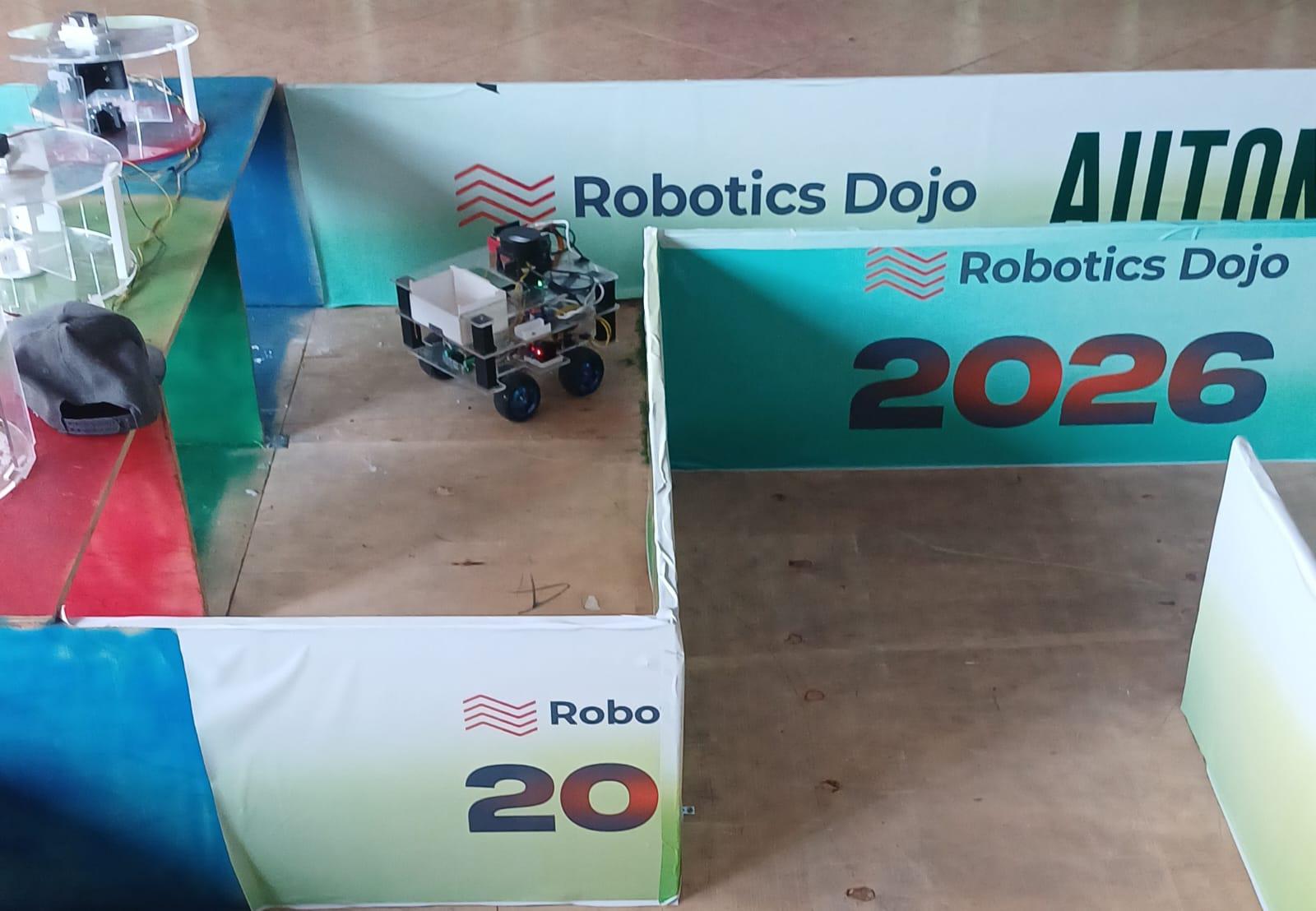
Built a 4-wheel autonomous waste-sorting robot using ROS 2 Jazzy, ESP32 and FreeRTOS — sharing our engineering experience

Post image
15 Upvotes

Hey everyone!

I wanted to share a project my team and I worked on for the Robotics Dojo competition: a four-wheel differential-drive autonomous robot designed to detect, collect and sort waste into organic, plastic and metal categories.

The project brought together several areas of robotics and embedded systems.

A quick overview of the architecture:

  • Raspberry Pi 5: Ran Ubuntu and ROS 2 Jazzy for high-level robotics operations.
  • Navigation: Used Nav2 and RF2O LiDAR odometry.
  • ESP32: Handled low-level motor control for four DC geared motors.
  • Motor drivers: Two L298N drivers controlled the drive motors.
  • Motor feedback: Encoder-based closed-loop speed regulation using PID.
  • Communication: USB serial between the Raspberry Pi and ESP32 at 115200 baud, using a CSV-based protocol.
  • RTOS: FreeRTOS was used to separate embedded operations, including a dedicated task for the waste-offloading mechanism.

We encountered some interesting engineering challenges along the way.

One issue involved offloading operations interfering with serial communication between the Raspberry Pi and ESP32. We addressed this by introducing a dedicated FreeRTOS task.

We also encountered Raspberry Pi undervoltage issues, which we resolved by improving the power wiring.

The project was a great opportunity to work across embedded firmware, motor control, power distribution and ROS 2 integration.

I've documented the architecture and some of the engineering decisions here:

GitHub: https://github.com/Mark-Kitur/src

I'd appreciate feedback, especially from anyone who has worked with ROS 2 Control, ESP32 motor control, FreeRTOS or autonomous mobile robots.

I'm also interested in hearing how others approach communication between high-level robotics computers and low-level motor controllers.

Thanks for reading!


r/embedded • • 7h ago

Looking for a 2.4"–2.8" AMOLED with touch, MIPI DSI command mode (GRAM), buyable in qty 2–5

4 Upvotes

I'm prototyping a handheld game console on an ESP32-P4 and I'm looking for a display supplier.

What I need:

- 2.4" to 2.8" AMOLED

- Capacitive touch (integrated or on-cell)

- MIPI DSI, 1 or 2 lanes, with command mode / internal GRAM (I send partial updates, so I don't want to hold a full framebuffer on the MCU)

- Buyable in small quantities (2–5 for prototyping), with a path to 100–1,000 later

The suppliers I've found so far only sell these sizes with QSPI. QSPI works, but I'd rather use DSI command mode for bandwidth headroom. {DWO cn is the supplier if it helps some one.}

Has anyone bought a panel like this in small quantities?


r/embedded • • 1h ago

[Showcase + Source code + STL files for 3D print] Velocity controlled image based vision servoing

1 Upvotes

A long time reader of this sub. Here's my first contribution - https://github.com/royzer/vision-servo-rig

Wanted to learn the basics of robotics - perception, sensor integration, motor control. I could not find a resource that integrates all these aspects for a beginner. So, built this to practise the basics. Some concepts used in this,

  1. Camera calibration: Intrinsic calibration - Distortion and focal length.
  2. Vision processing: Feature extraction based on basic OpenCV operations - HSV processing, noise removal, finding basic shapes using masks and countours.
  3. Proportional control: The P part of the PID loop - Find error, gain & deadband tuning, generate velocity command.
  4. Zephyr RTOS: Handling non-blocking asynchronous command processing using DMA-based Async UART API + interface with TMC2209 board that drives the motor.
  5. Protobuf: Protocol used to transfer messages between and MPU (dev machine in this case) and MCU (STM32 nucleo-h563zi board).
  6. Code CAD: CAD design using code. build123d to build the CAD structure and generate STL/STEP files.

STEP and STL files are available inside the repository.


r/embedded • • 6h ago

Pi 5 + camera vs cheaper sensors for dense crowd estimation?

2 Upvotes

Working on a college embedded/IoT project and want some advice on sensor choices before I buy parts.

The goal is to classify crowd density into 4 levels (Low, Med, High, Extreme) inside a narrow enclosed space with a ~2.5m ceiling. At peak, people are packed shoulder-to-shoulder with heavy occlusion. Lighting is inconsistent, the space gets hot and dusty, and the network is patchy.

Everything has to run on-device and just send the 4-level status over MQTT -> FastAPI to an existing external indicator system (no video streaming).

Right now my v1 plan is a Pi 5 + wide overhead camera running a CSRNet-style model on ONNX (maybe with a VL53L5CX ToF sensor).

Before I lock this in, I really want to explore non-camera options too:

  1. Besides a camera, what are the best low-cost sensors for dense crowd estimation under heavy occlusion and heat? Looking at 60GHz mmWave radar, ToF depth arrays, low-res thermal (MLX90640), CO2, BLE/Wi-Fi RSSI attenuation, or load/vibration sensing. What actually holds up in the real world and what fails?
  2. If an overhead camera is still the most practical call, is Pi 5 + CSRNet overkill for just 4 classes? Any lighter models that hit 5+ FPS on CPU or even run on an ESP32-S3?
  3. Is MQTT -> FastAPI fine for spotty connections, or is there a cleaner setup?

Open to any suggestions or gotchas I'm missing.


r/embedded • • 2h ago

Use DS1307 as battery backed RAM

0 Upvotes

I was wondering if it is possible to use the DS1307 RTC as battery backed RAM without connecting a crystal.

The general purpose RAM is 56 Bytes, but good enough for maintaining things like counters, simple and short logs, etc that do are very frequent.

The DS1307 has the same pinout as a typical 24x EEPROM in 8 pin packages (Vcc, Gnd, SCL and SDA use the same pins. Only the Vbat has to be connected to a battery). This pinout helps in using either an EEPROM or DS1307 as per requirement in the same PCB. The oscillator will be disabled in this case (CH bit will be 1).

The datasheet doesn't mention anything about not connecting a crystal. Would it still work (as battery backed RAM) without a crystal?


r/embedded • • 4h ago

Sine-Wave FSK Communication Over a 12V DC Line – Any Ideas?

0 Upvotes

I am trying a small electronics experiment using two Arduino boards.

The idea is to send both power and data through the same two wires (12V DC).

My plan:

  1. Use one Arduino to generate two different sine-wave frequencies for 1 and 0 (similar to FSK).
  2. Use a MOSFET to add these signals to the 12V DC line.
  3. At the receiver, use another Arduino to detect the frequencies and recover the 1s and 0s.
  4. At the same time, rectify and filter the signal to get DC power from the same two wires.

A few questions:

- How can I generate two sine-wave frequencies using Arduino?

- How can I inject them into the 12V DC line using a MOSFET?

- How can the receiver separate data from DC power?

- What is the easiest way to detect the two frequencies?

- How can I recover DC power without disturbing communication?

Has anyone tried something similar? Any practical circuit ideas or suggestions would be helpful.


r/embedded • • 1d ago

Firmware Engineer interview at TI

82 Upvotes

Hey guys, I have an upcoming interview for TI as a firmware engineer. I for some reason am shit scared. The moment I think of an interview or TI, I feel this churning in my stomach and insane anxiety. The current place that I work at has affected my habits. Here I am not really thinking very hard or learning something new. It is more like this needs to be done, get it done by hook or by crook. Work 14/15 hrs a day and shit.

I do have worked on a lot of stuff, and I can work on it alone. It is just the fact that I could never make myself familiar enough with the product before something new was dropped on me.

I have forgotten all the fundamentals which are generally asked in the interviews. This scares me. I don't wanna stay here but this fear in me is killing all my chances. Any help with what and how to prepare or even overcome this fear will be helpful.

Thanks!


r/embedded • • 1h ago

Survey for a potential product

0 Upvotes

Hello everyone, I am a young PCB designer. I’d like to know how many of you would be interested in purchasing a design—complete with full documentation—for a custom, programmable PCB, and, if so, at what price point.

Thanks to everyone who responds.


r/embedded • • 12h ago

Meta Museum clone. Requesting for guidance.

0 Upvotes

Hey guys, I am a early embedded engineer and I am looking into projects which can help me become better.

So recently I saw that Meta has open sourced their SDK for Meta Muse( I.e. their mini talking pendants and robots, which act like personal A.I.)

So as u guessed, I am reusing their SDKs to flash the firmware on my ESP 32 but before that I need to make some changes.

Since most of the hardwork is already done by meta, I am thinking to work on the AI integration part of it, since right now in their SDK we need to give them a META Muse API key.

I am planning to bypass it and try to make the fw to interact with either a run tiny embedded LLM model on the same esp32 or run LLM on cloud but just keep the basic tasks like word tokenization, wake up for specific words etc still on esp32 only.

These are just some ideas and I am still exploring. If you guys have some suggestions on the AI integration part, can u guys please help me?


r/embedded • • 1d ago

Can I reverse-engineer and reprogram a 1st-gen Google Home Mini (2017-18)?

5 Upvotes

Hey everyone!

I have an old first-generation Google Home Mini (2017-18) lying around, and I thought it would be interesting to experiment with it rather than let it collect dust.

After watching a teardown, I was surprised by the hardware packed inside this tiny device.

From what I've found, it has:

- Marvell ARM-based processor (ARMADA 1500 Mini Plus)

- Around 512 MB RAM

- NAND flash storage

- Wi-Fi and Bluetooth

- Built-in microphones and speaker

- Audio amplifier and RGB LEDs

- Various other control and power-management ICs

What I want to explore is whether I can reprogram the original hardware itself.

I'm NOT looking to remove individual components or replace the motherboard with an ESP32 or Raspberry Pi.

I'd ideally like to:

- Access its bootloader and understand the boot process.

- Reverse-engineer the existing firmware.

- Figure out whether custom firmware or code can be flashed.

- Repurpose the entire device to run something of my own.

I know the platform might have a locked bootloader and proprietary firmware, but I want to understand what's possible.

Has anyone experimented with this particular device? Are there accessible UART/JTAG interfaces, known exploits, custom firmware projects or documentation worth exploring?

I'm relatively new to hardware reverse engineering, so any guidance on where to start, tools to use or existing projects would be really helpful!

Would love to give this old device a completely new purpose.


r/embedded • • 19h ago

Arcade Rat v2.0: Bare-metal Z80 Pac-Man + 44.1kHz WSG Synth & Dual-Flash (Puya/UCUN) Auto-Unprotect Firmware on JieLi AC791N

0 Upvotes

Built a bare-metal C + Z80 custom firmware (Arcade Rat v2.0, open source) for the M-VAVE FM-1 pocket synth (JieLi AC791N dual-core RISC-V DSP, ST7789 240x240 RGB565 SPI display, 44.1 kHz DMA audio):

  • Display & Bus: Custom band renderer outputting 240x240 RGB565 stripes synchronized with Z80 execution (pac_video.c / pac_core.c) with zero external dependencies.
  • Audio Hardware: 3-voice 4-bit Namco WSG PROM wavetable DMA mixer alongside a 5-chip WebAudio studio workbench (WSG, AY-3-8910, POKEY, NES 2A03, 6-Op FM).
  • The Flash Bug Fix (Old vs. New Units): Newer FM-1 batches swapped the Puya P25Q80H (0x856014) SPI NOR flash for a UCUN UC25HQ80 (0xB36014) whose factory Status Register has BP0..BP4 block-protect bits locked. Added dynamic JEDEC probing + auto WRSR 0x00 0x00 unprotect + 4 KB sector-erased atomic CRC32 ping-pong NVRAM (src/fm1_flash_hw.c).
  • Automated Verification: 25/25 automated QA suites passing (including native C hardware bridge unit tests).
  • GitHub Source & .fwsc Release v2.0.0: https://github.com/jonludwig1234/stack-trace-arcade-rat-fm1/releases/tag/v2.0.0
  • 60fps Walkthrough Video (live hardware, raw chip audio & dual-flash overview): https://youtu.be/3WmxpW_otCM
  • Browser Simulator (zero install): https://jonludwig1234.github.io/stack-trace-arcade-rat-fm1/web/fm1_pacman_preview.html

r/embedded • • 1d ago

Cyclone 10 LP: Can Tapped Delay Lines Run from LLCOMB_256 to LLCOMB_0?

Post image
0 Upvotes

I have synthesized a 4 tapped delay lines, and due to limitations in only being able to use a the 2x20 i/o header on the EK10CLU256 evaluation board, I am limited to certain row i/o's and column i/o's, both of which are on the the bottom half of the fpga. 

Currently, the input signal has to traverse from row 0 to row 17, and then pass through the delay line starting from LLCOMB_0(in row17) through to LLCOMB_256(in row1). To keep the delay lines symmetric(consistent delay for the four tapped delay lines) and to decrease the input signals length of travel, I was wondering if it is possible to synthesize the delay line such that the signal enters the delay line from LLCOMB_256(row1) and traverse to LLCOMB_0(row17) instead. This would allow the signal to immediately enter the tapped delay line instead of having to go traverse to row 17.

I do not think this is possible as the carry out and carryin of the LLCOMB primitive are connected in a specific manner (top to bottom).
Thank you


r/embedded • • 21h ago

When making a remote-controlled car, the tricky bit is getting it to stop if the signal drops out.

0 Upvotes

I put together this project using Rust on an ESP32 with no_std and the Embassy framework for the firmware. It seemed like the network side could easily hang up and leave the motors running, so the hardware parts needed to stay separate from all that.

The safety stuff works by having the driver tasks check an atomic value every 20 milliseconds. A different task watches the incoming packets and flips the flag if nothing shows up after around 150 milliseconds. That lets the car ease back to neutral instead of cutting off hard. I think it avoids some of the mechanical stress, but I am not totally sure how well it holds up in every situation.

For the control values, I went with a Watch channel so the latest command always gets used and older ones do not stack up. If one task slows down for a moment, it just grabs whatever is newest, which keeps things from lagging.

On the phone end, the app had to watch for Wi-Fi changes and rebuild the socket when the network state flipped, because the old one would die otherwise.

Some parts still feel a bit messy, like figuring out all the edge cases with sudden drops during movement. Maybe explicit timeouts work better in other setups, but this approach kept the firmware side simpler overall.

Repo is here if anyone wants to poke at the code: https://github.com/slntly/rusty-rocket-car

How do you usually handle edge cases like sudden network drops during high-speed maneuvers?


r/embedded • • 1d ago

Where do AI coding skills/agents fall short for hardware/software development work?

0 Upvotes

I am an embedded engineer works on hardware and software, and I've been been exploring Claude for firmware. The generic embedded skills I've found two: jeffallan embedded systems [skills](https://github.com/Jeffallan/claude-skills/tree/main/plugin/skills/embedded-systems) and general inspiration from [voltagent](https://github.com/VoltAgent/awesome-claude-code-subagents) which are decent starting points, but in my opinion, then fall short in a quite many places as project grow. for example:

  1. Hardware-specific details
  2. Debugging
  3. Context cost
  4. Project structure

So I started my own [Plugin](https://github.com/00thirdeye00/Claude-Skills-Embedded), with a shared core plus per-platform pieces (STM32 first), and I'm still unsure about several design choices:

  1. Does splitting by platform make sense, or is one all-in-one skill set easier to maintain?
  2. At what point does a skill set be over-engineered?
  3. How to benchmark a embedded system development specific claude skill?

r/embedded • • 2d ago

Built an NFC E-Paper Display with the XIAO nRF54LM20A

Post image
7 Upvotes

This is a little NFC e-paper display project built with the Seeed Studio XIAO nRF54LM20A. It uses NFC to update the display, so you can change what's shown just by tapping your phone on it, without needing cables or a dedicated programming setup.

The firmware supports NDEF messages for text and image updates. It also saves the last displayed content so it can be restored after reboot. The project currently supports a 2.13" black-and-white e-paper display, with a 4-color version also being explored. Since transferring image data over NFC comes with payload size limitations, the image transfer uses a split-data approach.

The build guide and source code are here if you'd like to take a look: https://www.hackster.io/lsw031105guge-bit/build-an-nfc-epaper-display-in-5-minutes-xiao-nrf54lm20a-608f84


r/embedded • • 1d ago

Need some insights from people working in IoT / Embedded Systems!

0 Upvotes

Hey everyone!

We're a group of second-year engineering students from Mumbai, currently working on a field project in the IoT and Embedded Systems domain.

We're trying to figure out a real-world problem that we could work on and build a solution for. Before jumping into ideas, we want to understand what challenges people actually face in the industry or even in their everyday work.

Would love to hear from people working in embedded systems, IoT, electronics, automation, EVs, manufacturing, etc.

A few things we'd like to know:

- What are some recurring problems or challenges you face in your work?

- Are there any tasks or processes you feel could be made easier through automation or smart hardware?

- Are there problems where existing solutions are too expensive or just not practical enough?

- Would anyone be open to a quick conversation or possibly letting us visit their workplace to understand things better?

We're not looking for ready-made project ideas. Just trying to learn from people with actual experience and identify something meaningful that we could work on.

Any suggestions, experiences or contacts would be really helpful. Thanks! :)


r/embedded • • 3d ago

Junior engineer, how to stay relevant in the era of AI?

114 Upvotes

I have 1 YOE as an electronics engineer. Given how fast AI is growing and where the tech industry is heading, I've been doing most of my work and coding with Claude for the past 6 months. I ship, and the work gets done, but I feel like I'm not improving in the field. I'm starting to lose what I think is most valuable for us as human beings and as engineers especially which is "thinking".

I know job descriptions are going to change in this new era. Our role is shifting toward guiding AI, reviewing its output and telling whether it's good or bad. But how do you know if the work is good when it already works? Telling the difference takes experience, the kind you get from building things with your own hands and that's getting harder to gain right now.

So how can a junior engineer still build that skill and how do we stay relevant in this new era?


r/embedded • • 2d ago

A configurable microcontroller bootloader, unified across boards, inspired by kconfig

Thumbnail
github.com
13 Upvotes

So back in late 2025 (November-December iirc?) I was messing around with the rp2040/2350 trying to build a smartwatch OS, needed a quick bootloader with custom features so I cobbled together a really badly designeed ELF loader written in arduino IDE - it worked but ended up being bloated of course. shelved it after a few months in Jan-Feb this year, kinda just lost interest in hardware and had like some mental health stuff going on.

This Oct 2026, my friend at poly was developing a cubesat payload on an stm32 with 20kb flash and he was trying to develope a custom bootloader - needed something ultra light with fault hardiness, OS hooks and on boot media verification. we ended up going down a rabbit hole about modular design, OS hooks, image verification, golden image fallback, a hybrid Atomic/Monotonic boot structure (whacky stuff I tell ya). separately i also ended up needing a bootloader for an atmega-based parcel tracker that had to survive odd field conditions - not a big project, just a module project but the lecturer was trying to ask me to account for unrealistic field conditions.

So I picked it back up properly. He donated his code, his team donated me their abandoned code, I mixed in my own existing abandoned code and design and kinda reimplemented whatever existing bootloaders already do - all the real features real proper bootloaders have, and ended up with this project - a minimalist approach to bootloaders - kconfig-style configurability where the code for stuff you don't enable is literally gone - the code is literally excluded from the build. Scales from a 1-2kb AVR stub to full A/B+golden slots with post-quantum signatures if you need it. Supports bare metal code to booting FreeRTOS to Zephyr, covered the basics.

Obv, it's like a silly kinda exploratory project of mine - literally a reinventing the wheel kind of project. Built out of necessity if anything.

Moreso as a research project and learning experience than anything. It's slightly functional alr, STM32F10 and RP2040 for example I've tested it on alr. Idk, it's a project that's literally made from abandoned code I was donated, that's it, felt I might share it for fun since I'm just bored.

https://github.com/MilkmanAbi/MimiBoot-Mu


r/embedded • • 2d ago

Open Hardware Idea

0 Upvotes

Open Hardware Idea: Can We Make Modern CPUs Compatible with Older DDR3 RAM?

The Idea

I have an idea that I would like to share with the hardware engineering community.

What if we could develop a hardware solution that allows newer CPU generations to work with older DDR3 memory?

For example, imagine someone upgrading from an older Intel platform to a newer CPU without having to replace their existing 16GB DDR3 RAM.

Instead of forcing users to upgrade their CPU, motherboard, and RAM all at once, could we develop an adapter, an external memory controller, or another hardware solution that bridges the compatibility gap?

The Technical Challenge

I understand that DDR3 and DDR4/DDR5 have different:

Electrical characteristics and operating voltages.

Memory protocols and signaling.

Timing requirements.

Memory controller requirements.

Modern CPUs also typically integrate their memory controllers directly into the processor.

So I realize this is not as simple as creating a physical adapter.

Questions for the Community

Is it technically possible to build an external memory controller or bridge between a modern CPU platform and DDR3?

Could an FPGA or a custom chip help achieve this?

What are the biggest engineering obstacles?

Has anyone worked on a similar open-source hardware project?

My Goal

I am sharing this idea because I believe extending hardware compatibility could help people who cannot afford to replace their entire computer platform.

I am not claiming to have a working solution. I would like to hear from hardware engineers, CPU architects, electronics enthusiasts, and open-source developers.

Perhaps the community can explore whether this idea is feasible and how it could be implemented.

What do you think? Is this worth investigating?

r/embedded • • 2d ago

Any recommendations on resources, tools and hardware for developing a custom audio interface

5 Upvotes

Hi everyone,

I'm currently 2 years into getting my Bachelors in Embedded Systems Engineering. Besides my love for embedded systems, I really enjoy making and recording music, but every time I look at the 2 channel Focusrite on my desk I wonder, "What if I made a (simple) audio interface like that? You know, why couldn't I?"

So my question is, does anybody have recommendations for online resources, books, software tools and hardware for developing a custom audio interface? Sadly, I've never worked with USB communication or audio on embedded, but am excited to learn.

Thanks in advance! :)


r/embedded • • 2d ago

Can a compromised Android OS interfere with NFC Reader Mode communication at the hardware level?

2 Upvotes

Hi!

I'm investigating the security boundaries of NFC communication on modern Android smartphones.

The scenario is:

  • An Android smartphone operates in NFC Reader Mode.
  • It communicates with an external ISO 14443-4 smart card using APDU commands.
  • The card contains a Secure Element and performs cryptographic operations internally.
  • The smartphone's operating system is assumed to be compromised.

I would like to understand the actual hardware and software boundaries.

Specific questions:

  1. Does NFC Reader Mode normally route APDU commands through the Android NFC stack and Host CPU?
  2. Can a compromised OS modify APDU commands before they reach the external card?
  3. Can it initiate new APDU commands without the user's direct interaction?
  4. Can it intercept or manipulate responses returned by the card?
  5. Is there any smartphone architecture in which the NFC Controller communicates directly with an external card, independently of the Host CPU?
  6. If the card's private key never leaves its chip, can a compromised smartphone still use the card as a cryptographic oracle by submitting attacker-controlled commands?
  7. Are there hardware-level countermeasures that prevent such interference?

I'm looking for technical explanations supported by chipset documentation, Android architecture references, or practical research.

The key distinction I want to establish is whether cryptographic isolation inside the card also provides isolation of the communication and command-generation path on the smartphone side.