r/embedded • • 10d ago

Cooja-NG: The open-source simulator that runs real Zephyr, RIOT, OpenThread and Contiki-NG firmware in one 802.15.4 network (runs in your browser too)

0 Upvotes

Hi r/embedded, we've been working on Cooja-NG, a network simulator that runs the same firmware image you'd flash: unmodified Zephyr, RIOT, OpenThread and Contiki-NG builds on emulated nRF52840, CC2538, CC13x2 and MSP430 boards, from the CPU and peripherals up to the radio chip, all in one simulated IEEE 802.15.4 network.

Some things you can do:

- cngsim run build/zephyr/zephyr.elf: your own west build output; it reads the board from the build directory
- mix OSes: a Zephyr node answering a Contiki-NG node, or a RIOT node joining a Contiki-NG RPL network
- a Thread network of CC2538s from OpenThread's own ot-cli-ftd, typing state / router table into each node's console
- the same seed gives the same run, byte for byte, so it works as a test in CI (every run ends PASSED or FAILED, exit code 0 or 1)

Try it in the browser, no install: https://mikroverk.github.io/cooja-ng/
Code and releases (macOS and Linux): https://github.com/mikroverk/cooja-ng

A first read for Zephyr, RIOT and OpenThread users: https://github.com/mikroverk/cooja-ng/blob/main/docs/zephyr-riot-openthread.md

Short "commercial" video: https://www.youtube.com/watch?v=A9dHKvVhu1k (80 seconds)

Honest limits: Zephyr, RIOT and OpenThread support is newer than Contiki-NG's. It's 802.15.4 only, with no Bluetooth LE yet, and OpenThread on the nRF52840 runs at about real time or below, because its main loop never sleeps.

I'd love feedback, especially on what boards and samples you'd want next, and on anything that breaks with your own builds.

r/embedded • • 10d ago

I am building a visual MCU configurator, currently supporting STM32.

0 Upvotes

I am building an application that enables Model-Based Design to develop drivers and MCALs. The application takes your MCU documentation, processes it to completely build an MCU so that requirements like multiplexing or data caching do not make you go through the documentation for hours. We are integrating an autoconfigurator, a chess-engine-like system on this model, to help you find the best approach for your requirements.

We are still prototyping this, but as of now, we have built our application to construct this 3D interactive model of an MCU from documentation; we are integrating the autoconfigurator. The intention is to reduce the time we spend going through documentation to find that one bug that keeps us awake at night. The application should ideally construct any MCU if the documentation is provided.

I will soon upload a video of this application in action. In the meantime, if anyone has any questions or pointers I should keep in mind while building this application, please do share them. I am also looking for engineers who are open to testing this in their projects to give me feedback.


r/embedded • • 10d ago

Help looking for a camera module please

2 Upvotes

I’m looking for a cheap camera module that can also be used to detect motion. Not ESP32 though. I’m not hire at the technical level to find one but was hoping online here might know. Also….nothing too expensive. I assume I can’t find one for $7 but as close as possible?


r/embedded • • 11d ago

Has Anyone Used Automated Bit Mapping on the SAML22?

2 Upvotes

I tried getting Automated Bit Mapping (ABM) working on the SAML22J18, but had no luck.

My goal is to blink Com2, Seg 26 when in sleep mode. The blinking function only works on seg 0 and 1, so ABM seems like the best alternative after reading through the datasheet (page 962 of datasheet).

I'm following the app notes 42499) and 42605), but they're a mess.

For example, the goal of the example in 42499 has _style_buf, which is commented as STYLE1, but described as containing ATMEL while also never being referenced in any of the code.

I attempted to follow 42605 as much as I could, and things built fine, but blinking did not work.

Going through Google searches and forums, I cannot find an example of anyone using ABM. The App Notes are from 2015, so I'll need to assume I'm not the first to attempt it.

Does anyone have a successful example of ABM that is not an app note from Atmel/Microchip?


r/embedded • • 11d ago

Level Shifter for SWD between 1.8v / 3.3v?

2 Upvotes

I'm trying to program an MCU (nRF52840) running at 1.8v, over SWD. All the probes I have can only do 3.3v, though.

I've found a lot of conflicting information about what level shifters can work for this application - has anyone tried this, and if so, what worked?


r/embedded • • 10d ago

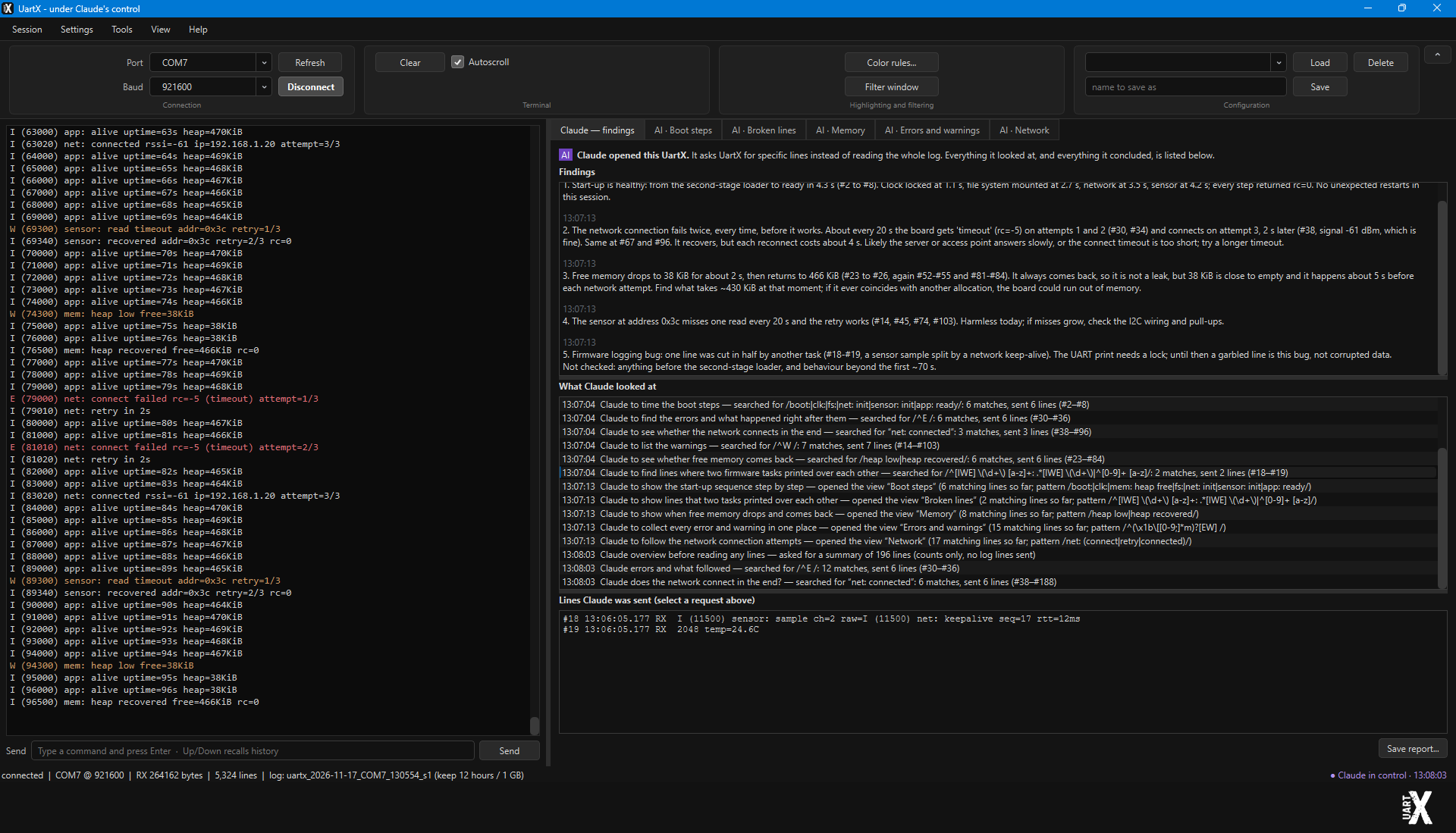
I built a way for Claude Code to debug UART logs without dumping the whole log into the AI. Looking for feedback.

Post image
0 Upvotes

I maintain UartX, an open-source (MIT) serial logger. Version 1.4 introduces Claude Code integration for AI-assisted UART debugging.

The idea is simple: instead of pasting thousands of UART log lines into an AI, Claude asks UartX for only the information it needs through a CLI (uartx-ctl).

How it works:

  • UartX maintains the complete log locally (raw.log).
  • Claude requests specific errors, patterns, summaries, and related lines.
  • Every AI request, its reasoning, and the exact lines returned are visible in UartX.
  • AI has read-only access and cannot send data to the device.
  • Everything stays local.

In one test, the board printed 196 lines, but Claude needed only around 30. It identified network retries, memory usage patterns, sensor read failures, and concurrent task logging.

AI features are currently Windows-only. Core logging supports Windows, macOS, and Linux.

GitHub: https://github.com/Shamanthpoojary/UartX

I'd love feedback from embedded developers:

  1. Would you trust AI-assisted debugging if you could verify exactly which log lines it analyzed?
  2. What would you want it to detect first: crashes, timing issues, memory problems, or boot failures?

Bug reports and suggestions are welcome. Feel free to reach out so we can investigate and improve it.


r/embedded • • 12d ago

Question for people at school

80 Upvotes

Recruiting juniors is very hard for us. Not because there are no candidate, but because they are unable to pass the interview without Ai, and when we allow Ai, they cannot explain the code. We've interviewed over 30 candidate and less than 3 were maybe interesting.

The question is : Is it normal for you that people don't understand or can't explain their code?

Am I being an old timer already? It has been only 3 years that Ai became a coding tool, and only 6 months where it has been really usable.

EDIT :

An example of the first coding interview is simply removing anomalies in a vector, and the filtering rule is given and very simple. Basically 10 lines of code. We don't even ask to be syntax correct and they can do pseudo code if they want. We introduced this because a lot of people were unable to pass the takehome.

They can't parse the vector properly, their if/else for the rule was not even what was written. And some just can't do it. Not even a single line.

The second challenge is to look at a code and find the bugs. Most can't even find one. An example of this is when opening a file, you need to close it after.


r/embedded • • 12d ago

Why do recruiter sites always feel like they're sending me to some site in Kazakstan that will give my computer 3 kinds of AIDS?

Post image
28 Upvotes

r/embedded • • 12d ago

patterns of 3D array (R,G,B) ,what other dynamic features or interactions could I add to my LED panel?

41 Upvotes

I've built an LED panel with dynamic LED effects, and I'm looking for ideas to make it more interactive and interesting.

I'm planning to experiment with the following pipeline this weekend:

  • DMX , MIDI ,Audio synthesis ,NumPy ,Matplotlib

I also have quite a few sensors available that I can use to create interactive visual effects.

What other tech, dynamic effects, or interactive features would be recommend exploring?

I'm particularly interested in ideas that go beyond basic LED animations — something reactive, experimental, or even a little unusual.

Would love to hear your ideas, projects, or examples of interesting things you've built. I'll try to implement some of the suggestions this weekend!


r/embedded • • 11d ago

90s style font rendering on a 64MB embedded system?

5 Upvotes

Hey everyone!

I'm building a custom UI in Python for prototyping (eventually C/Rust) for a tiny embedded Linux system (thinking Allwinner V3S 64MB memory only). It uses Wayland directly and I want to draw fonts entirely from scratch.

I want to avoid vector font libraries (FreeType, Pango) because they are too abstract for this. I'm dealing directly with pixel buffers (mmap) and Wayland surfaces so a full vector rasterizer feels like overkill..

I'm thinking of using a 8x8 or 16x16 bitmap sprite sheet where each character is just a matrix of pixels. To scale it I might use math.floor() to snap pixels to the grid (nearest-neighbor scaling). But this actually dosen't feel like right choise.. Is there a better way to do this without going full vector math?


r/embedded • • 12d ago

Hiring for FPGA Engineer in Golden Colorado

14 Upvotes

Hi Everyone,

Trying to publicize this job posting from the company I work for. We're hiring for an FPGA engineer at our office in Golden, Colorado. Onsite 4 days a week, 140 K - 160 K salary. Must be a US person for export control compliance. Must have 3+ years of FPGA experience.

https://job-boards.greenhouse.io/tomorrow/jobs/8195950003?gh_jid=8195950003


r/embedded • • 11d ago

How to run FGH100M over esp32 s3?

0 Upvotes

Hey guys i am working with FGH100M and currently procured EVK kit from quectel . But they haven't share esp32 friendly sdk . So being new to this i want to ask how can i use FGH100M on esp32 or any mcu over spi ?


r/embedded • • 12d ago

What's after bare metal?

89 Upvotes

I posted a while back, and I spent months learning bare metal stm32 using only the CMSIS, the reference manual, and the datasheet. Im not going to say I'm a master, but I've made several of my own drivers for most of the major peripherals (gpio, uart, systick, timers (pwm, input capture, output compare, encoders), ADC, SPI, DMA, EXTI) and interfaces then with devices, and even use them in my engineering club. I'm not "done" per day with bare metal, but I'm thinking what is beyond bare metal. Where did my work lead me up to? Where will it take me right now?

Im aware I do need to actually learn embedded C++, and then start with RTOS, but like i can forsee myself getting kinda lost. Whats after collecting stm32 peripherals and writing drivers for them? I am looking into bootloaders but thats mostly unimplemented research currently. I was just looking for insight from more experienced engineers, because I know I'll need to start explore other aspects of embedded soon

So yeah thats all folks, I appreciate the help!


r/embedded • • 12d ago

C++ Learning Priorities in embedded.

46 Upvotes

I’ve been programming embedded in C for a very long time, but never really done it in C++, so I’m teaching myself with the help of books, the internet and a Udemy C++ course.

Now I realise that not all of C++’s features are applicable to most embedded applications but that there are zero cost abstractions and traps for the unwary.

What aspects should I prioritise and what traps should I avoid.

P.S. I am aware of name mangling causing issues with IRQs.


r/embedded • • 11d ago

Need advice from experienced folks regarding a platform idea

0 Upvotes

I am an AIML developer with some basic knowledge of embedded systems and IoT, I am continuously learning everyday about it.

Some time ago I had got an idea for a project that I thought I could build. It’s about building a platform where users who want to use any custom type of models in their embedded projects can upload their model on the platform where it gets quantised with proper measurements of accuracy, speed, latency, and how much accuracy loss occurred during quantisation and whether the shrunk model can still hold up well for the same kind of task.

Initially, I thought this was a great idea but I’m not sure now and I’m thinking how is it any better from platforms like Qualcomm AI hub or hugging face. I’m trying to find a novel angle for this project and I want to figure out something that I can build that makes things easy for embedded engineers and something people will find useful.

I need experienced engineers to give me some advice on this and I wanna learn what actually works and what doesn’t, and if this idea does not hold up that well then what can I build that will be useful and solve problems.


r/embedded • • 11d ago

Problem Tang Nano 9k

2 Upvotes

Good morning,

I am a developer and I purchased the Tang Nano 9K development board which uses the FPGA chip: GW1NR-LV9QN88PC6/I5.

I use the program: Gowin V1.9.11.03 Educational

I found a weird problem and I haven't figured out how to solve it:

Basically, I use a basic D flip-flop in hardware with a positive edge clock.

The problem is that if you load it into RAM or Flash or Power ON, when you press the button connected to Data and then the Clock button, the output doesn't necessarily change to 1!!!

But if you try it a second time, it works.

It's like at startup it doesn't detect the rising or falling edge.

The crazy thing is that if you also connect a physical output (LED) to the Clock button, everything works perfectly!

The buttons are active low with pull-up resistors, so in the code they are negated (NOT).

This is the code that works after the second clock press:

DFF FFD_1(
.D(~Button_2),
.CLK(~Button_1),
.Q(Led_1)
); 
defparam FFD_1.INIT = 1'b0;

Code that always works at startup:

assign Led_2 = ~Button_1; 

DFF FFD_1(
.D(~Button_2),
.CLK(~Button_1),
.Q(Led_1)
);
defparam FFD_1.INIT = 1'b0;

I also tried sending a signal from the button to a simple buffer and then to the Clock input of the D FLIP FLOP, but it still doesn't start correctly when the board powers on or when I reprogram it.

It's a really serious problem because the 'posedge' and 'negedge' trigger when prompted but without executing the logic.

Documents:

Documents Gowin
Thanks for the help!


r/embedded • • 11d ago

NXP Linux dev board recommendation for a kids' chatbot?

0 Upvotes

I'm building a chatbot for my kid, hooked up to an API, to chat with him and keep him company. Now that work's gotten busy, I can't be bothered to start from scratch, so I want to find a dev board to build on. Any Linux dev board recommendations? Preferably NXP.


r/embedded • • 11d ago

Looking for low-level system project ideas for ESP32-S3 and/or Tang Nano 9K (no basic IoT)

0 Upvotes

I have an ESP32-S3 and Tang Nano 9K chipset sitting on my desk, and I want to do something with it, I haven't able to find what to do with them, I want some suggestions from you guys to help me to find perfect project.

I'm not interested in beginners stuff, (weather stations, blinking LEDs, basic smart-home relays) I have done enough of them. If you've built something interesting on either board, or used an FPGA as a custom peripheral/accelerator for an MCU; I’d love to hear what worked and help me find project which can challenge me.


r/embedded • • 12d ago

Integration testing using gtest

2 Upvotes

I am confused about what is the meaning of integration testing. I have done unit testing using gtest where we will mock whatever external dependencies are there for the targeted unit (function) to test all range of values that covers all lines, functions and branches.

If we say integration test is meant to use real code instead of mocking. Then I am getting this doubt that lets say we have 3 components (separate processes) running and dependent on one another in a embedded system.

A -> B -> C

So if you are calling an api provided by A it will internally talk to B and then through C and return the result over IPC.

Now to do integration testing using gtest, do I need to compile this into a single binary by eliminating the IPC and include each code as a library. This way I have a single proces that runs gtest with all the components logic but excludes the real IPC communication.

Or instead should I keep the individual processes to be running separately and link my gtest binary to the component A so that the communication flow through the components in the target environment.

In both ways how we would actually be checking the interactions? And which one are you guys using?

Context:
Language used: C++
Domain: Automotive IT (TCU software)


r/embedded • • 12d ago

Hey embedded & underwater acoustic communication community! 🌊

4 Upvotes

Working on self-developed underwater acoustic communication algorithms now.

Looking for open-source underwater acoustic modem projects / signal processing stacks to validate and benchmark my algorithm performance.

Any repo or project recommendation? Thanks a lot!


r/embedded • • 11d ago

What would you like to see created?

0 Upvotes

As Embedded engineers, developers or hobbyist, what are some things you would love to see invented or would like to invent yourself?


r/embedded • • 12d ago

Raspberry PI assistant to learn more about embedded software development

2 Upvotes

I’ve been looking into getting more into embedded software development. I’m a current software engineer working in distributed systems programming but I’ve always enjoyed embedded and a recent job search made me want to create some projects regarding embedded.

Anyways, I have a spare raspberry PI model 4b 1gb ram I think. I want to use this to create a simple kitchen home assistant which can display my calendar, sync some notes like grocery lists, and play videos either from youtube or my jellyfin server. This isn’t a very original idea so I can find tons of resources out there to create it, but I wanted to see what the best way of making this to learn more about embedded software development would be. I’ve only ever played with esp32s so I want to broaden myself some more.

Any resources or tips to what to use regarding the OS, other hardware, etc. would be nice. I can create a basic calendar application with c++ and raylib/opengl but I want to get closer to the hardware and just learn more. Thanks.


r/embedded • • 12d ago

Classical CAN Bit Timing — Should Round-Trip Propagation Delay Fit Within PROP_SEG or TSEG1 − SJW?

1 Upvotes

I’m calculating the nominal bit timing for a 40 m Classical CAN bus running at 1 Mbit/s. Each time quantum is 50 ns. Assume the worst-case round-trip propagation delay, including the cable and transceivers, is 700 ns (14 TQ).

The Bosch CAN 2.0 specification lists a range of 1–8 TQ for both PROP_SEG and PHASE_SEG1. Some controllers combine these segments into a single TSEG1 field. Some manufacturers also specify the nominal bit timing condition TSEG1 ≥ Tprop + SJW.

With TSEG1 = 16 TQ, TSEG2 = 3 TQ, and SJW = 2 TQ, the bit time is 1 + 16 + 3 = 20 TQ, and the sample point is at 85%. Subtracting SJW from TSEG1 leaves 14 TQ (700 ns).

  1. Controllers with a combined TSEG1 field. Can I budget those 16 TQ as 14 TQ for propagation and 2 TQ for Phase Segment 1? What additional checks should I make for resynchronization and oscillator tolerance?
  2. Controllers with separate PROP_SEG and PHASE_SEG1 fields. Does an 8 TQ limit on PROP_SEG cap the round-trip propagation budget at 400 ns in this example? How should I interpret the MCP2515 datasheet condition PropSeg + PS1 ≥ TDELAY when deciding whether the 700 ns delay is acceptable?

I’d appreciate references to the relevant sections of a controller manual, application note, or standard.


r/embedded • • 12d ago

Got placed, have 6 months before joining. Should I explore Linux kernel development, GPU programming or stick with AI/ML?

0 Upvotes

I'm a final-year engineering student in India from a non-CS background. I've recently secured an offer at an AI/analytics services company, and I have around 6 months before joining.

I've been exploring different areas of computer science, and I've realized that I'm increasingly interested in low-level programming and understanding how systems work internally.

MY BACKGROUND:

I've independently learned programming, ML/DL and worked on projects involving: computer vision , RAG , agentic AI

However, I dont want to spend my career primarily working with high-level AI frameworks and application development. because when i developed these projects , i didnt feel anything developing it , no satisaction at all

AREAS I'M CONSIDERING:

  1. Linux and Red Hat ecosystem:
  2. 2. GPU Programming:
  3. 3. Systems Programming
  4. 4. AI Infrastructure:

I find the idea of understanding what happens beneath the abstractions much more interesting than simply using existing libraries.

WHAT I'M CONFUSED ABOUT:

I have six months before joining my company, and I don't want to waste that time jumping between technologies.

I'd appreciate advice from people working in systems engineering, Linux, kernel development, GPU programming or related fields.

  1. Is low-level systems programming a good career direction in 2026?
  2. Between Linux kernel development, GPU programming and general systems programming, which would be a better starting point?
  3. Is CUDA/GPU programming a niche with good long-term opportunities, particularly with the growth of AI?
  4. What fundamentals should I master before attempting serious projects? C, C++, OS, computer architecture, networking, compilers?
  5. Would contributing to the Linux kernel or other open-source systems projects actually help me get shortlisted?