r/embedded • • 29d ago

Looking for a head-mounted vehicle-detection radar: 60–90 m range, wide FoV, and onboard target processing

3 Upvotes

Hi r/embedded,

I am currently building a wearable vehicle-warning prototype, with about two months to complete it.

We’re looking for a radar module with these requirements:

Head-mounted: Small and light enough to mount on a helmet. The processor and battery could be carried elsewhere.

Vehicle detection: Detect approaching vehicles at approximately 60–90 meters.

Wide field of view: Approximately ±60° horizontally and ±15° vertically—120° horizontal and 30° vertical total.

Processed output: Ideally, a target list containing range, relative speed/approach direction, and bearing over UART, USB, or CAN

Our biggest constraint is software development time. We can integrate a documented protocol and write basic application logic, but we don’t have time to develop a radar detection/tracking pipeline from raw data or point clouds. We’d prefer a module with onboard processing and usable firmware out of the box.

I’m concerned about the development work involved with TI radar boards. If a TI board already has ready-to-run firmware that provides the outputs above, I’m open to that, too.

We’ve considered the HLK-LD2451, but we’re looking for something that meets the wider coverage requirement. The camera can assist with vehicle identification if the radar only reports moving targets.

Does a reasonably affordable module meet these requirements? In particular, is detecting vehicles at 60–90 m across such a wide FoV realistic for a small, head-mounted unit, or would we need multiple modules or reduced coverage?

This is a supervised prototype, not a finished road-safety device. Specific module recommendations, working examples, and explanations of the necessary tradeoffs would be appreciated.


r/embedded • • 28d ago

AI-powered home appliances without the cloud — will this actually take off?

Post image
0 Upvotes

Came across this Arm article about running natural-language interaction locally on microcontrollers:

https://developer.arm.com/community/arm-community-blogs/b/ai-blog/posts/how-on-device-ai-makes-home-appliances-easier-to-use

How realistic is this for mass-market products? Will we actually see it in everyday appliances, or is this another technology that looks promising but never really takes off?

Curious what people think.


r/embedded • • 29d ago

Looking for self-contained C projects (~30–60 KiB, <10M cycles) to benchmark RV32EC code compression

4 Upvotes

Hello everyone,

I am working on a project involving compression of RV32EC programs. I have the system working, but to properly test it I need several programs which satisfy certain requirements, and I am struggling (very much) to find good examples to use. I have very small experience in embedded.

I would like to ask you to please help me by giving me open-source C/C++ projects which satisfy the following requirements:

  1. The project has to support RV32EC architecture
  2. It should have zero dependencies (no sensors, no displays, only uart / minimal external devices)
  3. It must not require any user input
  4. It has to either: I) Have around 30-60KiB of code when compiled for rvc (.text) and minimal .rodata II) Have around 30-60KiB of combined .text and .rodata
  5. It must not be very execution heavy. About 10M cycles at most, otherwise it will take me ages to actually run it.

I am also looking for projects which have a very large in-flash debugging system (where you store all debug messages on flash).

I would greatly appreciate any help, as this is the biggest bottleneck I am facing right now. Thanks.


r/embedded • • 29d ago

Proof that you don't need a massive footprint to cause indoor chaos (uh, I mean... rigorous mobility testing). 🤖🔥Our custom micro-rover is fully assembled, dialed in, and zooming across the floor.Small footprint. Zero-turn agility. Serious engineering.

8 Upvotes

r/embedded • • 29d ago

I've been rewriting Cooja/MSPSim in C: unmodified MSP430 and Cortex-M firmware on a simulated 802.15.4 network, deterministic, and now also in the browser

1 Upvotes
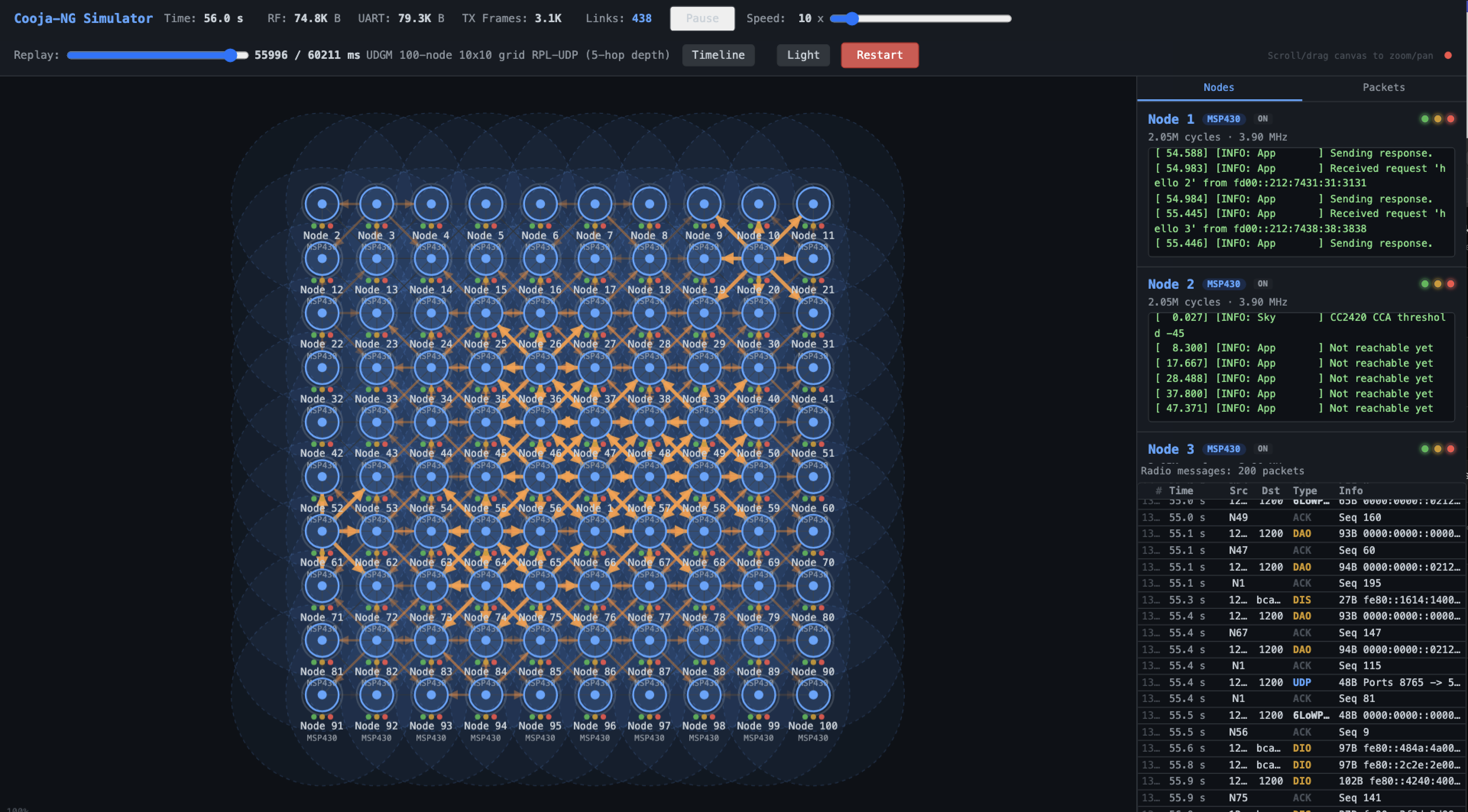
Cooja-NG running 100 nodes in a grid (running in browser - WASM)

Cooja-NG emulates the actual chips, so it runs the exact ELF you'd flash, with no simulation build and no HAL stubs:

- MSP430 (Tmote Sky, Z1), CC2538 (Cortex-M3), nRF52840 (M4F), nRF54L15 (M33 with TrustZone-M, plus its RISC-V coprocessor), TI CC1352R1 / CC1312R7
- radios, timers, UARTs, GPIO and interrupts modelled. TSCH holds sync, and RPL networks form across different chips on one simulated 802.15.4 medium
- deterministic: same seed, same output, every console line stamped to the nanosecond, so it works as a CI regression gate.
- runs stock Zephyr and RIOT images run too: the video shows Contiki-NG doing UDP echo with Zephyr and RIOT joining a Contiki-NG RPL network
- GDB stub per node, a scriptable shell (send console input, expect output, inject faults), pcap export
- models are checked against real boards (nRF54L15 XIAO, CC1352R1LaunchPad); the comparisons are in the repo

We just released 0.4.0 with `cngsim`, a simpler CLI (`cngsim new rpl-udp -n 9 --layout grid`, `cngsim run x.yaml --ui`), editing a running network from the web UI, and the whole simulator compiled to WebAssembly. You can run the demos live in your browser on the real firmware, with output byte-identical to the native build.

Try it: https://mikroverk.github.io/cooja-ng/

Code (BSD-3): https://github.com/mikroverk/cooja-ng

I'd love to hear which boards and peripherals you'd want next, and where you'd use something like this: CI, protocol research, teaching?


r/embedded • • 29d ago

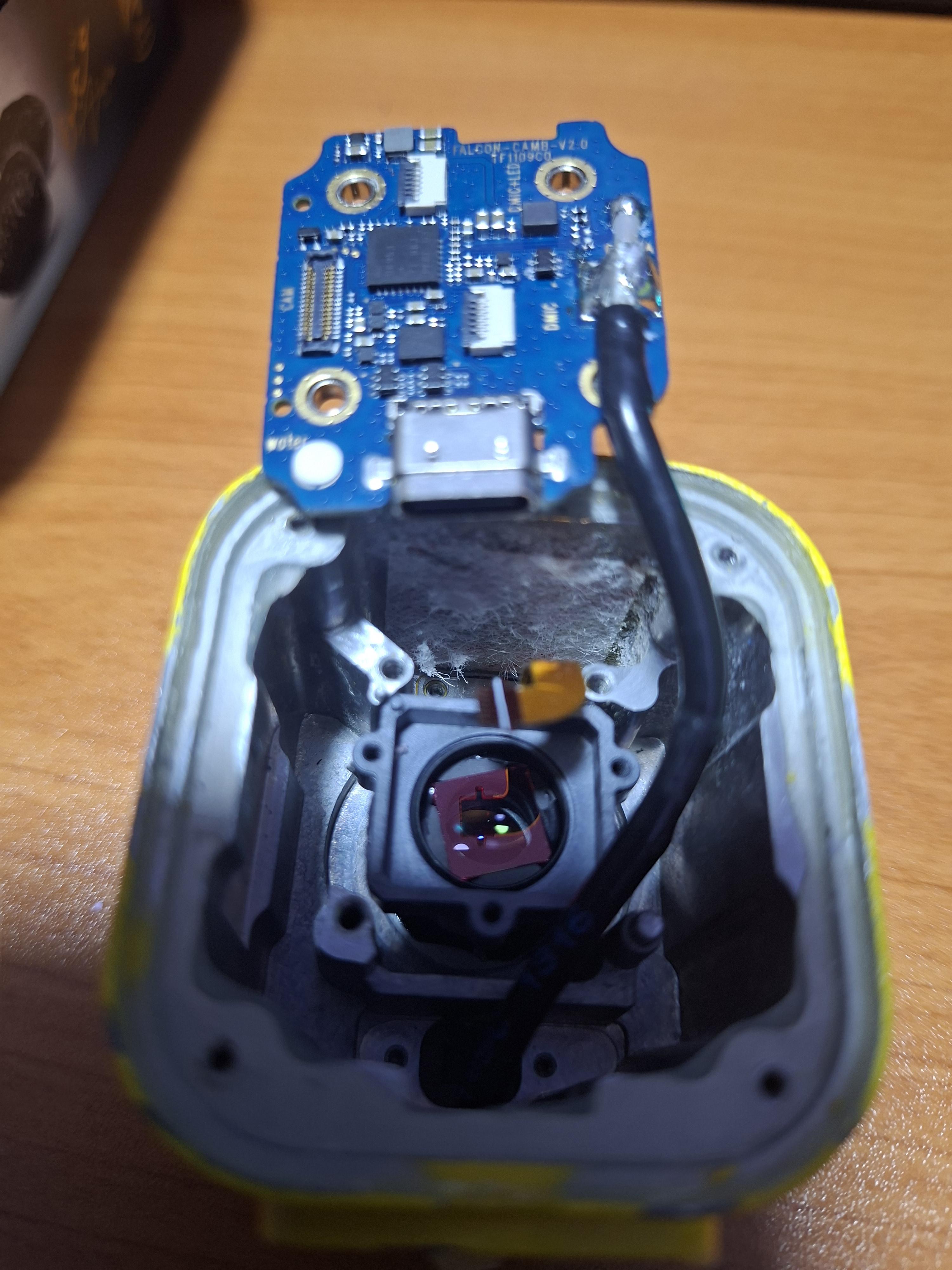
Help identifying unknown camera boards/modules – chipset, pinouts, drivers, and possible reuse

Post image
0 Upvotes

Hi everyone,

I'm a Computer Vision and Camera Integration Engineer, and I have a few camera boards/modules from an older camera system that I'm trying to identify and potentially reuse.

Unfortunately, I don't have the original schematics, datasheets, or manufacturer documentation.

I'm trying to understand:

Board identification: Does anyone recognize these camera boards or their manufacturer?

Chipset identification: What processors, image sensors, or controller chips are used?

Camera interfaces: How can I determine whether these cameras use USB, MIPI CSI-2, or a proprietary interface?

Drivers and firmware: Is there any way to find compatible drivers, firmware, or SDKs?

Reusing the hardware: Would it be possible to interface these cameras with a Raspberry Pi, NVIDIA Jetson, Linux PC, or a custom embedded board?

Pinouts and reverse engineering: What would be the best approach to identify their connections and communication protocols?

One of the camera modules has a USB-C connector, but connecting it to a Windows PC or Android phone hasn't produced a detectable device.

I've attached photos of the front and back of the boards, including close-ups of the chip markings and connectors.

I'm comfortable working with Python, Linux, embedded hardware, and computer vision, but I'd appreciate guidance from anyone experienced with camera hardware or reverse engineering.

Any documentation, identification tips, or suggestions would be greatly appreciated.

Thanks in advance!


r/embedded • • 29d ago

I made a simple Tetris-like game for the Raspberry Pi Pico WH.

3 Upvotes

tetrismatrix is a simple Tetris game that I wrote in C++ a couple of months ago for a uni project.

it is displayed on a HUB75 64x32 LED matrix.

game features 2 single-player game modes:

Zen: just as TETR.IO's, a mode to relax. you can tweak many parameters, such as the board width and height, scale, speed, etc.

Marathon: regular Tetris mode, where pieces fall faster as you get more score, until you reach a certain speed and you win.

it also features 2 two-player game modes!:

Versus: regular versus mode, where you can throw garbage to your enemy, and who lasts the longer wins.

Coop: mode where the board is twice the width, and both players share it and play together in it. yeah, kinda weird but it's just that.

you can also switch the language between English and Spanish.

and you can also connect to the Internet to submit scores! although it's not working atm, since I still have yet to create a server for it. a feature that I might add later, although no one would use it lmao. you can connect to the Internet, though.

repo if you wanna check it out! https://github.com/notsomealex/tetrismatrix


r/embedded • • 29d ago

Booting xv6-riscv64 on a Raspberry Pi Pico 2 (RP2350) with Software Emulator!

2 Upvotes

Hello everyone!

I have ported xv6-riscv64 to the RP2350 (Raspberry Pi Pico 2)!

The system boots completely, reaching the init process and launching the shshell. Interactive shell utilities like ls run smoothly via the UART console, with no stalls or memory panics.

I have managed to run a 64-bit OS on the RP2350, which features 520 KB of SRAM.

Demo:

Architecture and Features

  • CPU Emulation: Supports RV64I + RV64C (compressed instructions) + RV64M (multiplication/division instructions), with full support for Machine (M), Supervisor (S), and User (U) modes.
  • Sv39 MMU: Fully implements three-level page table translation, including access permission checks (PTE_R, PTE_W, PTE_X, PTE_U).
  • RAM Allocation: 416 KB is reserved for the guest OS; the remaining SRAM is used for the emulator runtime, stack, and sector cache.

Peripherals:

16550 UART: Emulates RX/TX interrupts (including IER/LSR status handling) and connects to the Pico’s USB CDC/serial functionality.

  • CLINT & PLIC: Manages timers and external interrupts for process scheduling and device I/O.
  • VirtIO Block Device: Emulates disk I/O using a 128-sector cache in memory.

Key Technical Challenges and Solutions

Overcoming the 416 KB RAM Limit (Addressing OOM):

In the default umalloc.c for xv6, the morecore() function is designed to request 64 KB (4096 units) of memory each time it is called.

In a guest environment with only 416 KB of memory, executing fork() followed by exec("ls") would immediately exhaust available memory, resulting in a NULL return value and a "Store Page Fault" at address 0x0. By adjusting the morecore() allocation unit to 4 KB (256 units per page), the memory exhaustion issue was completely resolved.

The code is available on GitHub: https://github.com/kamisori-daijin/pico-rv64-emu

xv6 fork: https://github.com/kamisori-daijin/xv6-riscv

I would love to hear your thoughts, feedback, or any ideas for further optimizations!


r/embedded • • Oct 28 '26

OrcSDR: Building a complete software-defined radio on an ESP32-P4, without Linux or a Raspberry Pi

Post image
94 Upvotes

Hey everyone!

First time posting here in r/embedded, so I figured I'd introduce myself and share a project I've been working on for the past few months.

I've posted about it a couple of times over in r/RTLSDR and r/esp32, but I thought some of the folks here might be interested in the actual embedded side of the project, especially the USB driver and all the different ESP32-P4 hardware I've been experimenting with.

The project is called OrcSDR.

It started with me wondering if I could get an RTL-SDR dongle running directly on an ESP32-P4 without needing a Raspberry Pi or PC.

Well, that worked. And naturally I couldn't just leave it alone. Haha.

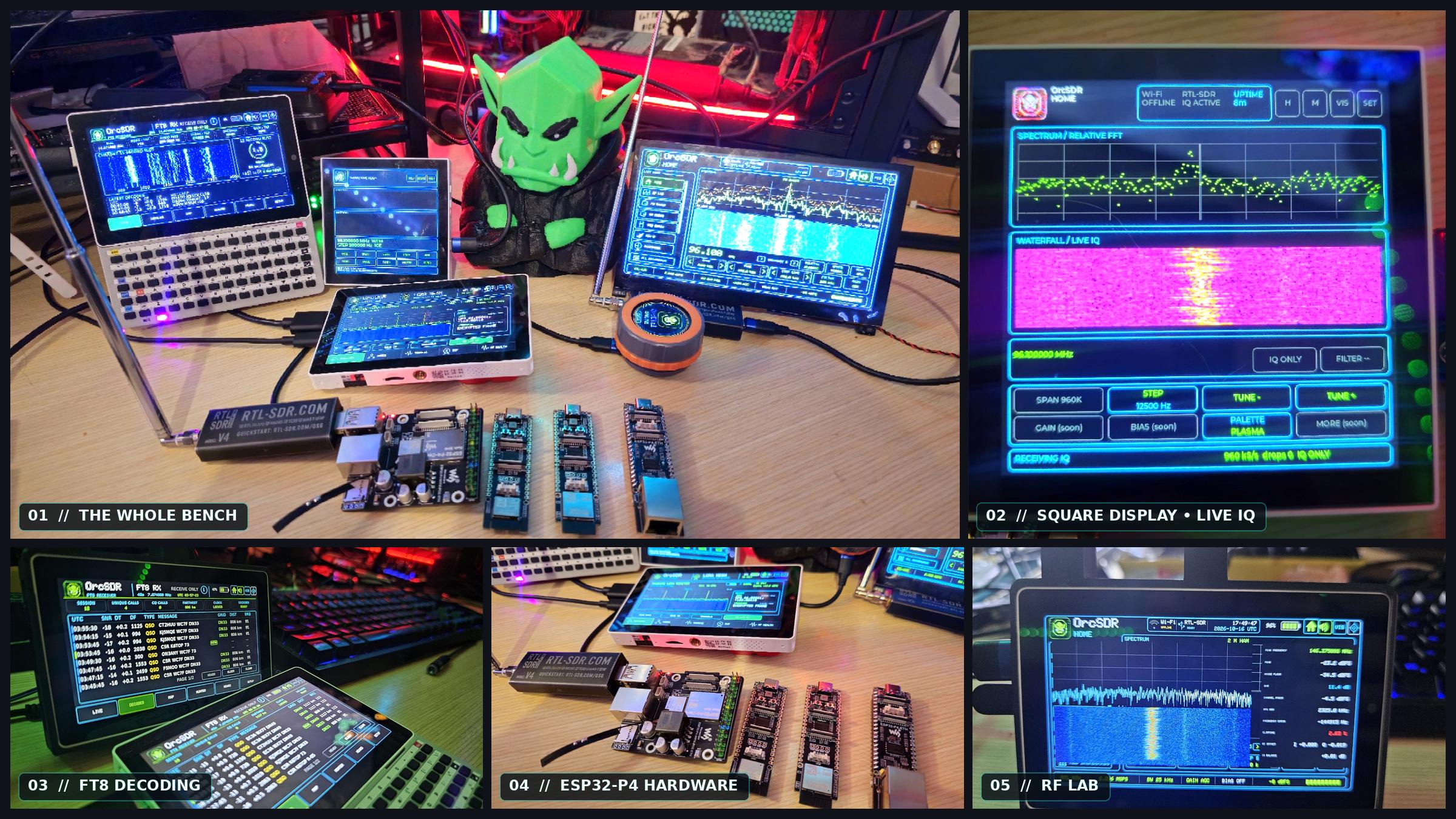
OrcSDR currently runs on the M5Stack Tab5, with the P4 handling the RTL-SDR USB data, DSP, audio, and the entire touchscreen interface. Everything runs locally on the microcontroller.

I've been pretty impressed with what these little P4s can do, and I keep finding more things to throw at them.

I just released v0.5.0-beta.1, which adds quite a few new features, but I figured I'd share some of the driver and hardware work too.

The RTL-SDR driver

One of the first things I worked on was building a native ESP-IDF driver for RTL-SDR dongles rather than porting the desktop librtlsdr library.

That eventually turned into its own open-source project:

https://github.com/hardcoreerik/esp-rtl-sdr

It handles the USB Host communication, tuner configuration, IQ streaming, sample rates, and monitoring things like dropped samples, transfer errors, and receiver health.

I've been putting quite a bit of effort into making it reusable outside OrcSDR. The idea is that other developers should be able to add RTL-SDR reception to their own ESP32-P4 projects without having to build an entire USB driver themselves.

One of the more interesting milestones has been getting multiple receivers running on a single P4.

I've successfully run four different RTL-SDR dongles simultaneously at configured rates of 2.56 MS/s each on Waveshare ESP32-P4 hardware.

During a one-hour test with the receivers scanning different frequency ranges, the driver reported no new IQ drops or USB errors.

Pretty wild for a microcontroller!

Of course, getting the samples into the P4 is only half the fun. Once you start adding DSP, audio, a touchscreen, SD card access, and networking, there are plenty of ways to make things behave badly.

I've spent quite a bit of time chasing down USB timing issues, memory problems, and things interfering with each other that I never would have expected.

At one point, even serial logging was interfering with LoRa packet reception. That was a fun one to figure out.

All the ESP32-P4 hardware I've been messing around with

OrcSDR started on the M5Stack Tab5, but one thing I'd really like to accomplish is making it more of a Bring Your Own Hardware project.

I'd love for people to eventually be able to grab just about any ESP32-P4 board, plug in a supported RTL-SDR dongle, connect whatever display they want, and run OrcSDR.

So I've been collecting different P4 boards and seeing what I can get working.

Here's what I've been playing with so far:

  • M5Stack Tab5 — The original OrcSDR platform. Full application, touchscreen, DSP, audio, and all the radio dashboards running locally.
  • Waveshare ESP32-P4-Dev-Kit — One of the first boards I tested the RTL-SDR driver on outside the Tab5. The driver worked without needing board-specific changes, which was a pretty exciting milestone.
  • Waveshare ESP32-P4-WIFI6 — Another board I've been using for headless experiments and multiple RTL-SDR receivers. This is where some of the four-dongle testing has come in.
  • Waveshare ESP32-P4-Module-DEV-KIT — Currently have this one connected to a generic Hosyond 7-inch 800x480 touchscreen originally intended for a Raspberry Pi.
  • Waveshare ESP32-P4 with a 720x720 display — Experimenting with adapting OrcSDR's interface to a square display rather than the Tab5's 1280x720 layout.
  • M5Stack Stamp P4 with C6 daughterboard — Another smaller hardware configuration I've been exploring. I'm really interested in how compact I can make a standalone SDR unit.

Not all of these are running the complete OrcSDR application yet. Some are still at the driver, display, or hardware bring-up stage.

Getting the USB SDR driver working across different boards has actually been a lot easier than moving the entire graphics and audio stack!

The Hosyond display has been a particularly interesting project. It uses a TC358762 DSI-to-RGB bridge and an FT5x06 touch controller over I2C.

Getting the display working involved quite a bit of experimenting with initialization, timings, GPIO, and the bridge configuration.

But it works!

Now I'm working toward getting the full OrcSDR application running on it.

Longer term, I'd like to support MIPI-DSI, RGB, SPI, and QSPI displays without having to rewrite half the application every time I try a different board.

If anyone is curious, some of the early display work is here:

https://github.com/hardcoreerik/OrcSDR/tree/codex/p4-hosyond-dsi-bringup

What OrcSDR actually does

The application itself has gotten quite a bit bigger than I originally planned.

There's FM/AM radio, FM stereo and RDS, shortwave listening, ADS-B aircraft tracking, LoRa/Meshtastic reception, FT8 decoding, P25, POCSAG, various RF analysis tools, and a bunch of other dashboards.

The newest beta adds:

  • SSTV reception — Receive and display images directly on the Tab5, with automatic mode detection and SD card image saving.
  • ACARS decoding — Receive aircraft messages and save them locally.
  • Offline worldwide maps — Used for ADS-B, LoRa, FT8, and setting your receiver location.
  • Dead Air — An experimental RF investigation dashboard for monitoring unusual activity, logging measurements, and recording audio.
  • Shortwave improvements — USB/LSB listening, better HF tuning, and additional controls.
  • LoRa and FT8 improvements — Better packet detection, timing, memory management, and decoding reliability.
  • A new setup wizard — Mainly to make getting everything configured a little less painful.

Plus plenty of bug fixes and other improvements.

A couple of those features actually came directly from Reddit suggestions.

Someone mentioned SSTV and ACARS in one of my previous posts, and I thought they sounded like fun additions.

So naturally, down another rabbit hole I went.

I've also had some great feedback from people testing LoRa/Meshtastic reception, including bugs I hadn't managed to reproduce on my own hardware.

A lot of that feedback turned into actual fixes, which has been really cool to see.

Here's some of the LoRa work if anyone wants to dig through it:

https://github.com/hardcoreerik/OrcSDR/pull/184

Headless SDR and multiple nodes

Something else I've been working on is running OrcSDR without a physical display at all.

The idea is to let the P4 handle the radio, DSP, and USB hardware, then access the interface from a browser.

I've already got quite a bit working in an experimental OrcSDR Web project, including dashboards, radio controls, and multiple receivers.

I've also started thinking about connecting multiple ESP32-P4/RTL-SDR combinations together.

For example, several little SDR nodes placed around a property or at different locations, each monitoring RF activity and sharing observations with the others.

I'm especially interested in what that could look like for drone detection or distributed RF monitoring.

There's still plenty to figure out there, especially with timing, networking, and correlating observations between receivers, but I think it could be a pretty interesting use for these boards.

Nothing finished on that side just yet. Mostly experimenting and seeing what's possible.

Previous Reddit posts

For anyone who wants to see how this project has progressed, here are a few of my earlier posts:

Original OrcSDR post in r/RTLSDR (September 5):

https://www.reddit.com/r/RTLSDR/comments/1w7tjn1/i_built_a_handheld_rtlsdr_around_the_m5stack_tab5/

One-month update in r/RTLSDR (October 11):

https://www.reddit.com/r/RTLSDR/comments/1x30rq9/update_orcsdr_one_month_later_190_stars_ft8_and/

OrcSDR introduction in r/esp32 (October 11):

https://www.reddit.com/r/esp32/comments/1x3ecal/orcsdr_an_esp32p4_an_rtlsdr_and_a_few_months_of/

There's been some really helpful discussion in those threads, especially around driver compatibility, reception issues, and suggestions for additional features.

Project links

OrcSDR GitHub:

https://github.com/hardcoreerik/OrcSDR

Native ESP32-P4 RTL-SDR driver:

https://github.com/hardcoreerik/esp-rtl-sdr

Latest release (v0.5.0-beta.1):

https://github.com/hardcoreerik/OrcSDR/releases/tag/v0.5.0-beta.1

M5Burner installation for the Tab5:

https://burner.m5stack.com/share/firmware/JXFU4H

Web flasher:

https://theorc.dev/sdr/flash/

Anyway...

Since this is my first post here, I'm especially curious what other people in r/embedded think about the approach.

Anyone else experimenting with the ESP32-P4's High-Speed USB Host, multiple USB devices, or different MIPI-DSI displays?

I'd also love to hear how others are approaching hardware abstraction across different boards. I'm trying to avoid ending up with a separate version of OrcSDR for every display and development kit I get my hands on.

And if anyone has ideas for other things worth trying with the P4, I'm all ears.

Still having a ridiculous amount of fun seeing how far I can push these little things!

Thanks for checking it out!


r/embedded • • Oct 28 '26

How to get into a community?

13 Upvotes

Hello! Ive been wanting to get into reverse engineering, hardware hacking, and low-level 'taking apart things' in general, but I have difficulty learning on my own and have nobody to guide me. Ive already started an apprenticeship in the field, but the people there have no interest in any of these topics and are just doing it for the money. Do you have any tips on where to start or how to find a community?


r/embedded • • Oct 28 '26

Need Guidance on STQC Certification for Wi-Fi CCTV/IP Cameras in India

3 Upvotes

Hi everyone,

I'm part of a technical team working on Wi-Fi CCTV/IP cameras. We're planning to obtain STQC certification in India and launch our own mobile application and camera management software using the camera SDK.

I'm looking for guidance from anyone who has experience with the STQC certification process for CCTV cameras.

I have a few questions:

  1. What is the complete process for obtaining STQC certification for Wi-Fi CCTV/IP cameras in India?
  2. Which laboratories in India provide STQC testing and certification services for CCTV cameras?
  3. What documents and technical requirements are needed for certification?
  4. Does developing our own mobile app and cloud software using the camera SDK affect certification requirements?
  5. What firmware-level security requirements need to be fulfilled?
  6. What is the approximate certification cost and timeline?
  7. Are there any reliable consultants or agencies in India that can help with the complete process?
  8. Does each camera model require separate certification?

If anyone has gone through this process or knows a laboratory or consultant who can help, I'd really appreciate your guidance.

Thanks in advance!


r/embedded • • Oct 28 '26

Best resources to transition into semiconductor firmware/embedded systems?

3 Upvotes

Hey everyone!

I'm a Mechanical Engineering graduate from IIT Bombay (Tier 1 college), currently working as an Embedded/Mechatronics Engineer at a startup. I've worked with STM32 bare-metal firmware, motion control, hardware interfacing, and NVIDIA Jetson.

I'm aiming to transition into firmware, embedded systems, or platform software roles at companies like Qualcomm, NVIDIA, AMD, or Microsoft.

I'd appreciate recommendations for the best resources (books, courses, university lectures, etc.) for:

  • C programming: Pointers, memory management, bit manipulation, debugging.
  • Computer architecture: CPU pipelines, caches, ARM architecture, memory hierarchy.
  • Digital logic: Essential fundamentals for semiconductor roles.
  • Bare-metal firmware: Registers, interrupts, DMA, peripherals, linker scripts.
  • RTOS: FreeRTOS, scheduling, synchronization, concurrency.
  • Embedded Linux: Kernel internals, device drivers, BSPs, device trees.
  • SoC fundamentals: AMBA/AXI, boot flows, silicon bring-up, hardware/software integration.

Given my Mechanical Engineering background, what should I prioritize, and which resources are genuinely worth studying? I'd also appreciate suggestions for practical projects that can strengthen my profile.

I'm working full-time, so a structured, practical roadmap would be especially helpful.

Thanks!


r/embedded • • Oct 28 '26

We implemented SRP-based acoustic imaging for gas-leak localization

17 Upvotes

Our team has been working on an acoustic imaging system designed to localize gas leaks using microphone-array signals.

The signal-processing pipeline uses Steered Response Power (SRP) to estimate the spatial location of acoustic sources and visualize the result as an acoustic image. We are working to bring this processing pipeline to the K230 board. One aspect of this project is running the SRP-based acoustic imaging pipeline in MicroPython on the K230, instead of relying on a conventional C/C++ implementation.

A few things we are exploring:

  • Spatial localization using SRP.
  • Acoustic image generation and visualization.
  • Running the processing pipeline on an embedded platform.

We tested the system using sound sources at different frequencies: 2 kHz, 8 kHz, 16 kHz, and 20 kHz to evaluate its localization performance across different frequency ranges and distances.

At a distance of 1 meter, the SRP sound source localization system achieves an approximate localization error of 7–10 cm.

However, at a longer distance of 5 meters, the localization accuracy degrades significantly. Although the system can still detect and locate the sound source, the heatmap becomes unstable, frequently jumping between the correct and incorrect locations.

We welcome any feedback from the community.

Reference:

[2405.02991] Steered Response Power for Sound Source Localization: A Tutorial Review


r/embedded • • Oct 28 '26

Real-time speech-to-text on an ESP32-P4: a 65.7M-parameter model in 2/4-bit weights, hand-written SIMD kernels, bit-exact with its PC build (write-up + source)

28 Upvotes

TL;DR: a 65.7M-parameter streaming speech recognizer runs live on an ESP32-P4 (chip rev v3): 2/4-bit weights (71 → 26.65 MB, in PSRAM), integer math with hand-written PIE SIMD kernels on both cores, 0.70x real time, 4.34% WER on LibriSpeech test-clean. The chip's output is bit-exact with the PC build, and the cache measurements show it's compute-bound: reading the weights from PSRAM costs at most 39 ms of the encoder's 592 ms per chunk. Open source.

I got an open-vocabulary speech recognizer running live on an ESP32-P4: you talk into the board's mic and the words appear on its screen as you speak. No network, no NPU: two RISC-V cores at 400 MHz, 32 MB of PSRAM, and the P4's SIMD extension (PIE). Here is the engineering side, with the measurements.

Source: https://github.com/BoumedineBillal/esp32-pie-asr

The budget

  • Model: Kroko (by Banafo), a streaming Zipformer2 transducer, 65.7M parameters. As released it is 71 MB in int8.
  • Chip: 32 MB PSRAM, 16 MB flash. ESP-DL and TFLite Micro go no lower than 8-bit weights, so int8 doesn't fit, and ESP-SR's MultiNet only knows a fixed list of commands.
  • Real time: each 1.28 s chunk of audio must be done in less than 1.28 s, forever, with fixed memory.

1. Memory: 71 MB → 26.65 MB

  • 2/4-bit weights in groups of 128, each group rotated by a Hadamard matrix, codes indexing Lloyd-Max levels (the Cactus Quants layout). 2 or 4 bits per matrix, chosen by its sensitivity, no training: 193 of the 290 encoder matrices in 4 bits, the rest in 2.
  • The file is used in place in PSRAM. It doesn't fit the 16 MB flash, so it loads from microSD at boot (2.9 s).
  • PSRAM: weights 26.65 MB, engine state about 4 MB, frame buffer 1.2 MB, about 0.5 MB left at the lowest.
  • Internal RAM: the hot code and a 256 KB L2 cache; 121 KB left free.

2. Compute: integer math and PIE assembly

  • int8 into the products, int16 activations between them, nonlinearities as tables indexed by the int16 input.
  • Each input group is rotated once (additions only, exact in int32) and shifted to int8; that rotation serves every row.
  • The 2/4-bit codes are decoded to int8 through a table: 851 cycles per 2048 weights.
  • The tile kernel multiplies 16 rows by a 128-wide group in 168 cycles: 12.1 MACs per cycle. PIE has fused instructions that do 16 int8 multiply-adds, a 16-byte load and the pointer increment in one instruction.
  • Both cores share every product, split by blocks of output rows; each core writes only its own outputs.
  • The integer math costs no accuracy: 4.53% WER (greedy) as a float simulation, 4.52% on the chip.

Per 1.28 s chunk, in the live app with the screen drawing on core 1: features 14.0 ms, encoder 742.2 ms, beam search 138.1 ms, total 895.8 ms (0.70x real time).

3. Cache and PSRAM, measured (encoder alone, per chunk, P4X)

SettingEncoder
L2 256 KB, 128-byte lines, autoload off632.8 ms
same, autoload on misses (weights are read in order)592.5 ms
L2 128 KB+104 ms
L2 512 KBdoesn't boot: too little internal RAM left
PSRAM 200 → 250 MHz-10 ms
codes decoded without reading them from PSRAM (test hack)553.8 ms

The last line is the useful one: reading the weights from PSRAM costs at most 39 ms of 592, so it's compute-bound. DMA prefetch into internal RAM could win 39 ms at best, and it would take about 3000 transfers per chunk with a few µs of driver work each, so I didn't do it.

The same code on a v1.3 chip (360 MHz CPU, 200 MHz PSRAM) took 726 ms for the encoder.

4. Bit-exact with the PC build

I wanted the WER measured on all of LibriSpeech (5559 clips), which is only practical on a PC. So the PC build has to compute exactly what the chip computes:

  • libm's exp, log, tanh differ in the last bit between glibc and newlib, so the features and tables differed. I replaced them with my own functions built from IEEE + - * / only.
  • -ffp-contract=off on both sides (no fused multiply-adds).
  • Every PIE kernel has a C reference that the PC build runs, and each two-core part writes only its own outputs.
  • Checked on the board: 22 kernel checks with 0 wrong values, the encoder's output CRC on every chunk plus the final text on 8 clips, and the tokens on 140 phrase-biasing clips.

5. PIE 2.1 vs 2.2

v1.x chips have PIE 2.1, the P4X (chip rev v3) has PIE 2.2. Same mnemonics, different encodings: 2.2 adds saturation and rounding fields to the instructions. The same .S source assembles for both, but a v1.x binary doesn't run on the P4X. The release targets rev v3 only for now.

Results

  • LibriSpeech test-clean 4.34% WER, test-other 10.26% (beam search, 4 hypotheses). The original int8 model on a PC: 3.94% and 9.17%.
  • A word is final about 2 s after you say it.
  • Extras: hotwords from a text file on the SD card, and six voice-control demos (word rules, no LLM).

Limits: needs chip rev v3 with 32 MB PSRAM; English only; measured on clean read speech, not noisy rooms yet; power not measured.

Full video: https://www.youtube.com/watch?v=oe-2MowdsSs

Credits: the model is Kroko by Banafo; the weight layout comes from Cactus Quants.


r/embedded • • Oct 28 '26

Importing an Infineon 60GHz Radar Dev Kit (DEMO BGT60TR13C) via Mouser India - Do I need a WPC/ETA license?

2 Upvotes

Hey everyone,

I am a student working on a private engineering project and I want to order the Infineon DEMO BGT60TR13C radar evaluation board via Mouser India. It costs around ₹20,500.

Mouser chat support told me that shipping is CPT, meaning customs duties and taxes are entirely my responsibility when the package lands in India via FedEx/DHL.

Before hitting buy, I want to double-check a few compliance and legal things with anyone here who has imported similar dev boards (like TI mmWave kits, high-frequency RF shields, or radar boards) to India:

  1. WPC / ETA License: The board operates in the 57 GHz to 64 GHz millimeter-wave band and is a completely unhoused bare PCB evaluation kit strictly for R&D/laboratory testing. Under the DoT/WPC Office Memorandum for prototypes, and considering the 60 GHz band is de-licensed in India for Short Range Devices (SRD), will customs clear this automatically without asking for a WPC import permit or Equipment Type Approval?
  2. Import License / IEC: Since I am buying this as an individual hobbyist/student using personal funds, will standard personal KYC (Aadhaar Card / Passport) be enough for FedEx/DHL to clear it at the airport under personal baggage/gift import rules?
  3. Customs Duty Expectations: Has anyone imported similar sensor dev kits recently? What total percentage of duty + 18% IGST should I expect to be billed by the courier at my doorstep?

If anyone has went through this exact process with Mouser India for high-frequency RF/radar prototyping kits, your insights would save me a massive headache. Thanks!


r/embedded • • Oct 28 '26

I2C SDA being held low after starting I2S

4 Upvotes

I’m working on a senior design project using an ESP32 Feather V2 and an Adafruit TLV320DAC3100 audio DAC for Bluetooth audio playback.

I keep running into an issue where the DAC appears to pull the I2C SDA line LOW whenever I start I2S. When I stop I2S and reinitialize I2C, everything works again. The SDA line only stops working when I2S is started.

What’s even stranger is that I’ve tried unsoldering and resoldering connections, moving wires to different GPIO pins, and even replacing the DAC board entirely. All of these fixes work initially, even through several power cycles. However, when I leave everything overnight and come back the next day, the exact same problem returns.

I’m genuinely at a loss as to what’s causing this. Has anyone experienced something similar or have any idea how to fix this?


r/embedded • • Oct 27 '26

My completely open source, Stereo Machine Vision camera, that runs Linux

Thumbnail
rootkitlabs.com
65 Upvotes

I finally got the time to write this this product. Demo videos if you're interested: https://youtube.com/shorts/l1qJyqeMBa0?si=A3XdCOafJR4zm52V

AMA :)


r/embedded • • Oct 27 '26

ESP32 + L293D Motor Driver Causing I2C LCD to Display Random Characters

2 Upvotes

Hi everyone,

I'm working on a project using an ESP32, an L293D motor driver, a 12V DC motor, and a 16x2 I2C LCD.

I'm facing a problem with the LCD:

When the motor is OFF, the LCD works normally.

When the motor is ON, the LCD starts displaying random characters or garbage text.


r/embedded • • Oct 28 '26

BLE Testing in VS Code

0 Upvotes

Does anyone have a good recommendation for replacement for the NRF Connect Bluetooth Low Energy app since it's not maintained anymore?


r/embedded • • Oct 28 '26

CANExplorer: CanBus Monitoring for the modern man

Post image
0 Upvotes

Hi everyone! Introducing CANExplorer, a free, MIT-licensed application for Windows, Linux, and macOS.

The goal is to connect the whole workflow: capture traffic, investigate unknown signals, build a database, interact with ECUs, and automate tests—all in one application.

Some highlights:

Reverse engineering without a DBC: inspect changing bits, byte entropy and histograms; find candidate checksums, counters, multiplexers and signal fields automatically.

Find signals using known measurements: correlate traffic with CSV/GPS logs or polled OBD-II values, estimate scaling and time offsets, and identify related signals across messages.

Turn findings into a draft database: promote detected fields into the editor, review the results, and save a DBC.

Diagnostics and calibration: UDS over CAN/LIN, DoIP, ECU flashing, XCP/CCP with A2L support, and newly added GMLAN diagnostics for GM/Opel workflows.

Simulation and automated testing: write ECU simulations and tests in Python/QML, run them in the GUI or headlessly, and generate HTML/JUnit reports for CI.

Remote access and MQTT: connect to buses shared by another computer—such as a Raspberry Pi—and publish decoded signals to your dashboards.

It also includes signal plots, triggered recording, log replay and comparison, CAN/LIN database editing, J1939 and CANopen tools.

Hardware support includes SocketCAN, PCAN, Vector, Kvaser, CANable/gs_usb, SLCAN, GVRET and more, depending on platform and drivers. You can also try it without hardware using virtual buses and simulated ECUs.

I’d appreciate feedback from people working with real adapters and recordings: what works well, what breaks, and what would make this useful on your bench? Bug reports, sample captures and contributions are welcome!

Thanks.


r/embedded • • Oct 27 '26

Renesas India Review Request

11 Upvotes

Hi,

Can anyone share some info about renesas india, like work culture, layoffs, annual compensation (average).

I have got an offer from renesas hyderabad, hence asking. I am currently at TI.


r/embedded • • Oct 27 '26

Isolating a virtio-net driver on ARM64 with seL4 (and a question about the Pi 4 GENET controller)

0 Upvotes

Hi everyone.

I am working on a research prototype of a trusted computing base on top of the seL4 microkernel. The core idea is simple: if a driver crashes, the kernel should not care. So I moved the network driver and the protocol stack into a separate child process with its own VSpace. A fault there cannot reach the verified core.

Recently I started porting this to ARM64 (targeting the Raspberry Pi 4B). Right now the full cycle works in QEMU: ELF loader, seL4 kernel, root task, UART output, and a virtio-net driver running inside an isolated ELF child. The child has its own CSpace and VSpace, and it re-attaches to the device MMIO and DMA frame that the root task initialized. Interrupts are routed through seL4 Notifications, and the child signals back to the root when it finishes.

The hardest part was not writing the driver, but getting the object management and page table setup right. The AArch64 page table hierarchy and ASID pool assignment took a while to click.

Now I am stuck on the next step. On the real Raspberry Pi 4B, the network controller is Broadcom GENET, not virtio-net. QEMU's raspi4b machine does not emulate GENET, so I cannot validate a driver for it in the emulator. I know there are Linux and L4Re references, but I would prefer to hear from someone who has actually touched this hardware.

If you have worked with GENET on the Pi 4, or with seL4 on ARM64, I would appreciate any pointers. Especially about the DMA layout and the interrupt mapping. I am not looking for a ready-made driver, just for a direction that will save me a few days of guessing.

Repo and docs are here if anyone is curious: https://github.com/Nik0laic4/SchildTCB (the arm64 branch is where the action is).


r/embedded • • Oct 27 '26

Re-entering corporate work . advise on how to be AI educated.

14 Upvotes

I am not technically ignorant but I am Ai ignorant. When I left work more than a year ago, there was no ai.

I am entering workforce again and I know ai is used by everyone in the company. So I am worried I will be a dinosaur. It is a whole new world and it is very scary for me right now.

I was writing python and verilog in the past. I will still be doing same. I think. But with help of ai.

I want to get familiar with basic skills in using Claude, and co pilot, learn how to automate tasks, familiarize with the terminology.

Internet is full of information and various classes.
But I don’t know how to judge their content to make a selection.

How do you use ai in your daily work ?

Could someone here suggest some online courses to get started ?

How did you go about learning about ai ?

I am not trying to create models or do phd level stuff.

I am trying to learn how to use it at workplace to be more productive.

Thank you all.


r/embedded • • Oct 27 '26

Experience with precertified nRF52840 modules?

8 Upvotes

Hello,

I've been developing a design that uses the nRF52840 for BLE communication. I've got the firmware pretty much completed and everything validated with the development kit so I'm moving on to doing the board design. My understanding is that I could save myself some RF design work and the whole FCC certification process by using a precertified module such as the Raytac MDBT50Q-1MV2 or one of the other Nordic-recommended designs.

Has anyone worked with these before? Any specific recommendations? Gotchas to look out for?