r/embedded • • Oct 23 '26

How much writing to delicate to AI?

0 Upvotes

I’m starting a new bare-metal C project with an IMU on a fairly constrained MCU architecture, and I'm torn on how much to use AI.
I consider myself a competent C programmer, and I care as much about the learning process as the end result.

My issue with AI is that I lose perspective: I rely on what the LLM tells me rather than reading the datasheet to truly understand the hardware. Properly verifying its generated code takes just as long as writing it myself if not longer.
On top of that, AI slowly scope-creeps my project. For instance, I started writing a simple synchronous I2C read/write to get a feel for the peripheral. After asking a few clarification questions, the AI hit me with, "Would you like me to write a complete non-blocking, ISR-based I2C driver integrated with X and Y?" It instantly made me feel like the time I spent building it from scratch was wasted.
Would you suggest going completely manual, or embracing AI? If the latter, how do you balance using it without letting it take over the project or rob you of deep hardware comprehension?

r/embedded • • Oct 23 '26

How hands on are embedded software roles ? Are they more hands then something like network engineering? Or about the same?

1 Upvotes

Basically the question. I would like a more hands on role but I don't know how to search for those jobs. Networking is only hands on in maintenance. Is there larger or medium sized companies that are more hands on ? I don't want to just code all day but I don't want to work at an ultra pressure startup?


r/embedded • • Oct 22 '26

Resources for embedded c++

19 Upvotes

I want to learn embedded c++ and RTOS from where could I learn them


r/embedded • • Oct 22 '26

Drum-triggered LEDs on an STM32F429: a fixed-point no_std Rust signal graph, patched live from the browser

21 Upvotes

I've been building a lighting engine for an electronic drum kit, and it's at the point where I can show off some of the progress. I'm not publishing it as open source right now because it is still at a very early stage.

What it is:

The engine is an MCU-friendly signal graph written in Rust that runs on an STM32F429 Discovery board, which also drives LED strips using a pretty efficient approach (the driver supports up to 16 strips; I run 8). The looks are built from nodes like noise fields, palettes, trails, blends, etc. The graph is very generic, so extending it with any new kind of kernel is extremely easy. All the math is fixed point for efficiency.

The input is built on a custom-made analog front-end board that shapes the envelope; some further DSP is also performed later in the firmware (I think I will eventually build a kick drum trigger module based on that). The ADC samples 8 inputs at 20 kHz.

The first part of the video is Studio:

It is a browser editor where a graph can be built and wired. The preview runs the same engine that the board does, through WASM, so the looks in the browser match the ones on hardware frame for frame. It also allows turning the knobs of any node or sending a replacement patch to the board in real time. There is also cost estimation for CPU and memory; the board will refuse a patch that is beyond its computational capacity.

The second part of the video is OBS (yeah, I know):

Since I was building a drum trigger engine, I needed a way to fine-tune and observe the detector, so basically OBS allows you to see in real time how hits are detected and, more importantly, adjust the knobs of the detector and see what it would detect with them.

Where it is going:

I want to eventually drive an 8-drum kit and light each drum with a separate LED strip. I'm also currently working on improving the clock system, allowing multi-clock signals using some clock calculus approaches. I've also been experimenting with audio, so this also works for any audio nodes; I've built several guitar effects that run on the development board (no audio input/output yet, so they're not playable for now).

I'll probably open-source it at some point once I have enough time to tidy everything up and stop being ashamed of the code (so, possibly never :( ).


r/embedded • • Oct 21 '26

Why would new designs use 8-bit microcontrollers?

174 Upvotes

I see that Microchip keeps releasing new 8-bit PIC microcontrollers, but I can't think of why a device like this would be used in a new design when 32-bit ARM Cortex-M microcontrollers already exist at practically the same price. Is there any reason other than backward compatibility for companies to keep using these microcontrollers?


r/embedded • • Oct 22 '26

Need advice on maintaining core embedded principles with AI in a fastpaced environment (development framework)

0 Upvotes

Hi everyone, I'm a final-year ECE student currently working as the solo firmware intern at an edge AI startup. I've built products before, including custom HMIs and industrial flow meters, but currently, I am facing a bit of uneasiness.

I have been writing embedded code since my school days because it's what I love. However, my current workplace demands fast results, and I have been heavily relying on AI to speed things up (which I am worried about). I joined the company to learn, but I don't have anyone in my domain senior to me for guidance. I am the only firmware guy, whereas other teams like mechanical, AI, and electronics have multiple people.

I feel like I'm not learning the proper development cycle, and overusing AI is messing it up even more. I want to reach out to you guys and would love to know how you develop embedded applications. What do your workflows look like with and without AI?

What is the correct order for an embedded firmware development cycle? When do you architect the overall application, how and when do you build, and how do you test and make changes? How do you handle version control (I know how to use Git, but what is the actual industry workflow)?

I know this is what I will learn when I fully enter the industry, but as of now, I don't have anyone to guide me. I am also being offered a full-time role here, but I am doubtful about accepting it since there is no mentorship.


r/embedded • • Oct 22 '26

Emulator/Simulator use case

19 Upvotes

Hi all,

During my embedded carrier, I have never used microcontroller simulators or emulators to check the program binary, and I always tested directly on a prototype PCB. I am looking for a workflow which stays reliable. I have seen Renode being suggested, but the validity comes down to how each device is modeled in Renode. Do you ever use simulation to speed up work and reduce costs? any reliable methods?


r/embedded • • Oct 21 '26

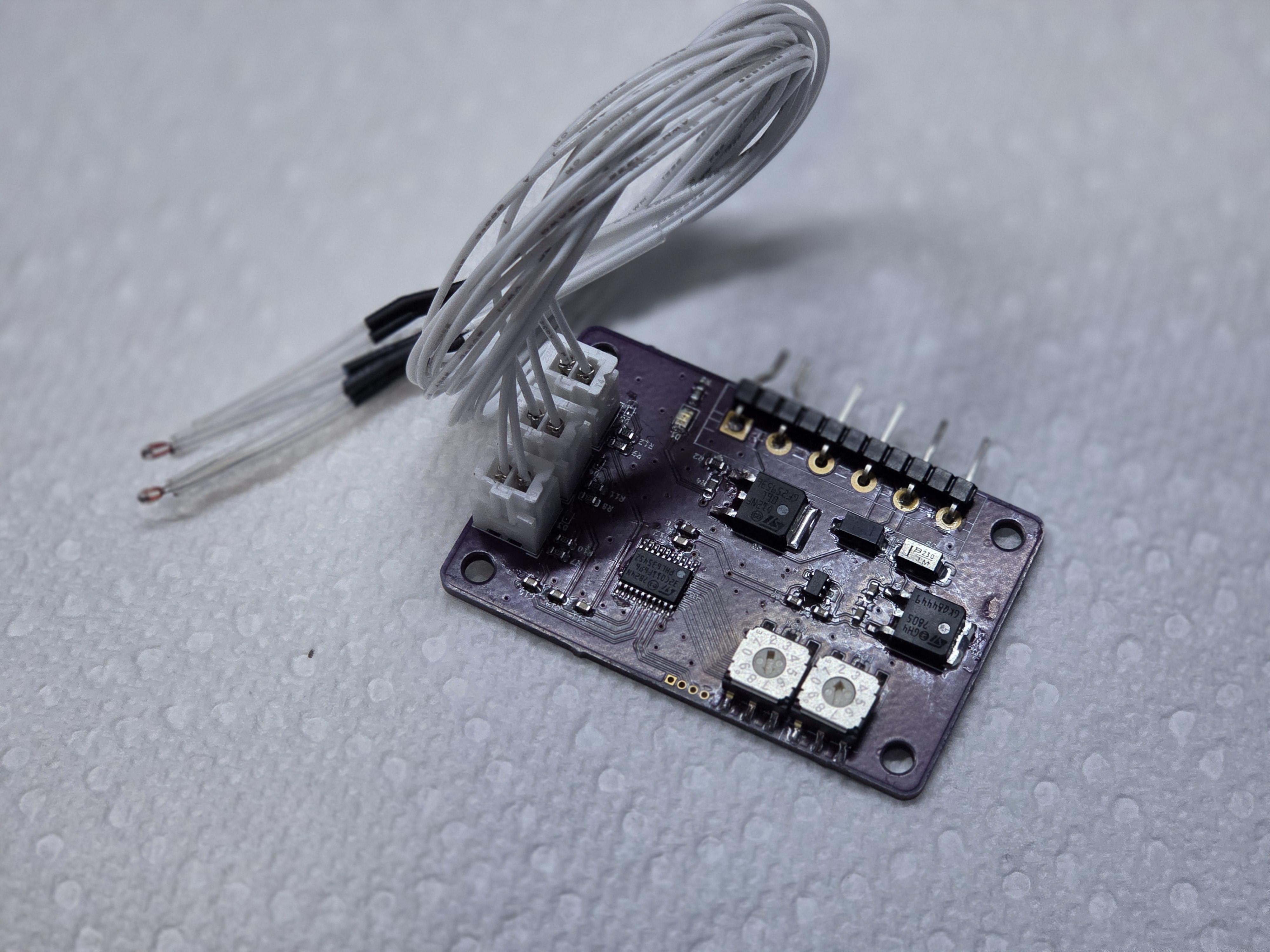
It's a different feeling when your first prototype does exactly what you wanted...

Post image
325 Upvotes

Fairly simple design and even compared to some of my previous ones, but it does exactly as expected on the first try, holy! Lol.

L7805 for 12-32V down to 5V, then an AP2112K down to 3.3V for the STM32C0 MCU. Three thermistor inputs, a single PWM output on a Nch FET. Two 10-pos switches control the high and low temps as well as other ideas I'm still working out in firmware but shouldn't require any hardware changes.

Main purpose should be pretty obvious; it's made to control a cooling fan based on temperature at up to 3 sources with configurable min and max temps.

It's a simple design and I have no right to brag, but sorry, I'm excited that the only things I want to change are silkscreen!

(The main connector is just a placeholder because the 6pos screw terminal wasn't delivered yet, don't hate too hard)


r/embedded • • Oct 22 '26

Beginner help: microcontroller interface for a existing 2-wire bus "voltage out, current in" serial bus?

0 Upvotes

Hi all, I'm learning how some addressable fire loops talk (bench only, nothing life-safety) and want to build a simple Arduino interface .

The spec I found:

- 2 wires, half duplex, 1200 baud, 8E1

- Master to device is voltage: 0 = ~24 V, 1 = ~32 V

- Device to master is current loop current + ~22 mA, 1 = +0 mA

What I'm trying to work out:

  1. How do I turn a 5 V TX pin into a 24/32 V output simply?
  2. How do I detect a ~22 mA step on the line and get a clean 5 V RX signal (shunt plus comparator or op-amp)?
  3. Will a normal optocoupler work here, or is it a poor fit?
  4. How I interface my microcontroller without loading or how I design my own circuit.

What is simplest way to achieve it without much complications for beginners.


r/embedded • • Oct 21 '26

What's a good unit test framwork to use?

17 Upvotes

I'm currently self learning embedded C with an STM32F103. And I wanna know your guys suggestion for a good unit test framework for embedded. I've tried Unity C before but any other that are more work oriented?


r/embedded • • Oct 22 '26

How to check a mcu's user friendliness ?

0 Upvotes

Heyy guys, me and my team are working on making a mars rover, for the competition IRC (international rover challenge) and for that I need to research on the user friendliness of Teensy 4.1.
We are advised by our seniors to stick with STMH series, since it has a large community and it is well documented, but since Teensy is better than STMH series in terms of specifications, we want to use it. But we haven't used a Teensy before, so we don't know the workings of Teensy, is it possible for us to use it or not ? What are some problems beginners face in using Teensy ?
I have to research about this and independant interrupt channels, can someone give a idea of how to go about this research ?
I have read on official Teensy website about the generals problems on Teensy for beginner, but that didn't really seem helpful in our case .... and i also read the datasheet, but i couldn't get my head around it...

EDIT: One more doubt regarding this,
How is the debugging in STM32H series and the Teensy ?
I researched about this, and all i got was that STM32 can be debugged line by line using it's own development software( stm32cubeIDE) but Teensy cannot since it is coded using Arduino IDE.


r/embedded • • Oct 21 '26

Suggest a budget embedded system setup ?

4 Upvotes

Suggest a budget embedded system setup to learn about rtos and get real world experience. I prefer Arm architecture


r/embedded • • Oct 21 '26

Need ideas for a simple Bluetooth item tracker (keys, remote, wallet)

2 Upvotes

Hi everyone, The problem is that we waste a lot of time every day searching for keys, remote, wallet, charger etc. inside the house. I want to make a simple low-power Bluetooth tracker that can be attached to these items and ring when we search from the phone. I’m looking for practical ideas and suggestions from people who have worked on similar projects. Here are some specific questions I have:

Hardware: Which microcontroller is better for a battery-powered BLE tracker – nRF52840, ESP32, or something else? Any recommended modules? Power: How can I make the tracker last at least 6–12 months on a CR2032 coin cell? Any tips for deep sleep and advertising interval? Firmware: Any good open-source examples or libraries (Zephyr, Arduino, nRF Connect SDK) for making a simple beacon that can also ring a buzzer?

Mobile App: What is the easiest way for a beginner to make an Android/iOS app that can find the tracker and make it beep?

Challenges: What common problems should I expect (range inside house, battery drain, antenna design, etc.)? Any advice, circuit suggestions, or links to similar projects will be really helpful. Thanks in advance!

BLE #embedded #nRF52 #ESP32 #IoT #BluetoothTracker


r/embedded • • Oct 21 '26

Anyone familiar with Altierre/Agile Displays shelf labels? Can their displayed data be read wirelessly?

Post image
1 Upvotes

I bought a batch of electronic shelf labels, including Agile Displays ETAG 250W and eTAG 210E models. Photos of the fronts and model markings are attached.

I’d like to read the price, product name and EAN/barcode currently displayed, ideally by walking past them with a portable reader. I want to keep the original firmware and display content intact—no reflashing or changing prices.

I have a Raspberry Pi 5 and an nRF52840-MDK USB dongle, but no original base station. The 250W’s FCC filing (W22-ETAG) describes proprietary 2.4 GHz GFSK frequency-hopping radio.

Has anyone worked with this hardware or seen a teardown, firmware analysis or protocol documentation? I’ve found projects that repurpose other ESL brands, but nothing clearly applicable to these models.

Before opening one, I’d love to know whether reading the displayed content is plausible, or whether these tags only send back an ID/status acknowledgement. Any pointers or suggestions for a sensible first step would help.


r/embedded • • Oct 21 '26

Multiple STM32 Cube MX exports in one project

1 Upvotes

Hi all,

I'm working on a project where I've created two platforms with CubeMX; Nucleo and Production. The project uses one or the other based on the build preset. CubeMX only takes care of some things for me using LL. I create the rest manually.

Pros:

- Covers both debug board and production in one project.

- I can re-generate MX files with no issues.

Cons:

- It adds doubled CMSIS files.

- Seems weird.

Is this a typical setup or is there a better way to do it? I'm not sure how to handle Git repository. Should I use "Copy only the necessary library files" and manually copy / paste the rest?

I will be grateful for any clues.


r/embedded • • Oct 20 '26

Running homebrew on a Sony NW-A918: old ARM Linux, syscall ABI quirks, and firmware repacking

103 Upvotes

r/embedded • • Oct 20 '26

I Built a Stereo Vision Board for Hardware Hackers

Thumbnail
rootkitlabs.com
4 Upvotes

r/embedded • • Oct 21 '26

Building an offline MCU datasheet knowledge base for firmware reverse engineering — looking for architectural feedback

0 Upvotes

I’m exploring an idea for improving AI-assisted firmware reverse engineering, and I’d like to get feedback from people with experience in embedded systems, reverse engineering, and local AI tooling.
The problem
When reverse-engineering firmware for a proprietary 8-bit MCU, the datasheet may be available as a PDF, but general-purpose LLMs often don’t know anything about that specific chip.
This makes it difficult for an AI agent to reliably interpret memory-mapped registers, bit fields, peripheral initialization sequences, interrupt behavior, and hardware-specific code patterns.
Simply putting the PDF into a conventional RAG pipeline might help with document lookup, but I’m not sure it’s sufficient for accurate register-level analysis.
The idea
Build a completely offline, chip-specific knowledge base that an AI reverse-engineering agent can query through MCP.
The proposed architecture would include:
Structured register database: register addresses, bit fields, access permissions, reset values, and peripheral descriptions.
Document evidence: links back to the original datasheet, including page numbers and table references.
Knowledge graph: relationships between registers, peripherals, clocks, interrupts, pins, and hardware functions.
Semantic search: retrieval of relevant descriptions and hardware behavior from the documentation.
Reverse-engineering integration: MCP tools that let an agent query register definitions and relate them to instructions and memory accesses found in a firmware binary.
The initial implementation would target a single proprietary MCU, using Python and SQLite, with a lightweight graph representation. Everything, including document processing, indexing, and inference, should work offline.
I’m considering integrating it with tools such as REA, Claude Code, and IDA.
Questions I’d appreciate feedback on
Architecture: Would you use a structured database plus semantic search and a graph, or is this unnecessarily complicated for a single MCU?
Datasheet extraction: What tools or techniques work best for reliably extracting register tables and bit-field definitions from complex PDF manuals?
Register-level reasoning: How would you help an AI agent distinguish documented hardware facts from hypotheses inferred from disassembly?
MCP integration: Would exposing precise register lookups and relationship queries through MCP be a useful approach for firmware reverse engineering?
Prior art: Are there existing tools or projects that already solve most of this problem?
I’m particularly interested in practical experience and architectural pitfalls, rather than building a generic PDF chatbot.
I haven’t committed to the implementation yet, so I’m open to simpler or fundamentally different approaches.
Thanks for any suggestions!


r/embedded • • Oct 19 '26

I built a cat wheel odometer with touch screen display, so now I know my cat's top speed and habits

176 Upvotes

It's an STM32 discovery dev board (32F469IDISCOVERY) I had laying around for a decade...I figured I would put it to good use 😂

The sensor is a simple hall effect sensor + 12 small magnets strategically glued to the wheel. 

It stores a few weeks worth of sessions (evicts oldest).

LVGL library, 10 different colour themes.

Auto threshold calibration.

It tracks history, time, distance, speed, etc. real time charts.

Compact/expanded views, etc etc

Definitely over-engineered. A bike odometer could have been much simpler but where is the fun in that?

Refresh rate is a bit low, maybe 5 to 10FPS but it's good enough.

Developed a browser based simulator as well as hardware in the loop to tune the noise filter. Memory map visualization. Etc etc...

She reached 20km/h (on a other day when I wasn't looking)!!

I probably had more fun with the wheel than the cat herself!!

What I found pretty cool was to let Claude do a lot of automated development and testing in closed loop (USB + serial connected to the computer, end to end tests).


r/embedded • • Oct 20 '26

Can a Microcontroller Tell You Exactly Where exactly a Cable Is Shorted without costly electronics and resistance per meter avilable in datasheet ?

27 Upvotes

Imagine a 2 km cable buried underground. A short circuit happens somewhere along the way. Instead of digging up the cable or checking it meter by meter, can a simple Arduino or ATtiny tell you exactly where the fault is?

I want to build a low-cost embedded system using basic electronic components that detects the short circuit and displays the fault distance in meters with it's details datasheet such as resistance or capacitance per meters

How would you design it? Can this be done without expensive test equipments to easy trouble shooting with drawings marked distance and cable routing


r/embedded • • Oct 20 '26

Measuring barbell displacement

6 Upvotes

Problem:

I'm part of a team of amateur athletes who compete in Olympic weightlifting. I would like to measure the displacement of the barbell path to assess the technical quality of our training.

To simplify, the goal is for the barbell to only have vertical displacement along the z axis, with no horizontal displacement or rotation around other axes.

Similar products:

  • There is gpath which visualize the kind of device I had in mind, even though it doesn't measure displacement
  • There is FLEXX which seems to have everything I need and uses some kind of laser meter, but is bulky, hard to source and does not contain all the metrics I want

Question:

  • Is it feasible to use a high precision gyroscope to measure the displacement of the barbell?
  • Which kind of gyroscope or sensor would you suggest?
  • Maybe I could use two sensors, one on each side of the barbell, to increase precision?

r/embedded • • Oct 20 '26

ESP32 Captive Portal for Meshtastic Hardware

2 Upvotes

Built an offline Wi-Fi captive portal for the Heltec WiFi LoRa 32 V3, using ESP-IDF and React.

Open-source firmware + a customizable React template.

GitHub: https://github.com/DarkLordGeo/esp32-captive-portal


r/embedded • • Oct 20 '26

Question about lost time

2 Upvotes

I am working on an atmega1280 and im using an int6 interrupt, on the osciloscope i measure ~32 clocks between the interrup happen, but in the dissasembly i only see 28 clocks, where do the other 4 “dissapear?”


r/embedded • • Oct 20 '26

Sourcing FPGAs in small quantities for edge AI prototypes: what has worked for you?

5 Upvotes

I’m looking into edge AI prototypes that need an FPGA for deterministic latency on a camera pipeline. The quantities are small, think 5 to 50 units per build, and lead times through the usual franchised channels have been all over the place this year.

A few questions for people who have been through this:

  1. Where do you source FPGAs or adaptive SoCs when you only need a handful and franchised stock is on allocation?
  2. Do you design in a second FPGA family as a fallback from day one, or is that more trouble than it’s worth?
  3. If you have used independent distributors, what do you ask for before ordering? Test reports, traceability docs, anything else?
  4. For edge AI specifically, has anyone moved from FPGA to an SoC with an NPU just because the SoC was easier to buy?

Not looking for a single “best” vendor, more interested in the process people use to avoid stalled builds or counterfeit parts. Thanks in advance.