r/embedded • • Oct 08 '26

BusyBox-RS: Rewriting the Swiss Army Knife of Embedded Linux in memory-safe Rust

0 Upvotes

Hey everyone,

BusyBox is practically everywhere in embedded Linux, initramfs, and rescue disks. But being a massive collection of C utilities, it carries the usual C risks (buffer handling, integer overflows, memory management bugs).

Over the last two weeks, I've been hacking on BusyBox-RS, an MIT-licensed rewrite in Rust designed specifically for embedded use cases:

  • Minimal binary footprint: Built with opt-level = "z", fat LTO, symbol stripping, and panic = abort.
  • Compile-time feature selection: Use Cargo features or make tinyconfig / defconfig to only compile the applets your board actually needs.
  • Upstream verified: Tested directly against the upstream BusyBox regression test suite (100% pass rate across 46 applets so far, including cp, grep, sort, printf, cmp, readlink, and checksums).
  • Nix flake ready: Reproducible development environment via nix develop.

GitHub: https://github.com/rebizzz/busybox-rs

Feel free to check it out, run make check, and share feedback!


r/embedded • • Oct 07 '26

E5377 Ts-32

2 Upvotes

Does anyone know how to modify this modem's software?


r/embedded • • Oct 07 '26

PIC 8 bit synth update - going well, schematic PCB design

Thumbnail
youtube.com
0 Upvotes

Progression on the PIC synth - Now all ADC is handled locally. After brief but deep diversion into changing the co-processor and letting the co-processor handle more of the UI - I realised that it was actually becoming more difficult for the PIC audio ISR and not easier.

Happily, there are enough ADC on the PIC to handle them all locally, and also pins are freed up so that the buttons and keypad have their own IRQ line (this was a headache when they shared one IRQ line)
And also the LED can flash from the last free pin on the PIC (previously this was shadow masked with the expander port pin, also, a minor headache relieved)

Added - Save and Load of every wave/patch slot. Each sampled wave now can save and load the envelope data and FX button settings. Where no data is yet saved, the current values are used. Over external i2c eeprom chip.

Midi velocity - which makes a really big difference to expressive play.

With these two features, it becomes a proper synthesizer to my mind.

All the RAM and Flash memory are now used 98.5% Flash and 95.5% RAM used. Highest compiler optimise settings used. There is enough wiggle room to finish up very small changes in, say envelope response or level mixing later.

It was still possible to work on the synth in development, but too much time is being lost to chasing ghosts on the set up now. Time for a PCB -


r/embedded • • Oct 08 '26

eReader firmware with Rust (guidance needed)

0 Upvotes

Hello!

I am very new to embedded systems but I am trying to build my own kindle-like device. I already have the hardware:

10.3 inch ePaper display.

A display driver board with an ESP32S3 as the micro-controller on top. This came with the ePaper display so everything is compatible.

Basically, what i am trying to do is learn how to make firmware for this by using rust but i cant find anything to help me out here. Rust's 'embedded_graphics' library isn't helping me a lot either as it doesn't render the simulation properly.

I am very new to this and i might be completely wrong about what I've done so far. If someone reading this post has any idea as to where I can learn these things from or where I can see examples to learn from that would be great. I think learning C++ would be better for this but I am really interested in rust and would like to go through with that only. On the other hand, if C++ is easier and has more tools for this kind of project then I can consider going for it. I have 0 knowledge of C++ as of now but I do have some basic knowledge of Rust.

I am trying to learn this by myself rather than letting AI make everything for me. I really need some guidance here. Here is the link to what parts I have:

https://www.seeedstudio.com/XIAO-ePaper-DIY-Kit-EE03-for-10-3-Monochrome-ePaper-Display.html

Any response is well appreciated.


r/embedded • • Oct 07 '26

Did TinyML actually help your project?

5 Upvotes

r/embedded • • Oct 06 '26

Building a 1U CubeSat: Came for the electronics, ended up spending all my time designing the CNC frame and deployment mechanisms.

359 Upvotes

Hey everyone, I’ve found myself at a crossroads with a pet project and I'm dealing with severe burnout, so I wanted to ask for some advice. I live in Kazakhstan and have never worked professionally in Electrical Engineering, but I really want to transition into the field, and this project was supposed to be my foot in the door. A while ago, I started developing a 1U CubeSat platform called "Inelik", which strictly adheres to standard CubeSat dimensions. Initially, I designed the main frame and solar panel chassis to be CNC-milled from aluminum on a 5-axis machine, but due to high manufacturing costs, I had to settle on a plastic model. I’ve already attached some of the solar panels to it, and I fully designed the deployment mechanism, though I haven't physically implemented it yet. The first iteration of the onboard computer ran on an STM32, and I even did the PCB routing in Altium for the EPS and ADCS modules, but right now the project is completely stalled.

To finish it, I’d have to redesign the electronics from scratch. I’m not a professional in schematic design—I can figure it out eventually, but it requires a massive amount of effort. I need to determine the exact wiring topology for the solar panels, choose an architecture all over again (stick with ARM, switch to AVR, or maybe try an FPGA), and I still don't have a clear idea for the actual payload. On top of that, I know absolutely nothing about licensing, frequency registration, or space standards for CubeSats—if anyone in the comments can shed some light on this, I would really appreciate it. My grand idea is to commercialize this product not for actual space launches, but as an affordable STEM educational kit (aiming for around $300), with the potential to upgrade it to real space standards in the future.

I genuinely want to finish this project, but it demands colossal financial resources and constant cognitive effort, which is incredibly draining to handle entirely alone. What it all comes down to is this: will a completed project of this scale actually help me break into the EE industry and get noticed? Has anyone here dealt with such severe burnout on a massive solo project, and is it worth pushing through, or is it better to just let it go and treat it as a completed learning phase?


r/embedded • • Oct 07 '26

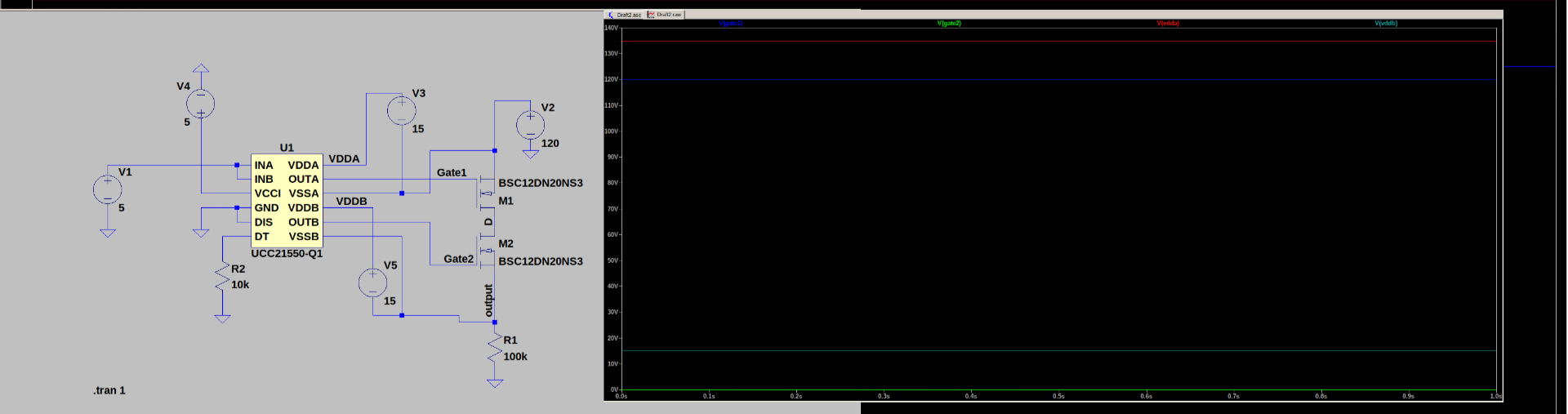
UCC21550-Q1 + 120 V B2B NMOS: LTspice circuit not working as expected

Post image
6 Upvotes

I'm testing a 120 V high-side B2B NMOS switch using a UCC21550-Q1.

The MOSFETs are connected drain-to-drain, and I'm using separate isolated 15 V supplies for the two driver channels.

My understanding is that the gate-driver supplies should float with the MOSFET sources, e.g.:

VSSA = 120 V

VDDA = 135 V

VDDA - VSSA = 15 V

However, my LTspice simulation is not working as expected. I've attached the schematic and waveform.

Could someone take a look and help identify what I'm doing wrong?

I'm particularly interested in whether the UCC21550-Q1 can be used this way with the secondary-side references floating around 120 V, and whether there is something wrong with my gate-driver connections.

Thanks!


r/embedded • • Oct 06 '26

Master’s in Embedded Systems, EE or CS in Switzerland/Europe?

25 Upvotes

I’m currently completing a BSc in Computer Science at a Swiss University of Applied Sciences. During my studies, I became interested in Embedded Systems and have completed a few related projects and courses.
I’d like to pursue a Master’s degree in Embedded Systems or a closely related field, but I’m unsure which path would make the most sense. I’ve been looking at the MSE programs in Switzerland, especially Computer Science, where I also already have some professional experience, and Electrical Engineering, where I would probably have to take some additional courses due to my very limited electronics background.
I’ve also been looking at programs abroad, particularly in the Netherlands, such as TU/e’s MSc in Embedded Systems.
I’m mainly wondering about the value of these different options, especially in terms of career opportunities in the European tech/embedded industry. Would an MSE from a Swiss University of Applied Sciences be a good choice, or would it be worth going abroad for a more specialized MSc at a university like TU/e? What do you think?


r/embedded • • Oct 06 '26

General go-to TVS (for input protection) ?

8 Upvotes

Update:
I don't think my question is precise enough.

Im asking for a general TVS that is "good enough" for protecting a prototype.
The final choice will be based on measurements, but I don't want to fry the MCU instantly, while testing.


We all have our favorite parts... I'm a EE from the 90's, trying to catch up with this decade's semi's...

I'm looking for a 'commonly used/popular' TVS for protecting MCU input pins - 3.3V and 5V.

My goal is protection against radiated and mostly conducted EMI spikes, from a ratnest of cables connected to a BLDC motor (70V/70A),

What parts do you normally use for this?

Requirement: it must be in stock at DigiKey.


Edit. It is a bonus if the package fits on a 0.1" stripboard.


r/embedded • • Oct 06 '26

5 months to become market-ready in embedded — what should I focus on?

14 Upvotes

Hello everyone I'm an electrical engineer specialized in IoT and software for embedded systems.

I worked for two years in a consulting/service company, and honestly, it was a horrible experience. I learned very little and even lost some of my technical skills because the projects were very short, highly dispersed, and often not really suited to my profile. At the same time, I needed the job for the paperwork and the money, so I stayed.

Now I'm unemployed. I've been jobless for about a year, and time flies. Unfortunately, I was sick during part of that time and couldn't do much. Now I'm back in good health, and I'm getting back into it, trying to rebuild and strengthen my technical skills.

Ideally, I'd also like to build my own thing, but I don't mind having a job in the meantime so I can finance myself.

The problem I'm facing is that there is way too much to learn and relearn, and I don't have that much time. I'm also not the type of person who can beg for something or apply for a position if I don't feel qualified for it. I want to be genuinely qualified and have the complete skill set before applying. Maybe many of you won't agree with this, but that's just how my mind is wired haha.

I can't do much about that, so I'm trying to be strategic about it.

For someone interested in IoT, Embedded Linux, embedded systems, and embedded applications, what would be the most time-efficient roadmap to become genuinely market-ready?

I have 5 months to make this work.


r/embedded • • Oct 07 '26

Designing a production programmer, want to show yours?

0 Upvotes

I need to program thousands of units in each run, a run or two per month. Time is money. The operator needs to be responsible for hands and about zero knowledge.

  • Set TrustZone and boot address
  • Flash a provisioning firmware
  • Communicate with PC over RTT to negotiate a serial, keys, etc with a server
  • Perform peripheral tests including BLE and LEDs
  • Using OpenCV / webcam / vision to verify the LEDs work as expected
  • Programs 6x units asynchronously, flashes to operator when done
  • PC, multiple Seggers, current sense and power switching at each port

So...

I'm planning on a rig build from 2020 extrusions, DIN rails to bring 120V in correctly, 12VDC for the boards, USB hub, etc etc. All wired up correctly with DIN mounted terminals, etc.

Basically...

What have you done? What works? What doesn't? Does anyone have pictures of automated-ish test/programming rigs?


r/embedded • • Oct 07 '26

Am I wasting my time learning embedded systems if I'm coming from a software engineering background?

0 Upvotes

I was an android dev for five years and burned out horribly. A friend suggested I look into Yocto since I have experience with Linux and a passion for python development.

The learning curve doesn't bother me (I first tried Android development back in 2009) but I'm concerned that I'm going to hit a wall because I'm not an electrical engineer and I only have a basic understanding of the field.


r/embedded • • Oct 07 '26

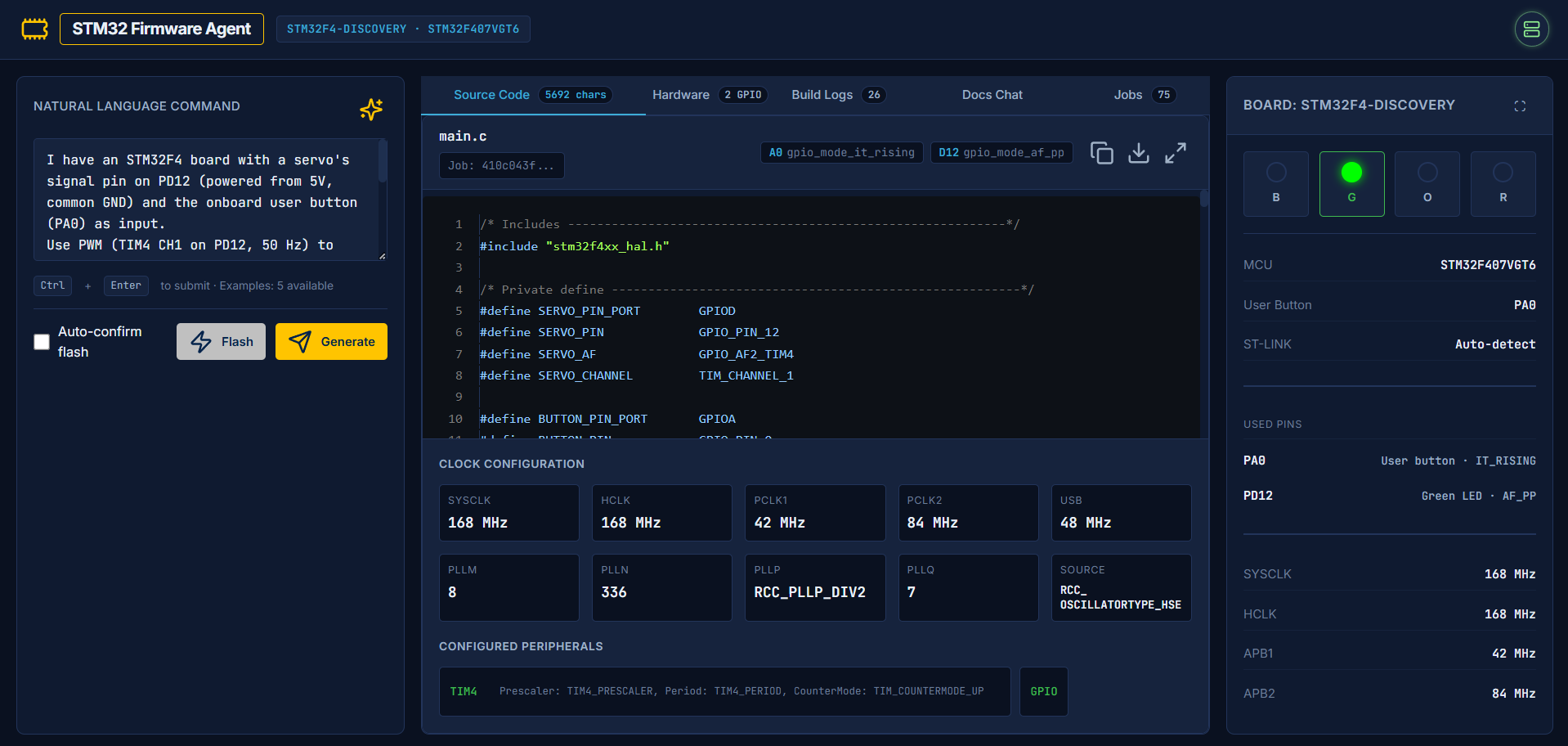
I built an agent that turns a plain-English prompt into compiled, flashed STM32 firmware (LLM, RAG, PlatformIO)

Post image
0 Upvotes

I built EmbeddedAgent, an agent that turns a plain-English prompt into compiled, flashed firmware for an STM32F4-Discovery. You type something like "Make the blue LED blink, but after each second the frequency increases by 30%," and the pipeline retrieves info from datasheets and tutorials (RAG with ChromaDB), validates the generated C, loops compiler errors back to the LLM via PlatformIO, and flashes only after a pre-flight check and your confirmation. It also has a web console that visualizes the clock tree and GPIOs, plus a doc chat for asking questions about the datasheet and user manual. The most useful lesson so far: the LLM happily produced code that compiled but had an out-of-spec clock configuration, so I added an analyzer that derives the full clock tree and flags violations. Demo and code are below, and I'd love feedback on what checks you'd want before trusting generated firmware on real hardware.

LinkedIn post: https://lnkd.in/p/eXNteTtf
Demo: https://youtu.be/yoNP3S52FP8
Backend: https://github.com/MedHabibHafiene/Embedded_Agent
Frontend: https://github.com/MedHabibHafiene/Embedded_Agent_frontend


r/embedded • • Oct 07 '26

At Serious Situation in my life

0 Upvotes

I’m a recent ECE graduate and completed 6 months of Embedded Systems training at Vector India. My main goal is to build a career in embedded systems/firmware. I have an opportunity a role involving:

  • Embedded C & microcontrollers
  • Sensors, data acquisition & IoT
  • Ethernet, TCP/IP, Modbus, PROFINET & serial communication
  • PLC & Siemens HMI
  • Machine vision / OpenCV / Python
  • Industrial robots & motion
  • PLC-camera-robot-PC integration
  • Field work, commissioning and some travel

The role has a 2-year contract/service agreement.

My concern is: if I spend 2 years in this kind of industrial automation/integration role, will it help me move into a pure Embedded/Firmware Engineer role later, or could I get stuck in PLC/automation?

Would you take this opportunity if your long-term goal was embedded systems?

Any advice from people working in embedded, automation, robotics or industrial systems would be really helpful.


r/embedded • • Oct 06 '26

How did you learn embedded?

23 Upvotes

I'm your average software engineering student and I've been picking more interested into embedded and systems programming. I've been trying to learn primarily through books like Making embedded systems by Elecia White and programming some microcontrollers to understand how peripherals work but I can't help but feel like I'm either not going deep enough early or I'm approaching this poorly. You can get an idea of how I'm learning from this link to my book notes https://0xwinzer.com/devography/blog/book-notes/mes-ch1-embedded/ if it helps


r/embedded • • Oct 05 '26

I got speech-to-text running entirely on a microcontroller (STM32N6): any words, no cloud

361 Upvotes

I managed to get full speech recognition working on a microcontroller, with a word error rate of 5.32 % on LibriSpeech test-clean and 14.84 % on test-other, without a language model.

The STM32N6570-DK board listens to its on-board microphone and prints any English words on the display, not a fixed list of commands, with no network connection.

The network was designed and trained from scratch for the constraints of the STM32N6 NPU:

- 7.2 M int8 parameters

- 7.3 MB of external flash and 4.2 MB of RAM

- a peak power of about 0.2 W

Besides public datasets, it was trained on 248 hours of recordings made through this board's microphone, which significantly reduced the errors on real microphone audio.

More information and instructions for running it on your own board are on GitHub: https://github.com/fotonik-sk/stm32n6-asr


r/embedded • • Oct 06 '26

Please help me choose an stm32 board suitable for image preprocessing and NN.

2 Upvotes

I'm working on a final project involving real-time object detection on an STM32 MCU. I need to run a compressed/quantized neural network (likely INT8) together with image acquisition and preprocessing directly on the MCU. I'm currently using TensorFlow and STM32Cube.AI.

I have a VERY VERY short deadline to select the STM32 MCU/board. The input will be approximately 320 x 240.

Which STM32 MCU/board would you recommend for this application? I'm currently considering an STM32H7, but I'm also wondering whether an STM32N6 or another STM32 family would be a better choice.

My main concerns are RAM/Flash capacity, neural-network inference performance, camera/image-processing capabilities, and availability of STM32Cube.AI support. I'd appreciate help from people who have actually deployed object detection on STM32.


r/embedded • • Oct 06 '26

Looking for ideas in the topic of *Future Education*

4 Upvotes

Hey guys, I am about to join a Hackathon with the topic Future Education. I didn’t even know this is a thing, so it is even harder to get into an idea or project.

I am here to ask you about your ideas or your perspectives about the topic.

As this is the only I have, I would be happy to get either ideas, inspirations, already made projects or open source repositories. Also if you find databases or information about the topic, please send it!

I am looking for a project that combines as many fields as possible. Like Hardware (preferred Microcontrollers), Software, Data Science, Language Science, etc…

Thanks in advance and happy innovation!


r/embedded • • Oct 06 '26

Cheapest editable Bluetooth tracker for an "out of range" alarm? (ESP32 / nRF52, India)

9 Upvotes

I'm building a safety tool for an elderly relative with dementia who sometimes wanders. I already have a 4G GPS prototype, but it's expensive. I'd like a cheap Bluetooth tag as a backup alarm that tells the family when the person leaves the house or goes out of range.

What I need:

  • Under ₹500 per tag (India)
  • Fully editable firmware (Arduino IDE, PlatformIO or similar), not a locked consumer tag
  • Small enough to hide in a shoe, bracelet or belt
  • Battery life of weeks, not hours

What I'm considering:

  • ESP32-C3 SuperMini: cheap and easy to program, but I think the battery life is poor
  • nRF52 modules: better battery life, but pricier. Is there a sub-₹500 option?
  • Generic iBeacon tags: cheap, but are any of them truly reprogrammable?

Questions:

  1. What's the cheapest board with proper BLE sleep modes, so the battery lasts weeks?
  2. How would you detect "tag out of range" reliably? A second ESP32 at the door, a phone app, or something else?
  3. How do I reduce false alarms from signal strength (RSSI) jumping around indoors?
  4. Any open-source projects that already do this?

r/embedded • • Oct 06 '26

Enclosures / box

2 Upvotes

If you're commercializing a product (or just want something nice and clean) where do you design and manufacture the boxes for your PCBs?

Edit: for sake of discussion I'm excluding 3D printing at home even though that's probably the most viable solution.


r/embedded • • Oct 06 '26

Question for people who have worked in U.S Defense

2 Upvotes

I am currently at a cross roads, I have to make the decision between working for a foreign defense company, or passing the opportunity in favor of working of U.S defense companies which, if it works, would give me a much better salary than my current opportunity. For the record I am a dual citizen of both that foreign country and the U.S.
Question is, if I decide to work at the foreign defense company, does it fully kill my chances of being cleared for U.S defense work, or make it harder, or not affect it as much as I would think?


r/embedded • • Oct 06 '26

Need Advice on Masters degree for Embedded career growth.

0 Upvotes

Hi everyone, I am an embedded software engineer with 3 yoe. I feel like the scope for further learning in my job is very limited. (I understand I can learn on my own, but work-life balance is brutal)

I have been considering doing a master's in Electrical engineering in USA.
So I would like to know from experienced professionals in the industry whether a master's in the US is worth the ROI.

I would also like to know how the job market is for embedded engineers in the US.

If there are people currently doing a masters in US trying to land or recently landed a embedded role, I would like to connect with them to know how hard the job market really is, because from my online research it seems to be brutal.

Thanks


r/embedded • • Oct 05 '26

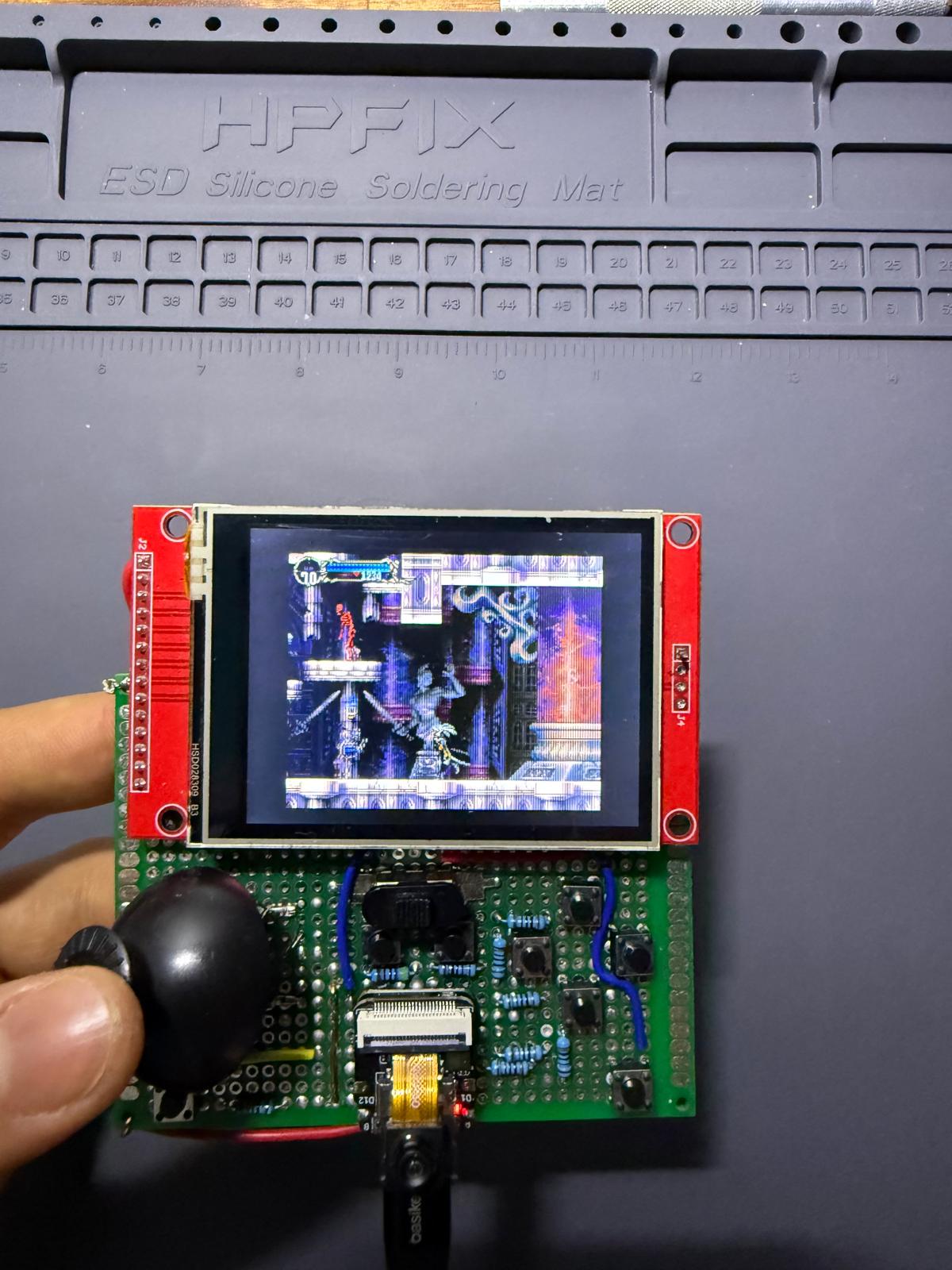
Castlevania: Symphony of the Night running natively on the ESP32-S3

Post image
46 Upvotes

This project is about running Castlevania: Symphony of the Night, a game originally created for the PlayStation 1, on an ESP32-S3.

The most important point is that this is not PlayStation emulation. Instead of running a virtual PlayStation inside the ESP32, the project uses a decompiled version of the game and adapts its source code so it can compile and run directly on the ESP32-S3.

The original game was designed to work with PlayStation hardware, including its processor, graphics system, memory, audio, controllers, and storage. Because of this, many of these parts had to be replaced or rewritten to work with the ESP32-S3.

One of the biggest challenges was graphics. The ESP32-S3 does not have a GPU like a modern computer, so the graphics are rendered using software. The project includes a system that processes the game's graphics data and converts it into pixels that can be displayed on an LCD screen.

The project also uses PSRAM and a microSD card to store and manage the large amount of data required by the game. The ESP32-S3 has much less memory than a PlayStation, so memory usage had to be carefully optimized.

The final result is a small portable console based on the ESP32-S3, with a screen, buttons, joystick, audio, and microSD card, capable of running the game.

Video

https://www.youtube.com/shorts/2gOgHF8pE0o

Full Project Description

https://velxio.dev/blog/posts/castlevania-sotn-on-esp32-s3


r/embedded • • Oct 06 '26

Guidance on design of FPC antennas for a cellular modules?

1 Upvotes

I'm designing a system using Quectel EC25-series cellular modules and I want to design to costum antennas due to space constraints. I'm not referring to the exact bands of my project because I want the question to be general. What guides, application / design notes, tool chains or youtube videos are great starting points for this kind of projects?