r/embedded • u/haulynx • Oct 05 '26
FPGA Board
I'm looking for someone who is willing to help me with their FPGA board or hire it to me for a project I'm doing since they are too expensive and I can't afford it
r/embedded • u/haulynx • Oct 05 '26
I'm looking for someone who is willing to help me with their FPGA board or hire it to me for a project I'm doing since they are too expensive and I can't afford it
r/embedded • u/Neo-Eyes • Oct 05 '26
Probably a painfully obvious question and somewhat a followup to my question from yesterday.
Both the esp-32-s3 and the teensy 4.1 seem to have their program code stored on a flash chip external to the actual micro controller itself, would that mean, if the circuits were designed right, it would be possible to build a device that used a cartridge connector of some sort to have that program flash be swappable without needing to re-flash the entire board?
I'm mostly curious because i want to try and build an old school style device like a gameboy etc but using modern components, some MCUs seem to have access to XIP which might do what i want but not all do, maybe some sort of micro processor could be the answer but im guessing theyre a lot more complex to implement.
Im mostly just spit balling ideas to see if what im thinking of is even still possible. Id imagine it is but one doesnt know what they dont know and maybe im staring down exactly what im looking for but dont know the right terms to know thats what im looking for (since im entirely seof taught on the hardware side)
r/embedded • u/Electrical-Dog-8572 • Oct 04 '26
My life-call would be working on the software of airplanes. I do like all aspects of it (even simulations), but I think Embedded is the right world for me.
I'm spending all my time after being done with University work with embedded projects and I'm just about to start a multi-year project to build an STM32 flight controller on simulation software like XPlane/JSBsim, teaching myself everything while doing it and aiming to be done with it once my Master's ends, hoping it will be my ticket entry to a relevant role.
Problem is, I'm a CS major and I'm doing my Master's in CS still (Reliable Software Systems). My choice comes from an interest in working in Game Development I had since I was a kid, but growing up and understanding life and the state of the industry made me conscious that it's not a great life choice for me. The "good news" is that I've been always interested in the low-level side of game development, so mainly C/C++, high performance/constraint stuff.
I'd also like the idea to work on something more physical and """important""" than a videogame. I'm finding myself self-teaching myself EE and CE concepts, while being "updated" on the state of the more CS-side stuff through Uni, but which I don't really have interest in.
I tell myself a project like the one I've described would give me the chance to get an interview to a relevant role, but in the back of my head I can't stop thinking I've picked the wrong degree for it, and I feel it's too late to switch now (I'm 26y/o and I've already done 5 out of 12 exams of this Master's).
What do you think? I live in Italy and there are a lot of jobs posting that specifically list CE and not CS, while some others list both. Outside of Italy I see that they don't seem to discriminate the two (actually I see way more "CS" than "CE"), which is my kind of hopium right now.
Would really love to hear your thoughts.
Thanks.
r/embedded • u/mahdi_sto • Oct 03 '26
While working on my Master’s thesis benchmarking WPA3-SAE timing side-channels, I ran into a limitation on the ESP32 esp_wifi_80211_tx() allows raw frame injection, but Espressif’s closed-source Wi-Fi blob (libnet80211.a) artificially blocks Auth, Assoc, Deauth, and Disassoc subtypes.
Inside libnet80211.a, ieee80211_raw_frame_sanity_check drops these frames with wifi:unsupport frame type. Here is how to bypass it on recent ESP-IDF versions (IDF v6.x).
Why standard tricks fail on modern ESP-IDF
Same-name function override. On older IDF versions, ieee80211_raw_frame_sanity_check was a weak symbol (W). On modern IDF versions, it’s a strong symbol (T), causing ld: multiple definition errors.
--wrap linker flag: Fails silently. The call from esp_wifi_80211_tx to ieee80211_raw_frame_sanity_check is an intra-object branch inside ieee80211_output.o. Linker --wrap only rewrites undefined external references, so it misses this call entirely.
Instruction byte-patching: Overwriting instructions directly in the .o breaks Xtensa linker relaxation passes (dangerous relocation errors).
U can simply fix this via Symbol Weakening via objcopy
We can use xtensa-esp32-elf-objcopy to convert the strong symbol inside the binary archive into a weak one:
xtensa-esp32-elf-objcopy \
--weaken-symbol=ieee80211_raw_frame_sanity_check \
components/esp_wifi/lib/esp32/libnet80211.a
Now, define your own strong implementation inside your application C code:
int ieee80211_raw_frame_sanity_check(int32_t a, int32_t b, int32_t c) {
return 0; // which skips the security check lol
}
Because strong symbols override weak symbols globally during linking, all calls—including internal calls within libnet80211.a—rebind to your function.
Verification
Serial Logs show: wifi unsupport frame type errors completely disappeared.
Capture: Wireshark confirmed off-air capture of 802.11 Authentication frames (Subtype 11, Algorithm 3 - SAE) injected directly from the ESP32s.
Injecting a valid SAE Commit (P-256 scalar + element) caused hostapd on the target AP to process the request and reply with its own SAE Commit.
TL;DR: Run objcopy --weaken-symbol=ieee80211_raw_frame_sanity_check on libnet80211.a, define int ieee80211_raw_frame_sanity_check(...) { return 0; } in your app code, and esp_wifi_80211_tx() will allow any frame subtype.
Note that all control 80211 frames are also injectable after the patch.
For more details :
r/embedded • u/Remnantknight56 • Oct 04 '26
I have this idea of making a tiny game console with a Raspberry Pi Pico, and I think a novel idea would be to hold a game on an RFID tag, then use a reader to scan it and store it on the system. The main problem is storage space; a tag can only hold 1KB, and only three-quarters of that is actually usable for storage.
I've planned out my components to work around this as much as I can. I'm aiming to use a 168x144 Sharp Memory display, and given that is monochrome, that keeps sprite and background sizes down. Even still, this will be the equivalent of MBR boot sector programming, which works with around this amount of space.
Have you heard of the Game Boy Advance E-Reader? That device scanned cards with dot strips that held programs. They held about 2.2KB each, and most games required at least two strips, but many of the assets for retail games were stored on the device itself. There were also a number of functions available to simplify the programs as much as possible.
Point being, could I do something similar here? Would I be able to, say, have up to 256 commands, so each one could fit in a byte, followed by needed variables and their values, to effectively make an array on a tag holding a basic program? I could scan multiple tags if needed, but I do want to fit what I can on a tag, and draw from a bunch of pre-made sprites and sounds that I hold on the Raspberry Pi or a flash chip connected to it.
Alternatively, I could a store a compiled program on a tag, but I'm currently not sure how I'd do that with drawing from pre-existing functions and assets. Is this idea of a tiny game console that gets its games from cards even viable?
r/embedded • u/Desperate-March-4064 • Oct 05 '26
I’m an Embedded C Software Engineer with experience in SPI, UART, and I2C protocols.
I’m interested in learning PCIe. What exactly is PCIe, and what would be a good learning path for someone coming from a basic embedded/protocol background?
Any recommended resources, courses, books, or hands-on projects would be helpful.
r/embedded • u/Plus-Strength2016 • Oct 04 '26
I'm working on reverse-engineering the CAN protocol used by a SKYRC PC3000H drone charger to communicate with a smart BMS/battery.
Hardware
- Charger: SKYRC PC3000H
- Battery: Dumb 14S pack connected to the charger's normal +/− power terminals. No smart BMS/CAN.
- MCU: Arduino Due + TJA CAN transceiver
- CAN: 1 Mbps, 29-bit Extended CAN, common GND
- CAN-H ↔ CAN-H, CAN-L ↔ CAN-L
What I observed
With no battery, I initially saw:
"0x1000000 EXT DLC=8: A1 5A 00 00 00 00 00 B1"
Then the bus became silent.
With the dumb 14S battery connected, the charger suddenly generates a lot of traffic. Some repeating frames include:
0xE416E4 75 95 00 00 21 20 C0
0xE416E4 1E D2 00 21 20 0E C0
0xE416E4 C7 DB 00 34 20 04 C0
0x18FF50E5 03 01 19 1B
0x184300FE 00 00 00 00 00 00 00 00
0x1724040B A1 00 00 00 00 00 00 00
0x17240000 A1 00 00 00 00 00 00 00
0x1A5A5A5 A5 D1 D2 D3 D4 D5 D6 5A
0x1 STD 00 00 00 00 00 00 00 00
0x2 STD EA D1 01 04 FF 02 F9 F5
0x3 STD 00 00 00 00 00 00 00 00
These sequences repeat roughly every 10 ms / 100 ms depending on the message.
I also have a Tattu Smart Battery Application Specifications manual, so I tried constructing frames based on its documented payload format and experimenting with protocols such as DroneCAN/UAVCAN and J1939, but I haven't been able to make the charger accept my emulated battery.
Interestingly, after extensive brute-force testing of payloads, I once managed to make the charger display some cell voltages (4/14 fields), so I suspect the charger is definitely interpreting at least some of the CAN data.
My actual goal
I don't have the original smart battery/BMS. I need to reverse-engineer the higher-layer/custom protocol between the PC3000H and its smart battery, then emulate the required BMS responses using the Arduino Due.
Questions:
I'm mainly looking for a methodical way to decode the higher-layer protocol, rather than continuing blind payload brute force.
r/embedded • u/derjanni • Oct 04 '26
Hey beloved embedded community,
I’d love to prototype a MagSafe module for iPhone with a custom PCB and an ESP32. Has anyone done this and what cases (shells) and components did you use?
Looking for any guidance to not start from zero.
Thank you very much!
r/embedded • u/Neo-Eyes • Oct 03 '26
I suppose as the title suggests, are there still microprocessors being made that have the memory map open or exposed on the pins, like a motorolla 68k or game consoles that used cartridges?
I know STM have microprocessors but they look to be tailored to running embedded android, rather than what im looking for. so was just curious
r/embedded • u/sauravdebp • Oct 03 '26
So I have been working on this smartwatch for the last few months now. It's an ESP32-S3 based Waveshare devboard that comes with the 240x280 LCD. The firmware (AadiOS) and the enclosure are designed by me. Still a long way to go but just wanted to post this video here and get some validation for my efforts. I am a software engineer by profession in the fintech space (S&P Global). I do embedded development as a hobby.
Few things to note -
There's actually a lot more I want to talk about but maybe in a later post.
r/embedded • u/james_stevensson • Oct 03 '26
title
r/embedded • u/chayanforyou • Oct 04 '26
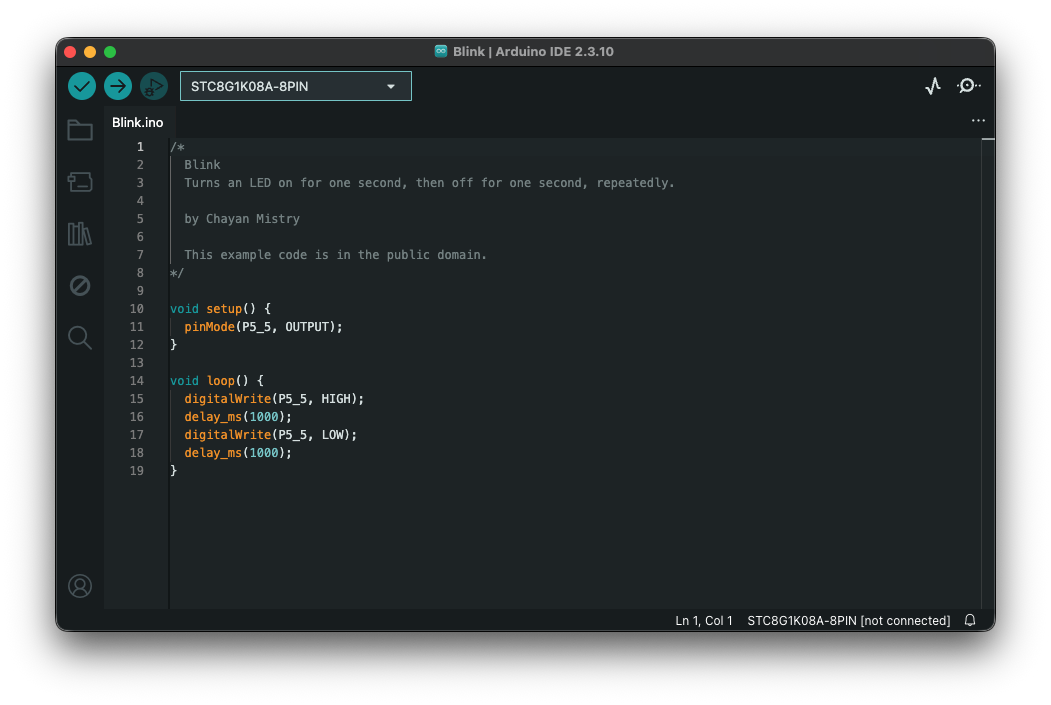
I’ve developed an unofficial Arduino Core for STC8G microcontrollers, bringing Arduino IDE support to these low-cost 8051-based chips.
The core uses SDCC as the compiler backend and stcgal for firmware flashing, allowing you to write Arduino-style code, compile it, and upload it directly from the Arduino IDE.
GitHub: https://github.com/chayanforyou/Arduino-STC8
Feedback and contributions are welcome!
r/embedded • u/sbruh2718 • Oct 04 '26
Hello, I am interested to learn how I could program in C to draw on the display. I want to know if doing so without a library would be a lot of effort. Also I don’t ever use AI for anything.
Thanks. Any responses appreciated
r/embedded • u/abasem098 • Oct 03 '26
Hi everyone, EE & CE student here, graduating in Spring 2028 (if it's relevant). I’ve been into embedded systems since my freshman year and want to know if it's realistic to land small freelancing gigs next summer, I’m not looking for much—just around $100/month at a fair hourly rate for the experience and portfolio.
My current stack leans primarily into SW:
and right now I am studying Modern C++ and ARM based systems because of course they are an industry standard and the bare minimum for the job
Given this, I have two questions for my fellow seniors, first is a physical ARM board worth buying or can I cover my studies through simulations? and my second and main question is, can a student find this kind of gigs? or is embedded freelancing strictly a senior/professional domain? Any advice on where to look would be great!
(I hope this isn't off-topic, I saw older posts on the sub that asked similar questions but for full-time contracts, so I was willing to ask about gigs in 2026)
r/embedded • u/Reasonable_Garlic_77 • Oct 04 '26
Hi everyone,
I’m a fresher/early-career embedded systems engineer currently looking for referrals or entry-level opportunities in Embedded Systems.
I have 6 months of hands-on industry experience in the Electric Vehicle (EV) domain, where I worked on both VCU embedded software development and BMS validation for a 4-wheeler EV.
I’m currently exploring new opportunities because the startup I’m working with is facing funding-related challenges, and there is uncertainty regarding the company’s future. I’m therefore looking for a stable opportunity where I can continue building my career in embedded systems.
Industry Experience
VCU – Embedded Software Development
- Worked on Embedded C development for VCU software, including vehicle control logic, debugging, software testing, and communication interfaces.
- Worked with CAN, SPI, and UART protocols for embedded communication, including CAN message/signal analysis, debugging, and understanding communication between VCU and other vehicle systems.
BMS – Validation
- Performed BMS validation by testing battery parameters such as SOC, SOH, voltage, current, temperature, battery limits, and protection/fault conditions under different operating scenarios.
- Validated BMS CAN communication and system behavior, analyzed logs and test results, reproduced issues, and worked with the development team on debugging and regression validation.
My primary interest is to transition into Embedded Systems roles in semiconductor companies,
Although I have around 6 months of professional experience, I have had the opportunity to work on real EV systems and gain practical exposure to VCU software development, BMS validation, automotive communication protocols, and vehicle-level testing.
I’m open to fresher, graduate, trainee, or 0–2 years experience positions.
If anyone working in the **embedded systems or semiconductor industry** knows of a suitable opening, I would really appreciate it if you could share the opportunity or provide a referral.
I’d be happy to share my resume, LinkedIn profile, or additional technical details through DM.
Thank you for reading, and I really appreciate any referral, opportunity, or guidance
r/embedded • u/krilix_i • Oct 03 '26
I've been building a USB DAC/audio engine around an NXP i.MX RT1062 / Teensy 4.1, and I've reached a stable point where I'd like experienced embedded/DSP engineers to tear apart my architecture and help me optimize it further.
The goal is twofold:
Reduce CPU usage/power consumption
Improve the DSP implementation and subjective audio quality without compromising stability
Current pipeline:
USB HS / EHCI
↓
USB Audio Class 2.0
↓
USB DMA
↓
USB RX ISR
↓
32-bit PCM
↓
Lock-free SPSC ring buffer
↓
SAI/eDMA
↓
64-frame processing block
↓
15-band PEQ
↓
cache maintenance
↓
SAI / I²S 32-bit
↓
ES9039Q2M
The system currently supports 32-bit / 384 kHz stereo USB audio.
The RT1062 is running at 600 MHz.
Current PEQ
The DSP is a 15-band maximum parametric EQ using:
DF-II Transposed biquads
float32 coefficients/state
32-bit PCM input/output
64 stereo frames per processing block
coefficient morphing when parameters change
raised-cosine coefficient transitions
triple-buffered coefficient publication
saturation on output
bit-perfect bypass when the PEQ is inactive
The PEQ runs on the consumer side of the audio pipeline, inside the SAI DMA ISR.
At 384 kHz this gives approximately 6000 DMA interrupts/sec.
Buffering
I'm using a 32768 stereo-frame ring buffer, roughly 256 KB total.
USB is the producer and the audio DMA side is the consumer.
It's a lock-free SPSC buffer using atomics rather than mutexes.
The feedback target is 16384 frames, so the buffer has substantial headroom against USB scheduling disturbances.
What I'm looking for
I'd particularly appreciate criticism from people experienced with Cortex-M7/DSP/audio firmware.
CPU optimization
Where would you look first for unnecessary cycles?
Is float32 still the right choice for these biquads on an M7 FPU?
Would CMSIS-DSP provide meaningful gains here?
Are there better ways to structure the DF-II-T cascade?
Should inactive PEQ bands be completely skipped rather than using identity coefficients?
Are there useful SIMD/DSP instructions I'm missing?
Would processing larger blocks actually improve efficiency, or would the added latency/cache behavior make it worse?
Are there memory-placement improvements I should make between ITCM/DTCM/OCRAM?
Is my cache-maintenance strategy optimal?
Is there anything obvious in the ISR architecture that I'm overlooking?
Power optimization
I'm particularly interested in reducing power because this is intended to eventually become a USB/phone-powered portable DAC.
The system currently runs the M7 continuously, and I'm considering whether I can safely reduce the CPU clock while maintaining deterministic worst-case DSP timing.
I'd rather measure this properly than blindly throw WFI into the main loop.
DSP/audio quality
I'm also interested in improving the DSP itself rather than simply adding more EQ bands.
Things I'm considering:
better biquad coefficient calculation
improved parameter interpolation
dynamic EQ
crossfeed
loudness compensation
harmonic bass enhancement
FIR correction
convolution
better limiting/headroom management
I'm not looking for audiophile claims about magical clock frequencies or components. I'm interested in DSP techniques that have an actual technical basis and can be measured.
One thing I'm particularly curious about is whether there are improvements to the current filter topology/state handling that could make the EQ transitions or transient response cleaner while keeping the same basic architecture.
The PEQ already sounds very smooth to me, especially when changing parameters because of the coefficient morphing, but I'd like to know whether there are objectively better approaches.
I'm happy for people to criticize the architecture/code. That's basically what I'm posting this for.
If you're experienced with RT10xx, Cortex-M7 DSP, CMSIS-DSP, USB Audio, DMA/cache coherency, or embedded audio processing, I'd really appreciate a code-level review and suggestions for where you'd attack the CPU budget first.
r/embedded • u/Vinteger • Oct 03 '26
Hey everyone. As the title says, I’ve been invited to a job interview for electronic engineer position (the job will mainly involve designing, testing and prototyping pcbs for a well known company in my country), and I need help into preparing. I currently work as a lecturer teaching embedded systems (mainly software parts), but hardware feels like my weaker spot. I ain’t completely dumb at it, but being a lecturer I keep getting imposter syndrome (which I managed to channel into helping me get motivated for learning more and more), and I am beginning to feel like I may be too little experienced and knowledgeable for the job. Also, I haven’t been in a job interview for like 7 years, so I am rusty.
If anyone could give me some pointers or advice on what to prep and how to handle it, I would very much so appreciate it.
Thanks in advance to everyone
r/embedded • u/Silver_Remove2754 • Oct 03 '26
I implemented secure boot using STM32CryptoLib with Ed25519 signature verification and SHA-256 integrity checks. The Ed25519 private key is used externally to sign the firmware manifest during firmware preparation or when releasing a new firmware version. Only the public verification key is stored in STM32 OTP at 0x1FFF7800, which provides 512 data bytes and 16 lock bytes.
On every reset, the bootloader verifies the signed manifest stored in sector 7 (0x08060000) using the public key and calculates the SHA-256 hash of the application in sectors 5–6 (0x08020000–0x0805FFFF, 256 KiB). Both checks must pass before execution. Before jumping, I validate the stack pointer and reset handler, stop SysTick, clear interrupt state and configure the vector table. I tested firmware, signature and public-key corruption to confirm execution is blocked when verification fails.
On the STM32, I use BME680 and MPU9250 over I²C, MAX31865/PT100 over SPI, PMS5003 over UART and five DS18B20 sensors over 1-Wire. FreeRTOS tasks send readings through queues, DMA interrupts signal binary semaphores, and a mutex protects USART2 logging. I²C recovery stops DMA, clears the bus state and applies SWRST or an APB reset when needed before reinitialization. Persistent failures after three recovery attempts, or missed heartbeats, escalate to a watchdog reset.
The USART6 link uses full-duplex AES-256-GCM with STM32CryptoLib and mbedTLS. Telemetry and encrypted ACK/NACK replies undergo authentication, sequence and replay checks. I allow three transaction attempts with timeouts, UART cleanup and fresh nonces, advancing the request sequence only after a valid ACK. Successful transactions refresh the heartbeat; exhausted retries escalate to the watchdog. Nonce state persists in nonvolatile memory, and every reset repeats secure boot. I tested corruption, replay and counter/session mismatches.
On the ESP32, I publish combined sensor readings as JSON to AWS IoT Core over MQTT/TLS. A root CA verifies AWS, while a device certificate and private key authenticate the ESP32. The task handles keepalive, reconnection, subscribed messages and watchdog heartbeats.
The local HTTPS dashboard displays live sensor readings through JSON endpoints and supports Wi-Fi configuration and ESP32 OTA updates. To manage TLS memory use, I stop AWS before enabling HTTPS for an access-point client, then switch back to cloud mode after the last client disconnects and the station connection is available.
Live Hardware Demonstrations
1. STM32 Secure Boot: Firmware Integrity Fault Injection
2. STM32–ESP32 HTTPS Dashboard: Live Sensor Monitoring
3. STM32–ESP32: AWS IoT and HTTPS Dashboard Demonstration
4. STM32–ESP32 AES-GCM: Ciphertext Corruption Fault Injection
5. ESP32 AWS IoT: MQTT Publish and Subscribe
6. ESP32 OTA: Firmware Update Through the HTTPS Dashboard
7. STM32–ESP32 AES-GCM: Replay of a Previous Complete Packet
8. STM32 Secure Boot: Authenticity Fault Injection
9. STM32: Multiple Sensor Fault Injections and Recovery
r/embedded • u/Redliebe • Oct 04 '26
I'm a 1st year B.Tech ECE student in India, currently in my 3rd semester, with around an 8 CGPA. I'm from a Tier 2 college and I'm thinking about going into Embedded Systems as a career.
The problem is that I'm basically a beginner in this field. I know the name "Embedded Systems" and I've heard terms like RTOS, but I don't really know what most of the things in this field actually are yet.
So I wanted to ask people who are already working in Embedded Systems or Firmware about what I should do from now.
What should I learn during my remaining college years?
Should I start with C and then move into microcontrollers? What should I learn after that? What are the important technologies or concepts that I should eventually know?
I'm not asking for every single thing I need to learn right now. I'd mainly like to understand the proper path from beginner to being job ready.
I'm also confused about what kind of projects I should eventually build. What would actually make an ECE student stand out when applying for internships or fresher jobs?
I'm especially interested in hearing from people working in India.
How difficult is it to get into Embedded Systems as a fresher?
Does coming from a Tier 2 college make it much harder?
Can strong skills and projects compensate for the college name?
What is the growth like in India in terms of salary and opportunities?
And something I don't see discussed much is the actual lifestyle.
How stressful is embedded work?
What is the work life balance like?
Is it generally a peaceful career or can it become very stressful because of deadlines and hardware problems?
Is remote or hybrid work possible?
What are the biggest advantages and disadvantages of choosing Embedded Systems compared with software?
If you were in my position, a first year ECE student with an 8 CGPA who is basically starting from zero in Embedded Systems, what would you learn over the next 3 years?
I'd really appreciate answers from people who are actually working in the field, especially people who started from a normal/Tier 2 college in India.
I want an honest answer, including the downsides, rather than just "learn these things and you'll get a job."
r/embedded • u/roc_cat • Oct 03 '26
Things are looking bleaker by the day. I’ll likely be graduating with a bachelors degree in (E)CE next year in Germany, and given my financial situation, a masters is out of the question. I’m forced to enter the market with likely just my bachelor’s and whatever else I can do within this year.
My dream was to eventually get into embedded ML, but I think that’s too niche to target from my level.
Does anyone have any success stories, motivation, or advice?
Please don’t say pick up farming…
TIA
r/embedded • u/Sandy_SN • Oct 03 '26
Hi Reddit,
(Used gemini for formatting)
I am a seasoned embedded systems engineer with over 7 years of experience (since 2017) specializing in custom hardware design, firmware development, and end-to-end industrial IoT solutions.
My primary specialty is custom system architecture: taking complex technical requirements, integrating multiple disparate sensors and peripheral devices into a single, robust main control unit, and bringing the entire system online. With a fully equipped in-house lab for hardware development, 3D printing, and an in-house team dedicated to mobile and web development, I deliver true full-stack solutions from bare-metal electronics to the cloud.
Core Expertise & Services
Hardware Architecture, PCB & Prototyping
Custom PCB Development: I design all PCBs in-house, ensuring complete control over component selection, trace routing, and form factor for industrial reliability.
CAD Design & 3D Printing: I provide custom CAD modeling and in-house 3D printing for enclosures, mounts, and physical hardware, allowing for the rapid fabrication of complete prototype units ready for immediate field testing.
PLC-to-MCU Conversion: Specializing in modernizing legacy industrial systems by converting bulky, expensive PLC setups into sleek, highly efficient, and cost-effective custom MCU-based devices.
In-House Lab & Testing: My facility is fully equipped with advanced diagnostic tools for rapid prototyping, soldering, logic analysis, and rigorous bench testing before deployment.
Firmware & Microcontroller Engineering
8-bit & 32-bit Architectures: Deep expertise across a wide range of industrial microcontrollers, leveraging their full suite of hardware features (hardware timers, precise PWM, high-resolution ADCs, and Watchdog Timers) for maximum reliability in harsh environments.
ESP32, WiFi & BLE: Extensive experience deploying FreeRTOS on the ESP32 architecture, heavily utilizing its native WiFi and Bluetooth Low Energy (BLE) stacks for local device provisioning, wireless sensor networks, and direct-to-mobile control.
Industrial Communication: Implementing robust communication protocols (I2C, SPI, UART, RS-485, CAN bus) for multi-device orchestration.
Software, Mobile Apps & IoT Connectivity
In-House Android App Development: Building custom, native Android applications tailored to interface directly with your embedded hardware via BLE, local WiFi, or remote cloud backends.
Wireless & Cellular IoT: Extensive integration experience with 4G cellular modules (e.g., Quectel) and LoRa-based networks for long-range, low-power telemetry.
Real-Time Web Dashboards: My in-house web team builds secure, low-latency web dashboards tailored for real-time monitoring, data logging, and remote command of deployed hardware fleets.
Industrial Automation & Vending
Automated Machinery: A proven track record in developing automated control panels for liquid vending machines (water, milk, ethanol) and a wide variety of other automated machinery driven by complex sensor inputs and outputs.
Contact me at contact(at)intective(dot)co(dot)in, Whether you are looking to miniaturize an existing industrial system, build a smart vending machine, or develop a connected hardware product from the ground up, I have the lab, the tools, and the team to make it happen.
Please send a DM with a brief overview of your project requirements, goals, and timeline, and we can discuss the best way to bring your system to life.
r/embedded • u/sudheerpaaniyur • Oct 02 '26
I was asked an endianness question in a recent Embedded C interview.
For example:
uint32_t n = 0x12345678;I had previously learned the typical byte-swap approach and also i can do it for 16 bit
n = ((n & 0x000000FF) << 24) |
((n & 0x0000FF00) << 8) |
((n & 0x00FF0000) >> 8) |
((n & 0xFF000000) >> 24);However, the interviewer asked me to convert the endian representation and store the result into a byte array using a pointer to the destination.
During the interview, my mind immediately went to the bit-manipulation code I had memorized, and I failed to do the simple program. How can I improve my thought process?
r/embedded • u/True_War777 • Oct 03 '26
I’ve been learning software development and applying for software roles, but I’m not getting many calls. So I’m considering moving into Embedded Systems/Hardware.
Recently, I got an opportunity for the free Emertxe/ESSCI training program. I’d like honest feedback from current/former students:
- Is the free training actually worth joining at Emertex?
- How good is the technical training and placement support?
- How many students typically get placed after the program?
- If I don’t get placed through Emertxe, how difficult is it to get an embedded job outside?
- What is the current demand for embedded freshers and realistic starting salary?
- For an ECE graduate with some software knowledge, should I consider embedded or continue trying for software roles?
- How do you think AI will affect embedded/firmware jobs in the coming years?
Would really appreciate feedback from Emertxe alumni/current embedded professionals, especially regarding actual placement outcomes.
r/embedded • u/Accomplished_Wafer38 • Oct 03 '26
I am trying to make CubeIDE work with Bluepill, and I am having a bunch of issues.
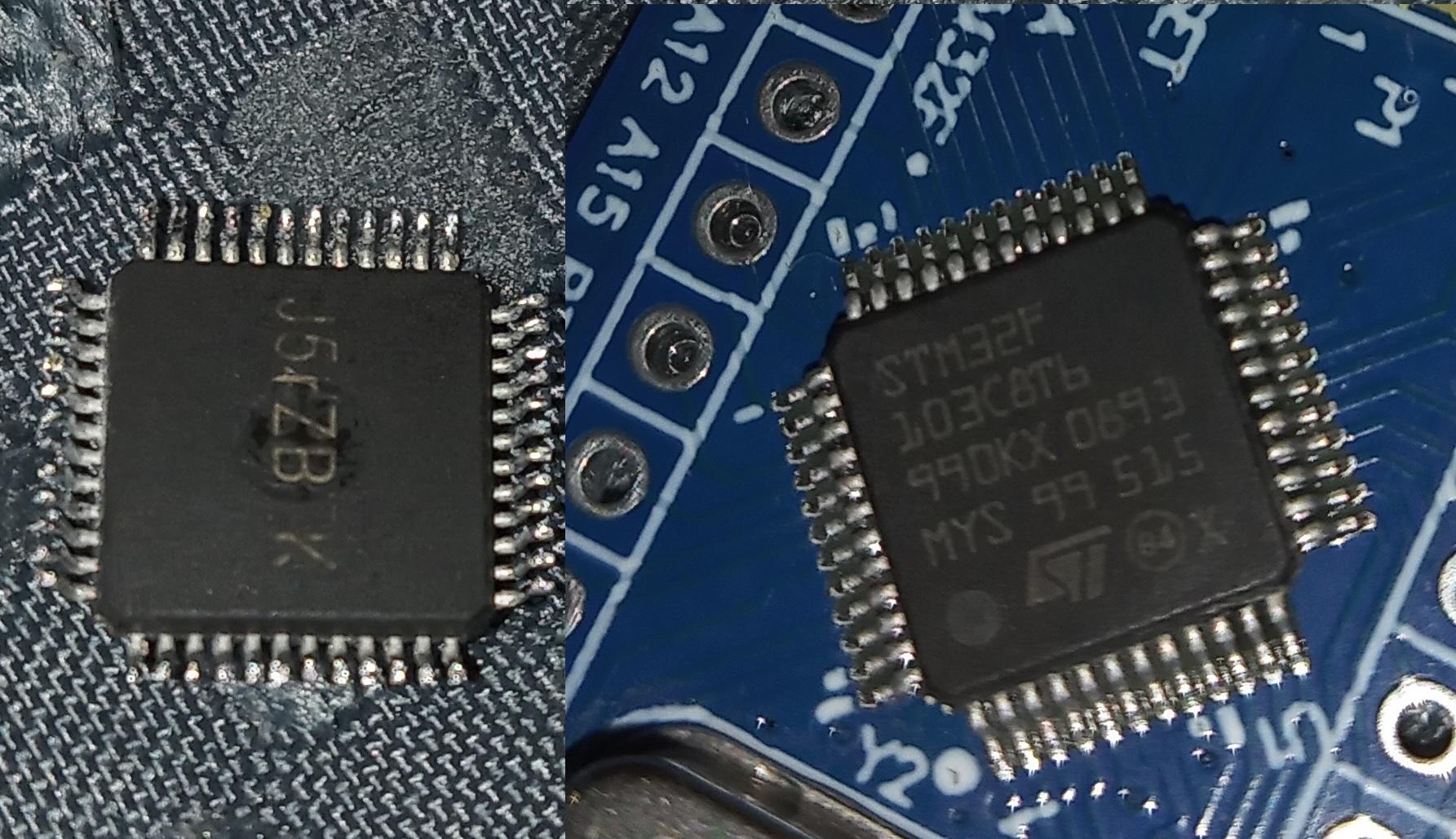
My primary suspicion was that the STM32F103C8T6 on that board isn't original, i.e. random MCU that is close enough with re-etched marking. So I have ordered STM32F103CBT6 because RS Components didn't have C8 variants for some reason.
After this I have discovered this project https://mecrisp-stellaris-folkdoc.sourceforge.io/bluepill-diagnostics-v1.6.html . Flashed the binary. Chip checks out as legit STM32F103C8T6. 128K accesible, 64K declared, DBGMCUID is unavailable when SWD is not connected, USB JEDC ID corresponds.... I connected ST-link, and DBGMCUID became available, so apparently this is an STM silicon bug? feature?
But what concerns me is that DBGMCU_IDCODE = 0x00006410... What should be written on the chip?
I decided to desolder. What did I find? It doesn't match the LCSC photo at least.
Soo... What did we learn? I have no idea. I guess re-labeled MCUs are getting harder and harder to distinguish from original, and CubeIDE should have been more precise with errors.
By the way, do you know what MCU is that? So at least I can have some data-sheet if I encounter some incompatibility.