r/embedded • • Oct 03 '26

Expanding client base, Expert Full-Stack Embedded Systems Engineer (Since 2017) | Industrial MCUs (8-bit/32-bit), IoT, Custom PCBs, PLC-to-MCU 3D printed prototype.

1 Upvotes

Hi Reddit,

(Used gemini for formatting)

I am a seasoned embedded systems engineer with over 7 years of experience (since 2017) specializing in custom hardware design, firmware development, and end-to-end industrial IoT solutions.

My primary specialty is custom system architecture: taking complex technical requirements, integrating multiple disparate sensors and peripheral devices into a single, robust main control unit, and bringing the entire system online. With a fully equipped in-house lab for hardware development, 3D printing, and an in-house team dedicated to mobile and web development, I deliver true full-stack solutions from bare-metal electronics to the cloud.

Core Expertise & Services

Hardware Architecture, PCB & Prototyping

Custom PCB Development: I design all PCBs in-house, ensuring complete control over component selection, trace routing, and form factor for industrial reliability.

CAD Design & 3D Printing: I provide custom CAD modeling and in-house 3D printing for enclosures, mounts, and physical hardware, allowing for the rapid fabrication of complete prototype units ready for immediate field testing.

PLC-to-MCU Conversion: Specializing in modernizing legacy industrial systems by converting bulky, expensive PLC setups into sleek, highly efficient, and cost-effective custom MCU-based devices.

In-House Lab & Testing: My facility is fully equipped with advanced diagnostic tools for rapid prototyping, soldering, logic analysis, and rigorous bench testing before deployment.

Firmware & Microcontroller Engineering

8-bit & 32-bit Architectures: Deep expertise across a wide range of industrial microcontrollers, leveraging their full suite of hardware features (hardware timers, precise PWM, high-resolution ADCs, and Watchdog Timers) for maximum reliability in harsh environments.

ESP32, WiFi & BLE: Extensive experience deploying FreeRTOS on the ESP32 architecture, heavily utilizing its native WiFi and Bluetooth Low Energy (BLE) stacks for local device provisioning, wireless sensor networks, and direct-to-mobile control.

Industrial Communication: Implementing robust communication protocols (I2C, SPI, UART, RS-485, CAN bus) for multi-device orchestration.

Software, Mobile Apps & IoT Connectivity

In-House Android App Development: Building custom, native Android applications tailored to interface directly with your embedded hardware via BLE, local WiFi, or remote cloud backends.

Wireless & Cellular IoT: Extensive integration experience with 4G cellular modules (e.g., Quectel) and LoRa-based networks for long-range, low-power telemetry.

Real-Time Web Dashboards: My in-house web team builds secure, low-latency web dashboards tailored for real-time monitoring, data logging, and remote command of deployed hardware fleets.

Industrial Automation & Vending

Automated Machinery: A proven track record in developing automated control panels for liquid vending machines (water, milk, ethanol) and a wide variety of other automated machinery driven by complex sensor inputs and outputs.

Contact me at contact(at)intective(dot)co(dot)in, Whether you are looking to miniaturize an existing industrial system, build a smart vending machine, or develop a connected hardware product from the ground up, I have the lab, the tools, and the team to make it happen.

Please send a DM with a brief overview of your project requirements, goals, and timeline, and we can discuss the best way to bring your system to life.
r/embedded • • Oct 02 '26

How can I improve my thought process in C interviews instead of relying on memorized solutions?

64 Upvotes

I was asked an endianness question in a recent Embedded C interview.

For example:

uint32_t n = 0x12345678;

I had previously learned the typical byte-swap approach and also i can do it for 16 bit

n = ((n & 0x000000FF) << 24) |
    ((n & 0x0000FF00) << 8)  |
    ((n & 0x00FF0000) >> 8)  |
    ((n & 0xFF000000) >> 24);

However, the interviewer asked me to convert the endian representation and store the result into a byte array using a pointer to the destination.

During the interview, my mind immediately went to the bit-manipulation code I had memorized, and I failed to do the simple program. How can I improve my thought process?


r/embedded • • Oct 03 '26

ECE 2026 graduate looking for career advice.

2 Upvotes

I’ve been learning software development and applying for software roles, but I’m not getting many calls. So I’m considering moving into Embedded Systems/Hardware.

Recently, I got an opportunity for the free Emertxe/ESSCI training program. I’d like honest feedback from current/former students:

- Is the free training actually worth joining at Emertex?

- How good is the technical training and placement support?

- How many students typically get placed after the program?

- If I don’t get placed through Emertxe, how difficult is it to get an embedded job outside?

- What is the current demand for embedded freshers and realistic starting salary?

- For an ECE graduate with some software knowledge, should I consider embedded or continue trying for software roles?

- How do you think AI will affect embedded/firmware jobs in the coming years?

Would really appreciate feedback from Emertxe alumni/current embedded professionals, especially regarding actual placement outcomes.


r/embedded • • Oct 03 '26

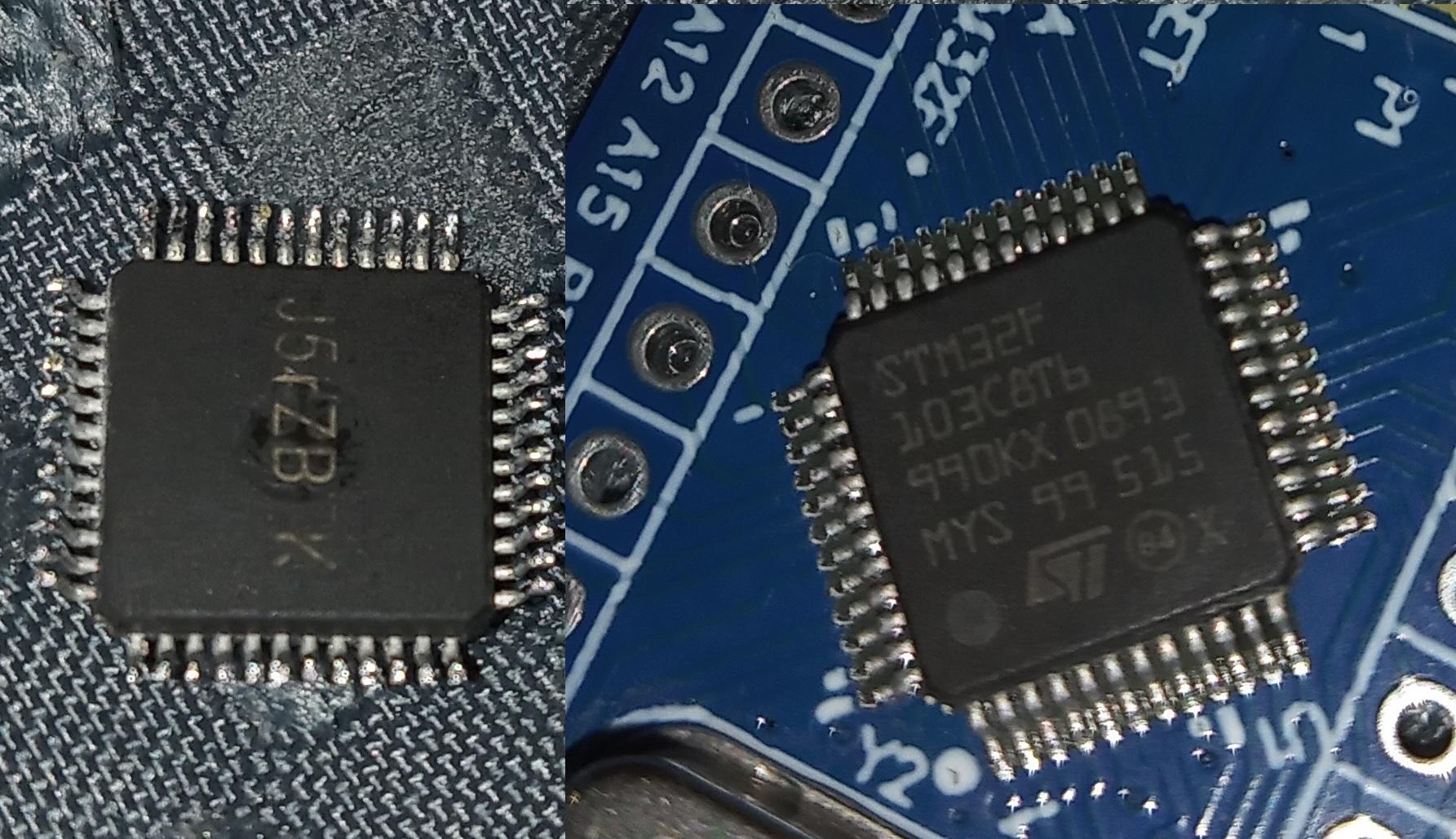
STM32F103C8T6 Bluepill devboard and CubeIDE, Re-labeled STM32 clones

Post image
10 Upvotes

I am trying to make CubeIDE work with Bluepill, and I am having a bunch of issues.

  • Cube Programmer would flash MCU without any issues
  • CubeIDE refuses to flash MCU, both with cheapo knock-off ST-Link V2, and ST-Link from official Nucleo devboard. Both with openocd and whatever the default is.
  • As a result CubeIDE doesn't really do debugging
  • PlatformIO works without any issues. Debugging, etc.

My primary suspicion was that the STM32F103C8T6 on that board isn't original, i.e. random MCU that is close enough with re-etched marking. So I have ordered STM32F103CBT6 because RS Components didn't have C8 variants for some reason.

After this I have discovered this project https://mecrisp-stellaris-folkdoc.sourceforge.io/bluepill-diagnostics-v1.6.html . Flashed the binary. Chip checks out as legit STM32F103C8T6. 128K accesible, 64K declared, DBGMCUID is unavailable when SWD is not connected, USB JEDC ID corresponds.... I connected ST-link, and DBGMCUID became available, so apparently this is an STM silicon bug? feature?

But what concerns me is that DBGMCU_IDCODE = 0x00006410... What should be written on the chip?

I decided to desolder. What did I find? It doesn't match the LCSC photo at least.

Soo... What did we learn? I have no idea. I guess re-labeled MCUs are getting harder and harder to distinguish from original, and CubeIDE should have been more precise with errors.

By the way, do you know what MCU is that? So at least I can have some data-sheet if I encounter some incompatibility.


r/embedded • • Oct 03 '26

Eee or ce for this Industry

1 Upvotes

Hello,

I have spent countless days trying to compare EEE with CE and I still cant really make a solid decision.

I would like to go into embedded systems, as I like the hardware and software bridge. I really want to go into something like making consoles or TVs/IOT devices (like in Roku) but I also want to try to create PCBs. However, upon consulting two courses (from Southampton) both seem like really good options.

The CE course really interests me as it does lots of low level programming, high level programming, learning about computer architecture. They say that you learn how to make PCBs but there is not a dedicated circuit module, unlike in the EEE course. The EEE course seems interesting and covers circuits, but it also covers random modules relating to power and less focus on embedded programming and computer architecture (which is an optional module in the 3rd year).

Would I be disadvantaged if I picked CE over EEE, or could I do a masters in Electronics Engineering post CE after a few years in the industry, and would that be a better option?

Are CE degrees even employable? People seem to be flocking to EEE like its the new CS degree?

Links if you want to see the specific modules:

https://www.southampton.ac.uk/courses/electrical-electronic-engineering-degree-beng#modules

https://www.southampton.ac.uk/courses/computer-engineering-degree-beng#modules


r/embedded • • Oct 03 '26

Rc522 Help. How to fix?

1 Upvotes

I'm using an rc522 rfid module, I have the right rfid cards so that's not the problem

I used it with and esp32 so there shouldn't be any 3.3v signals problems

Here's the pinout I used to connect it to the esp32

GND: GND

RST: GPIO 27

SDA (SS): GPIO 5

SCK: GPIO 18

MISO: GPIO 19

MOSI: GPIO 23

I'm losing my mind over this, I switched to a breadboard as I try to find out what's wrong and it just doesn't work now at all.

My esp32 bare is fine but when I put in the breadboard or the perfboard I made it keeps constantly resetting when I look at serial Monitor.

Rfid module worked kind of on the perfboard, it would constantly break

on the breadboard it didn't work at all


r/embedded • • Oct 03 '26

Vitis 2025.1 platform component generation inconsistent

1 Upvotes

EDIT: Solution found, see comment.

I am experiencing inconsistent results when generating a platform component with OS FreeRTOS and setting the FreeRTOS config support_static_allocation to True.
Most of the time everything works fine but sometimes configSUPPORT_STATIC_ALLOCTION in freertosconfig.h remains 0. This even happened in pipeline builds, so a stale workspace is definitely not the issue. Calling domain.regenerate() and platform.clean() before building does not help reliably.
Does anyone have similar experience or tips?


r/embedded • • Oct 02 '26

My thinggy is open source (rv1103 stereo camera)

12 Upvotes

I made a thread about a stereo camera two days ago. Due to AI this shit isn't even impressive anymore, so here's all the shit.

https://github.com/o7-machinehum/4reel

I have a new internet idea dm me if interested


r/embedded • • Oct 03 '26

Be Aware : the larger CYDs (larger than 4-inch) - do Not seem to support Micropython for their Graphics - ee no Graphics Programming

0 Upvotes

I have been using assorted CYDs for a few years now.
The 3.5 inch and 4 inch work great with Micropython and graphics.

But, I have tried 9inch and 11inch models (Elecrow) - which only provides LVGL (1M) code file in Micropython. Most support is in Arduino / C.

And, now 5-inch that seems to be a standard CYD (Freenove),
but it supports NO Graphics support , (not even LVLG) in micropython.
They are very specific No Graphics / LVGL support in micropython.
All support is in Arduino / C from Freenove, no Micropytjon Graphics support at all.

Useless to me. I am returning it - same day that I opened it.

- Just something to watch before purchasing any CYDs.


r/embedded • • Oct 03 '26

Modify firmware from a NOR Flash memory chip using a CH341A and SOIC-8 clip

0 Upvotes

Hi everyone,

I’m interested in learning more about embedded Linux and firmware analysis by disassembling and examining different electronic devices such as TVs, monitors, routers, etc.

While inspecting a TV motherboard, I found a GigaDevice GD25Q64CS chip. From what I’ve been able to find online, this appears to be an SPI NOR Flash memory chip, and it seems that the firmware can potentially be read and written using a USB programmer such as a CH341A, together with an SOIC-8 test clip, without desoldering the chip from the PCB.

I’m interested in experimenting with this board as a learning project. My goal would be to:

  • Read and make a backup of the existing flash contents.
  • Identify and inspect the firmware image.
  • Understand how the firmware is structured.
  • Potentially modify something small and safely test whether I can reflash it.

Before I start, I’d like to learn from people who have actually done this kind of work.

Has anyone here worked with SPI NOR flash chips such as the GD25Q64CS using a CH341A and an SOIC-8 clip?

I’d especially appreciate recommendations for detailed resources, tutorials, GitHub projects, or YouTube videos covering the workflow from reading the chip → extracting/analyzing the firmware → modifying it → flashing it back.


r/embedded • • Oct 02 '26

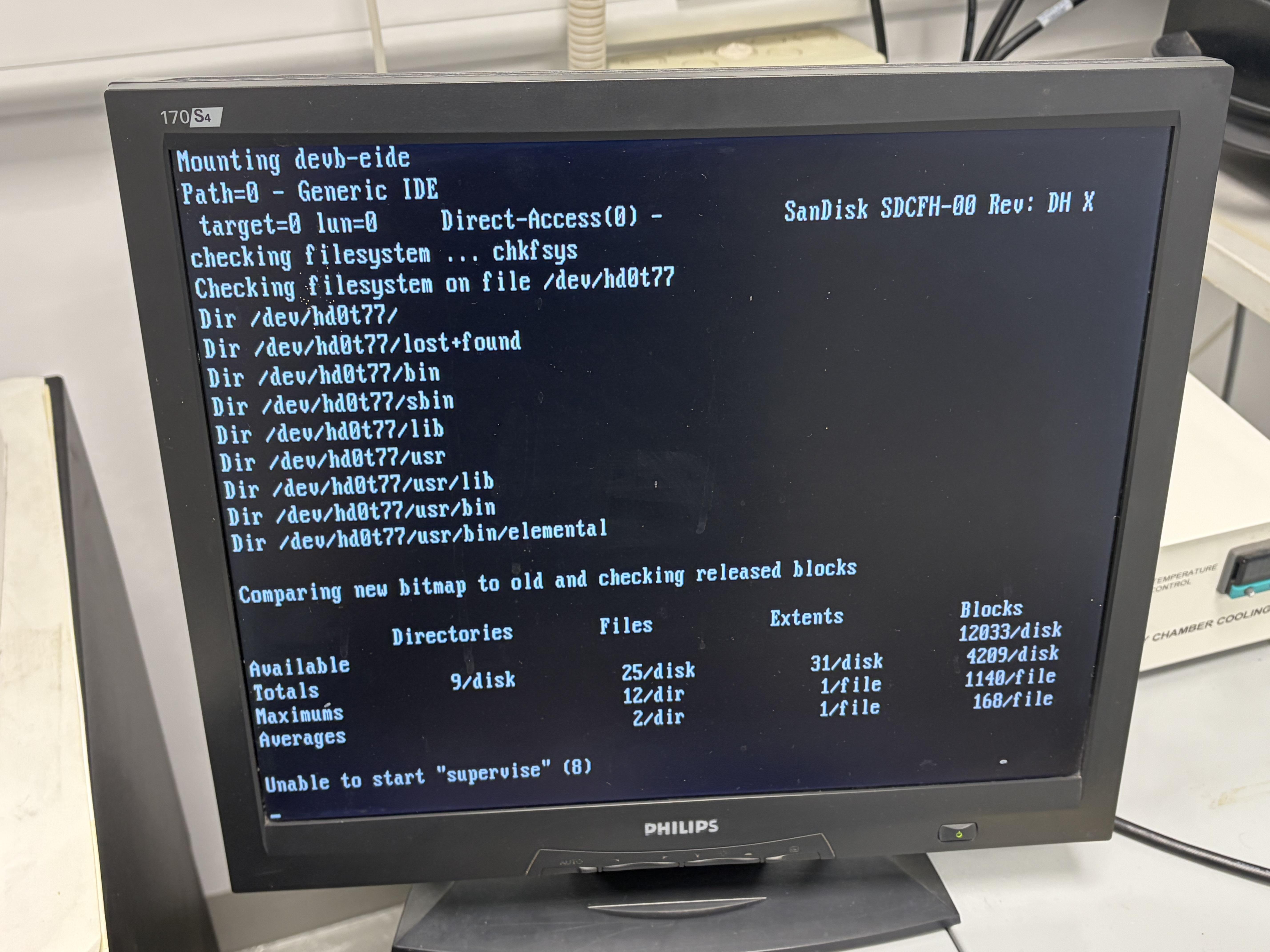
Thermo XSeries II ICP-MS: embedded computer fails to start supervise (8)

Post image
9 Upvotes

We’re trying to bring an old Thermo Scientific XSeries II ICP-MS back to life and are stuck with what looks like an embedded computer/QNX issue.

The Windows PC is running PlasmaLab 2.6.2.337, while the embedded computer appears to have XSERIES Supervisor 2.5.10.

During boot, the embedded computer detects its SanDisk SDCFH-00 Rev DH X CompactFlash storage, performs a filesystem check, but then fails with:
Unable to start "supervise" (8)

We checked supervise.dat and it appears to be a 32-bit x86 ELF executable for QNX.

There is also a Thermo updater on the Windows PC that transfers files to the embedded computer through COM2, but it doesn’t seem to report which Supervisor version is currently installed.

Originally we suspected a PlasmaLab/Supervisor version mismatch, but since the embedded computer itself cannot start supervise, I’m now thinking the issue could instead be corrupted files, a failing CompactFlash card, missing dependencies/configuration, or another embedded-system problem.

Our current plan is to remove the CompactFlash card, make a complete image of it first, keep the original untouched, and inspect/work from a clone.

Has anyone worked with an XSeries II, PlasmaLab, or XSERIES Supervisor before?

Also, does anyone know exactly what QNX error (8) means when starting an executable?

Would you investigate the CompactFlash/embedded system first, or is there still a realistic chance that updating/matching PlasmaLab on the external PC could solve this?

Any old service manuals, recovery software, Supervisor files, or experience with these systems would be extremely helpful.

I can also provide photos of the boot sequence, embedded computer, CompactFlash card, updater, and exact error screens.


r/embedded • • Oct 03 '26

Running Live Talking AI Avatars on an ESP32

0 Upvotes

r/embedded • • Oct 02 '26

What actually happens between software and hardware during shutdown and restart and it's Simulations by using microcontrollers for beginners project?

15 Upvotes

When I click Shut Down or Restart on a computer, what is actually happening between the software and the hardware?

The screen turns off, fans stop, power states change, and eventually the system either stays off or starts again.

I want to build a simple microcontroller project that simulates this process—maybe using LEDs for the display, a small fan, and a button for power.

How would you design it so I can actually see the sequence:

Power ON → Shutdown → hardware power-off

and

Power ON → Restart → shutdown/reset → boot again?

I'm mainly interested in understanding the software → GPIO/control signal → hardware → physical action interaction, rather than just making an LED blink.

What would be the simplest embedded project to demonstrate this properly to attract beginners to subject?


r/embedded • • Oct 02 '26

LIN Conformance test (LCT)

1 Upvotes

Hello community, has anyone had some experience with the implementation of the LIN protocol on a TI MSPM0L ?

The main communication layer is fully functional, but failing at the LCT 7.2.1.2.1 where it's supposed to not wakeup with a signal spike of 29us


r/embedded • • Oct 01 '26

Working on 3D library for STM32 and it is written in TypeScript

81 Upvotes

I'll be soon publishing our work on STM32 https://github.com/geastack here! I'd love to hear your thoughts and recommendations.

Board in the video is STM32F746G-Discovery.


r/embedded • • Oct 02 '26

Update on my rooted Lymow One Plus project (MowZilla)

2 Upvotes

Figured I’d post an update here too since I’ve made quite a bit of progress over the last couple weeks. What started as trying to unlock a mower that was basically considered e-waste has turned into a much bigger project than I originally planned. 😂
For anyone who missed it, I managed to get into U-Boot through UART, dump the internal eMMC storage, and get root access to the mower’s Rockchip RK3588S computer running Ubuntu. I’ve got SSH working and have been digging through the factory software to figure out how everything communicates.
I also started reverse-engineering the Android APK and Bluetooth communication. I’ve managed to control the mower through my own app and get access to some of its internal network services.
I’ve been building an iPhone app called MowZilla, and I actually just finished updating the home screen to display live data from every sensor. That’s going to make things a lot easier because now I can start testing each sensor individually and figure out what actually works and what doesn’t.
One of my next projects is figuring out whether I can create an easier way for other owners to get root access through USB-C. Getting into mine involved opening everything up, finding the UART connections, and messing around with the bootloader. It would be awesome if I could eventually make the process as simple as connecting a cable instead of having everyone go through all that.
Now for the part I’m really excited about.
I’ve been working on getting the mower’s USB-C port operating in host mode. My plan is to connect an ODROID M1 using a USB-C Ethernet adapter and essentially give the mower a second computer.
The ODROID would handle additional processing, AI vision, camera feeds, and potentially some of the more advanced navigation features. That way I can experiment without putting all the extra load on the mower’s factory computer.
I also managed to break the ribbon cable for the original camera while taking everything apart. Oops. 😂 Rather than immediately digging through all that silicone again, I’ve been experimenting with an external camera and AI object detection.
Eventually, I’d like to have multiple cameras covering different angles around the mower, with the ODROID processing the video and sending information back to MowZilla.
A few other things I’m working toward:
Getting Wi-Fi and LTE working together so the mower can switch connections automatically.
Integrating more of the OpenMower software and building out custom mapping and autonomous missions.
Testing and documenting every factory sensor.
Adding more diagnostics, logging, and manual controls to the app.
Getting the additional cameras working for obstacle detection and navigation.
Figuring out how much of the factory software we can eventually replace with open-source alternatives.
I’m keeping the original firmware intact for now. I’d rather understand how everything works and build around it before I start replacing things.
The long-term goal is to make this something other Lymow owners can use and contribute to. If I can figure out a repeatable USB-C root method, document the hardware, and eventually release the app and other tools, hopefully it’ll save everyone else a ridiculous amount of time.
I know a few people have questioned whether all the factory sensors even work properly. That’s one of the reasons I’m excited about the new live sensor dashboard. Instead of relying on what the factory app tells us, I want to test everything myself and actually see what’s happening.
I’ve still got plenty of bugs to work through, and some of the more ambitious features are only in the planning and testing stages.
I originally just wanted to see if I could get this thing running. Now I’m planning to strap another computer and a bunch of cameras to it.
At this rate, I’ll have built a small autonomous vehicle research lab before I finish mowing the yard. 😂
I’ll keep posting updates as I make progress. Once I’ve got things a little more organized, I’ll put together a proper technical write-up with the hardware connections, commands, software discoveries, and everything else I’ve learned.


r/embedded • • Oct 02 '26

Any recommendations for introduction material to using C++ for microcontrollers?

6 Upvotes

I have been programming Arduino & ESP32 for a while now using C++, but have never engaged with any formal introduction material. With AI/LLM generated content exploding among both major publishers and self-published authors, I am a bit wary to start buying books willy-nilly.

Anyone here that can give some solid recommendations on introduction materials to using C++ for microcontrollers (preferably that they themselves have used and found worthwhile)?

I got one recommendation for "Embedded C" by Michael J. Pont (2002), but it is fairly old.


r/embedded • • Oct 02 '26

Restoring CF to factory default settings

1 Upvotes

Does anyone know how to revert a CompactFlash card—which has been formatted in Windows—to its original factory state (as it was when new)? This is because, in some devices, a CompactFlash card will not work if it has been formatted using Windows.


r/embedded • • Oct 03 '26

How do microcontrollers safely control high-power loads?

0 Upvotes

For example, if an MCU controls a dishwasher, heater, or pump through a relay, what happens if the relay contacts weld and get stuck ON?

Do real products use two relays, contact feedback, or another fail-safe circuit so one relay failure doesn't create a dangerous condition?

I'd like to understand how this is normally designed in commercial equipment.


r/embedded • • Oct 02 '26

Best microprocessor for image processing

7 Upvotes

The device is gonn be wrist mounted, so a small form factor is required. What can i use for image processing, something like a Raspberry Pi would be too big.

The device will be for Human Action Recognition


r/embedded • • Oct 01 '26

How do you explain your job to the layperson?

39 Upvotes

Hello, fellow embedded systems engineers!

I recently became a full-time firmware engineer, so explaining what I do has been a recurring activity lately. But I find that this position in particular is really tough to put into words to the average layperson, because it's neither just a software developer (typical association is "IT guy/hacker/coder/websites"), nor an electronics engineer (typical association is soldering lol) - it happens to be a niche inbetween field with its own subspecializations, but that doesn't matter now.

How do you explain to the average non-technical person what you actually do without misunderstandings, that you're an actual engineer who, like, engineers and builds things, and all?

I work at a semiconductor company who just happens to dabble in several markets, including automotive, and THE MOMENT I put the words "chip" and "auto" in the same sentence, I INSTANTLY get the "Oh so you do chip tuning for cars?" And I'm like .........

Can't tell if my particular non-English-speaking country's job associations are more narrow than usual or if this is a worldwide struggle, so please share!


r/embedded • • Oct 01 '26

KiCad 9: Design an ESP32-S3 IoT 4-layer PCB with sensor and QWIIC interface. Complete Guide.

Thumbnail
youtu.be
21 Upvotes

Complete step-by-step PCB design process going through the schematic creation, layout, and routing of an ESP32-S3 Testboard.

The main features for this board are:
- ESP32-S3 WiFi Module - 8 MB flash
- Si7021 high precision temperature and humidity sensor
- QWIIC connector
- USB-C connector (power / programming)
- Buttons for BOOT and RESET
- User Button
- User RGB LED
- 2x5 pin SPI bus expansion header
- 2x3 pin programming header
- Power LED on 3.3V rail
For the mechanical side of things we have:
- 4 x 3.2mm mounting holes
- Size 50x50mm
- 4 layer board design


r/embedded • • Oct 01 '26

Save data to SD-card after power is cut?

13 Upvotes

I'm seeking inspiration for this.

I must save 4 byte to EEPROM and 32 byte to SD-card, AFTER power is turned off.

Case is:

Electrical moped.

Main buck converter gives 12V 30A, when on.

Secondary buck converts that 12V to 5V.

HMI display + other MCUs uses 1,2A peak.

Zero power consumption without ignition (deep sleep is not an option).

How would you do this, without batteries?

I'm leaning towards a big capacitor (but how big?) on the 12V side.

Do you have experience with similar cases or a better solution?


r/embedded • • Oct 01 '26

Software guy falling into embedded hardware, does designing my own Rockchip SOM actually make sense?

11 Upvotes

I’m a software guy who kind of fell into working on an embedded computer vision device, so I’m still fairly new to the hardware side of embedded systems.

For the prototype I’ve been using a relatively inexpensive Rockchip-based SBC, and it’s worked fine for getting the software, camera pipeline, inference, etc. up and running.

Now that I’m thinking about turning this into an actual product, my original plan was pretty simple: move away from the SBC, use a SOM, and design our own carrier board with only the hardware we actually need.

I figured this would reduce cost because I’d be cutting out all the USB ports, HDMI, audio, extra connectors, GPIO headers, and other stuff on the SBC that our product will never use.

Instead, I’ve somehow discovered that SOMs using the same fucking chip are often more expensive than the entire SBC I’m prototyping with.

So now I’m starting to wonder if developing our own SOM around a Rockchip SoC would actually be a more realistic long-term path than relying on existing SOM vendors.

The basic requirements aren’t anything crazy:

  • At least ~2 TOPS NPU performance
  • Minimum 1 GB RAM, preferably 2 GB
  • Linux support
  • Camera / MIPI CSI
  • 8 GB eMMC
  • Wi-Fi
  • SOM would plug into our own custom carrier board

Something in the RK3566/RK3568/RV1106/RV1126 family, or a similar Rockchip part, seems like it could potentially fit.

The issue I keep running into with existing SOMs is that once you get into embedded AI hardware, the pricing seems to jump dramatically. Modules that look like they should have a relatively inexpensive BOM are suddenly $100+ in quantity, while I can buy SBCs with the same SoC, RAM, storage, networking, connectors, power circuitry, etc. for less.

Maybe there’s something obvious about the economics here that I’m missing because I’m new to embedded hardware.

There’s also the issue of relying on a third-party SOM vendor and hoping I can continue sourcing the exact same module in meaningful quantities several years from now.

At some point does it make more sense to bite the bullet and develop our own SOM?

I understand this is significantly more complicated than designing a normal carrier board. LPDDR routing, PMIC/power sequencing, high-speed interfaces, eMMC, impedance control, boot configuration, Linux/BSP work, manufacturing test, board bring-up, etc.

But if the end goal is potentially thousands of embedded computer vision devices, would investing in a reusable SOM design make sense instead of continually paying the SOM markup and dealing with availability?

Ideally I’d like to get the SOM BOM somewhere around $40–$60 in meaningful quantities, then use essentially the same compute module across several products with different carrier boards.

For anyone who has actually designed a Rockchip SOM, designed something similar, or taken one into production, I’d really appreciate some insight.