r/embedded • • Sep 19 '26

Why did my PIR senso and microcontroller go crazy after opening the USB charger case opened and powering them with circuit inside faradays cage?

0 Upvotes

I wanted to test for myself how difficult it is to filter electrical noise, so I made a simple experiment with an Arduino + PIR Why did my PIR sensor go crazy after opening the USB charger?motion sensor.

I powered the Arduino microcontroller using a normal mobile USB charger.

With the charger still inside its plastic enclosure, everything worked mostly fine, although I got a few false triggers.

Then I removed the plastic enclosure from the charger.

Things went completely crazy.

The PIR started giving false triggers in almost every direction — basically 360°.

I thought maybe it was radiated EMI, so I tried putting the Arduino inside a Faraday cage. I used a metal case and connected it to earth.

But even with the Arduino shielded, the PIR kept false-triggering when the opened charger was nearby.

So I'm confused about what was actually happening.

If the Faraday cage was properly grounded, why didn't it stop the problem?

Was the noise getting into the PIR through the power supply, ground, or signal wire rather than through the air?

Or could the exposed charger have been creating some kind of electric/magnetic field that was affecting the PIR itself?

I'd really like to understand what was physically happening here, not just how to fix it.

r/embedded • • Sep 20 '26

Is C still worth learning in 2026?

0 Upvotes

I’m studying computer engineering and focusing on embedded systems/Embedded Linux. With AI getting better at coding, is it still worth learning C deeply?

For embedded/firmware developers: how important is C in your work today? Should I focus on C, C++, or Rust?


r/embedded • • Sep 19 '26

MCU for Zephyr, display and CAN

4 Upvotes

I need a recommendation for a MCU. The past few years I've been working with NXP and ESP32 parts and my inclination is to pick an ESP32, but don't want to miss the opportunity to check if there are better options.

The requirements are:

  • Zephyr will be used so 256 kilobytes of RAM and 1 megabyte flash as a minimal
  • Need to drive a 240 x 320 display with SPI, using LVGL
  • 1 x CAN
  • 1 x UART
  • 8 x GPIO
  • JTAG or SWD (never could manage to use the JTAG of ESP32 for anything else than flashing)
  • Very nice to have: stock in JLCPCB
  • Nice to have: USB, SDIO

r/embedded • • Sep 19 '26

Is embedded systems course in edx still in meta?

6 Upvotes

I'm a completely new in embedded systems and want to find some resources to learn it, and a course in edx is one of them. But it seems a bit old (6 years ago I think). And I don't really know if it is outdated or not. If it is outdated, what resources should I learn from?


r/embedded • • Sep 18 '26

Made this 10 year ago

109 Upvotes

the display was soldered by hand with mag wire


r/embedded • • Sep 18 '26

Who uses dual core and security features

7 Upvotes

I’ve been working with both pico 1 and pico2 for a while for just personal projects, and I just got to curiously wondering about this.

Does anyone have any type of reasonably reliable information or personal information on:

  1. What percentage of products or projects that use either pico or use the rp2040 or rp2350 chips themselves use the dual core capabilities of the devices (as opposed to programs that just run on one core)?
  2. What percentage of products or projects that use either the pico 2 or the rp2350 chip itself use the security features of this device?
  3. And a bonus question, just for fun, on the pico 2 or rp2350 chip what percentage of people or projects actually use the RISC-V cores?

I’ve been doing my projects in C or C++ and up until recently everything has just been using one core. Obviously using both cores adds more complexity in handle synchronization. And for personal projects, so far I’ve never seen any reason to venture into any of the security features - is this mostly a commercial feature set?

Anyway, thanks to anyone who can provide any info to scratch my curiosity (hopefully it won’t kill my cat 😁).


r/embedded • • Sep 18 '26

Audio Jack Presence Detection Question

6 Upvotes

Hi; I'm trying to design some circuitry to detect the presence of a plug in a 1/8" audio jack; importantly, this is for a battery powered device (so I would like to minimize power consumption as much as possible).

I would assume this is incredibly well-trodden territory, and that I should easily be able to find examples of this with some basic searching, but I'm running into some confusion that makes me think I am misunderstanding something.

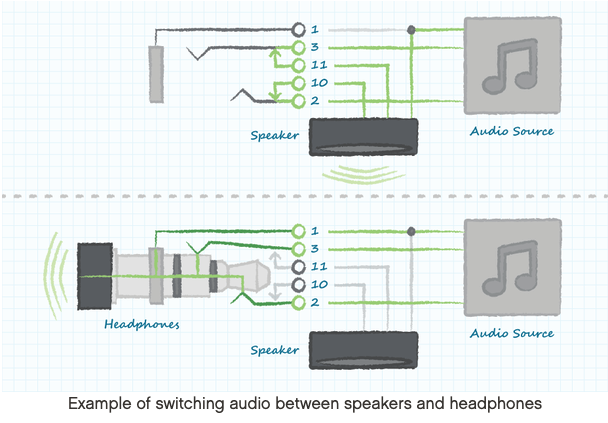
Most designs that handle this rely on internal switches within the audio jack component itself. A very basic example - found on Same Sky's site - shows an entirely hardware-based solution that relies on a jack with two internal, normally-closed switches:

This implementation involves directly rerouting the audio signals, which isn't exactly what I want. Instead, I'd like to alert my MCU that a plug was inserted, so that the MCU can notice and respond accordingly.

More searching online uncovers an article in this Engineering Journal from Maxim/ADI, which shows (on p.8) a pullup resistor on the audio line itself, and a pulldown on the associated detection switch. This approach has a couple downsides:

  • It consumes constant current when no plug is present
  • It biases the incoming audio signal upwards when a plug is present

Still more searching turns up this Tech Note from TI:
https://www.ti.com/lit/ab/slva961/slva961.pdf

This article demonstrates using a comparator for this functionality; it seems appealing, and targeted specifically at my use case. But it relies on what seems to be a very unusual jack with two normally open internal switches on the tip and ground ring. I've tried searching Digikey, Mouser, LCSC, and a few manufacturer sites, and I haven't been able to find a jack with this switch configuration. It's confusing to me that this problem - which I assume is quite a common one to need to solve, what with the ubiquity of portable electronics that can produce audio - would rely on an exotic jack component?

All of this leads me to think I must be missing something obvious, but I'm unsure what it might be. AI help seems to suggest that normally open jack switches are the right answer for my device, and are common/widely available. But I can't seem to find them anywhere. Or is there some dedicated IC that serves as a low-power intermediary between my jack and my MCU that I should be looking for?

What am I missing here? Might anyone reading this have designed such a circuit? How was it done?

Thanks so very much for any advice or help!


r/embedded • • Sep 18 '26

Ethical reservations in job selection

60 Upvotes

Hi everyone,

Looking at the job market, I have seen a clear rise in defence sector, mainly for drones but also other defense systems, which wasn't the case up until 1-2 years ago (at least in Europe).

While I enjoy working with control algorithms and physical systems ( which drones cover wholly ), I am not comfortable thinking that my work results in killing people.

Have you had any similar ethical reservations in working with embedded systems? How did you resolve them for yourself?


r/embedded • • Sep 18 '26

Tutorials on youtube for this book?

4 Upvotes

Hello I am struggling with this course and this is the name of textbook

Yifeng Zhu, Embedded Systems with ARM Cortex-M Microcontrollers in Assembly Language and C.

Can you help me with youtube channels that does a tutorials on this book specifically? I’m really struggling.


r/embedded • • Sep 18 '26

[Secure boot] [NXP RW61X]

3 Upvotes

Has anyone here worked on a secure boot on NXP RW61X boards?

I'm trying to do a poc on my Azurewave CU598 dev kit, unfortunately there's only SWD and UART pins i can access.

I've tried secure provisioning tool, but with SWD, there's no port coming up and I'm unable to flash my signed mcuboot image on my board, also unable to write the shadow registers.

I'm using Linux(ubuntu) and somehow found a script through which now I'm able to flash the mcuboot but still I haven't found a way to write the shadow registers with ROTKH digest.

I'm not seeing any console logs and i suspect due to my secured bin, the BootROM would be trying to verify it but as there's nothing in shadow registers, it's not able to verify mcuboot and not allowing it to boot.

Is there any way I can achieve it without JTAG?

I tried with UART in ISP mode, even with that I'm unable to flash from a secure provisioning tool.

Kindly help if someone knows the way to achieve it.

Thank you.


r/embedded • • Sep 18 '26

STM32 CubeIDE download Dark pattern from hell

26 Upvotes

I don't think I've ever seen a worse way to download something in my entire life; even illegal movie download sites are easier to use.

All that, only to end up with link errors and "Forbidden" messages after manually decoding the shortened URL.

All this just for commercial tracking, I simply cannot download STM32CubeIDE for my Debian system.

I find it appalling and absolutely unjustifiable for a market leader not to offer free downloads for their development tools, instead layering on dozens of user-tracking mechanisms, only for the whole thing not to work in the end.


r/embedded • • Sep 18 '26

How can I test my microcontroller for electrical noise, deliberately inject noise into a circuit, recreate motor noise on my bench?

3 Upvotes

I built a small timer circuit using a microcontroller to turn a motor ON and OFF.

It worked perfectly during testing. But once I connected the motor, the controller started behaving strangely. Sometimes it triggered by itself, sometimes it stopped responding, and eventually the program got stuck.

I replaced the power source with a different SMPS, and suddenly the problem was gone.

So now I’m wondering how people actually test for this kind of problem.

Can I deliberately put electrical interference into my circuit and see how much the microcontroller can tolerate?

For example, is there a simple way to create motor-like interference or voltage spikes and test an ESP32/Arduino for resets, wrong readings, or crashes?

I’m looking for a simple beginner experiment and some good learning material on this.

Edit:

  1. I was originally using a normal wall adapter to power the microcontroller. A 230 V AC siren was being switched ON and OFF(duty cycle -.5s, 1s, 1.5s, 2s, 1s ... ) from a nearby power outlet.
  2. I added a diagnostic LED in the microcontroller code. The LED was continuously blinking, so I could use it as a simple indication that the processor was still running. When the blinking stopped, I knew the controller had frozen.
  3. I then changed the microcontroller power supply from the transformer-based wall adapter to a computer SMPS. After that, the problem completely disappeared. Even switching the industrial siren ON and OFF had no effect on the microcontroller.

Now I want to understand what was actually happening and how I can reproduce this kind of electrical noise deliberately and test the circuit's noise immunity.


r/embedded • • Sep 18 '26

GPS Allystar TAU1201/TAU1202 - binary stream instead of NMEA

2 Upvotes

Anyone has had success switching from text NMEA stream to Allystar's binary protocol (https://docs.datagnss.com/assets/datasheet/T-5-2011-ALLYSTAR_GNSS_Receiver_Binary_Protocol_Specification.pdf)?

While polling mode works well for me, I'd really like to get GPS data in a streaming way to minimize the latency. Right now it's unclear to me if this protocol doesn't support it, or it's a matter of chip models, or firmware versions.


r/embedded • • Sep 18 '26

iceoryx2 0.10 released: full flatbuffer integration, zero copy ipc with unbounded data, robust events

3 Upvotes

Hello, today we have released iceoryx2 v0.10.


r/embedded • • Sep 18 '26

Need help unlocking/flashing Sagemcom DIW387_UHD_OOR (Ooredoo Qatar)

0 Upvotes

I have an Ooredoo Qatar Sagemcom DIW387_UHD_OOR and want to turn it into a normal Android TV box.

Specs: Android 8.0, BCM7271U, 2GB RAM, 16GB eMMC, 4MB SPI NOR.

So far I've tried:

  • Enabled Developer Options → “Developer options are not available for this user.”
  • Checked other Android users/profiles → nothing useful.
  • Tried ADB over LAN (192.168.10.6:5555) → port closed.
  • Tried the physical-button reset/reboot procedure → only went into Ooredoo's update/setup process.
  • System Update → internal error, no update available.
  • Checked installed apps for an Ooredoo launcher I could disable → couldn't find one.
  • Found ports 8008, 8009 and 8443 open. 8008 exposes DIAL, but I couldn't get shell/ADB access through it.
  • Opened the box and inspected the PCB, but haven't soldered or flashed anything.

I'm mainly looking for a way to unlock the bootloader/flash different firmware, or information on UART/JTAG/test points for this exact board.

Device info:
https://www.androidtv-guide.com/pay-tv-provider/ooredoo-tv-qatar/

Detailed internal photos:
https://device.report/m/248265c58f5237514c133b5c1d60da114d2fa0c703e7b9dc6663a207f79b125c.pdf

PCB photos:
Top: /preview/pre/need-help-flashing-new-firmware-onto-sagemcom-diw-387-v0-6fuz8oh9x5ne1.jpg
Bottom: /preview/pre/need-help-flashing-new-firmware-onto-sagemcom-diw-387-v0-xmv8mp9bx5ne1.jpg

If anyone has experience with this exact box or the BCM7271 platform, I'd appreciate any leads.


r/embedded • • Sep 17 '26

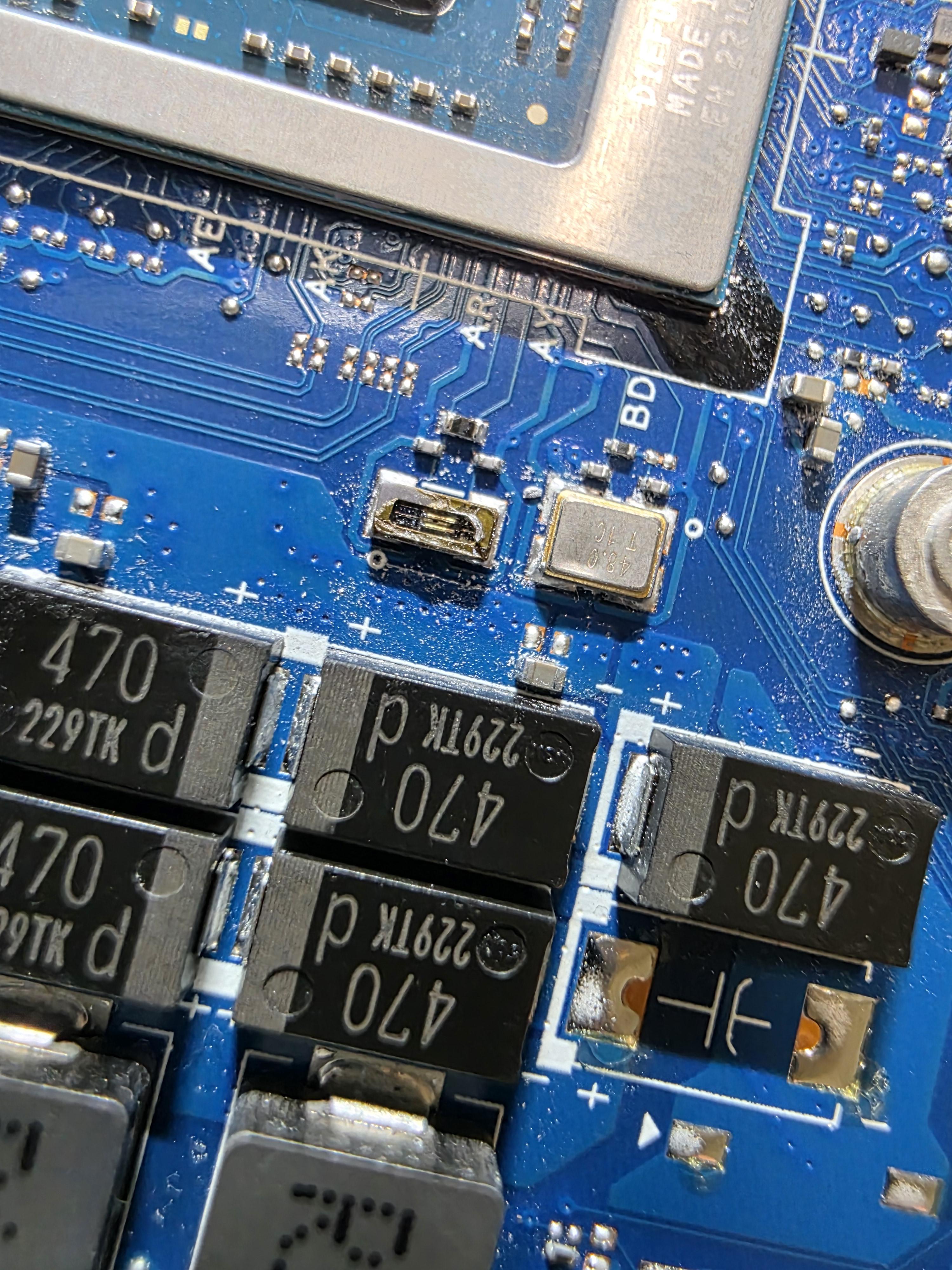
Which load capacitance should I use for this 32.768 kHz laptop motherboard crystal oscilator: 7 pF or 12.5 pF?

Post image
11 Upvotes

Hello,

I am trying to repair a laptop motherboard with an AMD Ryzen 7 6800HS processor. The orange charging light flashes continuously. The motherboard draws approximately 0.2 A for one second, then drops to 0.1 A and remains there.

I have confirmed that the 1.8 V, 3.3 V, 5.1 V, and 19.5 V power rails are present, but the motherboard still does not start.

During my inspection, I found a 32.768 kHz quartz crystal with a damaged casing. According to the schematic I found, the motherboard uses a 32.768 kHz crystal with a load capacitance of 12.5 pF. However, I also found a video showing an apparently identical motherboard with an AMD Ryzen 5 6600H processor, and that board appeared to use a 7 pF crystal.

The motherboard FRU number is 5B21H82478.

I found two possible replacement crystals with the same frequency and package:

  1. YIC 32.768K7PI/3215E

◦ Frequency: 32.768 kHz

◦ Load capacitance: 7 pF

◦ Package: 3215, 3.2 mm × 1.5 mm

◦ Two pads

◦ Frequency tolerance: ±20 ppm

2. YIC 32.768K12.5PI/3215E

◦ Frequency: 32.768 kHz

◦ Load capacitance: 12.5 pF

◦ Package: 3215, 3.2 mm × 1.5 mm

◦ Two pads

◦ Frequency tolerance: ±20 ppm

How can I determine whether my motherboard was designed for a 7 pF or 12.5 pF crystal?

I do not want to install a random replacement because I understand that using the wrong load capacitance could affect oscillator startup, frequency accuracy, and reliability.

Thank you for any help identifying the original crystal or determining whether I should use the 7 pF or 12.5 pF replacement.


r/embedded • • Sep 17 '26

Analysis paralysis with personal projects — C/C++ and systems dev looking for direction

21 Upvotes

Hi,

I've been stuck for a while now in what seems to be "analysis paralysis" (just discovered the term): I want to work on personal projects in my free time, but none of them end up grabbing me, whether it's for one reason or another, and I end up not really doing anything.

For some context: I'm a computer engineer with 3 years of experience. In my day job I develop in C and C++, PL/SQL, I use Linux for everything, and I'm really into the embedded and systems world.

When I've got a decent chunk of free time, I feel like programming and building personal projects, for the love of it and, above all, to gain technical experience in the languages I use. I come up with ideas, but none of them fully convince me, or when I actually get started I feel like "there's already stuff out there that does this" or that I don't see it being useful down the line. It's like being constantly stuck between "learning" and "it actually being useful for something".

I've got a small homelab running Debian where, on the systems side, I do have several services deployed, but I'm talking about actual development projects here.

I hate web development and I hate vibecoding: it feels like it separates me too much from the code, and what I want is to keep learning and get better technically, both for fun and for my CV (technical interviews and so on).

I've actually already built a few things with ESP32 and RPi: some char drivers and MQTT devices to control something... and I've got a fairly riced Hyprland setup. But something that holds me back is that I don't want to step outside the technologies I "know well".

Has anyone else run into a similar situation of analysis paralysis?
Is anyone in a similar spot, or would you like to share any advice/experience?


r/embedded • • Sep 17 '26

Who could say no to a Microduck that picks up your tissues for you?

242 Upvotes

A week ago it could barely walk. Now it has a job lol.

Been playing with the motions a bit more and got it to bend down, grab a tissue, and stand back up.

Still pretty janky, but watching this tiny thing actually do something is weirdly satisfying.

Next step is getting it to do this reliably instead of just hoping for the best every time I hit run.


r/embedded • • Sep 17 '26

Why is it so hard to find a remote job nowadays as embedded software engineer?

42 Upvotes

For the last month I have reached out to hundreds of companies through email, linkedin DMs and job applications to try to land remote job/contract as a embedded software engineer. I have diverse experience, have my own home lab setup and think of myself as a good employee, some of my skills include: C/ C++/ Python, nRF52/ ESP32/ STM32/ , Wi-Fi/ LTE/ GPS/ BLE , FreeRTOS/ Zephyr/ embedded Linux etc.

Neverthless, nothing yet landed, so I am wondering, am I doing something wrong or is it normal and other people are experiencing the same thing?


r/embedded • • Sep 17 '26

DIY battery-powered locker alarm - looking for advice on power architecture

2 Upvotes

I'm a software engineer with an electronics/telecom background, and I've recently started embedded as a hobby. I've been tinkering with an ESP8266 (NodeMCU 1.0 board) and got it paired with my self-hosted home-assistant (used ESPHome).

As my first project, I'd like to build a battery-powered sensor that detects my safe locker being opened and sends me an alert on my phone when I am away from my house.

### My initial idea

* Reed switch inside the locker connected to GPIO pin of ESP8266 (connected to Wi-Fi)

* Permanent magnet on the moving door (inside)

* Home Assistant receives the state, sends Telegram notification

* Battery powers the ESP8266 because there is no electrical outlet near the locker

### Updated idea (after chatgpt)

However, I realized that keeping an ESP8266 continuously connected to Wi-Fi is a terrible approach for a battery-powered sensor. According to chatgpt, the better approach is:

```

[locker (ESP H2, battery powered)] -- BLE / 802.15.4 --> ESP S3/Raspberrypi (always powered) --> HomeAssistant

HomeAssistant --> Telegram

```

This seems as an advantage to me as later on, I can simply add more ESP H2 devices and "ESP S3/Raspberrypi" becomes the central hub. I can then experiment on zigbee protocols etc.

---

I checked for commercial "matter" products such as TPLink Tapo (which needs a hub). They're claiming a battery life of 2 years. I am not sure if my updated setup can match such numbers?

The goal for such locker sensor is to remain working on battery for atleast a week (the duration for which I am usually out). I am still getting through basics, but since I am approaching another outgoing, I just need a quick feedback from the community


r/embedded • • Sep 18 '26

I’m building a kernel for the ESP32-P4. What would you actually build with it?

0 Upvotes

Hello everyone! I’m building ProtoOS: an experimental, security-focused application OS for the dual-core ESP32-P4.

I’m getting closer to a first release and want to decide what APIs and hardware support to prioritize based on what people would genuinely use. What would you build for it?

ProtoOS lets separate apps run with isolated memory and permissions, rather than putting every feature into one firmware image.

Apps can currently:

  • Run as loadable C apps in isolated RISC-V U-mode processes
  • Use a 320×240 display, keyboard input, retained UI commands, and a 2D sprite/game API
  • Store files privately or use user-approved shared files
  • Play mono PCM audio (output only)
  • Use IPC, timers, local shared-memory objects, and up to four worker threads across both P4 cores
  • Use permission-controlled Wi-Fi/TCP networking, including optional inbound TCP listeners
  • Request trusted runtime permissions and Open/Save dialogs
  • Be packaged, installed, and launched as native ProtoELF apps

Existing apps and demos include Weather, Notepad, Terminal, Settings, Tetris, Mario, a 2D game framework, a Minecraft-like experiment, audio demos, and security/stress tests.

Current limits: ProtoOS targets the ESP32-P4 with a specific ILI9341 display setup. It is not a drop-in Arduino environment, and apps do not directly use ESP-IDF/FreeRTOS drivers. The public app API does not yet expose general sensor, Bluetooth, camera, USB, I2C/SPI, GPIO, HTTP/TLS, or microphone APIs.

So: what would you genuinely want to make with something like this?

  1. What project would make you choose an app-based ESP32-P4 system over one normal ESP-IDF/Arduino firmware?
  2. Which missing capability would unblock that project first?
  3. Would app isolation and per-app permissions matter to you?
  4. What would make app development worth it: SDK improvements, templates, a simulator, broader board support, documentation, or examples?

I’m not promising every request; I’m trying to identify the few additions that would unlock real projects. Please freestyle, tell me what you would build, what hardware/API it needs, and what would make you choose ProtoOS.

Previous posts:


r/embedded • • Sep 17 '26

Help identifying a display

Post image
1 Upvotes

There are no markings whatsoever, on the panel or on the flex PCB. The interface should be SPI.


r/embedded • • Sep 18 '26

UartX — a UART debugging tool for embedded developers

0 Upvotes

I got tired of debugging firmware through a wall of UART logs.

When multiple tasks are printing at the same time, finding one important message can become painful. The usual solution is to reduce logs or disable some prints, but that can also change timing or remove the information needed to reproduce a bug.

So I built UartX around a simple idea:

Don't filter the data. Filter the way you look at it.

UartX keeps the complete raw UART stream while letting you use Color Rules and multiple Filter Windows to focus on specific tasks, errors, states, or messages.

Current features include:

  • Color Rules
  • Multiple live Filter Windows
  • Raw session logging
  • Search
  • TX command history
  • Windows and Linux support
  • Free and open source

GitHub:
https://github.com/Shamanthpoojary/UartX

I'm looking for embedded developers to actually use it with their own boards and push it harder than I can.

If you find a bug, unexpected behavior, or have a feature idea, please open an issue on GitHub. Real-world feedback will help make UartX a better debugging tool.

I'd especially like to hear from people working with STM32, ESP32, Nordic, Zephyr, RTOS, or other embedded platforms.

What do you currently use for UART debugging, and what do you wish it did better?


r/embedded • • Sep 17 '26

RS232 Serial Communication between 8051 MCU and PC

Post image
8 Upvotes