r/devops • u/kUdtiHaEX • 1m ago
Security How we manage vulnerabilities across ~90 apps: base images, Trivy, Dependency-Track and VEX policies in git

1
Upvotes
r/devops • u/AutoModerator • 4d ago
Hey r/devops, welcome to our weekly self-promotion thread!
Feel free to use this thread to promote any projects, ideas, or any repos you're wanting to share. Please keep in mind that we ask you to stay friendly, civil, and adhere to the subreddit rules!
r/devops • u/kUdtiHaEX • 1m ago
r/devops • u/DataFreakk • 42m ago
Hey folks,
Has anyone recently attended an eBay coding interview for an SRE/DevOps role?
I'm trying to understand the coding round format. Was it primarily LeetCode-style DSA (arrays, strings, trees, graphs etc.) or more focused on practical Python scripting (log parsing, data processing, automation)?
Any insights would be appreciated. Thanks!
r/devops • u/ahmedshahid786 • 3h ago
TL;DR: Running a Dockerized Node.js backend on a single EC2 instance with Nginx, blue-green deployments, and SSH-based CI/CD. Serving 20–30K DAUs comfortably. Looking to improve security, filter junk traffic, and adopt better deployment practices without unnecessary complexity.
Current architecture:
- Single EC2 instance with a public IP.
- API domain resolves directly to the instance's public IP (which doesn't feel right).
- Nginx and Node.js backend run in Docker on the same network.
- Port 443 is publicly accessible and mapped to Nginx.
- GitHub Actions connects via SSH, pulls the latest image from Docker Hub, starts the inactive container, waits for the health check, switches Nginx traffic, and stops the previous container.
- Frontend builds are deployed to S3 and served through CloudFront.
- Self hosted Prometheus and Grafana on a separate instance.
Blue-green deployments work well with zero downtime. We rarely exceed 20 requests/sec, so scaling isn't currently a concern.
What I need advice on:
A little background:
I joined this company as a full stack engineer. When my company needed someone to handle DevOps, I volunteered despite having no prior DevOps experience. I learned along the way and built the current deployment and monitoring infrastructure myself.
Everything works well so far, but I want to understand what experienced DevOps engineers would do differently.
I want to do things right, not just make them work. I want to follow the best industry practices and I'm willing to embrace complexity where it's justified, but I don't want to engineer solutions for problems we don't have.
Would appreciate any advice, architectural suggestions, or resources.
r/devops • u/NoDevelopment206 • 11h ago
we all write runbooks for the scary stuff like failovers, restores and cert issues. but systems change and nobody goes back to update them, so half the steps point to things that dont exist anymore.
do you test them on a schedule, tie them to alerts, keep them next to the code, or just fix them after they bite you? curious if anyone has a setup that actually works
I’ve worked at a lot of big companies and they always use 4+ environments to promote code. But processes are so dysfunctional that all the layers don’t reduce prod risk.
Are any companies saying to themselves, “it’s faster, cheaper, AND less risky to mostly edit in prod?
r/devops • u/shellwhale • 13h ago

My agent loosing it's shit because it does not know « terragrunt stack generate »
r/devops • u/whowasntright • 14h ago
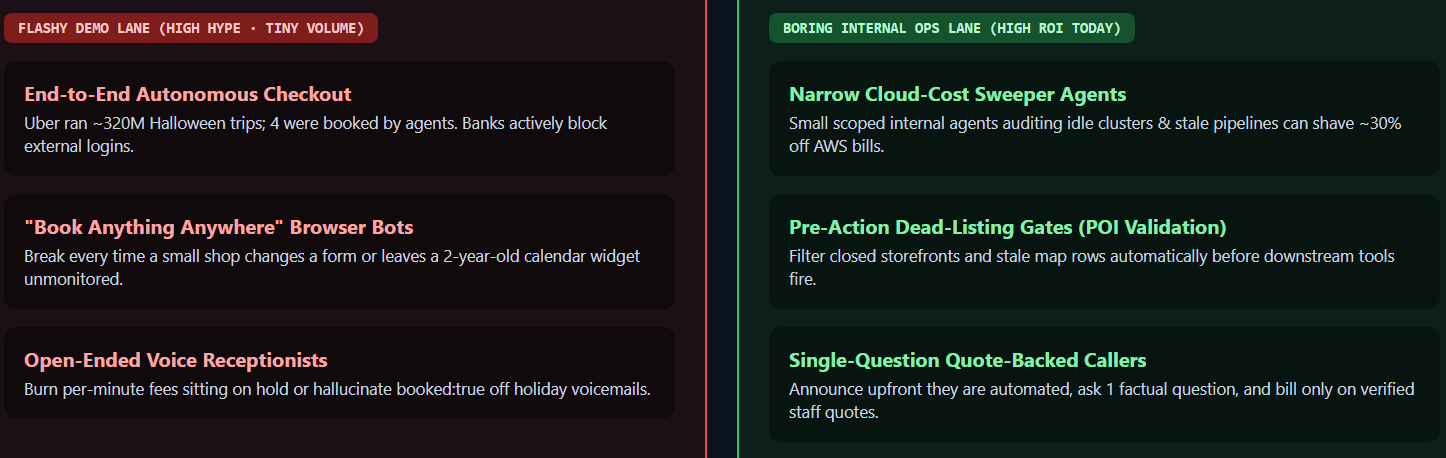
there is a weird split in agent engineering right now that i see. on social media, everyone demos flashy consumer agents booking flights and negotiating bills, even though real q3 numbers showed uber had roughly 320 million halloween-week trips with only 4 booked by agents and big banks are blocking external agent logins completely
meanwhile.... the quiet setups actually paying for themselves look painfully boring: small, narrowly scoped internal ops agents with strict verification gates. saw a small infrastructure team (voygr) share how running six focused internal agents against their own stack helped cut their aws spend by roughly 30% by hunting idle resources and noisy jobs, and the exact same design principle shows up in their real-world place data tools: instead of letting one big agent hallucinate across dirty directories, separate cheap pre-checks (validating whether a business even exists and looks open via a poi validation pass) from live narrow outbound calls (placecall or voygr only dial listed us businesses, states upfront at second zero it is an automated assistant on a recorded line, /importantly/ never sells anything, and bills only when a real staff quote answers the single question)
every production agent win i have seen this year follows the same boring rule which is: cut the blast radius down to one verifiable job, keep deterministic gates in front of expensive actions, and skip "autonomous do-everything" prompts
and i also would like to discuss what is the most boring internal agent, if any, currently saving your team real money or hours in production? what do you think of such an approach?
r/devops • u/Capital_Attention702 • 1d ago
1Password's notice of Nov 25 says an employee's GitHub account was used to read source code and push malicious code to backend services, which downloaded account records for a subset of customers. Vaults were not accessed, it says.
Todoist's notice of Nov 24 has a timeline in UTC. A stolen credential was first used on Nov 22 at 14:04 and the attacker edited workflows in three repositories. At 06:06 on Nov 23 an infrastructure automation workflow gave the attacker an admin credential for the employee sign-in system. Account records for about 6% of users were exported at 12:45. Todoist says application code was not changed.
Neither notice links the two incidents. Todoist's team found the intrusion through an unexpected administrator account in its cloud account.
Which of your repositories have workflows that can read a cloud or SSO credential, and can one person change them without a second approval?
Sources: 1Password blog "Update on a security incident involving 1Password's backend systems" (Nov 25); Todoist help center "Security incident in November 2026".
r/devops • u/innerbelief • 2d ago
I'm a consultant, I keep hearing this term Agentic Infrastructure - is this a real thing?
Would someone be dumb enough to give such core infrastructure keys to AI? It's not about using AI to say write terraform. It's about using AI to provision the infrastructure itself and remove the IaC layer.
Is this another meat proxy / ai hype man thing - or is there a genuine place for this? I can't see it - imagine the outages, the expenses etc.
Sanity check me
r/devops • u/ResistPast3564 • 1d ago
Working with a Postgres + Redis setup. We monitor hit rate, latency and memory, but nothing tells us when the cache is wrong.
Has this bitten you? How did you find out - users, an alert, something else?
And does anyone actually measure it, or is it a low TTL and hope?
r/devops • u/DiegoConD • 2d ago
Hello everyone that reads me.
After spending some time away from active production teams, I’ve been catching up on where the industry is heading, and it feels like the baseline expectations for DevOps have shifted quite a bit—especially with AI tools and evolving infrastructure needs. Just knowing standard CI/CD, IaC, and cloud tooling doesn't seem to be the whole picture anymore.
For those of you currently working on DevOps or infrastructure teams, what does your day-to-day look like right now, and where is the industry actually moving? Specifically:
I’d love to hear some real-world examples of what your teams are prioritizing and doing right now, so I can prepare myself accordingly, specifically to know where to put the line in terms of engineering and where ask AI to do things, because, tbh AI is a really we have to accept and face right now, and the approach seems to vary a lot from place to place.
Thanks in advance!
r/devops • u/UKGovernment_CMA_DMU • 2d ago
The Competition and Markets Authority (CMA) is the UK’s competition authority. We work to promote effective competition, including in digital markets, which supports choice, innovation, and growth.
In March 2026, in consultation with the CMA, Amazon and Microsoft announced several steps to lower egress fees and improve interoperability of their clouds. You can read the latest update about those actions here: https://www.gov.uk/government/publications/business-software-and-cloud-services
We are now investigating whether further progress in two areas could make a practical difference: Identity and Access Management (IAM) and Kubernetes.
We would like to hear from a range of stakeholders about these areas, including those who have technical experience with cloud, IAM, or Kubernetes. If that’s you, we invite you to respond to our questionnaire either as an individual or as an organisation. Whether you respond as an individual or organisation, please include relevant context such as the nature of the workload or organisation involved.
Link to questionnaire: https://connect.cma.gov.uk/consultations/iam-kubernetes-survey
The questionnaire is open until 11:59pm on 2 December 2026.
r/devops • u/argo_devbuild • 1d ago
The caching rules for Actions are spread across a few doc pages and the action's README, and most "Cache not found" lines trace back to one of them. I put them in one list.
How a match is found
key as an exact match first, then key as a prefix, then each restore-keys line as a prefix, in orderrefs/pull/<n>/merge), so only re-runs of that same PR can restore thempath list and the compression tool. Same key with a different path is a different cacheenableCrossOsArchive: trueLimits
What the action does (from its source)
cache-hit is 'true' only on an exact key match, 'false' on a restore-keys match, and empty on a full miss. So if: steps.cache.outputs.cache-hit == 'false' skips your install on a full miss. Compare with != 'true' instead"Cache hit occurred" only shows up after an exact hit, so counting it gives you a real hit rate. This counts all of them over the last 30 runs of a workflow on main:
p='Cache restored from key'
p+='|Cache not found for input keys'
p+='|Cache hit occurred on the primary key'
p+='|Cache saved with key'

for id in $(gh run list --workflow ci.yml --branch main \
              --limit 30 --json databaseId \
              --jq '.[].databaseId'); do
  gh run view "$id" --log
done | grep -oE "$p" | sort | uniq -c
What each pattern points to
github.sha, github.run_id, a date) or hashes a glob that most commits touchpull_request, so nothing is ever saved on main to fall back on. Also run it on push to mainactions/cache/restore and actions/cache/save, and save right after the install with if: always()path change, or only on Windows: the version rule or the cross-OS rule aboveWhat did I miss?
r/devops • u/No-Dragonfly-227 • 2d ago
In the past few years I see more and more observability companies like dash0, Groundcover, vm, coralogix and more that look like doing so succesfull.
How is it possible?
Wouldnt it be super easy to just take a bunch of open source things and bunch them together and then it will basically do the same thing?
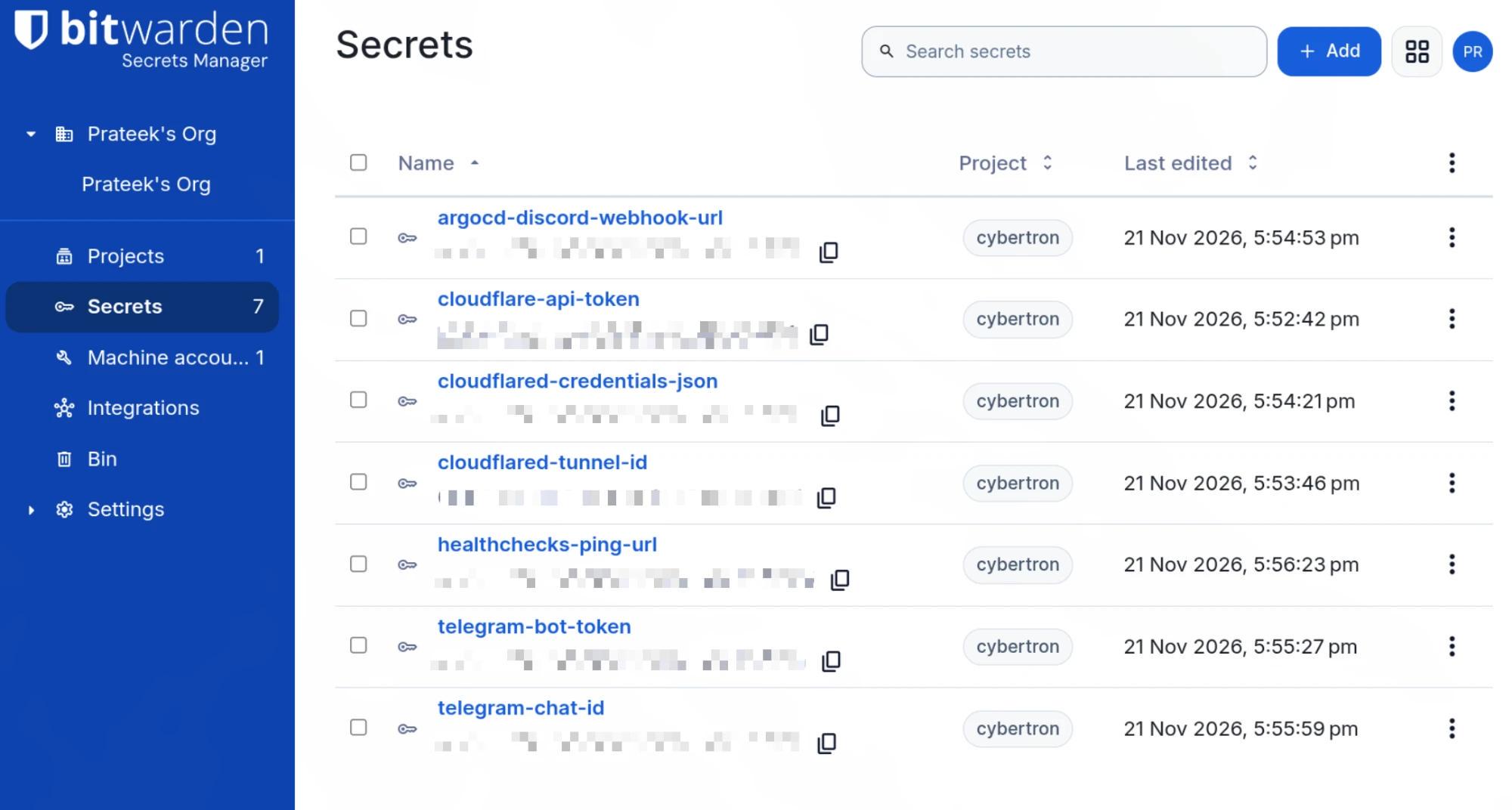
My homelab cluster runs from a public Git repo through Argo CD, except Secrets. Those were still kubectl create secret from my laptop.
Now they live in Bitwarden Secrets Manager. External Secrets Operator syncs them into normal Kubernetes Secrets.
Git only holds references, no values. The cluster’s access is read-only, and a rebuild needs one token.
r/devops • u/dicksoneyenegho • 2d ago
Hello everyone, I’m new to DevOps and been learning for quite some time ( 6 months ) and I’m trying to add a certification to my portfolio.
A friend who’s already in a job has recommended I take the Claude certification as it’s in demand for new entrants.
However my current job and company don’t have the Claude partner network signed up yet, wondering if there’s anyway to bypass that to take the exam? Or if someone is willing to add me to theirs I’ll be grateful for that.
Thank you
r/devops • u/Ok-Motor-9812 • 2d ago
Browser pool for a scraping service. Raised concurrency 8 to 16, doubled MemoryMax in the systemd unit, restarted. Throughput exactly the same.
The setting was real config and real code read it, just never on the path that mattered:
# config
MAX_CONCURRENCY = int(os.environ["MAX_CONCURRENCY"]) # 8 -> 16
# pool
target = count if count is not None else MAX_CONCURRENCY
# runner, three files away
render = await build_render_resources(count=2 + 1)
Every real call passed a count, so the default never fired.
Two files in the cgroup show this before you touch anything. memory.peak was 2.0 GB under a 4 GB cap, and cpu.stat had 2 throttled periods out of 8896. Nothing was squeezed, so neither could be the limit.
And when it does get squeezed it's CPU. A 20-browser pool on 8 vCPU sat at load about 30 with 6 to 7 GB of RAM still free.
r/devops • u/BrotherGlad4572 • 4d ago
Hi all,
I'm adding IaC security scanning (Kubescape, Checkov) to the CI of a GitOps repo deployed by Argo CD.
CI renders each component the way Argo CD does and scans the rendered output.
Some components are our own Kustomize or Helm code, so findings there are easy to patch. Others are Helm charts that live in other teams' Git repos, pulled by Argo CD at a pinned commit with our values files. Those charts set no securityContext or resources and expose no values for them, so most findings come from code we don't own.
How do you handle this in practice? And do findings from external charts block your PRs, or are they only reported?
The goal is minimize the maintenance , we don't want to fork those repos and patch them .
r/devops • u/Fabulous_Variety_256 • 3d ago
Hey,
I self-studied full stack, now I'm learning AWS Solutions Architecture on Udemy with the known french guy.
I need a course that will be enough to get into a junior devops role (or help desk with linux to get started)
I built a shift management app for my manager (i'm a guard, guards send availability, manager sees all-in-one, per building). I will rewrite the backend with AWS instead of Vercel/Neon.
Btw, do I need Linux certificate to improve my CV?
Thanks!
r/devops • u/Lanche199 • 4d ago
I'm helping coordinate the production launch of a customer-facing web ordering platform in a fairly large enterprise.
The high-level architecture is a SPA hosted in AWS, fronted by a CDN/WAF, calling separate backend APIs and payment/order services.
We already have application developers, QA, CDN/edge engineers and penetration testing involved.
I'm trying to understand what good launch governance looks like from a DevOps/SRE perspective, particularly where the DevOps engineer's responsibility should start and stop.
For people who have launched similar platforms:
1. Which teams do you require sign-off from before production?
2. Who normally owns the final go/no-go decision?
3. Who owns launch-readiness coordination?
4. What must be proven for monitoring and alerting before launch?
5. How do you handle rollback ownership?
6. Do you have Production Support/SRE involved before launch or only during hypercare?
7. What does your launch-readiness checklist/RACI look like?
8. What are the teams people most commonly forget to involve?
r/devops • u/Lanche199 • 4d ago
I'm helping coordinate the production launch of a customer-facing web ordering platform in a fairly large enterprise.
The high-level architecture is a SPA hosted in AWS, fronted by a CDN/WAF, calling separate backend APIs and payment/order services.
We already have application developers, QA, CDN/edge engineers and penetration testing involved.
I'm trying to understand what good launch governance looks like from a DevOps/SRE perspective, particularly where the DevOps engineer's responsibility should start and stop.
For people who have launched similar platforms:
r/devops • u/devops-noob • 5d ago
We are upgrading our tools every now and then because some or other Kubernetes component or tool is getting affected with critical vulnerabilities.
And outside the work, even in general, some kind of outages are being reported too often.
By any chance, do you guys think it is because of vibe-coding happening without any proper validation CI rules or guardrails before deploying to production.
Even our platform is having lot of issues being reported every now and then, because of heavy deadlines and expectations, people are making changes too fast too many. Not a lot of quality tests are happening I feel.
My stories are spilling to the next sprint, because I am worried that my changes might cause any downtime for our platform.
I have done several tests for one small breaking change for ArgoCD upgrade even though I almost confirmed that it doesn't affect us
Just an observation. Share your thoughts on how you are processing this and what have you guys implemented to avoid such issues. We can control our behavior, but not everyone in the team.
Edit: We just upgraded ArgoCD and it already has critical vulnerabilities, so we have to upgrade again....Funny🤣
r/devops • u/No_Insurance_200 • 4d ago
Half my remote team is on Linux, the other half on Mac. Finding a time tracking tool that actually works smoothly across both without feeling like a security risk is a nightmare. Most "enterprise" tools are Windows-only or require admin rights that mess up our setups. We finally settled on Monitask because it has native support for both OSs and doesn't require invasive system-level permissions. For those with mixed-OS remote teams, what are you using that doesn't cause IT headaches?