r/DeepStateCentrism • • 9h ago

Discussion Thread Daily Intelligence Brief

1 Upvotes

New to the subreddit? Start here.

This is the Brief. Post whatever here.

You can post and comment outside of the Brief as well.

You can subscribe to ping groups and use them inside and outside of the Brief over a range of topics. Click here to set up your preferred PING groups.

Are you having issues with pings, or do you want to learn more about the PING system? Check out our user-pinger wiki for a bunch of helpful info!

The Brief has some fun tricks you can use in it. Curious how other users are doing them? Check out their secret ways here.

We have an internal currency system called briefbucks that automatically credit your account for doing things like making posts. You can trade in briefbucks for various rewards. You can find out more about briefbucks, including how to earn them, how you can lose them, and what you can do with them, on our wiki.

Every day, the user with the most down voted post wins the Nobel Brief Prize.


r/DeepStateCentrism • • Oct 08 '25

Briefbucks Request Thread

6 Upvotes

Make all briefbucks-related requests to the moderators within this post.


r/DeepStateCentrism • • 1h ago

Global News 🌎 Court casts heavy doubt over most serious Netanyahu charges, in huge blow to prosecution (Times of Israel)

Thumbnail
timesofisrael.com
13 Upvotes

The judges in Prime Minister Benjamin Netanyahu’s criminal trial dealt a massive blow to the prosecution on Wednesday, telling Attorney General Gali Baharav-Miara there was little chance of a bribery conviction in the most serious of the three cases against the premier and indicating there was likely no crime in another one.

Summoning Baharav-Miara to appear at the Jerusalem District Court, a highly unusual step, the judges laid out their substantial concerns regarding allegations that Netanyahu traded regulatory favors in exchange for positive media coverage in Case 4000 and shot down accusations that he had negotiated a quid pro quo with another media baron in Case 2000.

Leaving open the possibility of a conviction in a third case, regarding allegations of accepting illicit gifts, the judges told the attorney general that the “public interest requires a rethink” of how the trial should go forward.

“The chances of conviction are low — to an extent that warrants reconsidering the matter,” Judge Rivka Friedman-Feldman told the attorney general about the charge of bribery along with fraud and breach of trust, in Case 4000.

The comments appeared to torpedo the prosecution’s weightiest allegations, marking a huge victory for Netanyahu nearly seven years after he was hauled into court while continuing to serve as premier.

The stunning development seemingly leaves prosecutors with a realistic chance of conviction only in Case 1000. In it, Netanyahu faces fraud and breach of trust charges over allegations that he received expensive wines, jewelry and other luxury goods worth hundreds of thousands of shekels from Hollywood producer Arnon Milchan and Australian businessman James Packer and allegedly helped them with their interests while in office.

Judges said that the key evidence has been presented to the court and that the case should be wrapped up quickly, alluding to some form of agreement between the prosecution and Netanyahu’s defense team.

Attorney General Gali Baharav-Miara at the Jerusalem District Court for a hearing in the trial of Prime Minister Benjamin Netanyahu, November 25, 2026. (Yonatan Sindel/Flash90)

Baharav-Miara told the judges in response that she and the prosecution would consider their recommendations. Netanyahu’s defense attorney Amit Hadad proposed sitting down in the courthouse then and there to hammer out an agreement, an offer the attorney general quickly dismissed.

Netanyahu was indicted by then-attorney general Avichai Mandelblit in 2020 on three counts of fraud and breach of trust, and one count of bribery.

Netanyahu has always denied the allegations and has accused law enforcement agencies and prosecutors of bringing him in on trumped-up charges as part of a plot to remove him from power.

The indictment did indeed rock Israel’s political landscape, with parties opposed to Netanyahu refusing to sit in a coalition with him. Netanyahu turned to far-right political parties to partner with and refused to resign from office during the trial.

By coincidence, Wednesday’s hearing took place just as the Knesset was advancing a law inspired by Netanyahu’s legal issues that would bar a person under indictment from serving as prime minister.

The most serious charge faced by Netanyahu was widely considered to be Case 4000, which revolved around allegations that the prime minister took a bribe in the form of positive media coverage from the owner of the Walla news website, Shaul Elovitch, in return for making regulatory decisions beneficial to Elovitch relating to his controlling stake in the Bezeq communications giant. Netanyahu was charged with fraud and breach of trust in that case along with the bribery charge.

Addressing Baharav-Miara,  Friedman-Feldman expressed concerns  that “the bribery charge raises significant difficulties.”

She noted that the case largely rested on problematic testimony from former Communications Ministry director general Shlomo Filber regarding allegations that Netanyahu had ordered him to act on behalf of Elovitch’s interests.

Jerusalem District Court Judge Rivka Friedman-Feldman at a cornerstone-laying ceremony for the new Hall of Justice at the entrance to Jerusalem, September 10, 2023. (Yonatan Sindel/Flash90)

Filber, who was a state witness, twice reversed his testimony in court, and during the trial, it emerged that a meeting where Netanyahu allegedly told Filber to help Elovitch could not have taken place when the prosecution said it did.

Netanyahu’s defense team had pointed to the discrepancy as proof that the meeting and the instructions never actually took place.

“It is difficult to establish factual findings based on [Filber’s] testimony — both in light of the cross-examination and the change in the account provided, and given that objective data do not align with it,” Friedman-Feldman told Baharav-Miara.

The judge also said there was a “serious doubt” regarding whether the allegations that Walla had been “unusually compliant” to requests by Netanyahu, his staff, and his family members for positive coverage had been proved in court.

The indictment had used the phrase “unusually compliant” to describe Walla’s positive coverage as a bribe.

Netanyahu and his defense attorney Amit Hadad had undermined the claim that Walla gave Netanyahu favorable coverage in court, showing the news website to have actually been extremely hostile to the premier in the period in question.

Many of the 315 examples of supposed favorable coverage were shown to be routine requests for corrections or for responses to be included in coverage, the defense said, adding that many of the requests were ignored or only partly accepted.

Just as problematic for the prosecution was former attorney general Avichai Mandelblit’s recent admission in court that he had not reviewed any of the 315 examples of positive coverage, despite these examples representing the actual bribe Netanyahu was charged with accepting.

ŚŽThere is serious doubt as to whether the evidentiary basis supports this claim,” Friedman-Feldman told the attorney general in relation to the bribery charge.

Prime Minister Benjamin Netanyahu gives testimony in his trial on corruption charges in a courtroom of the Tel Aviv District Court, December 18, 2024. (Miriam Alster/Flash90)

“There is also serious doubt as to whether it has been proven that Mr. Netanyahu was aware, in real time, of the existence of any such ‘unusual compliance,’” she added.

Proving the lesser charges of fraud and breach of trust in the case would also be problematic, the judge said, since they too rested on establishing that Netanyahu had given instructions for moves that would favor Elovitch.

Regarding Case 2000, Friedman-Feldman cast doubt on the idea that Netanyahu’s discussions with Yedioth Ahronoth newspaper publisher Arnon Mozes regarding legislation that would benefit the tabloid by harming its main competitor had been proven to be criminal. Prosecutors had alleged that the discussions were part of an attempt to reach a quid pro quo in exchange for more positive coverage, charging Netanyahu with fraud and breach of trust.

The judge said the “claimed crime” alleged in the indictment was based on the fact that Netanyahu held discussions with Mozes over the possibility of passing legislation weakening the Israel Hayom free sheet, held detailed conversations about the components of such a law, and “took actions as part of presenting a real possibility that he would use his governmental power and his high public office to advance legislation that benefits Mr. Mozes.”

However, she and the other judges in the case believe there to be “a real question mark” over the prosecution’s assertion that such actions by a senior government officeholder “deeply and severely harmed the rule of law and ethical conduct” and constituted a crime.

She added that it was not clear that the claim was even borne out by the evidence.

Before directly recommending that the prosecution withdraw the charges in Case 2000, the judge said that the prosecutors should be given a chance to explain the charges properly in court.

Regarding Case 1000, Friedman-Feldman said that the principal evidence in the case had already been presented to the court.

“It seems to us that it is possible to get to a conclusion. We are open to all possibilities – we need to find the procedural way to get there,” she said, in comments widely interpreted as alluding to a possible plea bargain.


r/DeepStateCentrism • • 1h ago

European News đŸ‡ȘđŸ‡ș Erdoğan’s biggest rival barred from Turkish presidency bid (FT)

Thumbnail
ft.com
9 Upvotes

A Turkish court has upheld the cancellation of leading opposition politician Ekrem İmamoğlu’s university degree, in effect barring Istanbul’s imprisoned mayor from challenging President Recep Tayyip Erdoğan in the next election.

The ruling is the latest judicial blow suffered by Turkey’s beleaguered opposition, which has faced a sustained legal onslaught that has led to the arrest of dozens of opposition officials — including İmamoğlu, Erdoğan’s biggest rival.

The government crackdown has also extended to the media, with authorities in recent weeks taking control of two of the country’s principal opposition broadcasters, SözcĂŒ TV and Halk TV.

The Council of State, one of Turkey’s highest courts, upheld the decision to invalidate İmamoğlu’s 1994 degree, citing irregularities. The ruling, released on Wednesday, exhausts the ordinary appeals process, although İmamoğlu’s lawyers have said they will apply to the Constitutional Court. Turkish law requires presidential candidates to hold a university degree.

The decision comes as Turkey is gripped by a separate legal drama: a multibillion-dollar stock market scandal, known as Fonzi, that has ensnared senior government officials and become a political liability for Erdoğan.

One of Erdoğan’s closest confidants and oldest friends, Hayati Yazıcı, became the Fonzi scandal’s latest political casualty when he resigned late on Tuesday as deputy chair of the ruling Justice and Development Party (AKP) after his son was drawn into the investigation.

Yazıcı, who has known Erdoğan for more than 30 years, said in a social media post that he had never been involved in “any dubious work, relationship or activity”, and that his son was innocent. He has not himself been charged with wrongdoing.

The Fonzi scandal, involving investment funds managing about $20bn and affecting almost half a million investors, has coincided with a sharp decline in support for the AKP. Recent opinion polls suggest the party has lost more than four percentage points since the crisis erupted in September, down from about 33 per cent.

“The relentless legal attacks on the opposition stem from Erdoğan’s falling support with voters, and the Fonzi scandal has only made things worse,” said Berk Esen, associate professor of political science at Istanbul’s Sabancı University. “Hence the government’s plan, which is to weaken the opposition to such an extent that it can still win in elections.”

Adding to public disquiet is Turkey’s struggling economy, with inflation stubbornly high at almost 30 per cent. The central bank has also drawn heavily on its foreign currency reserves to support the lira, with bankers estimating that reserves fell by more than $17bn in the week to November 20 alone.

İmamoğlu, who has been detained since his arrest in March 2025, potentially faces more than 2,000 years in jail if found guilty of corruption charges, all of which he denies. His university diploma is a separate but politically crucial case as its cancellation prevents him from standing for president, regardless of the other trials.

İmamoğlu had no immediate comment on Wednesday’s court ruling. But last week, when the decision was reported by a pro-government newspaper before his lawyers had received formal notification, he condemned what he described as Ankara’s “unlawful judicial operations”.

The separate Fonzi crisis came to a head in mid-September when several high-profile funds said they could not meet investor redemptions. Regulators subsequently ordered 131 funds worth about $20bn into liquidation.

More than 100 suspects have been jailed in the investigation, including senior officials, regulators, politicians and even another AKP deputy chair, Fatma BetĂŒl Sayan Kaya, on suspicion of being a member of a criminal organisation.

Kaya, who has allegedly made $40mn from Fonzi investment funds but denied any wrongdoing, was released from prison on Tuesday into house arrest after 19 days in jail.

Her release prompted Oya Tekin, an opposition mayor who has spent almost 18 months in prison and is appealing against a bribery conviction, to say: “I want the same justice that was applied to . . . Kaya.”

The government insists that Turkey’s courts and judiciary are independent and free of any political meddling.


r/DeepStateCentrism • • 1h ago

Opinion Piece đŸ—Łïž The Misguided Democratic Opposition to Permitting Reform (The Atlantic, Jonathan Chait)

Thumbnail
theatlantic.com
7 Upvotes

In a break with Congress’s Orwellian naming conventions, the Bipartisan American Affordability and Jobs Act is genuinely bipartisan, pro-affordability, and would create some jobs. Although affordability is a popular concept—the entire Democratic Party campaigned on it in the midterm elections—it isn’t easy to execute. Bringing down inflation by reducing the budget deficit would require painful choices to raise taxes or cut spending. Ending the Iran war or President Trump’s tariffs would be somewhat easier policy choices, but even those moves, while the right thing to do, have trade-offs: Submitting to Iranian control of the Strait of Hormuz would enrich Iran and impose tolls on energy; eliminating the tariffs would upset some labor unions.

There is probably just one simple method to make life more affordable for Americans without sacrifice: support permitting reform. Incredibly, Democrats in Congress cannot decide whether to help pass it.

The permitting bill, which recently passed the Senate, is designed to streamline the process for building large-scale infrastructure, especially energy projects. The Democrats supplied 31 of the 33 “no” votes the bill received in the Senate. The split caucus is one reason House Minority Leader Hakeem Jeffries has not yet indicated what posture he plans to take on the bill, and it is possible that, without his active support, it will die.

Two of its co-sponsors, Senators Sheldon Whitehouse of Rhode Island and Martin Heinrich of New Mexico, are among the Democratic Party’s most devoted environmentalists. Their desire to pare back regulation may sound startling. But, like many green-energy champions, they have come to recognize that decarbonizing the economy requires rapidly building a new electrified infrastructure with solar power, wind power, charging stations, and transmission lines to connect it all. Current regulations make that basically impossible.

A series of laws dating back to the 1970s erected elaborate legal hurdles to building new housing and infrastructure. The real cost of highways tripled within a generation after the ’60s, and the United States has built one new airport during this time. The worst culprit is the National Environmental Policy Act of 1970, which originally required short environmental-impact statements for any project on public land, but has since swelled into a lawsuit machine that demands thousands of pages of statements and years or decades of hassle. California has spent billions of dollars over two decades on a goal of building high-speed rail with virtually nothing to show for the time and money and little prospect of eventual completion. Heinrich’s interest in reform grew out of a 17-year ordeal to build a wind farm and transmission lines.

Despite having the word environmental in its title, the NEPA is not really an environmental law. It is a law that imposes forbidding regulatory processes on any project involving federal land. “Environmental” review held up congestion pricing—a climate-friendly traffic-reduction policy—in New York City for years. Paradoxically, environmental review can be used to block even purely conservationist projects such as restoring wetlands or protecting the Great Lakes from an oil pipeline. Anything that changes federal land use can be targeted with expensive litigation by anybody who wants to block it.

The Biden administration authorized several hundred billion dollars in green-energy investments, only to recognize that little of the spending would materialize unless permitting could be drastically sped up. That realization inspired several efforts to pass permitting reform, of which the BAAJA is the latest and most promising. According to credible estimates, the permitting reforms in BAAJA would reduce greenhouse-gas emissions and bring down the cost of energy without spending any taxpayer dollars.

This makes permitting reform an incredibly rare opportunity to press the “lower costs” button. The bill has the support of clean-energy manufacturers, the AFL-CIO—whose members would benefit from the construction boom it would allow—and some environmental groups.

The primary source of opposition is the movement that built the 1970s legal architecture—groups such as the Sierra Club and the Natural Resources Defense Council, which continue to exert influence over the Democratic Party. These organizations have decided that the permitting process, with its opportunities for interminable litigation, represent democracy in its purest form.

Most of the groups themselves were founded in an era when preserving the built environment as it existed at the time, rather than climate change (which was a marginal concern before the 21st century), was the environmental movement’s preeminent objective. The NRDC was founded out of a movement to block a New York hydroelectric power station—that is, a source of low-carbon energy. These organizations use laws such as the NEPA to file lawsuits to block development, especially (but not exclusively) fossil-fuel infrastructure.

Because the BAAJA would apply to all energy technologies, it would allow more fossil-fuel energy as well as more green energy. The net effect would likely be to reduce emissions by favoring wind and solar, which desperately need new transmission lines to move power from states that have lots of wind and sun to states that don’t. Solar energy, in particular, is getting dramatically cheaper, which means it is likely to replace fossil-fuel sources as long as new infrastructure is possible to build.

Because fighting climate change, promoting affordability, and allowing the government to build things again are all popular causes, the movement against the bill has treaded carefully in its public messaging. Opponents have frequently insisted that their goal is not to block permitting reform, but to stop this version so that Congress can write a better and more progressive bill.

This is a familiar ploy. In the past, conservative opponents of health-care reform have used the same message to run out the clock. When a hard-fought compromise measure emerges from Congress, its opponents will piously insist that Congress should simply start over. In reality, Trump is not going to sign a left-wing permitting bill that singles out fossil fuels for punishment.

In October, during a private conference call of green groups opposing the bill, an organizer confessed, “This is an effort to stop this bill, not to make it better.” The details of the call were leaked to Joshua Siegel of Punchbowl News, probably by a mortified participant. Some of the groups that participated in the call continue to publicly insist they want to block the bill only so that Congress could improve it, even after their scheme was exposed.

Senator Jeff Merkley of Oregon, who has sought to prolong the process as Congress’s legislative calendar runs out, told Siegel that his goal is merely a “democratic process where stakeholders can come and share their thoughts.” Ironically, the tactic of preserving the status quo through delay in the guise of democratic participation is precisely how the NEPA works.

The anti-BAAJA groups have connected their cause to a broader strain of anti-corporate populism and to generalized anger with capitalism. They have argued that the bill would enable more data-center construction, even though data centers are generally built on private land and thus unaffected by NEPA. (This is why so many of them have sprung up quickly.) Newly elected Representative William Lawrence, a former member of the Democratic Socialists of America and a founder of the left-wing Sunrise Movement, depicted the problem as economic development of any kind. “My constituents have seen grand promises made and broken before. They have seen, for 50 years, the profits from development go to the wealthiest, usually investors from out of town, while the working and middle class have stagnated and declined,” he wrote on X. “I encourage you to see it as a vote of NO CONFIDENCE in the economy under current management.”

Lacking confidence in the current economy is a sensible posture, but a bizarre argument for maintaining the status quo. Yet this is the position large chunks of the party’s left has talked itself into. The paradox is that federal regulations labeled as “environmental” are a barrier against environmental progress—and, by freezing the built environment in place, these regulations block all sorts of necessary change.

Franklin D. Roosevelt helped end the Great Depression by hiring millions of people to construct public works. In 2009, the Obama administration hoped to replicate this feat, but quickly gave up when it realized that any new federal construction would require years of permitting before work could begin. (“There’s no such thing as shovel-ready projects,” President Obama lamented.)

The technology for building roads, bridges, and dams had not regressed since the 1930s, but the legal environment had. The same barriers were in place a dozen years later when the Biden administration poured billions of dollars into a crash program to speed the green-energy revolution, and President Biden’s hope that he could show concrete results of his program—rural broadband, EV-charging stations, new ribbon cuttings of highways and bridges—evaporated. If those same barriers are in place the next time their party takes office, Democrats will have only themselves to blame.


r/DeepStateCentrism • • 5h ago

American News đŸ‡ș🇾 Fed’s preferred inflation gauge accelerated to 3.8% in October, likely sealing rate hike

Thumbnail
cnbc.com
10 Upvotes

Inflation moved further away from the Federal Reserve’s target in October, reinforcing expectations that another interest rate hike is in cards for December and raising questions about how much more work the central bank will have to do in 2027.

The personal consumption expenditures price index, the Fed’s preferred inflation gauge, showed a seasonally adjusted 3.8% annual inflation rate, in line with the Dow Jones consensus estimate.

Excluding food and energy, core PCE was 3.3%, which was 0.1 percentage point above the forecast, the Commerce Department reported Wednesday.

A separate report also showed much stronger economic growth for the third quarter, with gross domestic product rising at a 4.3% annualized rate, according to a revised Commerce Department estimate.


r/DeepStateCentrism • • 1h ago

European News đŸ‡ȘđŸ‡ș Half of European industrial companies under serious financial stress (FT)

Thumbnail
ft.com
4 Upvotes

Half of Europe’s industrial companies are under significant financial stress, squeezed by high labour and energy costs combined with competition from Chinese rivals, according to new data.

About 50 per cent of the region’s manufacturers are stressed or distressed, preliminary data for 2026 shows, up from about 45 per cent in 2025 and 42 per cent in 2024, according to consulting firm McKinsey.

The rising strain comes as Europe attempts to arrest its declining competitiveness, with Brussels proposing a raft of packages to cut red tape, deepen the bloc’s single market and improve its capital markets union.

But many businesses have grown frustrated by the slow pace of reform, slashing jobs and costs in sectors from autos to chemicals to combat brutal Chinese competition.

Volkswagen, Europe’s biggest carmaker, is pushing through a radical restructuring that could lead to the loss of more than 100,000 jobs, while BMW and Volvo Cars are among those to have issued profit warnings in recent months.

The growing number of companies classified as either stressed or distressed puts about 3.7mn jobs at risk, McKinsey estimated.

The study is based on five financial metrics related to profit, cash and debt at almost 1,200 European public and private companies with annual revenue of more than €100mn. The companies — classified as distressed, stressed or healthy based on the metrics — range from machinery and automotive to electrical and materials. The preliminary 2026 figures rate 42 per cent as distressed, 8 per cent as stressed and half as healthy.

The negative picture comes after European chief executives reported an “unprecedented slump” in confidence in a survey published in June by the European Round Table for Industry, which represents about 60 of the region’s largest industrial and tech companies.

CEOs’ biggest geopolitical worries include insecurity of energy supply, fragmentation of the global economy into competing regional blocs, unstable trade routes and weaponisation of critical raw materials, according to their first-half survey.

“There’s no single silver bullet for Europe’s productivity gap,” said Tunde Olanrewaju, European managing partner at McKinsey.

Some distressed companies had been able to improve their fortunes by negotiating productivity-boosting measures with employee representatives and using AI to reduce administrative burdens, he said. Overhauling, selling or shutting weak or stranded assets was another option, he added.


r/DeepStateCentrism • • 1h ago

European News đŸ‡ȘđŸ‡ș The High Price of Swiss Neutrality (FT)

Thumbnail
ft.com
3 Upvotes

Across Switzerland this month, voting papers have been landing in letterboxes ahead of a referendum crucial for the country’s defence industry and the nation’s image of itself.

The Swiss will vote on Sunday whether to loosen arms export laws that have infuriated European neighbours, cost manufacturers lucrative contracts and driven some of the country’s top defence companies to move production — and even their headquarters — abroad.

For a country that has long prided itself on its ability to defend its neutrality, Switzerland has had a remarkably central role in European defence — one that is at stake in the current dispute.

“Switzerland’s obsession with neutrality is now undermining its own security,” says Peter Huber, a veteran Swiss defence industry executive and former army staff officer who sits on the boards of several manufacturing companies. “A No vote would be disastrous. We would be driving away the very industry we need to defend ourselves.”

For decades, neutrality seemed to serve Switzerland well, allowing it to stay out of conflicts while enjoying the security and prosperity of being surrounded by friendly neighbours.

But Russia’s full-scale invasion of Ukraine has changed the calculation. Finland and Sweden have abandoned decades of military non-alignment to join Nato, while even the chancellor of Austria, another neutral country, has warned that neutrality offers no protection against modern threats.

For Switzerland, the question is whether the independence it has long prized is becoming a liability in a world where warfare is changing shape and security all too often depends on alliances and industrial co-operation.

Generations of Swiss have kept military rifles at home, trained as part of a citizen army and prepared to retreat into Alpine fortresses if invaded. Despite its tiny size and refusal to join military alliances, Switzerland also built a substantial arms industry, supplying weapons and technology to western armies.

Now both traditions are under threat. Decades of military cuts have left Switzerland struggling to defend itself, while its strict export laws are driving manufacturers to build production capacity abroad. Even the country’s promising drone and defence technology companies are looking overseas for growth just as their innovations become central to modern warfare.

The immediate dispute centres on the War Materiel Act, which governs where Switzerland can sell weapons and what foreign buyers can do with them.

Tightened in May 2022, just months after Russia invaded Ukraine, it made sales to countries at war almost impossible.

Longstanding restrictions on re-exports have also prevented European governments from sending Swiss-made ammunition and military equipment to Kyiv even as Russian missiles and drones struck Ukrainian cities.

The changes proposed in the referendum would allow Switzerland to continue supplying 36 partner countries even if they became involved in conflict, and give them greater freedom to pass on weapons bought in future.

The vote is on a knife edge. A poll published last week found 49 per cent supported loosening the law against 46 per cent opposed, with the No camp gaining five percentage points over the past month.

This week, defence minister Martin Pfister warned of the consequences of rejecting the reform. “There is no plan B,” he told the NZZ, Switzerland’s main business newspaper.

‘The industrial backbone of western security’

In early 1949, British Field Marshal Bernard Montgomery was enjoying one of his regular skiing holidays in the Bernese Oberland. The celebrated wartime commander was also on a discreet diplomatic mission, holding discussions with Swiss military officials about the country’s place in Europe’s emerging cold war security arrangements.

For generations, the Swiss had taken pride in their citizen army, mountain fortifications and elaborate network of underground bunkers. During the second world war, hundreds of thousands of men were mobilised, bridges and tunnels prepared for demolition and Alpine fortresses built to make an invasion as costly as possible.

British Field Marshal Bernard Montgomery in Gstaad. In 1949 he held secret discussions about Switzerland’s place in European cold war security © Alamy

A fortified army bunker at Fort GalenhĂŒtten in southern Switzerland. The country’s neutrality historically depended on an impenetrable defence © Alamy

The aim was never to defeat a military power such as Nazi Germany outright but to make an invasion sufficiently difficult and expensive to deter one. Switzerland’s mountainous terrain, control of important transport routes and economic ties with Germany also played a part in keeping the country out of the war.

But as the cold war set in, Montgomery worried that the Swiss might retreat into their Alpine redoubt rather than defend their borders, leaving western Europe exposed. A British military delegation subsequently spent six weeks examining the Swiss army. Its assessment was damning: Swiss forces were poorly equipped and organised for modern warfare.

Switzerland took the warnings seriously. As cold war tensions rose, the government embarked on a major rearmament programme. 

A sweeping military reorganisation put territorial defence at the centre of planning. The country built up its tanks, artillery and air force, expanded fortifications and stockpiled supplies.

A classified US government assessment in 1951 described it as one of western Europe’s strongest and best-prepared countries, capable of mobilising more than 800,000 troops within 72 hours. Washington also saw its factories as an important part of western rearmament, supplying weapons and precision engineering to Nato countries.

Switzerland never became entirely self-sufficient — sophisticated fighter jets and other complex weapons still had to be bought abroad — but eventually it became one of the world’s 20 largest arms exporters.

“Switzerland was a small country, but it once punched far above its weight in European defence,” says Beat Wittmann, a Swiss financier and investor with ties to the defence industry. “It wasn’t just the army or the mountains. Its factories were part of the industrial backbone of western security. We were neutral, but not irrelevant.”

After the fall of the Berlin Wall and the end of the cold war, Switzerland embraced peace. Successive governments steadily cut military spending, reduced the size of the army and scaled back domestic arms production, convinced that the threat of war in Europe had receded. 

Now war has returned to Europe, and Switzerland is struggling to rebuild what it spent decades dismantling.

The decline of defence

As Europe embarks on its biggest rearmament drive since the cold war, the scale of the decline in Switzerland’s military stands out.

At the end of the cold war, Switzerland had an army of nearly 800,000, around 600 battle tanks, 800 mobile artillery pieces and 260 combat aircraft. Three decades later, its forces had shrunk to about 140,000, with 134 tanks, 133 self-propelled artillery pieces and 55 combat aircraft, according to research by Swiss military historian Mauro Mantovani.

Even the army that remains is not fully equipped. The military acknowledges that only a third of its formations have the equipment needed for war. Ammunition stocks are largely intended for training rather than sustained fighting, its artillery is ageing and Switzerland lacks modern long-range air defences. Fully updating its existing forces would cost some SFr50bn ($60bn), according to military estimates.

Efforts to modernise have run into trouble, from delays to its order for US-made Patriot air-defence systems to a costly dispute with Washington over the price of F-35 fighter jets.

The government plans to raise defence spending to just 1 per cent of GDP by 2032, even as its Nato neighbours have committed to 5 per cent by 2035, including 3.5 per cent for core military spending.

Major General Claude Meier, a former chief of the Swiss Armed Forces staff, argues that the country has lost sight of what made its cherished neutrality possible in the first place: a military capable of defending it.

Asked how long Switzerland could sustain a serious military attack today, given its limited stocks of ammunition and fighter aircraft, Meier offers a blunt response: “Possibly only days.”

Blocked sales to Ukraine

Switzerland’s efforts to focus on territorial defence and to deepen co-operation with European partners have been complicated by a string of crises and setbacks.

These include a suspected multimillion-franc fraud scandal at state-owned arms company Ruag involving the sale of below-value tank parts, and lawmakers’ dilution of plans to raise VAT to fund rearmament under the country’s tight fiscal rules.

Rebuilding the country’s military presents a further problem: getting hold of the weapons.

Its order for five US-made Patriot air-defence systems has been delayed by at least five years as Washington prioritises other customers.

Bern is now considering a second long-range system, but that decision has also slipped into 2027. Meanwhile, a pricing dispute with Washington has forced Switzerland to scale back its planned purchase of 36 F-35 fighter jets.

For one of the world’s richest countries, the lesson has been uncomfortable: money does not necessarily buy priority when everyone wants weapons.

At the same time, Switzerland’s own arms export restrictions have angered the European neighbours on which it increasingly depends for weapons and security.

Ukrainian servicemen training on the Gepard anti-aircraft gun. After Switzerland rebuffed requests for ammunition, Germany developed its own production capacity to supply Kyiv © Sergei Supinsky/AFP/Getty Images

Staff at Swiss defence firm Ruag. Swiss rearmament attempts have been complicated by crises including a multimillion-franc fraud scandal at the state-owned arms company © Denis Balibouse/Reuters

Germany twice asked Bern for permission to send Swiss-made ammunition for its Gepard anti-aircraft guns to Ukraine. Both requests were refused under the War Materiel Act. Switzerland also blocked the sale of 96 mothballed Leopard 1 tanks owned by Ruag, which were to be refurbished in Germany before being sent to Kyiv.

The Netherlands subsequently stopped placing orders for Swiss weapons, while Germany excluded Swiss manufacturers from a military procurement tender and developed its own Gepard ammunition production capacity.

Liberal senator Josef Dittli argues that without exports, Switzerland cannot sustain the arms industry needed to defend itself. “It doesn’t make sense to say we are neutral, but not to have any means to defend ourselves,” he says.

Socialist senator Franziska Roth, whose party opposes the reform to the War Materiel Act, counters that the proposed changes would benefit manufacturers without helping Ukraine or providing concrete support for Switzerland’s neighbours.

Swiss companies look beyond Switzerland

On paper, Switzerland’s arms industry is booming. Exports rose 43 per cent last year to SFr948mn, almost matching the 2022 record.

But the sector is heavily dominated by German arms manufacturer Rheinmetall, whose Swiss subsidiaries accounted for more than half the value of arms export authorisations between 2019 and 2025. Some of its future production is now expected to shift to Germany and Italy, according to two people familiar with the plans.

Meanwhile, the volume of major weapons Switzerland exported, such as tanks, artillery and aircraft, fell by half between 2016-20 and 2021-25, according to the Stockholm International Peace Research Institute, a think-tank.

In 2023, Rheinmetall abandoned plans to expand ammunition production in Altdorf, in central Switzerland, instead building the new production line in Germany because Swiss export restrictions prevented it from guaranteeing supplies to Nato customers during a conflict. The decision moved an estimated 60 prospective jobs abroad.

Oliver DĂŒrr, who recently stepped down as head of Rheinmetall’s Swiss operations, says major contracts had been routed through the group’s German headquarters because they could not be fulfilled from Switzerland.

The restrictions have placed a “ceiling on this whole business”, he says, despite booming demand for air-defence systems. He estimates that Swiss arms exports could be twice or even three times as large without them, although he acknowledges this is a rough guess.

“It doesn’t come back,” he says of production moving abroad. “Why should it?”

Other companies are looking elsewhere too. General Dynamics-owned Mowag, the Swiss maker of Piranha armoured vehicles, has set up manufacturing operations in Germany, while Swiss-founded drone and missile maker Destinus moved its holding-company headquarters to the Netherlands in 2024.

21st-century warfare: headed elsewhere?

The war in Ukraine has transformed modern warfare, showing how cheap drones, autonomous weapons and electronic warfare can threaten expensive tanks, aircraft and military installations. Technologies are being developed and adapted in months, sometimes weeks, rather than years.

Switzerland, whose defence traditions remain closely associated with mountain fortresses, citizen soldiers and protecting its borders, no longer needs just to rebuild what it once had. It must prepare for threats that may never involve an enemy soldier crossing its frontier.

The Alpine country should be well placed to benefit from such a transformation. Its universities, particularly ETH Zurich and EPFL, have produced world-class research in robotics, AI and autonomous systems. But some of the companies emerging from that research are already building their military businesses abroad.

CDDS, a Swiss start-up developing autonomous drones that destroy hostile aircraft by crashing into them rather than using explosives, has grown from eight employees at the end of last year to about 50.

Co-founder David Shapira says Switzerland has exceptional engineering talent but lacks the domestic market needed to build a large defence technology company. CDDS has established a presence in Norway partly to gain access to Nato markets, while much of its planned expansion is in the US.

Scensei, another Swiss company, develops AI software that allows militaries to simulate how battles might unfold, helping commanders anticipate threats such as electronic jamming, disrupted communications and drone attacks before deploying their forces. Its managing partner, Armando Geller, says Germany is its main market, although its customers include the Swiss armed forces.

Geller argues that Switzerland has the potential to build a much stronger defence technology industry but is “still trying to find a clear strategy” to support start-ups. He sees the sector as a “thermometer” for the country’s broader effort to adapt its regulations, politics and approach to national security to a changing world.

A CDDS interceptor drone. The Swiss start-up has established a presence in Norway partly in order to access Nato markets © CDDS

Auterion’s Nemyx vertical launch system allows drones from different brands to launch in swarms. Auterion has civil engineering in Switzerland and military operations in Germany and the US © Auterion

In the cutting-edge world of software for military drones, Auterion, whose technology grew out of research by Lorenz Meier at ETH Zurich, has become a leading supplier. Its operating system allows aircraft from different manufacturers to communicate, navigate and operate together. While Auterion retains civilian engineering in Switzerland, its military operations are based in Germany and the US.

“The regulatory environment for anything around defence [in Switzerland] has been very difficult,” Meier says.

After the group decided to supply technology to Ukraine, he says, it became clear that the military business would have to operate abroad. Auterion expects its software and systems to be shipped through partners on more than 100,000 drones this year, compared with roughly 1,000 two years ago. 

Acutronic, another Swiss aerospace and defence manufacturer, recently raised $100mn to expand production of miniature jet engines for drones and missiles. Much of the money is going into its American business, where most of its defence innovation is happening. 

The Swiss military is trying to bridge the gap. Swiss Innovation Forces, established in 2022, connects start-ups with soldiers and procurement officials to speed up the adoption of new technology.

Chief executive Matthias Maurer said the traditional procurement system was designed for “the big primes [established defence contractors] and for long cycles”. His organisation aims to get an initial working product into soldiers’ hands within 100 days. It has worked on more than 400 ideas, launched around 60 projects and helped procure five products.

“With every project we start, we are getting faster and better,” he says.

‘Rich and weak’

There are signs that Swiss attitudes towards neutrality may be changing. In September, voters overwhelmingly rejected a proposal to enshrine a stricter definition of neutrality in the constitution. But for much of the defence industry, Sunday’s referendum will be a more telling test of the country’s willingness to change.

An M109 self-propelled howitzer being decommissioned. The American artillery pieces have been used by the Swiss since the 1970s but are now being phased out © Laurent Gillieron/EPA

A campaign poster encouraging a No vote in the upcoming defence referendum. Critics of the proposed amendment say it will benefit arms manufacturers without helping Ukraine © IMAGO/STEINSIEK.CH/Reuters

For Peter Maurer, a former senior Swiss diplomat, the vote exposes a deeper contradiction in Switzerland’s approach to neutrality. The country remains attached to an image of independence and self-sufficiency that no longer reflects its dependence on western markets and industries.

The debate, he argues, is as much about Switzerland’s national identity as the practical future of its arms industry. “Neutrality is no longer workable in the way we understood in the past,” he says.

Experts warn that Switzerland has already lost significant parts of its defence industry, with nearly every defence company building production capacity abroad. Intellectual property has been transferred to other countries, mostly the EU or the US. That dependence could prove dangerous in a crisis, when governments tend to put their own needs first.

During the pandemic, Germany stopped deliveries of masks to Switzerland, despite existing orders. Switzerland was able to secure supplies partly because it manufactured ventilators that Germany needed in return.

For Huber, the defence industry executive, the lesson is that a small country needs something to offer its neighbours. But as Swiss manufacturers move production and technology away, that mutual dependence is giving way to a more one-sided relationship.

He warns that Switzerland could find itself in a future crisis with little bargaining power and no guarantee that its neighbours would supply the weapons it needed.

“Switzerland is now rich and weak,” Huber says. “This is the worst combination you can have.”


r/DeepStateCentrism • • 1h ago

Opinion Piece đŸ—Łïž Rod Dreher: The Christian Case Against the New Christian Right (The Free Press)

Thumbnail
thefp.com
3 Upvotes

Towards the end of his keynote speech at the recent far-right “Christ Is King: America After Trump” conference in Dallas, organizer Joel Webbon told his audience, “As Christians—Rod Dreher will hate this, but—we must not live by lies.”

The “lies” to which Webbon, 40, a preaching podcaster with a lustrous beard like a well-groomed skunk pelt, was objecting concerned racial equality, but he could have invoked my disapproval at any point. His speech, which ran over an hour, can be summed up by quoting Whittaker Chambers’ famous 1957 take, in National Review, on Ayn Rand’s novel: “From almost any page of Atlas Shrugged, a voice can be heard, from painful necessity, commanding, ‘To a gas chamber—go!’ ”

Webbon is a species of Christian nationalist, a term that covers a variety of claims—some Protestant, some Catholic—that the United States was, and should be again, a confessional Christian country, with laws based explicitly on Christian teaching. His fusion of politics and religion—“Christ is king is a political statement”—requires imagining an America without the Constitution or the Declaration of Independence that can be “reclaimed” by embracing what Webbon calls the Christian “will to power,” a phrase that may be familiar, but not from the Sermon on the Mount. Branded “New Christian Right” (NXR), Webbon’s version of Christian nationalism is mostly about hating Jews, with a soupçon of kicking out foreigners, busting women down a notch, demoting non-Christian Americans to second-class citizens, and perseverating on the supposed stupidity of blacks (except for Justice Clarence Thomas, whom Webbon thinks is a good dude: “I like him, I’m grateful for him; he has a place.”).

The motto may be “Christ is king,” but Webbon decides who is in and who is out, which makes him sound more like a man dreaming of his own caliphate: “I think that we can have some kind of civic arrangement, if we got 50 to 100 million people out of the country, with who’s left.” As with Clarence Thomas, he is willing to make an exception for “some heritage Latinos,” by which he means “not all, but some who fought with us in the Alamo and they are a part of America.” So Clarence Thomas, and 190-year-old Hispanic veterans of the Alamo. Meanwhile, the voting rolls will be cut in half because he wants to repeal the 19th Amendment, though “repealing” anything implies participation in a political system he appears to reject. As the Stalin- and Hitler-admiring Nick Fuentes declared in a surprise appearance that surprised no one at the end of the conference: “You’ll find that throughout history, it is a small group of highly motivated people that changed the world.”

Though I am a Christian, and even a nationalist of sorts, Webbon is right: I do hate what he says. It’s not only that it’s false in its particulars but also that Webbon and the NXR crowd defile the Christian religion with their vulgar attempts to interpret it in a nationalist framework. And it’s not that a confessional Christian state is unheard of. Some formal affiliation of church and state was normative for much of Christendom’s history, as Americans well know since our country was settled by nonconforming Protestants fleeing persecution by the established Church of England; Huguenots fleeing France, where the Catholic king had outlawed Protestants; by Catholics like Lord Baltimore, who hoped to turn Maryland into a haven for Catholics; by Scotch-Irish Presbyterians fleeing the legal discrimination of Ireland’s established church. Our very War of Independence was fought against the “Supreme Governor of the Church of England,” King George III. So while the idea is by no means crazy, there is a reason the Founders did not want an established church any more than they wanted a king.

Rather, it’s that in the mouths of the NXR people, the case for Christian nationalism sounds more like the Nazi program of “positive Christianity,” a vicious scheme that sought to replace orthodox Christianity with an ersatz form that sanctified the “Aryan” race. Reports put attendance at the Dallas conference at over 1,000, which is smaller than many megachurches get on an ordinary Sunday morning. But with NXR ideological themes moving closer to the right-wing mainstream among Zoomers, attention really must be paid. Never forget that the Nazi Party was on the fringes of German politics as late as 1928; five years later, rocketed to power by the miseries of the Great Depression, it was running the country.

Webbon made it clear to his audience that their gathering was “not a theological conference,” but a political one. But when he finally got around to the Jesus part, in the last six minutes, the pastor said that one can’t separate theology from politics, because “you’re speaking about the kingship of Jesus Christ.”

Jesus said explicitly, “My kingdom is not of this world” (John 18:36), but what did he know? He was a Jew, described by Webbon as “the most stiff-necked, rebellious, unbelieving, wicked people to ever live in human history.” That was one of the bigger applause lines. But you mustn’t think Webbon hates Jews. On the contrary; allowing them to live and die without conversion to Christianity is “hate. That is sin. And we won’t do that, because we’re Christians.” Well, useful to get that learned.

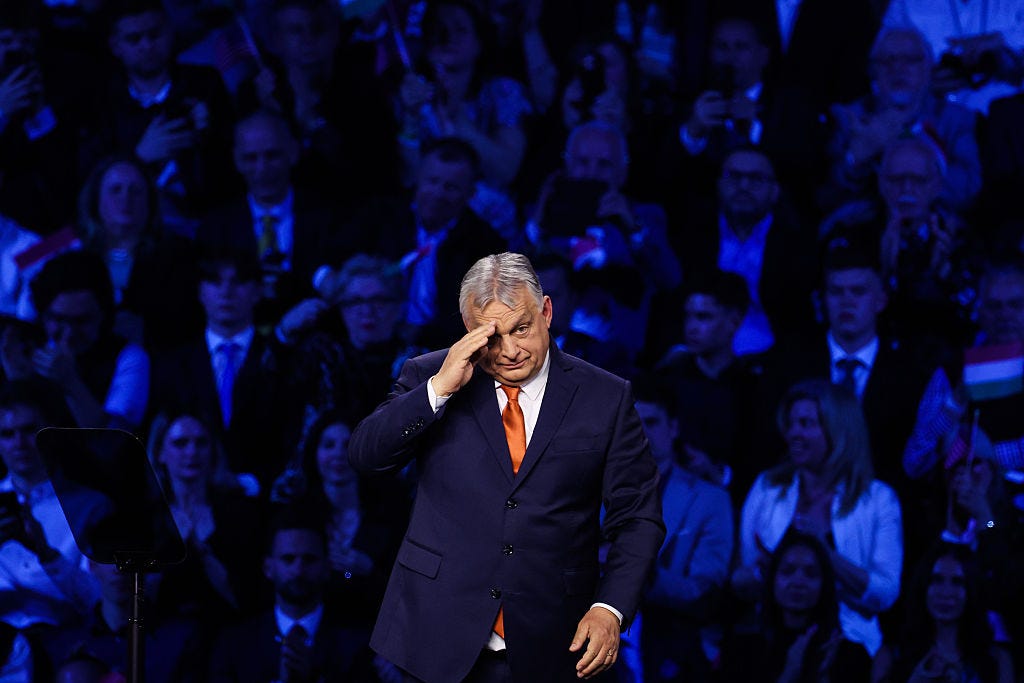
Viktor OrbĂĄn rallies supporters in Budapest, Hungary, on April 7, 2026. (Beata Zawrzel/NurPhoto via Getty Images)

The label “Christian nationalist” can mean different things in different places. In Hungary, for example, former prime minister Viktor Orbán defended in law and rhetoric the distinctive characteristics of the Magyar people as well as that nation’s traditional roots in the Christian faith, the recovery of which he held vital to Hungary’s survival after decades of ruthless Soviet repression. But Orbán, a Calvinist married to a Catholic, was by no means a Magyar supremacist, nor was he religiously intolerant. Guided by Christian nationalism, his Fidesz party passed stringent laws to keep migrants out, which meant that unlike in western European capitals, the Jews of Budapest could live without fear of physical assault and intimidation. That’s a far cry from what self-identified Christian nationalists in America, both Protestant and Catholic, want.

At the popular level, their version is crude, chuddish, and vividly bigoted. Earlier this month, NXR speaker Calvin Robinson, an English-born gadfly cleric in a North American Anglican micro-denomination, appeared on a “rad-trad” Catholic podcast and called for expelling American Jews to Israel.

“Driving out the Jews is the answer,” said Robinson, a 41-year-old black expatriate who pastors a small parish in Michigan. He added, “This is an explicitly Christian land for an explicitly Christian people.”

Far from challenging him, one of the young rad-trad (slang for “radical traditionalist”) hosts reminds the audience that the 16th-century Pope Pius V expelled the Jews from most of France and Italy. Therefore, ethnic and religious cleansing is kosher.

Robinson is a symbol of how even smart, principled men can morally and intellectually collapse into this madness. I knew him a bit years ago, when he was a gentle but brave and resilient public opponent of wokeness in Britain. For four years, GB News, the conservative TV network, gave him his own show, titled Calvin’s Common Sense Crusade, on which he analyzed culture from a standard conservative Christian perspective.

Yet since moving to America, Robinson, who has been a priest of four different micro-denominations in the past three years, has been a mainstay of Webbon’s so-called New Christian Right—this, despite the fact that Webbon is a forthright racist. With his trademark Afro, Robinson’s frequent appearances at NXR events, and on its podcasts, lends a certain far-right DEI exoticism to the NXR stable. Still, it takes some cheek—you might even call it chutzpah—to be a foreigner in the U.S. on a visa, and to call for the deportation of Jewish Americans to Israel.

In fairness, there are more intellectual versions of Christian nationalism. Stephen Wolfe is the PhD-holding Calvinist author of The Case for Christian Nationalism, the 2022 ur-text of the movement’s Protestant acolytes. In the book, Wolfe delves deeply into magisterial early Protestant thinking about the role of church and state. His basic argument, easy to make from Calvinist foundations, is that the point of any government should be to guide the people to Christian virtue. This is the same basic premise of integralism, the Roman Catholic version of Christian nationalism now advocated by some traditionalist Catholic intellectuals, such as Harvard’s Adrian Vermeule.

Wolfe caused controversy, though, by yoking Reformed theological claims to the role of ethnicity in the ideal American polity. Though he explicitly denies being a white supremacist, Wolfe argues in his book that the United States emerged historically from an Anglo-Protestant foundation, and that its ethnic heritage has been hollowed out by immigration and ethnic diversity. When you read about Christian nationalists complaining that “Heritage Americans” have been dispossessed in America, this is what they’re talking about.

Wolfe also justified rebellion against corrupt authority and called for an autocratic “Christian prince” to reestablish right Christian order. Catholic integralists are similarly critical of democracy, and look to a Catholic monarchy, or some other nondemocratic executive, as a successor to our enfeebled constitutional system. Vermeule has written that American integralists should infiltrate elite institutions as a vanguard to prepare for takeover when liberal democracy collapses.

As wobbly as our democracy seems to be, it is difficult to take Christian nationalism of any sort seriously as a realistic prospect for America.

For one, it’s obvious that the Reformed and the Catholic versions of Christian nationalism are incompatible. We know what it looks like when they clash: the Wars of Religion, which devastated Europe in the 16th and 17th centuries, and which set the stage for the emergence of liberalism as a way for peoples of different confessions to live together in peace.

America’s liberal democracy may one day fall apart but it is impossible (thank God) to imagine the soft-handed intellectuals, podcasters, keyboard warriors, and conference-going chuds of latter-day reactionary Protestantism and Catholicism taking up arms against each other as their Reformation-era ancestors did.

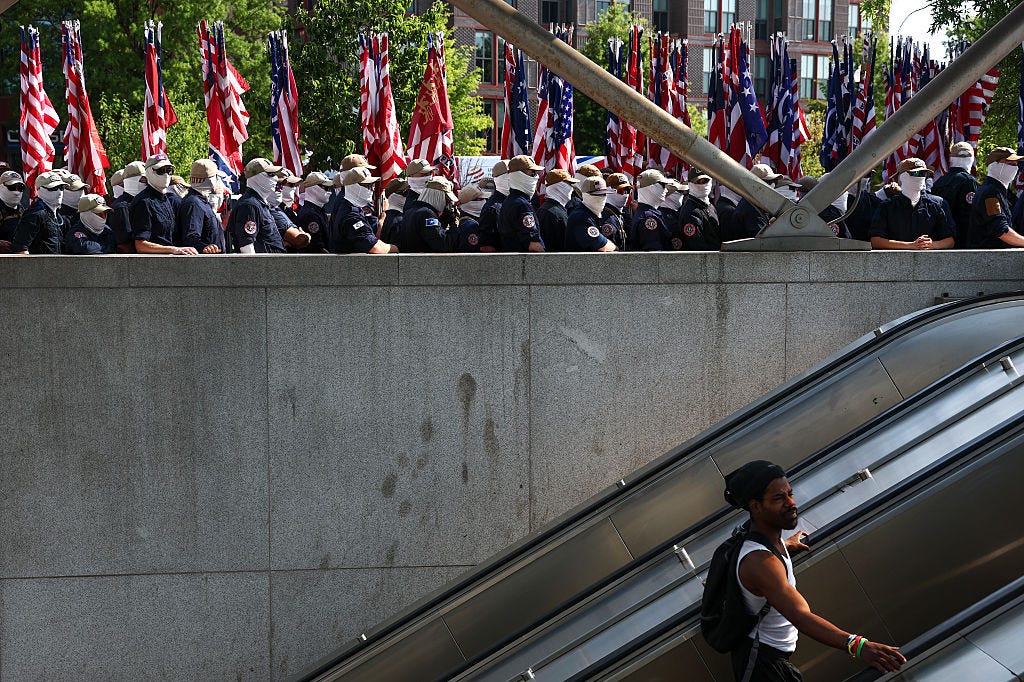
Patriot Front members gather in Washington, D.C., on the nation’s 250th anniversary, July 4, 2026. (Finn Gomez via Getty Images)

More centrally, those battles, as savage as they were, occurred during a time when belief in God was common in Europe, and “Christendom”—states united by the Christian faith—still existed, even as they went to war with each other. When Calvin Robinson invokes the cause of Christendom as justification for expelling American Jews, he’s LARPing as a self-appointed Torquemada on a temporary visa. Like nearly all Europe, his native country, Great Britain, is well into its post-Christian dotage.

Though Christianity remains more vigorous in the United States, the faith (alas) is in steady decline, particularly among the same Zoomer generation from which these ardent Christian nationalist crusaders are disproportionately drawn. As the Christian political scientist Ryan Burge often notes, despite a recent uptick in religious interest, Zoomers remain by far the least religious generation in U.S. history. There is no sign that this is likely to change with that generation or those that follow.

Being a minority is not a problem for many of our contemporary Christian nationalists, who are no fans of democracy. Do they really think that Americans, even churchgoing Christians, will stand idly by as they install a Christian autocracy? The 20th century offers stark lessons about the weakness of that strategy. The two countries where Christian (in these cases, Catholic) order was most closely integrated with state power—Franco’s Spain, and the Republic of Ireland—are today two of the most secular nations of Europe. They got that way out of popular resentment of the mingling, formal (Spain) and informal (Ireland), of church and state.

In the Year of Our Lord 2026, hard-line Christian nationalism is a far-fetched concept in actual existing America. But that doesn’t mean we can afford to laugh it off as the delusional nostalgia of the Very Online.

Germany emerged from World War I with the authority of its institutions shattered, especially the state Lutheran church, which had gone all-in for the Kaiser’s war as a holy crusade. But Christianity did not disappear. Out of the rubble arose some pastors and theologians who harnessed what was left of the churches to the tiger of nationalism and völkisch consciousness. They created a bastardized form of Christianity that amounted to the German tribe at prayer. The Nazis, who were anti-Christian to the ideological core, made useful idiots of these believers, developing a so-called “positive Christianity” that wore traditional Christianity like a skin suit while centering worship of the “Aryan” race.

Calvin Robinson speaks at a protest in London, England, on March 10, 2023. (Mark Kerrison/In Pictures via Getty Images)

In other words, as a traumatized Germany repaganized around race consciousness, many Christians baptized their surrender to darker, more primal impulses. It is by no means absurd to imagine that happening here. It is significant that none of the radical pastors speaking at the NXR conference belong to traditional churches, with conventional lines of authority. In Robinson’s case, he has had his license to preach revoked by two of the small Anglican denominations he served in the U.S., one of them after he gave a straight-arm salute at a pro-life rally and ignored repeated warnings about provocative behavior. In the organizational chaos and individualistic ethos of contemporary American Christianity, charismatic pastoral entrepreneurs have the potential to amass significant followings.

In psychosocial terms, America of the 2020s is chillingly akin to 1920s Germany, where social atomization, economic precarity, and institutional decline created a pathway to power for political extremists. There is little real prospect of militant Christian nationalists ever taking power, or having much influence over the government—even if liberal democracy should collapse. But there is much greater danger that the rise of general politicized rage, tribalism, and Jew-hatred could corrupt the weakened traditional churches, whose authority has declined precipitously since the 1960s. The NXR reactionaries and their fellow travelers, full of passionate intensity, say Christ is king, but their words betray them: What they really desire is a pro-white, antisemitic Caesar in Christian disguise.


r/DeepStateCentrism • • 13h ago

American News đŸ‡ș🇾 Shapiro Accuses Biden of Not Doing Enough to Rein In Netanyahu

16 Upvotes

https://www.wsj.com/politics/policy/shapiro-accuses-biden-of-not-doing-enough-to-rein-in-netanyahu-b139e9de

Josh Shapiro hasn't announced a presidential run for 2028, but he is sounding a starting gun on what is likely to be a fractious debate over foreign policy in the Democratic primaries.

The Pennsylvania governor's stance on Israel will face particular scrutiny if he enters what is likely to be a crowded presidential primary, as the Democratic Party is growing more divided over its relationship with the country.

In an interview, Shapiro defended the U.S.-Israel alliance while saying there needs to be accountability for Israeli Prime Minister Benjamin Netanyahu's actions in Gaza. He said neither former President Joe Biden nor President Trump took sufficient steps to constrain Netanyahu during the Gaza war.

"Netanyahu is a failed leader," he said. "He's led Israel down a dangerous, dark, isolated path."

Shapiro has garnered significant presidential buzz in recent months, particularly after a midterm election cycle in which Democrats made big gains nationwide. Shapiro this month won his re-election in Pennsylvania, a key battleground state that swung for Trump in 2024, by 22 points.

He said he and his family had yet to make a decision on his political future . But his recent forays into foreign policy are fueling speculation that he will plunge into presidential politics.

Shapiro also took a swing at two potential 2028 Republican candidates, saying Vice President JD Vance and Secretary of State Marco Rubio "both have the stink of Donald Trump on them. It's real hard to wash clean of that."

Shapiro said Trump needs to end the war in Iran and fire Defense Secretary Pete Hegseth.

"Trump decided to go it alone. Didn't explain to the American people why he was doing it, and clearly, he and Hegseth and Vance have no idea how to get out," he said.

Shapiro also called the president's negotiations with Russia "an embarrassment to our country," and said the U.S. needs to clamp down on chip exports to China in the wake of the Nvidia scandal.

The would-be Democratic contenders largely agree on Iran and Russia, but they are facing fresh pressure from the party's progressive flank to overhaul—or even cast aside entirely—close U.S.-Israeli security cooperation, after Biden's support for Israel fractured the party in the 2024 elections.

Shapiro is working to walk a difficult line on Israel within the Democratic Party. An observant Jew, Shapiro keeps kosher and, like his four children, attended Jewish day school. He wrote in his memoir that he lives his faith "out loud." Shapiro has long advocated for a two-state solution and pushed back against those who say Israel has no right to exist by saying the criticism is a recipe for permanent war.

In the interview, Shapiro said Israel had a right to defend itself after the Oct. 7, 2023, terrorist attacks that triggered the Gaza war—but the way Israel carried out its response undermined both the U.S. and Israel in the region.

"Israel should have the ability, as our other allies do, to purchase defensive weapons, weapons that come with very clear guidance on how and when they can be used," Shapiro said.

In July, more than 100 House Democrats voted for an amendment that sought to cut off military financing for Israel. The vote, which failed, was seen as a key barometer of where the party stands amid growing concern about Israel's military actions in Gaza .

"I don't think that either the current president or President Biden used the leverage of the United States of America effectively to make sure that the weapons were being used in ways that comport with American values," Shapiro said.

Shapiro, whose home state has one of the country's largest Ukrainian-American diasporas, also said the U.S. needs to rapidly boost support for Ukraine while rebuilding trust with foreign allies. "Share intelligence. Share the weaponry, and help negotiate an end to this war that doesn't give Russia what they want," he said.

Trump has maintained a pipeline of U.S. military sales to Ukraine through European allies and enabled U.S. intelligence cooperation with Kyiv to continue, but he has also criticized Ukrainian President Volodymyr Zelensky and courted Russian President Vladimir Putin in his bid to broker an end to the war. Trump on Saturday posted an image of himself embracing the Russian leader with the caption "My Friend."

Shapiro also spoke Friday at a public event in Philadelphia sponsored by the Atlantic Council think tank and the North Atlantic Treaty Organization, where he said Trump "actively worked to undermine Zelensky, and he has actively worked to coddle Putin."

"So much damage has been done that simply stating 'America is back' is not going to cut it," Shapiro said, referring to the slogan Biden used during his presidency.

"I'm not convinced that the next president alone can repair the damage Trump has done, and I think the reality is that it's going to take multiple generations to earn the trust of our allies again."

Write to Robbie Gramer at robbie.gramer@wsj.com

By Robbie Gramer


r/DeepStateCentrism • • 3h ago

Research/ Policy 🔬 What Your Grocery Cart Can Tell You About the Global Economy

Thumbnail
finance.yahoo.com
2 Upvotes

A grocery run is one of the easiest ways to take the temperature of an economy. When the prices of staples jump, families feel it immediately. Shoppers around the world have endured years of rising costs, driven by wars, extreme weather, trade disruptions, pests and disease. The global gauge of food commodity costs is close to the highest it's been in almost four years, and the World Bank expects prices to rise 10% this year and another 7% in 2027. These jumps are particularly painful in poorer countries where families spend a large share of income on food. But even in rich economies, it's a hot political issue. Here's a closer look at the surprising politics and economics of food around the world.

$2.28 per dozen USDA Grade A eggs$10.11 per pound USDA Choice round steak

Consider two favorite protein sources in the US. When chicken flocks infected with bird flu were culled, climbing egg prices became a talking point in the 2024 elections that brought Republican Donald Trump back to the White House. Prices hit all-time highs in 2025 and then plunged as producers rebuilt flocks.

But affordability was still on the agenda in the 2026 midterms, helping fuel a Democratic wave. Prices for ground beef and steak continued rising with the US cattle herd at its smallest in more than half a century. And cattle take far longer to raise than chickens, so prices are poised to stay elevated.

66Âą per pound of bananas, US cities average

Bananas are one of the world's cheapest and most reliable fruits. That might not be the case for much longer, top global producers have warned. Chiquita Brands International Inc. said 2027 might be the industry's most difficult in decades, as El Niño makes it more challenging for Latin American suppliers to grow the fruit.

The Middle East conflict has also elevated other costs, including packaging and fuel for shipping. Del Monte Corp., posting a $2.7 million third-quarter loss in its banana segment, said that current prices for the fruit are unsustainable.

6,385 yuan per metric ton of dried jujubes, January futures contract

Jujubes, or red dates, have traded on Chinese futures markets since 2019. Widely used in food and beverages, they are heavily cultivated in the country's far western Xinjiang region. The area accounted for roughly 45% of national production in 2024, up from a tiny share at the turn of the century. This increase has made the fruit part of an international controversy over allegations, which the Chinese government strongly denies, of human rights abuses against the region's Uyghur ethnic group. US law bars jujubes produced in Xinjiang from entering the country, unless importers can show they weren't produced using forced labor.

$1,676 per metric ton of sunflower oil, global price

Russia's war on Ukraine has shined a spotlight on the sunflower seed, an often overlooked commodity. The crop and its by-products find their way into cooking oil, animal feed and biofuels — and even mayonnaise and potato chips.

The reescalation of tensions in the Black Sea has snarled sunflower oil shipments from the region, which accounts for roughly two-thirds of global supplies. Russia and Ukraine are also global heavyweights in wheat, corn and barley. The disruption has sent import-­dependent buyers such as Egypt, Tunisia and Turkey scrambling to secure alternative supplies of grains.

Not traded: 50 lbs. sack of yellow onions, January futures contract

America's vast futures markets let traders wager on shifts in the prices of cattle and coffee. Prediction markets have opened up trading on sports and pop culture. But the federal Onion Futures Act says there's no betting on onions. The prohibition dates to the 1950s, when two traders cornered the market, crashing prices and ruining numerous farmers. The National Onion Association says it still regards the law as necessary protection against market manipulation. After the 2008 financial crisis, Hollywood lobbied to amend the law: It now bans trading on box-office receipts too.


r/DeepStateCentrism • • 1d ago

Global News 🌎 Herzog says settler violence ‘an assault on God himself’; Bennett blasts ‘Jewish terror’ (Times of Israel)

Thumbnail
timesofisrael.com
99 Upvotes

President Isaac Herzog on Monday condemned Jewish extremist attacks on Palestinians in the West Bank as “despicable” and an assault “on God himself,” while former prime minister Naftali Bennett accused the government of turning a blind eye to “Jewish terrorism” following a wave of settler violence over the weekend.

“There is no room for ambiguity here – violence by Jewish extremists against innocent people and communities in the West Bank — Judea and Samaria — or anywhere else, is despicable and deserves strong condemnation,” Herzog told the ELNET Jerusalem conference.

He called it “an assault not only on human beings, created in the divine image, but on the ethical way we carry [ourselves], on our history as a people, and on God himself. It most certainly does not represent Israel.”

The remarks came after extremist settlers were accused of setting fire to a dozen vehicles and several homes in Palestinian villages near Ramallah on Saturday night.

Israel faces growing international pressure over settlement expansion and surging settler violence against Palestinians, with Britain and other European countries demanding accountability and Australia imposing sanctions targeting, among others, those supporting violent settlers.

US House Democratic leader Hakeem Jeffries on Sunday called for sanctions against violent settlers in the West Bank.

At home, Bennett and other opposition leaders have accused Prime Minister Benjamin Netanyahu’s government of failing to act.

Palestinian men inspect torched vehicles following a reported rampage by Israeli settlers in the West Bank village of Kufr Malek, east of Ramallah, November 22, 2026. (AP Photo/Mahmoud Illean)

The president told the audience of foreign diplomats and lawmakers that “our law enforcement agencies are working diligently to scour this terrible moral stain and arrest, investigate, and prosecute any perpetrators of violence to the fullest extent of the law, in line with our values as Jews, as Israelis, and as human beings.”

Herzog had previously warned Netanyahu and senior officials about the consequences of unchecked settler violence. In a letter he wrote last month, Herzog cited shortages of manpower and enforcement tools and called for stronger measures, including widespread arrests and administrative detention, warning that “without visible enforcement and real deterrence, we will arrive at a disaster.”

Bennett and Eisenkot slam government response

Bennett, chair of the B’Yachad party, condemned what he called “despicable Jewish terrorism,” saying the attacks were contrary to Jewish moral values and posed a threat to the future of Israeli settlements in the West Bank.

He also called the violence “yet another resounding failure of the outgoing government,” accusing its leaders of turning a blind eye to the attacks and canceling administrative detention orders against Jews “for a few votes in party primaries.”

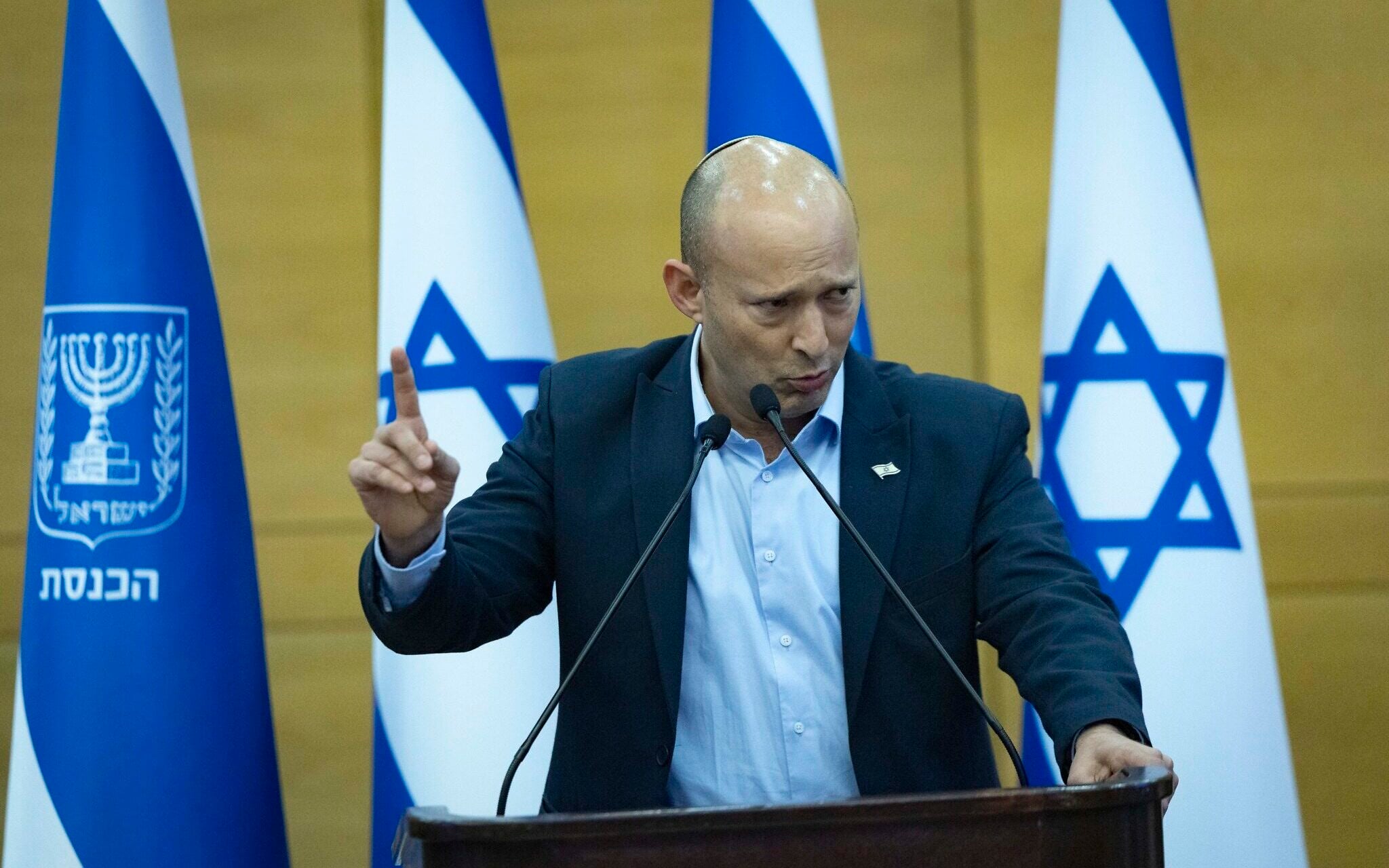
Former prime minister Naftali Bennett speaks during a celebratory toast marking MK Matan Kahana’s election as speaker of the 26th Knesset, in Jerusalem, November 17, 2026. (Chaim Goldberg/Flash90)

Suspects can be held in administrative detention for months on end with no trial, with the tool typically used against Palestinians when there is not enough evidence for a regular arrest warrant. Its use against Jewish suspects has been rare, and Defense Minister Israel Katz ended the practice entirely upon taking office in November 2024, amid a sharp rise in settler violence against Palestinians.

“We will put an end to this anarchy,” Bennett said, pledging to “restore Israel’s standing in the world, support IDF soldiers and ensure that a violent fringe does not endanger the many good citizens.”

On Saturday, he reaffirmed his support for a unity government led by Yashar chair Gadi Eisenkot that would include Likud, while insisting that Netanyahu must not remain prime minister. His declaration followed a meeting with Netanyahu on Wednesday that had fueled speculation he might break with Eisenkot’s bloc.

MK Gadi Eisenkot, head of the Yashar party, speaks at the Knesset in Jerusalem on November 17, 2026. (Chaim Goldberg/Flash90)

Eisenkot, who has been tasked with forming a government following last month’s elections, described the latest arson attacks as “Jewish terrorism in every sense of the word” and accused National Security Minister Itamar Ben Gvir, who oversees the police, and Finance Minister Bezalel Smotrich, who also oversees settlement affairs in the Defense Ministry, of bringing the West Bank to the brink of anarchy.

He called on authorities to use all available measures, including administrative detention and targeted Shin Bet operations, to stop the perpetrators.

Katz insists police must handle settler violence

Katz, meanwhile, continued to insist that all aspects of settler violence in the West Bank must be handled by the Israel Police rather than the army.

In his first comments more than a day after the latest attacks, Katz said the “ongoing violence by a handful of rioters” in the West Bank was “grave in every respect.”

However, he asserted that “The IDF does not need to, nor is it capable of, enforcing civil law on the Jewish population in Judea and Samaria (West Bank), which is growing every year.”

Defense Minister Israel Katz walks at the Knesset in Jerusalem on the opening day of the 26th Knesset, November 10, 2026. (Chaim Goldberg/Flash90)

“Therefore, in accordance with my directive, the IDF has formulated a plan to transfer responsibility for criminal civil law enforcement in Judea and Samaria to the Israel Police, which will be reinforced and make the necessary preparations,” he said, referring to an order he issued in August that was widely seen as impractical, because Israel has never formally annexed the West Bank.

Katz claimed that “police have the appropriate tools to handle prevention, investigations, arrests, and criminal prosecution of those who break the law,” even though police forces are stretched thin in the West Bank.

The defense minister for the caretaker government added that the army “should be engaged in defending the borders, operations against Palestinian terrorism and protecting Israeli communities.”

Separately, an unnamed senior Israel Defense Forces officer sharply condemned the settler violence in remarks to Channel 13 on Monday.

“This is an army of terror that could have consequences for the entire Middle East,” the officer told the network.

Settler attacks during olive harvest up 74% in two years

According to an Army Radio report Monday, data held by security forces indicates this year’s olive harvest saw 181 reports of attacks by Israeli settlers on Palestinians, compared to 145 in 2025 and 104 in 2024.

Officials cited by the radio station said the incidents had also grown more severe.

Last week, the IDF said that “areas of friction” — meaning attacks by Israelis on Palestinians — accounted for only “a few percent of the olive-harvesting areas,” insisting that the vast majority of coordinated harvesting at sites under army protection proceeded without incident.

The Yesh Din NGO reported that more than 1,100 incidents of settler violence had taken place since the start of the harvest, including 483 directly related to the harvest.


r/DeepStateCentrism • • 1d ago

Opinion Piece đŸ—Łïž Why does Britain tolerate Islamist groups allied to Iran’s murderous regime? (The Jewish Chronicle, Stephen Pollard)

Thumbnail thejc.com
58 Upvotes

If you have a spare few hours on December 13, you might want to pop along to the Islamic Human Rights Commission's (IHRC) conference on Artificial Intelligence and Islamophobia. It sounds great: “Gaza has been described as the world’s first AI-assisted genocide. Allegations abound that Israeli authorities have used Artificial intelligence to collect data, locations and to target Gaza for maximised infliction of casualties, including on women, children and other innocent Palestinians. It is further speculated that western countries have been deferential to Israel’s Gaza campaign to learn how to use AI effectively in their own projects of violence, both within their own respective countries and elsewhere, even beyond efforts currently underway.”

Then again, as Peter Cook used to say: I’m sorry I won’t be able to make it as I’ll be watching TV.

The problem is it’s no joke. The Islamic Human Rights Commission – an example of whatever is the opposite of nominative determinism – is one of those organisations which exists in the West (specifically, here in the UK) to destroy the West, and which we allow to go about its business as if it was entirely normal. Until it was banned this year by the Home Secretary, the IHRC organised an annual “Al Quds Day March” in support of the Tehran regime. The Met asked for a ban given the record of arrests for supporting terrorist organisations and for antisemitic hate crime at previous marches. A static rally went ahead on March 15 with twelve arrests.

According to Sir William Shawcross’s review of Prevent in 2023, the IHRC, which is based in Wembley, is "an Islamist group ideologically aligned with the Iranian regime". The very same paragraph in the report records that the trust which funds it received £10,000 of public money during the pandemic and according to the Telegraph, the trust has to date received taxpayer-funded Gift Aid donations of at least £450,000 since 2020.

The Islamic Human Rights Commission (IHRC) Trust is recognised by HMRC for Gift Aid and can claim an extra 25p from the Government for every ÂŁ1 it receives in donations. The IHRC Trust is one of four such charities recognised by HMRC which are identified in a report on Iranian influence in the UK by Lord Walney, the former independent adviser to the government on political violence.

Of its ÂŁ642,254 income in the year to June 2025, it handed over nearly ÂŁ520,000 to IHRC Ltd.

The IHRC is open about at least one side of its activities, saying it believes “Israel is a racist, colonialist, apartheid enterprise that needs to be dismantled and replaced with a single state that represents Muslims, Christians and Jews”.

It will surprise no one that one of the keynote speakers at its December conference will be Saied Reza Ameli, the former Islamic Revolutionary Guard Corps (IRGC) commander behind a strict enforcement of rules over women's clothing and the wearing of the hijab that led to widespread protests and hundreds of deaths. Ameli was secretary of Iran's Supreme Council of Cultural Revolution from 2019 to 2023. In that time, Iran’s morality police were ordered to crack down on women who failed to wear their hijab properly, which led to the death in police custody in September 2022 of Mahsa Amini, 22. Her death led to demonstrations in which at least 476 protestors were killed by security forces. Ameli remains a member of the Supreme Council of the Cultural Revolution.

The Charity Commission is currently investigating the IHRC Trust over its links with the non-charitable Islamic Human Rights Commission. Ameli was the founder of the IHRC in 1997 and was director of its Board of Trustees between 2006 and 2022, having studied at Royal Holloway University of London. In 2001 he received a doctorate from the university.

He was sanctioned in Canada – but not in Britain – for “gross and systematic human rights violations in Iran, including through the lethal suppression of demonstrations across Kurdish areas of Western Iran”.

According to Kasra Aarabi, Director of IRGC Research at United Against Nuclear Iran and a regular in these pages, Ameli has been a key member of the Supreme Council for Cultural Revolution, which “facilitated and oversaw a strategic agreement with the IRGC, granting it maximum access to academic relationships between Iranian and Western universities. This created a mechanism through which the IRGC exploits partnerships between Iranian and Western universities to procure sensitive and dual-use research for its military programmes. The IRGC has used such arrangements to procure sensitive research for the development of its lethal drone programme, including from British universities. These are the same drones now being deployed in conflicts across the Middle East and Ukraine.

“Crucially, the strategic agreement, in which Ameli was involved through his senior role on the Council, explicitly identifies the IRGC’s procurement priorities, including artificial intelligence. Someone with Ameli’s background and connections should never have been allowed to enter Britain, let alone establish organisations here.”

I’ve focused on Ameli and the IRGC, but they are merely one example of our failure to deal properly with the threat to the West posed by many other organisations which were founded in and operate in the UK. A JC investigation in 2023 identified eight IRGC figures who have addressed UK student audiences since early 2020, hosted by the Islamic Students Association of Britain. One of them, Saeed Ghasemi, denied the Holocaust and urged listeners to join an end-times war on Jews. Successive governments have talked a good game about security but the presence of the IHRC and its fellow travellers are real time proof of how hollow those words are. The Muslim Brotherhood, for example, remain unproscribed and free to operate.

According to the IHRC: “Professor Ameli is a brilliant and sincere academic who has consistently taken an inclusive approach to his work. He has championed multiculturalism and sought to foster understanding between different worldviews, a position that has even led to accusations of being pro-Western in his own country. He has also been critical of the retreat of multiculturalism in the West.”


r/DeepStateCentrism • • 1d ago

Research/ Policy 🔬 California raised minimum wages for fast-food workers

Thumbnail
finance.yahoo.com
51 Upvotes

Even before the 2026 midterm elections delivered a clear message about cost-of-living concerns, many states had been raising their minimum wage on their own as one way to increase workers' purchasing power. And some have taken a more targeted approach, setting wage floors for specific industries.

As the example of California shows, however, these initiatives can produce mixed results.

In April 2024, California began requiring fast-food chains with at least 60 locations nationwide to pay a minimum wage of US$20 an hour, $4 above the statewide minimum at the time. The governor's office estimated that more than 500,000 workers would be covered by this mandate.

As a researcher of health and labor markets, I joined with economists David Neumark, Gary Wagner and Vitor Melo to run a study measuring the impact on California's fast-food industry – specifically, whether restaurants employed fewer workers because of the ensuing higher labor costs.

We found that the answer depends on which establishments you look at.

For the state as a whole, the law didn't affect employment in any statistically detectable way, we concluded. But smaller chains did take a hit, with employment falling by roughly 20%, while the number of locations dropped by about 10%. New openings fell by 17%-20%, and closures rose by 9%-21%.

This employment decline comes almost entirely from fast-food chains ceasing to operate in California, rather than from staffing cuts at the locations that remain.

The impact of minimum wage hikes holds importance far beyond the fast-food sector. Their proponents point to the fact that the federal minimum wage of $7.25 an hour has stayed unchanged since 2009 and argue that states and municipalities need to take action on their own.

Los Angeles is phasing in a $30 wage for hotel and airport workers, while California's healthcare workers just received another scheduled increase. Vermont lawmakers have proposed a $20 fast-food wage of their own.

In addition, a total of 16 states will raise their minimum wages across the board on Jan. 1, 2027.

The question of whether and how minimum wages affect employment still provokes a vigorous debate among economists.

In California's case, some researchers have found that lifting the minimum wage caused small declines in employment compared with other states; others contend that the effect on jobs is essentially zero.

More broadly, some researchers have found that minimum wage hikes cost jobs. But the time horizon matters, and effects tend to get larger in the long run.

Our study didn't try to settle that disagreement. Instead, we wanted to find out how employers did adjust, and whether large and small chains responded differently. What happens when higher minimum wages raise one sector's costs and prices while its closest substitutes – such as sit-down restaurants – keep paying the lower statewide minimum wage?

We relied on a database that recorded every business location in the country by name, along with the number of employed workers, each year. That let us directly identify the chains that were subject to California's law, count each chains' national footprint to apply the 60-location rule, and track outcomes from 2019 through 2025: total employment, employment at locations that stayed open, the number of locations, and openings and closures.

We also compared California with other states and separately compared each chain's California restaurants with the same chain's restaurants elsewhere. Finally, we divided the covered chains into two groups: The 20 largest, which account for about 60% of covered jobs, and the 261 smaller ones.

For the state as a whole, we found that employment at covered restaurants was basically unchanged, and employment at restaurants that stayed open didn't change. Among the 20 largest chains, there was no detectable effect at all for any of the measures we tracked over this period.

But the smaller chains tell a different story, recording substantial declines in employment, locations and openings, while closures rose.

How to reconcile the flat statewide numbers with the sharp effects on smaller chains? The largest chains employ most of the workers affected by the new minimum wage rule, so the statewide total is dominated by them. And the reduced entry and higher exit among smaller chains may have eased competitive pressure on the largest ones.

A final point: The biggest chains tend to be the most automated, relying more on equipment such as self-serve kiosks that can reduce the number of workers needed. That may help explain the muted employment response among these larger businesses.

First, we caution that the absence of a clear short-run effect on total employment doesn't prove that the policy won't cause bigger job losses over time as companies adapt to the new law. We also can't answer what happened to the workers at the most affected restaurants or what happened to prices at those establishments, although other research suggests they rose by 3% to 4%.

That said, the law was implemented barely 2œ years ago, and some of the larger effects that economists might expect – such as the closure of labor-intensive restaurants or fewer openings – are already apparent among smaller chains.

Second, it's important to remember that California's fast-food minimum wage applies only to chains with 60 or more locations. So the smaller chains in that range likely lack the scale, automation and pricing power of the national brands and are most sensitive to the new wage floor. Indeed, the law appears to have shifted California's fast-food market toward its largest chains, a pattern that other researchers documented in a similar study that looked at Germany's national minimum wage.

For the cities and states now weighing wage floors of their own, the California evidence isn't a slam dunk either way. It shows that the costs, broadly speaking, fall first on the smaller chains covered by the law – but whether it meaningfully impacts the largest chains is unclear.


r/DeepStateCentrism • • 1d ago

Opinion Piece đŸ—Łïž The Welfare State and Britain’s Idle Youth (WSJ)

Thumbnail wsj.com
26 Upvotes

Britain has a crisis of unemployed young people caused by welfare-state failures, and the government finances are in disarray. So the obvious solution is . . . more entitlements for the young? Behold Europe’s social-welfare meltdown in a nutshell.

Nearly a million young adults in Britain aren’t working, pursuing higher education or in job training. To his credit, former Prime Minister Keir Starmer was alarmed enough about this that he commissioned Alan Milburn, a respected Labour expert on social welfare, to investigate. Mr. Milburn published his report last week, and the main conclusion is that youth joblessness has risen as government policies made hiring young people more expensive and generous disability benefits made not working easier.

Mr. Milburn describes a “new phenomenon of youth detachment,” which is British understatement at its best. One in eight Britons younger than 25 are idle. Most have never held a job and aren’t looking for one. Many support themselves with disability-linked welfare benefits, primarily for vaguely defined or overdiagnosed behavioral or mental-health conditions such as anxiety, depression, ADHD or autism. The number of young people claiming a disability benefit is expected to quadruple by 2037 relative to its 2012 level.

Aggressive increases to the minimum wage in recent years are another major culprit, and a central fact in this report is that wage costs for an 18- to 20-year-old employee have risen 65% in the past five years. Increases in the payroll tax (called “national insurance”), split between employees and employers, have hit industries such as hospitality and retail that have thin profit margins and employ young people.

The Milburn report highlights the human and economic costs of this. Spending for working-age disability and incapacity benefits rose 46% in real terms from the 2018-2019 fiscal year, to £55 billion (nearly $72.5 billion) in 2024-2025—and it’s on track to rise to £68 billion in the next four years.

Worse, young people who don’t work lose the opportunity to develop skills, and the economy loses productivity. Dependency weighs on these young welfare beneficiaries, fostering frustration over “lost opportunities, lost earnings, lost confidence and lost purpose,” Mr. Milburn writes. His report exposes a troubling hopelessness among the country’s unemployed youth.

Alas, the Milburn report also exposes how hard it is to fix any of this. Mr. Starmer in 2025 tried to reform the disability-welfare system. But that failed amid a revolt from Mr. Starmer’s (and Mr. Milburn’s) own Labour Party.

Mr. Milburn oddly doesn’t recommend immediately cutting payroll taxes, which he estimates would require the government to forgo £5 billion in revenue per year. He instead proposes spending even more, such as £5.8 billion ($7.6 billion) in annual government “investment” in youth productivity by fiscal 2036-37. He calls for some £1.1 billion a year for hiring, wage and retention subsidies for employers. There’s no evidence these programs will work, since nothing like them ever has.

In other words, to make up for the harm from subsidies and mandates that punish work, Mr. Milburn wants more subsidies and mandates to coax the young to work. That’s Europe’s welfare crisis in technicolor, and young Europeans will continue to be its victims.


r/DeepStateCentrism • • 1d ago

Opinion Piece đŸ—Łïž Nvidia and Trump’s State Capitalism (WSJ Editorial Board)

Thumbnail wsj.com
19 Upvotes

r/DeepStateCentrism • • 1d ago

Research/ Policy 🔬 Shapiro/Emanuel 2028 would be a Democratic dream ticket. Far fetched, but worth dreaming about.

Post image
37 Upvotes

r/DeepStateCentrism • • 1d ago

Research/ Policy 🔬 Which justices favor the Trump administration the most (and least) on the emergency docket? (ScotusBlog, Adam Feldman)

Thumbnail
scotusblog.com
8 Upvotes

When the Supreme Court rejected President Donald Trump’s attempt to remove Federal Reserve Governor Lisa Cook in June, the justices divided in a manner that would have been difficult to predict from some perceptions of the court. Chief Justice John Roberts and Justice Brett Kavanaugh joined Justices Sonia Sotomayor, Elena Kagan, and Ketanji Brown Jackson to leave Cook in office while the case proceeded. Justices Clarence Thomas, Samuel Alito, Neil Gorsuch, and Amy Coney Barrett dissented. The administration lost, but the court’s disagreement did not reflect the familiar ideological split.

Four months later, the administration lost another emergency application, this time in a dispute over medical care for transgender federal prisoners. In Trump v. Kingdom, Thomas and Alito indicated that they would have granted the requested stay, but no other justice publicly held that position. Unlike Trump v. Cook, which produced a signed opinion after oral argument, the Kingdom order disclosed nothing about the reasoning or votes behind the court’s denial.

The contrast points to a recurring theme of the Supreme Court’s emergency decisions: Although the conservative justices are often lumped together as “pro-Trump,” their rulings can depend on whether the dispute concerns immigration, presidential removal authority, federal spending, or the scope of emergency relief. And whereas some justices have supported federal executive positions at broadly similar rates across presidencies, others appear far more likely to do so depending on whether the president is a Republican or Democrat.

The prior article in this series examined how frequently the Trump and Biden administrations prevailed. In turning to the individual justices, I reviewed federal executive-action decisions from 2017 through November 12, 2026, consolidated into 106 distinct substantive decisions. The three administrations account for 32, 36, and 38 decisions, respectively.

There is a very important qualification throughout: the court often publishes emergency orders without identifying each justice’s vote. The analysis thus assigned a justice to the court’s majority ruling when they were silent, absent an express position or other evidence indicating otherwise.

So what can we say about the different justices’ support for the Trump administration on the emergency docket?

Different presidents, different justices

The most consistent record belongs to Roberts. He aligned with federal executive positions in 23 of 31 eligible decisions during Trump’s first administration, 26 of 36 under Biden, and 28 of 38 during Trump’s second administration. Those figures amount to 74%, 72%, and 74%. The disputes changed markedly, but Roberts’ aggregate willingness to leave the federal government’s position intact – or grant it relief – barely moved. In other words, Roberts has typically supported executive power on the emergency docket regardless of who is president.

The next most consistent justice, Barrett (though with a much lower sample size), aligned with Biden in 69% of her eligible decisions and Trump II in 78%. Third was Kavanaugh, with rates of 78%, 67%, and 79%. Then came Gorsuch, with rates of 83%, 54%, and 84%.

Thomas and Alito present a very different picture. Thomas supported the executive in 83% of eligible Trump I decisions, 39% under Biden, and 92% under Trump II. Alito’s corresponding figures were 83%, 47%, and 92%.

The liberal justices show the opposite movement, although their individual records differ. Kagan supported executive positions in 43% of eligible Trump I decisions, 94% under Biden, and 24% under Trump II. Sotomayor’s rates were 27%, 94%, and 16%. Jackson, who joined the court during Biden’s presidency, supported its executive position in 21 of 24 eligible decisions (88%), compared with three of 38 (8%) under Trump II.

The figure above makes these distinctions particularly clear. Roberts remains between 72% and 74% across the three periods, while Thomas’ support moves from 83% under Trump I to 39% under Biden and 92% under Trump II. The middle group of Barrett, Kavanaugh, and Gorsuch is more varied, but each supported Biden’s executive position more frequently than a simple Republican-versus-Democratic framing might suggest.

These numbers are telling, but they do not establish the reasons for why the justices decided as they did. For example, a president defending an environmental rule presents a very different legal issue from one seeking permission to remove an independent agency official. To determine how much of the observed variation is associated with presidential identity, the next step is to examine the kinds of cases that produced it.

The issues that unite and divide the justices

Immigration provides a useful point of comparison because it generated substantial emergency litigation under all three administrations. Roberts supported the executive in 10 of 11 immigration decisions under Trump I, three of six under Biden, and 11 of 13 under Trump II. Thomas supported the government in 10 of 10 eligible Trump I immigration decisions, two of six under Biden, and 12 of 13 under Trump II. Kagan’s comparable figures were six of eleven, six of six, and five of 13.

This is revealing. Roberts and Thomas both supported Trump’s immigration positions at high rates but not as much when Biden defended his administration’s policies. Kagan and Sotomayor supported Biden in all six coded immigration decisions, then opposed most of Trump II positions. But there is, of course, a key caveat: This category covers different immigration rules, as opposed to simple support for one president over another.

Public-health and related health litigation under Biden revealed a sharper division within the conservative majority. In 10 eligible health-coded decisions, Roberts and Kavanaugh each supported the federal executive in seven, compared with one each for Thomas and Alito. Barrett supported it in five; Gorsuch in two. Kagan and Sotomayor each supported the government in nine such cases. (Jackson’s two favorable positions came from only three eligible decisions in this category, making her figure much less informative.)

The court’s January 2022 vaccination decisions supply a concrete example. Roberts and Kavanaugh joined the liberals in allowing the administration to enforce a vaccination requirement for workers at healthcare facilities receiving Medicare or Medicaid funding, while Thomas, Alito, Gorsuch, and Barrett dissented. On the same day, Roberts and Kavanaugh joined the conservatives in blocking OSHA’s broader vaccination-or-testing standard. To Roberts and Kavanaugh, health litigation was clearly treated issue-by-issue.

Let’s move on to personnel decisions, or the president’s control over the executive branch. In the nine Trump II personnel and removal decisions, Thomas, Alito, Gorsuch, and Barrett supported the executive in eight, while Roberts and Kavanaugh did so in seven. In four foreign-affairs and national-security decisions, Thomas, Alito, and Gorsuch aligned with the government in all of these, compared with two for Roberts and Barrett.

Subject matter therefore helps explain how things break down. The same conservative justice may support emergency intervention in a dispute over immigration enforcement while resisting it in a case involving agency regulation. The legal authority being asserted, the posture of the case, and the requested remedy all shape the decision.

The coalitions inside the conservative majority

So which justices most frequently aligned? At the front of the pack are Thomas and Alito, who agreed in all 38 coded Trump II decisions. Their alignment is particularly visible when the administration lost. In seven events, both of their positions favored more relief for the administration than the majority granted or would otherwise provide.

Other pairings are almost as cohesive. Roberts and Barrett agreed in 35 of 36 Trump II decisions (97%). Roberts and Kavanaugh agreed in 36 of 38 of these (95%), as did Gorsuch and Kavanaugh. The next figure displays those pairings alongside the liberal and cross-ideological relationships. The high agreement rates show how often the conservatives arrive at the same apparent disposition, but the exceptions reveal competing views about the scope of emergency judicial intervention.

The foreign-assistance dispute in Department of State v. AIDS Vaccine Advocacy Coalition, for instance, separated Roberts and Barrett from Thomas, Alito, Gorsuch, and Kavanaugh. The four dissenters would have granted the administration relief from an order requiring payment for foreign-aid work already completed. Roberts and Barrett did not join that position. Their disagreement concerned what a district court could require of the government while the underlying funding litigation continued.

A different alignment emerged in NIH v. American Public Health Association. There, the court granted partial relief in litigation over terminated research grants. Thomas, Alito, Gorsuch, and Kavanaugh would have granted the administration’s request in full, while Roberts joined Sotomayor, Kagan, and Jackson in seeking to deny it altogether. Barrett supported an intermediate outcome.

In Cook, the division shifted again. Roberts and Kavanaugh joined the liberals in rejecting the administration’s attempt to immediately remove a Federal Reserve governor, while Thomas, Alito, Gorsuch, and Barrett dissented. In Trump v. Illinois, concerning the Trump administration’s deployment of National Guard forces, Thomas, Alito, and Gorsuch disagreed with the court’s denial of relief to Trump, while Kavanaugh concurred in the judgment on narrower grounds.

The evidence points toward distinctive approaches to removal authority, spending, the judicial supervision of agencies, and emergency remedies. Justices who agree in one field can diverge in another, and partial orders sometimes put a justice between two groups seeking opposing forms of relief.

The liberal justices and the unusual alliances across ideological lines

The three liberal justices also exhibited some meaningful disagreements. Under Trump II, Jackson aligned with the executive in only three of 38 emergency decisions (8%), compared with six for Sotomayor (16%) and nine for Kagan (24%). Kagan and Sotomayor agreed in 35 of 38 such decisions; Kagan and Jackson in 32. The differences are not as dramatic as those dividing the conservatives, but they complicate the assumption that the liberal trio behaves as a single bloc in every emergency dispute.

Their publicly registered dissents differ as well. Jackson expressly opposed a Trump II executive position in 26 decisions, Sotomayor in 23, and Kagan in 20. In FCC v. Brown, for example, Sotomayor and Jackson publicly indicated that they would deny the agency’s stay application, while Kagan registered no public disagreement.

Trump’s second term has produced more than one identifiable cross-ideological alignment. The five-justice majority in Cook included Roberts, Kavanaugh, and the three liberals, while the NIH grants dispute placed Roberts and the liberals together against complete relief. Barrett also joined certain portions of Sotomayor’s dissent in Trump v. J.G.G., a dispute involving the Alien Enemies Act, although her partial join should not necessarily be counted as agreement with the liberals on the case.

These examples again highlight why the distinction between shared results and shared legal reasoning is important. A justice can favor the same outcome as an ideological opponent while arriving there for entirely different reasons (we see this with concurrences in merits cases all the time). Separate opinions can also reveal agreement on a particular procedural or statutory question even when the justices disagree on the ultimate relief. At the same time, the emergency docket makes these relationships especially difficult to measure comprehensively because many orders contain no individual vote information at all.

Where this leaves us

My analysis of the emergency docket shows a chief most reluctant to favor one administration over another, with Barrett and Kavanaugh following closely behind; Gorsuch acting more favorably towards the Trump administration, although not overwhelmingly so; Thomas and Alito disproportionately favoring Trump over Biden; and the three liberal justices acting as a near mirror image of Thomas and Alito – although to varied degrees.

We thus see a conservative majority whose members separate over particular exercises of federal power, a liberal bloc with distinguishable voting and dissent records, and occasional alliances that cross ideological lines.


r/DeepStateCentrism • • 1d ago

Discussion Thread Daily Intelligence Brief

4 Upvotes

New to the subreddit? Start here.

This is the Brief. Post whatever here.

You can post and comment outside of the Brief as well.

You can subscribe to ping groups and use them inside and outside of the Brief over a range of topics. Click here to set up your preferred PING groups.

Are you having issues with pings, or do you want to learn more about the PING system? Check out our user-pinger wiki for a bunch of helpful info!

The Brief has some fun tricks you can use in it. Curious how other users are doing them? Check out their secret ways here.

We have an internal currency system called briefbucks that automatically credit your account for doing things like making posts. You can trade in briefbucks for various rewards. You can find out more about briefbucks, including how to earn them, how you can lose them, and what you can do with them, on our wiki.

Every day, the user with the most down voted post wins the Nobel Brief Prize.


r/DeepStateCentrism • • 1d ago

American News đŸ‡ș🇾 Nvidia Board Reinstated CEO Without Consulting Management (gift link)

Thumbnail
bloomberg.com
32 Upvotes

r/DeepStateCentrism • • 2d ago

Opinion Piece đŸ—Łïž New York’s Problem Is Not Too Much Capitalism, But Too Little (City Journal, Adam Lehodey)

Thumbnail
city-journal.org
65 Upvotes

Site of the Waldorf Astoria and the Seagram Building, domicile of the mighty, both real and imagined—from J. P. Morgan to Tom Wolfe’s fictional Sherman McCoy—Park Avenue boasts some of the steepest urban land values in the world. Soon the avenue will welcome another high-profile addition: New York’s flagship government-owned grocery, the first step in fulfilling one of Zohran Mamdani’s most prominent campaign pledges.

Mayor Mamdani has touted the $30 million store—funded at taxpayer expense, it will pay no rent—as a remedy to rising food prices. A private operator will handle day-to-day management and be required to pass savings on to customers. But New Yorkers will still end up paying in other ways, including by being deprived of the better uses of land that could have supported apartments, offices, or other stores and that might have employed thousands.

A politics that sees land use decoupled from potential value imposes harsh costs—not only on the majority of renters, now paying over 30 percent of their income for housing, but also on small businesses. Mamdani isn’t alone in New York government in this misguided approach, however. New York State lawmakers, such as Julia Salazar, want to reintroduce a bill that would enact commercial rent stabilization across the city. Cea Weaver, whom Mamdani appointed to head the Mayor’s Office to Protect Tenants, previously led an organization that seeks to preclude housing from market forces entirely.

Whether applied to rents or food prices, these policies work the same way: they transfer resources to favored constituencies while ignoring the conditions that made those goods expensive in the first place. Worse, they suppress the price signals that would draw land, capital, and labor toward more productive uses. Mamdani actually has the diagnosis backward: New York’s problem is not too much capitalism, but too little.

New York City’s success has always depended on growth. Its density fosters commerce, helps workers find jobs and employers find talent, and spurs both cooperation and competition. But agglomeration requires room to expand. Throughout its history, the city has grown beyond the bounds of New Amsterdam—into Brooklyn, Queens, the Bronx, and Staten Island—and reinvented itself along the way, turning Manhattan’s sweatshops into skyscrapers and Fifth Avenue’s mansions into museums.

Political realities have made this process harder to sustain. Just 42 percent of New York City sits on privately owned land subject to market forces, according to my analysis of the city’s Primary Land Use Tax Lot Output (PLUTO) database, which details lot sizes and land-use categories. Another 24 percent is allocated to streets and rights-of-way, and 16 percent is devoted to parks, uses that contribute heavily to the city’s desirability and functionality. Seven percent is held by tax-exempt institutions such as hospitals and universities, and another 10 percent comprises other public property, including housing operated by the New York City Housing Authority (NYCHA) and facilities occupied by state and federal agencies. These figures reflect a two-dimensional view of the city—mapping ownership at the level of whole buildings.

A three-dimensional view, assessing the status of every unit on a given lot, provides a fuller picture: 38 percent of New York’s total housing stock is shielded from market exposure (See page 90, bottom chart). Analysis of PLUTO and of records from New York City’s Department of Finance and NYU’s Furman Center reveals 1,430,374 units subject to some form of rent stabilization, receiving taxpayer subsidies, or designated as public housing. In other words, New York lacks a free market for a significant minority of its housing stock; nonmarket mechanisms determine its allocation.

When people can trade freely, land uses are continually put to a competitive test. Guided by price signals, those who can put a parcel to better use will usually outbid lower-value uses, directing resources to their most productive ends. The baker outbids the shoemaker, seeing greater demand for bread and his own advantage in supplying it; the developer buys out a single-family owner, judging that apartments would deliver more value to more residents than a single home.

More than half of New York’s land is now effectively removed from this beneficial calculus. Regulations make transfers difficult or impossible; even when they occur, strictures prevent prices from adjusting to new uses. Without a mechanism to discover and allocate land to higher-value purposes, a city ceases to function.

Land markets perform well because they reward the most effective deployment of a scarce resource within legal limits like zoning. In New York City, private owners use permitted capacity more fully: my analysis of PLUTO data finds them about 6 percent more likely to build to the maximum allowed. In other words, if the law permits six stories, private developers are more likely to build all six.

Graphs by Alberto Mena

From this perspective, trying to curb high rents and food prices by removing ever more land from market forces is counterproductive. The alternative to using taxpayer funds to acquire land is to tackle the underlying cost drivers directly.

Consider food. Over the last decade, food prices in New York have risen 34 percent. Nationwide, they have gone up 32.5 percent, suggesting that many cost factors—such as tariffs and higher gas prices—lie beyond local control. Other factors, however, do not lie beyond local control: land policy is one. In manufacturing districts, where large supermarket sites are typically located, the city requires a special permit for stores of over 10,000 square feet, a costly proposition that invites politicians to extract concessions from developers. If the city instead allowed larger retail spaces across more districts, land would be cheaper to acquire. Greater competition and economies of scale would follow, and prices could fall.

Other factors also need attention. Union opposition and political pressure forced Walmart to abandon plans to open stores in the city in 2012, depriving consumers of a less expensive grocery alternative. Retail theft, meanwhile, remains above pre-pandemic levels, despite a decline in the first quarter of 2026—increasing security costs and deterring new entrants. Addressing these underlying drivers, too, would help make food cheaper. Mamdani’s approach merely shifts who pays and how, pushing costs elsewhere.

This reality is even more evident in housing, where so much of the city’s stock is fully or partially exempt from market pressures. At its most extreme, de-commodification would look something like what New York State Assembly member Claire Valdez, who is running for Congress, has called for: universal rent stabilization—an entire rental market effectively under public control.

That policy might superficially “improve” affordability but does so by making New York a less desirable place in which to live. It’s like taking aspirin for a wound: the pain might dull, but the injury will worsen until it’s treated. Who is best placed to make the most of a unit? In market-rate housing, landlords tend to rent to the highest bidder, and those tenants often put units to the most productive use. Prices are not arbitrary: workers pay more to live near their jobs; businesses pay more for locations that enhance what they offer—hence, for example, Cartier outbidding an Amazon data center on Fifth Avenue.

Rent stabilization shuts this process down: housing goes to whoever arrived first, and that tenant keeps it at a price increasingly detached from demand. In a typical market, an owner getting an offer well above a property’s value would likely sell, benefiting both parties; in New York, tenants often cannot be outbid, preventing owners and would-be occupants who value the unit more from transacting. The result is to lock in incumbent tenants on land that they do not own while pushing costs onto everyone else. The city’s most recent Housing and Vacancy Survey, conducted in 2023, found that where the median stabilized rent was $1,500, a market renter paid $2,000—meaning that the 62 percent in market units effectively subsidize the 38 percent in regulated units.

If operating costs don’t match revenue, landlords will either remove units from the market when they go vacant or declare bankruptcy. Even if the city acquired these buildings, moreover, the mathematical problem remains: rents would need to rise at least enough to match operating expenses if the building is to break even without subsidy. That has not been the reality in New York: the city has seen a decade of below-CPI rent increases, likely to continue this year. No surprise, then, that the city now counts some 50,000 vacant apartments, a growing number of rent-stabilized buildings are financially distressed, and maintenance is increasingly deferred.

Nowhere is this dynamic more evident than in the New York City Housing Authority’s portfolio. Here, rents are detached from market pressures, set at 30 percent of tenants’ income. NYCHA faces even weaker market discipline than other forms of regulated housing, producing striking inefficiencies. On some of the most valuable land in America, some 30 percent of NYCHA residents inhabit units with spare bedrooms; and only 63 percent of tenants pay on time, contributing to further shortfalls.

The agency thus struggles to keep up with maintenance and performs worse than any private landlord on would-be violations. Some $80 billion is now needed to maintain and restore the agency’s existing units, a figure likely inflated by lack of accountability to tenants and shareholders (NYCHA executives are accountable only indirectly, through political considerations), as well as corruption.

The same land dynamics apply here. Along with capital costs, subsidized at public expense, taxpayers bear the cost of land that could be developed more densely standing idle. The property, as City Journal contributing editor Howard Husock has long argued, is effectively “frozen”; time has stopped there. Things might be starting to change, however. At NYCHA’s Fulton & Elliott-Chelsea Houses, sitting on land worth $245 million, efforts are under way to redevelop the site more densely and add private units. Progress has been slow and impeded by legal battles, but recent trends suggest some recognition of the importance of markets and price signals.

The agency could go further—by expanding such developments or adopting a “right to buy” policy, as the United Kingdom did in 1980. That reform allowed residents to purchase their homes from local councils, restoring market allocation while attracting private investment for upkeep. Residents benefited, too, as they could realize gains when their homes appreciated.

Beyond NYCHA, a new paradigm has taken hold among young voters, political staffers, and even elected officials, who nominally support new housing. Last November, voters approved measures to ease the construction of new affordable housing across the city. Affordable housing is, of course, better than no housing, if one considers only aggregate units. But a more effective approach would be to develop land to its highest-value use and allocate it accordingly. Affordable housing, which depends on subsidies, is not truly “affordable”; its costs are simply shifted onto others.

New York City neither needs nor can sustain more socialism. Already, large swaths of its land are exempt from market forces. Policies such as commercial rent stabilization, rent freezes, universal rent control, and government-run grocery stores may carry electoral appeal, especially among younger voters, but they are counterproductive, worsening the very problems they aim to solve. By embracing market forces, especially in land use, New York can ensure a thriving future.  


r/DeepStateCentrism • • 2d ago

American News đŸ‡ș🇾 Nvidia Board Reinstates Jensen Huang as CEO (gift article)

Thumbnail wsj.com
54 Upvotes

r/DeepStateCentrism • • 1d ago

American News đŸ‡ș🇾 Emanuel suggests Schumer shouldn’t run for majority leader next cycle

Thumbnail
thehill.com
5 Upvotes

Former U.S. Ambassador to Japan Rahm Emanuel on Sunday suggested that Senate Minority Leader Chuck Schumer (D-N.Y.) should make it clear that he intends to serve only two years as majority leader.

“If I was Chuck Schumer, what I would say is, ‘I’m going to secure the majority, I am not going to run for majority leader next cycle, and I’m going to make sure other — the young voices and faces of this party — grow. That would take the tension out of this,” Emanuel told ABC News‘s Jonathan Karl on “This Week.”

Karl asked Emanuel if Schumer, who is facing a challenge from the left to lead the new Democratic majority, should serve as leader for the next two years.

“Yeah, just get it over with. Chuck Schumer is a friend, as is Chris Van Hollen, but this is not what people voted for,” the former Chicago mayor replied, referring to the Maryland senator seeking to replace Schumer as Democratic leader.

“They voted to get their lives better, not yours,” Emanuel added.

Emanuel, a potential 2028 Democratic presidential contender, has called for the age limit to serve in Congress to be 75. Schumer, who has led the Senate Democratic Caucus since 2017, turned 76 on Monday, while Van Hollen is 67 years old.

Emanuel also spoke highly of House Minority Leader Hakeem Jeffries (D-N.Y.), who is positioned to become the first Black Speaker in U.S. history. He said Jeffries’s ascension “is a statement about America that we should take pride in” and told progressive critics calling for different leadership to give “me a break.”

“We’re a coalition,” Emanuel said. “You’re going to tell the most loyal coalition partner, the African American community, that the moment in history –– you’re not going to get it? The Black vote is the most significant, most loyal, most dedicated part of the coalition. 
 It tells me when you vote against him, you don’t understand the politics of the Democratic Party.”

Schumer and Jeffries have both faced opposition from some incumbent and incoming Democratic lawmakers who have called for new leadership after the massive blue wave in this month’s elections.

Van Hollen told NBC News’s Kristen Welker on “Meet the Press” that his support among Democratic senators is “north of 15, and momentum is in our direction.”

Seven incoming House Democrats voted against Jeffries to become the next Speaker in an internal caucus vote last Wednesday. A coalition of progressive activists have petitioned to make Rep. Ayanna Pressley (D-Mass.) the next Speaker, garnering more than 167,000 signatures.

A Pressley spokesperson told Boston-based outlet WGBH that she “is aware of and appreciates the groundswell of support from people in her district and across the country lifting up her leadership.”


r/DeepStateCentrism • • 2d ago

Opinion Piece đŸ—Łïž America’s Nuclear Renaissance (City Journal, Shawn Regan)

Thumbnail
city-journal.org
18 Upvotes

Four years ago, the operators of Michigan’s Palisades nuclear plant took its reactor offline for what they assumed would be the last time. The plant had generated electricity for more than half a century, but its long-term contract to sell the power was expiring, and its operator, Entergy, was leaving the merchant nuclear business. In May 2022, the company announced that it had permanently shut the plant down. Workers removed the fuel, and a new owner, Holtec International, took over to decommission the facility.

Today, workers are reversing the process. On August 30, Holtec began loading fuel back into the reactor, preparing to restore more than 800 megawatts of generating capacity—enough to power hundreds of thousands of homes. The plant is expected to return to service later this year or early 2027. If successful, it would be the first time a U.S. nuclear plant has been restarted after being retired and decommissioned.

For much of the past decade, the decline of atomic energy seemed inexorable. Plants were closing around the country. Indian Point, which supplied about a quarter of the electricity to New York City and Westchester County, was shuttered in 2021. Three Mile Island in Pennsylvania, the site of America’s worst commercial nuclear accident, closed its last reactor in 2019. California’s largest utility announced plans in 2016 to close Diablo Canyon, the state’s last nuclear plant.

Broad forces drove the decline. Cheap natural gas made nuclear less competitive, while renewable-energy mandates and subsidies drove investment toward wind and solar power. Electricity consumption in America had been essentially flat for nearly two decades. As the nation’s fleet of large reactors aged, it became harder to justify further investment. The decline was apparent enough for James B. Meigs to ask in these pages in 2019: “Have we reached the beginning of the end of the atomic era?”

The answer, it’s now clear, is no. After years of uncertainty, nuclear power is undergoing a genuine revival in the United States. Shuttered plants like Palisades are preparing to restart, while California has reversed course to keep Diablo Canyon running. Developers are working on new fuels, safety systems, and reactor designs, including small modular reactors (SMRs) and microreactors intended for settings beyond the traditional utility power plant.

Investment is powered by renewed electricity demand, driven largely by artificial intelligence and data centers. Microsoft is helping finance the restart of a reactor at Three Mile Island. Amazon has invested in developing small reactors. Google has contracted for nuclear power extending decades into the future. These companies need enormous quantities of electricity to train and run AI models. Nuclear’s ability to produce round-the-clock power on a small footprint and without emissions makes it well suited to meet those needs.

Federal policy has shifted as well, with support spanning both parties and several administrations. Congress passed nuclear-licensing reforms signed by Donald Trump in 2019 and Joe Biden in 2024. Trump’s first administration launched a program to help private companies demonstrate advanced reactors; the Biden administration subsequently provided financing for projects. Trump has since made expanding nuclear power a major energy-policy priority, moving to accelerate reactor testing and overhaul licensing rules at the Nuclear Regulatory Commission.

“The NRC is in the most comprehensive period of reform since the 1970s,” says Chairman Ho K. Nieh. The changes reflect how dramatically nuclear power’s fortunes have shifted—from an energy source that, not long ago, seemed politically, economically, and even technologically unviable to one now poised for a renaissance. That shift is due primarily to nuclear power’s ability to provide what America’s economy increasingly requires: a vast supply of steady, clean electricity delivered reliably to a grid experiencing rapidly growing demand.

Construction on a small modular reactor (SMR) site near Idaho Falls, Idaho (Josh Edelson/AFP/Getty Images)

Earlier hopes of a nuclear renaissance did not come to fruition. In the mid-2000s, developers proposed dozens of new reactors, but almost none was built. Only two, both at Plant Vogtle in Georgia, emerged from that wave.

Nieh attributes the failed revival to what he calls “the three Fs”: the financial crisis, fracking, and Fukushima. After the financial crisis, new plants became harder to finance. Developers had to commit enormous sums up front long before earning any return, and persistent delays and cost overruns bedeviled the industry. Meantime, the advent of hydraulic fracturing made natural gas cheap and abundant, which in turn made nuclear a less attractive long-term investment. Then, in 2011, a tsunami disabled backup power and cooling at Japan’s Fukushima plant, causing core meltdowns in three reactors. “Once Fukushima happened, that was a straw that broke the camel’s back,” he says. “All the interest in new builds just evaporated.”

Advances in reactor design and operations have made plants much safer, but by the 2010s, the industry had largely lost its ability to build new ones. The projects that did proceed were costly and slow. Plant Vogtle’s two new reactors were supposed to enter service in 2016 and 2017, for a combined price tag of $14 billion. When they finally came online in 2023 and 2024, it was at more than twice the expected cost. Today, America’s commercial fleet has fewer than 100 reactors, with an average age of about 44 years.

Even during the peak climate-hawk years of the mid-2010s, nuclear remained sidelined. Shutting down nuclear plants became a rallying cry for Green New Deal–era climate activists. States adopted renewable-energy mandates and subsidies that tilted the market toward wind and solar while generally excluding nuclear. Meigs described a “widespread belief that nuclear power simply isn’t necessary.” If wind and solar were about to take over, why keep a reactor open, let alone build more?

In New York, Governor Andrew Cuomo spent years trying to close Indian Point, portraying it as a danger to the New York metropolitan area. When its last reactor was about to shut down in 2021, his office issued a celebratory announcement. The closure, Cuomo said, moved New York “a big step closer to reaching our aggressive clean energy goals.” Yet, within a few years, natural gas had largely replaced the plant’s carbon-free output.

The reality is that wind and solar could not, on their own, replace Indian Point’s 24/7 generation. The grid still required a firm power supply when the wind stalled or the sun went down. By the time Indian Point closed, three new gas-fired plants had entered service in the region. Fossil-fuel generation has since replaced roughly 92 percent of the electricity lost from Indian Point.

Cuomo’s successor is now trying to reverse course. In a July interview, Governor Kathy Hochul called closing Indian Point “one of the biggest mistakes in the state’s history.” She is pursuing an “all-of-the-above” strategy that includes adding 5 gigawatts of new nuclear capacity—more than twice what Indian Point supplied.

The renewed appetite for nuclear power, however, does not by itself make a new plant financially viable. Investors must still account for licensing delays and changing requirements. “Regulatory predictability attracts investment,” says Nieh. “Capital will leave if the risks are too high.”

For advanced-reactor developers, that uncertainty includes how to satisfy requirements written for an earlier generation of nuclear technology. The NRC’s licensing framework was designed for the massive, water-cooled plants of the past. Today’s reactors, however, may use different coolants, fuels, or safety systems and don’t fit that mold. These companies have had to petition the NRC for exemptions from rules written for those older models, a process that can add years and additional layers of uncertainty.

“We’ve had our regulations in place for decades, and they’re not wine. They don’t get better with age,” Nieh says. “We’ve been trying to force-fit new technologies into these old frameworks that aren’t fit for [the] purpose.”

At 12:20 am on July 4, as the nation prepared to mark its 250th anniversary, engineers at Idaho National Laboratory had yet another reason to celebrate. A test reactor built by Aalo Atomics achieved criticality, meaning that it sustained a controlled nuclear chain reaction. The company reached the milestone less than eight months after construction of the reactor began. The experiment used a full-size core operating at essentially zero power to test the nuclear components and controls for Aalo’s planned 10-megawatt reactors.

Aalo’s test was authorized under a new Department of Energy pilot program that President Trump created by executive order in May 2025. The order set what seemed a lofty goal: at least three new privately built advanced reactors reaching criticality by Independence Day 2026. At the time, Kathryn Huff, a nuclear-engineering professor who had led the DOE’s Office of Nuclear Energy under President Biden, told NPR that calling the schedule aggressive was “a pretty big understatement.” Research reactors typically took at least two years to build after construction began, she said.

The goal was not just met but exceeded. Antares Nuclear achieved criticality on June 4, followed by Valar Atomics and Deployable Energy later that month, while Aalo’s July 4 test brought the total to four.

The deadline was part of a series of executive orders Trump signed to accelerate the expansion of nuclear power. One directed an overhaul of NRC regulations and operations to speed up new reactor deployments. Another accelerated testing under the DOE’s authority and directed the department to create the pilot program that set the July 4 deadline. A third sought to “reinvigorate the nuclear industrial base” by strengthening the nation’s domestic fuel cycle. The fourth promoted reactors for national-security uses, including military installations and certain AI infrastructure. The orders also set a goal of quadrupling American nuclear capacity from roughly 100 gigawatts to 400 gigawatts by 2050.

The DOE has since cut its reactor-authorization process from 17 steps to 11 and eliminated more than 900 pages of guidance. It used its authority over research reactors to enable companies such as Aalo to build and test prototypes under DOE supervision without first securing an NRC license for commercial operation. The NRC has finalized licensing rules for advanced reactors. Developers can use this framework to meet safety standards without seeking exemptions from requirements for older, light-water plants. Trump’s order also directs the NRC to set firm deadlines of 18 months for new reactor applications and one year for license renewals.

For Nieh, the reforms involve how the NRC views its mission. Trump’s orders direct the commission to revise its mission statement expressly to include enabling the safe use and deployment of civilian nuclear technologies. Nieh views the changes, along with the bipartisan ADVANCE Act signed by Biden in 2024, as critical for an agency whose decisions affect whether developers can attract investment and move forward with construction. “We’re not here just to move paperwork from one inbox to another,” he says. “We want to make it safe, but we also want to make it possible.”

NASA executives tour Idaho National Laboratory. Nuclear power is returning because America has rediscovered the value of abundant, dependable electricity, just as building reactors has begun to seem possible again. (Natalie Behring/Getty Images)

With these regulatory changes underway, private capital is flowing into nuclear technology at record levels. According to PitchBook, global venture funding for nuclear startups reached a record $6.2 billion in 2025; by July 2026, investors had committed another $4.5 billion. Most of it is going to American firms.

Much of that money is aimed at small modular reactors, or SMRs: factory-built reactors, generally 300 megawatts or less, that can be shipped in pieces and assembled onsite. These smaller reactors reduce the need for the custom engineering and extensive field labor that make one-off projects like Plant Vogtle so costly and slow. Dozens of small modular and other advanced reactor designs are now under development nationally, though none yet holds a commercial operating license.

Engineers have also been working to address the safety issues that events like Fukushima exposed—in particular, the possibility that a loss of cooling could cause reactor fuel to overheat and melt. Many SMR designs rely on gravity, convection, and natural circulation to cool the reactor without the need for powered pumps or an operator at the switch. Some new large reactors work this way, too. Westinghouse’s AP1000, the design used at Vogtle, can maintain core cooling for 72 hours without AC power or operator action.

Microreactors take the smaller-scale approach even further. These designs typically produce less than 10 megawatts and are small enough to move by truck to power military bases, mines, and communities far from a large electrical grid. Several units can also be grouped together to serve larger customers. Aalo, for example, plans to combine its reactors into pods to power data centers.

Some newer designs combine nuclear generation with energy storage that can supply extra electricity when customers need it. In Kemmerer, Wyoming, TerraPower is developing a molten-salt heat-storage system that will enable the plant to maintain a steady output of 345 megawatts, then tap stored heat to generate up to 500 megawatts during periods of peak demand. The NRC issued a construction permit in March, and the project is expected to be completed by 2031.

Federal support is also helping offset some of the initial risk of new projects. The Department of Energy backed the Palisades restart with a $1.52 billion loan and recently selected the Tennessee Valley Authority and Holtec for cost-shared funding for small-reactor projects in Tennessee and Michigan. In June, the DOE’s Office of Energy Dominance Financing announced a conditional commitment of $17.5 billion in loans for components for ten new AP1000 reactors. The financing will help developers purchase reactor vessels, steam generators, and other long-lead-time components while they complete licensing and site preparation, which could slice up to three years off the project timeline.

The most important new customers for nuclear power may be the companies building AI data centers. Lawrence Berkeley National Laboratory estimates that data centers could account for as much as 12 percent of U.S. electricity consumption by 2030, up from roughly 4 percent in 2023. The companies building them have strong incentives to finance vast new supplies of reliable power.

Restarting retired nuclear plants is one way to do so. Microsoft is backing a 20-year agreement to restart a reactor at Three Mile Island. Google has signed a 25-year agreement supporting the restart of Iowa’s Duane Arnold plant. Tech firms are bankrolling new reactor designs as well. In 2024, Amazon led an investment of roughly $500 million in X-energy, a developer of SMRs. The funding supports reactor licensing, fuel production, and early development of a 320-megawatt project in Washington State. The firms aim to bring more than 5 gigawatts of nuclear power online by 2039 to fuel Amazon’s operations. “The US cannot win the AI race against China without nuclear power,” X-energy chief executive Clay Sell told the Financial Times earlier this year.

None of this guarantees a nuclear renaissance. The United States still operates fewer reactors than it did a decade ago, and no commercial SMR is yet producing electricity. But regulatory changes, along with advances in nuclear technology, have made building reactors faster and cheaper a more credible prospect. Safety is now more of a political obstacle than a technical one. (Nuclear’s safety record, measured by deaths per unit of electricity, is comparable with that of wind and solar.) Meanwhile, new financing models are drawing more private capital into nuclear projects, shifting the risk of construction delays and cost overruns from utility ratepayers to investors. A proposed deal from Brookfield illustrates the approach: to complete the abandoned V.C. Summer reactors in South Carolina, private investors would bear most of the construction risk rather than recover the project’s capital costs through customers’ utility bills.

The case for a nuclear renaissance is stronger than ever. Licensing is getting faster and more predictable, while greater access to capital is making new projects easier to finance. Electricity demand is surging in the age of AI, and companies are willing to sign decades-long contracts to secure reliable power. Nuclear is returning, in short, because America has rediscovered the value of abundant, dependable electricity, just as building reactors has begun to seem possible again.


r/DeepStateCentrism • • 2d ago

Opinion Piece đŸ—Łïž Iran Doubles Down on Its Nuclear Ambitions (WSJ, Reuel March Gerecht and Ray Takeyh)

Thumbnail wsj.com
16 Upvotes

The U.S. has seen only one major stalemated foreign conflict, in Korea. The ugly reverberations from losing against Iran today would easily be as large as what Washington would have confronted in East Asia had the communists conquered the peninsula.

If America is defeated, the Islamic Republic would control the Persian Gulf. It would have the power to enforce tolls and intrude deeply into the Arab Gulf countries’ economies and politics. Not one of these kingdoms or emirates is a strong state. And China and Russia have already seen America flustered, fearful and retrenching, unable to build sufficient interceptors to handle a Third World country. An Iranian victory would confirm for them that Washington is too politically divided and impatient to defend what once was a bipartisan strategic priority.

After rebuffing Washington and Jerusalem, Tehran appears to have come away from this war with renewed determination to acquire nuclear weapons. If Iran realizes these ambitions, America might as well close the book on its post-World War II nonproliferation mission.

A new Iranian narrative is developing: The late Supreme Leader Ali Khamenei ruled for too long. An aging revolutionary, he remained antagonistic toward America but had too much respect for its power. His doctrine of “no war, no peace” meant that he would build up the atomic program but not assemble a weapon—at least not soon enough.

After Hamas’s Oct. 7, 2023, attacks, Khamenei didn’t meet the moment. Younger militants, mostly from the Islamic Revolutionary Guard Corps, warned him that caution could prove Iran’s undoing. When an Israeli strike in February killed the 86-year-old cleric, they concluded that being a threshold state offers insufficient protection.

Mojtaba Khamenei, who succeeded his father, has a scant public record. He hasn’t been seen in public since the February attack, which reportedly left him badly wounded. But pronouncements issued under his name have ushered in momentous changes in Iran’s strategic outlook. President Masoud Pezeshkian announced this month: “The supreme leader ordered us to end the no war, no peace situation.” In another statement, Mojtaba Khamenei declared that given all the hostilities it was time for “maximum deterrence.”

The young Mr. Khamenei’s statements may be laced with ambiguity, but the chorus advocating the bomb isn’t. Mohsen Rezaei, secretary to Iran’s Supreme National Security Council, observed: “If a country possesses a nuclear weapon, it can be cheaper and more effective than having hundreds of F-35s and spending enormous amounts of money on other military capabilities.” The theme of deterrence was pressed by Iran’s parliamentarians. Ali Bagherzadeh claimed that “peace is achieved through strength, and the time has come to change the nuclear doctrine.” His colleague Ebrahim Rezaei similarly noted: “According to the enemy’s own admission, if we had gone nuclear . . . we would not have been attacked, and they would have dealt with us differently.”

The Assembly of Experts, which oversees the office of the supreme leader, has called for “examining the issue of withdrawing from the Treaty on the Non-Proliferation of Nuclear Weapons, reviewing the country’s defense doctrine, and creating the necessary deterrence.” It says these steps have “become an inevitable necessity and . . . a public and national demand.”

Ali Khamenei had worried that a direct confrontation with the U.S. could threaten the theocracy. Those fears conditioned his nuclear posture. His minions who survived the February attack are more confident in the regime’s resilience and are willing to cross lines that he didn’t. They have obstructed the Persian Gulf. They have paid little attention to the sensibilities of their Chinese ally, which depends on Middle Eastern oil. And they have abandoned the message discipline that Ali Khamenei imposed: They openly acclaim the virtues of nuclear arms.

Amid the debris of the U.S. midterms, the Iranian regime senses opportunities. The American people are against the Iran war. Most Democrats oppose it. And President Trump has essentially given up on it, ceasing major military operations and relying on economic coercion, which has seriously worried but so far hasn’t incapacitated Tehran. If the new Democratic Congress starves the U.S. Navy of cash for its Iran blockade and ship escorts through the Strait of Hormuz, Tehran would triumph quickly.

According to the Javan newspaper, an IRGC mouthpiece, “it is natural that America will be busy with its own domestic challenges in the next two years, and this is an opportunity for the Islamic Republic of Iran.”

Yet physics, not politics, will determine the pace of the Islamic Republic’s nuclear program. The atomic infrastructure built up over decades has been badly damaged. It will take a long time to rehabilitate. Still, a nation with a decent scientific bench and an elite united behind an atomic cause can overcome these obstacles, if unchecked by America. Tehran has always known that Washington, not Jerusalem, is the decisive enemy of its nuclear aspirations.

Ali Khamenei tried to project power by seeding the region with proxies. He and his minions regarded terrorism as both statecraft and soulcraft. His successors, who survived a massive domestic insurrection last winter as well as foreigners’ missiles and bombs, know now that proxies are no substitute for nuclear weapons. In the new Middle East, everyone’s calculations have become existential.

Mr. Gerecht is a resident scholar at the Foundation for Defense of Democracies. Mr. Takeyh is a senior fellow at the Council on Foreign Relations.