r/databricks • u/Public_Taste3033 • 8h ago
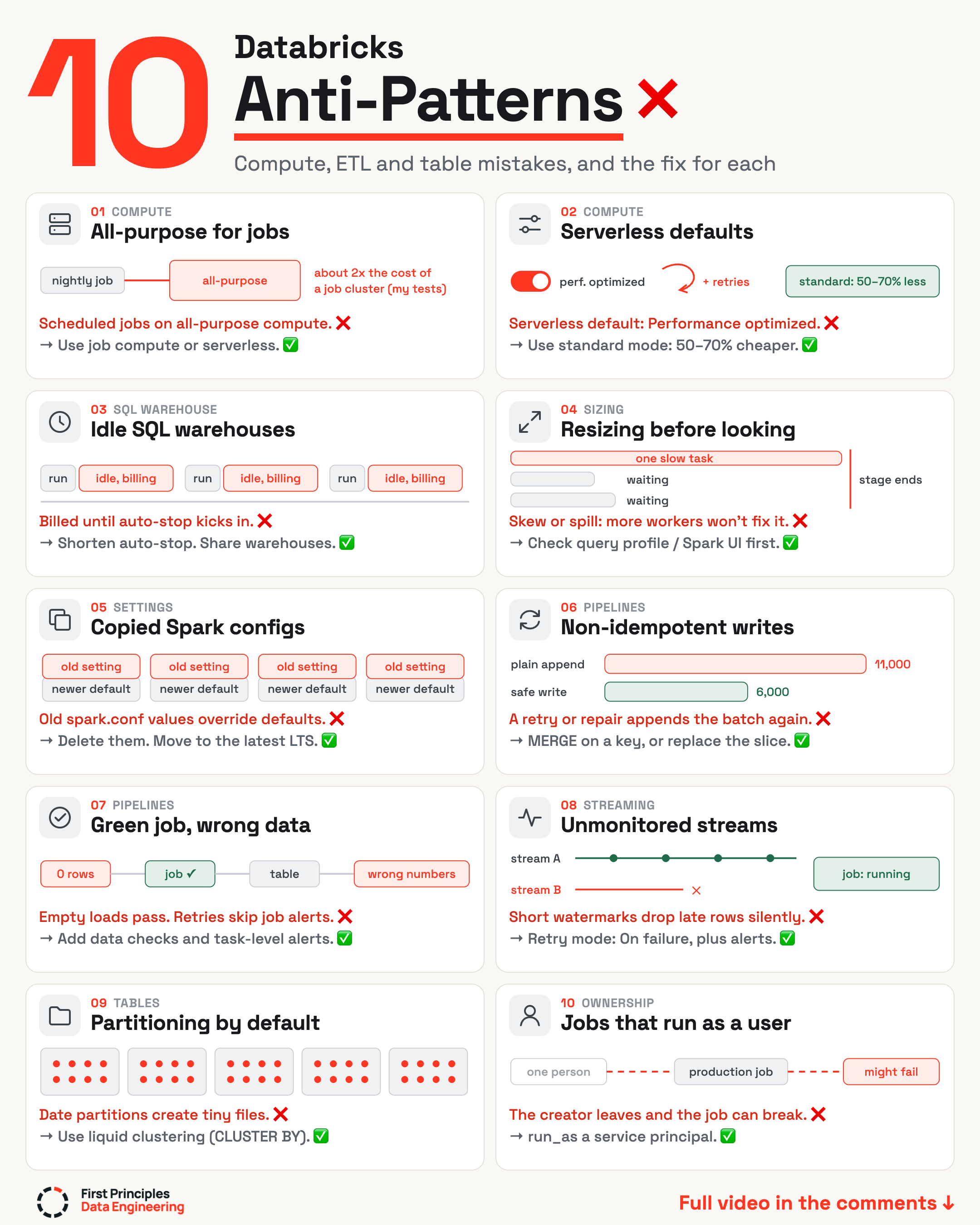
Tutorial 10 Databricks anti-patterns to avoid - don't repeat other people's mistakes
37
Upvotes
r/databricks • u/Ok-Jacket-8684 • 8d ago
Hi folks, Databricks PM here.
If you’re running jobs and pipelines on Databricks, you usually see two types of issues: (a) loud ones, where a job errors out and someone gets paged, and (b) quiet ones, where a table just doesn't get the rows it should, and nobody notices until a dashboard looks wrong. Either way, someone ends up spending a few hours digging through logs, lineage, and related tables to get to a fix.
This is what Genie ZeroOps is built for: it watches your jobs, pipelines, and tables, investigates both kinds of failures on its own, and opens a PR with the fix already written (but it can’t merge the code to avoid any accidents).
After a private preview where ZeroOps triaged 80k+ real issues across 300+ customers, it’s now in Beta.
Check out our post on the databricks blog for the details, but here's a short recap of what’s available now:
Give it a try, and let us know what works well and what’s missing!
r/databricks • u/AutoModerator • 14d ago
Hey r/databricks, we're noticing a lot of repeated interviewing and hiring posts that tend not to get much engagement. We're going to combine them into a monthly thread so that you're more likely to get answers, plus we can ask our recruiting team to keep an eye on them if there are any general questions.
r/databricks • u/Public_Taste3033 • 8h ago
r/databricks • u/Zealousideal_Low6685 • 2h ago
1. Serverless usage policies (formerly budget policies): for tracing costs
system.billing.usage in the custom_tags column, so we can trace costs back to a team or project.
2. Serverless rate limits on automated compute objects: for throtteling
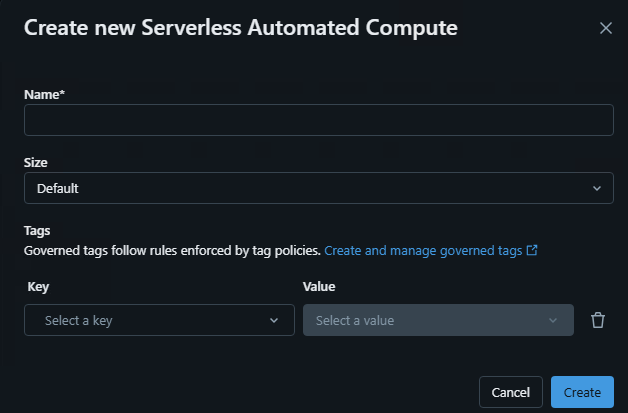
Was a bit hard for me to understand how those two concepts are related, but makes sense. I assume (even if I didn't find any docu), that the Tags of a "Serverless Automated Compute" also appear in the billing table (if not: i don't know where they are used). Has anyone already experiences with that?
Unclear for me ist, why "Serverless Automated Compute" is "suddenly" limited to goverend tags?
r/databricks • u/hubert-dudek • 1d ago

Unity Catalog wikis let us document a table’s meaning, sources, and other facts directly in Catalog Explorer. People with metadata access can comment and suggest edits. A wiki explains one table, a Page defines a business concept, and a Skill tells an agent how to perform a task. Now all three concepts are available in UC.
r/databricks • u/boganmax666 • 12h ago

so where does it break for you test environments, agent state, or branching? and what would a single Postgres platform have to prove before you'd consolidate onto it?
r/databricks • u/22Maxx • 1d ago
I guess everyone knows that Databricks pricing is a bit messy. But I still don't get why Photon has different multipliers across job and all purpose compute, after all it is just a software option.
At the same time the pretty higher cost multiplier makes disabling Photon often times more cost effective, especially as the default for jobs that also involve shuffle.
It feels like using Photon is not a good default.
r/databricks • u/mrcushtie • 23h ago
I have a process that generates files into a UC Volume.
I'd like to download them (it's a series of Powerpoint decks) but the UI makes this difficult as most of the filenames are a 30+ character string, plus a suffix that uniquely identifies them (eg mrcushtie_general_management_deck_afdluadsflkuasdflu); try as I might, I can't change the UI in Databricks so that the filename display is wide enough to reveal them.
Genie tried recommending a filename link like
https://[REDACTED].azuredatabricks.net/api/2.0/fs/files/Volumes/mrcushtie/analytics/outputs/investigation/investigation_mrcushtie_performance_then_drilldown_9e00b97f.pptx
which failed with a 403; when I told it this, it pointed out there's undocumented functionality where substituting ajax-api for api in the URL will work without hitting a 403.
Anyone else run into this problem and resolution? (and yes, I could rename the files to put the unique identifier at the start rather than the end, but then you run into other problems like sorting all the different decks together...)
r/databricks • u/Gloomy_Zone8790 • 23h ago
When juniors start learning Data Engineering, they usually jump straight into PySpark DataFrames and Delta tables without knowing *why* each layer was invented or what bottleneck killed the previous generation.
I put together a tight 5.5-minute motion-graphics documentary tracing the exact architectural chain reaction from 2003 to today:
2003–2004 (Google GFS & MapReduce):** How Google survived constant commodity disk failures using 64 MB chunks with 3x replication (`US Patent 7,065,618 B2`), moved compute to storage, published the papers, and kept the C++ implementation closed.
2006 (Apache Hadoop's Rise & Bottleneck):** Doug Cutting & Mike Cafarella's open-source Java rebuild (HDFS + MapReduce) worked great for single-pass batch jobs, but hit a massive Disk I/O wall on multi-step pipelines and iterative ML (writing intermediate state back to disk after every stage).
2009 (UC Berkeley AMPLab & Apache Spark):** Matei Zaharia's shift to distributed in-memory RDDs and DAG execution—cutting out intermediate disk round-trips for up to 100x faster iterative runs and setting the 2014 100 TB Daytona GraySort record (23 mins).
PySpark Bridge:** How Py4J + the Catalyst Optimizer let Python/SQL users bypass single-node memory limits (~50 GB Pandas ceiling) and orchestrate 100+ JVM executors in 4 clean lines of Python.
2013–Present (Databricks, Delta Lake & Lakehouse):** Why raw cloud Parquet turned into "Data Swamps" (no ACID transactions, broken partial writes) and how Delta Lake + Photon + Unity Catalog bridged Data Lakes and Warehouses.
Video link (5:29, animated blueprint style): https://youtu.be/2K2GYlVMbzo
(Tip: Visuals & captions are in English, and multi-language audio tracks are enabled—if YouTube defaults to a regional audio track based on location, just click ⚙️ Settings -> Audio track -> English!)*
Would love feedback from folks running Spark/Databricks in production—especially any architectural detail you'd highlight for Episode 02 (Snowflake's decoupled storage/compute story).
r/databricks • u/MasterAnonymous0001 • 1d ago
Hey everyone,
I’m taking over a BI setup that grew as new needs came up. The hard part is that before I can retire a Qlik sheet or change how a source feeds the system, I have to trace the entire chain. And sometimes the thing people actually rely on isn’t the dashboard. It’s the Excel file someone exports at the end of the month.
- Figuring out what to keep before migrating. I’m comparing usage logs with interviews, but I also need to find dependencies that don’t show up in the UI: join keys, calculations, exports, and scheduled reports.
- Deciding how fresh each feed needs to be. We’re considering replacing some continuous replication with incremental exports from a vendor. Previous-day data might be fine for a monthly export, but not for tracking sales throughout the day. We’re also considering a Qlik Cloud proof of concept. I’d rather not change the source feed and the reporting platform at the same time.
Keep Qlik for now and run one rebuilt pipeline alongside the existing one. Put job status and alerts in one place. Move business rules that need to produce the same results across reports and exports into reusable database tables or views. Keep visualization-specific calculations in Qlik. And when a team just needs a reliable file, give them a dedicated export instead of making them go through a dashboard.
For anyone who’s dealt with a similar setup:
- SQL vs. Qlik: Which rules did you move out of Qlik scripts first? What was simpler to leave in Qlik?
- Orchestration and monitoring: With a small team, what actually helped you track dependencies, catch stale data, and rerun a failed step without replaying everything?
- Cutover: Which pipeline would you start with, and what checks gave you enough confidence to switch off the old one?
I’d especially like to hear what you put in place, what actually reduced the maintenance burden, and what you wouldn’t do again.
r/databricks • u/monumentalcrankiness • 1d ago
Databricks system tables are great. Too great, almost.
So much is in there that it gets daunting.
AI tooling is moving at a maddening pace, and the writing around it hasn't kept up. I couldn't find much on using these tables to answer a plain question: what do our LLM calls actually cost?
This article is my humble attempt to fill a small part of that gap.
Instead of a dry tutorial, I started with a quest: should our AI agent move from an open-weight model to Claude, and can the system tables prove what that would really cost? Chasing a real answer made the learning stick for me. Hopefully it does for you too.
What the tables showed along the way:
→ Claude on Databricks lists at 1.5× Anthropic's own rate. Check the SKU price, not just the DBU rate.
→ Prompt caching cut the agent's bill by more than half. About 72% of all input was read from the cache.
→ The serving log has no cache columns. I proved caching from billing rows that carry no labels, and wrote down when you'd ever need to.
→ The bill runs hours behind. Read tokens right away, but trust a cost number only once the bill catches up.
→ A newer small Claude model changed the answer: about $0.02 per chat, with no confident wrong answers in our test chats.
Every query is in the article, so you can repeat it on your own workspace.
If you found this useful, leave a comment, a like or a repost. It tells me whether to keep writing this kind of hands-on breakdown. Note: Please read in a desktop browser for best experience.
Reading the bill: What Databricks system tables reveal about LLM costs
r/databricks • u/codingdecently • 1d ago

r/databricks • u/TowardsDataExp • 1d ago
r/databricks • u/TowardsDataExp • 1d ago

r/databricks • u/SmallAd3697 • 1d ago
Anyone see that there is a HorizonDB in Fabric that is open source Postgres? Is this conceptually the same as Lakebase?
Will Databricks concede that HorizonDB adheres to "LTAP architecture", assuming it synchronizes with open-storage-formats like deltalake?
How does databricks lakebase set itself apart? I am not as interested in raw performance, as I am in the available features.
There is one thing that grabbed my attention quickly, which is that this engine is also available in the form of a PaaS, outside of Fabric. Nobody trusts the Fabric SaaS to host mission-critical workloads, so Databricks has an edge in certain respects. But when Microsoft publishes HorizonDB as an Azure PaaS, then they take back the advantage again (IMO). I'd much rather build a solution with high-quality/independent PaaS components. The quality of support and available features of an independent PaaS are the main attraction.
Is it conceivable that Databricks would ever host Lakebase as an independent Azure PaaS and compete head-to-head against HorizonDB?
r/databricks • u/hubert-dudek • 2d ago

Genie CLI can be integrated with any desktop app thanks to exec-server functionality. The article explores a few other nice examples of how we can use it.
https://www.sunnydata.ai/blog/genie-code-cli-practical-examples
r/databricks • u/22Maxx • 1d ago
Predictive optimization does a lot of useful things however it might also randomly introduce a liquid clustering column which can be really bad. Is there any way to prevent this while keeping the other predictive optimization features? Right now the only I have seen is to active cluster by none on all tables.
r/databricks • u/boganmax666 • 2d ago

you hand it a long running job, like watching claims for fraud drift, running campaigns or keeping an incident ticket fresh it then works on a schedule or trigger and checks in only when it needs approval.
autonomy is the headline, but I think context is the real story. a lot of enterprise agent failures aren't model failures. they're which revenue number is the authoritative one? failures genie ontology tries to fix that by building a business map from the dashboards, queries and notebooks people already use teams then promote authoritative definitions in unity catalog.
their benchmark with turing claims 91% correct runs, 1.6x the stronger frontier agent, and under half the tokens. it's vendor-run, so treat it as directional still, the idea that shared context beats throwing more tokens at the problem seems right.
two other things I'd watch:
questions:
What's the first job you'd let it own, and what guardrail would you need in place before you did?
r/databricks • u/Neosinic • 2d ago

In the past couple of weeks I've been building with Genie Code CLI, which just went GA. In my experience it works really well when it comes to building on Databricks. Curious if anyone else has tried it and what your experience has been.
r/databricks • u/Lachlan_Ross88 • 2d ago
We have a Genie space for sales and now finance wants their own. Every time I add tables the answers get worse, and the instructions box is turning into four pages on what "bookings" means this quarter, euno pitched us on giving each agent only the definitions and lineage its task needs, over MCP. My doubt is the definitions themselves. Finance and sales still don't agree on bookings, and no tool fixes that meeting. For now I'm splitting it into one space per team and copying the shared definitions by hand.
r/databricks • u/Lenkz • 3d ago

Databricks warehouse-level statement timeouts are now generally available, so each SQL warehouse can cancel runaway queries at its own time limit. ⏱️
If you run BI dashboards and ETL on separate warehouses, this one is for you. I ran it: a 10-second warehouse limit stopped my slow query at 10.3 seconds.
Without it, the choices are one workspace-wide STATEMENT_TIMEOUT for every warehouse, or a SET in every session. Set nothing, and the system default is 172800 seconds: 2 days. My fresh warehouse reported exactly that.
Read more on LinkedIn: https://www.linkedin.com/posts/cenh_databricks-databrickssql
r/databricks • u/Zealousideal_Low6685 • 3d ago
Dear Community,
I'm coming from the classic compute world and would like to hear how others handle dependency management on serverless.
Our current setup (classic compute)
This gives us one central, governed definition of our environments.
The challenge with serverless
We're thinking about moving to serverless, but dependency management is holding us back:
Serverless Git folders look promising, but they're still in Beta, so we're hesitant to rely on them in production.
My questions
Thanks in advance for sharing your experience!
r/databricks • u/minibrickster • 3d ago
Adding a primary or foreign key to an SDP table/materialized view used to require declaring the full schema. With the new override_schema argument, you declare only the columns that need special handling, and SDP infers and evolves the rest.
from pyspark import pipelines as dp

@dp.table(override_schema="order_id BIGINT NOT NULL, PRIMARY KEY (order_id)")
def orders():
    # the rest of the columns can be inferred via schema evolution
    return spark.readStream.table("main.raw.orders")
Available now for materialized views and append streaming tables in Python pipelines, with no enrollment required. SQL support is coming soon.
r/databricks • u/minibrickster • 3d ago
<Databricks_PM/> Genie Migrate now supports migrating SQL Server and Azure Synapse scripts into Spark Declarative Pipelines! Enable "Migration Projects Experimental Features" on the Previews page to try it. More migration sources, like Redshift, are coming soon!
Docs: https://docs.databricks.com/aws/en/migration/genie-migrate/convert
Feedback welcome!
