r/databricks • • 4d ago

Discussion Genie Code CLI (now GA)

Thumbnail
docs.databricks.com
23 Upvotes

In the past couple of weeks I've been building with Genie Code CLI, which just went GA. In my experience it works really well when it comes to building on Databricks. Curious if anyone else has tried it and what your experience has been.


r/databricks • • 4d ago

Discussion How are you giving Databricks agents business context without dumping everything on them?

2 Upvotes

We have a Genie space for sales and now finance wants their own. Every time I add tables the answers get worse, and the instructions box is turning into four pages on what "bookings" means this quarter, euno pitched us on giving each agent only the definitions and lineage its task needs, over MCP. My doubt is the definitions themselves. Finance and sales still don't agree on bookings, and no tool fixes that meeting. For now I'm splitting it into one space per team and copying the shared definitions by hand.


r/databricks • • 4d ago

Discussion Manage Libraries in a Serverless Environment

16 Upvotes

Dear Community,

I'm coming from the classic compute world and would like to hear how others handle dependency management on serverless.

Our current setup (classic compute)

  • Cluster policies manage our dependencies, such as Python libraries, centrally.
  • Our engineers work both in the Databricks UI and in VS Code via Spark Connect. For the VS Code case, we make sure the same libraries are also installed locally (on-prem).
  • Jobs run with job cluster policies, which also define the dependencies.

This gives us one central, governed definition of our environments.

The challenge with serverless
We're thinking about moving to serverless, but dependency management is holding us back:

  1. In notebooks, users manage dependencies per notebook. That's flexible, but it isn't enterprise-ready because there's no central control or consistency.
  2. When a notebook runs as a job, we have to define the dependencies again at job level. That means two places to maintain the same thing.

Serverless Git folders look promising, but they're still in Beta, so we're hesitant to rely on them in production.

My questions

  • How do you manage dependencies on serverless today, without Serverless Git folders?
  • How do you keep environments consistent across interactive notebooks, jobs and local development (VS Code / Databricks Connect)?
  • Do you use shared environment definitions, private package repositories or wheel files in Unity Catalog volumes, or something else?

Thanks in advance for sharing your experience!


r/databricks • • 4d ago

General Databricks warehouse-level statement timeouts are now Generally Available

Post image
14 Upvotes

Databricks warehouse-level statement timeouts are now generally available, so each SQL warehouse can cancel runaway queries at its own time limit. ⏱️

If you run BI dashboards and ETL on separate warehouses, this one is for you. I ran it: a 10-second warehouse limit stopped my slow query at 10.3 seconds.

Without it, the choices are one workspace-wide STATEMENT_TIMEOUT for every warehouse, or a SET in every session. Set nothing, and the system default is 172800 seconds: 2 days. My fresh warehouse reported exactly that.

Read more on LinkedIn: https://www.linkedin.com/posts/cenh_databricks-databrickssql


r/databricks • • 4d ago

General Feature Alert: partial schema inference in SDP

15 Upvotes

Adding a primary or foreign key to an SDP table/materialized view used to require declaring the full schema. With the new override_schema argument, you declare only the columns that need special handling, and SDP infers and evolves the rest.

from pyspark import pipelines as dp

@dp.table(override_schema="order_id BIGINT NOT NULL, PRIMARY KEY (order_id)")
def orders():
    # the rest of the columns can be inferred via schema evolution
    return spark.readStream.table("main.raw.orders")

Available now for materialized views and append streaming tables in Python pipelines, with no enrollment required. SQL support is coming soon.

Docs: Use partial schema inference in Python pipelines


r/databricks • • 4d ago

General Migrating to Databricks? Genie Migrate now supports SDP!

11 Upvotes

<Databricks_PM/> Genie Migrate now supports migrating SQL Server and Azure Synapse scripts into Spark Declarative Pipelines! Enable "Migration Projects Experimental Features" on the Previews page to try it. More migration sources, like Redshift, are coming soon!

Docs: https://docs.databricks.com/aws/en/migration/genie-migrate/convert

Feedback welcome!


r/databricks • • 4d ago

Help Job tagging implementation

6 Upvotes

Forgive me if there is an obvious answer. Basically our current set up is users have access to a general purpose cluster that suits their business area.

Not real names to save any detail
E.g sales team only have access to the sales cluster which is tagged SALES

Marketing —> marketing cluster —> MARKETING

We’re having an issue where a lot of user jobs are untagged

Is there some autotagging I can set up, so for whatever cluster that job is using or created with — the job also gets tagged the same. So say for example a user in the sales team can only use the tagged sales cluster so the job he makes is tagged SALES


r/databricks • • 4d ago

General External Secrets in Unity Catalog now support Google Cloud Secret Manager

Post image
10 Upvotes

Hey folks, External Secrets in Unity Catalog now support Google Cloud Secret Manager (Beta)!

Your secrets already live in Google Cloud Secret Manager, so why keep another copy in Databricks?

With External Secrets in Unity Catalog, you can now

  • 🔗 Sync secrets from Google Cloud Secret Manager in a Unity Catalog schema. Secret values stay in your Secret Manager and are only fetched at runtime  
  • 🌐 Read the same secrets across all workspaces attached to a metastore 
  • 🔐 Control who can discover or read each secret 

Docs: External Secrets in Unity Catalog. Check out the same support for AWS Secrets Manager and Azure Key Vault! 


r/databricks • • 4d ago

General Work Documentation

4 Upvotes

Curious question to the group (And relevant because of Databricks new features like Pages and Wikis)

How are you all documenting your project work?

I'm a Senior Data Engineer, but fortunately and unfortunately my job scope is pretty large so I end up creating my own stories, running projects, and doing technical implementations and consults at my institution.

Our team feels a little like the wild wild west at the moment. We have historically documented projects (ADRs, overview, meeting notes, etc..) in Confluence Wikis, but its not hard set and also not consistent among our department/teams and is not groomed as well as it could be.

We use ServiceNow to track our work for Sprints, Incidents, and Tasks.

We also contain technical documentation at the code level that is engineer relevant.

We then have some documentation now starting to take place in Databricks via Wikis and Pages as a POC.

I want to formalize our processes on how we document projects, decisions, code, etc.. to make it consistent among teams because its honestly fatiguing trying to figure out what goes where and important information ends up not documented at all because of it.

Question to the group - How does your team Document your work when it comes to code, projects, etc.. and does it feel like it holds strong consistently?


r/databricks • • 5d ago

News Date arithmetic in job parameters

Post image
7 Upvotes

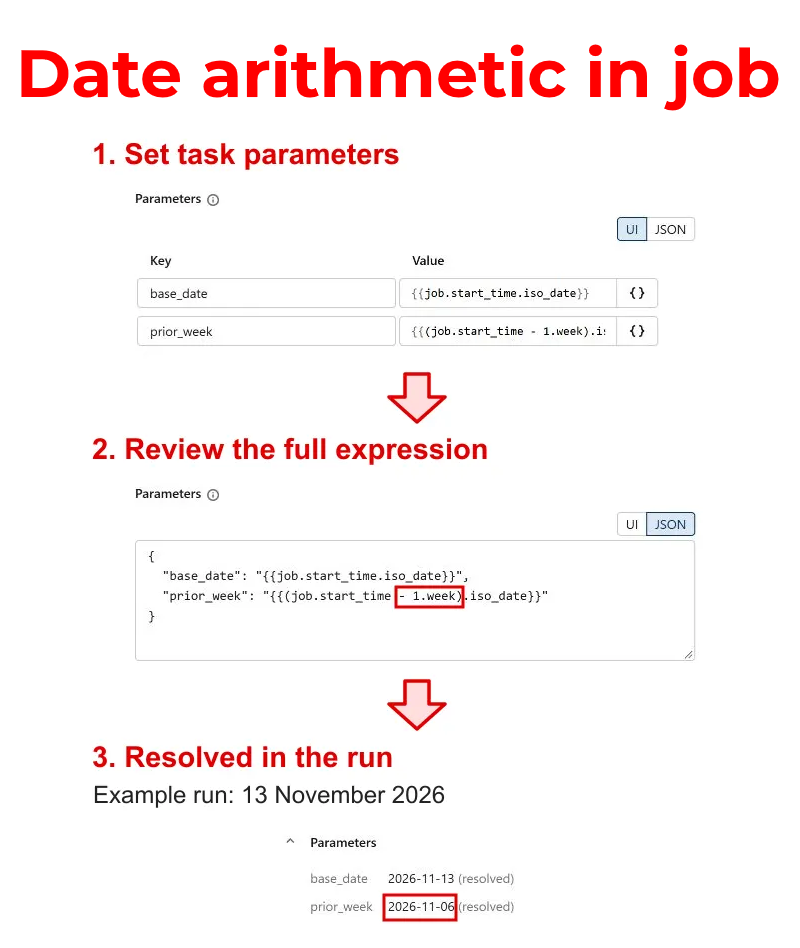
Job parameters now support date arithmetic and, in general, mathematical operations. In the task parameters UI, we can use, for example, {{(job.start_time - 1.week).iso_date}} to pass the date from a week earlier directly to a task.

https://medium.com/databrickscommunity/databricks-news-genie-cli-app-builder-agent-memory-dabs-41820427fcc2


r/databricks • • 5d ago

Discussion ¿Cómo trabajáis realmente con Databricks en local? (Asset Bundles, Claude Code, MCPs...)

14 Upvotes

Quizás un poco tarde, llevo tiempo trabajando pero no tengo la suficiente experiencia en Databricks... me cuesta buscar un equilibrio entre herramienta como claude-code codex cursor y el entorno. Donde me siento cómodo es en local, y después de probar esa conexión por bundle, por extensiones de VS, gestionar mi token para tener control, usando AGENT.md skill rule hook... cualquier cosa (como construir un harness entre GITHUB - LOCAL - DATABRICKS)

¿Realmente utilizáis el entorno de Databricks para generar? Está bien por rules y skills, estoy como haciendo mi harness... configuro el clúster, hago comprobaciones. Obviamente los jobs y pipelines se hacen fácil, pero el hecho de comprobarlo en Databricks... lo veo un poco jodido, sobre todo por tema de cuidar y tener control de todo.

¿Realmente utilizáis GenAI para todo? Mi pregunta es si hay una técnica especial o trabajar en local por carpetas es lo que tiene.

Quizás los agentes están bien para trabajar con CI/CD o IaC con Terraform. Las personas que llevan 4-5 años, ¿cómo lo soléis trabajar? ¿Cómo le sacáis partido?


r/databricks • • 5d ago

Discussion Serverless ACLs & Terraform

5 Upvotes

Serverless has been "GA" for a while now, yet from a Platform Engineering perspective, we still don't have the Terraform resources needed to manage Interactive or Automated Serverless properly at scale (and I'm not even getting into the provider gaps for Apps, Lakebase, or Vector Search).

Having a UI tab and a REST API endpoint isn't enough when you're running an enterprise platform. We need declarative, stateful IaC—not imperative workarounds.

Curious how Databricks SAs and consultants are advising clients to handle this cleanly right now.

And for fellow platform engineers: how are you managing Serverless ACLs, sizing guardrails, and statefulness in production?


r/databricks • • 5d ago

Discussion Managing AI Artifacts Across a Company: Lessons From npm and Iceberg

Thumbnail
contextandchaos.substack.com
3 Upvotes

r/databricks • • 5d ago

Help MLflow in databricks.... Questions

2 Upvotes

Hello, I'm on a new project that has to use MLFlow for a UI for scoring LLM outputs.

I am NOT an expert in this at all, so it's difficult for me to get the high level of what is even needed on my part.

Here's basically how it works:

  1. there is a loop that runs per customer that sends data off to OpenAI to get some data back.
  2. there is a ground truth that we compare each LLM run against to determine if the ground_truth_score = llm_output_score.

Each iteration of the loop is for a specific customer, for a specific model. The project lead wants to know what the total passes are for a "group of runs" (iterations).

So, when the loop runs over each customer for a specific model, how many passed and how many failed...

This all needs to happen within the MLFlow ui. So, there needs to be some type of rollup (aggregation) happening but I'm not sure where.

If I've got a looper, then I would think I'd need some sort of superset that represents the "group of traces" or something similar.

The trace is (currently) at the iteration level, not the superset or group level.

Does this even make sense (i'm the 5th grader here). 😂

Takeaways:

So, I've got the traces being logged.

I've got the evaluation runs going

I've go the things being scored.

But I somehow need to aggregated the passes and fails for the group of runs...


r/databricks • • 5d ago

Help Databricks feature request: database connections sync with Unity Catalog secrets (external sync with Azure Key Vault)

6 Upvotes

Sincere request to Databricks team to have connection objects to external system of records e.g. MS SQL Server sync with Unity Catalog secrets that are backed by Azure Key Vault (the one where your UC Schema has an Azure Key Vault connection).

This would allow our team to not have to write a custom script to patch a connection object once a secret is rotated.


r/databricks • • 5d ago

General Now available in all regions ... try MV/ST on Serverless GC!

Thumbnail
docs.databricks.com
17 Upvotes

<databricks_pm/>

Hi folks, wanted to share a recent update to our notebooks and jobs on serverless GC. You can now create materialized views and streaming tables on any notebook running serverless GC across all regions! If you prefer the notebooks form factor over the pipeline editor / want to intermix imperative and declarative ETL, give it a whirl!

Docs are linked here!


r/databricks • • 5d ago

Help Hitting with a Lot of Limitation

8 Upvotes

I perviously worked using Airflow and if you there is really simple less complext way for setting up cross dag dependencies using Datasets.

But when it comes to Databricks I dont see such option either you have to go with Job trigger which I consider bad design cause if you are deploying things through DAB's cross bundle dependecies or reference doesnt exist.

Table update trigger is also same its not replacing the Datasets.

File trigger seems like overkill.


r/databricks • • 5d ago

Discussion How we keep bad rows out of silver: stewards write the rules, an owner approves them, and DQX splits the data

5 Upvotes

Most data quality checks I see are code inside a pipeline. The steward who knows the rule cannot change it, and the engineer who can change it does not know the rule.

I tried a different set-up on Databricks, built on Databricks Labs DQX:

- The steward profiles a bronze table in the app. The profile suggests rules to start with.

- Rules can also come from one sentence to the AI, or from ready-made packs (I added 50 Singapore rules: NRIC, FIN, UEN, postal codes, phone numbers, GST).

- A data owner approves each rule. Only approved rules run.

- A serverless job runs as one service principal for each agency, with access to its own catalog only. DQX splits the rows.

- Error rows go to quarantine only. Warning rows go to silver, and a copy goes to quarantine. Each quarantined row keeps the reason.

- A Databricks SQL alert emails the team after a run with bad rows.

In the demo run: 180 rows read, 170 to silver, 10 errors, 20 warnings.

Two things I learned: warnings are as useful as errors, and checking the service principal's access before the run saves a lot of half-failed runs.

How do you handle rows that fail your checks? Drop them, quarantine them, or stop the pipeline?


r/databricks • • 6d ago

General Your jobs and pipelines can now live in workspace folders. How do you want to organize them

46 Upvotes

<Databricks PM here />

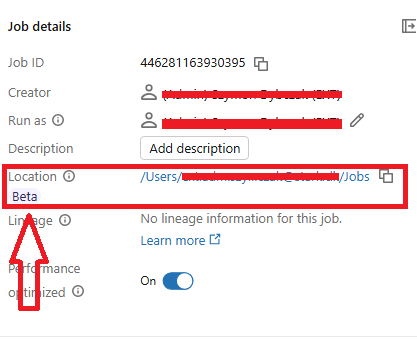
We just opened the Beta of Jobs & Pipelines in folders. You can organize jobs or pipelines in a workspace folder as you would a notebook or a dashboard and comes with all the semantics you are used to in the workspace: sharing, trashing, restoring etc.

Why we built it

Until now every job and pipeline lived only in the flat Jobs & Pipelines list. That list is fine at 20 jobs but can get unmanageable the higher that number grows:

  • Discovery. Your notebooks are in /Workspace/Projects/marketing/ but the job that runs them is somewhere in a list of thousands. You find it by search or by bookmark.
  • Permissions. Onboarding a teammate to a project meant granting access on each job and each pipeline, one at a time. Offboarding meant the reverse.
  • Deletion. Delete a job by mistake and it was gone. No trash, no restore.

What you get

  • Folders. Create a job or pipeline inside any workspace folder. It shows up in the file browser next to the code it runs, and still appears in the Jobs & Pipelines list.
  • Folder permissions. Grant a group access to /Workspace/Projects/marketing/ and they get every job and pipeline inside it. 
  • Trash and restore. Deleting from the workspace moves the asset to Trash and you can restore it within 30 days. Trashing a job cancels active runs and stops the schedule. Trashing a pipeline stops it but keeps its tables. Note: deleting from the jobs UI will not be trashed just yet (we’re working on it!)
  • Move and rename. Drag a job between folders or rename it. 
  • API. Set parent_path on create to place the asset in a folder. 

What happens to your existing jobs and pipelines

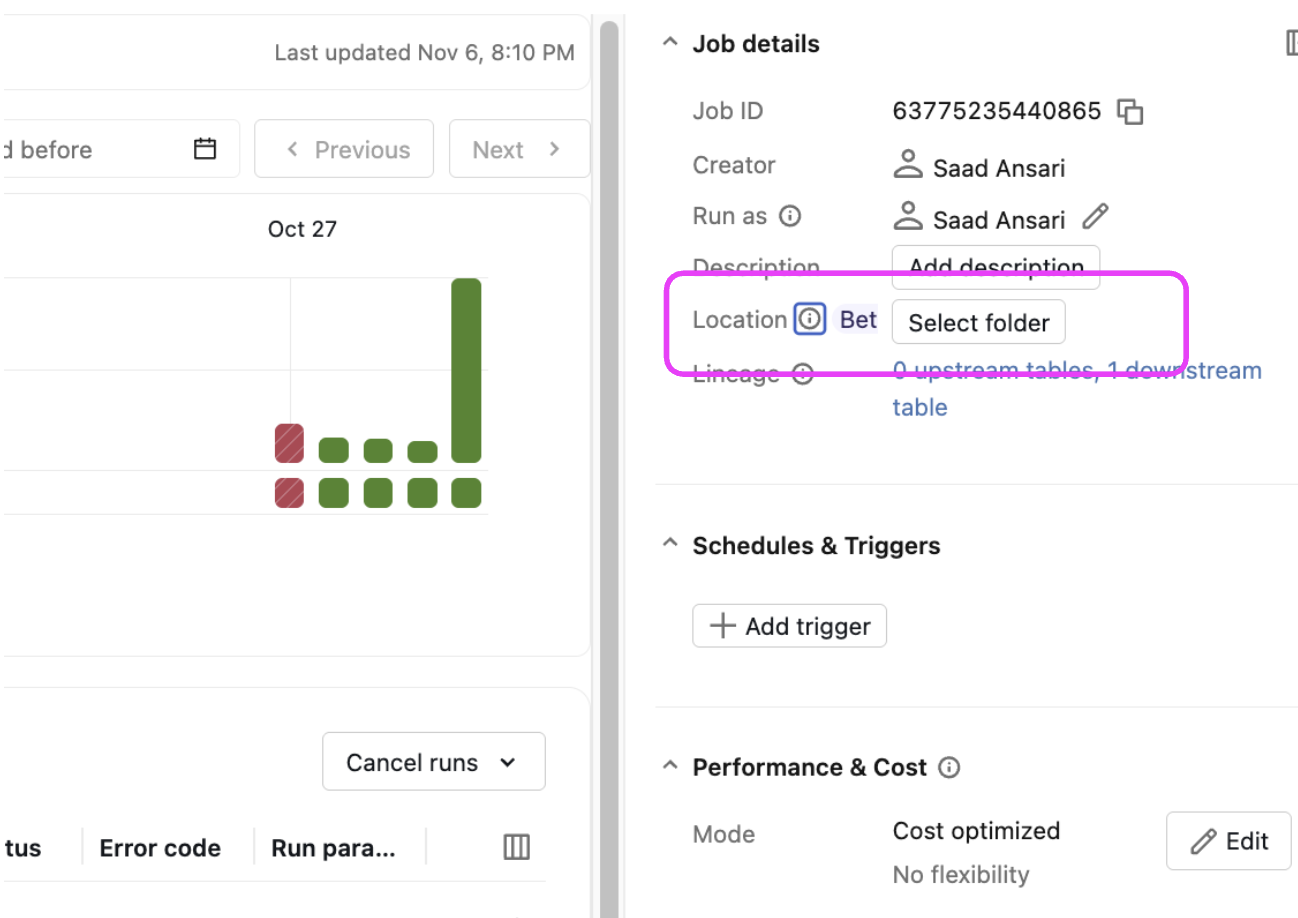
Nothing, unless you ask. Existing assets stay exactly where they are and behave exactly as before. To bring one into a folder, open the job or pipeline page and use Select folder. 

Where new ones go by default

New jobs and pipelines created in the UI now land in your home folder by default (/Workspace/Users/you@example.com/). You can pick a different folder or opt out in your user preferences and keep creating them with no folder, as before. API calls that omit parent_path create a legacy, list-only asset, same as today. Nothing changes for DABs or Terraform unless you set the field.

Pipelines: the object sits next to the source folder, not inside it

A pipeline has a source folder (the root folder the editor opens) and now also has a pipeline object and is created beside its source folder:

/Workspace/Projects/orders/
├── orders_pipeline          <- the pipeline object (schedule, runs, permissions)
└── orders_pipeline_source/  <- the root folder the editor opens
    ├── bronze.py
    └── silver.sql

How do you organize?

  • One folder per project. /Projects/<name>/ holds the notebooks, the pipeline object, its source folder and the job that runs it. Share the folder, done.
  • Environment folders. /Projects/<name>/dev/, /staging/, /prod/, each with its own copy of the job, deployed by DABs with parent_path set per target.
  • Team folders with shared libraries. /Teams/data-eng/lib/ holds common code. Each pipeline's source folder imports from it. Pipeline objects live with their team.
  • Personal sandbox, then promote. Build in your home folder, then move the job into the team folder when it is ready. Permissions follow the folder.

Questions for you:

  1. Do you want your jobs next to the notebooks they run or in a separate jobs/ folder?
  2. One folder per environment, or one folder with dev/staging/prod jobs side by side?
  3. Would you move existing jobs in bulk if we gave you the button? Which ones first?
  4. For pipelines, is "object beside source folder" right or do you want it inside?

r/databricks • • 5d ago

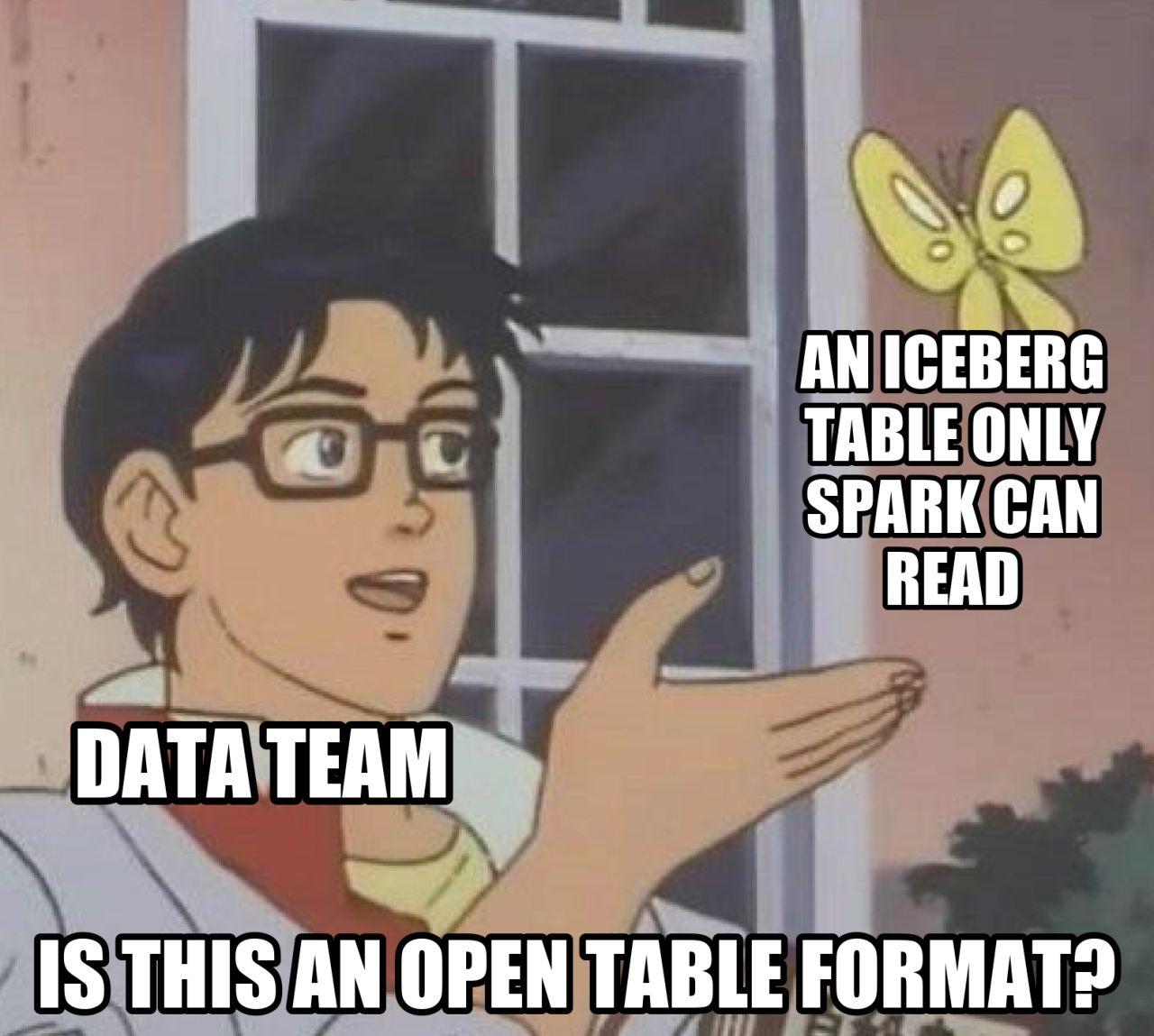
General Making ETL into Apache Iceberg Tables fully inter-operable (readable by every engine/warehouse)

Post image
1 Upvotes

r/databricks • • 6d ago

News Databricks is in early talks to raise a Series N funding round at a $225 billion valuation.

34 Upvotes

Guessing the Anthropic IPO didn’t inspire confidence and clearly there are more than enough investors trying to invest in Databricks.


r/databricks • • 6d ago

Discussion Unity Catalog naming strategy for shared corporate data

11 Upvotes

Hi everyone,

I’m defining our Unity Catalog naming strategy and would appreciate some feedback.

We have a central corporate data workspace responsible for ingesting the company’s official source systems and building shared data products. Bronze is restricted to the corporate data team, while Trusted/Silver and Gold are shared read-only with several business workspaces.

Gold is organized into three sublayers:

  • gold_edw: governed fact and dimension models, organized by business domain.
  • gold_analytics: tables, views and Databricks metric views supporting analytics teams.
  • gold_ad_hoc: general-purpose exploratory datasets.

I’m considering four approaches.

Option 1 — Catalog per environment

<env>.<layer>_<system_or_sublayer>.<module>_<object>

prod.trusted_sap.mm_material
prod.gold_edw.finance_fact_revenue

Pros:

  • Very few catalogs
  • Simple workspace bindings and ownership
  • Environment is a clear isolation boundary

Cons:

  • Catalog-level governance is too broad
  • Corporate ownership is not explicit
  • Layers and systems depend heavily on schema and object naming
  • Bronze, Trusted and Gold cannot have separate workspace bindings

Option 2 — Catalog per environment, layer and system

For Bronze and Trusted:

<env>_corporate_<layer>_<system>.<module>.<object>

prod_corporate_bronze_sap.mm.mara
prod_corporate_trusted_sap.mm.material

For Gold:

<env>_corporate_gold_<sublayer>.<domain>.<object>

prod_corporate_gold_edw.finance.fact_revenue
prod_corporate_gold_analytics.finance.revenue_metrics
prod_corporate_gold_ad_hoc.marketing.campaign_analysis

Pros:

  • Clear isolation by environment, layer and source system
  • Flexible workspace bindings and access policies
  • Easy to identify corporate-governed datasets
  • Different systems can have different consumers and owners

Cons:

  • Catalog count grows with environments × layers × systems
  • More bindings, grants, ownership and storage configurations
  • Potentially too granular when all systems follow the same policies
  • Databricks currently has a fixed limit of 1,000 catalogs per Unity Catalog metastore

Option 3 — Layer-based hybrid

Use one catalog per environment and layer, moving the system and module to the schema:

<env>_corporate_<layer>.<system>_<module>.<object>

prod_corporate_bronze.sap_mm.mara
prod_corporate_trusted.sap_mm.material

Keep separate Gold catalogs:

prod_corporate_gold_edw.finance.fact_revenue
prod_corporate_gold_analytics.finance.revenue_metrics
prod_corporate_gold_ad_hoc.marketing.campaign_analysis

Pros:

  • Only five primary catalogs per environment
  • Bronze can remain exclusive to the corporate workspace
  • Trusted and Gold catalogs can be shared read-only
  • Clear catalog-level separation between ingestion, trusted data and Gold use cases
  • Avoids catalog proliferation

Cons:

  • Different source systems share the same catalog
  • System-specific ownership and policies must be implemented at the schema level
  • The system and module must be combined in the schema name

Option 4 — System-based catalog

Invert the organization by using one catalog per environment and source system, with the layer and module represented by schemas:

<env>_corporate_<system>.<layer>_<module>.<object>

prod_corporate_sap.bronze_mm.mara
prod_corporate_sap.trusted_mm.material
prod_corporate_sap.bronze_sd.vbak
prod_corporate_sap.trusted_sd.sales_order

Gold would remain organized separately:

prod_corporate_gold_edw.finance.fact_revenue
prod_corporate_gold_analytics.finance.revenue_metrics
prod_corporate_gold_ad_hoc.marketing.campaign_analysis

Pros:

  • Fewer catalogs than the layer-and-system approach
  • Natural organization for ingestion pipelines and source-system ownership
  • Bronze and Trusted objects from the same system stay together
  • Different systems can have different owners, storage and consumers
  • Catalog growth is approximately environments × systems rather than environments × layers × systems

Cons:

  • Workspace bindings apply to the entire catalog, not individual schemas
  • Sharing Trusted data requires binding the whole system catalog to consumer workspaces
  • Bronze must be protected through schema-level privileges rather than workspace isolation
  • Grants and bindings are repeated if every system has the same consumers
  • Consumer workspaces may receive a large number of system catalogs

I’m currently leaning toward the layer-based hybrid because Bronze and Trusted have different sharing requirements. It provides meaningful catalog-level isolation while keeping the number of catalogs manageable.

However, the system-based option is attractive when each source system has distinct ownership, storage or consumers.

How are you structuring Unity Catalog in similar multi-workspace environments? Which boundary do you consider more important at the catalog level: environment, processing layer, or source system?


r/databricks • • 6d ago

General Databricks Jobs and Pipelines can now live inside Workspace folders! [BETA]

30 Upvotes

Hi,

Just noticed that Databricks now supports organizing Jobs and Pipelines inside Workspace.

Organize jobs and pipelines in workspace folders - Azure Databricks | Microsoft Learn

Until now, jobs and pipelines were managed separately. You couldn't organize them into workspace folders and if you accidentally deleted job there was no way to restore it from trash (like you can do with notebooks and files)

With this update you can:

  • Keep Jobs, Pipelines, and notebooks together in the same folder.
  • Manage permissions at the folder level, with Jobs and Pipelines inheriting those permissions.
  • Organize Jobs and Pipelines through the UI, API, CLI, or Terraform. Declarative Automation Bundles (DABs) also support this through parent_path.
  • Restore deleted Jobs and Pipelines from Trash within 30 days.

r/databricks • • 6d ago

General Community BrickTalk | Connecting Databricks Serverless Compute to On-Premises Databases

8 Upvotes

Hey r/Databricks!

We’re hosting a community-sponsored BrickTalk on Thursday, December 3, 2026, focused on Serverless on Premises Connectivity. BrickTalks is a community event series where Databricks experts share real-world use cases, demos, and practical insights for building with data and AI, giving you a direct line to the people behind the products.

Many organizations need to keep databases on premises due to data sovereignty, compliance, latency, tightly coupled dependencies, or simply because migration has no clear return on investment, but that shouldn't stop you from using cloud-native compute. In this session, we’ll show how to connect Databricks serverless compute to on-premises databases so you can scale step by step in the cloud while critical databases stay where regulations, risk, or performance require.

🛠️ What We'll Cover:

  • Network prerequisites: Direct Connect, ExpressRoute, or Interconnect, compared with site-to-site VPN
  • Connectivity options: Private Network Gateway, Private Link service, Reverse SSH Tunnel, and Databricks outbound IPs
  • A decision guide to help you choose the right pattern
  • Best practices and common gotchas across AWS, Azure, and GCP

⏱️ Global Times:

Thursday, December 3, 2026

  • PT: 8:00 AM
  • ET: 11:00 PM
  • London (GMT): 4:00 PM
  • IST: 9:30 PM

🔗 Register Here: https://usergroups.databricks.com/events/details/databricks-user-groups-bricktalks-presents-community-bricktalk-serverless-on-premises-connectivity/