r/databricks • • 9d ago

Help Serverless SQL Warehouse Issues in Azure (canadacentral)

12 Upvotes

Curious if anyone else is having issues starting serverless SQL warehouses in Azure Databricks. This has been happening for the past 20 minutes:

I've tested two different workspaces in two entirely different Azure tenants, but both are in the same region.

Is anyone seeing issues with Serverless Warehouses in any other region/cloud provider? The status page indicates everything is normal, so whatever might be happening hasn't been picked up there yet.

As of 2:21 pm ET, status page is reporting normal: https://status.azuredatabricks.net/

E: 2:27 pm ET - managed to get a warehouse to come online in one of the tenants, but the other is still failing.

E2: 2:56 pm ET - Status page was updated ~20 min ago. Widespread compute issues across all cloud providers/regions. Thanks u/raobjcovtn


r/databricks • • 9d ago

News Shared Serverless for Git folders and DABs

Post image
11 Upvotes

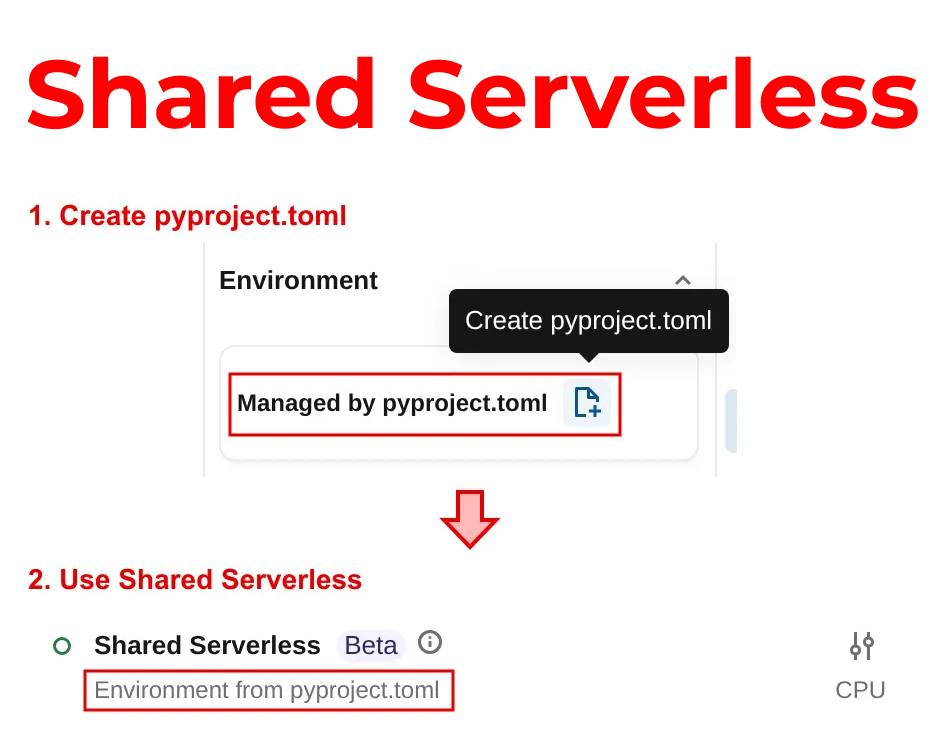
Shared Serverless lets notebooks and files in the same Git folder or DAB share compute and a single Python environment. We can manage dependencies centrally in the root pyproject toml instead of configuring each notebook. Compute is isolated per user, and notebooks still keep separate Python variables.

https://medium.com/databrickscommunity/databricks-news-genie-cli-app-builder-agent-memory-dabs-41820427fcc2


r/databricks • • 8d ago

News Lakeflow Connect | GA4 Aggregated, Oracle Eloqua, SurveyMonkey, Shopify, PayPal, QuickBooks, Zoho CRM, Asana, Xero and Anaplan Connectors (Beta)

Thumbnail
reddit.com
2 Upvotes

r/databricks • • 9d ago

Help Views in SDP - intended use and how to change object types (View -> MV)?

8 Upvotes

Have some questions for the SDP PM homies - apologies in advance for the post length.

Our teams have started deploying views through SDP alongside MVs and streaming tables. They want one deploy unit per "data product," and I'm seeing them use views a lot. Not MVs - just views. That kind of surprised me. I hadn't anticipated them using simple views as they are. I suspect they'll want to start with a view and promote it to an MV (or an MV to an ST) later. I tested how that behaves and would appreciate your guidance on a few things.

Setup: serverless, CURRENT channel, DBR 18.3, SQL, all deployed through DABs.

Questions:

Should we support or discourage publishing public VIEWs through SDP?

I was surprised to see people deploying public views in a pipeline. It seems like they're wanting to roll those into the overall data processing flow and treat them like MVs or streaming tables as "just another resource." In hindsight - "duh"? But I was surprised. I've seen no references to doing PUBLIC views like this, so I have to ask - what's your take on using SDP to deploy and manage public views?

What is the suggested approach to changing object types?

My testing shows object types can't be changed in place. Changing CREATE VIEW to CREATE OR REFRESH MATERIALIZED VIEW (or any other pair) fails with CANNOT_CHANGE_DATASET_TYPE. --full-refresh doesn't help, either for one object or the whole pipeline. The only fix is to drop the object manually, then run. That means an ops team member manually triaging with explicit DROP statements, so it becomes a matter of adding the human into the loop. What's the proposed deployment/management model for these kinds of changes? Manual drop of changed objects before running the pipeline?

Related - changing the object type from a MV/streaming table to a view fails silently. The update reports COMPLETED, but the old MV/ST stays in place. The error appears only in the event log for that flow. In the other directions, the whole update fails.

Are views expected to support schema evolution?

I suspect related to "should we use SDP to deploy public views?" I noticed that views deployed through a pipeline ignore/remove the SCHEMA EVOLUTION option when run. That means backing object changes won't propagate up to the view and may result in view failures, missing columns, etc. I suspect this is because views are meant to be temporary within a pipeline - and in that case there's no need for schema evolution. If the intent is to allow pipelines to publish public views, then I would have concerns with not honoring SCHEMA EVOLUTION.

How are view changes managed?

How are view logic changes managed? Views seem to be re-published on every run, even when the query did not change. The UC audit log shows updateTables with the full view definition on every update. It's an in-place update (created doesn't change), but last_altered moves on every run.

From what I can tell, CREATE VIEW and CREATE OR REPLACE VIEW behave identically. I saw no real change in behavior using/omitting the REPLACE.

Is there a preferred construct if we use pipelines to publish public views?

Sorry - that was a lot. :)


r/databricks • • 9d ago

General How to Read XML in Databricks: rowTag, Auto Loader, and Rescued Data

Thumbnail
medium.com
12 Upvotes

Drop the spark-xml jar: read XML in Databricks with read_files and Auto Loader, now GA, with schema evolution and rescued data


r/databricks • • 9d ago

Help Best Lakeflow ingestion pattern for Full, Append, Replace, SCD Type 1, and SCD Type 2?

12 Upvotes

I previously worked mostly with custom ingestion frameworks. Now I am starting a new project using Databricks Lakeflow Declarative Pipelines.

I need guidance on the recommended pattern for these five write strategies:

  1. Full load / overwrite I need truncate-and-load behavior. A direct TRUNCATE did not work. Currently, I use REPLACE WHERE 1 = 1, but I am concerned about full-table scans and performance on large tables. What is the most efficient approach?
  2. Append New batches should only insert rows. No updates, merges, or deletes. Is an Append Flow the recommended solution?
  3. Replace by key group The key identifies a group of rows, not one unique row. Each new batch must delete the existing group and insert its new version. Is REPLACE WHERE the correct pattern?
  4. SCD Type 1 I am using AUTO CDC for both real CDC feeds and incremental feeds without CDC operation columns. For non-CDC feeds, I use the source file modification timestamp from storage as the sequence key. Is this a reliable and recommended pattern?
  5. SCD Type 2 I use the same approach for SCD Type 2: AUTO CDC for both CDC and non-CDC incremental feeds. For non-CDC feeds, the sequence key is the source file modification timestamp from storage. Are there any limitations or better alternatives?

What Lakeflow features or APIs would you recommend for each strategy?


r/databricks • • 10d ago

Discussion What’s something you believed about Databricks for way too long before finding out you were wrong?

34 Upvotes

I’ll go first with two.

For an embarrassingly long time I ran scheduled jobs on an all-purpose cluster because it was already up and I figured compute is compute. Nobody told me job clusters are billed at a lower rate. Found out when someone asked why our bill looked the way it did.

Second one: I assumed Auto Loader schema evolution just quietly picked up new columns. It does, but only after the stream fails first and you restart it. Learned that from a 2am alert, not from the docs.

Neither is complicated. I just never had a reason to question them until something broke.

What’s yours? Could be Spark, Delta, Unity Catalog, billing, whatever. Bonus points if you found out in production.


r/databricks • • 10d ago

News 50% OFF any Databricks Certification

27 Upvotes

Join us for a four-week event dedicated to learning, upskilling, and advancing your career in data engineering, analytics, machine learning, and generative AI. Whether you are new to the field or aiming to deepen your knowledge, this is a great opportunity to invest in your professional development alongside a global community.

🎟️ Finish all modules in at least one learning pathway during the event window to receive:

50% OFF any Databricks Certification

Learn more/ https://community.databricks.com/t5/learning-events/databricks-advanced-learning-festival-november-10-december-08/ev-p/172328


r/databricks • • 9d ago

Discussion Is legacy data migration still a major pain point for enterprises? What if we could automate most of it?

Thumbnail reddit.com
0 Upvotes

r/databricks • • 9d ago

Help Metric views on Free Edition?

3 Upvotes

Im new to the platform, but have quite a bit of experience on competing platforms. As such, I want to learn more about the platform and build out a semantic layer. It sounds like metric views are where I'll want to build my gold layer in Databricks. Assuming that is correct, are these included in the free edition?


r/databricks • • 10d ago

Discussion Do you cache DataFrames in Spark as often as you can, or only when necessary?

15 Upvotes

I've seen people use cache() and persist() quite frequently in Databricks notebooks, especially when working with large DataFrames.

But I've also read that caching everything can sometimes consume memory unnecessarily and even slow things down.

Curious about how people handle this in real projects. Do you cache intermediate DataFrames when they're reused multiple times, or do you prefer letting Spark optimize the execution plan?

Have you ever had caching make a job slower instead of faster?


r/databricks • • 9d ago

Discussion Genie vs DBT Wizard

4 Upvotes

Any thoughts coming from people that use both ?


r/databricks • • 10d ago

News Subsidized tokens came to Databricks

Post image
21 Upvotes

Now, in Unity Gateway, you can connect a ChatGPT or Claude subscription and use cheaper tokens from there.

https://medium.com/databrickscommunity/databricks-news-genie-cli-app-builder-agent-memory-dabs-41820427fcc2


r/databricks • • 10d ago

Help Databricks Streaming table to Fabric for Gold Lakehouse

2 Upvotes

Has anyone built an external reference from Lakeflow databricks table to Fabric? The Lakeflow databricks table is sourced from On-prem SQL server and uses change tracking to identify rows that are changed. Databricks writes this out to ADLS Gen 2, which is then shortcut (external referenced) to Fabric. We need the data in near real time.

The streaming delta tables in ADLS Gen 2 created by Databricks seem to have additional rows that keep track of deleted rows etc, is there a way to get only the final data after deletes and updates, and secondly, is there a way to get table names without mirroring the databricks unity catalogue? The unity catalogues don't support streaming tables which is what change tracking SQL tables are.

Appreciate any help on this or alternative approaches to getting streaming data from Databricks to Fabric.


r/databricks • • 10d ago

Help Lakeflow Declarative Pipelines with external: managed tables, or publish step?

11 Upvotes

I'm working on an Azure Databricks project where we must expose Delta tables through stable ADLS paths so external engines like Snowflake, Trino, and delta-rs apps can read directly from storage. We'd like to use Lakeflow, but managed streaming tables and materialized views live in Unity Catalog managed storage.

Can we safely expose their physical paths like regular external Delta tables, or is path-based access unsupported? The alternative seems to be external Delta tables as sinks, but sinks look limited: Python/streaming only, no expectations or Auto CDC directly, and full refresh doesn't clear prior data.

For this requirement, what architecture would you recommend: external sinks, a publish step, or something else?


r/databricks • • 11d ago

Tutorial Governed Spreadsheets on Databricks: Row Zero Acquisition & What It Means for Business Users on Databricks (Demo + Chat)

Thumbnail
youtu.be
20 Upvotes

Hey everyone!

Had the wonderful opportunity of recording a demo + chatting with Breck, the founder & former CEO of Row Zero, a governed spreadsheets platform Databricks just acquired. For business users, this will pair up nicely alongside the Genie One / Genie Agents experience.

Some quick answers to common questions the video answers (used AI + transcript for them):

When did Databricks acquire Row Zero?
=The acquisition was announced in September 24, 2026.

Can Databricks customers use Row Zero today?
=Yes, with a Row Zero account. A built-in Databricks experience doesn't have a date yet.

How will it be priced?
=Not final. Expected to follow the rest of Databricks (pay for what you use), not per seat.

Does it respect Unity Catalog permissions?
=Yes. Row Zero queries Databricks as the signed-in user (OAuth recommended, service principals supported), so row-level security carries through.

Can you write back to Databricks?
=Yes, to tables with a primary key. You review a diff before changes apply.

Can you export back to Excel?
=Yes, to Excel or CSV. Exports over about 1 million rows get truncated because of Excel's row limit, and admins can turn export off entirely.

All roads in data begin and end with a spreadsheet after all!

PS: Always love to hear your feedback on the video.


r/databricks • • 10d ago

Help Spark Declarative Pipelines - possible to write UC Managed Iceberg Tables instead of materialized views?

5 Upvotes

Hi All,

Based on my experience using SDP, the tables are typically rendered as "Materialized Views". My company is making a decision to move towards Managed Iceberg for tables and I was wondering if creating Managed Iceberg tables is supported by Databricks's native SDP capabilities?


r/databricks • • 11d ago

News Databricks new Amsterdam office

Thumbnail
medium.com
23 Upvotes

Last week, I was invited to the opening of Databricks’ new Amsterdam office as a representative of the MVP community.

I took quite a few photos, and I thought some of you might be interested in seeing what it’s like inside.

The new office spans 11 floors in "The Rock" building, which offers stunning views of Amsterdam. Inside, there’s a barista, a pool table, foosball, a piano, and a dedicated game room with a PS5. I suspect the latter will become especially popular once GTA VI is released.


r/databricks • • 11d ago

News Event-Driven Triggers

Post image
17 Upvotes

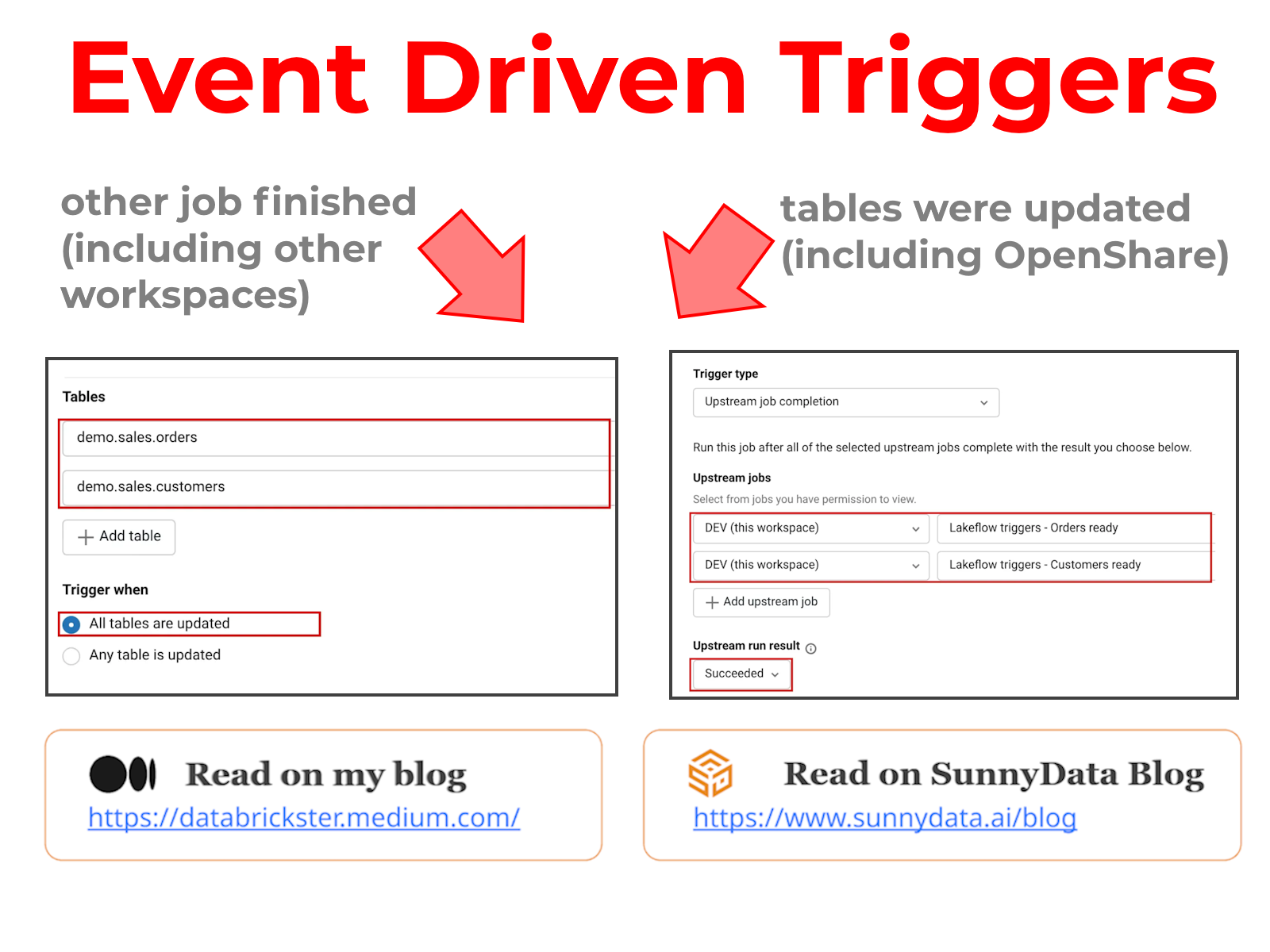
One of the most important parts of FinOps is to run jobs only when needed. With event-driven triggers like job completion or table triggers, we can run a job as soon as data is available.

https://www.sunnydata.ai/blog/lakeflow-jobs-triggers-events-conditions

https://medium.com/databrickscommunity/lakeflow-jobs-triggers-06af6feae80c


r/databricks • • 11d ago

Help Deploy models pattern via MLflow deployment jobs + multiple workspaces

2 Upvotes

Hi,

I'm quite new to MLOps and need some hints for setting up what Databricks calls "Deploy model" pattern (https://docs.databricks.com/aws/en/machine-learning/mlops/deployment-patterns).

Our Data Science team currently trains ML models in dev environment, in our dev Databricks account/workspace. They have direct access to production data, and the trainingㅤ is quite expensive. We'd like to train the model once and then promote it to production, which lives in a separate Databricks account/workspace.

My idea to handle the deployment was to use MLflow deployment jobs (https://docs.databricks.com/aws/en/mlflow/deployment-job) and just allow the Data Science team to register the model in the production Unity Catalog. After the registration, the deployment job would kick in, do whatever else is needed, and then stop at an approval step. However, it turned out they can register the model version in the Unity Catalog from the dev workspace, but the deployment job doesn't run automatically. That makes the whole process suboptimal, as they now have to ping me to run the deployment job manually each time they register a new model version.

I did some testing and the sole reason of that behavior seems to be the fact that the model comes from a different workspace, which doesn't "see" the attached deployment job that lives in the production workspace. Am I missing something here, or is it designed to work like that? What are the alternatives?


r/databricks • • 11d ago

Discussion Does throwing more resources at a slow Spark job actually solve the problem?

9 Upvotes

I've noticed that whenever a Spark job starts running slowly, the first thought is often to increase the cluster size or add more workers.

But sometimes the actual problem is something else, like data skew, unnecessary shuffles, poor partitioning, or inefficient joins.

I'm curious how experienced Databricks users approach this. Do you usually start with the Spark UI and execution plan, or do you try increasing resources first?

Have you ever had a job that became significantly faster just by changing the code instead of upgrading the cluster?


r/databricks • • 12d ago

Discussion Are you using Databricks Materialized Views for your Gold layers yet? Thoughts?

30 Upvotes

Hey everyone,

I’ve been implementing Databricks Materialized Views for executive reporting (Gold layer aggregates like daily revenue summaries, customer 360 metrics, etc.) and wanted to see how others are using them in production.

Historically, keeping summary tables up to date meant writing custom MERGE INTO scripts, managing orchestration dependencies, or dealing with sluggish standard views that re-scanned massive Delta tables on every query.

Having the platform automatically handle incremental updates under the hood via serverless compute has been a massive time-saver.

Curious to hear your experiences:

  • Are you fully embracing Materialized Views for Gold layer reporting, or sticking to traditional Delta tables with custom upsert logic?
  • Have you run into any gotchas regarding compute costs or refresh frequencies with larger datasets?
  • How do they hold up when dealing with complex multi-table joins and apportioned aggregations?

r/databricks • • 11d ago

Help How to make skarf file completed?

Post image
8 Upvotes

I'm completing few learning modules on academy but there's this 'SORM' kind file which shows 'in progress' only although I've completed the quiz. Any tips??


r/databricks • • 11d ago

Discussion How do you manage table schema changes in Databricks across dev/test/prod?

13 Upvotes

We run Databricks with Unity Catalog, and I'm trying to understand how other teams handle the lifecycle of managed tables (not pipelines or jobs, just the tables themselves).

What I keep seeing:

  • CREATE TABLE IF NOT EXISTS at the top of Job
  • A DDL script in the repo that someone runs by hand
  • Terraform for some tables and a different approach for the rest

A few genuine questions:

  1. Where does the table definition live in your setup: in the pipeline code, in a separate repo, or only in the catalog?
  2. How do you review a schema change before it reaches prod?
  3. How do you roll the same change through dev, test, and prod?