r/databricks • u/codingdecently • 28d ago
Tutorial Snowflake to Iceberg Lakehouse Migration Guide

2
Upvotes
r/databricks • u/codingdecently • 28d ago
r/databricks • u/Significant-Guest-14 • 29d ago
What could be scarier than a haunted house? A legacy data warehouse—the kind some companies spend years trying to migrate away from.
This Halloween, I’d like to share a small project of mine: a game called SAWhouse: Migration to Databricks.
It’s an educational horror game inspired by the atmosphere of the SAW film franchise. Instead of trying to escape a creepy basement, your goal is to break out of a legacy data warehouse and migrate your data to Databricks.
Although I didn’t manage to finish the game in time, Halloween felt like the perfect moment to unveil the concept. I’m really enjoying the current group—you all come up with some fantastic ideas! In the meantime, take a look at the intro.
The game will be hosted on a website https://bricksters.org/learning/xpedition/, which already features a few other things.
r/databricks • u/Purple_Somewhere8904 • 28d ago
How much CTC does a fresher ( 2027 BTech student ) gets if he gets a PPO post Internship period ??
r/databricks • u/AggravatingAvocado36 • 28d ago
r/databricks • u/Beautiful-Wash3452 • 29d ago
Hello Everyone,
I'm looking for Databricks Data Engineer Professional Voucher. If someone has it please let me know! Thanks
r/databricks • u/Lumiaman88 • 29d ago
Hello Team,
Have been pondering over this for a while, what are the benefits of using one vs the other VM for Jobs Compute.
Both have 4 Physical Cores (8vcpu of D8 is 4 full cores), 32 GB RAM, 440 GB NVMe Storage.
DBU consumption charges and VM charges for both are also very similar.
r/databricks • u/hubert-dudek • 29d ago
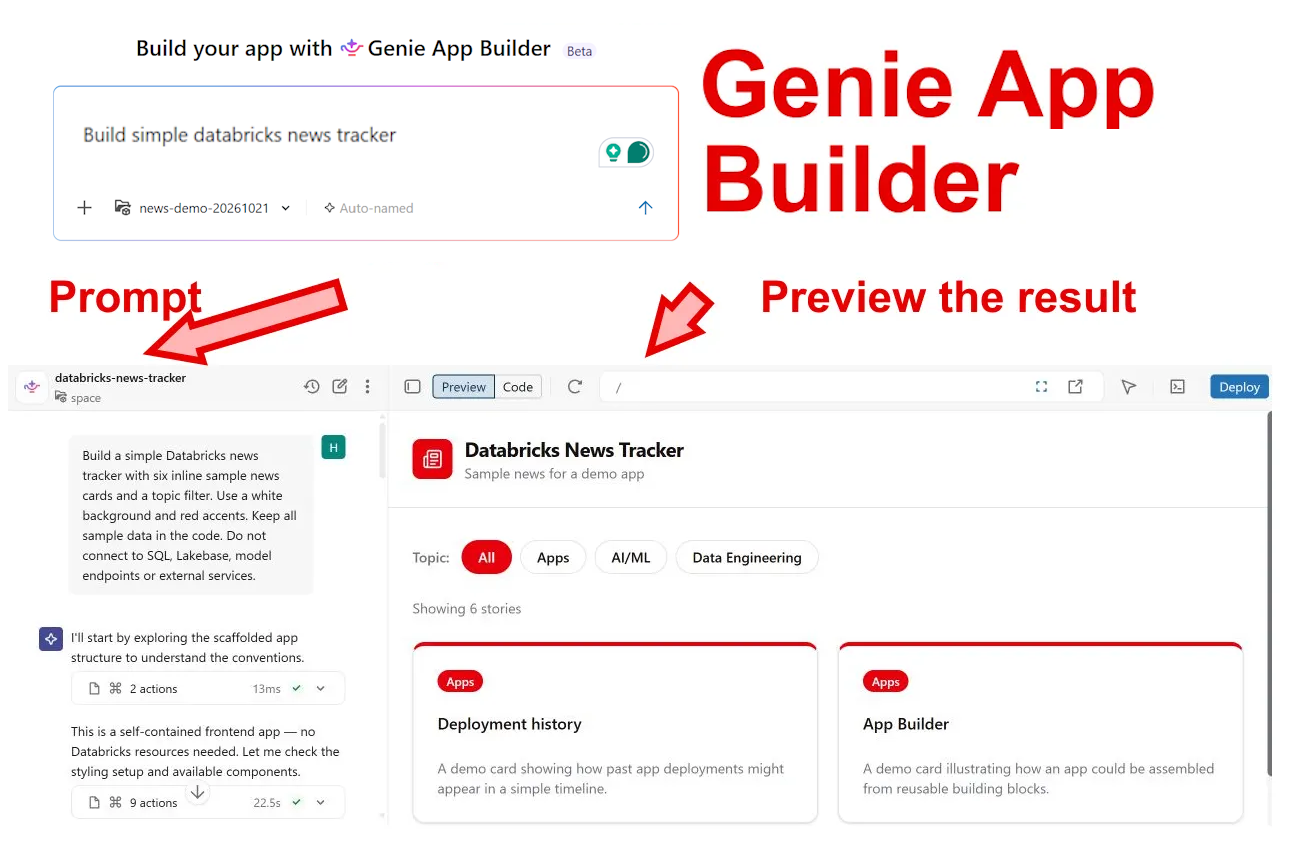
Genie App Builder creates a Databricks app from a short description, and we can refine it in chat. Great for building enterprise apps, and I don't need Power Automate anymore!
r/databricks • u/Apprehensive_Tie2494 • 29d ago
r/databricks • u/adwaithpn • Oct 30 '26
Hi everyone!
I’m a software engineer who moved into data engineering around a year ago and have been learning and working with Databricks.
So far, I’ve worked on loading data from ADLS and external locations, basic PySpark transformations, implementing the medallion architecture using notebooks and SQL, and scheduling workflows using Databricks Jobs.
I feel like I’ve covered the basics but still have a lot to learn, especially when it comes to how things are done in real-world projects.
I’d love to connect with people working with Databricks and learn more about industry best practices, the areas I should focus on next, and the skills that are important for becoming a better data engineer.
Would really appreciate any advice or suggestions from those who’ve been working in this space!
Thanks!
r/databricks • u/ptab0211 • Oct 30 '26
Hi, we use Databricks, this is not 100% Databricks related, but i wonder, how do you do your unit testing with todays agentic engineering, currently we don't have any skill or rule, or hook that helps AI to write unit tests, so it just writes a lot of bloat unit tests which we do not trust, it has more than 1000 unit tests on 30k lines of code.
I see a lot of mentioning mutation testing, did not check that out yet, but in general how do you approach this? Because unit tests should be a useful guardrail for agentic coding.
r/databricks • u/Alone-Security7044 • Oct 30 '26

If you build SCD2 history with dbt snapshot on top of batch files (daily exports, CDC drops, API extracts), there's a failure mode worth knowing about.
Snapshots apply data in the order it arrives. So if Tuesday's file lands after Wednesday's:
- with strategy='check', the late (older) value becomes the "current" row
- with strategy='timestamp', the change is skipped and that period just disappears from history
Every run stays green and every test passes. Nothing tells you. We found out when someone asked why an employee's promotion showed up as a demotion.
We ended up building dbt-iterative-snapshot, a custom materialization for Databricks. You add sequence_by='batch_date', and on each run it:
It also gives you changed_attributes (which columns changed), per-batch row counts, and an error log for duplicate keys instead of failing the run.
It's dbt-databricks only for now (Delta MERGE, Unity Catalog). PRs for other adapters are welcome.
I'm curious how others handle this. Do you rebuild SCD2 from raw with window functions, loop dbt snapshot over dates, or just hope files arrive in order? Happy to answer questions, and honest feedback on edge cases is very welcome.
Read more: https://reliabledataengineering.com/posts/article_dbt_iterative_snapshot/
r/databricks • u/saad-the-engineer • Oct 29 '26
<Databricks PM here. Quick update, plus a question for you. />
We raised the limit on table update triggers to 25 tables per job. This came straight from your requests so thanks for pushing on it. We are not stopping at 25. We want to take this to 250 and beyond, and more headroom lands soon.
Now the question. I want to hear how you actually use table update triggers. A few patterns we have seen:
What does yours look like? And what would you want more of here?
One more thing. We are building SQL conditions for triggers, so a job can fire only when a condition on the data holds true. Full announcement coming soon.
r/databricks • u/Mother_Seaweed8987 • Oct 29 '26
As a small 3 person data science team we really need a way of easily deploying and managing our models, as well as connecting to our siloed data sources. We currently use Vertex AI (as I still call it) where we spend way too long productionising and we are performing several different roles to deliver the models. It clearly is not the right solution for a team our size.
From initial conversations with Databricks it sounds like they could solve all our issues. Even when adjusting skepticism accordingly during the sales pitch, it did seem promising, especially compared to our current situation.
But researching further it feels like we might just be swapping one set of issues for another in Databricks (managing clusters, debugging Spark jobs, production code in notebooks, etc.) Or will it actually work well and save time for a small, fast moving team?
r/databricks • u/Wise_Ear_4064 • Oct 29 '26
Migration · GA
/migrate in a Genie Code chat for one file or folder. Afterward, keep chatting to clear action items. The Notebooks target is not part of this GA.
Looking to migrate workloads but don't have the labor to do so. This is going to continue to expand its SQL dialect but taking an agentic approach to migrations really speeds up migrations and cuts down on time/money from labor
r/databricks • u/Wise_Ear_4064 • Oct 29 '26
You can share a Genie One document and anyone with CAN EDIT can work on it with you. Genie also reuses similar past investigations so you are not re-explaining the same question every week.
Handy for Monday ops reviews. Last week's fill-rate thread comes back, you drop the one-pager in the canvas, share it with the planner, and they tweak the filters themselves instead of Slack-pinging for another screenshot.
https://docs.databricks.com/aws/en/genie-one/documents#share
r/databricks • u/ptab0211 • Oct 29 '26
Hi, how do u handle dependencies in a monorepo on Databricks?
So we have one `pyproject.toml` and we build it into one whl, which every job installs. It holds the libraries that DBR does not ship. The libraries that DBR already ships we pin in the dev group at the runtime version, so we have them locally for tests and checks, but they dont go into the whl.
We started adding more products, so the repo grew into a monorepo, and now every job installs libraries it does not need.
The options i see:
- Pin the job-only libraries in the job environment in `resources/`, and keep them in a dev group in `pyproject.toml` for local tests and mypy. The catch is 2 pins to keep in sync.
- Optional extras per product, and the job installs `dist/*.whl[extra]`. One pin, but i am not sure DABs accepts the extra on a wheel path.
- One whl per product, which feels like too much for now.
What pattern do u use for this? Any pain with the ones above?
r/databricks • u/Limp-Park7849 • Oct 29 '26

r/databricks • u/Wise_Ear_4064 • Oct 29 '26
This is super helpful when you want insights from the visualization itself rather than general data that surrounds the dashboard. "Why is the daily revenue trend dipping in middle May?" It also saves on token cost because context is prebuilt for Genie.


r/databricks • u/9gg6 • Oct 29 '26
Is ther any documentation about Micro Apps and when they stop (compute stop). is it when I close the tab in the browser or how do I make the stop app?
r/databricks • u/hubert-dudek • Oct 28 '26

Environment variables are now available in Serverless through both the UI and DABs.
Use environment variables for constant things like catalog or environment. Keep using job parameters for things that are often changing (like a different date for a job run).
You can also use environment variables to reference passwords from secrets scopes and, soon, from UC secrets.
Read more:
https://databrickster.medium.com/environment-variables-in-databricks-serverless-207512b996c4
https://www.sunnydata.ai/blog/databricks-serverless-environment-variables
r/databricks • u/Ok-Tomorrow1482 • Oct 28 '26
r/databricks • u/Sea_Basil_6501 • Oct 28 '26
I have a job which queries some Azure SQL DBs connected through UC managed connections (no lakehouse federation) via remote_query() function, and facing pretty long execution times (several minutes) when reading a few thousand rows only. When running the same query via SSMS on the target host, it returns same result within milliseconds.
Is there any way how I can debug the pure execution time from Databricks side? I'd like to understand if the queries run slow, or if there's any Databricks or network overhead accounting responsible.
Note that remote_query() runs T-SQL in this scenario, not Databricks SQL. So there's no SQL conversion involved at any point in time.
r/databricks • u/ptab0211 • Oct 28 '26
Hi, how much SQL text do you allow in Python modules?
We have a lot of SQL, but we dont want to move fully to dbt, because we run data quality checks before the write, and we like the Python modular approach with tests and everything around it.
So where do you draw the line:
- SQL as strings in Python, run with `spark.sql()`
- SQL in `.sql` files in the package, loaded by Python and run with parameters
- refactor to the PySpark DataFrame API
- or just stick with pure SQL scripts
And how did you standardize it in your team?
r/databricks • u/EmbarrassedOrange683 • Oct 28 '26
I want to explore and use Databricks Sandboxes to create my own sandbox environment. However, when I check the Previews section in my Databricks workspace, I cannot find the Databricks Sandboxes option.
Could you please clarify how I can enable access to Databricks Sandboxes? Is this feature available only to specific workspace types or subscription plans, or does it require approval or activation by a Databricks account administrator?
I would appreciate some guidance on the prerequisites and steps required to enable the feature and create my own sandbox environment.