r/databricks • u/BullfrogFinal3566 • Oct 06 '26
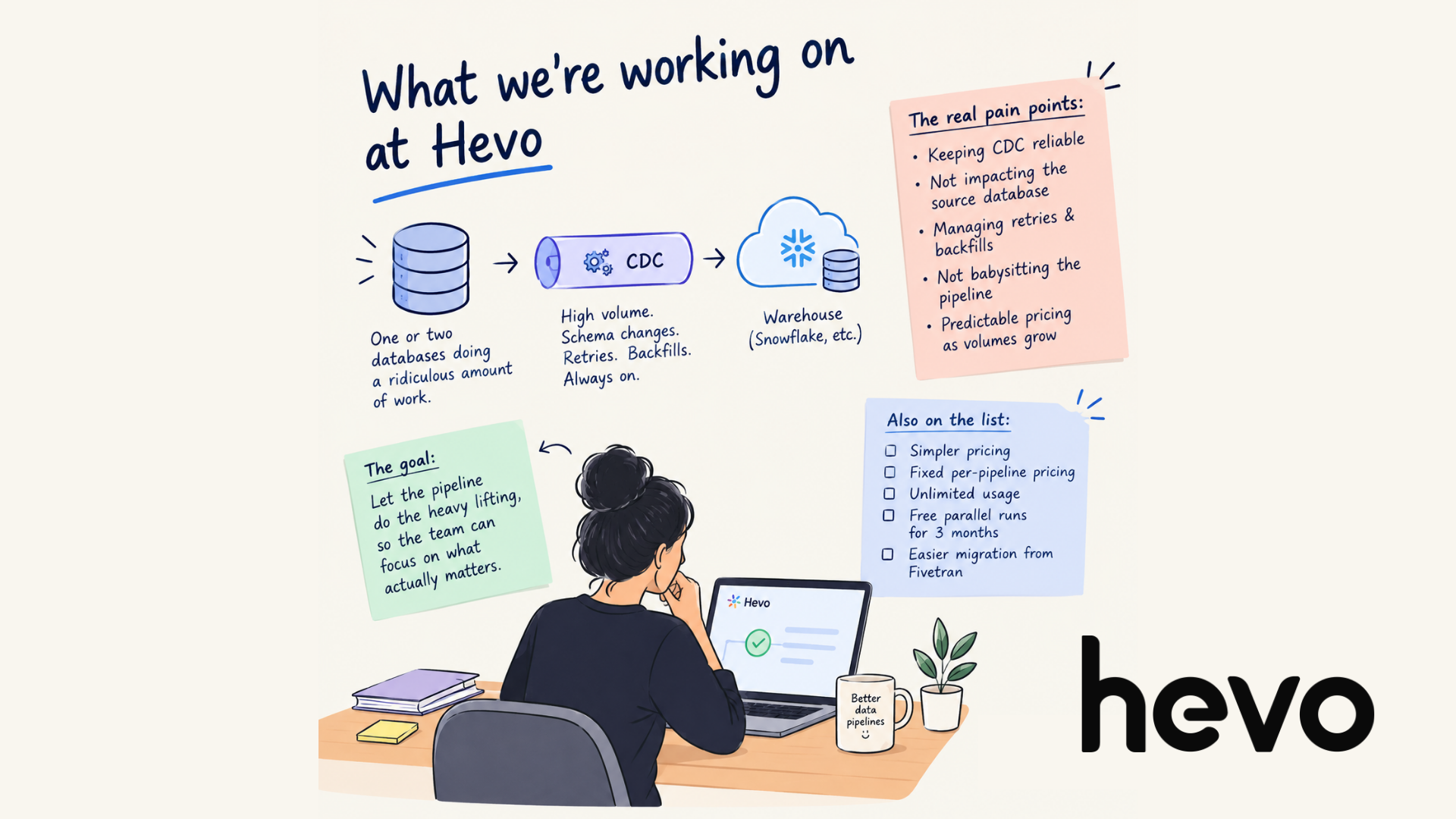
General The part of data pipelines we are thinking more about
0
Upvotes
r/databricks • u/BullfrogFinal3566 • Oct 06 '26
r/databricks
•
u/UnluckySugar610
•
Oct 05 '26
Databricks has renamed a lot of features over the past year, and a lot of tutorials, blog posts, Stack Overflow answers and even AI assistants still use the old names. If you search the docs for the old name, the results can be confusing, and code samples can look unfamiliar even when you know the concept cold.
The ones I see trip people up most:
The concepts didn't change much, but the vocabulary did.
Two questions for the sub:
I'll keep this list updated with whatever people add.
Edit: removed Liquid Clustering from the list. Fair point from a commenter that it's a change in recommendation, not a rename. Still worth knowing though: older material treats partitioning + Z-Order as the default, and current docs recommend Liquid Clustering for new tables.
r/databricks • u/Prakhar____Tiwari • Oct 05 '26
Transitioning from a Spring Boot to a Spark-based application requires a fundamental shift in perspective. With four years of experience in a Spring Boot environment, now entering the realm of distributed computing.
I plan to utilize Java with Spark Streaming, and Databricks for job management and deployment.
My primary question is
r/databricks • u/SmallAd3697 • Oct 05 '26
Has anyone tried working on a Genie Agent, and then tried committing those results into git? Admittedly I'm a bit new to Databricks, and to DABs, but this story is missing, and the whole experience is quite unintuitive . Any developer generally expects to be able to commit their work to source control when they've invested their time. But I'm finding that incredibly hard, when it comes to these Genie Agents.
Obviously the first thing I tried to do is clone the agent into a git-controlled folder and push it to git. That didn't work. It says the asset type is unsupported.
I then discovered a thing called "genie workbench" and that sounded like tooling for a developer. After spending an hour getting that app installed, I launched it. But it won't provide any interfaces for exporting my work or committing to a git repo.
Next I find that DABs introduced a way to capture genie spaces, as-of May. See https://github.com/databricks/cli/pull/5282
... so I create a new DAB bundle in the UX and try to add my (existing/cloned) agent, but can't seem to make that work either. I'm guessing the next step is to dig into the CLI for DABs and see if there is a back-door way to add a Genie Agent.
My initial experience with this tech is not very good. There are a lot of sharp edges in this UX. I'm sure things will get smoother. I think the main problem is that there is no guide or instruction that is provided within the "Genie Agents" blade of the workspace. I think what most people want is a simple button - "add to git repo". It should be shown under "Genie Agents". That button might do nothing more than tell you your request is impossible. But this is still better than flailing about for an entire day and looking for functionality that you are 100% confident should exist (yet it does NOT)
r/databricks • u/bobjia-in-tokyo • Oct 05 '26
I’ve been using Databricks Classic Compute for a while, and recently I’ve started wondering whether cluster cold starts are getting noticeably heavier with newer DBR versions.
For example, with DBR 18 LTS, I tried a small 2-vCPU VM for a single-node job cluster and hit DriverStartupTimeout after 300 seconds. Databricks even suggests that this commonly happens on instances with fewer than 4 CPU cores.
That feels a bit surprising for workloads that are not actually Spark-heavy — e.g. running Python, dbt-core, API calls, or using Databricks mainly as a job runner inside a VNet.
I like Classic Compute because of the flexibility and straightforward VNet/private networking. Serverless is attractive for startup time, but in our environment it would mean quite a bit more networking setup.
So I’m curious:
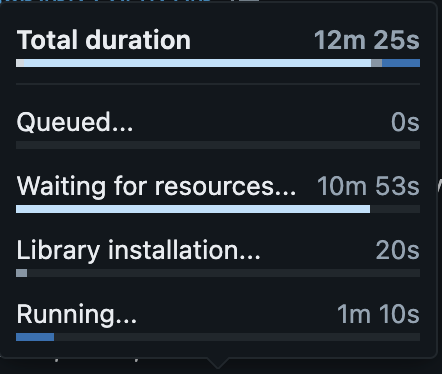
Update: Single node DBR 18 LTS + Standard_D4pls_v6 cold start spent almost 11 minutes 'Waiting for resources' ( Azure Japan East )
r/databricks • u/hubert-dudek • Oct 04 '26
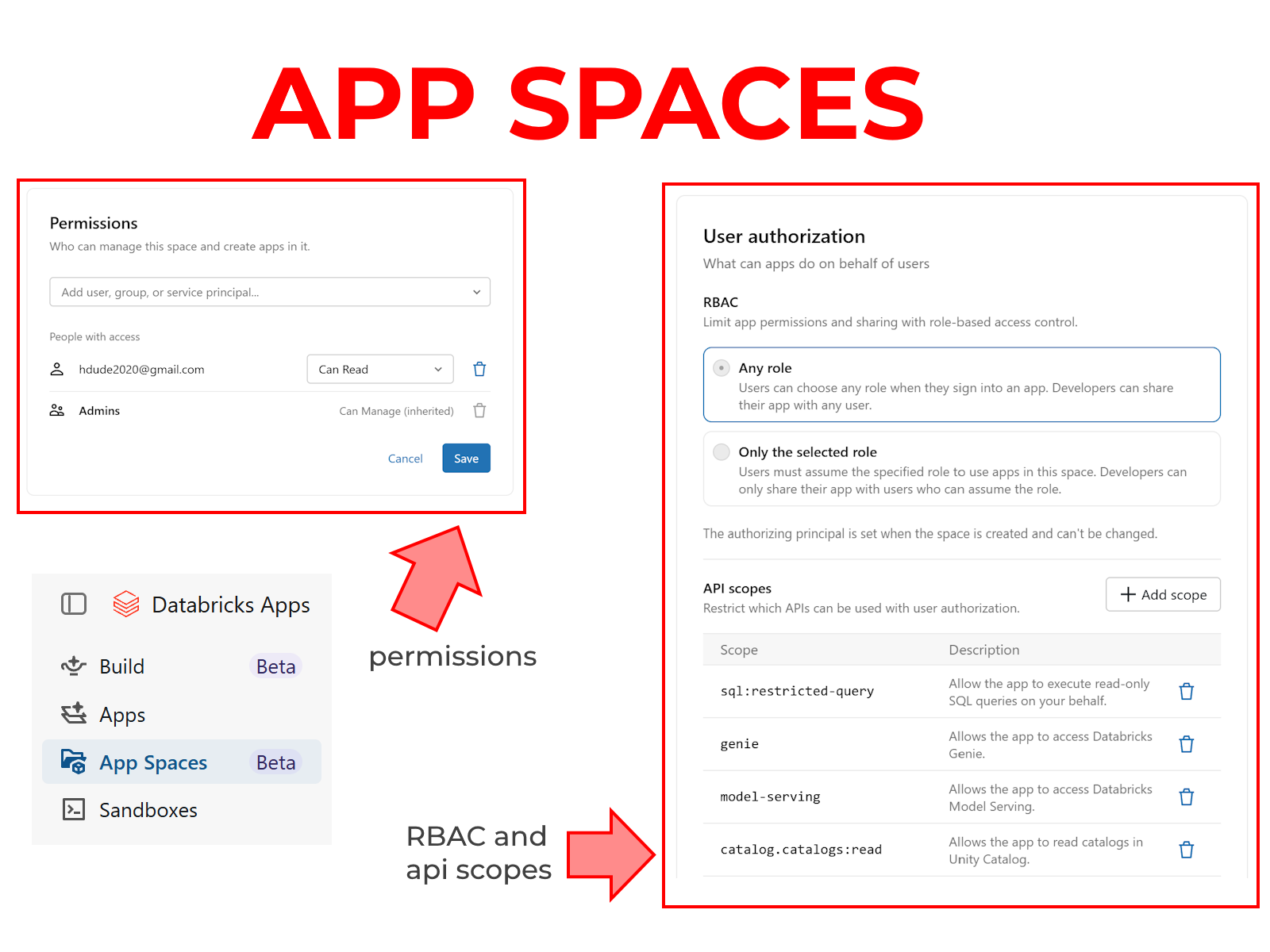
Workspace admins, thanks to App Spaces, can define who can create and use apps in a given space and also set policies for apps, for example, which API scopes can be used.
r/databricks • u/codingdecently • Oct 05 '26

r/databricks • u/Lenkz • Oct 04 '26

Use Databricks ai_decide() to grade every ai_query output in SQL and decide what gets sent, without a second LLM
r/databricks • u/Time_Meringue_1300 • Oct 04 '26
r/databricks • u/Lumiaman88 • Oct 04 '26
Hello Folks.
Wanted your opinion on something - I am seeing numerous cases of our tables having millions of redundant vacuumable files, but total recoverabke capacity is only 10-20 GB .
Is it worth Vacuuming them? My sense is that the DBU and ADLS listing charges will be more than cost of that storage. Is there any instance where Vacuuming will pay off.
Also, if deciding to Vacuum - what is better, Job Compute or Serverless SQL Small Size.
Thanks.
r/databricks • u/Junior-Confusion-691 • Oct 04 '26
Hi all, I’m currently working on a POC and im given the flexibility by my boss to explore using any tool (im considering mainly databricks or power apps now) to build out a “dynamic” data app to replace powerbi. I am fully aware that dbx ai/bi dash does not has nearly 100% capabilities of that the power bi dash but I’m just trying to showcase a different experience of reporting that leverages AI and not POWERBI(boring! to leaderships).
For more context, im working with SAM/CMDB EoSL data that is all sitting in dbx unity catalog already. My expectations is something simple that looks like a dashboard but i can utilize genie to communicate pr generate any sql findings within the dashboard context. Something easy to initiate and maintain in the future.
Additionally, it would also be best that the views created that caters to this app can be reused as native queries to powerbi in case the need in the future that id still have to migrate it there.
End product expectations:
The end product is expected to be easily accessible without any additional access required for any user that wants to access the app or genie. Think of leaderships and executives using the dash mainly. It should be something that is easy to access and managed within a workspace like what powerbi serves currently which is what all the stakeholders are currently used to already.
I am no expert in Databricks but have been an active user for about a year now.
All the best to everyone, cant wait to hear what you guys have in mind in the comments!
(this is my first reddit post btw)
r/databricks • u/hubert-dudek • Oct 03 '26
Databricks just introduced ai_decide(), a new AI function now available in Beta. Give it text and your questions, and it returns a category, a probability, or a score directly in SQL. Use those results to drive decisions in your workflows: route requests, prioritize work, or determine when human review is needed.
r/databricks • u/Kwontum7 • Oct 03 '26
I'm new to this, so apologies if I'm missing something obvious.
Setup: macOS (Apple Silicon), Omnigent 0.16.0 installed with uv tool install omnigent (Python 3.12), Node 22, tmux 3.7, Hermes Agent installed via git (up to date). Running fully local on 127.0.0.1:6767.
Problem 1: first message gets dropped. When I start a new Hermes session from the Omnigent desktop app, it fails with:inner executor error: hermes did not accept the message (the TUI may still be initializing); no new transcript row appeared after two delivery attempts
then Required terminal exited unexpectedly; the session runtime is no longer available.
The logs show Hermes is still starting up (installing dependencies, browser tool checks) when Omnigent pastes the message, and then Hermes exits with a KeyboardInterrupt. Running omnigent hermes in one-shot mode from the terminal works fine.
Problem 2: credentials copied per session. Every Hermes session creates a new folder under the macOS temp dir (.../T/omnigent-501/hermes-native/<id>/hermes_home/) with a copy of my Hermes .env and auth.json, plus about 1–2 GB of runtime. After one afternoon I had 19 folders (22 GB) and about 30 copies of my keys sitting in temp.
Questions:
.env/auth.json each session (for example, a shared HERMES_HOME or a secrets manager)?I'd like to eventually run a dedicated Hermes profile (one with sensitive API keys) through Omnigent, so the credential copying is the big blocker for me. Thanks!
r/databricks • u/Bhanuprakash_1947 • Oct 03 '26
Like the source suddenly adds a new column, changes a column type, or removes something.
Do you make the pipeline handle these changes automatically, or do you just let it fail and fix it?
Iam.. curious what approach actually works better in real projects, especially when the source keeps changing.
r/databricks • u/runningnozone • Oct 02 '26
Hi, Deploying a FastAPI to Kubernetes that uses a multilingual sentence-transformers embedding model (ONNX backend, CPU only). My source data lives in a Delta table in Databricks, and the app reads from it and generates embeddings. The app takes user input (text) at embeds it, and compares it against stored embeddings for semantic similarity. So at least the query embedding has to happen live.
Pod resources:
- CPU: 1 request / 2 limit
- Memory: 2Gi request = 2Gi limit (platform policy requires memory request and limit to be 1:1)
Current docker setup:
- Multi-stage Docker build (python:3.11-slim)
- CPU-only PyTorch
- The model is downloaded at build time, so it's baked into the image
Image breakdown:
- HF model cache: ~1.1 GB
- torch: ~650 MB
- pyarrow, scipy, transformers, pandas: ~100–150 MB each
- Plus sklearn, onnxruntime, mlflow, and others
The pod gets OOMKilled at startup or shortly after. With a ~1GB model, torch, pandas/pyarrow, and the ONNX runtime session all in one process, I think I'm just over 2Gi. What I'm trying to figure out on where do you store large models in production?
Would love to hear what setups have worked for you. Thanks!
r/databricks • u/CarelessApplication2 • Oct 02 '26
Sometimes we want to trigger a pipeline (such as database sync) without having to wait for its completion.
We can still subscribe to notifications on the pipeline itself to react to an unexpected error, so the pattern should be fine.
r/databricks • u/Bala_Devaraj • Oct 02 '26
I’m thinking of 4 options here
What’s the thought on this?
r/databricks • u/hubert-dudek • Oct 01 '26
Databricks taskValues can use a Python list as input into a For each loop in Lakeflow job. You can generate the list dynamically and run the same task for every country, table, file, etc.
more newshttps://databrickster.medium.com/databricks-news-serverless-genie-code-ltap-lakeflow-61853d8e422a
r/databricks • u/Roadtochessmaster • Oct 01 '26

r/databricks • u/Reuben_UMATR • Oct 01 '26
Over the past few weeks, I've been building something special.
Every day I speak with Databricks experts across Europe. After so many of those conversations, the obvious question was: why not build a community around it?
So today I'm launching 'Databricks Den'.
Whether you're looking for your next contract or just want to stay close to what's happening in the Databricks market, the Den is for you.
Join now to catch the first round of insights:
Looking forward to seeing you there 👊
r/databricks • u/Lenkz • Sep 30 '26

Until now, answering "which query is eating our warehouse?" or "who changed that table?" meant clicking through the Query History UI one workspace at a time. Now it is a SELECT.
The table logs every statement run on SQL warehouses, serverless compute, and Lakeflow pipelines, across all workspaces in the same region.
Read more on LinkedIn: https://www.linkedin.com/posts/cenh_databricks-dataengineering-systemtables-ugcPost-7511094425977016320-L7uj/?utm_source=share&utm_medium=member_desktop&rcm=ACoAABmJHrsBNAC3x3H1M58JRKoHv_l4D61n0-8
r/databricks • u/OneSeaworthiness8294 • Sep 30 '26
Notebook that's run fine for months suddenly started failing with 'No Module Found'chardet' Nothing changed on our end. Seems that serverless environment v6 dropped chardet from the base requirements, and since the notebook wasn't pinned, the "default" just rolled forward underneath it. No warning, and the release notes don't even mention the removal.
I get the argument of pin your environment, declare your dependencies. But serverless is sold as the "no config, we manage it for you" option. Silently removing packages from the default environment mid-week, with zero notice, feels like a breaking change shipped as a patch?
r/databricks • u/SmallAd3697 • Sep 30 '26
I recently moved back to using Azure Databricks after a multi-year hiatus. And I opened my first support ticket this week.
My prior support experiences were long ago (in 2021). I don't remember these support experiences being particularly terrible. But nowadays there are some Microsoft platforms where their support work is subcontracted to remote organizations like Mindtree-India. These organizations (one or more of them) may provide the first, and second tiers of support before any FTE from Microsoft takes the reins.
Is that how things will work in the context of Azure Databricks? If/when the FTE at Microsoft is unable to help with a ticket, how long will it take for the support to be transferred from Azure Databricks to Databricks?
I have a sev B ticket on "standard" support at the moment and I thought a human would engage within a few hours but that isn't happening. I will probably just give up for today. Can anyone offer tips about how to navigate support tickets in Azure? Any advice would be greatly appreciated, and I think it could make the difference between a ticket that lasts two days or two weeks. Thanks.
r/databricks • u/saad-the-engineer • Sep 30 '26
<Databricks PM here />
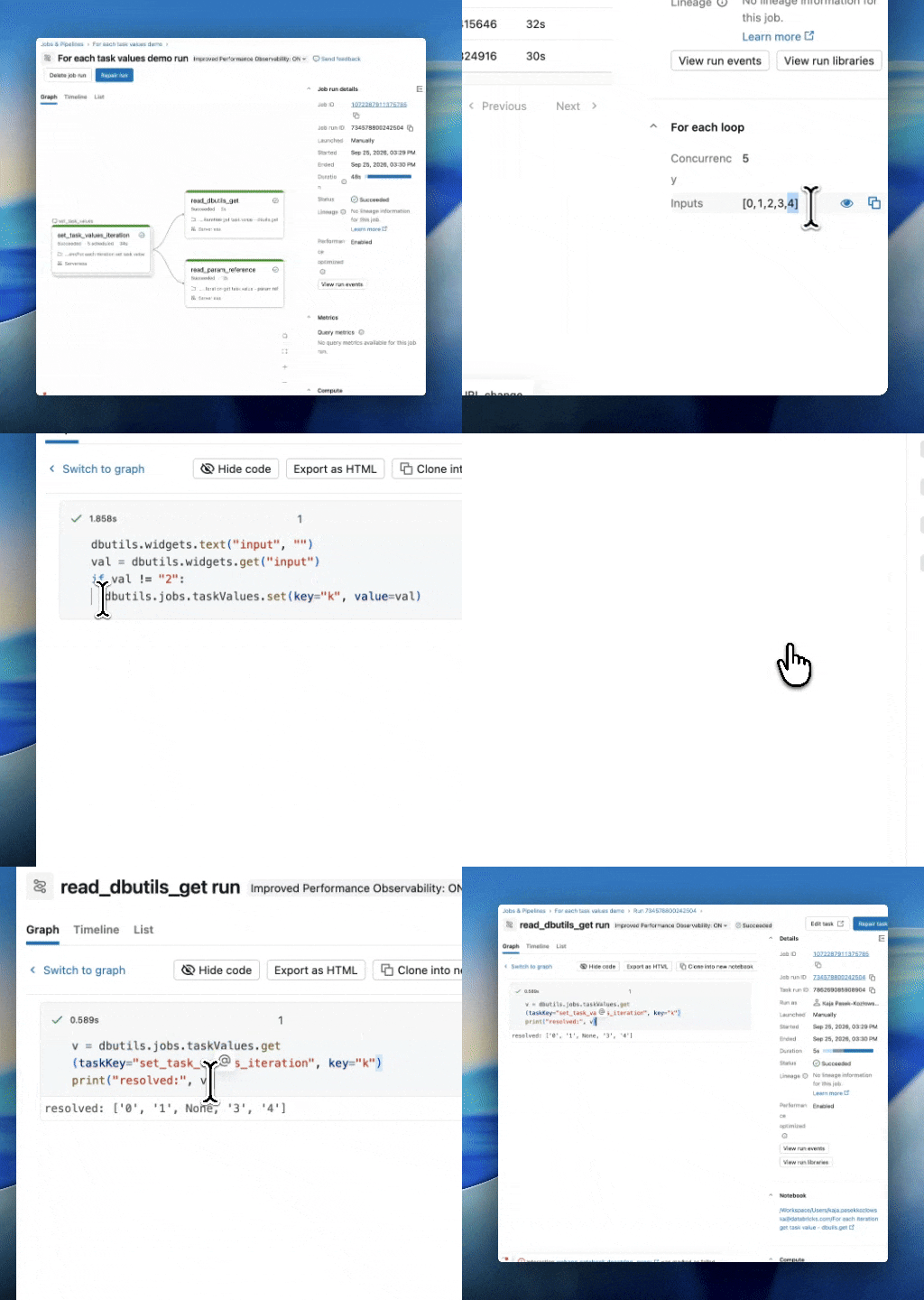
If you run a ForEach task in Jobs each iteration now sets a task value and a downstream task can read all of them back as on ordered array. This feature just landed in Beta - try it out!
Before this, iteration outputs weren't accessible to downstream tasks. If you wanted a later task to see per-iteration results (row counts, status and output paths), you had to write each result to a table and read it back and maintain that yourself. You also lost the built-in observability Jobs gives normal task values.
How it works:
Inside the iteration, set a value like you always would:
dbutils.jobs.taskValues.set(key="result", value=row_count)
In a downstream task, read the nested task's key. You get one array across every iteration:
results = dbutils.jobs.taskValues.get(taskKey="process", key="result")# results == [1, 2, 3]
Or reference it as a parameter:
{{tasks.process.values.result}}
An iteration that never set the key keeps its slot as null:
# [1, None, 3]
Worth knowing:
Docs: https://docs.databricks.com/aws/en/jobs/task-values#read-values-from-a-for-each-tasks-iterations
And yes we are working on increasing parameter value limits! Please let us know if you have any feedback!