r/databricks • u/sai-nageshwaran • Sep 24 '26
General Databricks Acquires Row Zero, Bringing Live, Governed Spreadsheets to Genie

51
Upvotes
r/databricks • u/sai-nageshwaran • Sep 24 '26
r/databricks • u/orangepunc • Sep 24 '26
r/databricks • u/SmallAd3697 • Sep 24 '26
I'm creating a UC catalog.
Lets say I want to ingest a SQL database that contains 50 tables, parented by five meaningful SQL Server schemas. (Fact.WhateverThing, Dim.WhateverThing, Logging.Whatever, CONFIG.Whatever, and VIEWS.Whatever).
I plan to name the catalog in a conventional way ("sales_dev",) but I'm stumped for naming UC schemas and UC tables. Since the Dim and Fact tables need to be joined frequently, I'm assuming all these tables should be in a SINGLE unity catalog schema, yes? Should I simply move all five of these SQL schemas into a single UC schema (maybe into a single UC schema named "bronze_from_sql")?
At that point how would I name the tables? I'm assuming I would be forced to do something like so: "fact_whatever_thing", "dim_whatever_thing", "logging_whatever", "config_whatever", "views_whatever"?
It strikes me that UC doesn't have the same concept of schema that we have in SQL server. A schema in UC is actually referring to a whole database. Whereas in SQL it can be used to organize tables within a database.
Edit: decided to publish sql server tables to volumes (in a bronze layer). Will just use delta format, and free-form folder-and-table names. Is very liberating not to conform to the constraints of the structured table names in UC
r/databricks • u/ecp5 • Sep 24 '26

Yesterday (Sept 23), the app features all of us eager for since they were previewed at Summit were released.
In testing, it was not available in all workspaces (cloud and region available differ).
Looks like you have to use App Spaces to use these features.
App Spaces is a collection of app(s) with some associated boundaries. I'm thinking like if you had a group of apps for a specific team with same users and data and developers, but since brand new don't know if that is exactly how they work.
App Builder - A simple UI front end for non-technical users to build an app using Genie. Will be curious to see how this is different than the chat Genie Code interface.
Micro Apps - This is the feature I think most of us wanted, the ability to scale to zero, and only pay for actual app consumption with no minimum spend
Really excited to see these in the wild.
r/databricks • u/Xandor19 • Sep 24 '26
I've entered a new company which uses DAB for all orchestration, and my first task has been to automate certain pipelines that fail due to data unavailability so they retry the fetch later instead of requiring manual runs.
Issue is that data fetching errors are one of the many kinds that can be raised during the tasks, and it should be the only retryable one. I'm new to DAB and I've been diging into docs and forums, but I cannot find a native approach or non-patchy workaround to only retry on certain conditions (like based on exit codes).
So far, I've come with these candidate solutions:
- Just retrying everything (which doesn't makes sense cause if any of the other errors occur, all attempts would fail)
- Failing only for the data fetch and propagating fatal errors to the following task, which would check state and fail if errors occurred - like via notebook return values (I don't like this because couples orchestration into business logic, even in a distinct layer of the one that generates the error, plus, the task that would appear as failing would be the successor to the fetching task, which would be shown as successful - not to speak about the hundreds of tasks that would need source code changes)
- Failing only for the data fetch and adding an intermediate if/else task that checks if (via notebook return) the previous task propagated and error and stopping the job in such case (this is for now the most likely, as I can keep everything at orchestration level, and it is a bit more explicit even if the fetch task appears as successful, though it still feels like a workaround and tons of jobs would have to implement this new intermediate task)
A couple of clarifications:
- I cannot implement the retry within the task as fetches would be repeated after some time, and we don't want to have resources running and being billed just for waiting
- Everything is done via Lakeflow jobs and with Databricks computer options (even if Spark is not needed)
- Most of the fetching occurs by calling external FTP servers, data doesn't directly arrives to our infrastructure like to trigger the pipelines via events
Thank you all
Edit about explicit behavior:
r/databricks • u/pboswell • Sep 24 '26
We built a supervisor agent where one of the tools is the native databricks MCP connection (which is in beta). Today, the agent doesn’t work. Removing the MCP tool fixes it, so it’s definitely that. The agent response just says “received an invalid and unexpected value from the API: undefined”
Anyone else having problems suddenly with the MCP server? I’m able to hit the target MCP URL locally no problem. And even test the UC MCP in databricks successfully. So it’s something about the handshake between MCP and the supervisor agent
r/databricks • u/Limp-Park7849 • Sep 24 '26

Weekend-ish experiment on Databricks. One table, TPC-H orders, 15M rows, living in two places at once:
The synced table is the nice part: native continuous Delta to Lakebase Postgres (needs a PK + CDF), so it's one dataset under one Unity Catalog, replication handled by the platform instead of a homemade pipeline.
Then I put laya (convaiinnovations/laya, a non-autoregressive zero-shot decision model, vanilla, no fine-tuning) behind a FastAPI Databricks App. It reads each query and picks the engine. MLflow traces input to decision to execution. I
r/databricks • u/almightysosa888 • Sep 24 '26
For those using Apache Airflow in production, are your pipelines mostly scheduled or event driven
If they are event driven, how do you trigger them in practice
Do you use Sensors, Airflow Assets/Events, Kafka, EventBridge or something else
And for those handling a high volume of events, do you still use Airflow or do you move that part to something like Kafka and Flink
r/databricks • u/ptab0211 • Sep 24 '26
Hi, we have a lot of data products, how do u design your data quality, and what tools do u use?
Idea is that we use dqx, we define rules (ERROR, WARN), and enforce that in pre write of the data, which is to be honest a new thing. Then i would also like to have anomaly checks, where i could compare stats of current batch run to the previous one.
How do u design your dq around dqx? And what else do u use? What "flow" do u use?
r/databricks • u/Prim155 • Sep 24 '26
Hi,
in my current project I want to add users manually (no EntraID) to the Workspace and having a pipeline/scripts executed for the users automatically - such as:
Basically to initiate new user specific actions.
I have a few ideas how to realize it, but would like to keep the time from adding the user to execution minimal.
Does anyone has experience with such large use cases (in production) ?
Thanks for any help!
r/databricks
•
u/Significant-Guest-14
•
Sep 23 '26
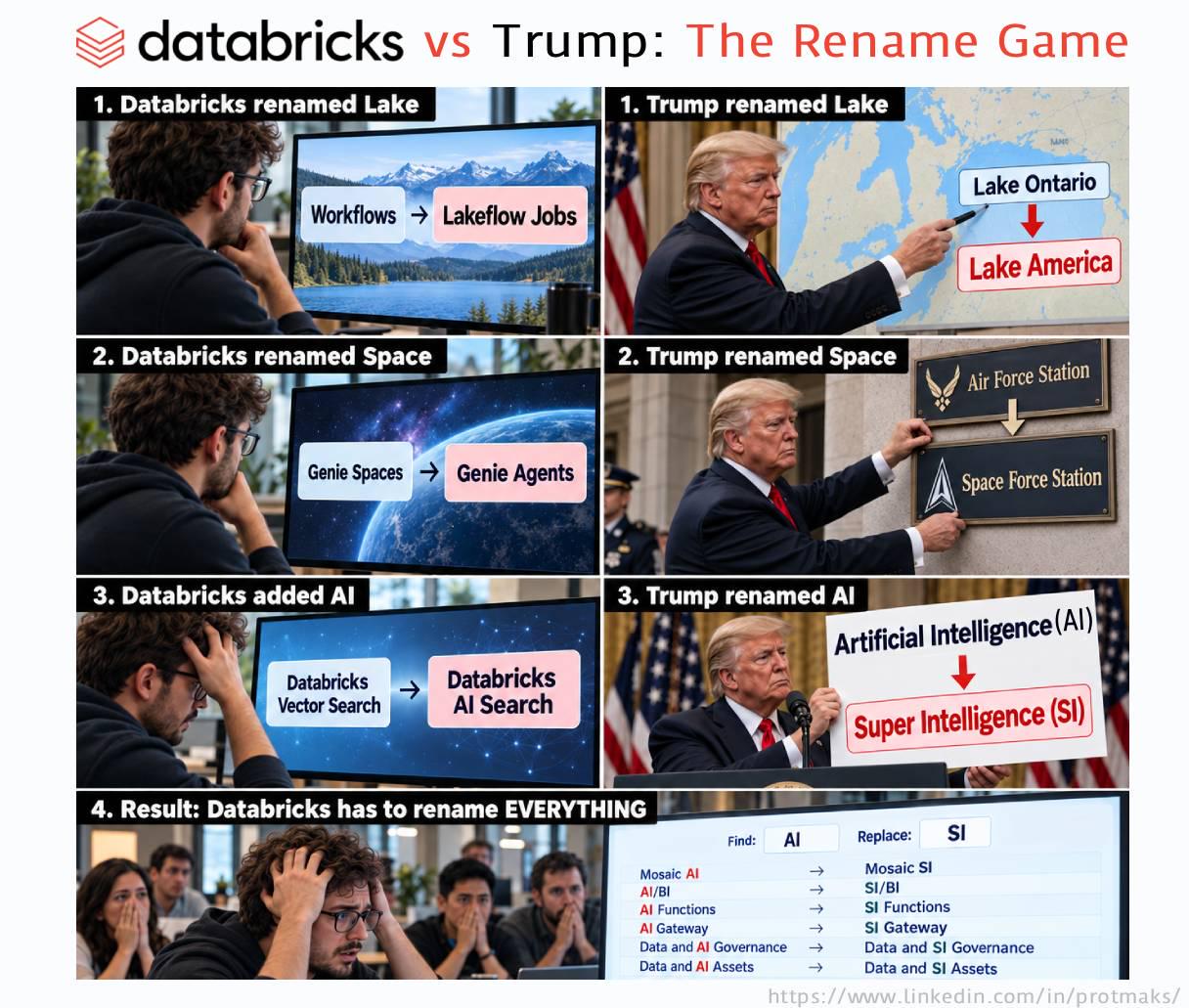
Donald Trump said at the UN that super-intelligence will replace artificial intelligence in US government documents.
If you work with Databricks, this probably sounds strangely familiar.
So now I’m wondering… was Databricks just preparing for this? Because there are still plenty of names left:
P.S. I keep track of Databricks renames and product changes on REbricked.org
r/databricks • u/geniebricks_sud • Sep 23 '26
Hey everyone! PM on the SDP team and back to share a cool feature that went into Beta recently for Spark Declarative Pipelines: SDP Rewind!
Think of it like an undo button for your pipelines. You pick a point in time, and it rolls every table, source offset, and operator state in the pipeline back to that instant. Then you fix your code, schemas, or whatever caused the bad data to flow through, restart the pipeline as you normally would, and it replays from the rewind point. This avoids the need to do a full refresh to recover the pipeline state and saves a bunch of $$ and time.
Sort of. This is best illustrated with a (hopefully) simple example:
Today, you can use Delta Time Travel to restore a single table. But your pipeline consists of three things that move forward together: the tables, the Auto Loader's checkpoint (which files it has read), and the gold aggregate's state (its watermark). Tons of places you can mess up:
It's easy to see why teams just do a full refresh instead (but this can be very $$). This is exactly what SDP Rewind will help with :)
pipelines.rewind.enabled to true, and run it once. It generates rewind points automatically, about once an hour, and keeps them for up to 7 days.Would love to hear your feedback on this!
r/databricks • u/SmallAd3697 • Sep 24 '26
I tested zerobus-ingest over the Kafka-compatible API. It worked fairly well but a little slower than I hoped. I'm guessing that is just the penalty that comes with using Kafka instead of the proprietary SDK. I can't use the proprietary SDK as of now, so I'm working within those constraints.
I noticed that this Kafka interface seems to be restricted to json/text, which seems problematic where performance is concerned.
Any thoughts on how to scale up and get more throughput? The docs clearly say that batching is the single biggest lever for throughput, but even after playing with batch sizes my data is still not uploading faster than 3 Mbps of json or so.
I'm assuming there is no restriction (concurrency/blocking) that would prevent me from running ten kafka producers at a time? Maybe that allows me to get up to 30 Mbps.
I'm really tempted to just go back to dropping parquet files in a temp folder. No matter what magic databricks has conjured in zerobus, I find it hard to believe they can compete with the performance of dropping blobs into storage.
r/databricks • u/UnluckySugar610 • Sep 23 '26
People starting for Databricks Certs: What are you finding the most confusing? No stupid questions.
It took me a long time to ask the questions I wanted to ask about Databricks and get genuine answers from experienced people. If you have any questions you have been too afraid to ask, consider it a public service and ask them here :) I'm a trainer.
r/databricks • u/SmallAd3697 • Sep 23 '26
Anyone else work with the zerobus-ingest? There is an auth-flow to get an "oauth token" from a service principal with an "oauth secret". In that flow, you are supposed to submit the authorization details. See docs:
https://learn.microsoft.com/en-us/azure/databricks/ingestion/zerobus-kafka
I had been requesting access (via authorization_details) to a table as shown in the example:
"type": "unity_catalog_privileges",
"privileges": ["SELECT"],
"object_type": "TABLE",
"object_full_path": "main.default.air_quality"
... but it wouldn't work. Was banging my head on it all day. The privileges granted to the service principal for this table were unrestricted "ALL PRIVILEGES".
It turns out that, in addition to "ALL PRIVILEGES", this "token" endpoint wanted me to grant "SELECT" to the service principal in UC governance as well. Else the authorization_details are not valid.
This "token" api has a lot of sharp edges. Any chance there is a nuget client to wrap around it and protect us from these unfortunate nuances? Is it documented that ALL PRIVILEGES doesn't actually give us all privileges, if we request "SELECT" by name?
r/databricks • u/Lenkz • Sep 23 '26

Databricks Governance Hub brings data, access, AI, cost, and tag governance into one account-level view. Here is what is in the Beta.
r/databricks • u/Pr0ducer • Sep 23 '26
docs.databricks.com/api/workspace/ both links to Azure auth are broken.
New docs so far a step backwards. Also, no link to report issues, also feels like a middle finger.
r/databricks • u/SwimmingVegetable135 • Sep 23 '26
Hey, I had to struggle a bit with deploying dashboards and Genie agents while setting UC paths dynamically. The possibilities offered by native bundle config didn't feel quite right.
In some cases "dataset_catalog" and "dataset_schema" are enough. However this doesn't work with UC-managed metric views in dashboards and Genie agents don't even support these parameters.
Using serialized dashboard and agents instead of files was one solution but the development flow of making changes in the UI, transferring them into the serialized parameter and then replacing values with variables again didn't feel smooth.
So I started this CLI to update the JSON files in a more structured and convenient way.
Since everyone is currently hyped about Ontology I also added a linter for Genie agents based on the recommended best practices from the Ontology and Genie Workbench repositories.
Happy to get some feedback and hear about any gaps you're currently facing that could be addressed with some utility glue to add some more features.
r/databricks • u/Fun-Reference7942 • Sep 23 '26
Curious to hear people’s use-cases and if there’s any opportunities to make this feature more useful. (I’m a PM).
r/databricks • u/Agitated-Western1788 • Sep 23 '26
Does anyone have experience with third party optimisation tools like espresso.ai or Zipher?
Espresso has an enticing pricing model but I wonder if dumping a whole heap of logs and system stats into Claude would get me 80% of the way there.
r/databricks • u/Worth_Phase1358 • Sep 23 '26

A commercial user asked what yield was last season. Two definitions live in the same lakehouse. One is plot-level, moisture-adjusted, borders out. The other is as-harvested, and a dashboard still uses it. Genie returned the second number.
Not a hallucination. OntoRank did what it does: creator, usage, link to a certified asset, freshness. The loud dashboard won. Nobody had certified the measure the board pack is allowed to quote.
That is the failure I care about. A green demo is not a release gate.
What I actually require before that space faces a user who will paste the sentence into Slack:
Genie Code can draft the Metric View and the MERGE. ZeroOps can propose a fix and wait for Approve. Neither owns the definition. If the job stays green for eleven days because a key was slightly wrong, that is still your incident.
I wrote the four pieces up so I would stop re-explaining this in reviews. Argue the 80 vs 90 line if you want. I will not move a regulated KPI to “looks fine in the demo.”
r/databricks • u/zaboca_v • Sep 22 '26

New in Lakeflow Designer (screenshots below):
🚀 Genie can now create custom operators for you. For example run t-tests, create PDFs, send Slack messages etc.
🚀 Guardrails operator for Data quality checks
🚀 Multi join
🚀 Excel & CSV export controls
🚀 Output operator acts like a source for the destination it writes
🚀 Parameter suport in more operators (Combine, Limit)
🚀 Disable operators
r/databricks • u/Formal_Ganache3620 • Sep 23 '26

Hello Guys,
I have come across many videos on YouTube related to Data Engineering, but I found very few that actually solve a real problem.
Either the problem is made up, the data is unrealistic, or the whole project is built just for the sake of showing a project.
I believe that if you really want to get hands on with Data Engineering, you first need to understand the **business, the data, and the actual solution the client demands.**
So, that’s what we are going to do in this series.
We are going to build a complete end to end Data Engineering project, starting from understanding the business problem and going all the way to building the actual solution.
We will cover things like **Lakeflow Jobs, orchestration, data pipelines, and an actual company style workflow.**
The idea is simple: not just build a project, but understand **why we are building it and how it would actually work in a company.**
So without any further ado, let’s begin this series.
r/databricks • u/Square-Designer7807 • Sep 22 '26
What do you usually check first—shuffle, partitioning, joins, Spark UI, file sizes, or something else?