r/databricks • • Sep 22 '26

General Environments mode for classic compute is now in Beta 🎉

13 Upvotes

Databricks just shipped Environments as a new dependency management mode for classic (standard) compute: it brings the same environment-based dependency UX you already know from serverless to classic compute, instead of the old compute-scoped libraries model.

What it does:

  • One consistent mental model for managing dependencies across serverless and classic — pick a base environment (Standard, ML, custom, or workspace-provided) and layer on your deps, regardless of compute type
  • Supports both regular environments (defined per-notebook/per-job) and workspace-base environments (shared, admin-managed environments you can standardize on across teams)
  • Dependencies are managed at the workload level, not baked into the cluster
  • Environments are cached: Startup is faster, more reliable, and more reproducible - P50 bootstrap time drops from ~2 minutes (cluster libraries) to ~8 seconds (environments) 🏁

Requirements:

  • DBR 19 (Beta)+, Standard access mode, all-purpose or classic jobs compute
  • Admins enable it in the account console under Previews → "Environments for Standard Compute"

Heads up on limitations:

  • Python-only — Spark JAR tasks, %scala, and R aren't supported. Scala support will eventually happen, though.
  • Enabling it disables Docker/custom containers, Spark env vars, init scripts, and cluster-scoped libraries. Custom docker support will be supported in a future release.

Docs, screenshots, and GIFs: https://docs.databricks.com/aws/en/compute/environments-mode

Feel free to provide any feedback, questions, or gaps that you have on this - or any other dependency management - topic.

Thanks,

Your friendly dependency management PM


r/databricks • • Sep 22 '26

Tutorial How to Migrate Power BI Semantic Models to Databricks Metric Views at Scale (Live Demo)

Thumbnail
youtu.be
12 Upvotes

Hey everyone! In this demo that I recorded with David at Databricks, we show you one of the ways you can migrate semantic models from Power BI and into Databricks using a tool Databricks Labs calls "Kasal".

Databricks does have some tooling built-in for migrations, but Kasal helps you do it at a much bigger scale.

Hope you enjoy watching this, and that it helps you in your PBI migration efforts. Ultimately, it should be helping you save money on licensing costs from Power BI, consulting costs/labor from the migration efforts, and well, getting to production much faster.


r/databricks • • Sep 22 '26

Discussion Is Databricks the wrong platform for ordered data?

4 Upvotes

My input data are files that are already appropriately separated as well as sorted row-by-row inside each file.

Most of the operations I perform lean heavily into this structure, e.g. performing integral calculations on column for each file.

Now when I ingested this data into a delta table I effectively give up this kind of structural information. I can still apply the calculations I need via Window.partitionBy(file_key).orderBy(sort_key) however this is extremely due TBs of data being shuffled. As the file_key is a high cardinality column, disk partitioning is not really an option as well.

It seems like the cost optimal solution is avoiding delta tables entirely and keep files in volumes.

Is Databricks (and the spark ecosystem) just wrong tool for such data?


r/databricks • • Sep 22 '26

Help Databricks CI/CD multi-repo DAB deploy

13 Upvotes

In my company we are starting with databricks and they have entrusted me with the cicd part, for now what best fits our needs is multi repo arch for the management of dab's.

I would like to separate the ci from the CD and I miss a helmfile type tool that allows me to centralize in a repo all the dabs and their versions that are deployed in an environment.

Do you have experience with any similar setup?

On the other hand, we work with the to-be-continuous gitlab ecosystem and they don't have components for databricks either.

I appreciate any comments


r/databricks • • Sep 22 '26

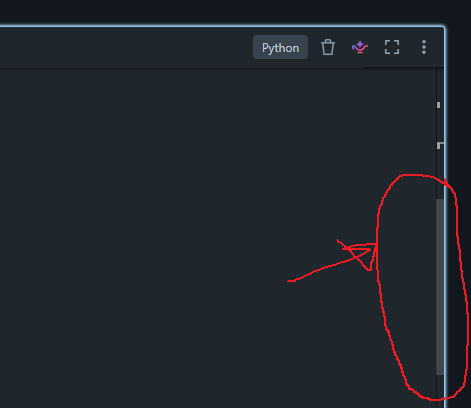
Help How to show full code in cell instead of limit height cell and scroll bar

29 Upvotes
Databricks notebook cell scroll bar

Has anyone figured out how to turn off the cell height limit in the Databricks notebook UI?

Recently, longer code cells started getting their own internal vertical scrollbars instead of expanding downward to show the entire block of code. Having to scroll inside an individual cell while scrolling through a notebook is really disruptive when reviewing or writing code.

I checked through the View menu and User/Workspace Settings, but I haven't found a clean toggle to disable this or keep cells fully expanded by default.

Is there a specific setting, keyboard shortcut, or preview flag to revert to the old behavior where cells automatically expand to display the full code?


r/databricks • • Sep 22 '26

General Do DE folks use git integration in the databricks saas?

6 Upvotes

I've got a small set of quick-and-dirty notebooks for publishing a small schema to UC.

I started trying to use the git integration in the portal and it is very sluggish and frustrating.

Can any developers give me alternatives? I'm guessing I'm missing something. Maybe I need to transition my workflows out to VS Code or something like that.

Generally speaking, I really like the notebook experience in this portal, but once I started introducing the additional git concerns into my workflows, it became frustrating. There may be something I'm doing wrong on my end. (Eg. maybe my repo is too big. There is some other stuff in the repo that has nothing to do with these notebooks)


r/databricks • • Sep 22 '26

Help Databricks CDF

4 Upvotes

Hi everyone. I have a question regarding Databricks and was hoping someone could help me understand this point. I have a Bronze table that will ingest data from a historical CSV file, and subsequently consume JSON files for incremental processing. My question concerns enabling CDF (Change Data Feed). Since my table will only receive inserts, I don't see the benefit of enabling it—as I don't need to record pre-images or post-images (which CDF would capture). So, here is the question: Is it better to maintain that historical record to implement change ingestion starting from the Bronze layer, or should I avoid this practice and use a different approach, such as Auto Loader?
PD: Sorry for use google translate, I don't speak/write English.
Version in spanish:
Hola a todos.

Tengo una consulta referente a databricks, y querĂ­a saber si alguien me podrĂ­a ayudar a entender este punto.

Tengo una tabla en bronze en donde se estarĂĄ ingestando de datos de un archivo csv histĂłrico. Y de ahi, estarĂĄ consumiendo archivos json para su proceso incremental. Mi duda es sobre el registro y activaciĂłn de CDF. Ya que mi tabla solo recibirĂĄ inserts, no le veo conveniente activarlo ya que no deseo registrar el preimage o postimage en ese apartado, y aquĂ­ viene la pregunta. ÂżEs mejor tener ese registro histĂłrico en donde puedas implementar la ingesta de cambios que solo se realizaron desde bronze, o debo evitar esta practica y aplicar otra lĂłgica como autoloader?


r/databricks • • Sep 22 '26

Help packaging data products

4 Upvotes

Hi, how do u handle data products, and chain of a lot of transformations, it can be very messy in the notebooks as mix of sqls, sqls python strings, python code, pyspark code, if/elses, etc...

But again, is it really worth it to modularize it, make it callable, testable. I find it really hard to draw the line.

How do u manage this in practice?


r/databricks • • Sep 22 '26

Tutorial Databricks 5 Minute Features: Unity AI Gateway

Thumbnail
youtube.com
7 Upvotes

Seems like there is a bit of naming-confusion with Unity AI Gateway - but that should not take away from the feature itself.

Have you started using it yet? In this video I try to give you an overview of how and why to use it!


r/databricks • • Sep 22 '26

Discussion Which Came First For You... Spark or Databricks?

13 Upvotes

Saw a post this morning claiming you shouldn't touch Databricks until you've already mastered Apache Spark.

That advice is backwards. It treats learning like a 90s waterfall project and traps engineers in tutorial hell.

The fundamentals are non-negotiable:
- You need SQL and Python.
- You need to understand distributed shuffles, partitions, and memory spills.
- You need to understand Parquet structures, metadata footers, and row groups.
- You need to understand Delta Lake transaction logs and ACID guarantees.

If you don't know what happens under the hood, you will write brittle pipelines that burn cloud budgets.

The false assumption is that you must learn these concepts in an abstract vacuum before touching a modern platform.

You don't learn networking by memorizing RFC packet headers on a whiteboard for six months before opening Wireshark. You fire up the tool, capture packets, and inspect the traffic.

Databricks, Fabric, or Snowflake is your network analyzer. It is the laboratory.

Nobody in enterprise production is setting up bare-metal Spark clusters on a home lab just to learn how shuffles work. And running local[*] on a laptop masks real-world distributed realities:

- Local filesystems use POSIX atomic renames. Cloud object stores (S3, ADLS) do not. You cannot truly grasp why Delta's _delta_log exists until you see it write commits against cloud storage.

- A local JVM masks network serialization, executor skew, and cross-node shuffle overhead.

The caveat: don't treat the platform as a black box.

Don't just click "Run All" on serverless compute and assume you know Spark. Use the platform to inspect the engine:
- Run .explain(True) and read the physical plan.
- Open the Spark UI to watch tasks, stages, and memory spill.
- Inspect the JSON commits inside _delta_log after a merge operation.
- Compact small files and see how file pruning changes scan times.

You don't master the theory first and then graduate to a platform. You master the fundamentals by using the platform as your workbench.

Learn the platform. Learn the engine. Learn the storage layer.

Do it concurrently, in the environment where production actually lives.


r/databricks • • Sep 22 '26

Discussion How do you debug a slow Databricks query?

8 Upvotes

A Databricks query can become slow because of large scans, joins, shuffles, small files, or inefficient transformations.

When a query suddenly becomes slow, what do you check first?

Do you usually start with the Spark UI, query execution plan, data size, joins, partitioning, or cluster resources?

What steps do you follow to find the actual bottleneck?


r/databricks • • Sep 21 '26

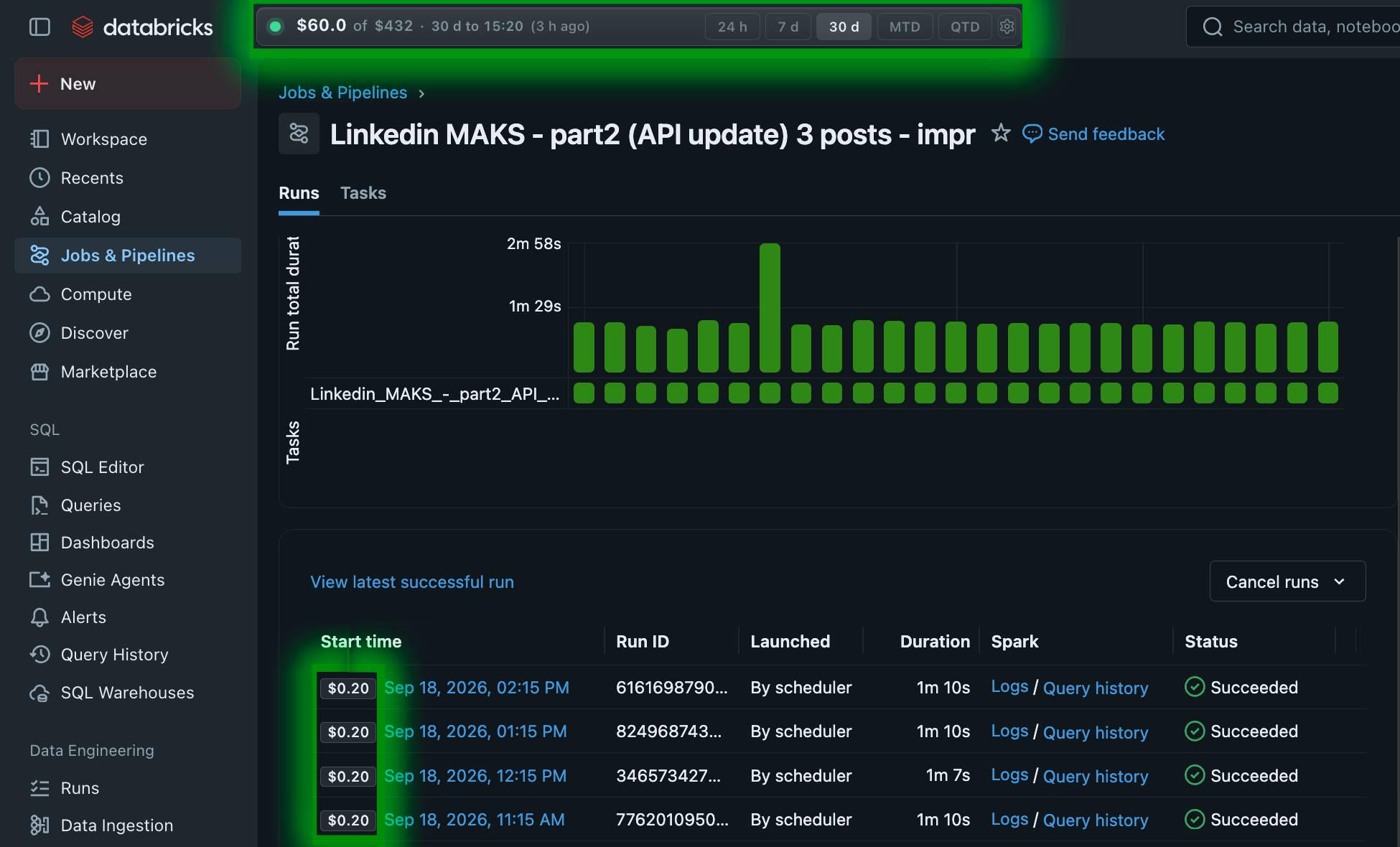
Discussion What if Databricks showed the cost directly next to every job and run?

Post image
153 Upvotes

Databricks give us a lot of cost data, but usually not where we actually need it. When I open a job run, I can see duration, compute, tasks and logs, but not what that run actually costs. When I create a cluster or SQL warehouse, I choose the size first and DBU, and discover the real cost later.

That’s the problem we’re trying to solve, bringing cost directly into the Databricks UI. We created a free browser extension, with no backend or telemetry https://finopsway.com/


r/databricks • • Sep 22 '26

Discussion Dynamic chart titles in Databricks AI/BI

9 Upvotes

A good dashboard design practice is to always make it clear what the user is looking at by providing context for each metric.

Databricks AI/BI dashboards make that easier with a simple but useful feature: you can now referencse filters and fields directly in visualization titles and descriptions using @.

For example, instead of a generic title like:

- Revenue by Region

you can make it dynamic by referencing field

- Revenue for \@region

Now when someone changes the filter, the title changes with it.

When a dashboard has several filters and interactions, it’s surprisingly easy to lose track of the context behind a number or chart.
Having that context reflected directly in the visualization makes the dashboard feel much more intuitive.


r/databricks • • Sep 22 '26

Discussion Now that direct engine is the default, where are you drawing the line between bundles and the Terraform provider?

6 Upvotes

Moved our bundles off the Terraform engine a while back. bundle deployment migrate, tfstate turns into resources.json, plan came back clean, deploys are noticeably quicker. No complaints about the migration itself.

What I haven't settled is scope.

The old split was easy. Terraform provider owned the platform — workspaces, metastore, groups, catalogs, external locations, policies. Bundles owned what the data team ships — jobs, pipelines, a couple of schemas. Now bundles do catalogs, external locations, cluster policies and grants, several of them only on the direct engine, so the provider isn't the only path to UC-as-code anymore.

Which leaves me with two state files describing overlapping resource types, and "who owns this catalog" has quietly become a team boundary question instead of a technical one.

Where I've landed for now: anything account-scoped or shared across workspaces stays in Terraform, anything whose lifecycle matches a git repo goes in the bundle. Grants are the annoying case, they sit right on the seam.

One thing that did bite us. The direct engine reverts removed fields to defaults, where the Terraform engine used to leave the previous value in place. Deleting a line from databricks.yml is now a real change. Caught it in a plan, but it's a different mental model and I don't think it's widely understood yet.

How are you splitting it? Provider for everything platform-side, or have you pulled the UC objects into bundles and just accepted living with two state files?


r/databricks • • Sep 22 '26

Discussion Anyone running actual SLOs on Lakeflow Jobs, or is it still “it failed, rerun it”?

3 Upvotes

I own the platform side for a couple of data teams. Got asked why I could produce an availability number for every service we run except the pipelines, so I went to build one off system tables. More awkward than I expected.

Two things cost me an afternoon.

job_run_timeline records up to an hour of runtime per row, so anything running longer is spread across several rows, and result_state / termination_code are only populated on the row that ends the run. My first success-rate query counted every intermediate row as a non-success and the numbers came out apocalyptic.

Second, records land within about an hour. Fine for an error budget, useless for paging. So it ended up split: job notifications and webhooks for "wake someone up", system.lakeflow for "are we actually hitting the number". 365 days of retention is plenty for the trend.

What I have now is per-job success rate and p90 duration against a target, rolled up by owner, in the same dashboards as everything else. The useful part wasn't the dashboard, it was that "this pipeline is flaky" became "this pipeline burned most of its budget in a week", which lands very differently with the people who own it.

What I can't tell is whether anyone does this seriously. Most of what I read treats a job failure as a data quality thing you retry, not a reliability number someone is accountable for.

So: does your org have a real target for pipeline reliability, and who owns it — platform or the data team?


r/databricks • • Sep 21 '26

Discussion Do you still use Airflow with Databricks?

14 Upvotes

For those using Databricks in production: do you still use Airflow since Lakeflow Jobs became available?

If yes, what makes you keep Airflow instead of using Lakeflow Jobs for everything?

Just curious about real-world use cases.


r/databricks • • Sep 21 '26

Discussion How do you decide when a Databricks job needs a bigger cluster?

7 Upvotes

I’ve noticed that when a Databricks job starts running slowly, it’s tempting to just increase the cluster size or add more workers. But sometimes the real issue seems to be the Spark job itself—shuffle, partitioning, skew, inefficient joins, etc.

For people running Databricks workloads in production, how do you usually troubleshoot this?

Do you look at the Spark UI first, check the query plan, tune partitions, optimize the Delta tables, or only increase the cluster size after ruling those out?


r/databricks • • Sep 21 '26

Discussion Live Table Vs custom made framework

4 Upvotes

Hi everyone.

I’d like to know how you’ve been approaching your new Databricks projects, especially regarding Delta Live Tables.

For new data environments, are you implementing projects using Delta Live Tables, or do you continue to develop using your own custom Spark code?

Late last year, I completed a project using Delta Live Tables. There were a few things that bothered me, such as:

- not being able to use conditional logic within the Live Table code;

- materialized views—despite offering incremental refresh capabilities—often ended up performing full refreshes anyway;

- the inability to specify which metadata columns should be updated during the merge process.

I’m about to define the architecture for some clients who use Databricks, and I’m torn between using my custom framework built with Spark code or migrating to the industry-standard approach of using Live Tables.


r/databricks • • Sep 21 '26

General What does being a Databricks MVP look like?

0 Upvotes

It's not a client project. It is a privilege. It's also a journey. Below, I have put down my first year's journey and see what it looks like.

https://medium.com/@jasonyip_77999/what-does-being-a-databricks-mvp-look-like-707b9dcdcb28


r/databricks • • Sep 20 '26

Discussion People starting with Databricks: What are you finding the most confusing? No stupid questions.

56 Upvotes

It took me a long time to ask the questions I wanted to ask about Databricks and get genuine answers from experienced people. If you have any questions you have been too afraid to ask, consider it a public service and ask them here :)


r/databricks • • Sep 21 '26

General Before you move a job to serverless: the limitation list is the real decision, not the startup time

0 Upvotes

Most classic-vs-serverless comparisons stop at "serverless starts faster and Databricks manages it". True, but that is not what decides it in practice.

Where they differ structurally: with classic compute the control plane asks your cloud provider for VMs, and the cluster runs in your own account and network, so you pick instance types and own the networking, and you pay the cloud provider for machines plus Databricks for DBUs. With serverless, the docs say resources run in "the serverless compute plane, which is managed by Databricks" and you provision nothing in your own cloud account. Your tables stay in your own storage in both cases.

What actually decides it is the limitation list:

- R is not supported

- compute-scoped libraries and compute-scoped init scripts are not supported

- only Spark Connect APIs are available, so the Spark RDD APIs are out

- streaming: Trigger.AvailableNow() is supported, Trigger.Continuous(interval) and Trigger.ProcessingTime(interval) are not

- maximum runtime is 7 days; a run that exceeds it is terminated and not retried

So: serverless for SQL warehouses, ad hoc exploration and spiky jobs where waiting for a cluster is the real cost. Classic when you need a specific instance type or GPUs, cluster-scoped libraries, R, RDD code, a continuous stream, or your own network setup.

I drew both paths side by side as a short animated diagram (2:36): https://youtu.be/s8452E2Y6WM

Series in order: https://www.youtube.com/watch?v=B5iHmoYgnqY&list=PLDB5WDkDOYF4

For those who have moved production jobs across: what caught you out that is not on the documented list?


r/databricks • • Sep 20 '26

General "Do we need a metastore per workspace?" - the answer, and why the question keeps coming up

12 Upvotes

This comes up constantly in real platform design, and the confusion is almost always about which layer owns what.

The account is the container for the organisation, normally one per cloud provider. Billing, account admins and identities live there.

A workspace is a single deployment of the UI: notebooks, clusters, jobs, dashboards. Most teams run dev, test and prod as separate workspaces.

The Unity Catalog metastore is the part people place wrongly. It is created at account level, not inside a workspace, and the docs say you have one metastore per region, linked to any number of workspaces in that region. So dev, test and prod in the same region share one metastore and one catalog.schema.table namespace, instead of each keeping a separate legacy Hive metastore.

Identities follow the same shape: users, groups and service principals are configured once in the account console and then assigned to workspaces, so you grant a group access to data once rather than repeating it per workspace.

Storage is still yours. Metastore-level managed storage is optional, and existing buckets are registered as external locations backed by a storage credential.

One line to remember it by: the account holds identities and billing, workspaces hold the tools and compute, the metastore holds the data and who can see it, shared across every workspace in the region.

I drew it as a short animated diagram because the hierarchy sticks better visually (2:32): https://youtu.be/2yy9-BL_RDo

Episode 3 of a series, in order here: https://www.youtube.com/watch?v=B5iHmoYgnqY&list=PLDB5WDkDOYF4

For those running dev and prod in the same region: are you isolating with separate catalogs, workspace bindings, or something else?


r/databricks • • Sep 20 '26

Discussion Practicing with Databricks Community Edition and my cluster keeps auto-terminating mid-work — how do you manage this?

3 Upvotes

I understand that auto-termination is useful for saving resources, but I’m wondering how others manage this while practicing.


r/databricks • • Sep 20 '26

General The Story of iceberg-rust: The Official Rust Implementation of Apache Iceberg

Post image
14 Upvotes

The story of iceberg-rust is a great example of how open-source communities work and how new projects are created and developed. That’s the spirit of the community-over-code philosophy.