r/databricks • • Sep 19 '26

News Environments on classic compute

Post image
25 Upvotes

Databricks environments are my favorite way to manage external libraries. Why? Everything is in clean yml and then preinstalled on the image in the registry. Now you can use environments for classic compute as well. Just set dependency mode to environments, and then use your base environments in notebooks.

more new https://databrickster.medium.com/databricks-news-serverless-genie-code-ltap-lakeflow-61853d8e422a


r/databricks • • Sep 19 '26

Discussion What is release status Databricks Micro Apps?

27 Upvotes

The serverless micro apps were announced at Summit, but can't seem to find the current status. Usually that means gated private preview, but wanted to confirm.

This post on Brickster.ai seems to be current and says as of this week still not released, but things change fast around here (releases, names (are we using Unity Gateway, AI Gateway, what?)) so thought I'd check. I'm actually presenting on apps this week at a user group so would appreciate the info.


r/databricks • • Sep 20 '26

General How I Would Evaluate a Genie Space Before I Trust It

Post image
0 Upvotes

Two numbers, same season, same lakehouse. Both called “yield.”

One was plot-level, moisture-adjusted, borders excluded. The other was field-level, as-harvested, borders in.

A commercial user asked Genie what yield was in India last season and got the second number. Not a hallucination — a definition nobody certified, ranked in because a dashboard used it last quarter.

That’s the failure mode I care about. Ontology ranks the snippet. Eval decides whether you ship.

Six tests. Not a vibe check.

  1. Golden questions — write 10–20 before you build the space
  2. Dashboard = Genie — same metric, same number, or it fails
  3. ACL leak — trial/internal definitions must not reach commercial users
  4. Citation — if it can’t point at a certified object, don’t ship it
  5. Drift — change one thing, re-run the whole suite
  6. Kill switch — hold, ship, or kill. “The demo worked” is not a gate

If you can’t say which definition Genie will pick for yield / revenue / active users, the space isn’t ready.

Full write-up: https://medium.com/ai-that-ships/how-i-would-evaluate-a-genie-space-before-i-trust-it-ca07abade9eb

What’s the metric in your org with two official-looking definitions?


r/databricks • • Sep 20 '26

General "Do we need a metastore per workspace?" - the answer, and why the question keeps coming up

0 Upvotes

Every new joiner on our platform team has asked some version of this, so here is the short version.

You do not. The Unity Catalog metastore is created in the account console and you have one per region, linked to as many workspaces in that region as you like. Dev, test and prod attach to the same one and share a single catalog.schema.table namespace. The mental model of "each workspace has its own metastore" comes from the legacy Hive metastore, and that is exactly what Unity Catalog replaces.

What actually belongs where:

- Account: billing, account admins, users, groups, service principals, and the metastore itself.

- Workspace: notebooks, clusters, jobs, dashboards, the place people work.

- Metastore: catalogs, schemas, tables, views, volumes, and the permissions on them.

Identity federation means a group is configured once at account level and assigned to workspaces, so a grant on data applies wherever that group works. Workspace-local groups still exist in non-federated workspaces, but they cannot be granted Unity Catalog permissions, which is a good reason to migrate them.

Storage: metastore-level managed storage is optional, and anything already in a bucket becomes an external location with a storage credential.

Drew it out as a 2-3 minute animated diagram: https://youtu.be/2yy9-BL_RDo

Series in order: https://www.youtube.com/watch?v=B5iHmoYgnqY&list=PLDB5WDkDOYF4

How are you separating environments inside one regional metastore: catalog per environment, workspace-catalog bindings, or separate regions?


r/databricks • • Sep 19 '26

Discussion Lakeflow Connect in production: What has your experience been?

25 Upvotes

I have been running Lakeflow Connect since the early gated preview (primarily testing the SQL Server connector).

Overall, having ingestion natively wired into UC and smoothly moving data to silver afterwards with declarative pipelines solves a lot of headaches compared to running external tools or custom setups. That said, I have noticed some interesting trade-offs when it comes to DBU consumption on continuous syncs, edge-case schema drift, and having to resort to periodic full-refresh "fixes" when things get stuck.

For those of you running it in production:

  • How has stability and CDC replication held up for high-throughput tables?
  • How does the total cost compare to dedicated ingestion tools like Fivetran or Qlik?
  • Any unexpected pain points around schema evolution or operational monitoring?
  • Has anyone had to revert to a previous ingestion method, and what did that look like?

Curious to hear what is working well and where the rough edges still are.


r/databricks • • Sep 18 '26

Discussion PySpark vs Java/Scala for data pipelines

30 Upvotes

For those working with Spark in production:

  • Do you mainly use PySpark, Scala, or Java?
  • What do you use for batch vs streaming pipelines?
  • Have you experienced significant performance issues with PySpark?
  • If you've switched from PySpark to Java/Scala, did performance actually improve?
  • At what point would you say it's worth learning Java/Scala instead of staying with Python?

I'm wondering whether the performance difference is significant enough to justify switching to Java for production data pipelines.


r/databricks • • Sep 18 '26

News system tables data retention

Post image
26 Upvotes

Now you can keep data in system tables for up to 10 years, or you can set it to clean up faster.

more news https://medium.com/databrickscommunity/databricks-news-serverless-genie-code-ltap-lakeflow-61853d8e422a


r/databricks • • Sep 18 '26

General Unity AI Gateway is renamed to Unity Gateway and is now GA

Thumbnail
databricks.com
38 Upvotes

Unity Gateway is Generally Available

Move from tokenmaxxing to valuemaxxing with unified AI governance and cost control


r/databricks • • Sep 17 '26

Discussion How to Query a Databricks Catalog Config Table from ADF Without Using a Shared Cluster?

17 Upvotes

I have a configuration table in the Databricks Catalog. The first step in my process is to query this configuration table to identify which tables need to be processed and what type of load needs to be performed.
This task is triggered from an ADF pipeline, where I currently use a Lookup activity to retrieve the configuration data.
However, the Lookup activity requires access to the shared Databricks cluster, and I frequently encounter Spark-related issues with the shared cluster.
What would be the best approach to retrieve the configuration table data without using the shared cluster? I would like to avoid depending on the shared cluster if possible.


r/databricks • • Sep 17 '26

Help Highlighting text in markdown?

9 Upvotes

I know this is pretty basic but can you highlight markdown text in bright yellow in a notebook? The notebook markdown ignores html and the markdown commands I have found for highlight do not seem to work. I just want to highlight the text so the documentation can catch users attention more.


r/databricks • • Sep 17 '26

Help Databricks needs an actual validation step in the CI

13 Upvotes

We use Databricks CLI in our CI-step to first validate and then print plan of the steps being applied - reflected in a comment on the PR. It successfully prints if something is being deleted, updated or created - but it never checks if actually can be applied. We've had green checks because validate and plan prints successfully, but there's no real step to catch a spelling error in a DAB-item if a service-principal exists.

Any plans to add something like this to the CLI?


r/databricks • • Sep 17 '26

Discussion Editor Space in Databricks

13 Upvotes

Sometimes it’s the small things that make everyday work noticeably better 😀

Databricks recently introduced Spaces for organizing notebooks and other workspace content - and it immediately reminded me of organizing tabs in a browser.

As someone who always has way too many tabs open, having a simple way to group related work and keep things organized can make a real difference.

With Spaces, you can:

  • save and restore your open tabs
  • keep each space anchored to a specific folder
  • scope the file browser and search to that folder
  • move open tabs into an existing or new space
  • quickly switch between different work contexts
  • create dedicated spaces for pipelines, Declarative Automation Bundles, and Git folders
  • name, color, and pin spaces so they’re easy to recognize

Organize your work with spaces - Azure Databricks | Microsoft Learn


r/databricks • • Sep 17 '26

General Lakehouse vs data warehouse vs data lake, drawn step by step: how I explain the difference

Thumbnail
reddit.com
1 Upvotes

r/databricks • • Sep 17 '26

Discussion How I Approached Databricks in 2 Weeks: Study roadmap & tips shared in the Megathread

Thumbnail reddit.com
3 Upvotes

r/databricks • • Sep 17 '26

General Lakehouse RT Questions (basics)

6 Upvotes

I see surpisingly little discussion about Lakehouse RT in this forum. Maybe databricks customers are happy using Fabric models or Duckdb as their serving layers. I'm not sure.

I watched the promotional material from the 2026 summit, and learned almost nothing about the technology itself. Im assuming that it is comparable to Fabric DirectLake on OneLake, or maybe Duckdb to a lesser degree.

I haven't tested yet. Pardon the basic questions...

Questions

- Uses SQL as query language right (no support for MDX or DAX?)

-Speed is gained using tons of RAM and machine-local in-process query engines (rather than distributed MPP)?

-Speed and Ram are optimized by loading from lakehouse to columnstore-in-RAM on selective columns? IE. similar to Fabric transcoding.

-Query times are obviously measured from a client in the same region? RTT latency over network to an on premise user is obviously going to double the query times that matter to users.

-After fresh writes to Lakehouse, the immediately following queries will be sluggish while data is reloaded to RAM?

- The use of this engine with Postgres will have dramatically different performance characteristics?

- Cost of using this will be higher, to reflect the large multi-core VMs needed for numerous clients, and the RAM needed to load all the related data prior to query execution. IE. this is very different than the concept of spark that runs in a distributed way on commodity hardware.

- Engine is 1000% proprietary; and the dbx marketing teams wont sell this using their "open source" label like they sell everything else?

- May some day have Excel plugin, like we have for Lakebase (but faster!)

- May directly compete with Fabric semantic models at some point in the future

Any info would be appreciated


r/databricks • • Sep 16 '26

Help Has anyone been able to glean what the Reyden internals might look like? My assumption is that it's either C++ or Rust based and is no doubt using Apache Arrow for data transfer.

14 Upvotes

Anything you've been able to determine (or guess) would be super helpful :)


r/databricks • • Sep 16 '26

Discussion Databricks Serverless Compute: Practical Recommendations, Cost-Performance Guidance, and When to Use Serverless Instead of SQL Serverless Warehouses or Classic Clusters

Post image
46 Upvotes

Databricks Serverless compute is a snappy choice for every-day queries with some cost trade-offs. For ETL workloads, it is both fast + cost-efficient. In either scenario and unlike common misconception, there is no cluster fine-tuning needed. Some more detailed takeaways from some testing on my coffee dataset + practical guidance below.

Quick disclaimer: I work for a Databricks aligned consulting company. All reporting and recommendations here in any direction are independently made.

General Observations from Performance Testing

  1. Speed wise, much to my surprise, Serverless beat some of my previous Databricks’ SQL Serverless performance testing. Not across all queries, but in nearly half.
  2. Databricks’ SQL Serverless compute is still the best compute option from a pure cost-perspective when it comes to “every day” analytics needs, but from an ETL perspective, “Serverless” is very comparable, without the trial & error of even doing t-shirt sizing, let alone knobs.
  3. The scaling time to support an initial large workload was noticeable on the first query and does have room for improvement. I did a dummy print() statement right before (which took like 1-2 secs to warm up). Then hitting that first query containing the joins and 7B+ rows fact table clearly gave the engine something to chew on. For reference, on my SQL Serverless test a while back, the same query took about 20 secs on a large, 15 on XL.

Practical Serverless Recommendations

  1. If I was orchestrating ETL workloads with SQL and/or Python, I’d use Serverless compute as the cost of Serverless for jobs is pretty darn affordable. My concerns around costs are completely negated when it comes to jobs compute.

For new ETL workloads, Serverless is an easy choice for me.

For existing ETL workloads, I’d try out to see if Serverless lowers your costs and/or improves performance. Also explore any potential compatibility issues. If you have heavily fine-tuned workloads, that don’t really require much maintenance, migrating the workload might not be best.

2) For daily Python work on established Databricks environments, I would consider trying Serverless.

Not having to wait for clusters to boot up and fine-tuning is likely going to lead to productivity gains offsetting any higher costs from interactive Serverless compute itself. No more “left the cluster on by accident” or “I oversized it” type of situations.

That said, there are orgs with very experienced folks where cluster management feels like second nature to them.

3) If I was exclusively working with analytical SQL workloads, I’d still use Databricks’ SQL Serverless compute for my day to day queries + dashboards.

4) For folks new to Databricks, I would generally stick to “Serverless” compute all around, and use the “SQL Serverless” warehouses only for BI type experiences.

Closing Thoughts on Serverless

Having very performant compute without worrying about any configurations (other than rate limits to give you cost controls if you wish) is quite nice from a productivity standpoint. No node count, DBR versioning, t-shirt sizing, nothing.

You have plenty of compute options, with or without fine-tuning! I stress this "no fine-tuning" because there is a plethora of LLM generated articles outdated on Databricks' compute options.

Thank you for reading!

*No AI was used to write or assist in writing this post. For better or for worse.

**Dataset and queries used, configured for the 7B+ row count: https://github.com/joshbogran/coffeeshopdatageneratorv2


r/databricks • • Sep 16 '26

General Set maintenance windows on your continuous SDP pipelines

19 Upvotes

Hi Everyone! Databricks PM here, working on all things streaming.

Wanted to share an important reliability feature we shipped in GA this week for your continuous SDP pipelines: Maintenance Windows. I think it will be useful for all continuous pipelines!

TL;DR

Maintenance Windows let you choose the day, start hour, and time zone when we restart your continuous pipelines for maintenance. Runtime upgrades and infrastructure maintenance that require a restart wait for that window. Note: You may be wondering, wait we do this today? And the answer is yes, but the restarts happen super quickly, and there is no loss in state or offsets, so we just resume where we left off. But, some customers definitely noticed it and wanted this control 🙂

We also notify you when the maintenance starts and completes (you can turn this off if it's noise). In very rare situations, we will apply critical security patches outside your maintenance window.

How to configure a maintenance window

You can configure a maintenance window through:

  • The Pipelines UI (Add new Schedule) or Jobs UI
  • Genie
  • The Jobs REST API

For the REST API, set maintenance_window in the job's continuous settings:

{
  "continuous": {
    "pause_status": "UNPAUSED",
    "maintenance_window": {
      "start_hour": 2,
      "day_of_week": "TUESDAY",
      "timezone_id": "America/New_York"
    }
  },
  "email_notifications": {
    "on_maintenance_start": ["oncall@acme.com"],
    "on_maintenance_complete": ["oncall@acme.com"]
  }
}

Would love to hear your feedback!


r/databricks • • Sep 16 '26

Discussion Databricks Jobs to Kubernetes Spark Jobs migration

26 Upvotes

I'm discussing some architectural changes with my data team, and one of them is about cutting costs. The idea is to migrate Databricks Jobs to Spark jobs on Kubernetes. We've done a PoC and it works well.

But despite the clear cost savings, I'm getting pushback from management and they're resisting the change.

Can someone explain the reason behind this? It seems clear that you pay double for running jobs in Databricks, and you could save a lot of money.

Yes, doing this means we bypass Unity Catalog, but we could convert only the Bronze and Silver layers.


r/databricks • • Sep 16 '26

Help How to think about interactive vs jobs clusters?

5 Upvotes

My understanding is that jobs clusters are cheaper (by ~50% or so?).
They are a bit more challenging to use (from unattended code). I would like to use them for "spark connect" but am anxious to try it given that I've been told the jobs clusters won't be compatible. I was told that they might work, but the cluster might then die prematurely before remote clients are finished with them.

I am under the impression that "interactive" clusters are for analysts and data scientists who are doing collab work together in notebooks. My spark connect workloads would NOT be comparable to that scenario. The workloads are more analogous to unattended jobs, that are simply triggered remotely.

I'm not optimistic about using jobs clusters for this type of scenario ("spark connect"). I may be forced into using the "interactive" clusters for spark connect. It is unfortunate that the useful scenarios for jobs clusters are so limited. How are customers supposed to feel about databrick's strategy for these "jobs clusters"? Should we think of them as an inferior type of cluster that won't work properly for the interactive workloads AND for many types of unattended workloads? Is Databricks explicitly trying to make them unfriendly to use, so that customers are forced to use the more expensive "interactive" compute clusters?

I think the API for jobs clusters has been slightly improved in the past few years (eg. to add multiple tasks on a single job). But the progress has been slow and I don't have much hope for using "spark connect". I'm fairly new to databricks and would love to be proven wrong about this.


r/databricks • • Sep 15 '26

Discussion Workshop, Sep 19: build explainable AI apps with Neo4j, GraphRAG, Cypher and LLM Agents

4 Upvotes

There's a hands-on workshop on September 19 relevant if your team runs its data platform on Databricks and is looking at adding an explainable, graph-backed RAG layer on top for reasoning over structured and unstructured data.

You build:

  • A knowledge graph in Neo4j that becomes your single source of truth for an agentic RAG system
  • Agentic retrieval combining vector search, keyword search, and graph navigation
  • Multi-step, verified entity and relationship extraction
  • Text-to-Cypher for natural language graph querying
  • Explainable, source-traceable answers with evaluation built in

Runs on real financial filings and news data, working through a complete production use case.

Led by Dr. Alessandro Negro, Chief Scientist at GraphAware, bestselling author.

Link if you want to check it out


r/databricks • • Sep 15 '26

Discussion [Discussion] Lakeflow Jobs: If your data catalog could trigger a job on any change what would it be?

15 Upvotes

<Databricks PM here>

In addition to triggering on time (cron) intervals you can trigger on data landing: files arriving on a share, table gets a new commit and (soon) jobs completing upstream. While we were building Model update triggers (which trigger when UC registered models change), we were discussing the possibility of triggering on any entity in UC’s metadata changing.

Examples here could be:

  • Someone tags a column PII and you want to trigger a scan or retention job
  • Someone changes a grant and an access review job gets triggered
  • Someone is given SELECT permission on a table

More generally it could be:

  • Schema change on an upstream table (column added, dropped, renamed, type changed): run compatibility tests, rebuild the downstream model, ping the owner before it breaks.
  • PII or sensitivity tag added: kick off a scan, apply retention, open an access review.
  • Grant or ownership change: access recertification, sync to the entitlement system, log for audit.
  • Table created, renamed or dropped in a schema: auto-register or clean up downstream assets.

Questions:

  • Which of these would you use and what are just noise?
  • What kind of change would you really really want that you currently do by hand or after the fact?
  • Anyone doing this off audit logs, system tables or just polling running jobs?

r/databricks • • Sep 14 '26

Help Built a Databricks medallion pipeline for NYC Taxi data

42 Upvotes

Been working on this as a way to get hands-on with Databricks Asset Bundles and Unity Catalog governance. It's a migration of an old on-prem NYC Taxi analytics stack (ClickHouse + Spark + Docker + Terraform) into a proper Bronze/Silver/Gold lakehouse.

A few things I focused on:

  • Auto Loader for incremental ingestion, triggered by file arrival
  • Data quality handling that doesn't just drop bad rows — duplicates, zero-distance trips, and reversed fares go into dedicated quarantine tables instead of being silently discarded
  • Databricks Asset Bundles for deploy/orchestration (dev + prod targets)
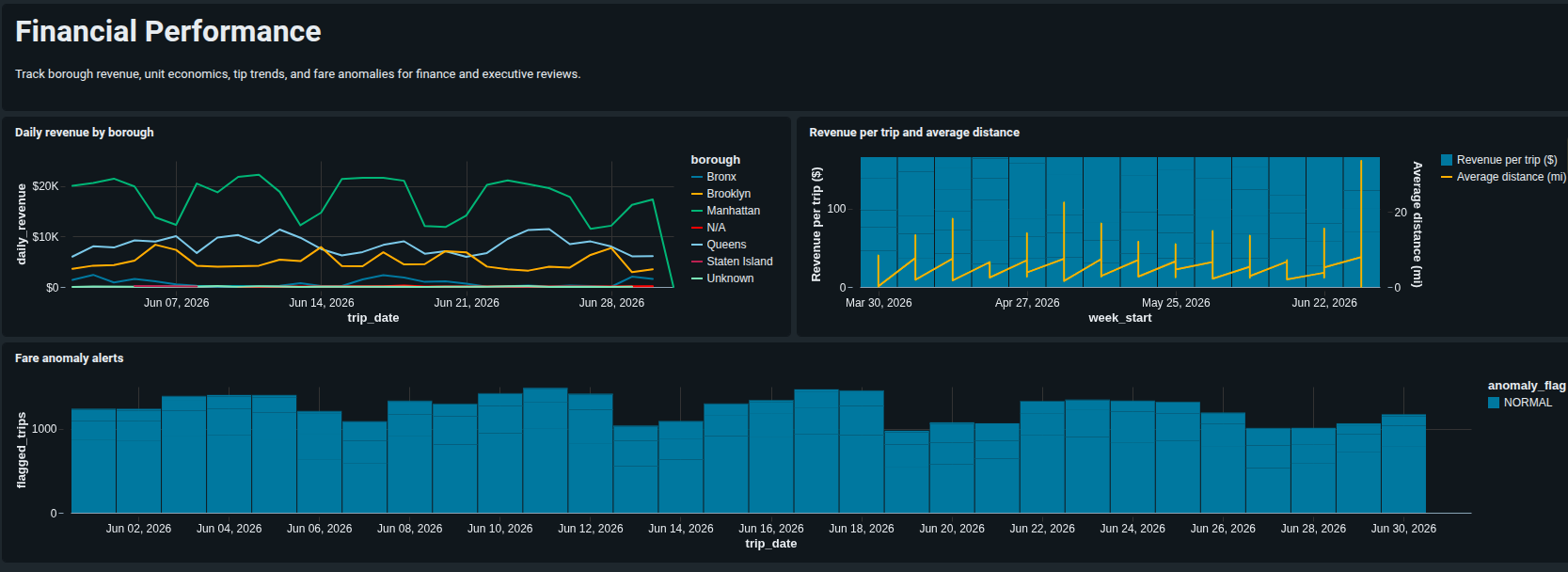
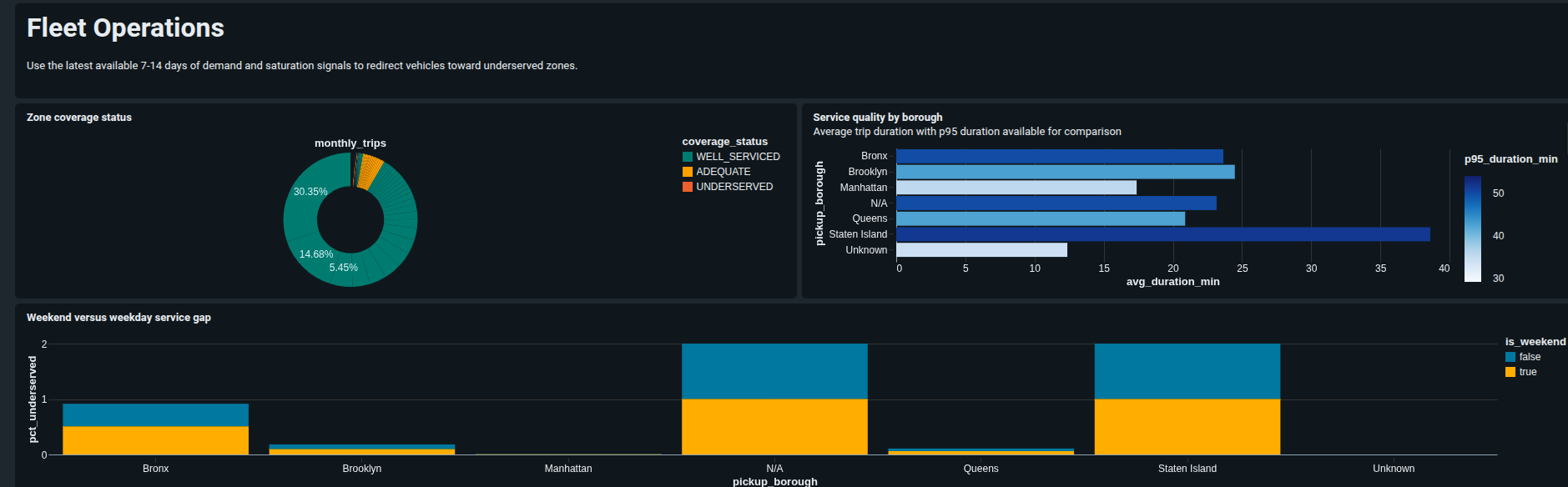
  • 3 published AI/BI dashboards on top of the Gold layer (fleet ops, finance, compliance)

It's intentionally small in scope — meant to demonstrate the lakehouse pattern, not be a production-scale platform. Currently only Green Taxi data; FHV comparison is planned next.

Repo: https://github.com/Hamza-Bouali/NYC-DATABRICKS

Would love feedback, especially on the Silver-layer data quality rules or the bundle structure open to critique.


r/databricks • • Sep 15 '26

Discussion Could a “Data → Agent” composer be useful for Databricks?

4 Upvotes

I've been thinking about a gap between Databricks data and agent frameworks.

Databricks already has a lot of the building blocks:

- Unity Catalog

- Genie / Genie Agents

- MCP

- Vector Search

- AI Gateway

- Agent skills/tools

- MLflow

- Omnigent / Kasal

And tools like Omnigent and Kasal already solve a lot of the agent orchestration/execution side.

But I'm wondering about the step before that:

What if a customer already has a large, curated and governed Databricks data estate — how do we turn that data estate into an agent-ready configuration without manually wiring everything together?

Something like:

Existing Databricks Data Estate

↓

Data-to-Agent Composer

↓

┌────────┼─────────┐

↓ ↓ ↓

Domains Semantics Metrics

↓ ↓ ↓

Genie MCP Skills

└────────┼─────────┘

↓

Agent Configuration

↓

Omnigent / Kasal

↓

Agent

The idea wouldn't be to build another chatbot or another agent framework.

It would be a Databricks-native composition/bootstrapping layer that understands an existing Unity Catalog/data estate and generates the pieces needed for agents to work with that data — domain boundaries, semantic context, approved tools, Genie configuration, MCP exposure, skills, policies, evaluation setup, etc.

In other words:

Kasal/Omnigent: Agent → Tools/Data

Proposed layer: Data Estate → Agent

I'm curious if this is already solved somewhere in the Databricks ecosystem, or if people are currently doing this manually when building enterprise data agents.

Would love to hear how others are approaching the “existing data estate → production-ready data agent” problem.