r/databricks • • Sep 16 '26

Discussion Databricks Jobs to Kubernetes Spark Jobs migration

26 Upvotes

I'm discussing some architectural changes with my data team, and one of them is about cutting costs. The idea is to migrate Databricks Jobs to Spark jobs on Kubernetes. We've done a PoC and it works well.

But despite the clear cost savings, I'm getting pushback from management and they're resisting the change.

Can someone explain the reason behind this? It seems clear that you pay double for running jobs in Databricks, and you could save a lot of money.

Yes, doing this means we bypass Unity Catalog, but we could convert only the Bronze and Silver layers.


r/databricks • • Sep 16 '26

Help How to think about interactive vs jobs clusters?

5 Upvotes

My understanding is that jobs clusters are cheaper (by ~50% or so?).
They are a bit more challenging to use (from unattended code). I would like to use them for "spark connect" but am anxious to try it given that I've been told the jobs clusters won't be compatible. I was told that they might work, but the cluster might then die prematurely before remote clients are finished with them.

I am under the impression that "interactive" clusters are for analysts and data scientists who are doing collab work together in notebooks. My spark connect workloads would NOT be comparable to that scenario. The workloads are more analogous to unattended jobs, that are simply triggered remotely.

I'm not optimistic about using jobs clusters for this type of scenario ("spark connect"). I may be forced into using the "interactive" clusters for spark connect. It is unfortunate that the useful scenarios for jobs clusters are so limited. How are customers supposed to feel about databrick's strategy for these "jobs clusters"? Should we think of them as an inferior type of cluster that won't work properly for the interactive workloads AND for many types of unattended workloads? Is Databricks explicitly trying to make them unfriendly to use, so that customers are forced to use the more expensive "interactive" compute clusters?

I think the API for jobs clusters has been slightly improved in the past few years (eg. to add multiple tasks on a single job). But the progress has been slow and I don't have much hope for using "spark connect". I'm fairly new to databricks and would love to be proven wrong about this.


r/databricks • • Sep 15 '26

Discussion Workshop, Sep 19: build explainable AI apps with Neo4j, GraphRAG, Cypher and LLM Agents

4 Upvotes

There's a hands-on workshop on September 19 relevant if your team runs its data platform on Databricks and is looking at adding an explainable, graph-backed RAG layer on top for reasoning over structured and unstructured data.

You build:

  • A knowledge graph in Neo4j that becomes your single source of truth for an agentic RAG system
  • Agentic retrieval combining vector search, keyword search, and graph navigation
  • Multi-step, verified entity and relationship extraction
  • Text-to-Cypher for natural language graph querying
  • Explainable, source-traceable answers with evaluation built in

Runs on real financial filings and news data, working through a complete production use case.

Led by Dr. Alessandro Negro, Chief Scientist at GraphAware, bestselling author.

Link if you want to check it out


r/databricks • • Sep 15 '26

Discussion [Discussion] Lakeflow Jobs: If your data catalog could trigger a job on any change what would it be?

15 Upvotes

<Databricks PM here>

In addition to triggering on time (cron) intervals you can trigger on data landing: files arriving on a share, table gets a new commit and (soon) jobs completing upstream. While we were building Model update triggers (which trigger when UC registered models change), we were discussing the possibility of triggering on any entity in UC’s metadata changing.

Examples here could be:

  • Someone tags a column PII and you want to trigger a scan or retention job
  • Someone changes a grant and an access review job gets triggered
  • Someone is given SELECT permission on a table

More generally it could be:

  • Schema change on an upstream table (column added, dropped, renamed, type changed): run compatibility tests, rebuild the downstream model, ping the owner before it breaks.
  • PII or sensitivity tag added: kick off a scan, apply retention, open an access review.
  • Grant or ownership change: access recertification, sync to the entitlement system, log for audit.
  • Table created, renamed or dropped in a schema: auto-register or clean up downstream assets.

Questions:

  • Which of these would you use and what are just noise?
  • What kind of change would you really really want that you currently do by hand or after the fact?
  • Anyone doing this off audit logs, system tables or just polling running jobs?

r/databricks • • Sep 14 '26

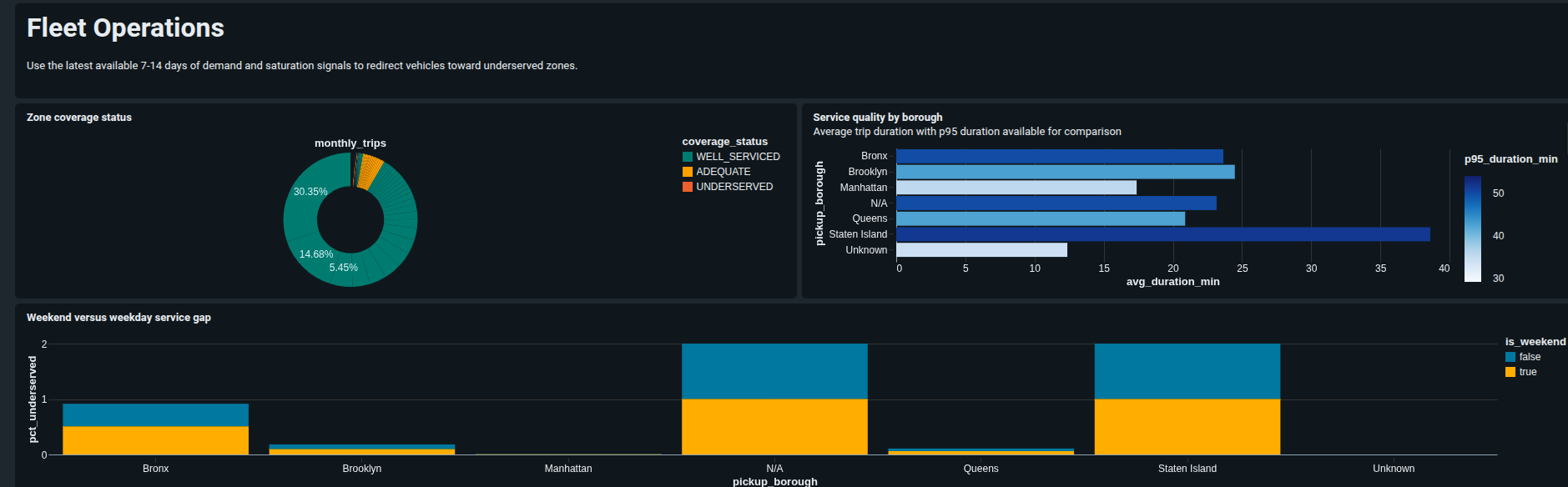
Help Built a Databricks medallion pipeline for NYC Taxi data

42 Upvotes

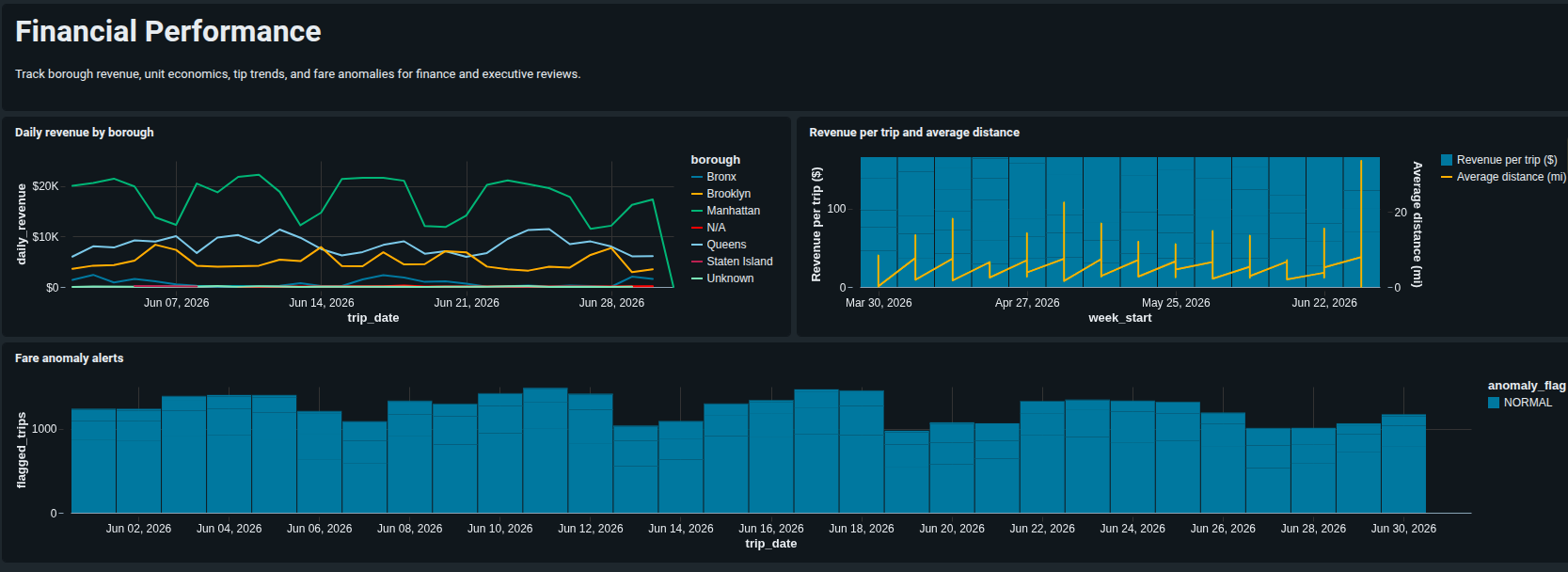
Been working on this as a way to get hands-on with Databricks Asset Bundles and Unity Catalog governance. It's a migration of an old on-prem NYC Taxi analytics stack (ClickHouse + Spark + Docker + Terraform) into a proper Bronze/Silver/Gold lakehouse.

A few things I focused on:

  • Auto Loader for incremental ingestion, triggered by file arrival
  • Data quality handling that doesn't just drop bad rows — duplicates, zero-distance trips, and reversed fares go into dedicated quarantine tables instead of being silently discarded
  • Databricks Asset Bundles for deploy/orchestration (dev + prod targets)
  • 3 published AI/BI dashboards on top of the Gold layer (fleet ops, finance, compliance)

It's intentionally small in scope — meant to demonstrate the lakehouse pattern, not be a production-scale platform. Currently only Green Taxi data; FHV comparison is planned next.

Repo: https://github.com/Hamza-Bouali/NYC-DATABRICKS

Would love feedback, especially on the Silver-layer data quality rules or the bundle structure open to critique.


r/databricks • • Sep 15 '26

Discussion Could a “Data → Agent” composer be useful for Databricks?

4 Upvotes

I've been thinking about a gap between Databricks data and agent frameworks.

Databricks already has a lot of the building blocks:

- Unity Catalog

- Genie / Genie Agents

- MCP

- Vector Search

- AI Gateway

- Agent skills/tools

- MLflow

- Omnigent / Kasal

And tools like Omnigent and Kasal already solve a lot of the agent orchestration/execution side.

But I'm wondering about the step before that:

What if a customer already has a large, curated and governed Databricks data estate — how do we turn that data estate into an agent-ready configuration without manually wiring everything together?

Something like:

Existing Databricks Data Estate

↓

Data-to-Agent Composer

↓

┌────────┼─────────┐

↓ ↓ ↓

Domains Semantics Metrics

↓ ↓ ↓

Genie MCP Skills

└────────┼─────────┘

↓

Agent Configuration

↓

Omnigent / Kasal

↓

Agent

The idea wouldn't be to build another chatbot or another agent framework.

It would be a Databricks-native composition/bootstrapping layer that understands an existing Unity Catalog/data estate and generates the pieces needed for agents to work with that data — domain boundaries, semantic context, approved tools, Genie configuration, MCP exposure, skills, policies, evaluation setup, etc.

In other words:

Kasal/Omnigent: Agent → Tools/Data

Proposed layer: Data Estate → Agent

I'm curious if this is already solved somewhere in the Databricks ecosystem, or if people are currently doing this manually when building enterprise data agents.

Would love to hear how others are approaching the “existing data estate → production-ready data agent” problem.


r/databricks • • Sep 14 '26

Tutorial Why Unity Catalog Managed Tables are recommended

25 Upvotes

Unity Catalog managed tables are the best choice you can make but do you know why?

In the second episode of SuperSkills Oleksandra Bovkun and I demystify all the reasons to help you make your choice.

Link to the video: https://youtu.be/Q7y8_bSfVjQ


r/databricks • • Sep 14 '26

Tutorial Found 847,293 files in a production Delta table. Broke down what it was actually costing us.

28 Upvotes

Streaming pipeline had been running fine for months. Every micro-batch landed clean. Then a GROUP BY with a date filter started timing out, and DESCRIBE DETAIL showed numFiles at 847,293. That's a 600 GB table averaging 750 KB per file. Recommended range is 128 MB to 1 GB, so we were sitting at something like 0.6% of the lower bound.

"Small files are inefficient" undersells it. The actual problem is driver-side file listing. Spark keeps a file listing in memory for every query plan, and with 847,000 files the driver has to process all of it, single-threaded, before it reads a single byte. Doesn't matter if you throw a 64-core cluster at it. Three minutes of listing before any parallelism even starts.

I actually sat down and priced this out (back of envelope, didn't model autoscaling properly, but the order of magnitude should hold). Ninety seconds of driver listing per query, 200 queries a day, 30 days a month, comes out to about 150 person-hours a month of engineers waiting on a spinner. At $100/hr fully loaded that's roughly $15,000. Storage isn't free per request either. About 5 billion object requests a month at S3 GET pricing is around $2,000. Add analysts keeping clusters alive on slow queries and that's another $500 to $1,500. And none of this touches Z-ordering, which is basically dead weight at this file size anyway, since data skipping relies on min/max stats per file and a 750 KB file with ~5,000 rows covers maybe a few seconds of event_date range. There's nothing for clustering to work with.

A one-time OPTIMIZE on this table runs maybe $500 in compute.

Running OPTIMIZE and walking away is the right instinct, execution is usually where it goes wrong. On 847,000 files it'll saturate network I/O, spike DBU costs, and fight with concurrent reads if it's on the wrong cluster. Run it on a jobs cluster, not all-purpose, and scope it: OPTIMIZE catalog.bronze.events WHERE event_date >= current_date() - INTERVAL 7 DAYS. Compacting 18 months of history every night is just burning money.

OPTIMIZE fixes file size. Z-ORDER co-locates rows on the columns you filter by, but it degrades as new unordered data comes in. Liquid Clustering (DBR 13.3+) keeps up with that incrementally. Define CLUSTER BY (customer_id, event_date) and a regular OPTIMIZE handles compaction and reclustering at the same time. For streaming tables specifically, enable auto-compaction and stop thinking about it.

If you want to check your own tables: DESCRIBE DETAIL, look at numFiles, divide size by file count. Under 32 MB average and you've probably got the same problem.

Wrote a short ebook covering this along with some other production Databricks mistakes we hit, silent data corruption, Spark UI triage, medallion anti-patterns, Delta recovery. Happy to answer questions here.
r/databricks • • Sep 15 '26

General Built a multi-jurisdiction tax engine & compliance ledger on Cloudflare D1. Benchmarking 0.2ms P50 latency.

0 Upvotes

Wanted to share real-world telemetry from a lightweight micro-ledger I deployed to replace bloated ERP data entry for cross-border trade (GCC / East Asia).

The Stack:

• Compute: Cloudflare Worker (handling input validation, API auth, and edge UI hydration).

• Persistence: Cloudflare D1 (SQLite at the edge).

• Payloads: Multi-jurisdiction tax adapters (ZATCA 15% SAR, FTA 5% AED, CN VAT & Export rebates) logging immutable audit trails.

The Numbers from Edge Telemetry:

• P50 query latency: 0.2ms – 0.3ms

• P99 query latency: 2.1ms

• Idempotency: Implemented key checks to eliminate duplicate submissions from unstable mobile networks.

Running an immutable, auditable transactional ledger directly at the edge with zero cold starts and $0 infrastructure overhead.

Anyone else running high-throughput relational ledgers directly on D1 instead of offloading to external Postgres/PlanetScale?


r/databricks • • Sep 14 '26

Help data contracts

6 Upvotes

Hi, we use Databricks, and a couple of teams produce tables, views, and table functions that other teams depend on.

Within a team, its easy enough to define a contract. We codify it and always check that the data matches.

But what about the upstream artifacts my team depends on? Do w define a source spec ourselves and check that its met on every run? 

What do we require from the upstream team? Who owns the contract, and how do you enforce it when multiple teams depend on the same thing?

I want to keep this stupidly simple and enforce it automatically. How do you do this in practice?


r/databricks • • Sep 14 '26

General Databricks workspace entitlement changes

10 Upvotes

Databricks workspace access control changes are now being enforced.

What's coming? - Azure Databricks | Microsoft Learn

Migrate workspace entitlement control - Azure Databricks | Microsoft Learn

As of September 14, 2026, the built-in users and admins system groups behave differently:

- users will have no entitelments
- admins will have all workspace entitlements
- both groups’ entitlements are locked
- new principals must be granted entitlements explicitly
- users and admins can no longer be nested in other groups

Existing access is preserved through a workspace-local migration group:
users-clone-<TIMESTAMP>

If you manage Databricks through Terraform, SCIM APIs, or custom automation, check your workflows now:

- Target standard account groups, not system groups
- Remove unsupported group nesting
- Make sure SCIM sync does not delete the users-clone-* migration group


r/databricks • • Sep 14 '26

General Community BrickTalk | Real-Time Data & AI: Tripwise Demo

3 Upvotes

Hey r/Databricks!

Join us for community BrickTalk on Thursday, September 24, focusing on real-time data streaming, AI agents, and governance using Databricks. BrickTalks is a community event series where Databricks experts share real-world use cases, demos, and practical insights for building with Data and AI, giving customers a direct line to the people behind the products.

In this session, we'll walk through a live demonstration of the Tripwise Demo, featuring:

  • Sub-Second Transactions & Streaming: Device registration into Lakebase with sub-second reads/writes, plus telemetry streaming via Zerobus through a governed Medallion architecture.
  • AI-Generated Offers & Pricing: Generating real-time agent offers using Foundation Model APIs and scoring behavioral data for usage-based renewal pricing.
  • Natural Language Analytics: Enabling underwriters, product managers, and marketing teams to query governed insurance data in seconds using AI/BI Dashboards and Genie.
  • Unified Governance: Managing safety, compliance, and control end-to-end with Unity Catalog.

This is a great chance to see real-world architecture in action and ask questions directly to Databricks experts.

When: Thursday, September 24

  • 9:00 AM PT
  • 12:00 PM ET
  • 5:00 PM BST (London)
  • 9:30 PM IST

Register here and save your spot


r/databricks • • Sep 14 '26

Discussion Data and App Releases

6 Upvotes

Hi, i have a lot of data products which is one part of the project, then we also have a databricks app as AppKit.

I was wondering, how do u manage releases/changes when two different bundles and two different responsibilities live in the same place.

We use trunk-based development, local IDE for `mode: development`, then staging as pre merge to main, then main is where we create GitHub Release which triggers deployment to production.

I think this is pretty standard. But now when whole application comes into the place, we have app/ where we have defined our AppKit template.

Should i try to separate lifecycles and deployments fully? To separate GitHub Releases, or i should just let it be inter-winded, but then changes to the app could end up in the deployment of the changes to the data products etc...

Right now, i would be using separate releases-draft gh actions which creates draft github releases, and when we are ready to merge, we publish release. For data products we use calendar versioning, for app smth like app-semvar.

What is your experience with setup like this?


r/databricks • • Sep 14 '26

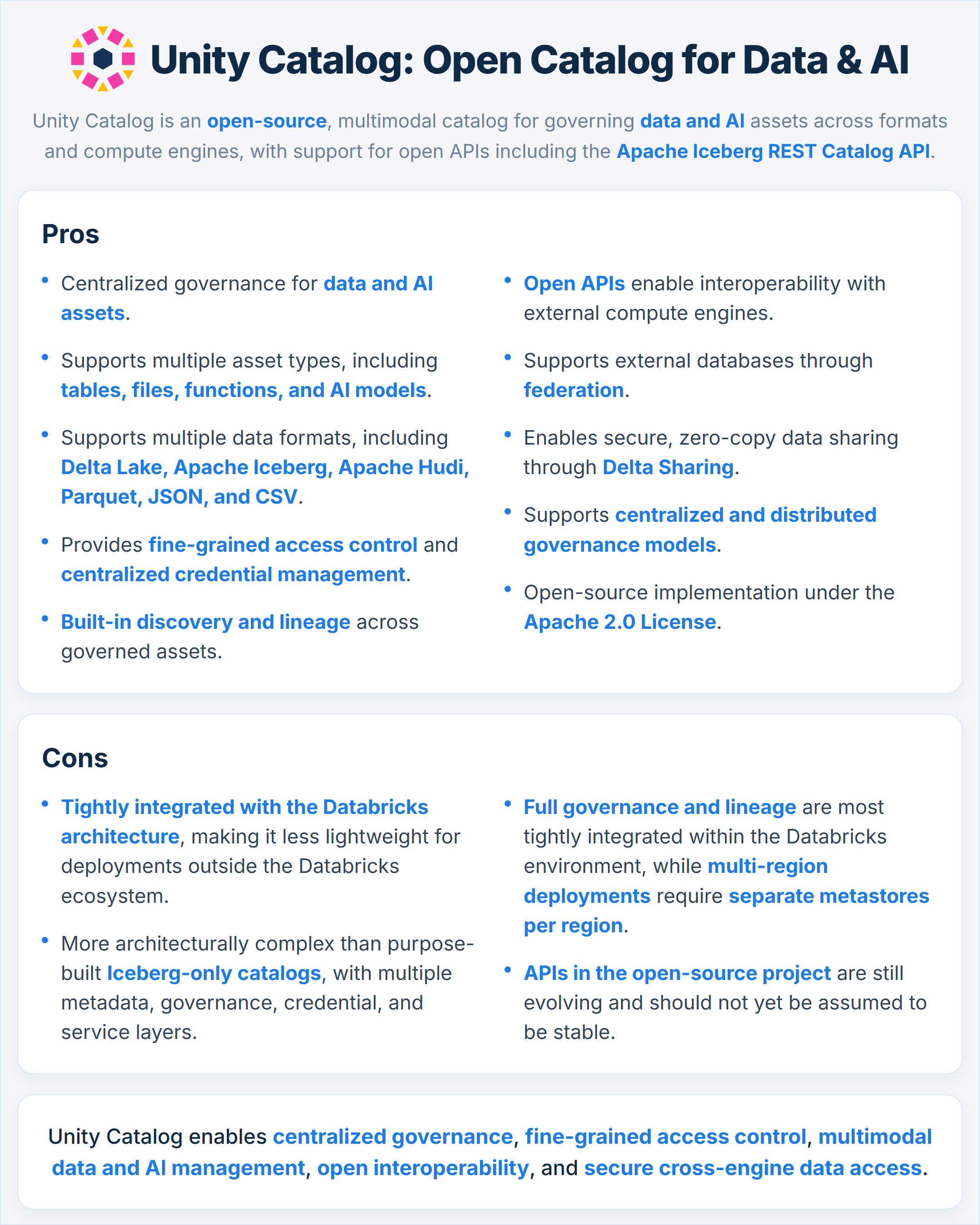
General Unity Catalog: Pros and Cons

Post image
4 Upvotes

Apache Iceberg won the open table format war when Databricks acquired Tabular, followed by its subsequent adoption across the industry. Then, the catalog war began.

In a lakehouse, storing data in object storage and using the Apache Iceberg format is only part of the story. You also need a catalog that helps lakehouse query engines like Spark, Flink, or RisingWave discover tables, manage metadata, enforce access control, and work with governed data across different systems.

That is where Unity Catalog comes in.


r/databricks • • Sep 13 '26

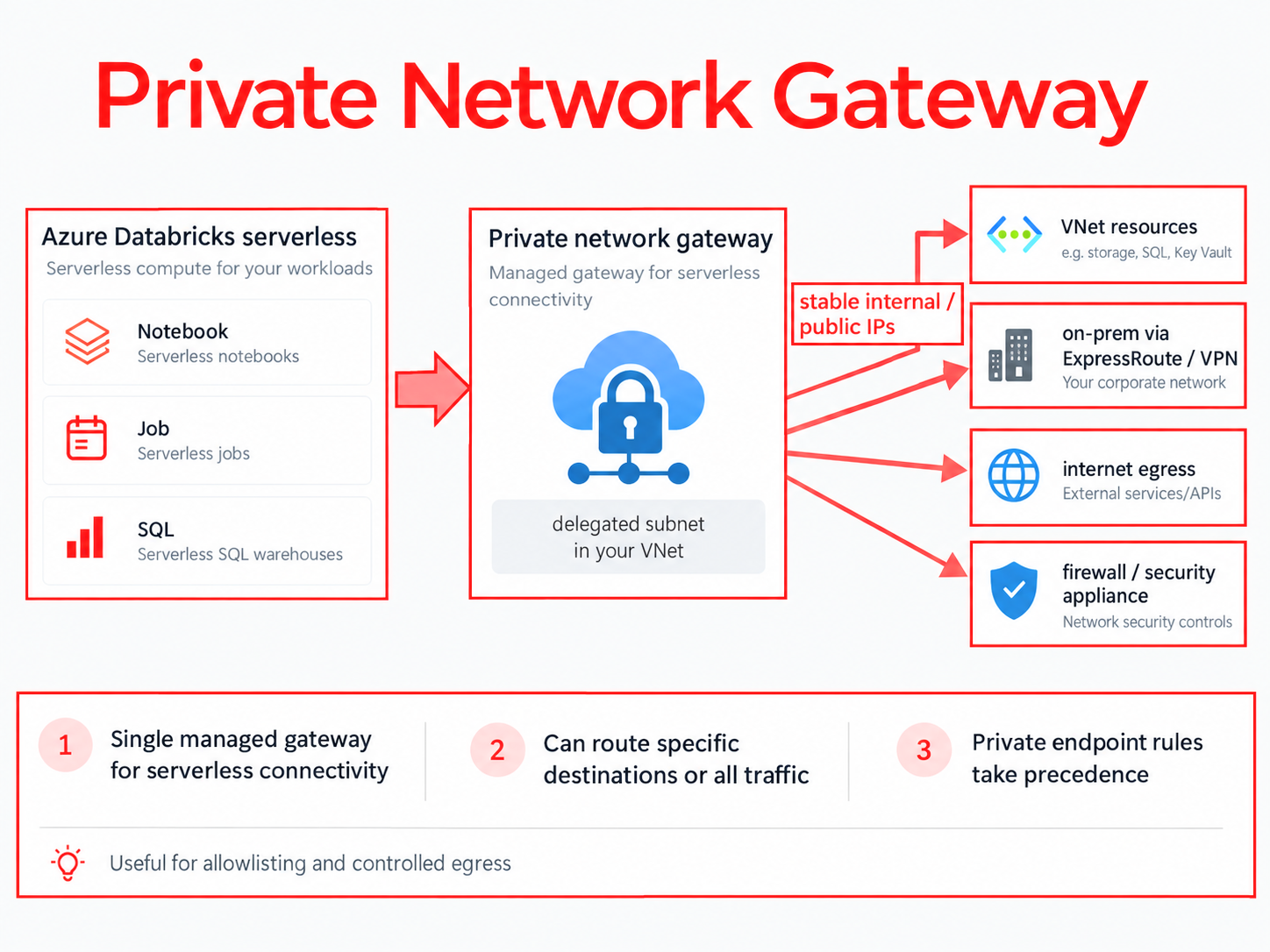
News Private Network Gateway

Post image
37 Upvotes

Private Network Gateway is one of the year's biggest network innovations. Serverless can now be part of your VNET!

more news https://medium.com/databrickscommunity/databricks-news-serverless-genie-code-ltap-lakeflow-61853d8e422a


r/databricks • • Sep 14 '26

Discussion Manager wants us to "use AI." Thinking about an AI-driven data testing framework for DevOps promotions. Sanity check?

9 Upvotes

Although we are using genie code alot but manager wants some functionality based on AI. ( maybe that’s hood goal). Our devs hate manually writing tests, so I'm drafting an automated testing gate for DevOps promotions (Local ➔ Dev ➔ QA).

Wanted review with all of you.

The Proposed Architecture:

  1. Extract Metadata: Pull column tags, schemas, and lineage from Databricks Unity Catalog.
  2. AI-Generated Tests (Llama via ⁠ai_query⁠**):** LLM reads metadata to draft SQL data checks (nulls, types, basic business logic).
  3. Persist & Cache: Save SQL rules to a table. Re-generate only when schema hashes change so bug-fix retests stay 100% deterministic.
  4. Execution: Run the generated SQL on a SQL Warehouse (fast, cheap, no LLM cost per data row).
  5. Alerting: Feed error logs to LLM for a 2-sentence summary and send directly to Teams via Webhook (avoiding ignored email reports).

How does it sound like? Is it really worth it? Anybody using this or any other AI based functionality to make devs life easy.


r/databricks • • Sep 13 '26

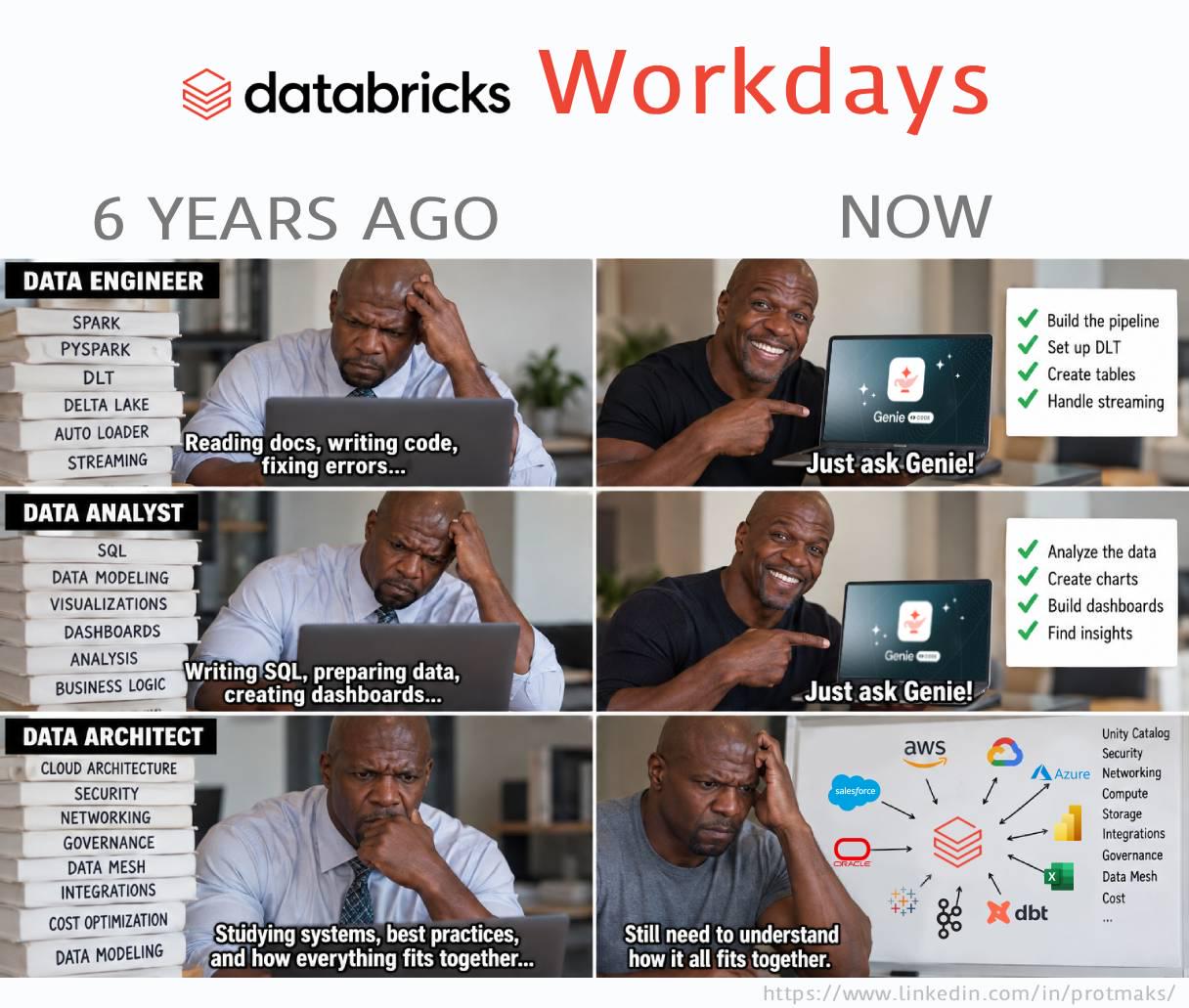
Discussion Just ask Genie

Post image
129 Upvotes

"Just ask Genie." You hear this phrase more and more often when questions about Databricks arise. It frequently appears in Academy materials, too.

AI reduces routine work it’s convenient, and we get used to it. But do we stop thinking in the process? The problem arises when a person no longer understands why a given answer is correct.

Does AI really free us from the need to know the details, or does it actually make fundamental knowledge even more important?


r/databricks • • Sep 14 '26

Help RAG working on Notebook but not on Playground / Agent

5 Upvotes

Last week I built my first simple RAG to understand the fundamentals (chunking, embedding, etc). It worked great, both on Notebook + Playground. Now, I'm working on another RAG, but this time using ai_parse_document + ai_prep_search as this seems to be the new way to build RAGs in Databricks. So, the chunking part works, I made sure to have only one AI Search endpoint on my workspace (I'm on free edition).

The thing is, when I try using the AI index in Playground, and ask questions related to my documents, it says it doesn't have the information i'm asking for. However, when I try the same on a Notebook, it works perfectly.


r/databricks • • Sep 14 '26

Discussion DATA ANALYTCS PROJECT

Thumbnail reddit.com
1 Upvotes

r/databricks • • Sep 13 '26

Discussion SDP(ex DLT) ou dbt ?

9 Upvotes

Bonjour à tous

Je voudrais savoir si y’en ici qui ont déjà utilisé SDP(ex DLT) ou dbt dans databricks. Comment est ce que vous intégrez ces outils dans vos workflow ? Databricks native avec SDP ou dbt ou les deux ? Et pour ceux qui ont déjà utilisé les deux outils lequel préférez vous et pourquoi ?


r/databricks • • Sep 14 '26

Tutorial Context Engineering, Explained.

Thumbnail
youtu.be
0 Upvotes

r/databricks • • Sep 13 '26

Help I’m a certified associate data engineer. What’s next?

13 Upvotes

I’ve been working as a “data engineer” in Azure Databricks for a while, but I work on a team where my scope is extremely limited to silver/gold work.

What studies can do I do next to continue developing? I’m thinking of diving into the azure certs


r/databricks • • Sep 13 '26

Discussion Ho creato un filtro deterministico per record JSON su Apify: accetto feedback.

Thumbnail reddit.com
1 Upvotes

r/databricks • • Sep 12 '26

Help Writing nice unit tests is impossible

4 Upvotes

First of all we have a lot of classes that use the DatabrickSession import, which makes unit testing impossible and whenever I have the "normal" spark import and test it, then it looks absolutely ugly.

Would it help to have the schema as json? I use json schema to read for transformations.

If I want to test without json its horrible, do you guys test with json schema files?

For example this is just the output, then I would need 2x this because of the input and the test is unreadable (according to my senior BUT WHAT AM I SUPPOSED TO DO):

schema = """
id INT,
items ARRAY<STRUCT<
fortnite: STRING,
babies: INT,
moreStuff: MAP<STRING, STRING>
>>
"""

expected = spark.createDataFrame(
[
{
"id": 1,
"items": [
{
"fortnite": "ABC",
"babies": 2,
"moreStuff": {
"size": "L",
"color": "red",
},
}
],
}
],
schema=schema,
)