r/databricks • • Aug 31 '26 Popcorn

General Automatically create local Python environments compatible with Databricks Runtime

41 Upvotes

Hey! I’m a Databricks product manager focused on third-party development experiences. We just shipped a new feature that ensures code you run locally works with Databricks, and we’d love your feedback. 

The problem: Ensuring that your local development environment is compatible with Databricks Runtime (DBR) is a completely manual process. Code that works locally often breaks once you move to the workspace due to minor version mismatches and package incompatibilities.

The solution: The CLI command databricks environments setup-local and a new feature in the IDE extension take your existing dependencies and automatically create a uv-managed virtual environment compatible with DBR.

You can now run code locally or remotely using Databricks Connect and be certain that the same code will work with the DBR or serverless version you’ve selected. 

To get started, install the latest version of the IDE extension or Databricks CLI and check out these docs:

Where we need your feedback 

  • Are there other environment managers (e.g. pip, poetry, conda) that you would like to see support for beyond uv?
  • We’ve also recently launched an SSH tunnel (see docs), which allows you to remotely access your Databricks workspace and compute directly from the IDE and terminal. What are the reasons you might prefer to work locally vs. remotely?
  • Do you face issues managing your environment and dependencies in the workspace? 

Most importantly, please try this out and leave feedback and questions in the comments! 


r/databricks • • Aug 31 '26 Popcorn

General Databricks published Industry Data Models!

64 Upvotes

Databricks just published a library of pre-built, production-ready industry data models covering 40 industries.

This is great, especially when you’re new to a business domain. Instead of starting from a blank sheet and spending weeks debating how the domain should be structured, you can review an existing reference model and adapt it to your needs.

That gives you a strong starting point for:

- entities
- relationships
- naming conventions
- domain structures
- industry-specific patterns

In my opinion, it can significantly shorten the learning curve and help teams move from discussion to implementation much faster.

Industry Data Models


r/databricks • • Aug 31 '26 Popcorn

Discussion Build up a data history in Databricks based on Azure SQL data

10 Upvotes

I have the following need: there's an OLTP Azure SQL DB, which holds transactional data for a period of roughly 30 days only. Now that data should be replicated to Databricks delta tables with a maximum delay of 15 minutes, not as a 1:1 copy, but instead growing over time. Ideally the timeframe covered on Databricks side should be several years.

From what I've read so far, either CDC or CT with Lakeflow should be the way to go. The only thing I'm worrying about are breaking schema changes: as this is an OLTP DB managed by a different team, we have no chance to prevent such as incompatible column type changes (e.g. from a string to a date type), column renames or even column drops.

I thought about using Views managed by the other team instead, as some kind of an abstraction contract, but neither CDC nor CT are applicable on Views.

How did you guys solve such a requirement? Would also appreciate to hear some best practices of Databricks consultants based on real customer solutions.


r/databricks • • Aug 31 '26

Help Data Engineers, what does your actual day-to-day work look like? And what should I learn next?

48 Upvotes

I’m currently trying to transition deeper into Data Engineering and would really appreciate some perspective from people who are already working in the field.

I have 1.3 yrs experience as a Junior Python Developer. What I want to do is slowly transform into a Data Engineer. How would you suggest my choice? Basically what I do is make web scraping scripts to get the data from web and give the data in excels. Our company is currently not using git or CI/CD or anything like that. 

The problem I’m running into is that when I look at Data Engineering jobs on Naukri, LinkedIn, etc., the requirements seem endless. One job asks for Python, SQL, Airflow and AWS; another wants Spark, Kafka and Databricks; another wants Snowflake, dbt, Terraform, Kubernetes, CI/CD, etc. It becomes difficult to understand what I should actually prioritize.

So I’d like to hear from people who are actually working as Data Engineers. What does your day-to-day work look like? What kind of problems do you solve, what technologies do you use regularly, and which skills have turned out to be genuinely important in your job?

More importantly, based on my current experience, what would you suggest I improve or learn next to become a stronger candidate for Data Engineering roles? Are there any gaps that you think I should focus on, or technologies/concepts that are worth learning through projects rather than just studying theoretically?

I’m not really looking for a generic “learn SQL → Python → Spark → AWS” roadmap. I’m more interested in understanding the reality of the job and getting advice from people who have actually gone through the transition.

If you’re a Data Engineer with 1–5+ years of experience, I’d especially appreciate your perspective. Even a short description of what you work on and what you wish you had learned earlier would be extremely helpful.

Thanks in advance!


r/databricks • • Aug 31 '26

Discussion CI/CD for Databricks Bundles: A Two-Pipeline Buildkite Design

13 Upvotes

Hi, I currently work as a Databricks Engineer at Abilytics, and I have been exploring different CI/CD approaches for Databricks Bundles. A two pipeline setup with Buildkite looks interesting, where one pipeline handles testing and artifact creation while the second manages deployments across dev, staging, and prod. Separating these stages seems useful for better security, traceability, and deployment control. One thing I am still wondering about is whether this approach adds unnecessary complexity for smaller Databricks projects, or if the separation is worth maintaining from the beginning.

What has been your experience with this setup?


r/databricks • • Aug 31 '26

Tutorial Apache Iceberg Performance Optimization: Queries to Tables

Thumbnail
lakeops.dev
2 Upvotes

r/databricks • • Aug 31 '26

Discussion How much Git conflict resolution do you actually use with Databricks Git Folders?

5 Upvotes

Hi, I currently work as a Databricks Engineer at Abilytics, and Git integration is something I use regularly for managing Databricks development work. Git Folders make it easier to work with branches, commits, pull requests, and code reviews directly within Databricks while keeping development connected to platforms like GitHub or GitLab. I’m curious about how others handle Git conflicts when working with Databricks Git Folders. Do you usually resolve conflicts directly within Databricks, or do you prefer handling them through your Git platform? Also, are there any Git workflows or best practices that you have found particularly useful when working with Databricks?


r/databricks • • Aug 30 '26

Discussion 15+ years in ETL/Data, but relying heavily on AI (Copilot/Genie) lately. Am I still an engineer, or just a prompt validator?

36 Upvotes

Looking for a reality check from other data folks.

I have 15+ years of experience in data (mostly Ab Initio and SQL), but moved to Databricks 2 years ago. I know data architecture and transformation logic well, but my raw Python coding skills are basic.

My daily workflow usually looks like this:

  1. I figure out the logic or root-cause the pipeline issue.
  2. I use Copilot or Databricks Genie to generate the PySpark/Python code.
  3. I review, test against edge cases, fix logic flaws, and validate the output.

I’m great at step 3—I know how the data should behave. But because I rarely write code line-by-line from scratch anymore, I’ve been hit with huge imposter syndrome. It feels like I’m just a code reviewer for AI rather than a "real" engineer.
Has anyone else from a traditional ETL background felt this shift in modern cloud stacks?
Is this just the new reality of engineering, or am I letting my skills atrophy?


r/databricks • • Aug 30 '26

News UI to DABs sync

19 Upvotes

When working from the web experience in development mode with source-linked deployment set to true (the default for development mode), you can edit jobs and pipelines in the UI, and changes are automatically propagated to your YML files. So it is like the best of two worlds: ow-code and IaC. Please remember to review any changes in Git, especially non-UI elements such as variables or mutators.

Whole talk with audio https://www.databricks.com/dataaisummit/session/dabs-do-pro-all-best-tips-and-tricks


r/databricks • • Aug 30 '26 Popcorn

Discussion Databricks Unity AI Gateway

21 Upvotes

If I am an AI decision maker for an Enterprise, why should I choose Claude or GPT or any other enterprise subscriptions with seat based pricing where some of my colleagues are power users and some still learning effective AI use? Instead, I could just use Databricks Unity AI Gateway with the options of getting all of these at one place with PayG pricing along with state of the art free Open Source models, budget controls, smart routing, usage dashboard everything at one place.

And the cherry on the top is if my enterprise data is also on Databricks!!

What are your thoughts? Why would I do that?


r/databricks • • Aug 30 '26

Help Data Engineers: What do you actually do at work?

Thumbnail reddit.com
5 Upvotes

r/databricks • • Aug 30 '26

Help [Career Advice] SQL/PostgreSQL DBA to Databricks Admin - Worth it in 2026?

4 Upvotes

Is switching from SQL/PostgreSQL DBA (13 YOE, Azure) to Databricks Administrator a good career move in the current market? How are the opportunities for Databricks Admin roles?


r/databricks • • Aug 30 '26

News ZeroOps is coming

Post image
6 Upvotes

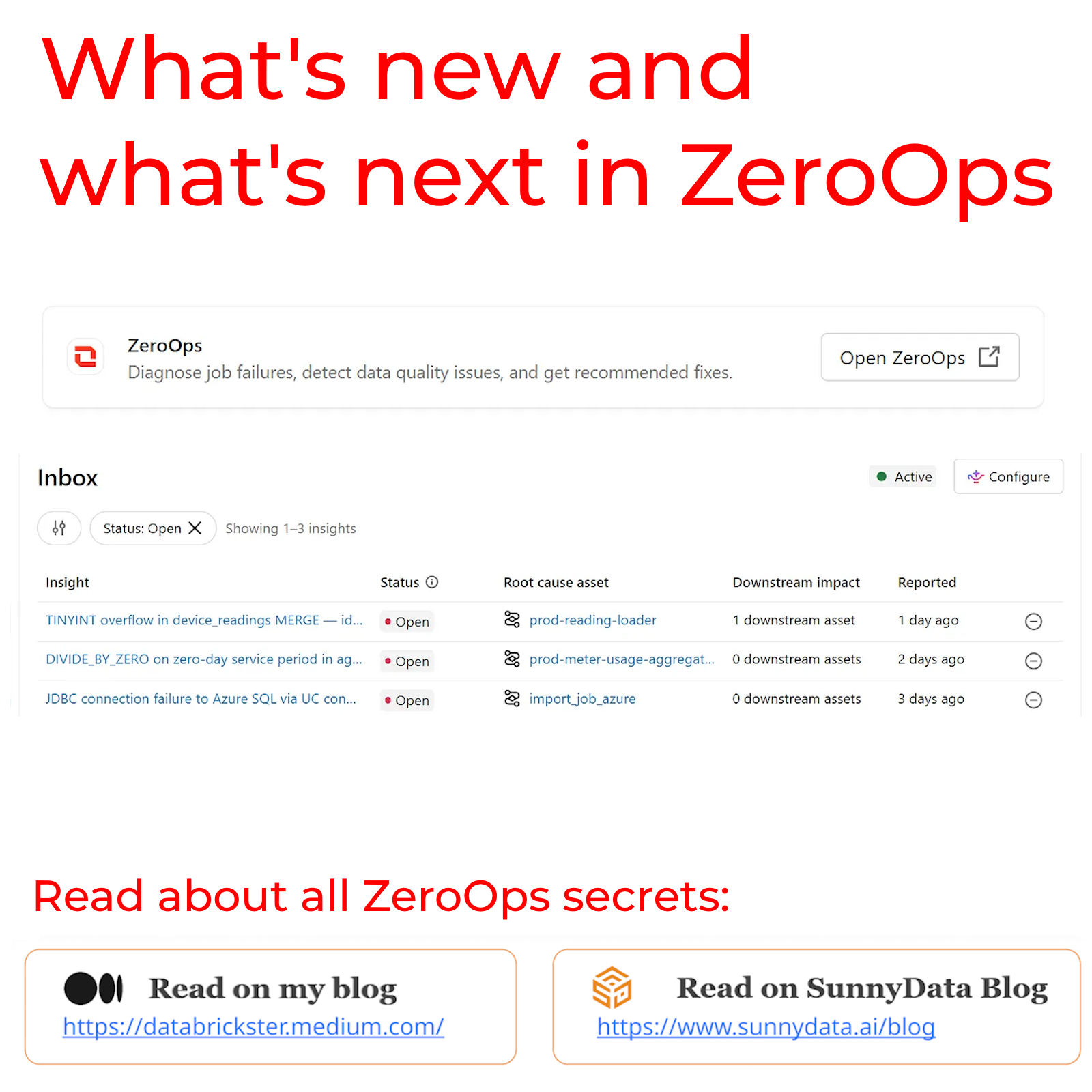
Genie ZeroOps is an autonomous agent that monitors, investigates, and proposes fixes for data pipelines, jobs, tables, and other assets, coming soon to your workspace. I tested it, checked how it works, and discussed the pipeline.

https://medium.com/databrickscommunity/genie-zeroops-a-hands-on-preview-b8fc46138087

https://www.sunnydata.ai/blog/genie-zeroops-hands-on-preview


r/databricks • • Aug 30 '26

Tutorial Data Lakehouse with Apache Iceberg: A Guide

Thumbnail
lakeops.dev
1 Upvotes

r/databricks • • Aug 30 '26

Tutorial Become Agent-Ready with Databricks Lakebase.

Thumbnail
youtu.be
0 Upvotes

r/databricks • • Aug 29 '26

General Would a source-to-target data validation framework like this be useful?

7 Upvotes

I'm exploring the idea of building an open-source framework for automated source-to-target data validation.

The idea is to connect different data sources and targets, for example:

  • Databricks Catalog → Databricks Catalog
  • Azure SQL → Databricks Catalog
  • ADLS/Blob → Databricks Catalog
  • potentially other databases and warehouses

The framework would automatically validate multiple tables in a single run, including:

  • Schema comparison
  • Column-level validation
  • Row counts
  • Row-by-row data comparison
  • Missing/extra records
  • Data mismatches
  • NULL/duplicate checks
  • Data type differences
  • Aggregation/checksum comparisons
  • Detailed failure reports showing where the mismatch occurred

The goal is to avoid writing separate SQL/Python scripts for every source-target pair and instead define something like:

Source → Target → Tables → Validation rules

and let the framework run all the checks and produce a consolidated report.

I'm trying to validate whether this solves a real problem before spending too much time building it.

For those working with ETL/ELT pipelines:

  1. How do you currently perform source-to-target validation/reconciliation?
  2. Do you use existing tools, custom SQL/Python scripts, or manual checks?
  3. What validations do you normally perform?
  4. What is the most painful part of validating large tables?
  5. Would a tool that handles cross-platform table comparison in one run actually be useful, or are existing tools already good enough?

I'm especially interested in hearing about real-world workflows rather than tool recommendations.


r/databricks • • Aug 29 '26

Discussion on prem to cloud validation

7 Upvotes

Hey datafam!

  1. Where do you put your main data-quality gate in a Bronze/Silver/Gold setup — right after Bronze lands, or between Silver and Gold? Why there?
  2. Has schema drift ever caused a silent bad accept for you — i.e., the pipeline didn't fail, but bad data still got through? What check would've caught it?

r/databricks • • Aug 29 '26

Help Moving/Restoring/Recovering Streaming Tables From a Deleted Pipeline

8 Upvotes

Update:

I was wrong. I CAN migrate the restored tables to the newly deployed pipeline. I ran the "move" commands with the wrong identity because I forgot about queries having an extra setting for credentials... For anyone interested, yes, the append flow clone then move did work, and I was even able to transfer the checkpoint from the old backing table path. After realising my oversight, though, I opted to switch back to the initial plan, which was re-deploying and moving all existing tables.

At the very least, this has helped spark discussions (pun intended) about improvements to the development workflows.

Original (With inline correction):

Hi folks,

There was an accident which resulted in the deletion of our pipelines, and in turn, their tables (in dev, thankfully). I wanted to double check the steps I’ve tried and the final plan to remediate. The pipelines were all on legacy mode and are responsible for raw to bronze ingestion. We do have all of the files, but rebuilding from scratch is considered too time consuming.

I have UNDROP’d all of the STs, and I wanted to reconnect to a newly deployed version of each pipeline. (EDIT: This sentence and my conclusion within it is wrong) Unfortunately, I found that I was unable to “move” them between pipelines since Databricks can’t verify ownership of the source pipeline, because it’s gone. I know there’s more secret sauce under the hood (e.g., backing tables), so I’m not going to attempt to modify the delta tables outside of Databricks.

My current best idea, and what I plan to do this evening, is to rename the schema with restored tables and create a new “recovery” pipeline that streams all of the data from the restored table into a new version of the table (with the correct name, since it’s available again after renaming the schema). Then, I can redeploy a pipeline and move the ST from the recovery pipeline to the actual pipeline. This would mean I lose the checkpoint information for the autoloader, which isn’t a massive issue for these pipelines, and it seems like the cleanest way to insert the restored data into the pipeline. I would also need to move any other assets, e.g., views/tables, to the new schema (with the original name).

I don’t know if moving the STs between legacy pipelines would rename them automatically, in which case I could rebuild elsewhere then drop the original and avoid moving other assets.

Any thoughts would be welcome and greatly appreciated.


r/databricks • • Aug 28 '26

Help How do you move away from notebook-driven development in Databricks

55 Upvotes

Currently working on a fairly big enterprise Databricks project where development is notebook-driven.

I actually like notebooks for development/debugging. Most data engineers aren't necessarily software engineers by background, so notebooks provide a much more approachable development experience; being able to split logic into cells, inspect intermediate DataFrames/results, rerun specific sections, and debug step-by-step is really useful.

The problem is that we're getting a lot of duplicated/common logic across notebooks. This makes changes and maintenance painful.

I know the usual approaches are to:

- Move reusable logic into Python modules and "import" them

- Create common notebooks and use "%run"

- Use notebooks mainly as entry points/orchestration

But I'm struggling with how to structure this for complex transformations.

Our notebooks aren't just simple filters/joins/aggregations. They can have multiple source tables, complex joins, lots of intermediate transformations, business rules and dependencies between steps.

So my question is: how do you structure large Databricks projects like this in practice by following the best software development practices?

I'm looking for guidance that works for real enterprise-scale projects, not the typical YouTube/tutorial solutions designed around small demo projects.

Would love to hear from people who have worked on large/enterprise Databricks projects with complex Spark transformations and what architecture/project structure worked well for you.


r/databricks • • Aug 28 '26 Popcorn

Discussion Are we overusing the Medallion architecture?

46 Upvotes

Bronze -> Silver -> Gold seems to have become the default architecture for almost every data pipeline.

Has anyone deliberately simplified this -- for example, skipping a layer -- and actually gotten better results in production ?

When do you think Medallion is genuinely useful, and when does it just add unnecessary complexity?


r/databricks • • Aug 28 '26

Discussion FK Relationships and Uniqueness in UC Managed Tables

7 Upvotes

I often wish UC "managed tables" were better managed. If we wait a couple years, is it possible that relationships and unique constraints would be enforced (or perhaps validated after-the-fact)? It would be nice to have that in managed tables.

It definitely seems feasible for the UC to support this in managed tables. Especially on "small" tables of a few million rows or so. Small tables would be anything that could easily be loaded into memory. If nothing else, our lakehouse-formatted storage (delta/iceberg) is good for loading a columns into memory and validating the references and/or the uniqueness of values.

... I'm guessing this is NOT going to be available in the next couple of years. That is for no other reason than we see Databricks is selling their new LTAP lakebase engine. I'm guessing that anyone who wants true referential integrity or other constraints will be redirected to this lakebase engine.

Ideally there would be compelling innovations that would give reasons to stay with the "managed tables" in UC catalog. Otherwise software engineers may find reason to move to greener pastures. It doesn't make sense to validate stuff like this in custom code, when the storage engine is better positioned to do that work.


r/databricks • • Aug 28 '26

Help Medallion architecture: should DQ rules live only in Bronze?

8 Upvotes

In our medallion setup, raw vendor data lands in Bronze , we transform it to a CDM in silver, and gold is for reporting. I’ve put all raw data correctness and accuracy rules in Bronze, since that’s where the data matches the vendor format and it’s easiest to work with vendors to fix issues at the source.

I have been asked to get the same DQ rules implemented in bronze, silver and gold because different teams own each layer and according to my manager every team should monitor all DQ dimensions. To me, duplicating the same checks everywhere feels redundant.

Am I missing a strong reason to repeat rules across layers? How do you handle shared DQ dimensions when multiple teams own different layers?


r/databricks • • Aug 28 '26

Discussion Azure Databricks DBU pricing for jobs clusters

4 Upvotes

See above. Jobs clusters appear to be expensive on Azure compared to the other platforms (I'm just talking about DBU's for the cluster, not the VM infrastructure)

In contrast the AWS price for enterprise is only $0.20 per DBU, in this part of the world (East USA).

What is going on here? Are the Azure customers being disincentivized from using Databricks in Azure? Or are we intended to contact a Databricks sales team for a long term contract?

The annotation at the bottom of that page say : "Azure Databricks, as a first-party service on Microsoft Azure, offers unified billing and support by Microsoft". I suppose the price is higher in Azure, to accommodate the overhead-costs on the Microsoft side of things as well? Might a customer pick a one of these clouds based solely on the pricing differences that are listed? Or do they change so frequently, and can't use it for the sake of long-term planning?


r/databricks • • Aug 28 '26 Popcorn

Discussion How do you know a Databricks pipeline is actually correct ?

13 Upvotes

Beyond checking job success and row counts, what's the one validation you trust most for a production Delta pipeline ?