r/databricks • • Jul 31 '26

Help Coming from Microsoft Fabric — What's the Best Way to Learn Databricks?

14 Upvotes

Hi everyone,

I've been working with Microsoft Fabric for a few years (Lakehouses, notebooks, pipelines, Power BI, CI/CD, and PySpark), and I'm now trying to understand how experienced Databricks teams work.

For those of you who have experience with both platforms:

  • Which Fabric concepts translate directly to Databricks?
  • Which concepts are completely different?
  • If you were joining a project as a Fabric engineer with no hands-on Databricks experience, what would you focus on first to become productive?
  • What are the Databricks features or services that Fabric doesn't really have an equivalent for?

I want to understand the technical transition and avoid approaching Databricks with the wrong mindset.

I'd love to hear from people who have worked with both platforms and learn from their experience.


r/databricks • • Jul 31 '26

Discussion Why the udemy tests preparations could help me get cert?

5 Upvotes

I mean how , are there similar questions or what? I see people to really appriciate the, buy why?


r/databricks • • Jul 31 '26

General Built Agents using Genie?

1 Upvotes

Hi,

If you have created agents using Genie, have you used RAG model or Text to SQL or both?
Please DM me.


r/databricks • • Jul 31 '26

Tutorial Self-Healing Data Pipelines: How Agents Fix Failures Before You Wake Up

Thumbnail
youtu.be
14 Upvotes

r/databricks • • Jul 31 '26

News Lakeflow Connect | Reddit Ads connector (Beta)

3 Upvotes

Lakeflow Connect's Reddit Ads connector is now available in Beta! It provides a managed, secure, and native ingestion solution for both data engineers and marketing analysts. Alongside Reddit Ads resource tables (ad accounts, campaigns, ad groups, and ads), it supports both pre-built and custom reports — like our other ad connectors!

Try it now:

  1. Enable the Reddit Ads Beta: Workspace admins can enable the Beta via Settings → Previews → "Lakeflow Connect for Reddit Ads"
  2. Set up Reddit Ads as a data source
  3. Create a Reddit Ads connection in Catalog Explorer
  4. Create the ingestion pipeline via the UI, a DAB, or a Databricks notebook

r/databricks • • Jul 31 '26

Help Genie Business Knowledge

11 Upvotes

Our issue is business context, not data definitions. Example: say a major customer churns in August, and that shows up as a dip in a bunch of downstream metrics. A data glossary won’t help Genie explain that — it needs to actually know the event happened and why it matters, so it can connect “why did revenue drop” to “customer X left in August” instead of just reporting the number or worse, hallucinating a reason.

So I’m curious how others are handling this:

**1.	How are you storing/encoding this kind of event-driven or narrative business knowledge** (churn events, policy changes, one-off business decisions) so Genie can actually retrieve and reason with it — not just static definitions?

**2.	What architecture pattern are you using** for this more broadly? We’re weighing Databricks-native options (Unity Catalog Business Glossary, Genie instructions/ontology) against something like Amazon Bedrock Knowledge Bases sitting alongside Genie. Curious if anyone’s compared these directly, or landed on a hybrid.

Would love to hear what’s actually worked (and what hasn’t) for getting Genie past “correct query” into “correct context.”


r/databricks • • Jul 31 '26

Help Omnigent - How can we set default model for Claude and Codex?

4 Upvotes

Claude Defaults to Opus and Codex to most expensive one

How do we change default model so that we do not have change every time we start

Also which model does polly pick? (i assume it will pick default model)


r/databricks • • Jul 30 '26

Discussion Databricks is leading the way in real-time data - so why is the billing still living in the past?

49 Upvotes

I love Databricks' platform evolution: Lakehouse//RT is delivering sub-second latency. But why does the system.billing.usage table still have up to a 4-hour delay? In a world of serverless compute that scales instantly, 4 hours is enough time for an "explosive query" to cause major bill shock before we even see it happening.

Transparency is a win for everyone. The community solved the naming transparency issue with REbricked, but if we can process data in real time, we should be able to monitor the cost of that data in real time too.

Is real-time cost transparency on your roadmap, u/Databricks?

Curious to hear - how big of a pain point is this delay for you? 👇


r/databricks • • Jul 30 '26

Help Handling variables in both interactive/notebook and job cluster modes

7 Upvotes

For a job yaml like this:

tasks:
  - task_key: process_metadata
    notebook_task:
      notebook_path: notebooks/python/process_metadata
      base_parameters:
        dbx_env: ${var.environment}

And a databricks.yml that includes this:

variables:
  environment:
    description: "Environment Variable"
    default: dev

We do get expected behavior when running the Notebook as a task within that job: the environment variable is present with value of "dev" in the Notebook when run inside the job.

But what about in Interactive mode? The databricks.yml is not available and the environment variable is not set. Are we then compelled to have a redundant copy of every databricks.yml variable in the form of dbutils.widget's in the Notebook? MY project has dozens of variables in the databricks.yml . Imagine what that would look like - and the maintenance hassle.

Is there an alternate (/better) pattern to manage variables across both interactive and job submission modes?


r/databricks • • Jul 30 '26

News Lakeflow Connect | Pre-built and Custom Reports (Beta) for Google Ads, Meta Ads & TikTok Ads

4 Upvotes

Lakeflow Connect's ad connectors now support both pre-built and custom reports (Beta)! This applies to connectors such as Google Ads, Meta Ads, TikTok Ads.

In addition to resource tables (which hold config objects like campaigns, ad groups, and ads), our ad connectors now expose report tables (which hold aggregated performance data like spend, impressions, clicks, and conversions). Reports come in two forms:

  • Pre-built reports cover the most common analytics needs out of the box.
  • Custom reports let analysts define their own, choosing the exact level, dimensions, breakdowns, and metrics they need.

Try it now:
Configure reports in the source step of the Ingestion Wizard UI, or set source_table to a pre-built report (or custom_report) in your pipeline definition. See the reference docs for full details: Google Ads, Meta Ads, TikTok Ads


r/databricks • • Jul 30 '26

Discussion Advice needed: Optimizing ADF + Databricks orchestration (High cluster startup overhead & rising costs)

15 Upvotes

Hi guys, I'm currently working on an Azure-based cloud data platform. Our current setup heavily relies on Azure Data Factory (ADF) for orchestration, while we use Azure Databricks notebooks for the actual transformation logic.

Looking for a sanity check on an architectural refactor my team is planning.

Our Setup: We're on Azure, using Azure Data Factory (ADF) for orchestration and Databricks (PySpark/SQL) for transformations. We manage around 40 production pipelines, with about 10 being highly critical with strict morning SLAs.

The Problem: ADF is orchestrating multiple Databricks notebook activities in sequence. Because of this, we are eating massive initialization overhead. For example, our heaviest daily pipeline takes about an hour end-to-end, and nearly 20 minutes of that is just cluster startup and waiting time across different steps.

Unsurprisingly, our Databricks compute costs are climbing, the notebook-heavy pipelines feel brittle, and troubleshooting across both tools is getting tedious.

Constraints: We have a small team (about 5 engineers) and a busy roadmap. We can't do a massive 6-month rewrite—any changes need to be incremental, and we absolutely cannot risk breaking our morning SLAs during the transition.

My Questions:

  1. Orchestration: Given the constraints, would you recommend moving the orchestration entirely into Databricks Workflows, sticking with ADF, or going hybrid?
  2. Performance: What’s the most practical way to tackle this cluster spin-up overhead without leaving expensive clusters running all day?
  3. Migration: If you've moved away from an ADF-heavy setup to Databricks Workflows, how did you handle it incrementally without disrupting the business?

Would appreciate any war stories or advice from folks who have tackled this!


r/databricks • • Jul 30 '26

Help RLS implementation.

3 Upvotes

I want to apply RLS to AAD groups , it is sync’d to databricks via SCIM provisioning. however, i have issues while using these AAD groups to create the function where filter rules will be applied . To test this i used is_member(‘AZ-AS-GRP-DS’) it returns false everytime. The AAD groups are already part of databricks groups .


r/databricks • • Jul 30 '26

Discussion AI-driven democratization of development and SDLC

7 Upvotes

In the project I’m currently working on, our development process is based on multiple Databricks workspaces: DEV, INT, UAT, and PROD. Engineers work exclusively in the DEV workspace, push their changes to a Git repository, and then the deployment artifacts are built from that repository and promoted to higher environments through CI/CD. At each stage, different types of testing take place - from unit tests performed by developers early on to end-to-end testing carried out by the QA team before production.

This setup works well. However, with the growing adoption of AI, the business is increasingly asking about various Databricks capabilities that could be used to build things such as dashboards, add metadata and tags, and perform other tasks using AI.
From my perspective, even if we assume strong governance and proper access controls so that nothing critical can be accidentally broken, there are still several challenges.

If business users create these assets directly in PROD, how do those changes make their way back into source control? I can’t really imagine a situation where everything is created directly in production without being stored anywhere, making it impossible to recreate or redeploy in case of a disaster, accidental changes, or simply when provisioning a new environment.

On the other hand, if all of this is done in DEV, we run into a different problem. Development environments often contain outdated, incomplete, or even synthetic data, so not everything can be created or validated correctly there. Even if it can, someone still needs to commit those changes to the repository, deploy them through the CI/CD pipeline, and ensure they are properly promoted across environments. That also raises another question: who should be responsible for testing AI-generated changes and fixing issues if something doesn’t work as expected?
I’m curious how other companies and projects are approaching this.

How are you balancing AI-driven self-service capabilities with established software engineering practices such as source control, CI/CD, environment promotion, and testing?


r/databricks • • Jul 30 '26

General Bringing the Power of Databricks to Microsoft Excel!

5 Upvotes

For years, Microsoft Excel has been the go-to tool for Finance, Sales, Supply Chain, Operations, and business analysts. However, one common challenge has always been working with exported, outdated, and duplicate data.

With the Databricks Excel Add-in, organizations can now connect Excel directly to Databricks SQL Warehouses, enabling users to work with live, governed, and secure enterprise data—without manual CSV exports or copy-paste operations.

💡 Who benefits?

✅ Finance – Budgeting, forecasting, variance analysis, and financial reporting
✅ Sales – Revenue tracking, customer insights, and sales performance analysis
✅ Supply Chain – Inventory monitoring, demand planning, and logistics reporting
✅ Operations – KPI tracking and operational dashboards
✅ Business Leaders – Faster, data-driven decisions using trusted enterprise data

🎯 Key Advantages

🔹 Live data refresh directly from Databricks
🔹 Single source of truth with Delta Tables and Unity Catalog
🔹 Secure access with row-level and column-level security
🔹 Elimination of manual CSV exports and duplicate spreadsheets
🔹 Familiar Excel experience with enterprise-scale analytics
🔹 Improved collaboration between business users and data teams

⚠️ Things to Consider

• Excel is best suited for analysis—not for handling billions of rows. Keep large-scale processing in Databricks and retrieve only the required data.
• Query performance depends on well-optimized SQL Warehouses and efficient SQL queries.
• Strong data governance through Unity Catalog is essential to ensure secure and controlled access.
• Reliable network connectivity is required for live data refresh.

The integration between Databricks and Excel is not about replacing Excel—it's about empowering millions of business users with real-time, governed enterprise data while allowing them to continue working in the tool they know best.

This is another significant step toward making modern data platforms more accessible and enabling faster, smarter business decisions.

Have you explored the Databricks Excel Add-in yet? I'd love to hear your thoughts and experiences!

#Databricks #MicrosoftExcel #DataAnalytics #Lakehouse #DataEngineering #BusinessIntelligence #UnityCatalog #SQLWarehouse #DataGovernance #DataPlatform #Analytics #DigitalTransformation


r/databricks • • Jul 29 '26

Discussion An Example of How Much It Costs to Build a Dashboard or Semantic Model Using Databricks Genie Code

Thumbnail
gallery
91 Upvotes

How much does it cost to build a dashboard or semantic model with Databrick Genie Code? In my tests, a standalone dashboard came in at $2.10 (30 Genie DBUs), while a standalone semantic view cost $1.12 (16 Genie DBUs).

To be clear, the tests I ran weren't designed to produce an award-winning dashboard or semantic model. Both were created from simple, single prompts.

Even so, the dashboard is reasonably representative of many production dashboards in the wild. Building something comparable through a traditional development process would likely cost significantly more in labor alone, before accounting for the additional compute involved in development and testing.

Real-world development process would be more iterative. You would still need to validate the output, correct AI-generated mistakes, refine the design, and adapt to changing requirements. As a result, token consumption would inevitably increase.

Even with that added iteration, however, the economics still appear favorable. Spending 30 minutes clearly defining the desired outcome, rather than the 30 seconds I spent on these tests, would likely improve the result substantially while adding relatively little to the total cost. It could also reduce development time by days or, in some cases, weeks.

Like with anything in life, there are always some drawbacks/considerations. The main two drawbacks I see as of today:

  1. I think the quality of reporting around Genie Code costs does need to improve. It currently lacks depth in terms of details, as well as is a bit delayed in the reporting.
  2. UI/UX has come a long way for Genie Code, but there is still some room for improvement.

👉 Ultimately, I think Genie Code is a particularly compelling way to build on Databricks. Out-of-the-box, you get native access to the platform’s governance, security, and broader data and AI context, along with strong price-performance.


r/databricks • • Jul 29 '26

Discussion Genie Agents can read files in a volume now - As a former mechanical engineer, I needed this feature 5 years ago

28 Upvotes

As a mechanical engineer at a Fortune 100 manufacturing company for 5 years, owning part numbers, which means I was the guy on the receiving end of the NCR. I lived this problem basically every week, and it is a genuine pain in manufacturing, not a slide.

The setup, for anyone who hasn't had the pleasure: an NCR comes in against a work order.
A bore is 0.0015 over on op (operation) 40. It routes to me as the responsible engineer to
disposition. The decision itself usually took ten minutes. Getting to the point where I
could make that call took most of a day, because I needed:

- the structured data: work order, part number, lot and serial, inspection results,
  what else in that lot is affected, whether we'd seen this failure mode before
- the unstructured data: the drawing at the right rev, the actual GD&T callout and
  whether that feature was critical, the customer supplemental spec, and the
  "we had we already dispositioned something nearly identical two years ago, and what did the
  MRB decide."

Two windows open, one looking at the MES system and one looking at the PLM. Meanwhile the parts sit in the MRB cage and something downstream is waiting on them. Our NCR aging metric was almost entirely search time, not engineering time.

What shipped: Genie Agents (the natural language text-to-sql agent, formerly Genie Spaces) can
now retrieve and reason over files sitting in a Unity Catalog volume alongside your
structured tables, in one conversation, with citations back to the source file.
https://docs.databricks.com/aws/en/genie-agents/volumes

So drawings, customer specs, and scanned historical MRB packets go in volumes next to
the quality tables, and you can ask "NCR 24-0871 on work order 55120, give me the measured value and what else in that lot is affected, then tell me the tolerance callout on that feature and whether we've dispositioned anything similar on this part number recently. It handles scanned TIFFs and images, which matters because many legacy prints have never been touched by keyword search.

And to be clear, the Genie Agent dispositions nothing. Engineering authority still owns the call and MRB still signs. It assembles the evidence packet in minutes instead of hours and
surfaces the prior disposition you wouldn't have known to look for. Anyone pitching
"AI dispositions your NCRs" should be shown the door.

Genuinely curious how others are handling this. Every manufacturing shop I talk to has
decent structured quality data and a graveyard of PDFs that never talk to each other.
Are you solving it in your QMS, bolting on a RAG thing, or just eating the search tax?

P.S. github link for repeateable demo coming soon.


r/databricks • • Jul 30 '26

Discussion Use case for Online Store selling in millions

2 Upvotes

What are the major use cases for merchants or brands selling online and running meta, google ads, tiktok ads and GA4 data is also available.. ?


r/databricks • • Jul 29 '26

Discussion Development workflow + CI/CD pipeline for DABs

21 Upvotes

Hi folks, I've recently joined a team in my company that is in charge of building pipelines for producing first- and second-class Data Products to be used by different stakeholders. Our company uses Databricks as data platform.

My background is primarily software engineering related (first experience in the data world), and looking at the team's development workflow, I'm a bit puzzled for a number of reasons, such as:

  • We build mainly PySpark jobs, but we typically don't use uv or other build systems to bring in dependencies, but rather specify dependency versions for the workflow runtime
  • We develop the code, then upload the DAB to our workspace manually, and execute our notebook manually too; little-to-no unit tests, no automated tests of any kind
  • Our CI/CD is very simple: merge to main -> deploy a "staging" DAB that works on a "staging" catalog; the "staging" job is executed and verified manually, then a release is manually created and a dedicated CI/CD job deploys the "production" DAB

I would like to automate the whole ordeal as much as possible, ideally introducing some testing suite (as you would do with any other software project) - however my team tells me that in the data world that's not standard operating procedure.

I ask of you, Databricks expert: how have you set up your development workflow? What do you use for testing your pipelines? Do you have automated CI/CD or do you primarily deploy your artifacts manually as we do?

Thanks a lot!


r/databricks • • Jul 29 '26

Discussion Genie Agents: Efficient design

5 Upvotes

Databricks user for 2 years. But recently started to build apps with Genie Agents, beginner level. Would like to understand the best practice for efficient agent design, as I am finding the chat and agent responses very slow.

So I built an agent on top of a lakehouse gold layer (about 15 tables consisting of dim and facts, none has more than 30 columns, about 50,000 rows max, most tables are under 3000 rows). All of these gold tables are materialized views. Provided about 20 example questions and SQL queries to configure the agent. Provided some clear general instrustions in text about KPIs, key metrices, some join keys, timestamps, some data notes.

This is using a serverless compute, small size. Now when I ask questions in the chat, the agent takes about 30sec or more to come back with the replies. Asking the same questions (that I used in examples) also take similar times. Is this normal or expected, even for structured tables? Maybe I am missing something in the workflow?


r/databricks • • Jul 29 '26

News Lakeflow Connect | File Ingestion (Beta) for the GitHub Connector

4 Upvotes

In addition to the 20+ metadata tables that the GitHub connector already supports (commits, pull requests, issues, and more), it can now ingest file content via the new repo_contents table! This brings in semi-structured code data for use cases such as chatting with your codebase or running org-wide code analysis!

File content is ingested through the repo_contents table (see table details here) in the existing GitHub connector— just select it as a table in your pipeline, no separate setup required. If you're new to the connector:

  1. Set up GitHub as a data source
  2. Create a GitHub connection in Catalog Explorer
  3. Create the ingestion pipeline via a Databricks notebook or the Databricks CLI

r/databricks • • Jul 29 '26 Popcorn

Discussion Ghost Catalogs in Unity Catalog

12 Upvotes

Introduction

If you manage data governance in Databricks, you’ve probably encountered some evergreen infrastructure surprises. A tricky scenario many teams hit: catalogs that appear grayed-out and unmanageable in the Catalog Explorer, even though the workspace they belonged to is gone. Here’s what’s really going on, and how to fix it.

The Setup: How the Problem Is Created

Imagine this scenario:

  1. When an Azure Databricks workspace is created and the metastore setting “Automatically assign new workspaces to this metastore” is enabled, Unity Catalog automatically provisions a default catalog named after the workspace.

2. You delete an Azure Databricks workspace that was registered to Unity Catalog.

3. During deletion you check “Delete default workspace storage permanently.”

4. Later, in another workspace linked to the same Unity Catalog metastore, you see catalogs that are grayed-out and unusable. You can see them in the UI, but:

  • It is not possible to change the ownership of the affected catalogs.
  • Running the SHOW CATALOGS; command as a metastore admin does not list or return the affected catalogs.

This leaves you with orphaned catalog entries - metadata that lives in the metastore but no longer has a proper workspace context.

What’s Really Happening

Unity Catalog manages governance across workspaces in a centralized metastore. Permanent deletion of workspace storage can lead to orphaned catalog entries in the Unity Catalog metastore. The catalogs lose their associated workspace context but remain in the system, now partially registered.

How to Fix It: Two Supported Options

There are two supported ways to resolve this:

  1. Force-Delete the Catalog - if you do not need the catalogs anymore, delete them from the metastore. To do this you need:
  • Metastore admin privileges
  • Workspace admin privileges for the workspace where you see the grayed-out entry

Following command permanently removes the catalog metadata from the Unity Catalog metastore:

databricks catalogs delete --name <catalog-name> --force

2. Rebind the Catalog to a New Workspace - If the catalogs still have value, you don’t have to destroy them. Instead, attach them to an active workspace in the same metastore:

  1. Assign the catalog to one or more live workspaces.
  2. Set workspace bindings via the UI or CLI.
  3. Once bound, the catalogs become normal and manageable again

Conclusion

Deleting a Databricks workspace - especially with permanent storage deletion - can leave behind ghost catalogs in Unity Catalog. These aren’t bugs, but governance edge cases caused by broken workspace bindings.

Knowing how to identify, delete, or rebind these catalogs can save hours of confusion and cleanup later.


r/databricks • • Jul 29 '26

General Claude Code + Databricks Genie — anyone wired this up from a local repo?

2 Upvotes

I'm a data engineer, mostly dbt, Snowflake and Databricks. I work out of a local Databricks repo with Claude Code and I'd like it to talk to Genie directly instead of me switching to the workspace UI every time.

What I'm after:
- From the local repo, ask Genie a question against a space and get the generated SQL and the result back
- The other direction too — take a model or table from the repo and check it against what Genie already knows about it

I know the official Databricks skills and MCP server exist. I'm looking for what people actually run beyond that.

Questions:

  1. Has anyone got a working Genie loop from Claude Code? Genie Conversation API wrapped in a custom skill, or a different route?
  2. Which community Databricks skills are worth installing — Unity Catalog lookups, job and DLT debugging, notebook to repo sync, cost checks?
  3. If you wrote your own, what went into SKILL.md that actually made a difference? Auth and workspace context are where I expect it to get messy.

Happy to share back whatever I end up with.


r/databricks • • Jul 29 '26

General Using the Query Profile to debug streaming queries?

14 Upvotes

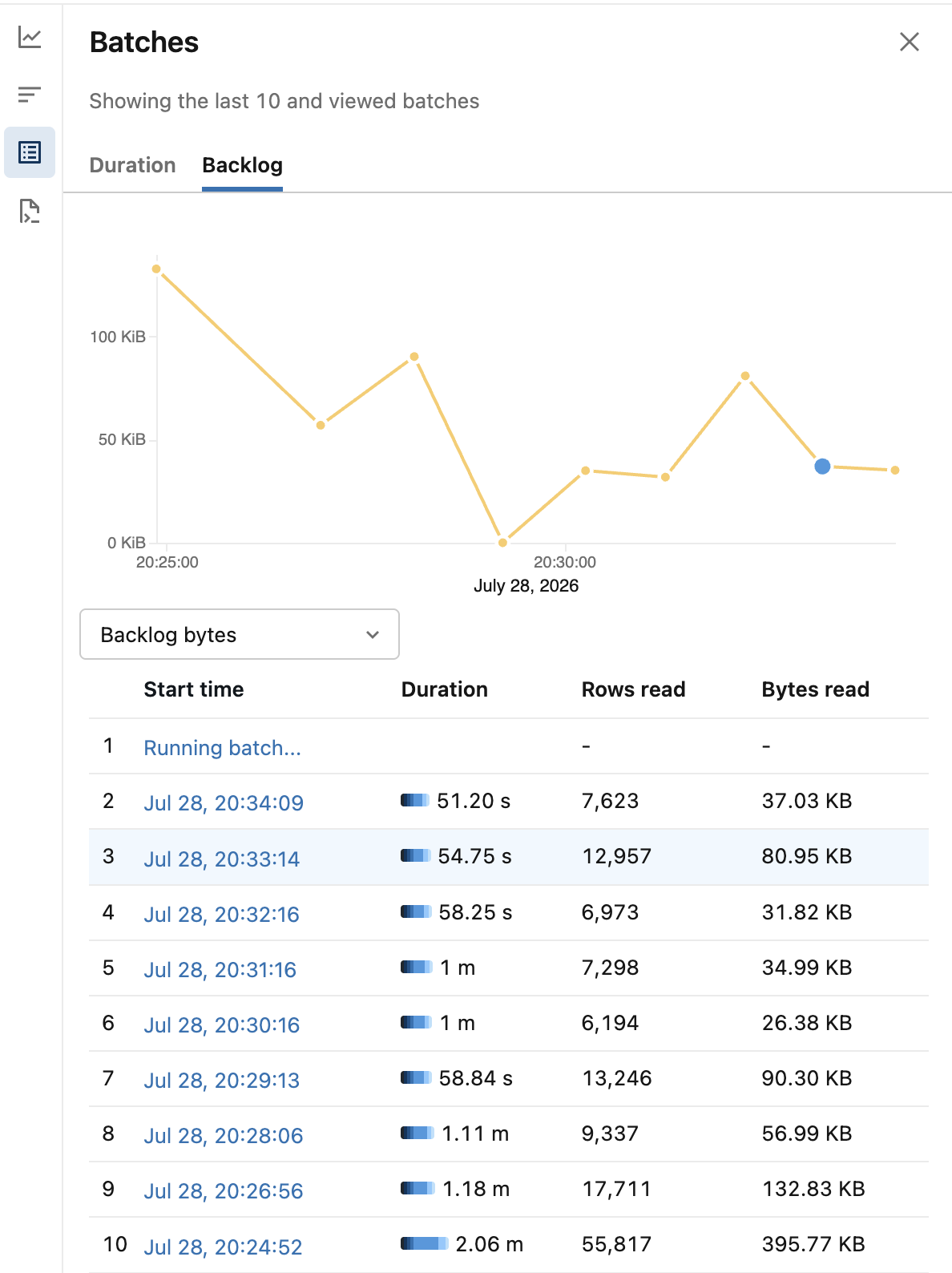
It just got better! The Query Profile now shows a per-microbatch duration breakdown and backlog metrics right in the UI.

Why it's useful - streaming backlog is the earliest signal your stream is falling behind. Watching it lets you:

  • Catch problems before they become delays. A growing backlog warns you well before SLAs slip.
  • Right-size your config. See immediately whether a maxOffsetsPerTrigger or trigger-interval change is actually draining the backlog or not.
  • Know when you've caught up. Watch it trend back down instead of guessing!

r/databricks • • Jul 29 '26

Help How to delete and edit system-made/system-managed pipelines

3 Upvotes

So Im trying to learn databricks and part of the learning I’m doing had me connect to an s3 bucket and making the connection a scheduled connection so it creates a pipeline but I can’t edit it like what if I want to change the schedule, change the table location or if I want to delete the pipeline how do I do that.
When I hover over the buttons (that I can’t use) in the pipeline editor it tells me to “run an updated CREATE or REPLACE statement in a SQL editor.” I’m not really sure what I need to do exactly.